
On the structural transformation of the conference format from information exchange to deal-making infrastructure, how SiGMA Group built an 80,000-delegate global network from a 1,000-person Malta iGaming summit, why Dubai became the most consequential geography for the convergence of AI, blockchain, and regulated technology, and what the SiGMA Eurasia summit reveals about the new centre of gravity in global technology commerce
There is a moment at any serious technology conference when the formal programme becomes secondary — when the panel discussion that was scheduled has been overtaken in importance by the conversation happening in the corridor outside the hall, when the pitch that was rehearsed has been replaced by the unscripted negotiation happening over dinner, when the conference badge is no longer primarily an access credential but a social signal that says: I am in the room where these decisions are being made. SiGMA Eurasia in Dubai is a conference that has understood this moment and built its entire architecture around it. The agenda is serious. The conversations beside it are the point.
In 2014, Eman Pulis organised the first SiGMA summit in Malta. One thousand delegates attended an iGaming conference on an island that had positioned itself, with characteristic Mediterranean efficiency, as the regulatory home of European online gaming. A decade later, SiGMA Group employs more than 340 people across offices in Malta, Limassol, Manila, São Paulo, Yerevan, and Belgrade; hosts more than 80,000 industry delegates across eight international summits annually with more than 1,200 exhibitors; operates four business pillars spanning events, gaming media, venture capital, and philanthropy; and runs a summit in Dubai that drew 13,000 delegates to the Festival Arena at Dubai Festival City for a programme spanning artificial intelligence, blockchain, fintech, quantum computing, IoT, esports, and the evolving regulatory landscape of digital commerce across the Eurasia region. The trajectory is not simply one of scale. It is one of category evolution: from an iGaming conference to a convergence summit at the centre of a structural transformation in how technology, regulation, and capital interact.
The architecture of the modern summit — why conferences became deal infrastructure
The conference format has undergone a structural transformation whose significance is underappreciated in the coverage it receives. The conference of the twentieth century — organised around the transfer of information from speakers to audiences, with networking as a supplementary social function — has been substantially replaced by the conference of the current moment, which is organised around the creation of conditions for commercial and strategic encounter, with the formal programme as the legitimising context in which those encounters occur. The distinction matters because it changes what a serious conference is actually for — and what attending it is actually worth.
In industries characterised by rapid regulatory change, significant capital flows, emerging technology uncertainty, and the need for cross-border commercial relationships, the ability to be physically present with the decision-makers, regulators, investors, and counterparts who govern one’s commercial environment has a value that digital communication cannot replicate. A conversation that would take six weeks of email exchange to reach its third substantive point can be resolved in twenty minutes at a conference dinner. A regulatory relationship that would require months of formal correspondence to establish can begin with an introduction on a conference floor. A venture investment that required twelve due diligence meetings in separate cities can be seeded by a thirty-minute conversation in a VIP lounge. The conference, in this model, is not primarily an education event. It is a compression mechanism — a device for accelerating the commercial and relational processes that govern an industry’s development. The most valuable environments in contemporary commercial life share this quality: they are not primarily what they appear to be on the surface but instruments for creating the conditions in which consequential things happen between people who would not otherwise be in the same room.
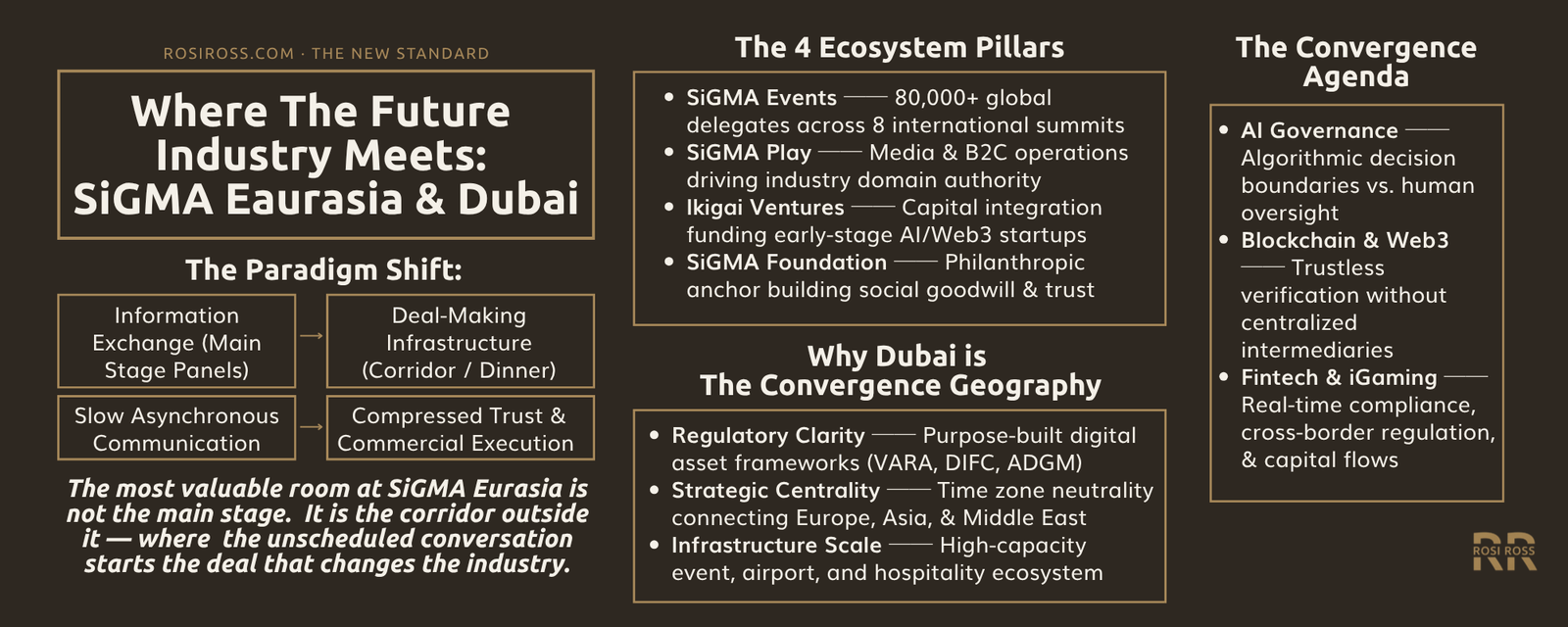
SiGMA Group was founded by Eman Pulis in Malta, with its first event held in 2014 attracting 1,000 delegates to an iGaming-focused conference. The organisation has since expanded to host more than 80,000 industry delegates annually across eight international summits, with more than 1,200 exhibitors and 340+ employees in offices across Malta, Limassol, Manila, São Paulo, Yerevan, and Belgrade. The group operates through four pillars: SiGMA Events (international summits), SiGMA Play (gaming media and B2C operations), Ikigai Ventures (a technology-focused venture capital fund investing in esports, blockchain, fintech, AI, and frontier tech), and the SiGMA Foundation (philanthropic and charitable programmes). The evolution from a regional iGaming conference to a global technology convergence summit reflects the structural change in the industries it serves — as gaming, fintech, blockchain, and AI have converged into an interconnected digital economy governed by overlapping regulatory frameworks and shared capital markets, SiGMA’s agenda has expanded to reflect these convergences rather than treating them as separate categories.


Dubai as the convergence geography — why Eurasia chose the Emirates
The decision to anchor the SiGMA Eurasia summit in Dubai is not primarily a logistical one, though the logistics are convenient: Dubai International Airport is among the most connected in the world, the Festival Arena at Dubai Festival City provides a venue of sufficient scale and quality for a summit of this ambition, and the city’s hospitality infrastructure is capable of absorbing tens of thousands of international delegates without significant friction. The more consequential reason is geographical and regulatory: Dubai sits at the intersection of the European, Asian, African, and Middle Eastern markets in ways that no other major city replicates — and its regulatory framework for digital assets, blockchain applications, fintech, and gaming is among the most developed and most actively evolving in the world.
The UAE’s Virtual Assets Regulatory Authority (VARA), established in 2022, represented one of the most significant regulatory developments in the global digital asset industry: a purpose-built regulatory body for virtual assets, operating within a major international financial centre, providing the kind of regulatory clarity that institutional and commercial participants in the digital economy require to commit capital and make long-term commercial decisions. Dubai’s Abu Dhabi Global Market (ADGM) and the Dubai International Financial Centre (DIFC) provide additional regulatory frameworks that create a layered, sophisticated regulatory environment for financial technology and digital commerce that few jurisdictions outside of Singapore and certain European markets can match. For an industry whose primary constraint on growth is regulatory uncertainty rather than technological capability or commercial demand, the regulatory sophistication of the UAE is not incidental to Dubai’s attractiveness as a summit location. It is the primary argument.
As Eman Pulis noted following the Eurasia summit that drew 13,000 delegates: “In the midst of Covid, on the brink of filing for bankruptcy, we launched our first event outside our comfort zone in Malta: that event saved the business and shaped what we stand for: a business that thrives in regions where the industry needs us to be.” The UAE was where the industry needed SiGMA to be because the UAE was where the regulatory, capital, and commercial conditions for the digital economy’s most consequential decisions were being formed. The same structural conditions that make Dubai the most consequential location for luxury hospitality’s most ambitious propositions — the intersection of global capital, cosmopolitan sophistication, regulatory clarity, and the specific ambition of a city that understands its own strategic position — make it the most consequential location for the technology industry’s most serious conversations.



The agenda as an argument — what SiGMA Eurasia is actually proposing
The agenda of SiGMA Eurasia — spanning artificial intelligence, blockchain and digital assets, fintech and digital payments, quantum computing, IoT, big data, esports, iGaming regulation, and the convergence of all of these into an interconnected digital economy — is not simply a list of technology topics. It is an argument about what the most consequential technological developments of the current period have in common: they are all, ultimately, about the structure of trust in digital systems.
Blockchain’s core proposition is the creation of trust without a central authority — the ability to verify transactions, ownership, and identity without requiring a trusted intermediary to maintain the record. AI’s core governance challenge is the question of which decisions can be trusted to algorithmic systems and which require human oversight — a question that becomes most acute in the contexts of financial services, healthcare, legal adjudication, and creative production where AI is developing the fastest and the stakes of error are highest. Fintech’s core regulatory challenge is the question of how to extend the trust infrastructure of established financial systems to new forms of value, new payment mechanisms, and new participant populations while maintaining the safeguards that the existing system’s trust is based on. Quantum computing’s most significant near-term implication is the potential challenge it poses to the cryptographic systems that currently underlie most digital trust infrastructure. The trust infrastructure question is not a technology question alone — it is the central governance question of the digital economy, and it is what connects the apparently disparate topics of the SiGMA Eurasia agenda into a coherent intellectual and commercial programme.
The esports and iGaming dimensions of the agenda — which might appear to be the conference’s more commercially specific and less intellectually ambitious components — are in fact the domains in which many of the most consequential questions about digital trust, digital ownership, digital identity, and the regulation of digital commerce are being tested at scale and in real time. The regulated online gaming industry has been grappling with questions of cross-border regulation, anti-money laundering compliance, responsible gambling safeguards, and the integration of blockchain payment systems for longer and more seriously than most other digital commerce sectors — making it a productive laboratory for the regulatory intelligence that the broader digital economy will eventually require.
SiGMA Eurasia (also known as AIBC Eurasia) is an annual three-day summit held at the Festival Arena in Dubai Festival City, bringing together decision-makers, investors, regulators, operators, and technology leaders from across the AI, blockchain, fintech, gaming, and emerging technology sectors. The summit is distinguished from conventional technology conferences by its explicit commitment to the convergence of these sectors — treating AI, blockchain, fintech, and gaming not as separate industries with parallel agendas but as interconnected components of an emerging digital economy governed by overlapping regulatory frameworks and shared capital markets. Its programme spans keynote panels, startup pitches (the Startup Village provides a dedicated arena for early-stage companies), VIP networking dinners, the AIBC Awards ceremony, cultural and experiential programming in Dubai, and a gala dinner supporting the SiGMA Foundation’s charitable initiatives. The summit’s most significant commercial function is not the programme itself but the conditions it creates for the commercial, regulatory, and investment relationships that are formed within and alongside it.
iGaming refers to online gambling and gaming in its broadest commercial definition — encompassing online casino gaming, sports betting, poker, esports wagering, and increasingly skill-based gaming and virtual world gaming economies. The iGaming sector has been at the forefront of digital commerce regulation for over two decades because it combines the most demanding regulatory requirements in digital business: identity verification (knowing who is playing), financial compliance (preventing money laundering and ensuring payment security), consumer protection (responsible gambling safeguards), cross-border jurisdiction (players and operators routinely operating across multiple regulatory regimes simultaneously), and data protection (managing sensitive personal and financial data at scale). The Malta Gaming Authority (MGA), established in 2001 and one of the world’s most respected gaming regulators, created the template that subsequent iGaming regulatory frameworks have followed. The regulatory intelligence developed in iGaming is directly applicable to the broader digital economy’s most pressing governance challenges — which is why the iGaming industry’s participation in discussions about AI governance, blockchain regulation, and digital asset frameworks at summits like SiGMA Eurasia is substantive rather than peripheral.


The startup ecosystem — why early-stage companies need the room
One of the most instructive dimensions of the SiGMA Eurasia format is its treatment of early-stage companies — not as peripheral participants in a conference primarily organised around established industry players but as central to the summit’s intellectual and commercial proposition. The Startup Village that forms part of the Eurasia programme reflects a specific understanding of how the technology industries the conference serves actually develop: through a continuous process of disruption in which established companies are challenged by emerging ones, and in which the most significant commercial relationships are often those between founders with new capabilities and investors or operators with the capital and scale to deploy those capabilities at market.
For an early-stage company operating at the intersection of AI, blockchain, fintech, or gaming, the access that a summit like SiGMA Eurasia provides to potential investors, strategic partners, regulatory advisers, and potential acquirers in concentrated form over three days represents a quality of commercial opportunity that months of individual meetings might not replicate. The pitch competition format — which provides a structured context for founder presentations to a curated audience of investors and industry leaders — is not primarily about the prize. It is about the visibility and the conversations that follow from it. The same structural shift that is producing the most significant innovation in creative industries — the democratisation of powerful tools that previously required significant infrastructure investment — is producing the startup density in AI and blockchain that makes the Startup Village not a side event but a window into the next generation of the industry’s competitive landscape.
Ikigai Ventures — capital as a conference product
The most strategically significant dimension of SiGMA Group’s evolution from an events company into what might more accurately be called a technology ecosystem organisation is the establishment of Ikigai Ventures — the group’s venture capital arm, which invests in early-stage companies in the esports, blockchain, fintech, AI, and frontier technology sectors. The fund’s limited partners are described as leading European technology founders and investors who have built and scaled significant companies in these verticals, and its Collective — a community of approximately twenty founders and developers from various sectors — provides both capital and the specific operational and network support that makes venture backing most valuable in the early stages of a company’s development.
The integration of a venture capital function into a conference organisation is not simply a diversification strategy. It changes the nature of what the conference is — from a forum in which deals might be initiated to one in which the conference organiser is itself a participant in the outcomes those deals produce. This creates a different kind of alignment between the event and its ecosystem: SiGMA has a stake in the success of the companies that present at its summits, which means it has a structural incentive to ensure those summits connect the right companies with the right capital in the most productive possible way. The conference becomes, in effect, a deal flow mechanism for the fund — and the fund becomes a demonstration of the conference’s ability to identify and support the companies that matter in the industries it serves.
Dubai’s emergence as the primary geography for technology and fintech convergence summits reflects five structural conditions operating simultaneously. Geographic centrality: Dubai sits at the intersection of European, Asian, African, and Middle Eastern markets, making it the most efficient single location for convening global participants from all of these regions. Regulatory sophistication: the UAE’s Virtual Assets Regulatory Authority (VARA, established 2022), the Abu Dhabi Global Market (ADGM), and the Dubai International Financial Centre (DIFC) provide a layered regulatory framework for digital assets, fintech, and digital commerce that institutional participants require for commercial commitment. Governmental commitment: the UAE government’s active engagement with technology regulation and adoption — including participation in SiGMA Eurasia panels by government officials — signals regulatory predictability that reduces the risk of operating in the jurisdiction. Infrastructure quality: Dubai’s event infrastructure, hospitality capacity, and international connectivity are capable of supporting summits of significant scale without the logistical friction that constrains other potential venues. Time zone neutrality: Dubai’s time zone (GST, UTC+4) allows effective working-day communication with both European and Asian markets, making it genuinely accessible for global participants rather than convenient for one region at the expense of others.
The SiGMA Foundation — the commercial ecosystem and its social obligation
The SiGMA Foundation — the group’s philanthropic arm — is not peripheral to the commercial organisation that supports it. The gala dinner at SiGMA Eurasia, which functions simultaneously as the summit’s most prestigious networking event and as the primary fundraising mechanism for the Foundation’s charitable programmes, creates a specific kind of social contract within the commercial ecosystem: the most successful participants in an industry whose commercial success depends on the trust and regulatory goodwill of the societies in which it operates are invited to demonstrate, through charitable giving, that they understand the wider social context of their commercial activity.
The future of the summit — why the physical conference becomes more valuable as the digital world expands
The paradox of the contemporary technology conference — that the more digitally sophisticated the industries it serves become, the more valuable the physical gathering of their participants becomes — is not a paradox at all when examined closely. The value of physical presence in a commercial and relational context is not information exchange, which digital communication handles efficiently. It is trust creation, which physical presence achieves through mechanisms — the read of a face in conversation, the informality of an encounter over a meal, the shared experience of a significant event — that digital communication does not replicate. As the commercial stakes in the digital economy increase and as the regulatory complexity of operating within it grows, the need for the specific quality of trust that physical encounter creates becomes more rather than less acute.
SiGMA Group’s expansion — from Malta to Dubai to Cape Town to São Paulo to Manila, with the flagship AIBC World summit moving to Rome’s Fiera Roma (150,000 square metres of exhibition space, capacity for 60,000 participants) and the Eurasia summit expanding to include Ras Al Khaimah — reflects the understanding that the geography of the most consequential commercial conversations in the digital economy is itself expanding. The industries the summit serves are global in their operations, in their capital markets, and in their regulatory environments. The summit that can convene their most significant participants across the most consequential geographies is the summit that becomes most indispensable to the ecosystem it serves. The most enduring institutions — whether ancient or contemporary — are those that understand their role not as service providers to an existing community but as the architecture of the community itself.
The SiGMA Eurasia summit in Dubai is, in this sense, more than a conference. It is the infrastructure of an industry’s self-understanding: a place where the people who are building the digital economy come to understand what they are building, who else is building it, what the regulatory environment they are building it within is likely to become, and where the capital that will fund the next stage of its construction currently resides. These are consequential questions. The conference that convenes the people who can answer them is not simply a commercial event. It is a civilisational one. The structural transformation of the digital economy — through AI, blockchain, spatial computing, and the evolving regulatory frameworks that will govern them — is the most significant civilisational project of the current generation, and the summits where its most important decisions are made are as significant to that project as any laboratory or boardroom.
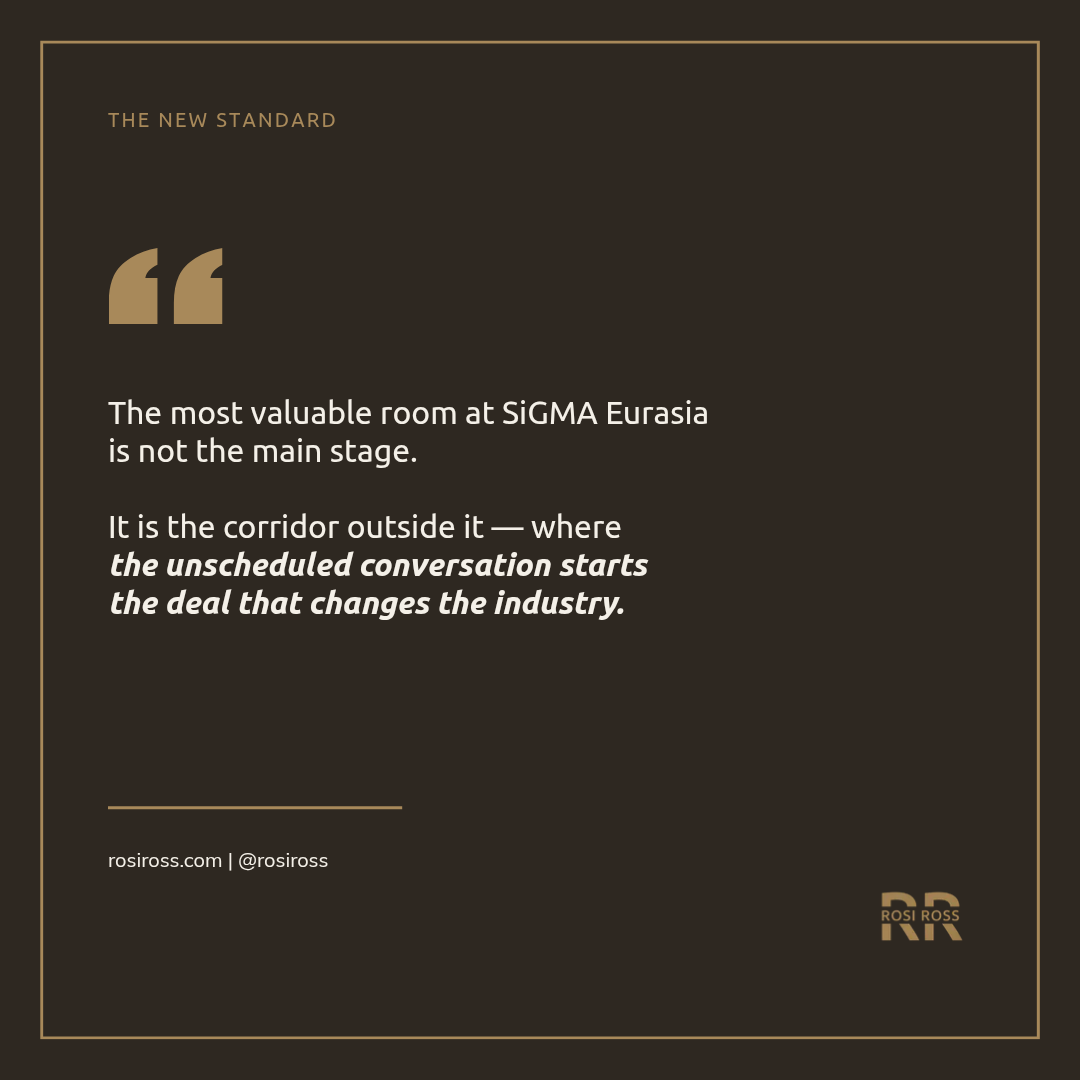
“The most valuable room at SiGMA Eurasia
is not the main stage.
It is the corridor outside it.
The conversation that was not scheduled.
The introduction that was not on the agenda.
The deal that begins over dinner
and closes six months later
in a jurisdiction that did not exist
as a viable commercial environment
three years ago.
This is what a serious conference does.
It does not simply inform.
It creates the conditions
in which the future
becomes possible
between the people
who are building it.”

