
On marble gateways that still face the sea, castles that overlook working cafés rather than empty courtyards, and why the rarest luxury left in the Mediterranean is a place that never stopped being itself
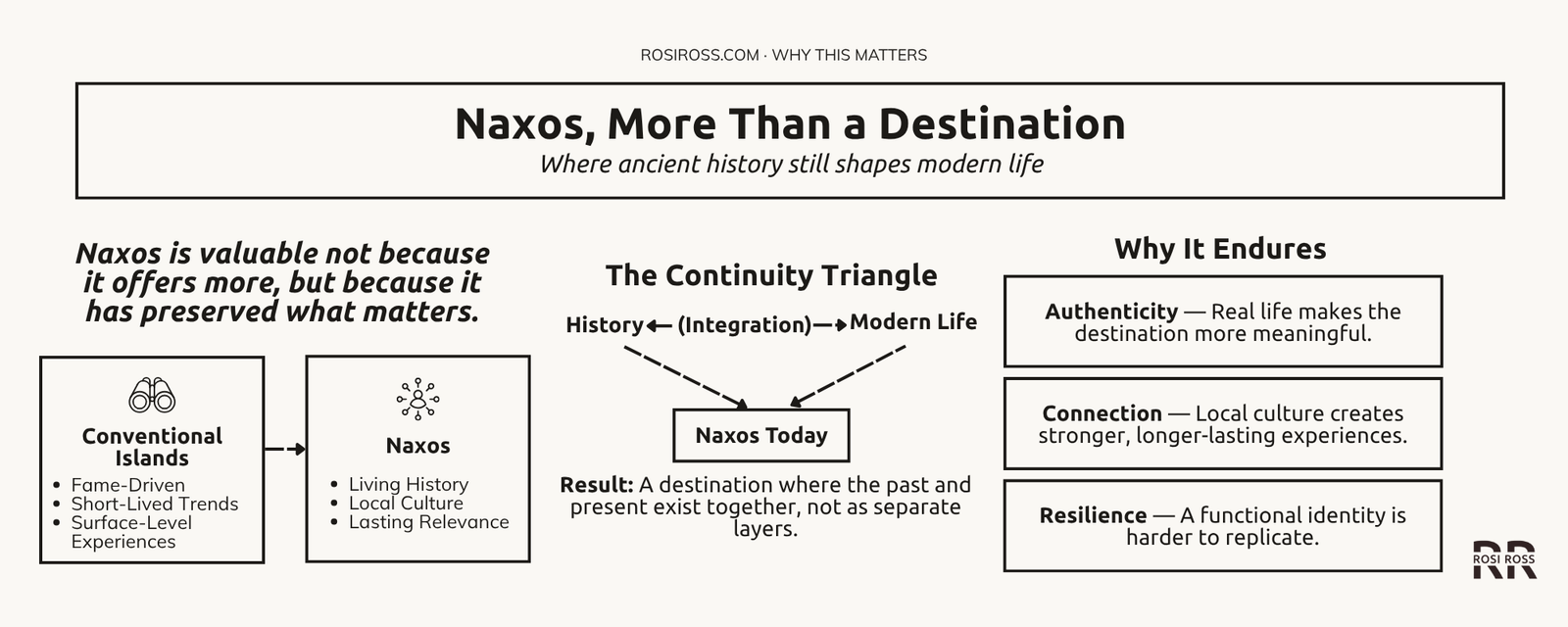
The most valuable destinations are increasingly not the ones that offer the most. They are the ones that have managed to preserve something. Naxos does not ask travellers to escape history. It invites them to walk through it.
In a Mediterranean landscape crowded with destinations competing for attention, Naxos makes a different proposition entirely. A marble gateway stands beside the sea, unfinished for two and a half thousand years and none the worse for it. A medieval castle looks down over cafés that opened this season. Ancient temples sit surrounded not by fencing and signage but by working farmland. A harbour continues at the same rhythm it has followed for generations, indifferent to whichever island nearby happens to be fashionable this year. Naxos is not a destination built around a single moment. It is a destination built around continuity — and continuity, it turns out, is far harder to manufacture than glamour.
The New Mediterranean Traveller Is Searching for Meaning
The question has shifted from “where has everyone been” to “where can I experience something meaningful” — and that shift, more than any single trend, explains why islands like Naxos are being reconsidered. For a generation, travel was measured by visibility: the famous address, the photographed view, the place that proved a journey had been taken. The newer measure is closer to weight. A trip is judged less by what it shows than by what it leaves behind.
The modern luxury traveller increasingly values cultural depth over visibility. This shows up first as a preference for living heritage — destinations where history is not preserved behind glass but genuinely integrated into daily life — and second as a broader appetite for slower travel: longer stays, local food culture, cities and islands built for walking rather than transiting, encounters that carry weight rather than simply filling an itinerary.
Naxos supplies both in ordinary quantities. Above Chora, the Venetian Kastro, founded in the thirteenth century by Marco Sanudo, is not a monument but a neighbourhood: descendants of the original Venetian families still live in some of its mansions, and its lanes hold a Catholic cathedral, small museums and cafés, in a place that works as a home before it works as an attraction. Inland, in the fertile Tragea valley, the villages carry the same quality. Halki, the former administrative capital with its neoclassical houses, is home to the Vallindras distillery, where kitron, the citron liqueur made only on Naxos, is still produced. Apeiranthos is paved in marble, with small museums and a pride in its heritage that a visitor feels before being told.
The appetite for slowness finds equally concrete answers. The island is widely described as largely self-sufficient in food, so the table is local almost by default — graviera and arseniko cheeses, Naxian potatoes, fresh fish, honey — and a meal in a mountain taverna is a lesson in the island’s farming rather than a performance of it. Old footpaths link villages, valleys and chapels, including a trail that passes the Kouros of Flerio, an unfinished marble statue, and the Temple of Demeter at Sangri, built in the sixth century BCE, stands among the fields. These are not experiences that can be completed in an afternoon, which is precisely their appeal.
Naxos was never designed to meet this appetite. It simply never stopped being the kind of place that satisfies it, which is precisely why its relevance is growing rather than fading. That sequence matters. Destinations built to meet a demand tend to be shaped by it, and in time they begin to perform themselves; Naxos kept its farms, its marble, its harbours and its fortified town because they were useful before they were beautiful, and the visitor arrives to find an island that already has a reason to exist. The reconsideration now under way carries its own test, since attention is the one thing that can undo what it came for. But the lesson of the island, like the lesson of the windmills on Mykonos, is the same: what endures is what was built for use, and what travellers increasingly want is to stand beside it.
Unlike islands built primarily around nightlife, resort branding, or international visibility, Naxos has maintained an unusually direct relationship with agriculture, local communities, archaeology, and traditional architecture. The same landscapes that supported ancient civilisation — the olive groves, the marble quarries, the vineyards, the villages scattered through its mountainous interior — continue to shape daily life on the island in the present tense. This is the distinction worth understanding: Naxos’s identity has survived not because it was frozen for preservation, but because it has remained functional. A temple that still sits inside farmland is a different kind of monument than one relocated to a plaza for viewing, and the difference is legible the moment a traveller arrives, as the Greek National Tourism Organisation has itself noted in framing the Cyclades’ agricultural islands as a distinct category within Greek travel.
Portara: The Island’s Ancient Symbol
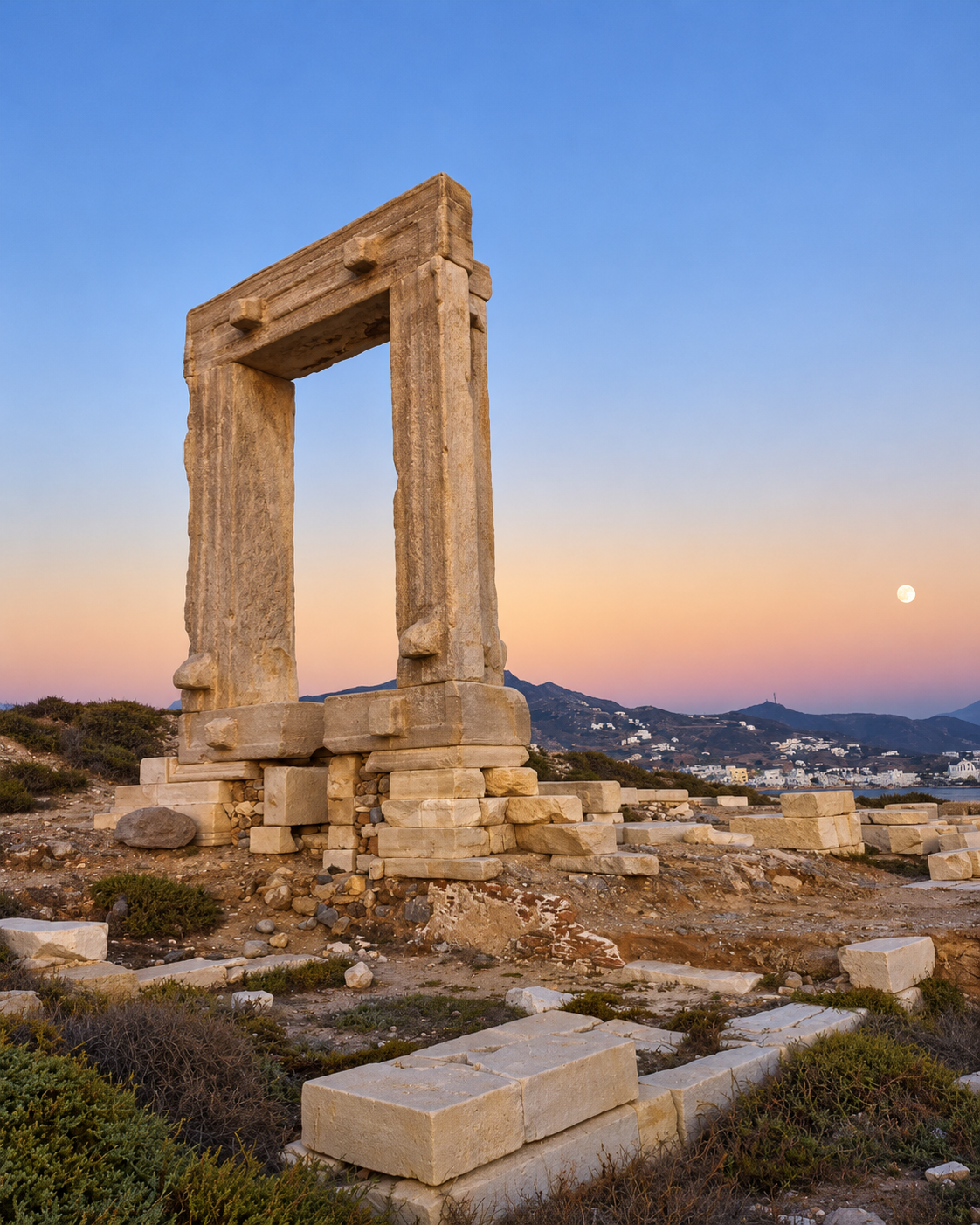
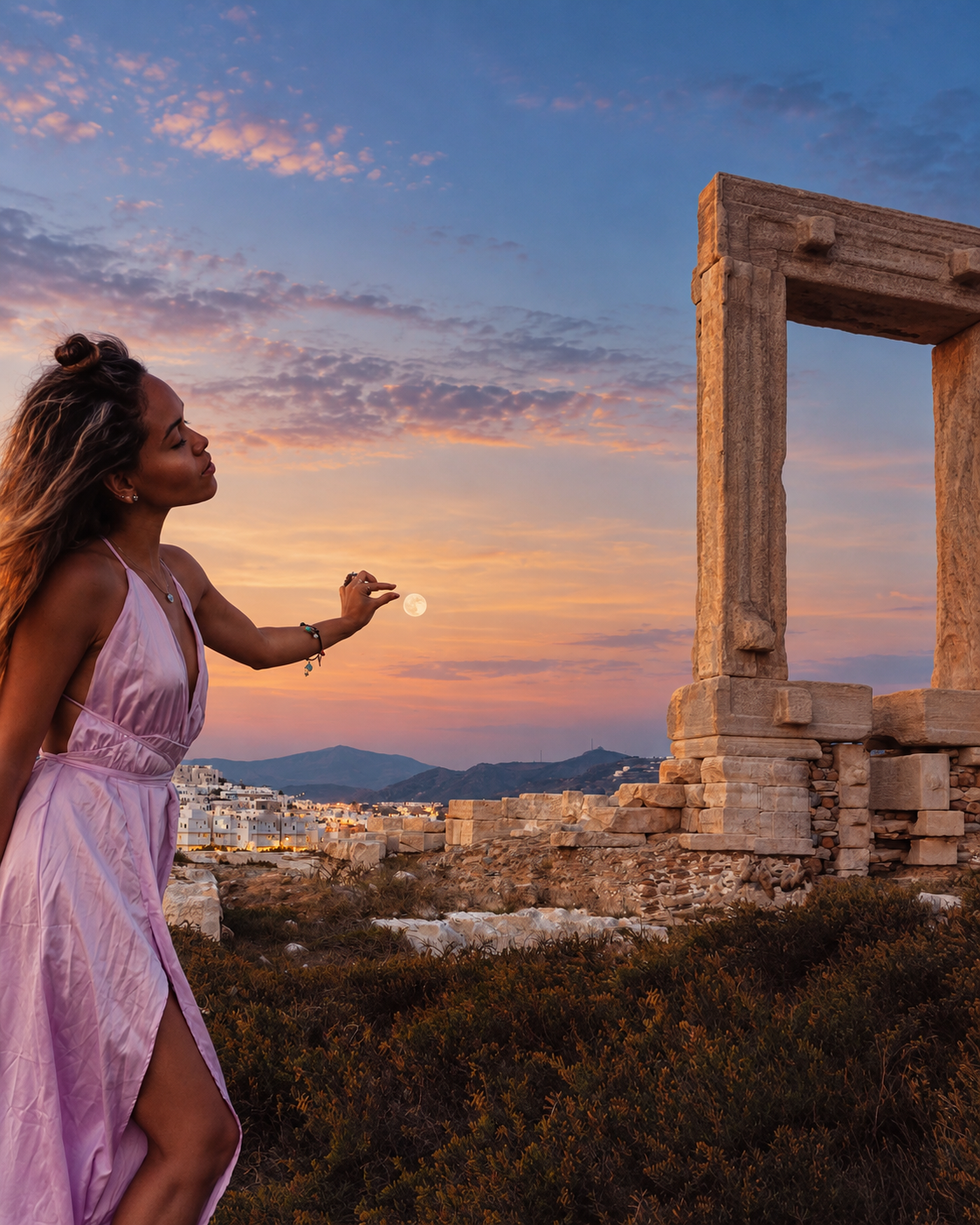
The Portara is the first structure most visitors see, its marble frame visible from the water long before the harbour comes into focus. Begun around 530 BC as the entrance to an intended Temple of Apollo and abandoned around 524 BC, it stands roughly six metres high and three and a half wide, now connected to the town by a short causeway rather than the temple it was meant to introduce. The temple was the ambition of Lygdamis, the tyrant of Naxos, who set out to rival the great temples of Athens and Samos; when he was overthrown, the building stopped, and it never resumed. Its incompletion is, in a sense, the entire point: this is ancient ambition left visibly unresolved, a doorway that leads to nothing but sky and sea, and precisely for that reason it has become the island’s most recognisable symbol and one of its most reliable places to watch a sunset.
The gate itself is a lesson in how unfinished it is. It was assembled from four enormous blocks of local marble, each weighing up to twenty tons, quarried at Flerio some ten kilometres away and brought to the islet of Palatia, and the lifting bosses used to hoist them are still visible, a sign that the final dressing was never done. Its entrance, unusually, was oriented toward Delos, the sacred island of Apollo, so that the doorway looks across the water to the god’s birthplace; the two islands, as the lions of Delos suggest, were in conversation long before either was a destination.
What survives is partly an accident of weight. Later centuries treated the temple as a quarry: a Christian church was built over the ruins, and the Venetians reused much of the marble for the castle of Naxos above the town. The great doorway was simply too heavy to move, and so it remained. Walk through the alleys of Chora and the Kastro today and pale stones from the temple can still be picked out against the darker masonry, a kind of scattered afterlife for a building that was never finished.
The experience of the Portara is an experience of timing. The causeway to the islet is short and open to the public, and the best hour to cross it is either early in the morning, when the gate stands almost alone, or late in the afternoon, when the light lowers and visitors gather to watch the sun go down behind the Aegean, framed by the marble. At that hour the unfinished doorway does exactly what it was always going to do: it turns the horizon into a threshold.
Why is the Portara famous? Not simply because it is old, but because it continues to shape how visitors understand Naxos before they have set foot on it — a monumental threshold between land and Aegean that has outlasted the temple it was built to serve. It also performs a quiet argument that runs through the whole island: that what endures is rarely what was completed, but what was too solid, too well placed or too well loved to be taken away.







Chora of Naxos: The Living Heart
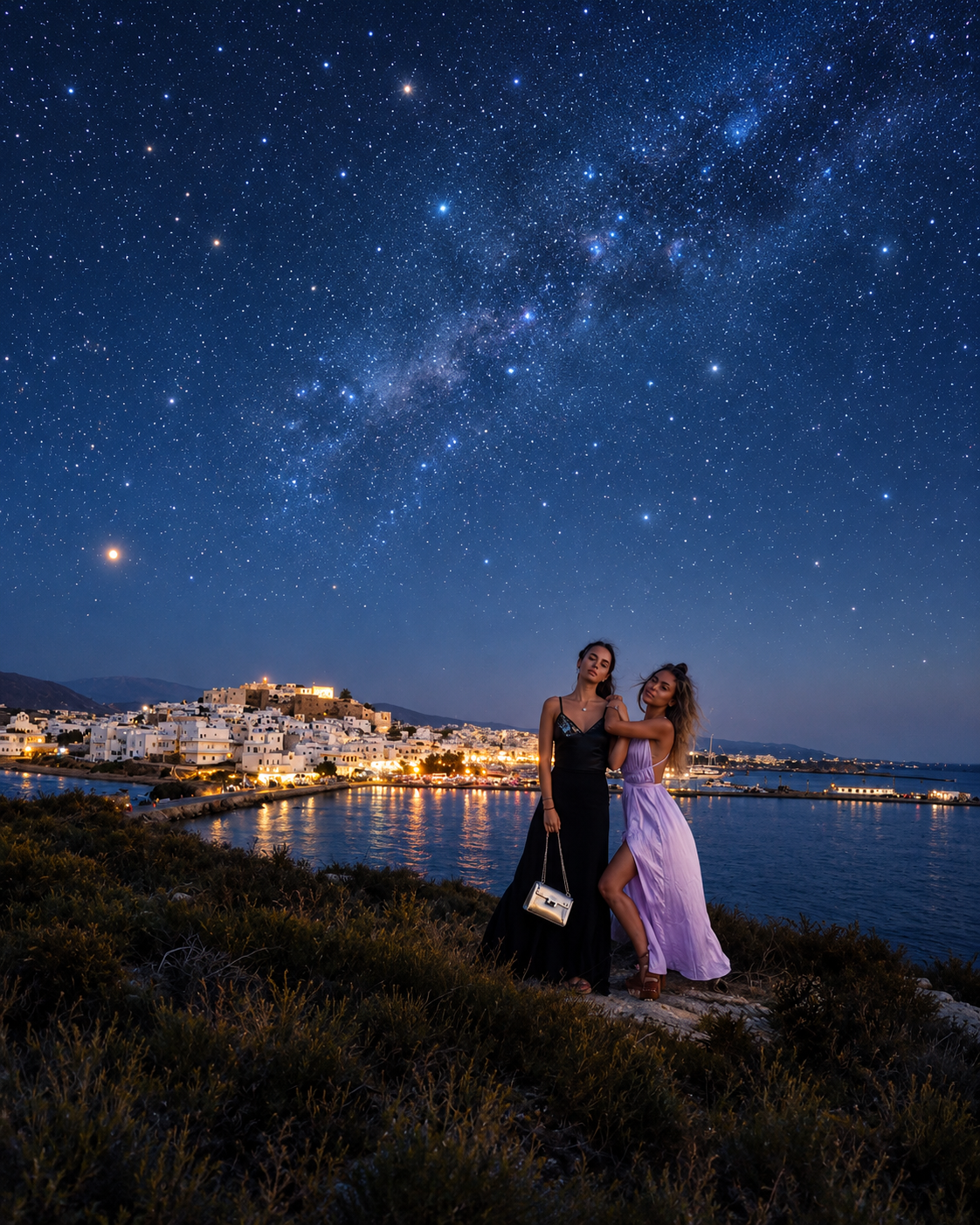
Locals call the town Hora rather than Naxos, and the distinction matters: this is the island’s port, capital, and arrival point, laid out in narrow, twisting alleys traditionally said to have been designed to disorient invaders rather than charm visitors. It succeeds at both. A traveller can move through the waterfront promenade, its bars and tavernas facing the harbour, and within minutes be lost in whitewashed lanes shaped by Venetian rule centuries earlier — a layering of identity, ancient foundation beneath medieval structure beneath contemporary café culture, all occupying the same short walk.
The layering is literal. The old town divides into two quarters that still keep their separate characters. Below, the Bourgos was the Greek Orthodox town, a maze of lanes with unexpected dead ends, shaded in cool darkness and then suddenly opening into sunlight, and today the home of the covered market street, where shops sell Naxian cheese, kitron, honey and potatoes. Above, the Kastro, founded by Marco Sanudo in the thirteenth century, was the Venetian Catholic quarter, entered through the Trani Porta, or Great Gate, and still holding a cathedral, a Venetian museum in the Della Rocca-Barozzi tower and an archaeological museum with one of the richest collections of Cycladic figurines in Greece. Beneath it all lies older history: the castle stands over the remains of the ancient acropolis, and in Mitropoleos Square, excavations have uncovered city walls from the Mycenaean period. Few towns allow a visitor to cross three thousand years in the time it takes to finish a coffee.
Chora is where the island’s daily commerce actually happens: the shopping, the coffee, the long evening drink. The inner part of the harbour promenade is car-free, lined with tavernas, ouzeries, cafés and bars, and at the end of the day it becomes the island’s living room, with the Kastro lit above it and the Portara standing at the water’s edge. This is also one of the busiest ports in the Cyclades, which gives the town a working energy that more purely resort-minded islands lack: ferries come and go, delivery vans edge down the lanes, and locals share the promenade with visitors rather than leaving it to them. It is a town to explore on foot, and not a flat one: the climb to the Kastro rewards comfortable shoes and a late-afternoon start.
The beaches follow naturally. Agios Georgios, the town beach, is a short walk south, with shallow water and cafés behind it, and Grotta lies just east of the port. A short bus ride to the west, the golden, gently sloping sand of Agios Prokopios stretches for more than a kilometre along the coast, close enough that a morning swim can fit between breakfast in town and lunch on the harbour. Chora, in other words, is not only a point of arrival but a base that makes the whole western coast easy.


The Fortezza and the Archaeological Museum: Layers of Naxos
Where the Portara represents ancient ambition, the Fortezza represents a very different chapter of the island’s history. Raised from 1207 under the Venetian Duke Marco Sanudo, the castle sits roughly thirty metres above sea level on the steep hillside above the town, reached by a climb through stepped lanes. Within its walls survive a genuinely improbable range of structures for a single fortification: the monastic complexes of the Jesuits, the Capuchins and the Ursulines, a Catholic cathedral, the former chancellery of the Duchy, now the Catholic archbishop’s palace, and the Crispi tower, known as the Tower of Glezos. Of the castle’s three original gates, two survive — the Trani Porta, or Great Gate, to the north, and the Paraporti, the side gate, to the south — and passing from one to the other makes the point better than any description could: Greek identity was never shaped by a single empire, religion, or trading route, and Naxos preserves the overlap more legibly than almost anywhere else in the Cyclades.
At the summit, on the castle’s central square, stands the island’s Archaeological Museum. It occupies an elegant seventeenth-century Venetian building, five floors high, set along the line of the medieval wall and incorporating two of its towers. It was built for a Jesuit school, later served as the island’s commercial school, where the writer Nikos Kazantzakis was among the pupils, and became the museum in the early 1970s. The building is itself a lesson in the layers the castle holds, and the collection inside gives scattered ruins and monuments a coherent narrative. Early Cycladic marble figurines, among the finest outside Athens, share the halls with Mycenaean pottery and grave goods, Geometric pottery and gold jewellery, Archaic statues of kouroi and korai, and Roman glass, tracing a civilisation whose visual language has since become foundational to how the ancient Aegean is understood globally, a lineage the Museum of Cycladic Art in Athens has spent decades contextualising for wider audiences.
The climb from the harbour, ten to twenty minutes depending on the route, is in its own way appropriate. It takes the visitor through the lanes of the lower town, in through one of the castle’s gates and up to a square where the ancient and medieval worlds sit side by side. Understanding Naxos, like understanding most things worth understanding, requires a small amount of effort before it opens up.


The New Luxury of Slow Island Travel
Naxos’s version of luxury rests on five qualities rarely offered together: authenticity, in a destination that has remained recognisably itself; time, in the freedom to slow down that a large, agricultural island naturally provides; knowledge, in the depth of history available to travellers willing to seek it out; connection, through genuine contact with local communities and traditions rather than curated approximations of them; and simplicity, in experiences that require no excessive design to hold their value.
Authenticity here is a matter of continuity rather than preservation. The Venetian Kastro is still a neighbourhood, with descendants of the original families living inside its walls; the interior villages still farm, distil and cook as they did before visitors arrived; and the island is widely described as largely self-sufficient in food, which means the table is local by default rather than by marketing. Nothing needed to be staged because nothing was ever taken off the stage.
Time is the most practical of the five, and the least often priced. Naxos is the largest island in the Cyclades, its beaches, mountains and villages spread across enough distance that no single day can contain them, and the geography itself discourages hurry: a drive south through Vivlos to Kastraki, or an afternoon in the Tragea valley, is measured in hours rather than stops. Slowness is not a service here. It is a property of the landscape.
Knowledge is the quality that rewards effort. The Portara, the Fortezza and the Archaeological Museum tell a continuous story from the Cycladic figurines of the third millennium BC through the Archaic temple that was never finished and the Venetian duchy that outlasted it, and nothing in that story needs to be read from a panel. A visitor who climbs to the museum, walks the causeway to the Portara at dusk, or follows an old footpath to the unfinished kouros at Flerio is doing the reading in person, which is the only kind that lasts.
Connection follows from the same logic. It is found in a kitron distillery in Halki where the liqueur, unique to the island, is still made and poured by the people who make it, in a taverna in Apeiranthos where the food comes from the surrounding valley, and in the ordinary rhythm of a town where locals and visitors share the same promenade. The encounter is not designed. It happens because the island’s economy still runs through its own people.
Simplicity, finally, is the quality the other four depend on. Plaka’s miles of dune and sand, Kastraki’s cedar-shaded shore and the easy ritual of Agios Prokopios all hold their value without a layer of design placed on top: a swim, a long lunch, a slow evening. Luxury, in this sense, is not what has been added but what has been left alone.
This combination speaks to several overlapping travellers at once. The cultural traveller, drawn to archaeology and heritage, finds an island where ancient, Venetian and modern layers sit within a single walk. The slow traveller, who prefers depth to velocity, finds a place designed by geography for long stays. The food traveller, who reads a place through its cuisine, finds graviera, Naxian potatoes and kitron at the source. The design traveller, attentive to traditional architecture, finds whitewashed lanes, marble-paved villages, Venetian towers and neoclassical houses that grew from use rather than image. And the luxury traveller, seeking privacy and a more personal relationship to the Mediterranean than its more famous islands now allow, finds room: space on the beach, quiet in the interior and a pace set by the island rather than by the guest.
Will Authenticity Remain the Ultimate Luxury?
As Mediterranean travel continues to prioritise authenticity, heritage, sustainability, and genuine local economies over sheer visibility, the operative question is no longer which island is the most beautiful. It is which island still has something real to teach a traveller willing to listen. Naxos answers that question the way it answers most things: by continuing to function as it always has, rather than performing a version of itself for an audience. The same instinct now shapes travel decisions across the region — from the sunset ritual that turned neighbouring Mykonos into a global lifestyle brand, to the quieter beach argument made by Naxos’s own coastline, to a city built on a comparable density of unbroken memory in Cairo, where Pharaonic, Coptic, Islamic, and modern life continue to share the same street rather than existing in separate eras.
This preference for what endures over what merely impresses echoes across other categories of considered luxury as well: a wardrobe built around fewer, better-made pieces rather than constant acquisition, a jewellery philosophy rooted in objects chosen for meaning rather than volume, or a skincare approach built around supporting a system’s own biology rather than overriding it. Naxos operates on the same underlying logic, extended across an entire island: preserve what already works, and let time do the rest of the argument.
Naxos’s greatest attraction was never what it managed to preserve. It is what it continues, quietly and without ceremony, to keep alive — the temple still standing in working farmland, the castle still overlooking a functioning town, the harbour still moving at its own pace regardless of who is watching. Other islands have learned to perform a version of Greece for visitors. Naxos has simply never stopped being it.
“Naxos was never preserved.
It was simply never abandoned —
by the farmers who kept working the land
the temples were built to bless,
by the town that kept living
inside walls a duke raised
eight centuries ago,
by a doorway to nowhere
that the sea still frames
every evening, on schedule,
whether anyone arrives to watch or not.
This is not Greece
remembered.
It is Greece,
still speaking
in the present tense.”

