
On how outdoor performance became a language of urban status, what a French mountain brand’s Shanghai runway reveals about the convergence of technical apparel, travel, wellness and style, and why the harder question is durability rather than visibility
Waterproof was never the whole promise. It was a way of saying: I am ready for weather, for travel, for the day as it actually arrives.
The technical jacket has left the trail. It now sits in the city: on commuter trains, in café queues, in departure lounges and, increasingly, on runways. The change is usually described as outdoor becoming fashionable. That framing is too small. What has changed is that performance, the promise that a garment will actually work, has become part of the vocabulary of modern luxury, and China is accelerating the transformation at unusual speed and scale.
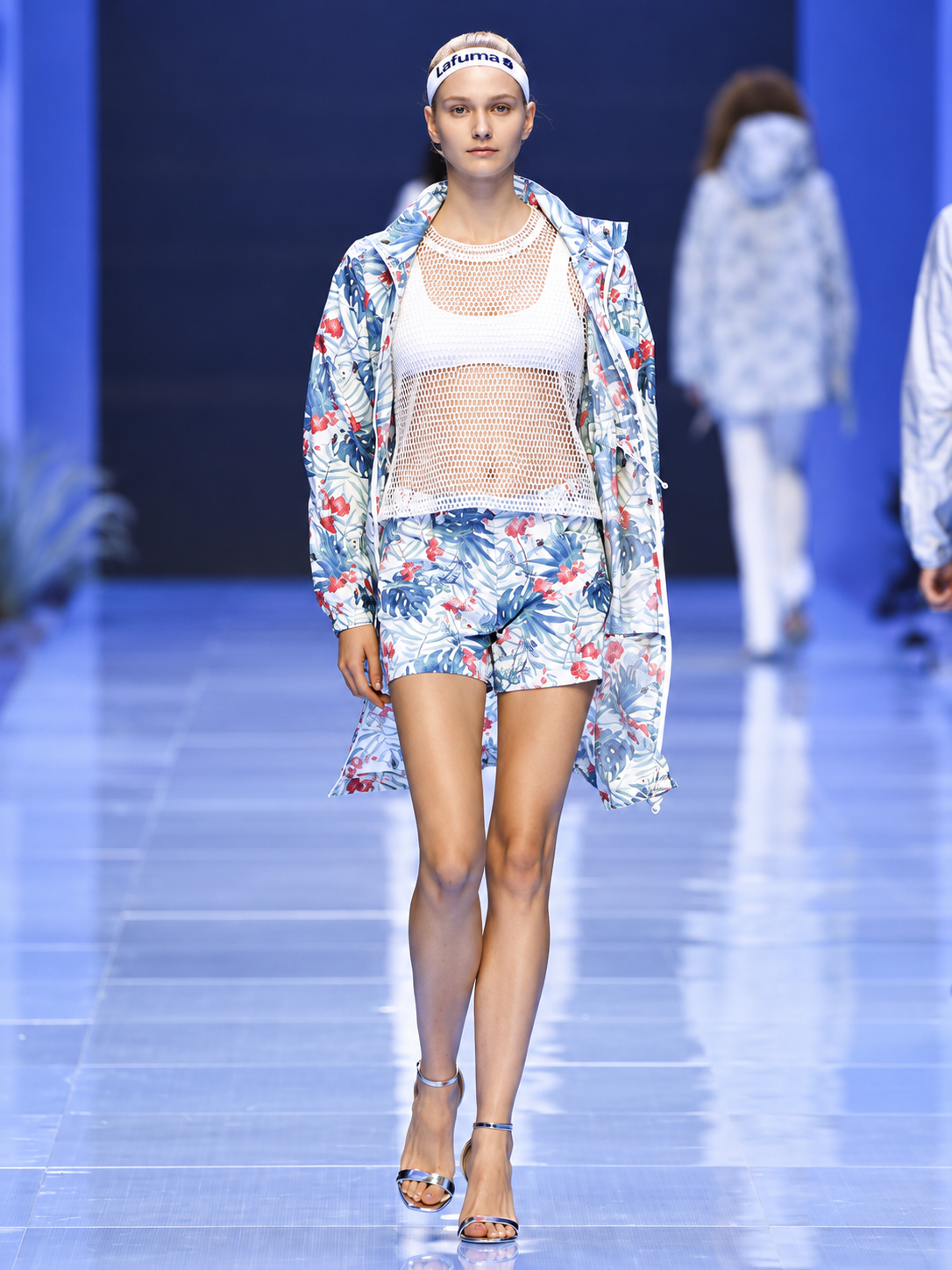
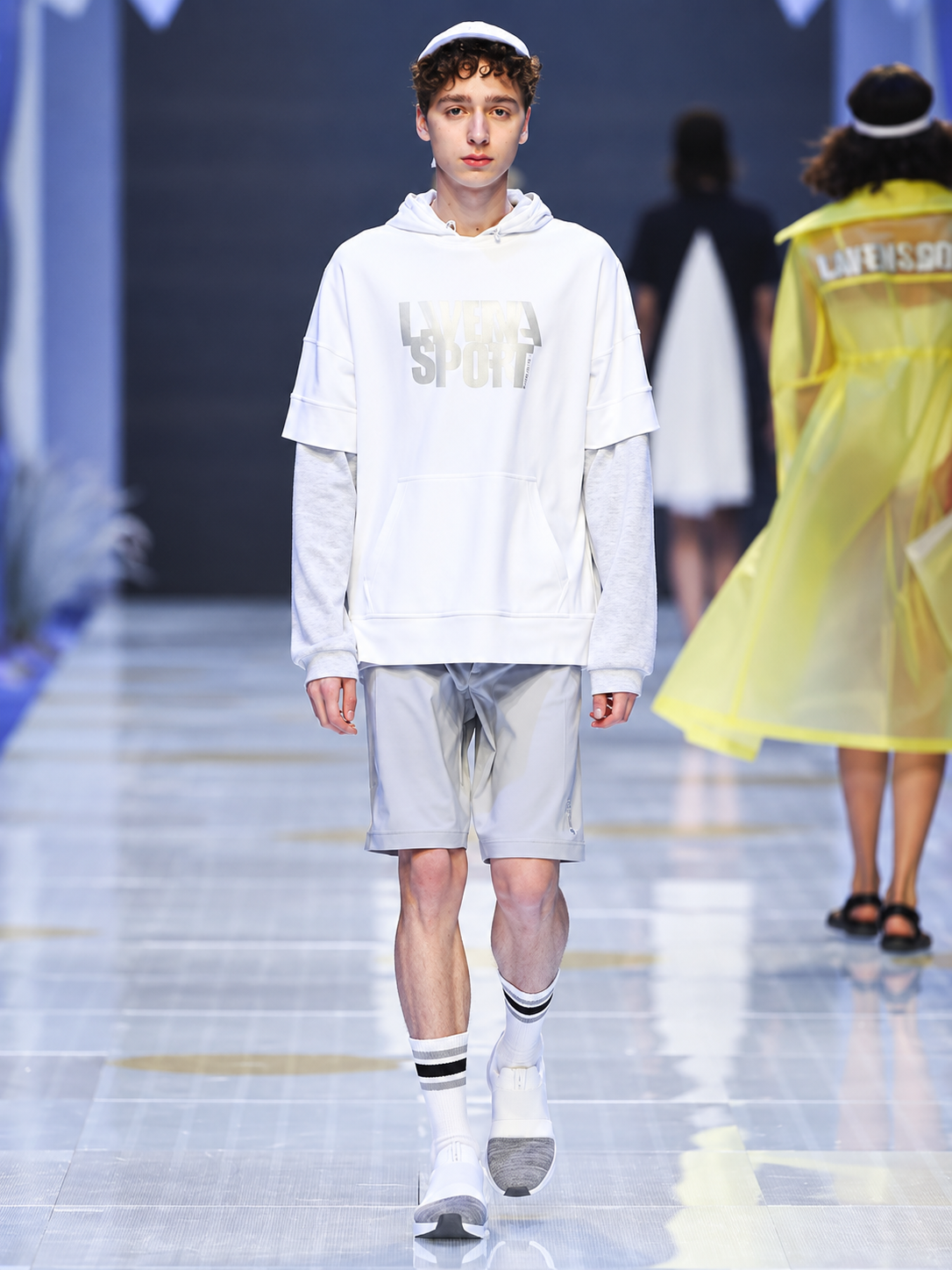
Lafuma is the case study. The French brand, which began in 1930 making backpacks in a small town in the Drôme, appeared on a Shanghai Fashion Week runway in October 2018, and its own history records it as the first outdoor-leisure label to do so. The show matters less as an event than as a symptom of a shift in how consumers, retailers and brands define the category. The analysis that follows treats it that way, and ends where the evidence leaves it: with an open strategic question rather than a verdict.
Why Outdoor Performance Became an Urban Status Language
Performance signals competence.
A jacket that handles rain, wind and a long day of movement says something about its wearer: that they travel, that they plan, that they expect the day to bring weather. In cities where commuting, short-haul travel and weekend escapes are routine, those signals are legible, and they travel well from mountaineering into daily life. The boundary between technical apparel, luxury consumption, travel, wellness and everyday dress has been eroding for years. The outdoor jacket is simply where the erosion is most visible.
What is urban outdoor fashion? Urban outdoor fashion is clothing that carries the design cues and, to varying degrees, the performance features of outdoor apparel into city life: weather-resistant shells, technical fabrics, functional silhouettes and travel-ready accessories worn for commuting, travel and leisure. It differs from purely aesthetic outdoor styling by the degree to which the garment is built to perform as well as to look the part.
China has become one of the places this convergence is watched most closely. China Daily reported that the market was being driven by a growing base of young, affluent, style-conscious urban consumers, that Amer Sports, the owner of Arc’teryx and Salomon, was recording strong growth in Chinese revenue, and that premium outdoor labels such as Mammut were launching urban collections while Hoka and On pursued collaborations with luxury designers. Reports like these are snapshots of a moment, not forecasts. Some market commentary has also cautioned that outdoor adoption can behave like a fashion cycle, and that scarcity erodes quickly once a look is everywhere. Both observations belong in any serious account of the category.

Precedents: When Weatherproof Became Elegant
Luxury has borrowed from utility before, and the garments that lasted were the ones whose function never stopped being real.
The pattern is older than the current moment. The trench coat began as weatherproof military outerwear and became a staple of urban elegance. The waxed jacket moved from the countryside and the fishing boat into city wardrobes. The parka travelled from cold-climate utility into the street. In each case, a garment designed to solve a problem earned its place in fashion because the solution was visible and credible, and in each case the prestige came from the function, not instead of it. Today’s technical shell belongs to the same lineage. What distinguishes the present is the speed of the crossing and the number of categories converging at once.
LAFUMA and the Business of Translating Heritage
Heritage is an introduction, not an argument.
The heritage is real and specific. Company histories record that three brothers, Victor, Alfred and Gabriel Lafuma, started a canvas-bag business in 1930 in Anneyron, in the Drôme region of France. The backpack became its first success and was adopted by the French military, which remained a principal customer into the 1950s. A metal-frame backpack followed in 1936, camping furniture in 1954, and an outdoor clothing line in 1993. Today the company sits within the Swiss Calida Group, a reminder that heritage brands rarely stay in the hands, or the country, where they began.
Foreign provenance does not automatically create prestige in a market full of credible alternatives, and a century of history is an asset only while the product and the story still match. The scrutiny that applies to any luxury association applies here too, and an association that can be confirmed is worth more than one that is merely borrowed. Lafuma’s task in China was therefore translation: taking a French backpack maker’s story and turning it into a reason to buy a jacket in Shanghai.
What does LAFUMA represent in the outdoor market? Lafuma is a French outdoor and travel brand founded in 1930 in Anneyron, Drôme, historically known for backpacks and later for clothing and camping furniture. In China, where it trades as 乐飞叶, it positions itself around the idea of “light outdoor, joyful travel”: apparel functional enough for city weather and travel, styled for everyday wear, rather than an expedition-grade technical label.
The brand’s own history records the steps of that translation. Lafuma China was established in 2010 with a first store in Beijing; in 2014 the brand articulated a concept it calls Fashion into Technology, applying fashion design to outdoor product; and in 2018 it brought the “light outdoor, joyful travel” idea to the Shanghai runway. The Sangar jacket, launched alongside the clothing line in 1993, remains the heritage reference point in its Chinese channels. The structure is worth noticing: a heritage anchor product, a repositioning concept and a runway used as the public declaration of both.


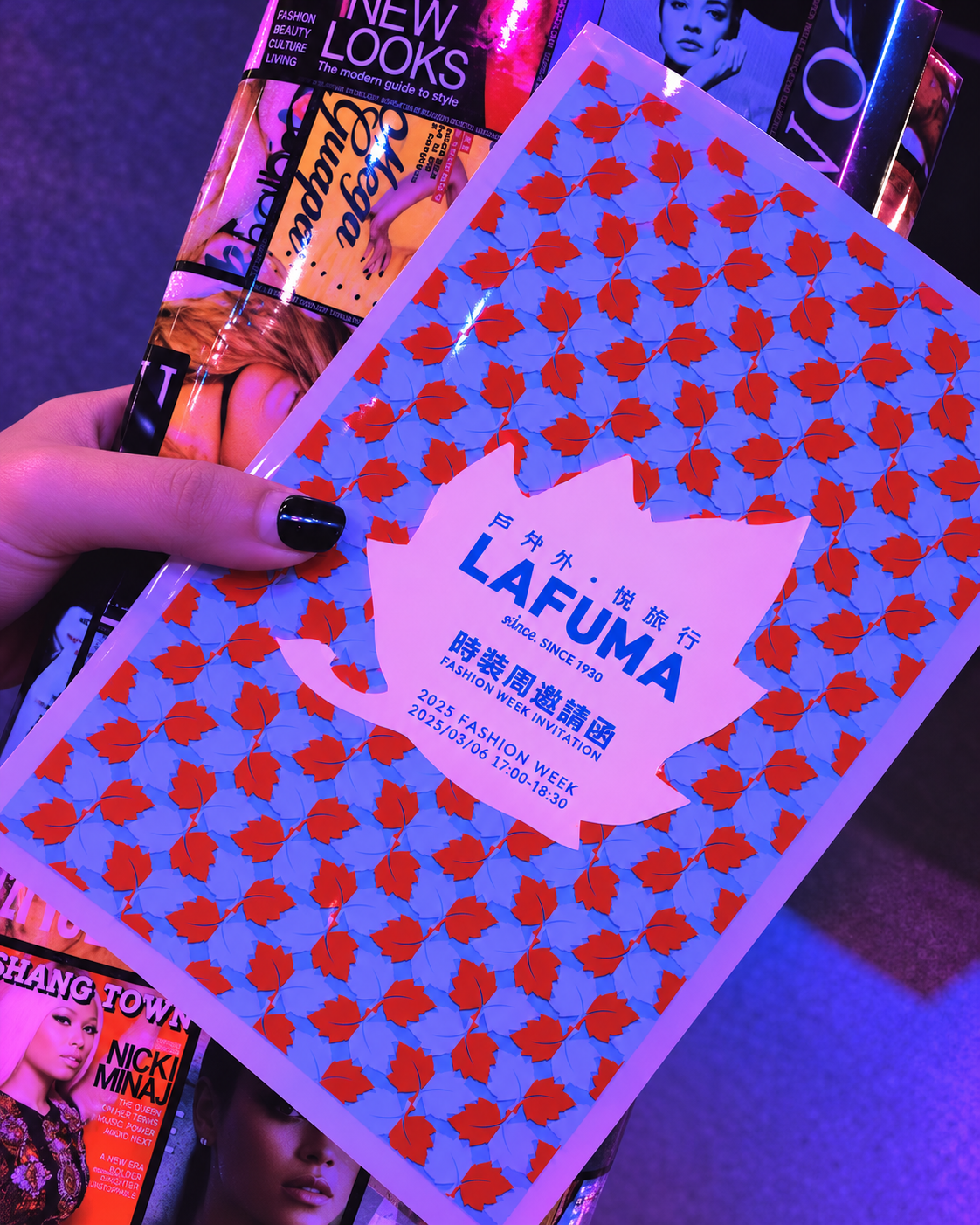

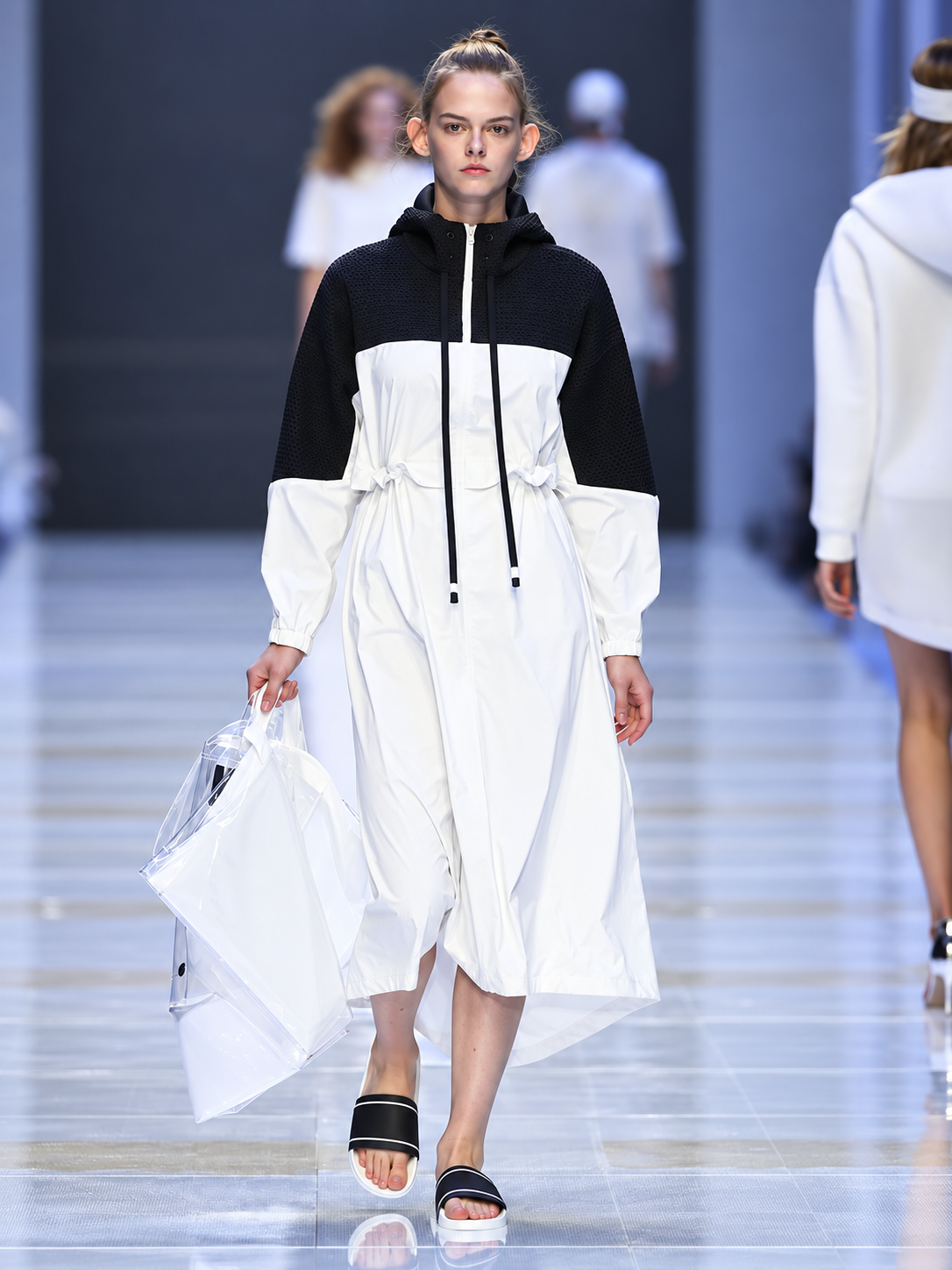
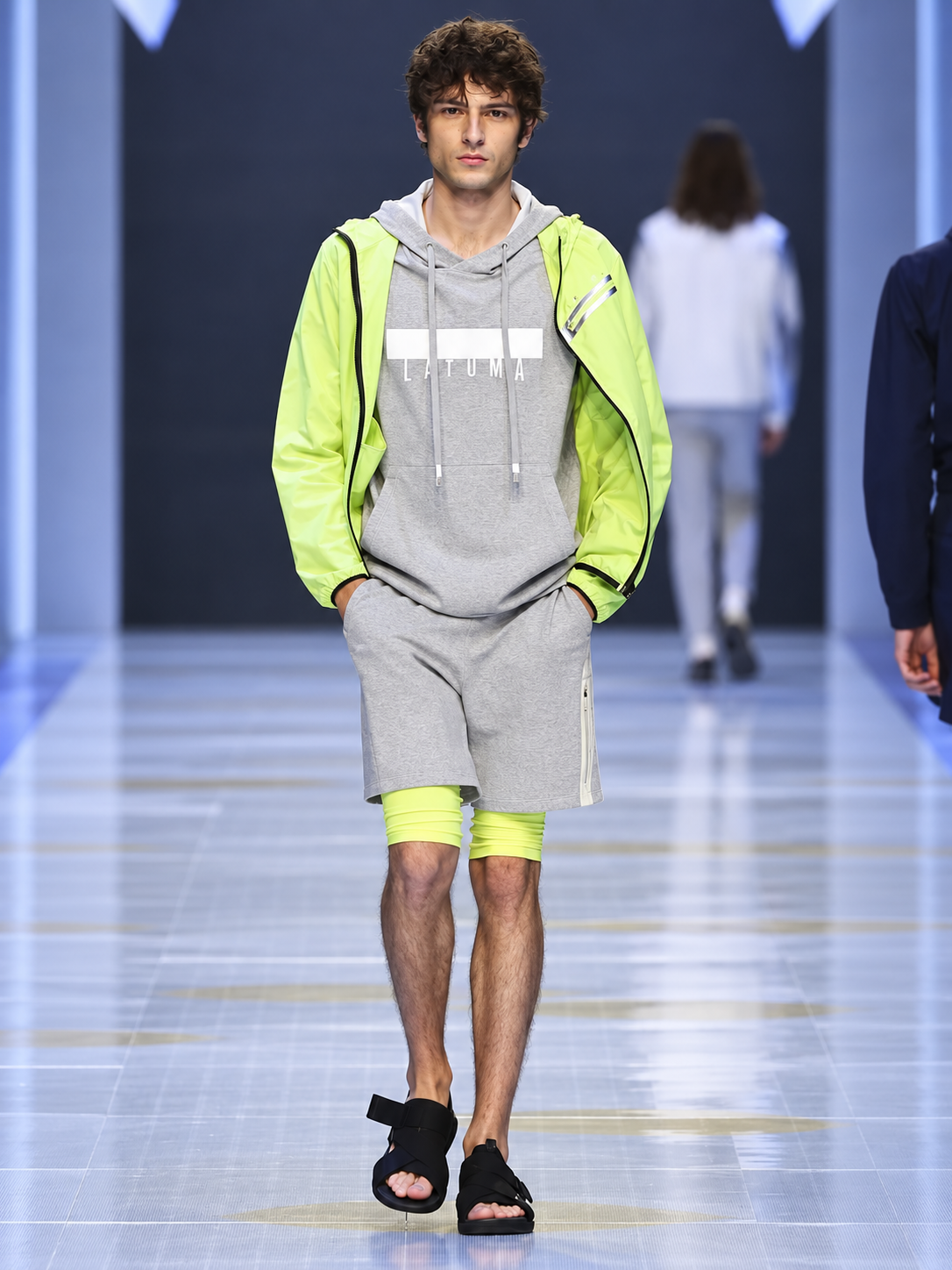
The product proposition is deliberately calibrated. The brand’s Chinese materials emphasise weather protection, comfort and colour for city and travel use, rather than altitude or expedition performance, and consumer reviewers in China routinely distinguish light outdoor wear from professional-grade labels. That calibration is not a weakness. It is a positioning decision, and it defines both the opportunity, a large middle ground of everyday users, and the risk, competition from brands with sharper technical credentials above and sharper prices below.




Why Shanghai Is the Market to Watch
It is not a verdict that China is “the future.” It is a claim about speed of feedback.
Shanghai matters for a practical reason: it concentrates the conditions under which a hybrid category is tested. A dense retail environment, nearly every global outdoor and luxury label, a digitally fluent customer base and a fashion-week infrastructure sit within the same city, so a brand’s positioning is judged quickly, at scale and in front of a sophisticated audience.
Why is Shanghai important to global fashion brands? Shanghai combines a large, dense and highly competitive consumer market with fashion-week and showroom infrastructure that converts visibility into wholesale and retail relationships. Global brands use it to test positioning in front of experienced customers, and the city’s pace of retail and digital experimentation makes outcomes visible faster than in many other markets.
The pattern also repeats rather than starting and ending with one show. Lafuma returned to the runway format in Beijing in 2022, where Xinhua’s coverage describes a collection themed as a travel journal and organised around three scenes: urban, travel and active. Fashion week is functioning as a recurring communications platform for the brand, not a single announcement.
Fashion Week as Commercial Infrastructure
The runway is a signalling device. The commercial work happens around it.
Why would an outdoor brand show at fashion week? Not to sell jackets from a catwalk. The runway is aimed at buyers, retail partners, media and customers, and what it signals is design fluency: evidence that a technical label can think like a fashion house. The deals happen in showrooms, wholesale appointments, retail partnerships and social media.
Why do outdoor brands show at fashion week? Outdoor brands show at fashion week to signal design fluency and reposition how their products are perceived, from equipment to lifestyle. The runway reaches buyers, retail partners, media and consumers at once, while showrooms and trade events around it turn that visibility into wholesale and distribution. Runway visibility is a means to commercial relationships, not proof of commercial success.
FashionUnited’s reporting on Shanghai’s recent seasons describes a programme of shows alongside trade shows and showrooms, and notes that showrooms have helped professionalise fashion wholesale over the past decade. Other cities are building their own platforms with different priorities; Dubai’s fashion week offers a different market-activation model. In each case the principle is the same: a fashion week is commercial infrastructure first and a spectacle second.




From Function to Lifestyle: Where the Margin Expands
A jacket sold on function competes on specifications and price. A jacket sold as part of a life competes on identity.
A jacket sold as part of a lifestyle, commuting, travel, weekends and the photographs taken along the way, competes on identity, colour, fit and occasion, and it earns margin from each of them. The mechanisms are straightforward. Design differentiation supports price. Seasonal newness encourages repeat purchase. Accessories such as bags extend the basket. Control of channels, whether owned stores or direct online sales, keeps more of the value. And content and community turn customers into distributors of the brand’s story.
The listed apparel group that runs Lafuma’s China business states the logic plainly. In its regulatory filings, Baoxiniao Holdings describes the brand’s concept as wearing Lafuma to travel and looking good in photographs, and ties it to consumers’ habits of enjoying nature, camping and sharing images. An investor-relations record adds a sober note: end-market sales were growing quickly, but the brand still represented a small share of the group overall, and the plan was to focus on two series, leisure travel and outdoor sport. A growth brand with a small base is an honest description of where the margin story stands. Retail environments that function as media are part of the same logic, a dynamic the Ounass, Dolce&Gabbana and Cloud 22 collaboration makes explicit in another category.
Why China’s Outdoor Consumer Is More Sophisticated Than the Trend Narrative Suggests
The sophistication lies in discrimination.
Chinese consumers are not a single group, and the outdoor market shows it. Serious participants buy performance-first labels, among them domestic names such as Kailas that compete on technical credibility. Fashion-led urban buyers adopt premium technical shells as status objects. Light-outdoor and travel customers, Lafuma’s territory, want weather protection and comfort inside a wardrobe they can wear to a café. Price-led shoppers buy elsewhere. The brand’s own operating team has described its core customer, in a case study on WeChat’s merchant platform, as pragmatic, quality-conscious and broadly in the 30-to-50 range, weighted toward women, and has said it avoids price wars by offering new-season product. That is a self-report and should be read as one.
Why are Chinese consumers buying more performance apparel? Several factors work together: the practical value of weather-ready clothing for urban commuting and short-haul travel, growing participation in domestic leisure and camping, a culture of sharing travel photographs, a wider supply of credible products across price tiers, and the fashion appeal of technical design. Market commentary also cautions that part of the demand is a style cycle, so growth and durability should not be confused.
A customer who owns an expedition shell for weekends in the mountains, a lighter jacket for travel and a second layer for the office is making distinctions a single “outdoor boom” narrative erases.
The Localisation Test for Global Outdoor Brands
The brands that succeed treat localisation as an input to a consistent identity, not a replacement for one.
The test for any international brand in China is whether it can localise without losing identity. Lafuma’s version has several moving parts: a French heritage, a Swiss parent, and a China business run by a Chinese listed apparel group that sells through shopping-mall stores, boutique department stores and street shops offline, and through major e-commerce, livestream and social platforms online. Its community programming, per the brand’s own account, includes a monthly mountain outing and a leave-no-trace outdoor initiative, built on the WeChat ecosystem since 2017.
That structure has strengths: local design, local speed and local channel expertise. It also raises the question every localised brand eventually faces, which is how much of the story, the price positioning and the product decisions the heritage owner can still shape.
Beyond Gorpcore: The Permanent Hybridisation of Fashion and Performance
“Gorpcore” names a styling moment, and moments age. The structural change underneath is the hybridisation of categories.
Luxury houses borrow performance technology. Outdoor labels adopt fashion-level creative direction. Sports brands behave like lifestyle houses. Travel, wellness and fashion keep converging, so that the objects that make travel easier and the habits that make rest better are increasingly part of the same consumer conversation as clothing.
How has technical clothing become part of luxury fashion? Technical clothing entered luxury through a convergence of function and status: performance fabrics and construction became visible markers of quality, premium outdoor labels adopted fashion-level design and retail presentation, and luxury houses began borrowing technical features. As a result, a garment can now be judged by how convincingly it solves a modern lifestyle, including travel, weather and movement, not only by which category it belongs to.
Two pressures will shape the next phase. Materials, repairability and durability are drawing more scrutiny, which suits brands whose heritage is built on making things last. And Asian markets are exerting more influence on global product and retail strategy, as brands design for the customers who are testing these hybrids first.
The New Premium Outdoor Brand
No brand scores equally on all five capabilities. The useful test is whether they reinforce one another.
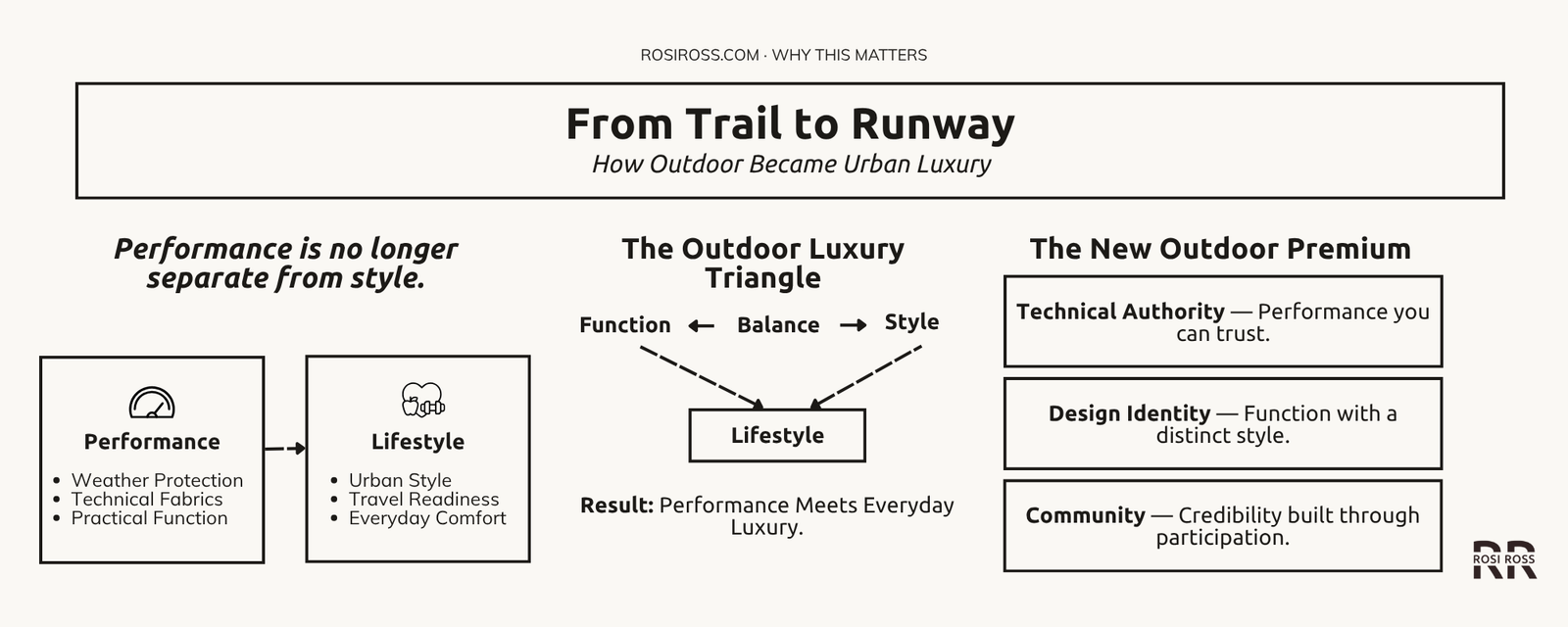
The brands best placed for this convergence combine five capabilities. Technical authority comes first: products must justify their performance claims, and claims that cannot survive scrutiny cost more over time, as the shift from virality to evidence in skincare has shown. Design fluency follows: function must translate into an identifiable visual language. Cultural relevance is the third: the brand needs a reason to matter beyond equipment. Community comes fourth, because participation builds credibility in active categories. And retail theatre is the fifth: stores and events increasingly function as media. The weighting differs by market, and the useful test is not whether a label belongs to the outdoor category or the fashion category.
What This Means for the Future of Fashion
The most powerful brands may not choose between performance and style. They may make the distinction feel obsolete.
The next phase of outdoor fashion will likely be less about outdoor becoming fashionable and more about categories hybridising for good. The future brand may be judged less by which category it belongs to than by how convincingly it solves a modern lifestyle: how it handles the commute, the trip, the weather, the photograph and the weekend within one coherent offer.
For Lafuma, the strategic question remains open, and it is more valuable than any verdict on the show. Can the brand convert heritage and fashion visibility into durable relevance in a market where consumers have an expanding number of technically credible and culturally sophisticated choices? The runway made the brand visible. Whether it makes the brand necessary is decided elsewhere, in repeat purchase, price integrity, product consistency and the quiet accumulation of trust.
In the next era of fashion, the most powerful brands may not be those that choose between performance and style, but those that make the distinction feel obsolete.
“The jacket left the trail
and found the city waiting.
Waterproof was never the whole promise.
It was a way of saying
I am ready for weather,
for travel,
for the day as it actually arrives.
The brands that last
will stop asking
whether they are performance or style —
and make the question
sound like it belonged to another era.”

