
On the biology of the most vulnerable skin on the face, the science separating a $9 formula from a $30 one, and why the most important thing you will read in this guide has nothing to do with colour
Lips are the only area of facial skin with no sebaceous glands, no melanin, a stratum corneum three to five cell layers thin, and a transepidermal water loss rate higher than any other facial tissue. They are, by every dermatological measure, the most vulnerable skin on the face. And the product category designed to protect them is the one most consumers choose by flavour at a checkout counter without reading a single ingredient.
This guide corrects that. Every product discussed here was selected because it illuminates a distinct ingredient category — not because of its price, its brand prestige, or its packaging. Together they map the full landscape of modern lip care science, from the oldest and most dermatologically understood moisturising agent to the most recently developed peptide technology. The goal is not to tell you what to buy. It is to give you the vocabulary to decide for yourself.
The biology of the lip — why nothing else on your face behaves this way
The lip vermilion — the coloured portion most people think of as the lip — is a semi-mucous membrane: a transitional tissue moving from external skin to internal mucosa, and in that transition it loses most of the protective properties the rest of facial skin possesses. No sebaceous glands, which means no natural oils and no capacity for self-lubrication. No melanin, which means no baseline UV protection of any kind. A stratum corneum — the outermost protective layer of skin — that is roughly three to five cell layers thick, compared to fifteen to twenty on the cheek or forehead. The consequence of this anatomy is a transepidermal water loss rate substantially higher than any other area of the face, and a UV vulnerability that has no parallel elsewhere on the body’s surface.
Every other area of facial skin can, in principle, manage minor environmental stressors through its own biology. The lip cannot. It is entirely dependent on what you apply to it — which makes the ingredient content of that application the most consequential decision in daily lip care, and the one most consumers have never thought to make deliberately.

Before any specific ingredient can be usefully evaluated, three categories need to be understood. An occlusive sits on the skin surface and physically prevents moisture from escaping — it is a seal, not a source of hydration. A humectant draws water into the skin, either from the environment or from deeper tissue layers. An emollient smooths the skin’s surface by filling microscopic gaps between cells, improving texture and feel without necessarily affecting water content. Most lip balms do one of these things well. The best do all three. Every ingredient discussed in this guide will be understood through this framework, because it is the most useful tool available for evaluating any lip product, at any price point, from any brand.
Lips have no sebaceous (oil) glands and therefore produce no natural lubricating oils. Their stratum corneum — the outer protective layer of skin — is three to five cell layers thin, compared to fifteen to twenty on other facial skin. They contain almost no melanin. The result is a transepidermal water loss rate significantly higher than any other facial tissue, and a complete dependence on topically applied ingredients for both moisture retention and UV protection. No other area of the face has this combination of vulnerabilities simultaneously.
Lanolin — the original, and still unmatched
Lanolin is a waxy substance secreted by the sebaceous glands of wool-bearing animals, primarily sheep. In chemical terms, it is a complex mixture of esters, fatty acids, and alcohols — a structure uniquely close to the lipid composition of human skin. This structural similarity is the reason dermatologists have trusted it for over a century and the reason it remains, by most clinical measures, the closest thing to a perfect moisturising agent for lips: it does not merely coat the skin surface, it is absorbed and integrated into the stratum corneum in a way that most synthetic alternatives cannot replicate. The term for this property is biomimetic — designed to mimic the biology of what it is treating. A biomimetic moisturiser works with the skin’s existing architecture rather than imposing a different structure on top of it.
Lanolips built an entire brand on this single insight, and the discipline of that focus is what makes their formulas worth examining. Their ultra-pure lanolin is refined to pharmaceutical grade, removing the contaminants that give lanolin its historical reputation for causing sensitivity reactions. The Tinted Lanolin Lip Balm delivers what the brand describes as lip-identical moisture: hydration that is absorbed into the lip tissue rather than sitting on its surface, preventing transepidermal water loss from within rather than simply sealing it externally. In the occlusive/humectant/emollient framework, lanolin at this purity is genuinely all three. It is also the ingredient most closely analogous to what Lanolips has applied across their full range with the same ingredient intelligence.

Lanolin is a complex wax ester secreted by the sebaceous glands of wool-bearing animals and refined for cosmetic use. Its lipid composition is structurally closer to human skin sebum than almost any synthetic alternative — which is why it functions as an occlusive, emollient, and partial humectant simultaneously. Pharmaceutical-grade lanolin, refined to remove potential sensitising compounds, is absorbed into the stratum corneum rather than sitting on its surface. This property — biomimetic integration rather than surface coating — makes it the most dermatologically sophisticated moisturising agent available in lip care.
Hyaluronic acid and the tripeptide revolution
Hyaluronic acid is the most discussed humectant in modern skincare, and its arrival in serious lip formulas marks a genuine shift in how the category thinks about hydration. It is a glycosaminoglycan — a long-chain sugar molecule naturally present in connective tissue — with a capacity to bind up to one thousand times its own weight in water. In a lip formula, it functions as a humectant in the most precise sense: drawing moisture into the lip tissue and binding it there. Its limitation in lip care, as in facial skincare, is that it requires an occlusive ingredient alongside it to prevent the water it attracts from simply evaporating off the surface. A formula that pairs hyaluronic acid with an occlusive is more intelligent than one that includes it alone.
The INKEY List Tripeptide Plumping Lip Balm is the most scientifically precise product in this selection, and the percentage disclosure alone places it in a different category of transparency from most lip products. Six percent tripeptide complex alongside two percent ultra-filling hyaluronic acid spheres that deliver moisture within the lip tissue rather than onto it. The tripeptides — chains of three amino acids — work by stimulating collagen production and improving the structural integrity of the lip’s dermis over time. This is treatment-grade thinking applied to what the market has historically treated as a commodity product. The presence of peptides in a lip formula is the clearest available signal that a brand is designing for long-term skin health rather than immediate sensory impression.

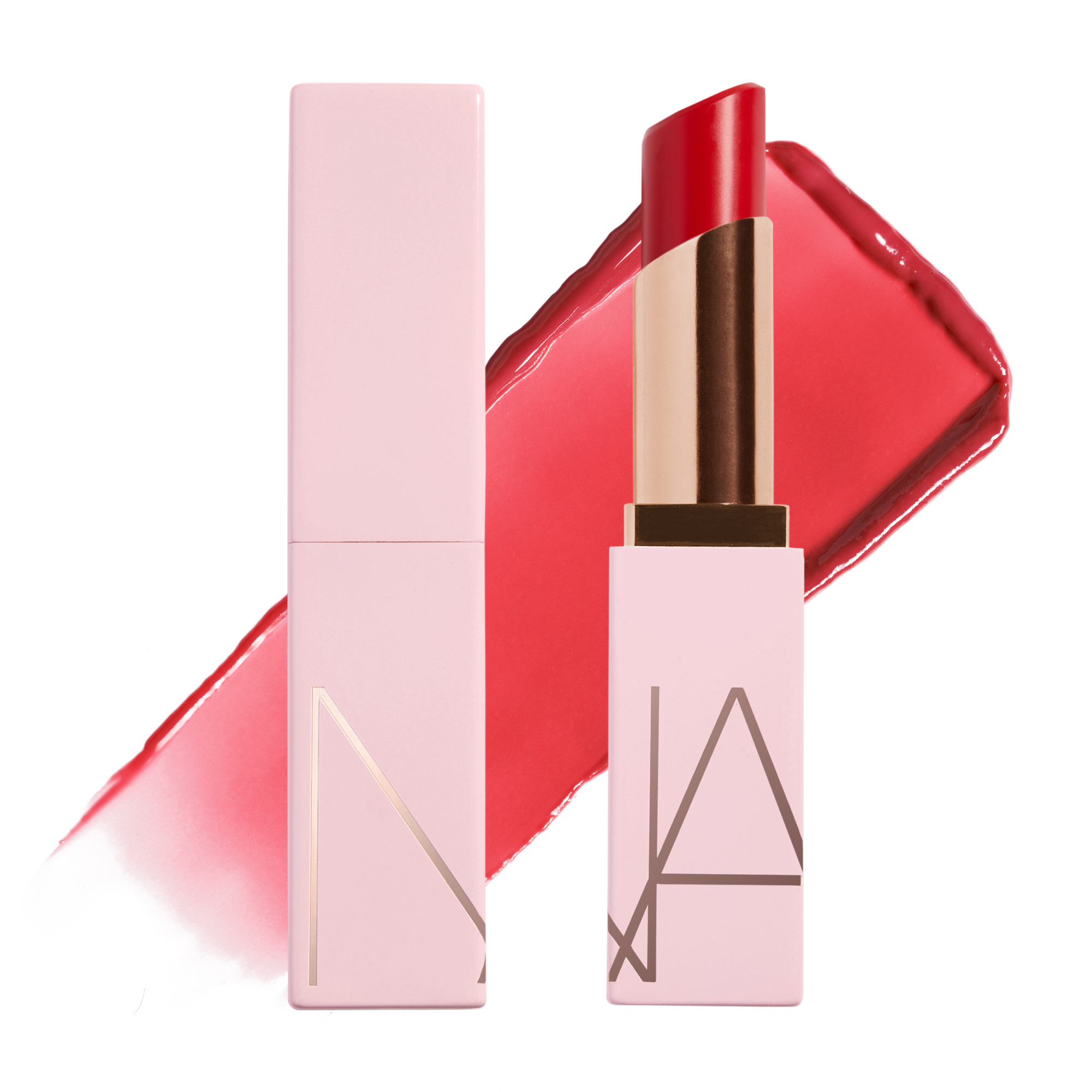
The NARS Afterglow Lip Balm carries a 24-hour hydration claim, which is worth unpacking rather than accepting or dismissing. Hydration claims in cosmetics are measured using corneometry — a technique that measures electrical conductance in skin as a proxy for water content. A 24-hour claim means that corneometric measurements remain elevated 24 hours after a single application under controlled clinical testing conditions. The conditions of a clinical test are not the conditions of daily life — wind, eating, drinking, and environmental humidity all affect the result. But a formula that tests well under clinical conditions is, by definition, more effective than one that does not. The claim is meaningful. It is simply not unconditional.
Hyaluronic acid is a humectant — a glycosaminoglycan capable of binding up to 1,000 times its own weight in water. In lip care, it draws moisture into the lip tissue and binds it there, rather than sitting on the surface. Its most effective application is in combination with an occlusive ingredient that prevents the moisture it attracts from evaporating. Hyaluronic acid alone in a lip formula will hydrate briefly; hyaluronic acid paired with lanolin, shea butter, or squalane will hydrate durably. The difference between these two formulation strategies is the difference between a product that works for an hour and one that works for a day.
The butter architecture — shea, mango, argan, and cocoa
Plant-derived butters are the workhorses of modern lip care, and the consumer confusion around them is almost entirely the result of treating them as interchangeable. They are not. Shea butter, mango butter, cocoa butter, and argan butter are all plant-derived lipids with meaningfully different fatty acid profiles — and those differences determine precisely what each one does on the lip, at what speed, and at what concentration.
Shea butter is approximately 45% stearic acid and 45% oleic acid, with triterpene compounds that carry anti-inflammatory properties. It is a primary emollient and occlusive that creates a protective film on the skin surface while having some capacity to calm inflammation — which is why it appears in more lip formulas than any other butter. Mango butter is higher in oleic acid, with a lighter skin feel and faster absorption; it functions primarily as an emollient rather than an occlusive, and is most useful in formulas where wearing comfort is a priority. Cocoa butter, primarily stearic and palmitic acid, is one of the most effective occlusives in the category — it sits on the skin surface and prevents moisture loss with exceptional efficiency, which is why it has been used in lip care for over a century. Its limitation is skin feel: at high concentrations it can feel heavy.
The e.l.f. Glow Reviver Melting Lip Balm is the most important product in this selection for consumer education, specifically because it discloses percentages — a transparency that is the exception rather than the norm. Five percent mango butter, two percent shea, three percent cocoa, one percent hyaluronic acid: four distinct ingredients, each with a declared concentration, each doing something specific and documentable. The fact that this formula costs $9 and offers this level of transparency while a $30 formula from a prestige brand withholds the same information is not a minor point. It is the entire argument about ingredient intelligence versus brand premium. A formula you understand is a better purchase than one you cannot evaluate, regardless of price.

The Moroccanoil Lip Balm represents the opposite end of the formulation spectrum: the most ingredient-dense product in this selection, with four distinct active mechanisms working simultaneously. Argan oil — high in oleic and linoleic fatty acids — provides rapid-absorbing emollient benefit. Argan butter, the more occlusive derivative, provides moisture sealing. Peptides address collagen synthesis and structural integrity at the dermal level. Hyaluronic acid provides the humectant function. No single formula in this selection demonstrates as completely what a multi-mechanism approach to lip hydration looks like when every ingredient has a clearly defined and distinct role.

The Benefit California Kissin Moisturising Lip Balm pairs wild mango butter with hyaluronic acid — a two-ingredient logic that works precisely because the faster-absorbing emollient and the humectant address different mechanisms without redundancy. The simplicity is not a compromise. It is intelligence applied with restraint. The same principle that makes a well-edited wardrobe more functional than a crowded one applies to skincare formulation: fewer ingredients doing distinct, complementary things outperform a longer ingredient list where several components are redundant. Ingredient literacy — the ability to evaluate a formula by what its components actually do — is the most significant shift in beauty consumer behaviour of the past decade, one that has moved the most intelligent beauty consumers away from brand prestige and toward formulation transparency at every price point.

Treatment-grade lip care — peptides, antioxidants, and anti-ageing
The boundary between cosmetic and treatment-grade lip care has been shifting for a decade, and the ingredients that occupy the treatment end of the spectrum have clinical precedents in facial skincare that are worth understanding before being applied to the lip context. Squalane — a stabilised derivative of squalene, a lipid naturally found in human sebum — is classified as both an emollient and a mild occlusive, with a molecular structure light enough to absorb rapidly into the lip tissue but stable enough to maintain an effective moisture barrier. It is, along with pharmaceutical-grade lanolin, one of the few lip care ingredients that functions genuinely as both absorbed and protective simultaneously. The Laura Geller Jelly Balm pairs it with vitamin E — and this pairing requires careful explanation, because vitamin E in lip care is almost universally misunderstood.
Vitamin E, or tocopherol, is an antioxidant. Its primary mechanism is the neutralisation of free radicals generated by UV exposure at the lip surface. It is not a moisturiser in any meaningful clinical sense — its hydration benefit is minimal. Its function is preventive rather than reparative: it mitigates the oxidative damage that UV radiation generates before that damage compounds into visible ageing and cellular dysfunction. Understanding this distinction changes how vitamin E should be layered with other ingredients. It is not a substitute for an occlusive or a humectant. It is a separate mechanism operating at a different cellular level. This is also why it pairs so logically with a squalane-based formula — the squalane manages moisture, the vitamin E manages oxidative stress. The same logic that drives the inclusion of vitamin C and niacinamide in facial serums applies here. The most intelligent skincare formulas address multiple mechanisms simultaneously rather than stacking redundant ingredients.

The Huda Beauty GloWish Super Jelly Lip Balm takes the antioxidant argument to its most developed expression in this selection. Blueberry extract and goji berry seed oil provide plant-derived polyphenols that neutralise oxidative stress at the lip surface — the same mechanism driving the inclusion of vitamin C in leading facial serums, applied to a lip-specific context. The pH Bloom technology, which adapts the formula’s behaviour to individual skin chemistry, represents the most sophisticated formulation innovation in the selection: a system that adjusts its surface properties to the specific pH of the individual’s lip tissue. The practical result is a formula that behaves differently on different people — which is, ultimately, what genuinely personalised skincare looks like at the molecular level.

The Julep 24/7 Shea Butter Balm introduces the only ingredient in this selection with an explicit anti-ageing mechanism beyond antioxidant protection: Songyi mushroom extract, which has shown in preliminary research the capacity to inhibit tyrosinase — the enzyme responsible for melanin overproduction — and to support collagen synthesis. The clinical evidence is more developed in facial skincare than in lip-specific applications, and this should be stated honestly: it is an emerging ingredient at the frontier of what lip treatment can address, rather than an established actives category. But its presence signals where lip care treatment is heading — toward the same clinical ambitions that transformed facial skincare over the past decade, applied to a tissue that needs them more acutely than almost any other area of the face. The same environment-as-architecture logic that makes consistent ingredient use in wellness formulations the most effective strategy applies here: the compounds that produce real outcomes need time and consistency to do their work.

The Cheekbone Beauty Revive addresses the question that vegan formulation raises in lip care with unusual directness. Lanolin and beeswax are two of the most effective ingredients in the category — both animal-derived, both with centuries of efficacy data, both biomimetic in meaningful ways. Replacing them with plant-based alternatives requires understanding exactly what each one does and finding plant-derived compounds that address the same mechanisms. The best vegan lip formulas achieve this; some do not, and the difference is legible in the ingredient list if you know what to look for. Cheekbone Beauty’s formulation, combined with their Canadian manufacturing provenance and sustainability commitments, represents what ethical formulation intelligence looks like when it takes the science as seriously as the values. The same principle — that ethical choices and ingredient intelligence are not in opposition — defines the most considered formulation across all beauty categories.

The SPF chapter — the most important thing in this guide
Melanin is the pigment that provides baseline UV protection to skin. As the NIH’s clinical documentation of actinic cheilitis confirms, the lips have almost none. The stratum corneum of the lip vermilion is three to five cell layers thin. The lower lip protrudes further from the face than the upper, receiving direct UV exposure at an angle that no other facial tissue experiences consistently. The result is what dermatology classifies as the most photosensitively vulnerable skin on the face — the tissue most likely to develop actinic cheilitis, a precancerous condition caused by chronic UV damage, and the one most directly associated with squamous cell carcinoma of the lip, which accounts for approximately 90% of the more than 3,500 new cases of lip cancer diagnosed annually in the United States alone.
These are not edge-case concerns. They are the predictable consequences of treating lip care as a cosmetic category rather than a dermatological one, and they are entirely preventable. The American Academy of Dermatology recommends applying a lip balm with SPF 30 or higher as part of daily sun protection — the same standard applied to the rest of the face. The Skin Cancer Foundation similarly requires SPF 30 or higher for its Seal of Recommendation on daily-use sunscreen products, a threshold reflecting the real-world under-application that makes lower SPF ratings inadequate under typical conditions. The reason most people do not follow this recommendation is not knowledge. It is that SPF lip products have historically been unpleasant to wear: clinical in texture, flavourless or aggressively flavoured, and positioned as a medical product rather than an aesthetic one.
The Laura Geller Shine-N-Shield Lip Balm SPF 15 addresses this barrier directly. Sheer, wearable colour in a formula that provides daily UV protection: the combination that should be the baseline for daily lip care rather than the exception. SPF 15 is the minimum clinical recommendation for daily protection and the threshold at which meaningful UV blocking begins. For daily wear as a base layer under other products, it is adequate. For sun exposure, outdoor activities, or any environment where UV levels are elevated, SPF 30 is the appropriate standard.

The Lanolips Sun Balm SPF 30 Tropical is the only product in this selection that combines the biomimetic hydration of pharmaceutical-grade lanolin with clinically adequate broad-spectrum sun protection. The untinted formula makes it ideal as a base layer under any other lip product — SPF applied first, colour or treatment applied on top. This is the correct sequencing, for the same reason that SPF is applied before moisturiser in facial skincare: the UV filter needs direct contact with the skin surface to function effectively. An SPF buried under two other products is an SPF partially compromised.

Yes — unambiguously. Lips contain almost no melanin, the pigment that provides baseline UV protection to other skin. Their stratum corneum is three to five cell layers thin. The lower lip receives direct UV exposure at an angle no other facial tissue experiences consistently. The American Academy of Dermatology recommends applying a lip balm with SPF 30 or higher as part of daily sun protection. Actinic cheilitis — precancerous chronic UV damage to the lip vermilion — affects an estimated 31% of people over 45 in high sun-exposure populations. Squamous cell carcinoma of the lip accounts for 90% of lip cancers in the United States, with more than 3,500 new diagnoses annually. The most effective prevention is consistent daily SPF application. SPF 15 is the daily minimum. SPF 30 is the standard for any sun exposure.

The most important thing a person can do for the long-term health and appearance of their lips costs less than fifteen dollars and takes three seconds in the morning. It is not a particular formula. It is not a particular brand. It is SPF, consistently applied, from today. Everything else in this guide — the lanolin, the tripeptides, the hyaluronic acid spheres, the pH-adaptive antioxidant complexes — compounds in value when the skin it is applied to is not simultaneously being damaged by unprotected UV exposure. Protect first. Treat second. The order is the strategy. The same logic that makes consistent daily use of the right tool transformative — across every category, in every discipline — applies here more urgently than almost anywhere else.
“Lips are the most vulnerable skin on the face.
They have no sebaceous glands, no melanin,
a stratum corneum three to five cell layers thin,
and a transepidermal water loss rate
higher than any other facial tissue.
The product category designed to protect them
is the one most consumers choose by flavour
at a checkout counter
without reading a single ingredient.
The science to do better has existed for decades.
What has been missing is the guide.”

