

Istanbul is a city full of history and wonder, and the place to meet European culture and Asian culture. The paths are adequate to cycle, the large and ancient trees all seem like the stories, and the mild weather is interesting. This Turkish city is a vibrant cultural and creative hub that everybody must see in their lives.
Currently, İstanbul Havalimanı New Airport serves as one of the main connections to several airlines and destinies between Asia and Europe. Most of the layovers are long hours so Turkish Airlines offers and stop and drop services where you can see the city during your stop by leaving the luggage at the airport for small fees and then taking the bus for the tour directly at the airport. What a brilliant idea!
So, with transport or without it, here are Istanbul’s top 5 tourism spots you can see in 72 hours or less:
Blue Mosque
Construction of the Blue Mosque began in the early 1600s (17th century) in Ottoman and Byzantine designs. During the Ottoman Empire, Sedefar Mehmed Aga’s architect was responsible for the design of the Imperial Mosque. It is as vibrant as ever. Incredible mosaics of thousands of handcrafted ceramic tiles line the rotating walls. All of which matched in some manner with a vast array of designs and colors. In addition to this, stuck glass covers the walls in a number of layers. The huge chandeliers that are hanging from the ceilings are astonishingly low.
Opposite to the Ottoman royal residence, you can find the Sultan Ahmed mosque in Topkapi Palace. It connects Hagia Sophia and the Byzantine Hippodrome. The site’s location resulted in unfavorable opinions. This was especially due to the fact that instructions were given to demolish many of the existing Palaces which were owned by the Ottoman ministers.
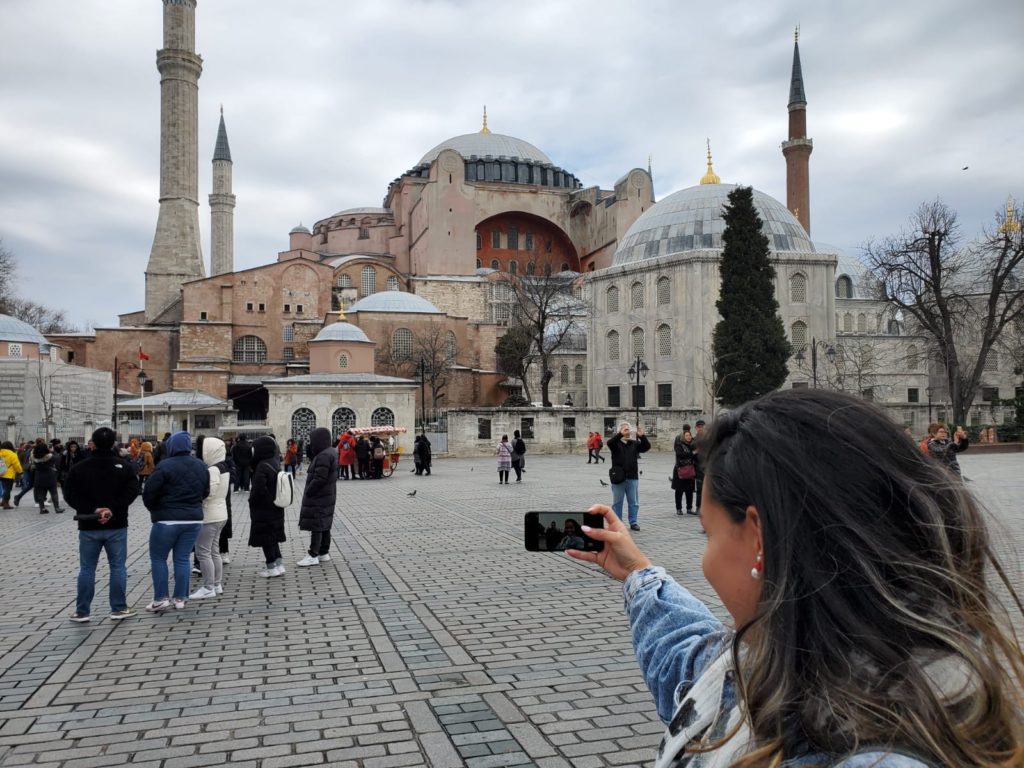
More on the Blue Mosque
The Istanbul Blue Mosque is also the first mosque with six minarets ever built. In previous times, mosques could not have more than four minarets. After the building of the mosque, however, policy changes made it possible. As a result, this leads to some disputes during that time. At the corners on the prayer hall, you can find four of the minarets. You can find the remaining two on the outside of the courtyard. These minarets each have a number of balconies that adorn its lean shape.
More than 20,000 ceramic tiles, as well as those on the lower level of the pier, protects the Blue Mosque. They were all made by hand. Although the higher level has a more modern style of decorations, the lower level remains traditional. A graven niche of marble placed in the middle of this wall guides the believers in the right direction. To its right, an ornamental roof envelopes the wide and thin marble pulpit.
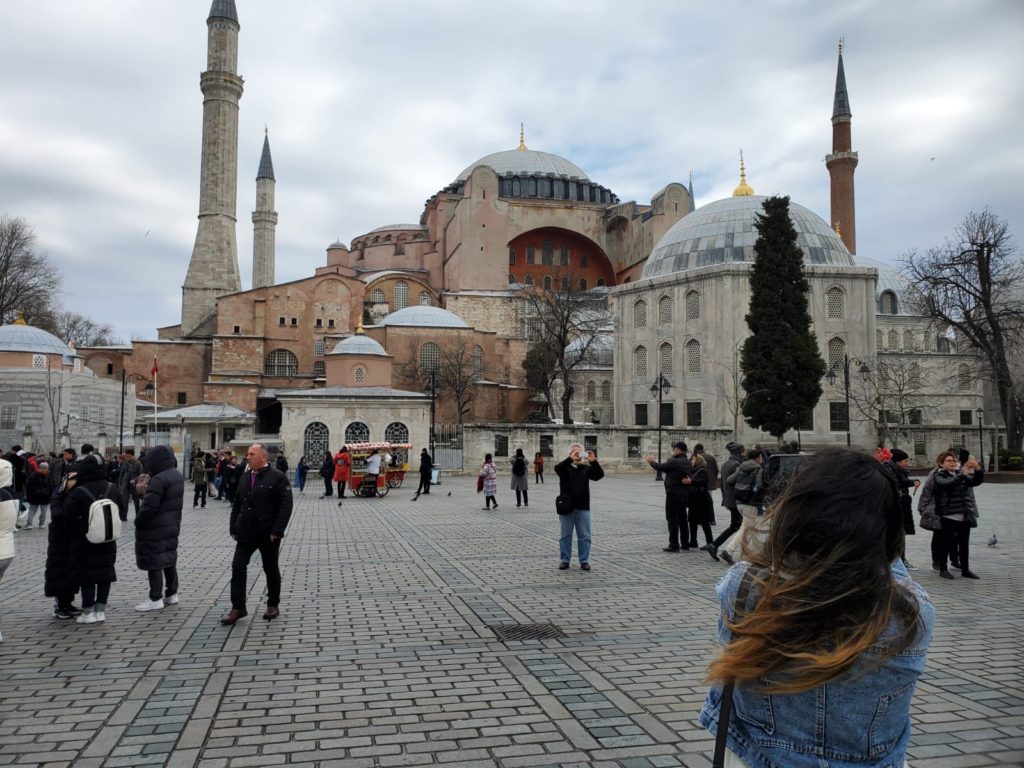
Specific requests for the building’s construction was made by Sultan
The typical tile motifs such as cypress trees, tulips, flowers, and fruits evoke a view of a lush paradise. Sultan specifically made requests for these for the building’s construction. The sumptuous use of interior tiles was the first in the colonial style of the Ottoman Mosque. The function of natural light from 200 screens highlights the tile’s complexity. Each having its half-domes and sidewalls that permeate the main dome. Originally, these windows featured stained glass in Veneto.
Initially, the stained-glass windows had allowed for complete illumination of the Mosque. However, this changed with the addition of several chandeliers. Like everything else in the mosque, the chandeliers are also decorative objects.
Galata Tower
In the neighborhood of Old Pera, the Galata Tower is one of Europe’s most famous destinations. A medieval stone tower and after its discovery in 1348, it now serves as a prison and a fire observatory in the Galata region. After the rebuilding of the Galata Tower, it saw its official opening after the revolution in 1967. The tower has a cafeteria above, and after the last restoration in 2013 they built a nightclub.
Some ascents take you up but the stairs lead to the panoramic terrace, 51 meters above ground, are still three more floors. Inside the hotel, on the entry stage, there is a tiny souvenir shop across the ticket office. The top reaches today contain a coffee shop, a bakery and a bar, all accessible through the lift in the nine-story building, with stunning views.
The reign of Sultan Selim III resulted in the addition of an alcove, even after the tower’s damage by fire In 1794. After a further fire’s devastating effects in 1831, Sultan Mahmud’s commission rebuilt the tower along with two more floors and a conical tip. Currently, the 99 Ft. high tower (66.90 meters), with tourists heading up from the rooftop to see the Istanbul with a breathtaking panorama of 360 °, is a tourist attraction. Thankfully, a lift brings tourists up to seven stories, but only by raising the stairs are the last two stories available.
How the Galata Tower is used
Following the centuries, the singers and fire patrols would be the ones mainly using the Galata Tower. It is now a private company-run restaurant despite suffering explosions and floods. The final two floors will carry you through an elevator to the 7th level, one of the hotels with a 360 degree Istanbul view.
The Tower of Galata is by far one of the most significant tourist attractions in Turkey and not just in Istanbul. It is situated in Instabul Galata, which is easily accessible, just as the name clearly indicates this.
One of the more famous stories revolves around the legendary Ottoman aviator Hezarfen Ahmed Celebi, and some interesting tales about the Tour de Galata.HezarfenCelebi climbed with his weapons fastened from the top of the tower into Dogancilar Plaza, in Uskudar. Sultan Murad Khan reportedly was suspicious of the individual and sent him to exile in Algeria because of this magnificent feat.
Grand Bazar
Travelers who like to shop should not skip a pass to the Grand Bazaar. This is especially due to the fact that it has over five thousand stores rendering it one of the world’s biggest indoor markets. The Basin includes things like shoes, moving and hand-painted carpets, herbs, antiques, and carved tiles, attracting over one quarter million guests annually. The business has seen a countless number of updates throughout its long history. In addition to having several columns, the Bazar’s walls also have beautiful details. Stores and other market areas are likely to meet all your needs. In the south of the Cevahir Bedesteni is host to ancient products. There are vintage doors, valuable stones, encrusted weapons, and antique furniture to be found by visitors. There’s a labyrinth of roofing lanes, lined with shops and stalls, which offer every Turkish souvenir and craftsmanship you could imagine.
The main area of the Grand Bazaar has 64 streets and 22 entries but it is also considered to be a market area for the whole area surrounding the historical Bedesten.
The Grand Bazaar experiences are what makes the discussion and the negotiation with the sellers, who often speak fluent languages in more than one. Dozens of retailers selling similar products next to each other, rendering trading and customer service important. Accepting tea doesn’t mean that any party has signed the deal, but rather it’s the Turkish way. If you don’t like the offer, go to another location and find a better deal.
Craftsmanship
The customized services offered by many of the Hans are one of the main reasons locals visit the Grand Bazaar. Although the shops show ready-made goods, artisans have workshops at the back of the Hans. For many years, such seminars have taken place and the knowledge passed from generation to generation. Traditional goldsmiths and jewelers derive their skills and inspiration from centuries-old practices in Istanbul and their true sources go farther.
In the Ottoman era, craftsmanship in the style of Istanbul utilizing valuable materials became familiar. This, as a result, caused the establishment of the impression of the town as an artisanal regional hub. There are currently cinematic groups of articles known to be authentic in Istanbul: gold chains, rose-cut pieces, pearls, golden coin jewelry, and belt buckles, among others. Some artisans deal on original designs, while others are skilled in acting on orders of a client.
Suleymaniye Mosque
The Süleymaniye Mosque is one of the most known landmarks in Istanbul, located on top of the hill above Sultan Ahmed city. The mosque’s founding in 1550 was as a result of the order of Sultan Suleyman the Magnificent on the Third Hill of Istanbul. Indeed, the mosque is magnificent, combining the greatest architecture in Islam and Byzantine history.
The gateway to the mosque includes a road with a central fountain, as with all the colonial mosques in Istanbul. The outside façade of the mosque is decorated with Iznik tile window glasses in rectangular blue. This mosque complex consists of several houses, built as clinics, Qur’an, elementary schools, public baths, etc. There is a minaret, two high and two short, on each corner of the courtyard. Four minarets for mosques provided by a Sultan have historically been used. Two minarets could be designed by the Princes and Princesses; just one more.
The minarets have a minimum of ten galleries, historically indicating that Suleyman 1 was the 10th Sultan of the Ottoman Empire. 53 meters wide is the central dome. Granite, graphite and porphyry columns adorn the outside of the mosque resulting in the colonnade theme being highly prominent. The mosque has faced several challenges over the years, especially during the First World War where the mosque sustained damages caused a fire. Not to mention the fact that the gardens were used as a weapons store. It saw restoration in the middle of the 20th century.
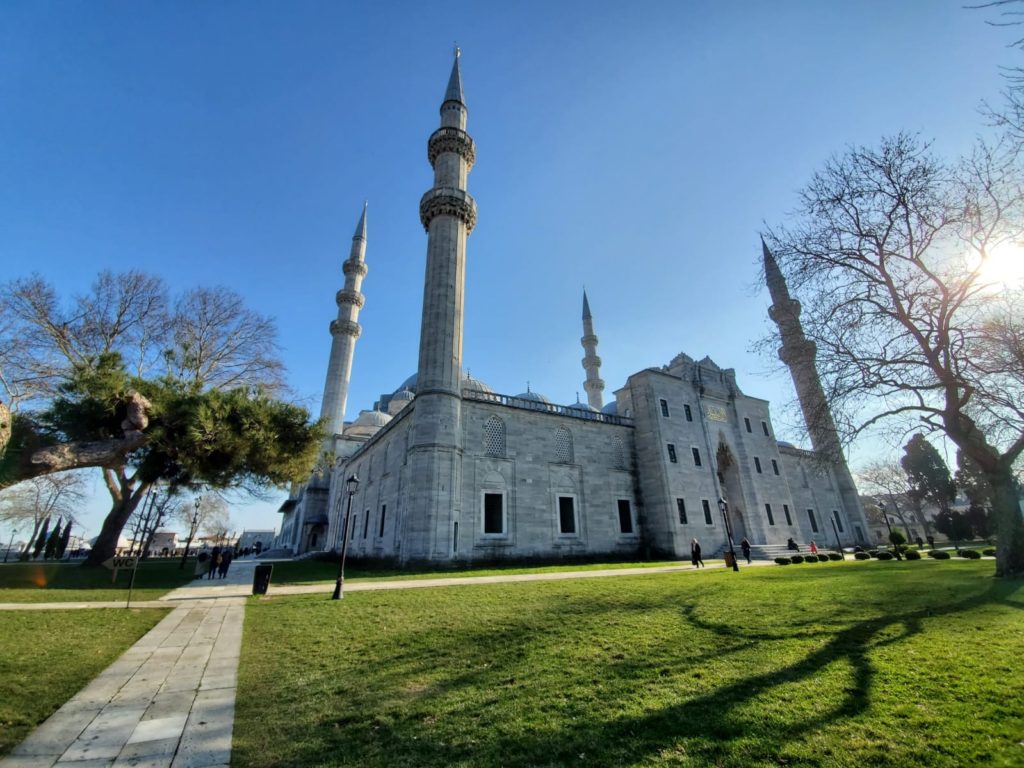
The building’s dimensions
Once you reach the mosque you have an aura of unpretentious simplicity. Its interesting features will trouble and interest you once you actually enter through the screen. The four columns from various places around the world are inside them. The dome is 53 meters high and 27.5 meters in diameter. The perfect design aided by the supply of the 32 screens, enables the mosque’s natural lighting. Its outstanding acoustics comes from every corner which enables superb noise detection. Furthermore, the empty pots under the dome can also be an explanation for the superb acoustics.
In the garden behind the main mosque, there are two mausoleums including the tombs of Sultan Suleyman I, Suleyman II and Ahmed II. You can find a section of the Hajar al-Aswada in the central mausoleum. This is the holiest place in Islam the Black Stone next to Makkah.
Sahaflar Carsisi
In the foraging of new titles, second-hand manuscripts, maps of the past, the Qur’an (in several languages), ancient texts and other uncommon discoveries in the Sahaflar Carsisi (Beyazit Book Bazaar), book lovers and bazaar hunters. Sahaflar Carsisi bazaar is an old book seller’s spot, where the Grand Bazaar is situated. It includes not only thousands of important authors but also 556 past years. In the year 700’s Umayyad made the first use of book sales in Andalusia. Baghdad was the second base, and the Ottoman empire was the third center. Between Bursa and Edirne, the first cities, established libraries in the Ottoman Empire settled in Istanbul. rand Bazaar saw undergo transformation into a hub for printing and literary exchange, while it underwent a transformation in the region of Beyazit during the Ottoman period.
In Old Book Sellers Bazaar there are 50 shops and there are 300 people working in Grand Bazaar. For 456 years until 1894, the Old Book Sellers stayed in the Grand Bazaar. In 1894, Basar’s life in Beyazit continues. We see that the Grand Bazaar is a great proposition when we look at the 120 years of history of the Old Book Sellers Bazaar. Book auctions were carried out on Tuesdays and Fridays in the Old Book Sellers ‘ Market, where precious books were purchased and sold in Grand Bazaar. Some days had special protection for those who liked the novel. The books that have been ordered to be auctioned will first be sent to the old book sales manager. The sales manager will then submit the experience to give them full value and then deliver.
The 1950 Flames
For the Ottoman Kingdom, SahaflarÇarşısı once was a popular place for students. Students frequently visited the Sahaf to buy books from the madrasas around the area. Twenty-three of the shaft shops survived even after the çarşı saw an eruption of flames in 1950. These shops are still in existence today. Reconstructions for all the wooden shops in čarşı later took place, converting them into concrete buildings. Within the first Turkish printer ŠtabrahimMüteferrika, you can find the bust in the middle of çarşı.
In 1729, the writing of the first book took place in Turkey in SahaflarCarsisi. Whether that be fact or fiction, Ibrahim Muteferrika, an Ottoman ambassador who wrote the first book, is the figure in the center of the patio

