
On a Pacific city of crossings, and the tigers, neon rooms, rail terminals, waterfront sculptures, submarines and triumphal arches that explain how a military outpost at the edge of a continent became a place worth reading slowly
Some cities are built to be admired. Vladivostok was built to be held — a harbour at the far edge of an empire, fortified, closed, reopened and slowly reinvented. To understand it is to follow its geography back to the orders that shaped it, and then to notice how much colour has grown in the space those orders left behind.
Search for Vladivostok’s hidden gems and you will be handed a list. The list is the least interesting thing about the city. Vladivostok was founded as a military post on 2 July 1860 and named, with imperial confidence, Lord of the East. In the century and a half since, it has been asked to be a harbour, a fortress, a frontier, a closed city and a railway terminus, sometimes several at once. Every place worth finding here is evidence for one of those jobs, and the most surprising discovery is how far the city has travelled from them: the same streets that once belonged to the navy now hold neon-lit bars, panoramic dining rooms and waterfront promenades.
This essay collects no secret addresses. The phrase “hidden gem” is travel’s version of going viral — a promise of discovery that tends to arrive already crowded, and one that works best when it replaces looking with collecting. A destination can also be assembled for the camera, a pattern familiar from manufactured paradises elsewhere, and Vladivostok, for better and worse, mostly was not. It was assembled by geography and by orders issued from a long way away. Reading it means following those orders back to their source, which turns out to be a more rewarding way to walk a city than ticking off its secrets. What follows moves through the city in five registers: its public face, its nightlife, its railway, its quiet corners and its military and historical weight.
Where the Map Runs Out: Vladivostok in Russia and in History
To understand Vladivostok, begin with a map. Russia is the largest country on earth, and Vladivostok sits at its far southeastern corner, in Primorsky Krai, on the shores of the Sea of Japan and Peter the Great Gulf, a short distance from the borders with China and North Korea. It lies roughly nine thousand kilometres from Moscow by rail, the official distance of the Trans-Siberian line being 9,288 kilometres, and seven time zones ahead of the capital, so that the city starts its day while Moscow is still asleep. For most of its history, that distance was the central fact of the place. It was not Europe’s Russia but Russia’s edge, a port facing the Pacific from the far end of a continent, closer to Seoul and Tokyo than to any European capital.
Its history is shorter than its remoteness suggests. The land around the bay was part of the Qing Chinese sphere until the mid-nineteenth century, when treaties between the Russian and Chinese empires, the Treaty of Aigun in 1858 and the Convention of Peking in 1860, brought the coastal region of Primorye under Russian control. Vladivostok was founded within months of that settlement, in 1860, as a military post, and the name chosen for it, Lord of the East, announced exactly what the empire expected of it. The navy moved its main Pacific base here in 1872, the Trans-Siberian Railway reached the city at the turn of the twentieth century, and for much of the Soviet era the port was closed to outsiders because it served as the home of the Pacific Fleet. It opened to foreign visitors in the early 1990s. The place that results is one of the youngest of Russia’s great cities and one of its most unusual: a frontier that became a fortress, a fortress that became a port, and a port that is still learning what else it can be.

A City With Many Faces: Tigers, Domes and the Promenade
The city sits on the tip of the Muravyov-Amursky Peninsula, with Amur Bay to the west, Ussuri Bay to the east and the Golden Horn Bay curving along the south. Nearly everything the city is follows from that arrangement: a deep, sheltered harbour at the edge of an enormous landmass, backed by hills steep enough to make every street a position. The Imperial Russian Navy made it its main Pacific base in 1872. For decades of the Soviet era the entire city was closed to foreign visitors, from 1958 until 1992, because its harbour belonged to the Pacific Fleet.
What is Vladivostok? Vladivostok is a Russian port city on the Pacific coast, founded as a military post in 1860 and the eastern terminus of the Trans-Siberian Railway. It is the administrative centre of Primorsky Krai and long served as the home port of the Russian Pacific Fleet. Its name translates as Lord of the East.
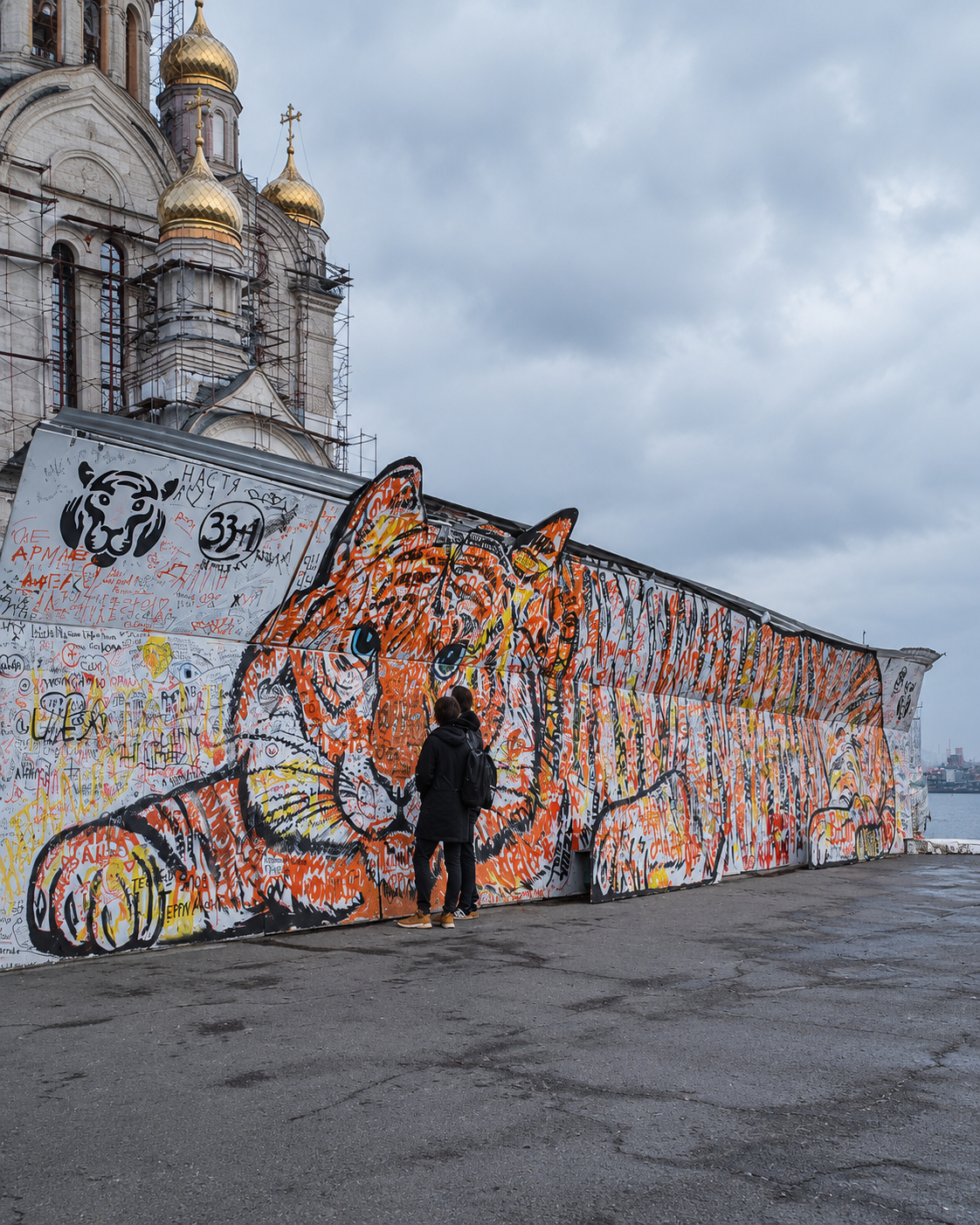
The city’s public face reflects all of that history at once. The Amur tiger, the great cat of the surrounding forests of Primorsky Krai, is the region’s emblem and appears on the city’s coat of arms, and it appears again, painted large and loose, on walls along the waterfront, a reminder that this is a place where the taiga runs down almost to the sea. Behind the murals, golden onion domes rise above the harbour: an Orthodox cathedral, in these photographs still under scaffolding, which says something about a city that is not finished and does not pretend to be. Along the promenade, the mood is gentler and a little theatrical; on a spring day, even a horse dressed in yellow flowers is part of the scenery. It is a useful first impression. Vladivostok is neither a museum nor a resort. It is a working port city with a sense of occasion, and its public spaces carry symbols of nature, faith and festivity in the same frame.




After Dark: Colour, Neon and the Table at the Edge
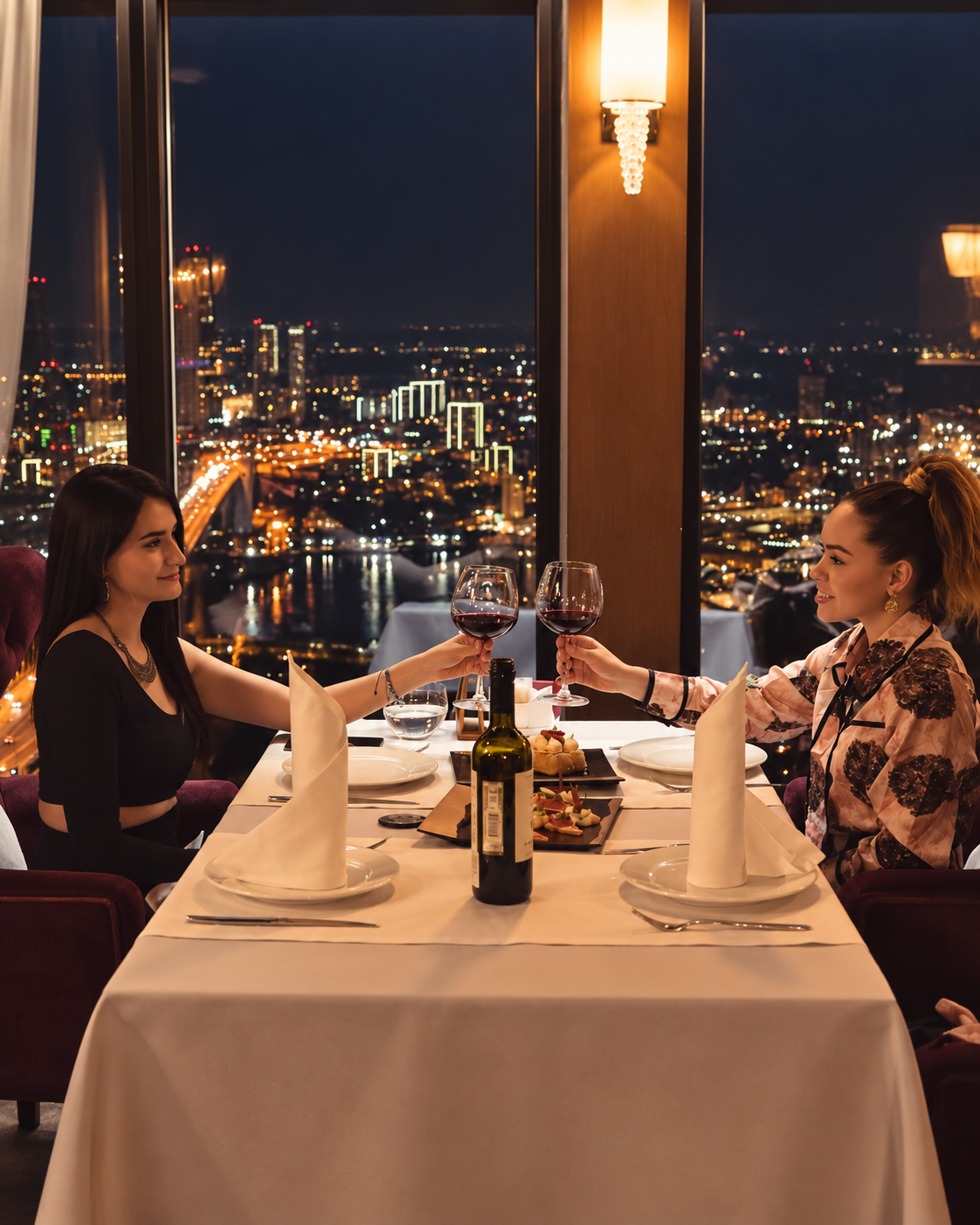
The surprise of Vladivostok after nightfall is its colour. A city once defined by grey ships and closed gates now has an evening life of mirrored interiors, terrazzo and neon, of lounges washed in pink and green light, of high-rise dining rooms with the whole harbour glittering beneath them and of restaurants themed on the cuisines of its near neighbours. The contrast is the point. A place that was closed to outsiders for more than three decades has, since reopening, built a social scene that looks outward, borrowing freely from Seoul, Tokyo and the wider Asia-Pacific and mixing it with Russian hospitality.
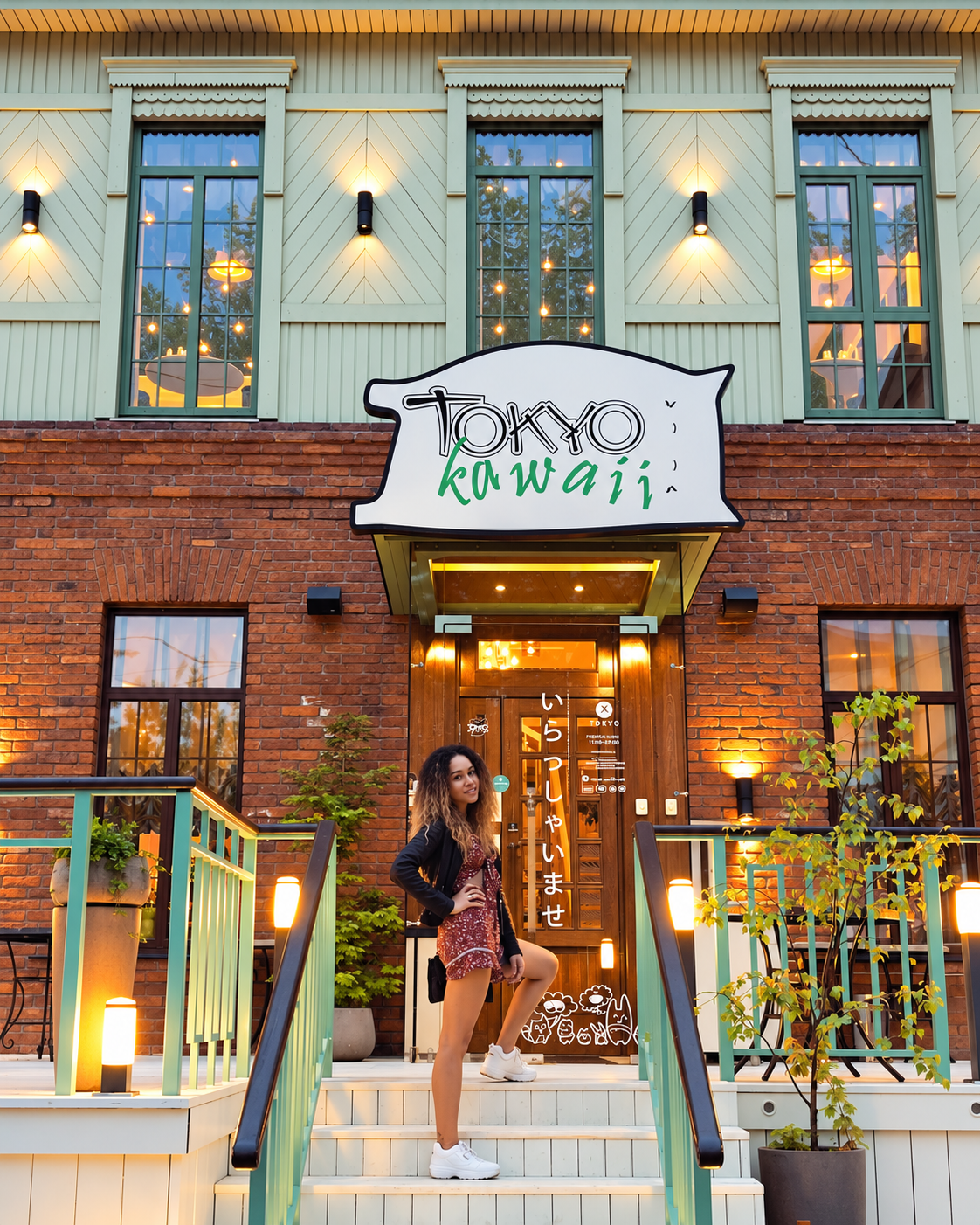
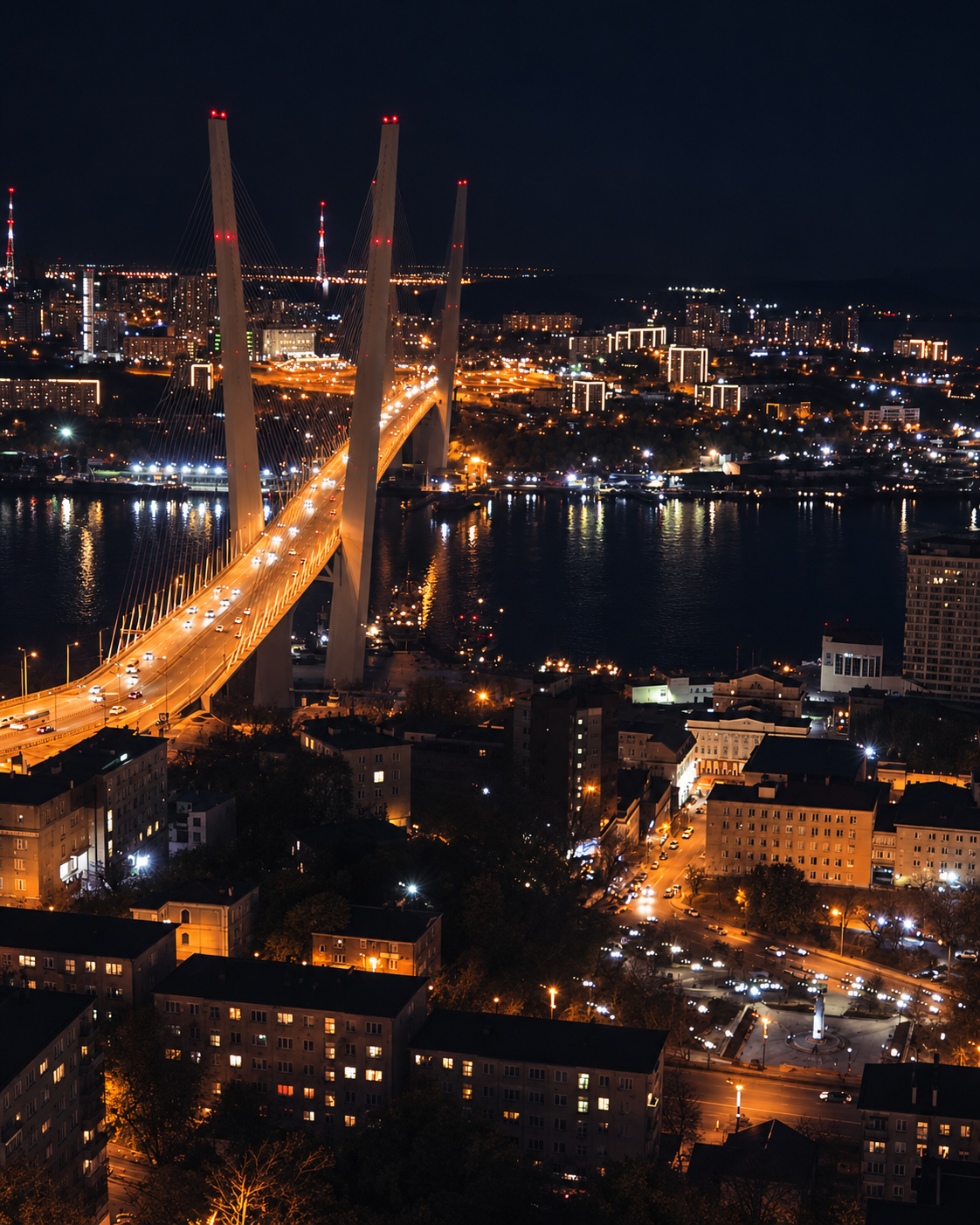
Two settings capture the range. At height, a panoramic dining room frames the Golden Bridge, which crosses the Golden Horn Bay and was completed in 2012, lit against a dark harbour, a view that makes the city’s geography legible at a glance: water on three sides, hills rising behind. At street level, a Japanese-themed restaurant occupies a brick-and-timber building with soft lighting and a pale green façade, a reminder that Japan lies only a short distance across the sea. Between them are the rooms that make the scene distinctive: a bar decorated in fearless pink with a sense of humour written into its neon, a salon-style dining room with chandeliers and heavy drapes in a more classical register, and even a washroom designed with the same ambition as the dining room, all mirrors and coloured light. None of it is accidental. A port that once defined itself by what it hid has begun to define itself by what it shows.
The table follows the same logic. Seafood is the constant, and the cuisine carries the region’s mixed inheritance. Korean communities have lived in the Russian Far East for well over a century, and dishes of Korean origin, adapted over generations in the Russian and Soviet context, form part of the local food culture, including pies and salads built around ingredients such as ferns. Because spellings, recipes and names vary by family and kitchen, treat any single description as an introduction. Fishing runs through local life as well: anglers describe a year-round culture, with winter smelt fishing on the ice and summer squid fishing after dark among the seasonal traditions, though conditions, regulations and licences change and should be confirmed locally.
What is Vladivostok’s nightlife and dining scene like? It is a contemporary scene shaped by the city’s position on the Pacific: seafood, Russian and Asian influences, Japanese and Korean-inspired menus, design-led interiors and rooftop or high-floor dining with views of the harbour and the Golden Bridge. Venues open and close often, so check current listings before planning an evening.




The Terminus: Rails, Post and the Harbour Station
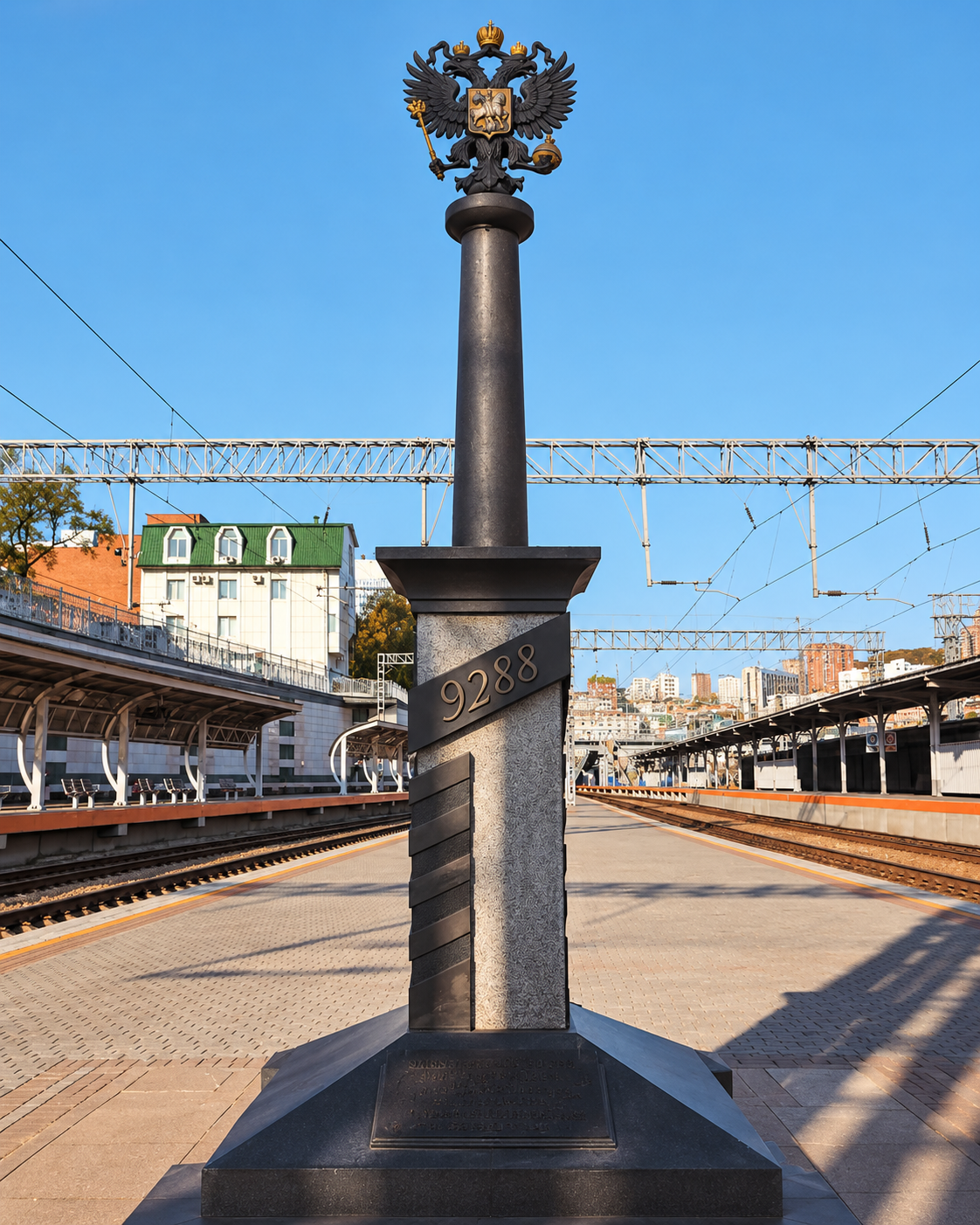
No object explains the city’s purpose better than the railway that ends in it. The Trans-Siberian line, which runs from Moscow across the full width of Russia, is generally described as the longest railway in the world, and the official distance, 9,288 kilometres, is marked on a monument at the Vladivostok platform. Encyclopaedia Britannica’s account of the Trans-Siberian Railway records how it was built to bind the empire’s far east to its capital, and Vladivostok was the point the whole project was drawn toward. For the traveller, the station is both a finish line and a starting point: the place where a week of landscape ends and the Pacific begins.
The station tells that story in its objects. A preserved steam locomotive stands on a platform beside modern carriages in the livery of Russian Railways; a mail car marked Russian Post is a reminder that the line was a postal artery long before it was a tourist route, carrying letters and parcels across eleven time zones; beyond the tracks, the harbour and its cranes are in the same frame. The railway was an instrument of administration and defence before it was a journey, carrying troops, supplies and settlers to a frontier that the state wished to hold. That is easy to romanticise and worth resisting. Arriving by rail is still the clearest way to feel why Vladivostok was never a casual place: it was the end of a line drawn deliberately across a continent.


Hidden Spaces: Viewpoints, Sea Gods and Waterfront Chapels
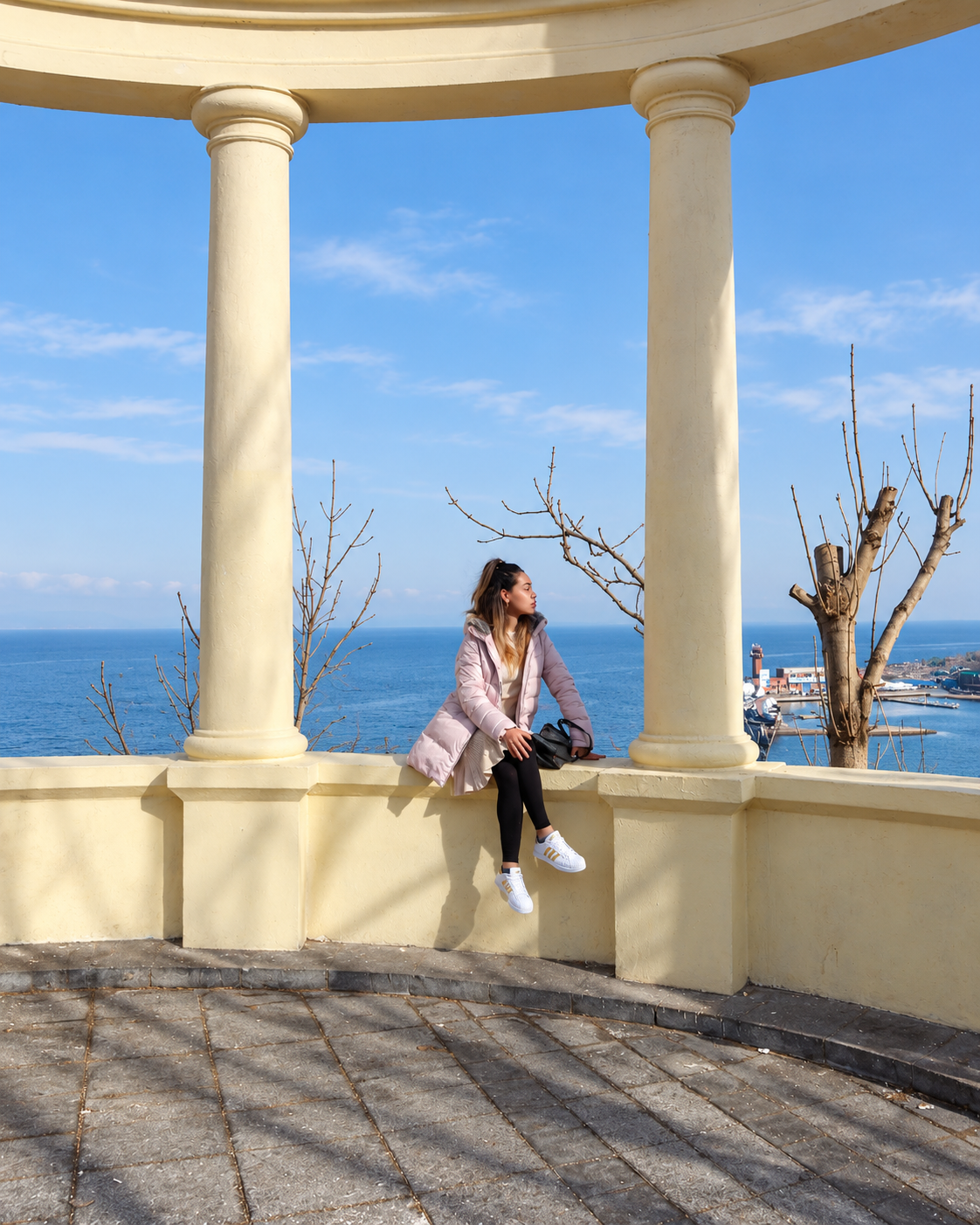
Beyond the main sights, the city’s quieter character appears in small, deliberate spaces: a pale rotunda on a headland, open to the wind and the sea; a bronze sculpture of King Neptune, bearded and crowned, rising from a stone base with waves for hair; a small chapel with a golden roof, tucked among bare trees; a heart-shaped steel frame on the embankment, hung with the padlocks of couples who left their promises on the railing. They are modest, and none of them is a major monument. They are the kind of places that a city builds when its residents begin to treat the waterfront as somewhere to linger rather than somewhere to pass through. In a port that was long closed to the public, that change is itself a form of history.
Other hidden spaces are older and harder to read. The Tokarevsky Lighthouse stands at the tip of the Egersheld district, on the Shkota peninsula, at the end of a spit of roughly 800 metres that was built up by hand along with the small islet carrying the tower. The station dates to 1876; the white stone tower in use today was built in 1910. The lighthouse remains an active aid to navigation, administered, according to the regional tourism authority, by the Pacific Fleet’s hydrographic service. The structure is plain. The effect is not: you walk a narrow causeway toward a white tower with open water on both sides, and the sensation of leaving the land is physical. Accounts disagree on how the spit behaves when the water rises, from ankle-deep to fully submerged, and the coast is open to the south, so the practical conclusion is to check local conditions on the day.
Then there is the city’s most deliberately concealed layer. Millionka was Vladivostok’s Chinese quarter, a dense district of multi-storey buildings and interior courtyards beside the port and railway station, formalised by municipal acts in 1906 and home at its height to tens of thousands of Chinese migrants, according to historians writing for the Wilson Center and the South China Morning Post. Soviet authorities liquidated it in the 1930s as part of deportations targeting Chinese and Korean residents. What survives is mostly architecture: courtyards off streets such as Admirala Fokina, with their inward-facing entrances and wooden stairways. A courtyard is a good place to practise reading a city. Look for evidence of use — the stairs worn on one side, the doors that face inward rather than toward the street — and then ask what the documentary record says. A heritage label is only as strong as the evidence behind it.
For the larger view, climb. The funicular that rises Eagle’s Nest Hill, opened in May 1962, links Pushkinskaya and Sukhanov streets and is one of the few public funiculars in Russia; beside the track runs a staircase of about 370 steps that locals call the health stairs. From the top, the Golden Horn Bay opens below with the Golden Bridge arching across it and the fleet’s grey hulls moored beside the cranes. Fridtjof Nansen, as Wikivoyage records, compared the city’s terraced setting to Naples, and the comparison holds: the street grid is an afterthought to the slope. At the far end of the city’s reach, Cape Tobizina on Russky Island offers a trail of about two and a half kilometres from Karpinsky Bay, leading to rock platforms and basalt cliffs. The coast is exposed and the cliffs are high, so the walk rewards care and a light, well-organised kit.




Military Power: The Submarine, the Fleet and the Fortress
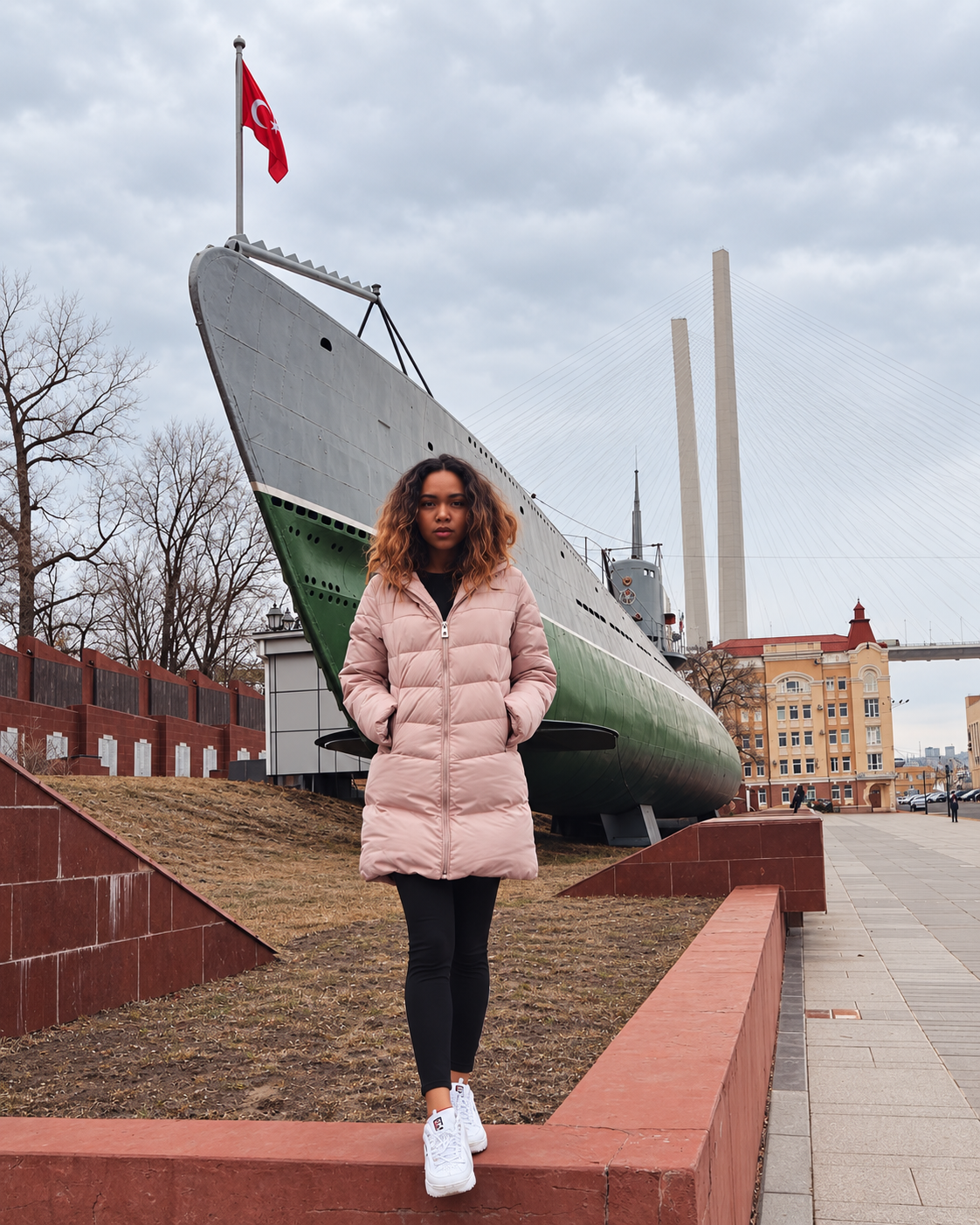
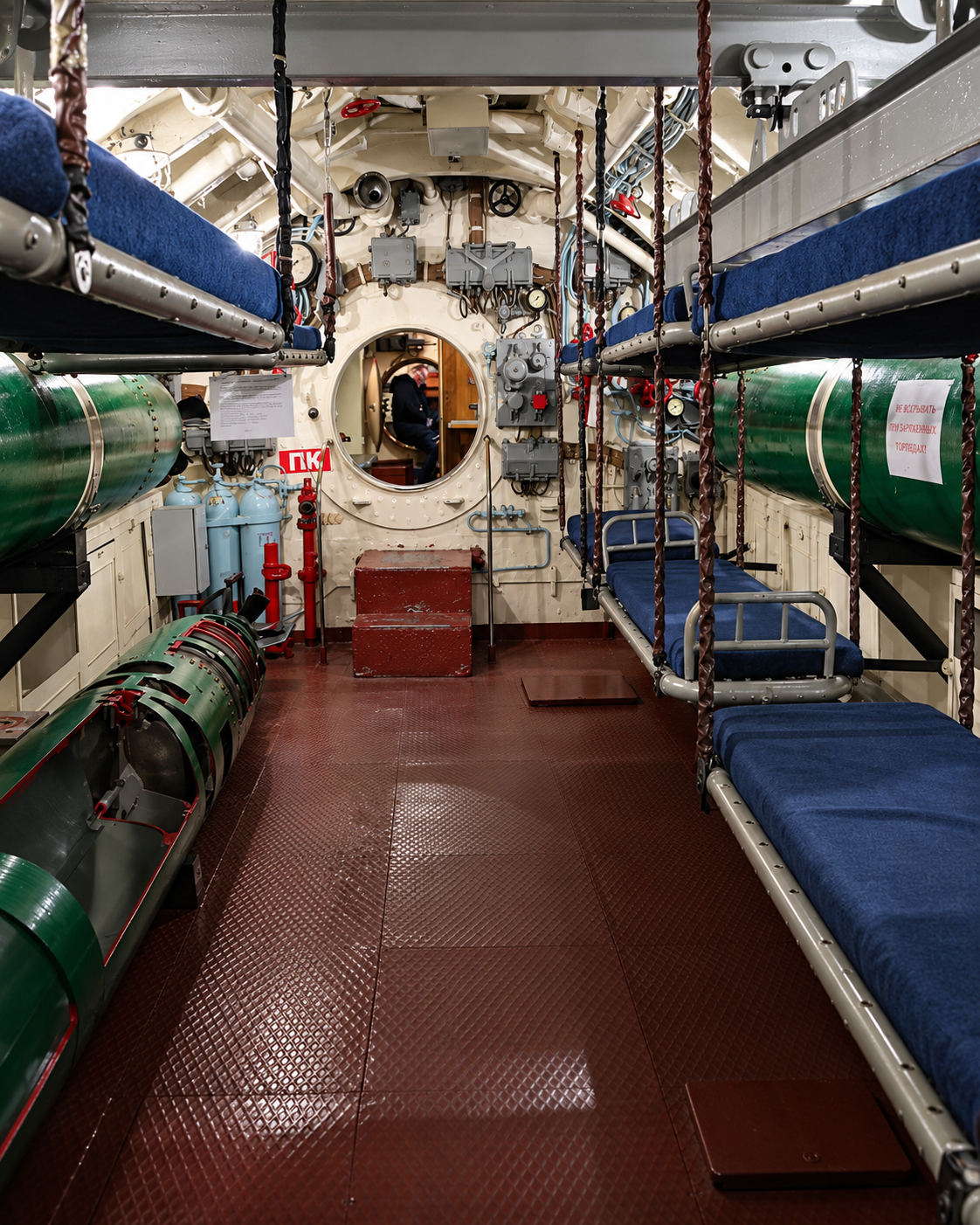
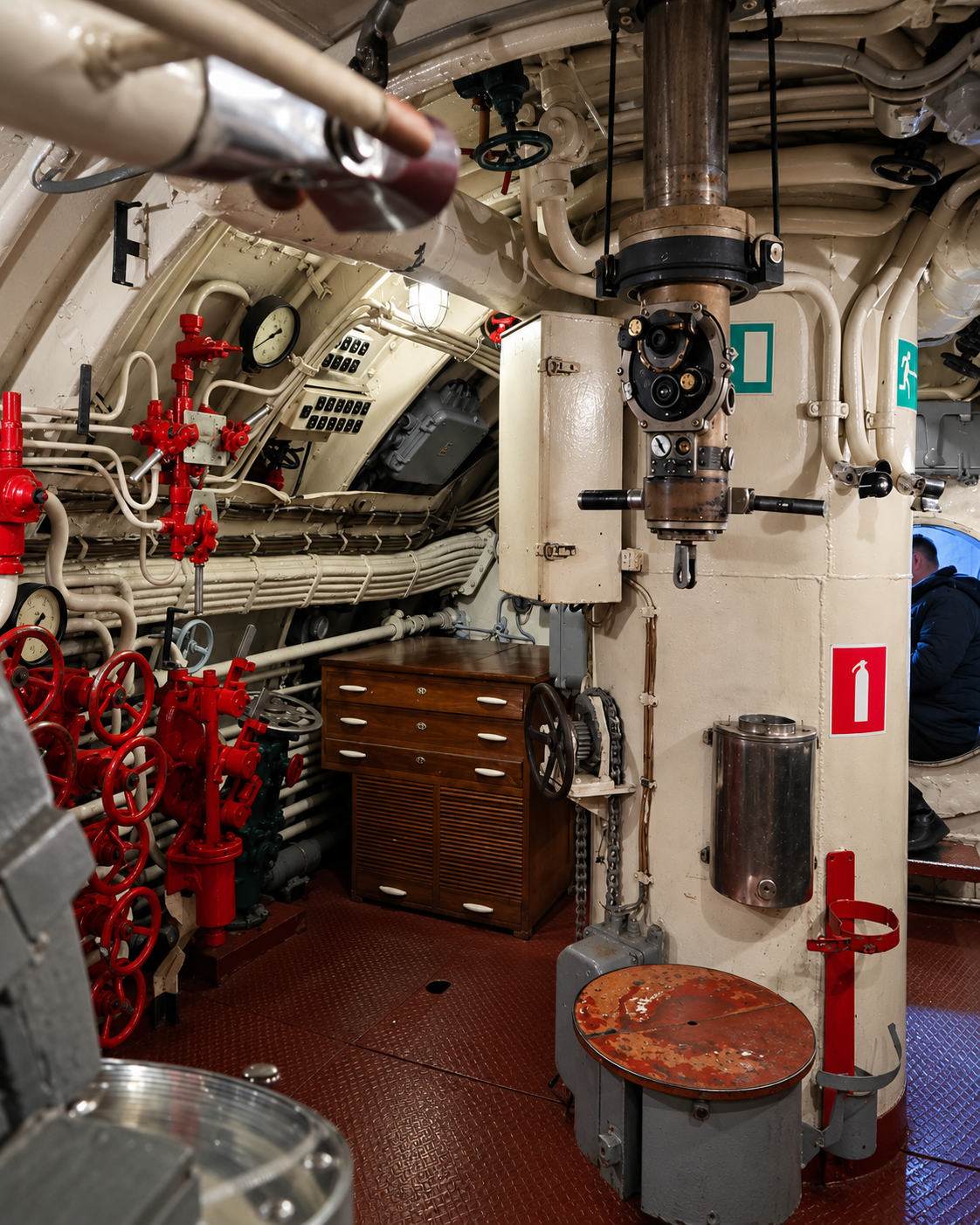
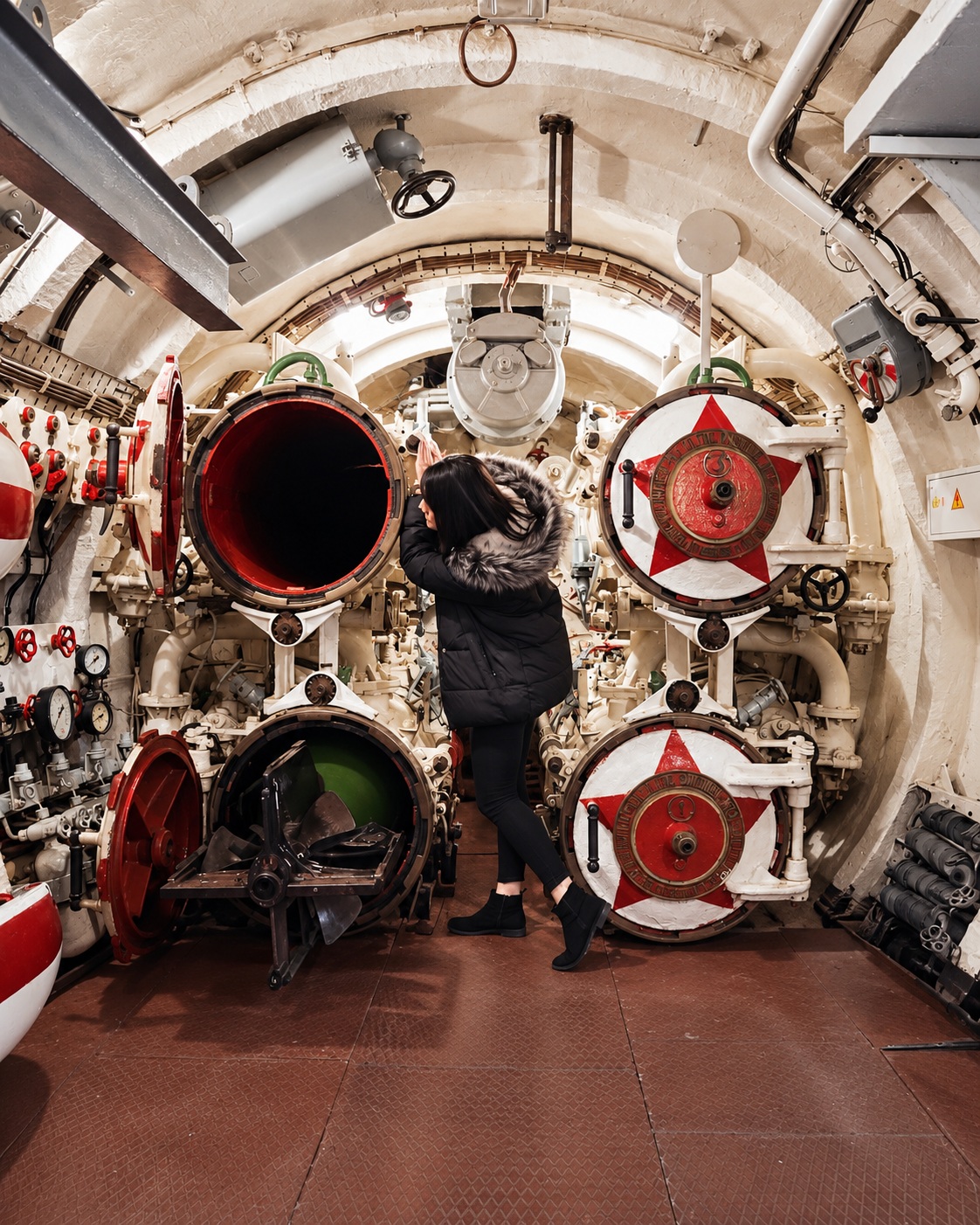
Nothing in Vladivostok makes the city’s purpose as tangible as the submarine that sits ashore near the harbour. The S-56, completed in 1936, delivered to the Pacific Fleet in 1941 and in service until 1975, is preserved as a museum, with the hull visible from the street and the interior open to visitors. Inside, the scale is the surprise. The compartments are narrow and densely packed: bunks stacked beside torpedoes, valves and gauges painted in red and white, a torpedo room with its hatches marked with Soviet stars. It is an exercise in how little space was available to the people who served in these vessels, and a reminder of how seriously the city’s defence was taken.
The submarine is the most visitable part of a system that stretches across the bay. The Vladivostok Fortress began construction in 1889 and was substantially strengthened after the Russo-Japanese War of 1905. The island of Russky, the largest in Peter the Great Gulf, carries the physical record of that role: Visit Primorye counts six forts and twenty-seven coastal batteries built across it. The most visitable is the Voroshilov Battery, officially Coastal Turret Battery No. 981, where two three-gun 305-millimetre turrets, taken from the battleship Poltava, entered service in 1934. Descriptions of the site stress how it was hidden: placed between hills near Novik Bay so that the approach from the sea reveals almost nothing of it. The guns, by Russian press accounts, never fired at an enemy. The battery was stood down in 1997 and is now a branch of the Pacific Fleet’s military history museum.
What is the Voroshilov Battery? The Voroshilov Battery, officially Coastal Turret Battery No. 981, is a 305-millimetre coastal defence battery on Russky Island, Vladivostok. It entered service in 1934 with two three-gun turrets taken from the battleship Poltava, was stood down in 1997, and is now a branch of the Pacific Fleet’s military history museum.
The turrets are the visible part; the substance is underground, in multi-level chambers that carried shells to the guns by overhead monorail, and the logistics of delivering them, with barrels and turret sections shipped to the island by sea and moved inland on a purpose-built railway, are part of the exhibit. The newer layer on the island is civilian. The Russky Bridge, completed on 2 July 2012, the anniversary of the city’s founding, to serve the Asia-Pacific Economic Cooperation summit, has a main span of 1,104 metres that was the longest of any cable-stayed bridge in the world when it opened. The Far Eastern Federal University campus on the island hosted the summit, and an oceanarium that the regional tourism authority describes as the largest in Russia sits nearby. The two layers share the same ground, and the contrast is the point of the island: a landscape engineered, first for defence and then for diplomacy and education, within a single century. This essay reads the batteries as architecture and history only.




Historical Value: The Arch, the Marker and the Memory of the Port
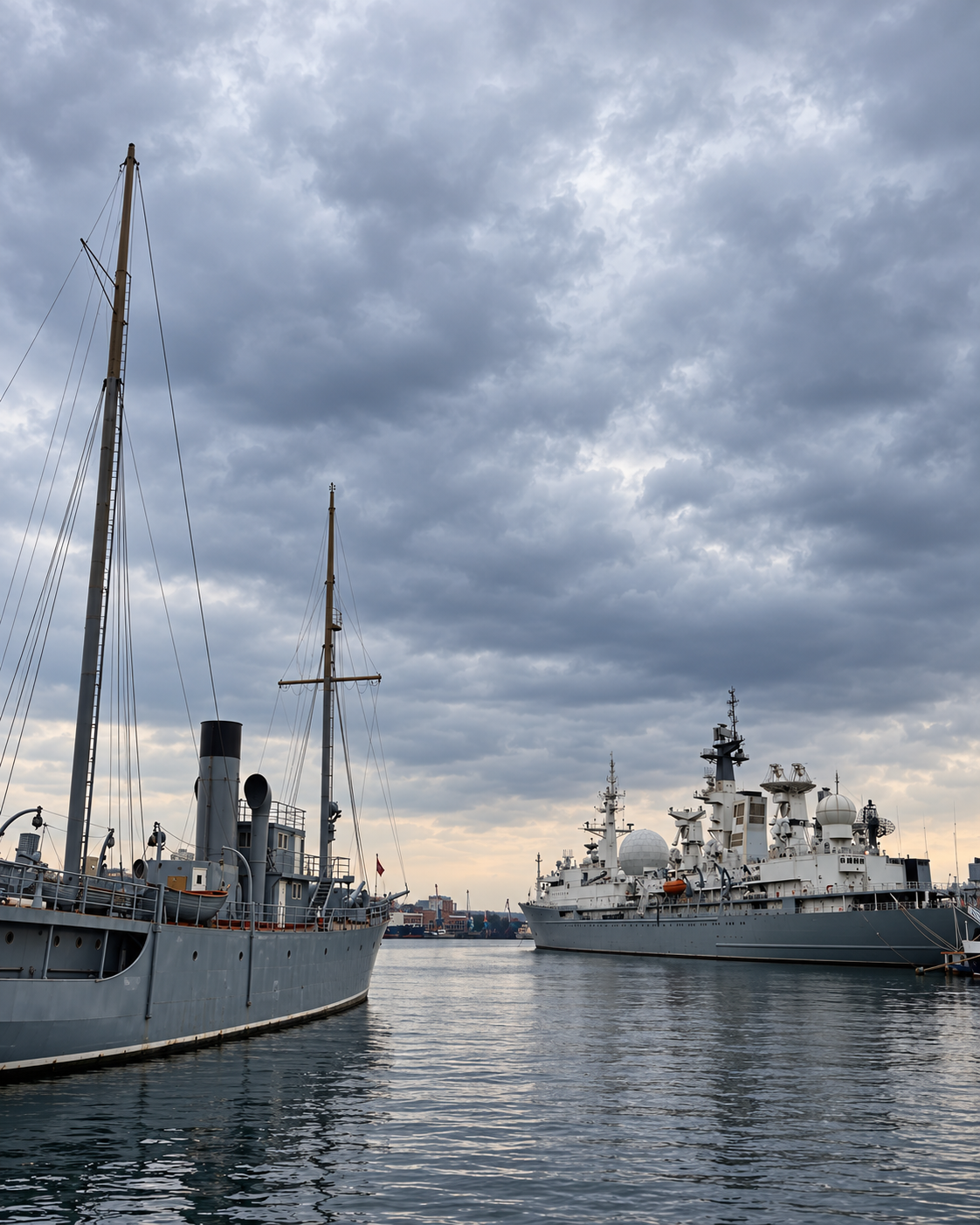
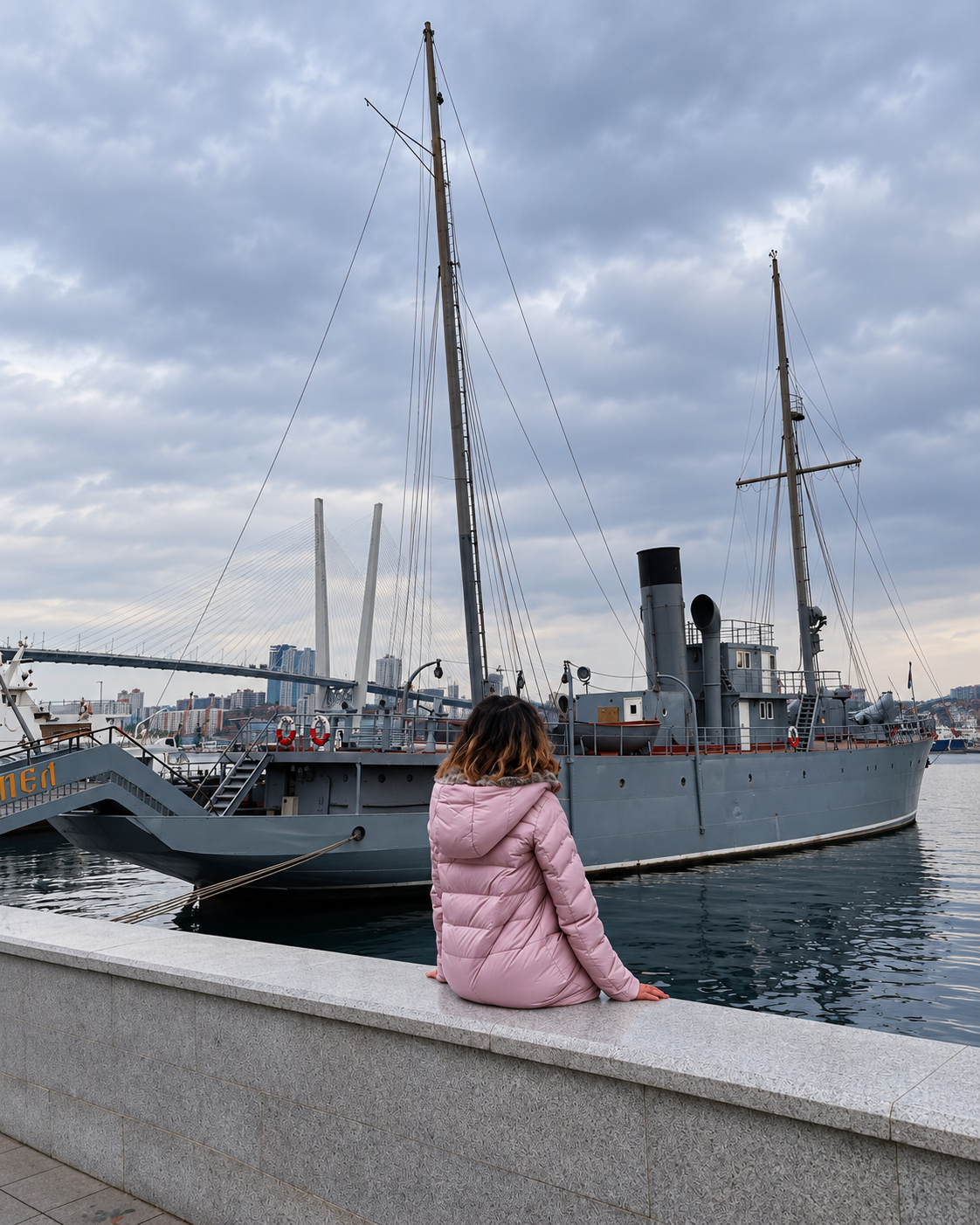
The city’s historical weight is best read in a handful of monuments that sit close together. A museum ship moored along the waterfront, grey-hulled and rigged with masts and funnels, lies beside the modern vessels of the fleet and shows, in a single frame, how much naval technology has changed in a century. A monument at the railway platform carries a double-headed eagle above the number 9288, the distance in kilometres from Moscow. And a triumphal arch, in a pale and ornamented style with the year 1858 inscribed above the opening, stands above a flight of granite steps near the waterfront, recalling the imperial ceremony with which the city welcomed visiting dignitaries.
Behind the monuments lies a more complicated story about who gets to be credited with knowing a region. Vladimir Arsenyev (1872–1930) was a military officer, explorer and ethnographer whose expeditions through the Ussuri region between 1902 and 1907 produced the books Along the Ussuri Land and Dersu Uzala. The second became a film by Akira Kurosawa that won the Academy Award for best foreign-language film. The memorial house-museum on Arsenyev Street is the apartment where he lived from 1928 until his death in 1930. The museum notes that his wife was arrested in 1937 and his daughter in 1941, a reminder of what the decades after his death did to the people who lived in these rooms. The museum’s own language credits his work with opening a distant, unknown region to the world. That framing deserves a second look: the region was unknown to the empire’s map-makers, not to the people who lived in it, and the book that made Arsenyev famous is named for his guide. This is a reading, not a verdict, and the museum is the right place to form your own.


Finally, there is the question of position. Measured in straight lines, Seoul lies roughly 750 kilometres away, Beijing a little over 1,300 and Tokyo a little over 1,000, distances that place the city closer to the great capitals of East Asia than to any European one. The nickname “Gates of Asia” is a reminder of what the city has always been in the Russian imagination: the door through which the country faces the Pacific. In December 2018 a presidential decree designated Vladivostok as the capital of the Far Eastern Federal District, a role previously held by Khabarovsk. For the traveller, connections, routes and entry requirements for a place on a border change with circumstances and differ by passport, so they must be checked against current official guidance. What does not change is the geography.
Vladivostok is not memorable because it hides places from outsiders. It is memorable because its geography rewards attention: a city whose character emerges through the relationship between sea, distance, defence, migration and reinvention, and whose every stop is a clause in the same sentence. The hidden gems are valuable only to the extent that each one explains a piece of that identity. Collect them, and you have a list. Connect them, and you have the city.

The Value the Sea Keeps: Vladivostok’s Lasting Place in the Marine World
There is one more value the city will always hold, and it is easier to see from the water than from the land. Vladivostok is among the great working harbours of the Pacific, and its standing in the marine world does not depend on any single era or any single flag. The waters of Peter the Great Gulf have long supported fishing, shipping, naval architecture and marine science, and the city’s oceanarium, university and protected coastal waters show a place that studies the sea as much as it defends it. Wherever the ocean economy turns, whether toward fisheries, trade routes or research, a deep, sheltered harbour on the Pacific rim remains a rare and durable asset. Its hidden value is quieter still. Vladivostok teaches the habit of looking outward: a city that spent a century being closed has become one of the best places in the world to understand what an opening means. The sea is the great constant in that lesson. It rewards patience, punishes haste, and has been telling this city, and anyone who listens, exactly where to look.
“Nothing here was hidden.
It was simply facing
the other way —
toward the water,
toward the east,
toward a century of reasons
to look out
instead of in.
Turn around.
The city has been
telling you where it came from
the whole time.”

