
On how a marine-science institution on one of Russia’s most heavily fortified Pacific islands keeps the ecological memory of the seas that shaped Vladivostok, and how to read it as a traveller: a travel-intelligence guide for the new citizen of the world
A cannon keeps its shape for a century. A sea does not.
On Russky Island, concrete gun emplacements face the same water that now fills the tanks of Russia’s largest public aquarium. The geography has not changed. The meaning of the sea has. Where the Pacific was once read as strategic exposure, a coast to be watched and defended, it is also read as a body of biological knowledge, something to be bred, measured, taught and kept.
That tension is the organising idea of this guide. The Primorsky Aquarium is usually described by its scale and its animals, but it belongs to a longer conversation about what the Russian Far East is: frontier, fortress, laboratory and ecosystem all at once. A cannon can stay intact in a fortress for a century. A marine ecosystem cannot be placed under glass and left alone. It requires continuous care, reproduction and scientific adaptation, which makes an aquarium a different kind of monument, one that preserves history through living continuity instead of static memory.
This guide is written for the new citizen of the world: the traveller who moves between regions, languages and institutions and prefers to understand a place before consuming it. That reader does not need a ranking of attractions. They need intelligence: what the place is, who runs it, what it claims, what it leaves unsaid, and in what order its layers are best met. Summer in Vladivostok, with its mild days, cool sea air and the mist that can roll in off the water, is a fitting season for that kind of reading, and the aquarium is a good place to begin it.
How Big Is Primorsky Aquarium?
Begin with the institution’s own description, and keep a little caution for the superlatives.
The official site calls the Primorsky Aquarium Russia’s largest public aquarium, with nearly 500 species of marine and freshwater life on display and almost 10,000 animals, in a collection drawn from every ocean and climatic zone. It opened to the public on Russky Island, off Vladivostok, in September 2016, following an official ceremony on 3 September. Other published descriptions give different numbers for species, animals, tanks and water volume: a regional tourism guide cites more than 500 species and more than 15,000 individuals, and one profile cites a total water volume near 25,000 cubic metres, while an older institutional profile cites 135 tanks holding about 15,000 cubic metres. That spread is typical of a living collection and of figures written at different times, so any single count should be tied to its source and date.
How big is Primorsky Aquarium, and is it the largest in Russia? The Primorsky Aquarium on Russky Island, Vladivostok, describes itself as Russia’s largest public aquarium, with nearly 500 species and almost 10,000 animals on display according to its official site. Its older institutional profile describes more than 37,000 square metres of interior space, a 70-metre underwater tunnel and an 800-seat dolphinarium, and calls it the third largest in the world. “Largest” is the institution’s own claim, and counts vary between sources and over time.
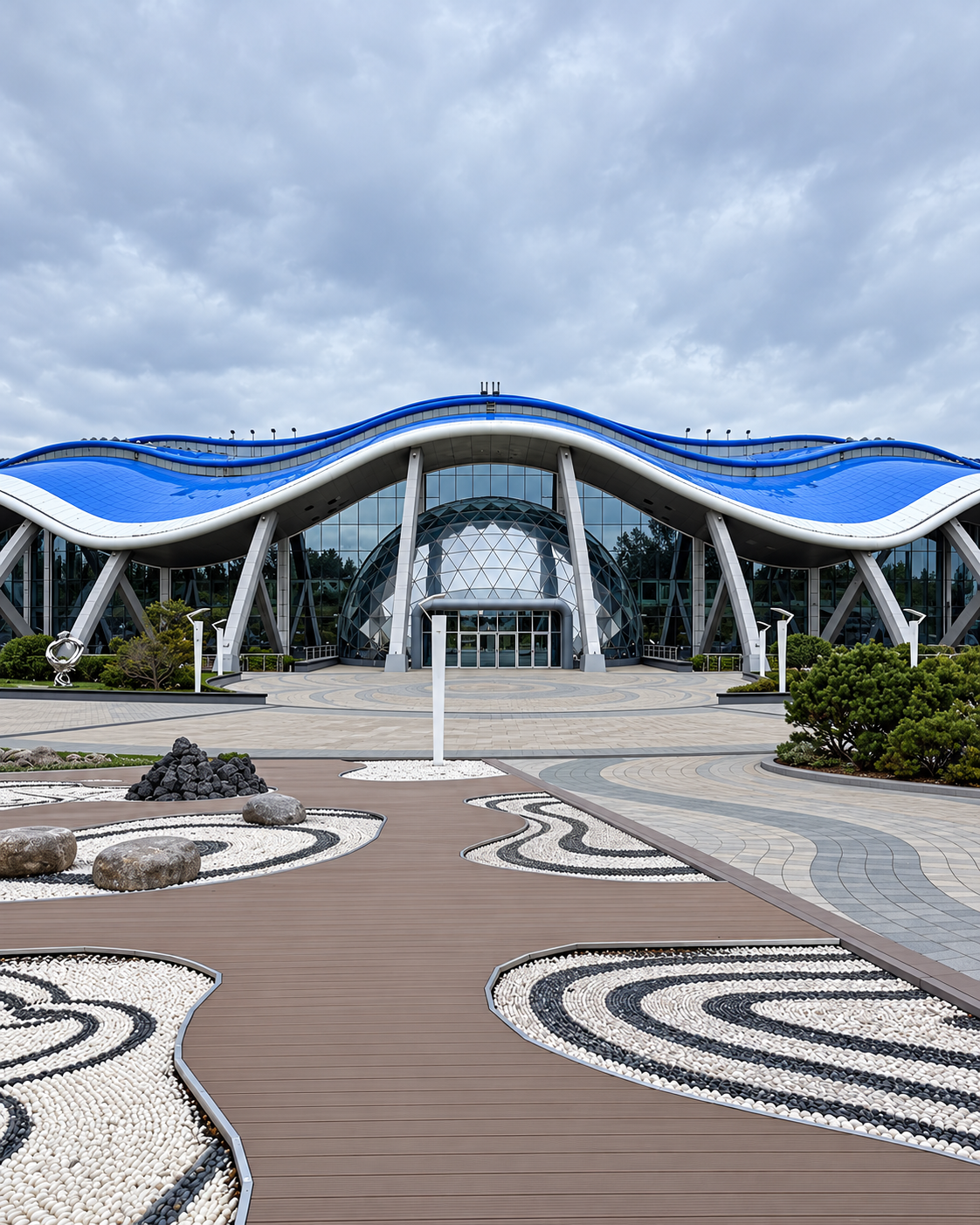
The physical detail matters because scale is part of the message. The main building takes the form of a partly open mollusc shell, and the interior is large enough to feel less like a gallery than a piece of infrastructure. The collection is also not a regional one. It includes tropical, freshwater and polar species from around the world, so the Far Eastern exhibits are best read as one layer of a global collection, not as a description of all of it. A sensible visitor holds both ideas at once: a world collection, with a regional argument running through it.

Reading the Place Before You Go: A Short Orientation
A city founded as an outpost still reads as one.
Vladivostok does not need a long introduction, but it needs one. Britannica records that the town was founded in 1860 as a Russian military outpost, and that its name is variously interpreted as “Rule the East,” “Lord of the East” or “Conqueror of the East.” It became the main Russian naval base on the Pacific in the early 1870s, a free commercial port around 1900 and the eastern terminus of the Trans-Siberian Railroad. Its history is therefore the history of a frontier: ships, rails, forts, migration and the long effort to anchor a continental state on an ocean coast.
The practical lesson for the new citizen is that this is a city to be read in layers. The harbour, the fortifications, the railway and the university all belong to different chapters, and they sit within sight of one another. Russky Island, across the Eastern Bosphorus Strait, compresses several of those chapters into a single landmass, which is why a visit to the aquarium works best when it is not a stand-alone excursion.




Russky Island: The Military Geography Behind the Aquarium
The location is historically loaded, and the load is still visible.
Russky Island, the largest island in Peter the Great Gulf, was until recently a base of the Pacific Fleet and a restricted territory, and it carries the island component of the Vladivostok Fortress. Visit Primorye’s account of the fortress describes more than 100 objects, about 150 kilometres of defence lines, 9.8 kilometres of underground galleries and 1,606 gun positions, built to secure Russia’s eastern maritime frontier. The island portion alone contains six forts and 27 coastal batteries, as the tourism board’s own guide to Russky Island notes, and sites such as the Novosiltsev Battery and Fort Pospelov survive as visitable historical monuments. Fortification guides place a coastal battery on the Zhitkov Peninsula beside the aquarium itself, and tour operators describe the view from Fort Pospelov’s hill, about 150 metres up, taking in the university campus, the aquarium and Peter the Great Bay in a single sweep.
Why is Russky Island historically important? Russky Island is the largest island in Peter the Great Gulf and a central part of the Vladivostok Fortress system, with six forts and 27 coastal batteries built to defend the eastern approaches of Vladivostok. For much of the twentieth century it was a restricted military territory. Today it also hosts a university campus, scientific institutions, tourism sites and the Primorsky Aquarium.
This guide treats the fortifications as architecture and history, which is how the museum-reserve that manages them presents them. They are evidence of how seriously the Pacific coast was taken as a vulnerability. They are not a spectacle, and they are not a counterpoint to be won or lost. The layers coexist, and the useful posture for a visitor is attention, not romance: some sites are open to visitors, some lie within active military territory, and the right course is to rely on official and licensed channels for access rather than assumption.
From Fortress to Scientific Campus
It would be too simple to say that a military past was replaced by peaceful science.
Russky Island now combines military heritage, a university campus, scientific institutions, tourism and protected coastal landscapes, and the older defensive geography has not been erased. The island’s modern layer was built largely around the 2012 Asia-Pacific Economic Cooperation summit, which brought the Russky Bridge and a Far Eastern Federal University campus that hosted the summit. The bridge was completed in July 2012, and Guinness World Records lists its 1,104-metre cable-stayed span as the longest of its kind. The aquarium followed in 2016. Anyone arriving by road crosses the bridge first, so the approach is itself an introduction: a record-scale structure, a strait, and an island that was closed to most visitors within living memory.
What gives the island its gravitas is the coexistence. A place built to guard the edge of the state has also become a place for studying the ecosystems beyond that edge. The aquarium’s research facility, opened in 2019, makes the link explicit: among its listed work is environmental monitoring of the coastal waters around Russky Island, alongside the identification of marine microalgae and studies of marine mammals.
The Aquarium as a Map of Russia’s Far Eastern Seas
The strongest sections are the regional ones.
The aquarium’s “Russian water space” exhibits cover the Amur River, whose fish fauna the institution describes as the most diverse in Russia, with about 150 species including the kaluga, among the largest freshwater fish in the world; Lake Khanka, the largest lake in the Russian Far East; Lake Baikal; and three seas that define the Pacific side of the country: the Bering Sea, the Sea of Okhotsk and the Sea of Japan, called the East Sea in Korea. Together they map the waters that structure the region’s settlement, fishing and strategy.
What species from the Russian Far East can you see there? Regional exhibits cover Amur River fish, Far Eastern marine invertebrates and species from the Sea of Japan, the Sea of Okhotsk and the Bering Sea, including sea otters, northern fur seals and king crab, according to the aquarium’s exhibit descriptions. The wider collection also includes animals from every ocean and climatic zone, so not everything on display is native to Primorye.
The distinction between this regional core and the wider collection matters, because not every animal on display is native to Primorye, and the institution’s own descriptions are careful to say its collection spans all oceans. A visit works best when the regional exhibits are read as a deliberate argument: that a country’s relationship with the Pacific should be understood through the specific seas it borders.
The Sea of Japan/East Sea: Vladivostok’s Living Geography
The tanks make the sea legible.
This is the exhibit that connects the aquarium to the city outside it. Vladivostok does not simply sit near the sea. It is structured by bays, currents, shipping routes, fishing, naval strategy and marine food culture, and the aquarium’s exhibit text explains why the waters off southern Primorye are so rich: warm and cold currents meet, producing the highest species abundance of any sea in the Russian Far East. Of 1,170 fish species known from the Sea of Japan, it notes, 365 live in Russian waters, and the exhibit gives particular attention to Peter the Great Bay and its fauna, ending with a display of jellyfish. The cast of characters is local: rockfish, flounders, seahorses, starfish, sea urchins, scallops and trepang, the organisms that appear on the region’s tables and in its fishing economy.
What can you see in the Sea of Japan/East Sea exhibit? The exhibit interprets the waters off southern Primorye, including Peter the Great Bay, explaining how warm and cold currents produce the highest species abundance among the seas of the Russian Far East. It cites 1,170 fish species known from the Sea of Japan, of which 365 occur in Russian waters, and presents the bay’s characteristic fauna and jellyfish.
The legibility has a scientific edge. A 2015 trawl-survey study of Peter the Great Bay, indexed by the Food and Agriculture Organization of the United Nations, is reported to have recorded rare species new to the bay and concluded that its fish composition had been shifting, with warmer surface water bringing southern migrants and cooler water near the bottom favouring boreal fish. A regional exhibit is, in that sense, a snapshot of a system that is moving.
The Sea of Okhotsk and Bering Sea: Ecology as National Infrastructure
These are not decorative ecosystems.
The northern-sea exhibits turn from abundance to economy. Their text describes the Bering Sea and the Sea of Okhotsk as highly productive seas that provide the bulk of the fish and seafood caught in Russia. The Bering Sea, the deepest and biggest in the country, is credited with about 400 fish species and major populations of marine mammals; the Sea of Okhotsk is described as the most biologically productive marine ecosystem in Russia, with some 300 fish species and the most numerous populations of red and blue king crab. A giant kelp-forest tank anchors the exhibit.
They are tied to fisheries, seafood economies, marine resources and long patterns of settlement and extraction. The institution is also candid about the pressure: the exhibit text notes that oil and gas are produced on the Okhotsk shelf and that maintaining a reasonable balance is a priority of sustainable resource management. That candour is the strategic point. Marine science in the Russian Far East has economic and political weight as well as ecological interest, and an aquarium that interprets these seas is, whether it says so or not, interpreting national infrastructure.
Species as Historical Evidence
An animal is a document, if you know how to read it.
The most useful way to read the animals is as carriers of regional history, not as an inventory. The sea otter, which the exhibit text says narrowly escaped extinction through overhunting for its fur, carries the story of the maritime fur trade in the North Pacific. Northern fur seals, kept in the same exhibit, belong to that history of exploitation and of early international conservation efforts. King crab links directly to the economics of Far Eastern fisheries. Kelp forests are both habitat and resource, the foundation of coastal food webs. Salmon carry the story of migration, jellyfish the story of cold-water adaptation, and marine mammals the story of how much of the sea’s behaviour remains to be studied.
The collection also shows what documented breeding looks like. The aquarium reports a Humboldt penguin programme, a CITES-protected species not native to Primorye, with more than 40 chicks hatched since 2018 and birds placed in other institutions in Russia. That is a documented husbandry result, and it is worth separating from a wider claim about species recovery. The aquarium’s value is strongest when each animal connects to a larger environmental, economic or historical story, and weakest when it is presented as simply impressive.
Why Preservation Means More Than Saving Endangered Animals
Conservation begins with knowing what is there.
Aquariums often communicate conservation through threatened animals. Primorsky allows a broader argument: preservation also means preserving ecological literacy. A region can lose knowledge of its own seas before it loses every species within them. By breeding organisms, maintaining regional exhibits, supporting research and teaching, the aquarium preserves familiarity with systems that increasingly feel remote from urban life. Its programme of excursions, lectures and workshops, including sessions for school groups, is part of that work.
That principle belongs to every field that trades on trust. Credibility, not attention, is what lasts, and an institution that documents what it keeps, in public, is building the kind that lasts. For the traveller it is a useful test of any place: ask what it records, not only what it shows.
Inside the Scientific Institution Behind the Spectacle
The value lies in what happens out of sight.
Behind the glass is a research institution. The aquarium is a branch of the A.V. Zhirmunsky National Scientific Center of Marine Biology of the Far Eastern Branch of the Russian Academy of Sciences, an institute that, as its own history page records, was founded on 1 January 1970 as the Institute of Marine Biology. The aquarium’s official materials describe a core research facility opened in 2019 for environmental monitoring, molecular identification of microalgae, blood and diet studies in marine mammals and tissue analysis, as well as experiments in underwater bioacoustics. Its biologists breed jellyfish, amphibians, bony and cartilaginous fish and marine mammals. The institutional value lies in quarantine, animal care, reproduction, behavioural study, water chemistry, disease monitoring and scientific collaboration, work that most visitors never see.
Is Primorsky Aquarium mainly a tourist attraction or a research institution? It is both. The Primorsky Aquarium is a branch of the A.V. Zhirmunsky National Scientific Center of Marine Biology within the Russian Academy of Sciences, with a research facility, breeding programmes and education activities, and it is also one of the Russian Far East’s major visitor attractions. Its public displays and its science operate together, and its research work is largely out of public view.
A serious account also has to hold the ethics open. The aquarium keeps marine mammals, and its dolphinarium lists species including bottlenose dolphins, beluga whales, Baikal seals, Pacific white-sided dolphins, a walrus, fur seals and Steller sea lions. Keeping such animals, and presenting them in public demonstrations, is the subject of a legitimate debate that scientific purpose does not settle. Regional history shows why scrutiny of the wider system matters. In 2018, close to a hundred belugas and orcas captured for sale to aquariums were held in pens in Srednyaya Bay, near Nakhodka in Primorye; National Geographic reported that all 97 animals were released over some four and a half months, ending in November 2019. That case did not concern this aquarium, and the sources used here say nothing about the origin of its animals. The fair questions for any institution, this one included, are about provenance, welfare and what the animals contribute to knowledge. Spectacle should be read with the scepticism that manufactured experiences deserve elsewhere.
Why the Aquarium’s Monumental Scale Matters
Size is part of the message.
The main building is designed as a partly open mollusc shell, and its interior volume makes the institution feel less like a gallery than a piece of infrastructure. Scale of this kind is cultural symbolism: it announces that Russia’s Pacific science belongs on a monumental footing. The same logic runs through experiential architecture elsewhere, from a sky pool built to be seen from far away to destinations designed as experiences, and it is worth noticing how often the sea is the stage.
The opening on 3 September 2016 was attended by President Vladimir Putin and Japan’s then Prime Minister Shinzo Abe, which this guide reports as institutional context, not as endorsement. The timing matters because the island had by then been redeveloped around the 2012 summit, and the aquarium can be read as part of an effort to present Russky Island as a scientific, educational and international-facing centre of the Far East. Institutions of this scale also concentrate capability, a pattern visible in other places where infrastructure and ambition are built together.


What Primorsky Aquarium Adds to the History of Vladivostok
The Far East has always been shaped by what lay offshore.
Vladivostok’s history is usually told through ships, railways, forts, war, migration and geopolitics. The aquarium adds another archive: currents, fish, mammals, kelp, coastal habitats and marine science. Together they produce a fuller account of a region shaped not only by what happened on land but by what existed offshore, and it is the argument for visiting both the batteries and the tanks within the same day’s journey.
The structural point looks ahead. As climate change, fisheries pressure, warming seas and biodiversity loss alter marine ecosystems, institutions capable of long-term observation and public education will become more important. The value of a place like this may increase not because it grows larger, but because it can document change over time in a region whose identity is inseparable from the Pacific. The Russian Far East is not only a military frontier. It is also a marine world, and the aquarium is one of its living archives.
The New Citizen’s Toolkit: Sea Air, Skin, Scent and Restraint
A coastal day rewards a short, well-chosen system.
The island is exposed. Wind comes off the water, fog can settle quickly, and a day moves between a heated aquarium hall and an open fortification slope. Dress in layers and in quiet, practical fabrics, in the spirit of the new language of quiet luxury, with sturdy shoes for uneven ground at the batteries. Sea wind and indoor air strip skin quickly, which is the practical case made in Barrier Beauty Returns: Why Lanolin Is a Skin Investment; a protective routine matters more than a long one. In warm weather, and in humid indoor halls full of tanks, fragrance behaves differently, a subject explored in Summer Fragrance Science: Heat and Skin Chemistry.
Scent is a quieter tool. A familiar fragrance can carry a sense of identity from one hotel room to the next, the argument made in The Language of Scent: How Fragrance Becomes Identity, but in enclosed public halls and shared transport, restraint is the better courtesy. The sort of travel essentials that keep a long island day easy help here too, since the sites are spread across the island.
Sequencing the Day: A Travel-Intelligence Approach
The question is not how much to see. It is in what order.
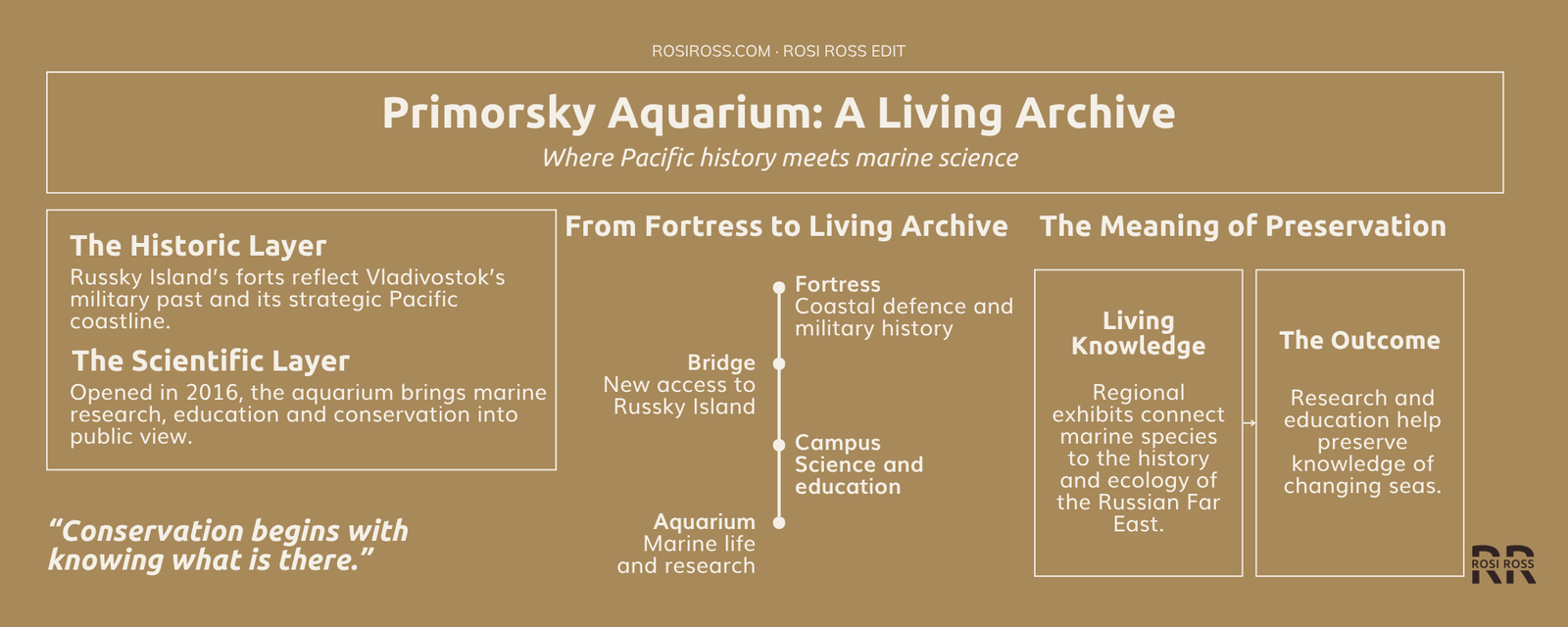
The island rewards a sequence that moves from the strategic to the biological. Begin with the approach: the bridge, the strait and the sense of an island that was closed for much of the last century. Spend a first part of the day at the batteries or the fort, where the defensive geography is easiest to read, then move to the aquarium, where the same water is interpreted as an ecosystem. Finish where the two meet: a view over the bay, or the campus on the shore, where military heritage, a university and a marine-science institution share the same coast. Allow a long half day for the aquarium alone if the regional exhibits and the research interpretation interest you, and treat a visit to the dolphinarium as a separate decision, informed by the ethical questions above.
Where is Primorsky Aquarium located? The Primorsky Aquarium is on Russky Island, off Vladivostok in Russia’s Primorsky Krai, reached by road across the Russky Bridge. The official site notes that road signs may read “Ocean Park” rather than the aquarium’s name.
Service box: check before you go. Opening hours, ticket prices, show and feeding schedules, school-group days, directions and road signage change, and the official site notes that road signs may read “Ocean Park” rather than the aquarium’s name. Some fortification sites may be restricted or close at short notice. Entry requirements and government travel advice for Russia differ by passport and change as well. Confirm all of these with the aquarium’s official website, the tourism authority and your own government before travelling. This guide deliberately keeps practical details out of its main narrative.
The most useful thing a visitor can bring to the island is the habit of reading in layers: the battery, the bridge, the campus and the tank as parts of the same long argument about what the Pacific is for.
“A cannon keeps its shape for a century.
A sea does not.
It has to be fed, bred, measured, watched —
looked after, day after day,
by people who know its names.
On an island built to guard the edge,
the edge is now something to be understood.
Conservation begins
with knowing what is there.”

