
On the post-influencer era, skin streaming, functional formulations, and why the beauty consumer is the most educated — and most sceptical — in history. The beauty industry spent a decade building an empire on attention. The next decade will be decided by something it never had to earn before: trust.
What is happening inside the global beauty market right now is not a correction. It is a structural reckoning. For years, the machinery of beauty consumption was powered by novelty — by the promise of transformation encoded in packaging, by the authority of the face promoting the product rather than the formulation inside it, by the social algorithm’s appetite for the new and the visually arresting. That machinery has not stopped running. But the consumers who were meant to keep feeding it have begun to step back, read the ingredient list, and ask a question the industry was not designed to answer: does this actually work?
The answer, too often, has been insufficient. And the consequences are reshaping one of the most significant consumer categories in the world.
The Trust Recession
The State of Beauty report, produced jointly by McKinsey and The Business of Fashion, identified a $450 billion global industry whose seven percent annual growth from 2022 to 2024 is now confronting market saturation, evolving consumer preferences, and a fundamental recalibration of what beauty consumers believe they are buying.
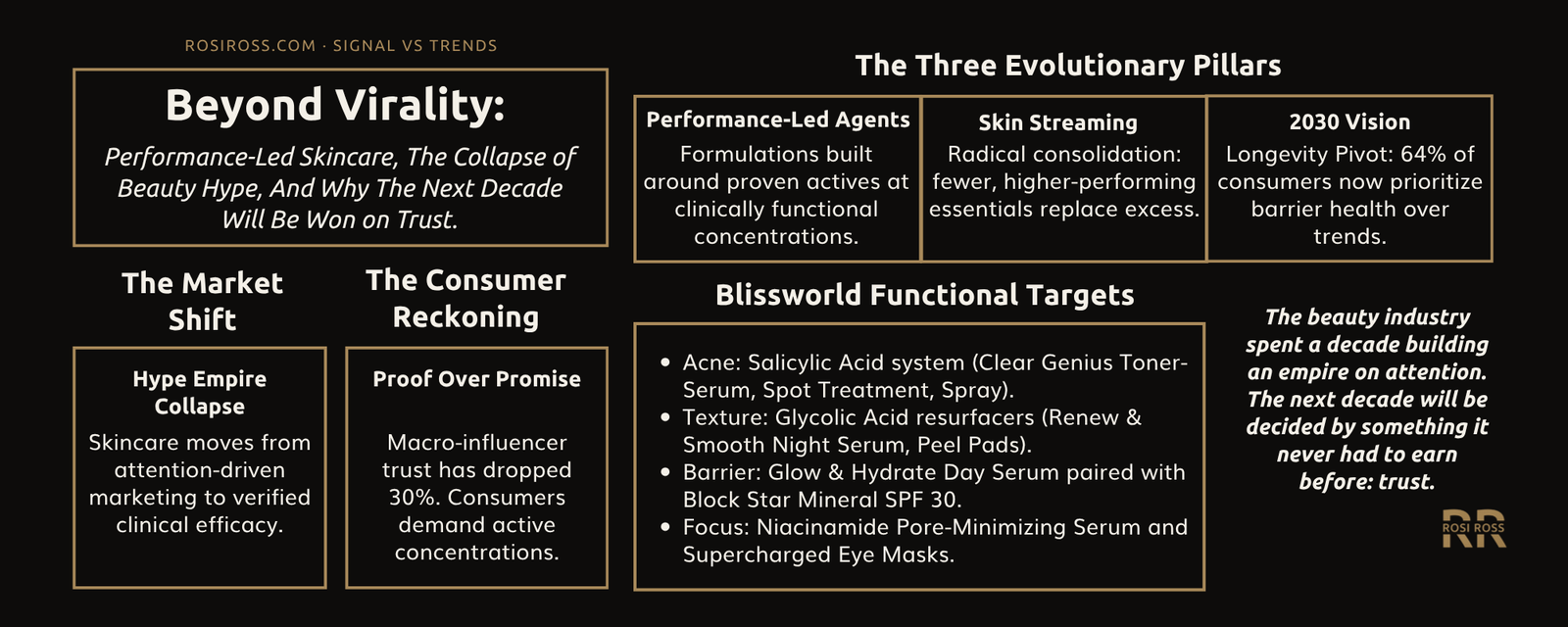
The headline finding is precise: seventy-five percent of beauty executives now identify value perception as the primary force shaping the market. Not newness. Not virality. Not celebrity endorsement. Perceived value — which, in the context of skincare, increasingly means demonstrated efficacy. Trust in macro-influencers has dropped thirty percent since 2021. Celebrity beauty brands are discovering that audience scale no longer equals purchase intent.
As The Business of Fashion documented in its analysis of the skincare trust crisis, consumers are now seeking clinical credibility with an urgency that brands have rarely faced — moving toward dermatologists, cosmetic chemists, and ingredient educators as the primary arbiters of what is worth buying. The same social media platforms that created the influencer-beauty economy also created the conditions for its disruption: skincare educators built an audience of ingredient-literate consumers who know what glycolic acid does, who understand the difference between a functional concentration of niacinamide and a token inclusion on a label, and who have learned — through expensive, disappointing experience — to read claims with scepticism.
The Rise of Performance-Led Skincare
Performance-led skincare is not a trend. It is what skincare was always supposed to be before the machinery of modern beauty marketing learned to separate the promise of transformation from the chemistry required to produce it.
A performance-led formulation is built around active ingredients — glycolic acid, salicylic acid, niacinamide, peptides, mineral sunscreen filters — present at concentrations that produce measurable outcomes rather than at trace levels included for label appeal. The efficacy claim precedes the marketing claim. The formulation is the argument. Glycolic acid has been exfoliating, brightening, and accelerating skin cell turnover since its first clinical applications in the 1970s. Salicylic acid has been clearing pores and managing acne since dermatologists first understood its keratolytic properties. Niacinamide has been regulating sebum, minimising pore appearance, and supporting barrier function across decades of clinical observation. These ingredients do not go viral. They also do not stop working.
Performance-led skincare refers to formulations developed around active ingredients — including exfoliating acids (glycolic acid, salicylic acid), barrier-supporting actives (niacinamide, peptides), and protective filters (mineral sunscreens) — included at concentrations sufficient to produce clinically observable outcomes. The primary distinction from trend-driven skincare is that the formulation standard determines the marketing claim, not the reverse. Performance-led brands prioritise long-term skin health over short-term transformation aesthetics.
The Business of Fashion’s beauty analysis identified a clear market dynamic: clinically backed brands are gaining traction as consumers move toward expert-validated products. The brands winning consumer trust consistently share the same characteristics — founded or developed with dermatologists and cosmetic chemists, leading with ingredient education rather than lifestyle aspiration, and building credibility on the consistency of outcomes rather than the spectacle of the launch.
Why Simplification Became the New Luxury
The ten-step routine was always more an aesthetic proposition than a dermatological one. It looked like dedication. It generated content. It sold twelve products where two would have done the same work. The concept of skin streaming — the deliberate consolidation of a skincare routine to its highest-performing, most essential components — has emerged not as a budget-driven compromise but as an expression of sophistication.
Skin streaming is a skincare philosophy defined by radical routine simplification — the reduction of a multi-step regimen to its most functional essentials. Rather than applying multiple products with overlapping or redundant actions, skin streaming prioritises a small number of high-performance formulations, each selected for a distinct, evidence-based purpose. The approach reflects a broader shift in luxury beauty away from excess and toward efficacy: fewer, better formulations consistently outperform a greater volume of products with lower individual performance standards.
This shift has an analogue in every other category of considered luxury consumption. The new language of quiet luxury has for several seasons been describing a preference for fewer, better objects chosen for how they hold over time rather than how they read in a single moment. In fragrance, the same instinct has moved serious consumers toward ingredient-first, clean formulations like Ellis Brooklyn — built around the quality and intention of what is actually in the bottle. The skincare consumer consolidating her routine to a salicylic acid toner, a niacinamide serum, and a mineral SPF is making the same fundamental choice as the one who retired the fast-fashion wardrobe in favour of three pieces she intends to keep for a decade.
BlissWorld and the Architecture of Functional Beauty
BlissWorld is instructive not because it is exceptional but because it is representative — a brand whose positioning and product architecture reflect the broader movement reshaping the category. Understanding its range as a system reveals more than understanding any individual product. Each category addresses a distinct dermatological concern; each formulation deploys its active at a level designed to produce an observable outcome.
Acne Management
The Clear Genius architecture is built around salicylic acid — a beta-hydroxy acid that is oil-soluble, meaning it penetrates into the pore lining rather than acting purely at the skin surface. This is the specific property that makes salicylic acid structurally suited to acne management in a way that many alternatives are not. The Clear Genius Clarifying Toner Serum applies this at the toner stage — the point in a routine where absorption is most efficient and the active has direct, unimpeded access to the pore environment.

The Clear Genius Acne Spot Treatment concentrates that action for targeted intervention — the architecture of a point-of-contact response to active breakouts, where the highest available salicylic acid concentration can be applied without the systemic dryness of a whole-face active treatment.

The Clear Genius Body Acne Spray extends the same logic to the body — a category the skincare industry has historically underserved relative to facial acne, despite the fact that the underlying biochemistry is identical. The spray format resolves the delivery problem that body acne presents: broad surface coverage without requiring manual application across difficult-to-reach areas.

The Clear Genius Clarifying Peel offers periodic, higher-intensity treatment within the same active framework — consistent in its chemistry, differentiated in its application frequency and concentration. This is the architecture of considered active skincare: the same ingredient logic deployed across a graduated system of intensities.

Texture and Resurfacing
Glycolic acid — an alpha-hydroxy acid derived from sugar cane, with the smallest molecular weight of the AHAs and therefore the deepest dermal penetration — is the central active in this category. The Renew and Smooth Glycolic Acid Night Serum deploys it in a leave-on application — the delivery method that allows the active the extended contact time required to accelerate cell turnover and produce visible textural improvement. Night application is the clinically correct choice: glycolic acid increases photosensitivity, and leave-on application during sleep maximises the cellular turnover window without UV exposure risk.

The Bliss Pro Incredipeel Glycolic Acid Pads offer the same active in a format designed for controlled, periodic resurfacing. The pre-saturated pad ensures consistent active concentration per application, eliminating the over-application risk of liquid formats.

The Pumpkin Powerhouse Resurfacing Face Mask combines enzymatic exfoliation — pumpkin enzymes breaking down dead skin cell protein bonds — with acid action for a dual-mechanism treatment. The enzymatic pathway is gentler than acid alone at equivalent resurfacing outcomes, making this the appropriate entry point for those building tolerance or managing sensitivity.

The Jelly Glow Peeling Gel represents the gentler end of the resurfacing category — physical-meets-chemical exfoliation suited to those maintaining results established by more intensive treatment, or building a consistent resurfacing habit from a lower-intensity starting point.

Hydration, Barrier Support, and Protection
The Glow and Hydrate Day Serum sits at the intersection of hydration and radiance — the daily maintenance layer that supports barrier function and provides the consistent foundation on which active treatments compound. In a performance-led routine built around exfoliating acids, barrier support is not optional. It is structural: the active treatments work precisely because the barrier is maintained, not despite it.

The Block Star Clarifying Mineral Sunscreen SPF 30 is, in the framework of a performance-led routine, the non-negotiable — the single product whose daily, consistent use has more documented impact on long-term skin health than any other skincare step. Mineral filters — zinc oxide, titanium dioxide — sit on the skin surface and physically scatter UV radiation. For skin using active exfoliants, the choice of mineral over chemical filter carries additional clinical significance: acid-treated skin is photosensitised, and physical blocking is the appropriate protective response.

Targeted Treatment
The Disappearing Act Pore-Minimising Serum centres niacinamide — a form of vitamin B3 whose clinical evidence base for sebum regulation, pore appearance reduction, and skin tone evenness has made it one of the most widely validated actives in contemporary dermatology. Niacinamide’s versatility is its clinical argument: it addresses multiple concerns through a single mechanism, which is precisely the formulation intelligence that the skin-streaming consumer requires. Understanding how to select serums for specific skin concerns is the foundational literacy that makes this kind of considered product selection possible.

The Supercharged Eye Masks address the periorbital area — the zone with the thinnest dermal layer and the highest concentration of expression-related fine lines — through a delivery format that maximises contact time and ingredient absorption. The occlusive mask format ensures active penetration without the dilution of an open-air application. For those building a comprehensive skin-concern-specific routine, targeted eye treatment represents the kind of category precision that a performance-led approach produces.

What this architecture reveals collectively is a product philosophy that mirrors the shift underway in the broader skincare market: category coherence over trend responsiveness, active ingredient logic over lifestyle marketing, and the patient accumulation of measurable skin improvement over the promise of immediate transformation. The parallel to ingredient-led wellness formulations like NEOM — where functional actives deployed consistently produce outcomes that no quantity of trend-adjacent products can replicate — is precise. In both categories, the most sophisticated consumer is the one who has learned that consistent, functional use of fewer, better things produces the outcomes that accumulation never does.
The trajectory of beauty consumption is not difficult to project once you understand what is driving it. A consumer cohort that has spent a decade developing ingredient literacy does not unlearn those things. It compounds them.
Formulation transparency. Full ingredient disclosure at functional concentration levels will shift from a differentiator to a baseline expectation. Brands that cannot disclose this will lose ground to those that can.
Routine reduction. Sixty-four percent of skincare users already prefer fewer, more effective products. Brands whose business model depends on selling many products to the same consumer face structural pressure from a market actively learning to want less of what works rather than more of what promises.
Clinical substantiation. Consumer perception claims are already losing credibility relative to quantified clinical outcomes. The brands that invest in clinical trials, published data, and third-party validation are building the kind of authority that social media campaigns cannot replicate.
Longevity over transformation. Beauty Independent’s trend analysis identified longevity as the defining theme of contemporary skincare — consumers moving away from quick fixes toward long-term barrier health, cellular support, and skin resilience. This is the same instinct that has made Lanolips’ lanolin-based formulations a sustained preference over more trend-volatile alternatives: the consumer who understands what the ingredient does does not need a new story every season. The formulation is the story. The results are the marketing.
The Larger Argument
What is happening in skincare is a proxy for something much larger — a structural shift in how educated consumers relate to the marketing of products that make claims about their bodies and their wellbeing. The beauty industry built an extraordinary commercial machine on the premise that transformation could be purchased. That premise has not disappeared. But it has met a consumer who now knows enough to demand the evidence.
The brands that will define beauty are not the ones currently generating the most attention. They are the ones quietly building a different kind of relationship with their consumer: one in which the formulation is the argument, the ingredient is the proof, and the result — however gradual — is the only marketing that ultimately compounds.
The next decade of beauty will not be defined by who has the largest audience. It will be defined by who has earned — and kept — the greatest trust.
“The beauty industry spent a decade building an empire on attention.
The next decade will be decided by something it never had to earn before: trust.
The consumer who reads the ingredient list,
who understands what glycolic acid does at a functional concentration,
who has stopped buying the promise and started buying the proof —
that consumer is not going back.
And the brands that understood this early
are the ones that will still be standing
when the hype has moved on
and only the chemistry remains.”

