
On how a nineteenth-century trunk maker turned practical craft into one of fashion’s most durable cultural systems, and why accumulated time may become luxury’s most defensible asset in an age of instant creation: a cultural-intelligence essay for the new citizen of the world
Technology can accelerate creation. It cannot accelerate provenance.
Before Louis Vuitton became a monogram, it was a young craftsman learning how to protect other people’s belongings. He entered an industry built around trunks, boxes and packing at precisely the moment modern mobility was changing the meaning of luggage: railways were shortening distances, steamships were multiplying them, and every journey required a way of moving a household’s worth of possessions without losing them to water, weight or theft. The logo came later. The skill came first.
That order of events is the argument of this essay. It is tempting to describe Louis Vuitton as a famous luxury brand and to explain its fame by its fame, a circular logic that fashion media has repeated for decades. The more useful question is structural. What exactly survives when a house outlives its founder, its first customers, its first technologies and most of its first competitors? And why might that survival become more valuable, not less, in a period when images, products, narratives and even convincing brand identities can be produced faster and more cheaply than at any point in history?
The answer developed here is that legacy is a form of scarcity, and that the scarce ingredient is time. It cannot be bought, prompted or growth-hacked. It has to be accumulated, through products that survived use, techniques passed from one pair of hands to the next, archives, mistakes, reinventions and visual codes that stay legible while their meanings multiply. Louis Vuitton offers an unusually clear case because the house began with a physical problem and turned the habit of solving problems into a durable system.
This is written as intelligence, not as tribute or biography, and the distinction matters. Documented history is separated from brand-authored mythology; claims are attributed to the source that makes them; and dates the sources themselves treat loosely are given loosely. The history is the evidence. The argument is about what that evidence implies for any house, old or new, that hopes to last.
How to Read This Essay
Documented history, brand narrative and interpretation are three different kinds of knowledge.
The first is documented history: chronology drawn from the house’s own heritage pages and from LVMH, which are authoritative on dates, places and product facts but are also, inevitably, the house telling its own story. The second is brand narrative, the retellings that circulate around any famous name, including famous clients, famous anecdotes and famous firsts. Where a story could not be confirmed it has been left out rather than repeated. The third is interpretation: the argument about what the first two layers mean. That layer is open to disagreement, and it is marked as argument wherever it appears.

Who Was Louis Vuitton?
The founder’s authority was built first through competence, and only later through a name.
According to the house’s own heritage account, Louis Vuitton was born in 1821 in Anchay, a small village in the Jura mountains. He arrived in Paris in 1837, aged sixteen, and entered the trade of the layetier-emballeur, the box-maker and packer, apprenticing with a master named Monsieur Maréchal. The house’s history states that he stayed for 17 years before opening his own workshop at 4 Rue Neuve-des-Capucines, near the Place Vendôme, in 1854.
Seventeen years is the number worth pausing on. It is a longer apprenticeship and journeyman career than most modern careers allow for, and it means the person who founded the house was not a designer who had an idea about luggage but a tradesman who had spent most of his working life learning what luggage must survive. The craft of packing is a craft of anticipation: how a load shifts, how a lid seals, how a corner takes a blow, how a client’s wardrobe should be arranged so that nothing is crushed on arrival. Those are problems of proportion, protection and customisation, and the house’s later identity is a long elaboration of those same three words.
Who was Louis Vuitton, and how did Louis Vuitton start? Louis Vuitton (1821–1892) was a French craftsman who trained as a box-maker and packer in Paris and opened his own workshop in 1854. The business began as a trunk-making and packing business, serving travellers whose journeys depended on railways and steamships, and it grew into the global house that carries his name. His son Georges took over the direction of the house after his death in 1892 and extended it, as the sections below describe.
A note on what the evidence does and does not support. Retellings of the founder’s youth tend to add colour: the age at which he left home, the length of the journey on foot, the hardships along the way. The house’s own chronology fixes two points, a birth in 1821 and an arrival in Paris in 1837 at sixteen, and this essay keeps to those. The craft, the apprenticeship and the workshop are documented. The mythology is optional, and a house confident in its history does not need it.
The Trunk That Changed How People Travelled
Luxury often begins when function is resolved so well that the solution becomes desirable.
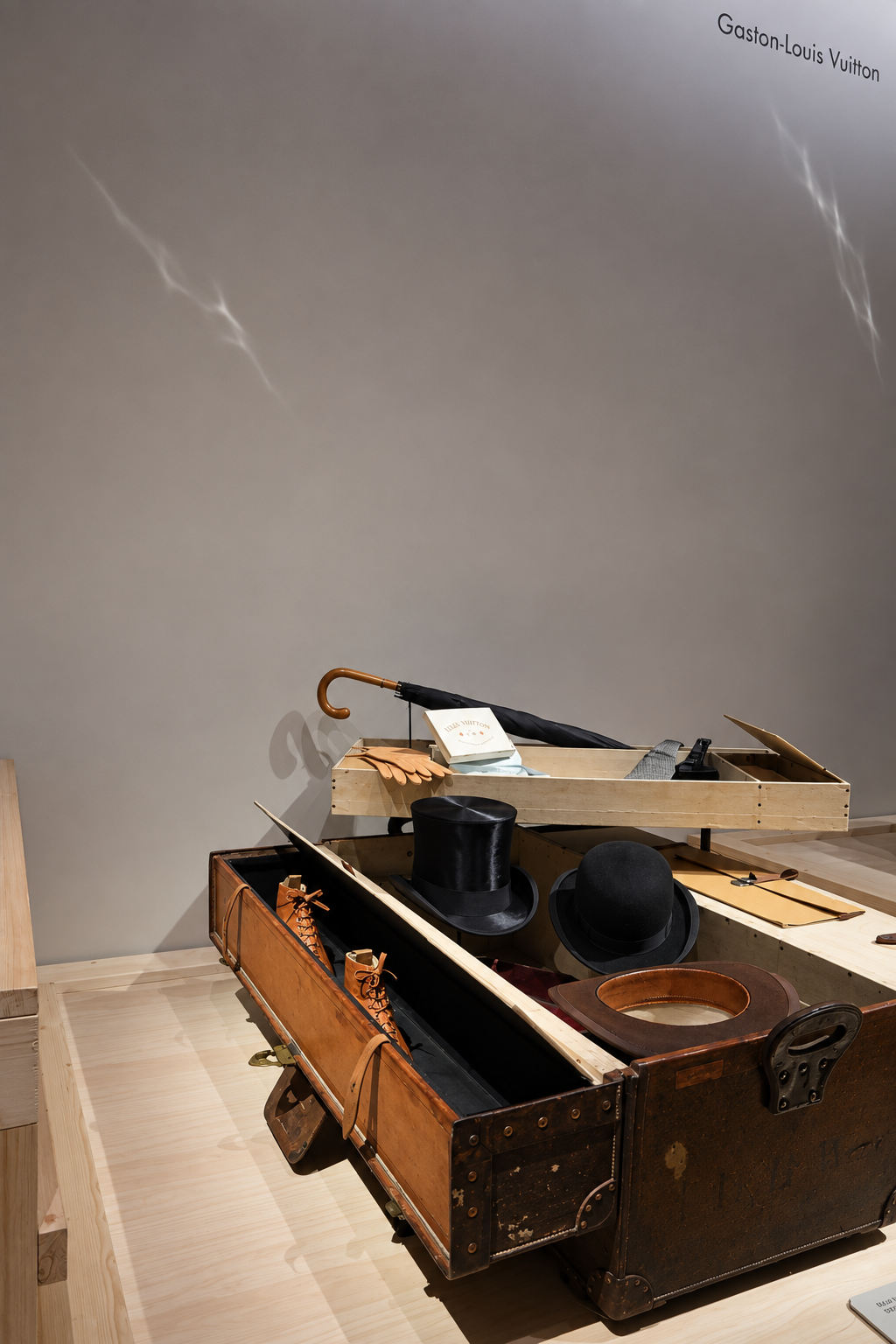
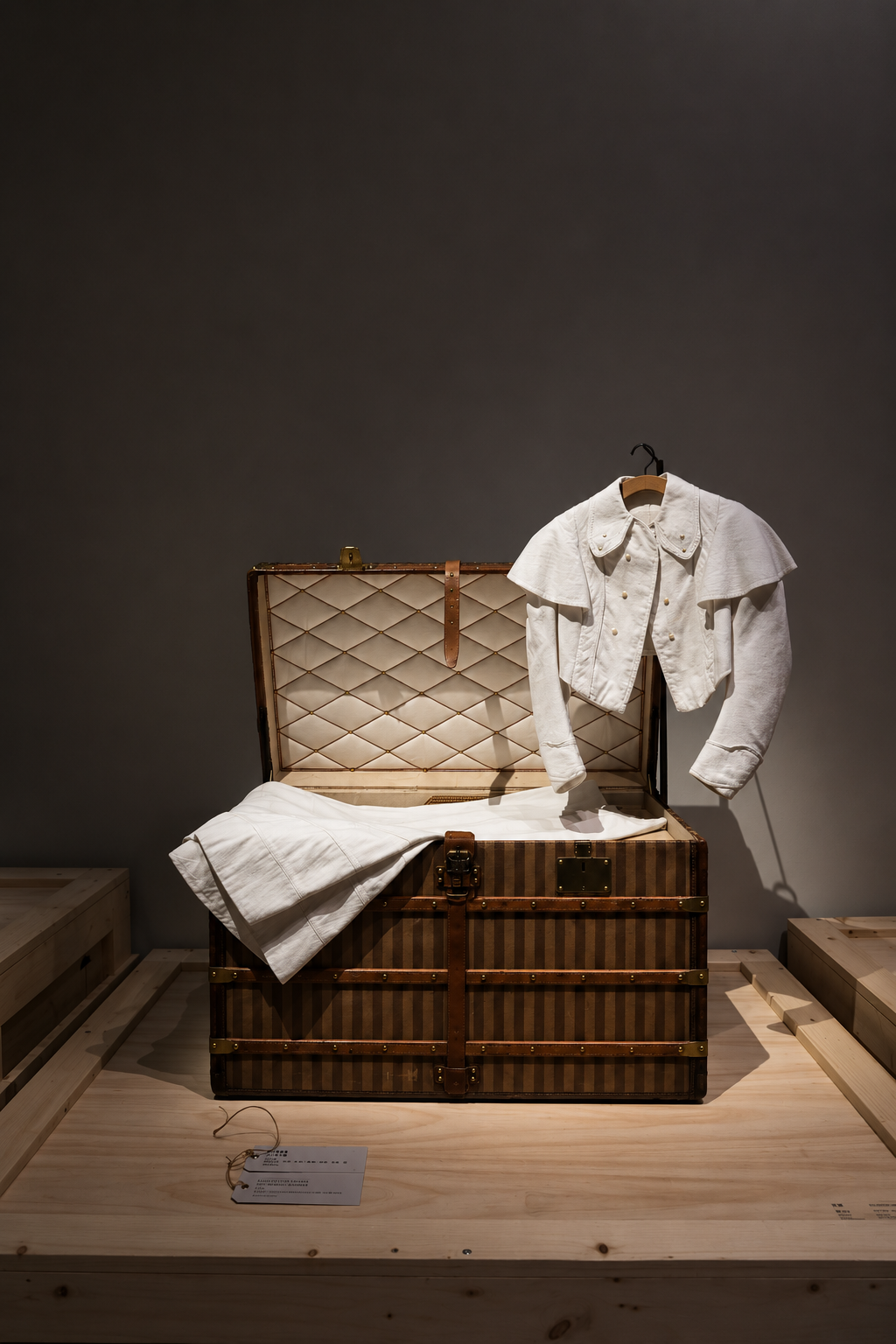
The Vuitton trunk is best understood as an engineering object. Travel trunks of the period commonly had rounded, domed lids, a shape that helped shed water but made them awkward to stack in the hold of a ship or the luggage van of a train. As travel became organised around mass transit, stacking became a real logistical constraint. According to the house, Vuitton reimagined the structure and introduced a flat-topped model in Trianon grey canvas, lighter, stronger and stackable, a design suited to a world on the move.
The canvas deserves as much attention as the shape. The house describes the colour as initially called “gris ordinaire”, the ordinary grey, and later known as Trianon Grey, a name that echoes the tones of imperial residences. A lightweight, water-resistant canvas stretched over a frame of light poplar wood solved three problems at once: weight, weather and durability. The point is not that the trunk looked luxurious. The point is that it solved the problem well enough to become desirable, and that desirability then attached itself to the solution rather than to an advertisement for it.
The brief for this essay asks for precision on one question that popular accounts blur, and it is worth stating plainly. Louis Vuitton did not invent luggage, and the flat-topped trunk did not appear in a single moment on a single date. The house dates the canvas to 1854, and published accounts place the flat-topped model at around 1858 to 1860. What can be said with confidence is that the founder innovated the form of the travel trunk and the profession of packing, at the moment when the market for both was changing. Some accounts also speculate that the founder drew on flat-topped designs by other makers of the period. Innovation, in this telling, is not a lightning bolt. It is a sustained, practical refinement carried out at the right time.
Why did Louis Vuitton make flat-top trunks? Flat-topped trunks could be stacked, which suited the cargo holds of ships and the baggage cars of trains. Combined with a light, waterproof canvas, they made luggage easier to transport and easier to protect.





Asnières: Where the Legacy Became Physical
Craft is not preserved only in museums. It survives when people continue doing it.
In 1859 the house moved its production to Asnières-sur-Seine, a village a few kilometres northwest of Paris. The choice was operational before it was romantic. The Seine allowed poplar wood to arrive by water, and a railway line ran through Asnières to the Gare Saint-Lazare, close to the house’s Paris shop. The workshop was a piece of logistics: raw materials in by river, finished trunks out by rail, and a family home beside the workshop, so that the people who ran the business lived beside the people who made the product.
The house’s history records that the workshop started with 20 employees, grew to nearly 100 by 1900 and to 225 by 1914. It also states that the family home has been preserved as part of a private museum while artisans continue to work on site. LVMH describes the atelier today as a place where leather craftworkers, woodworkers, casemakers and locksmiths work side by side on hard-sided trunks, pieces in exotic or rare leathers and special orders. The Louis Vuitton site for Asnières describes the same workshops as continuing to pass down their know-how in the “very same Eiffel-style workshops” in which it began.
More than 160 years later, the site remains active, and that continuity gives the house something no campaign can manufacture: a physical place where institutional memory is still practised. The strategic value of that is easy to underestimate. A founding story can be told by any brand, and an archive can be assembled, but a workshop in which the same categories of work have been done by successive generations is evidence of a different kind. It is also an operational asset. The people at Asnières hold knowledge about how a lock is fitted or how a corner is bound that is not fully captured in drawings, and which survives because it keeps being used.
What is the Asnières Louis Vuitton workshop? Asnières-sur-Seine, northwest of Paris, is the historic workshop and family home of Louis Vuitton, established in 1859. The house describes it as the place where its trunks, certain exotic-leather pieces and special orders are made, and where craft knowledge continues to be transmitted between artisans.
From Protection to Identity: The Birth of the Monogram
The strongest brand codes are not merely recognisable. They are reusable without losing their origin.
The Monogram enters the story late, and that is deliberate. The house’s own signatures were layered over time: a striped canvas in 1872, the Damier check in 1888, and then the Monogram in 1896. Each was, among other things, a response to imitation. A trunk that was recognisable at a distance, in a crowded station or a ship’s hold, was harder to copy convincingly and easier to claim.
LVMH states that the Monogram was created in 1896 by Georges Vuitton as a tribute to his father Louis, and has embodied an ongoing dialogue between heritage, innovation and culture for well over a century. Trade coverage of the anniversary adds that the pattern combined interlaced initials with floral motifs and was registered as a protected design. It was, in other words, a defensive signature, a tribute and a decorative system in the same object.
Interpretation: what makes the Monogram a useful case study is what happened after it was no longer defensive. A pattern designed to prevent copying became, over time, one of the most widely recognised brand codes in the world, and, more unusually, one that other people were repeatedly invited to rework. A code that can only be repeated is a logo. A code that can be reinterpreted, by artists, by designers and by successive generations of customers, without losing its origin, is a language.
What is the history of the Louis Vuitton Monogram? The Monogram canvas was created in 1896 by Georges Vuitton, Louis’s son, as a tribute to his father and as a way of protecting the house’s creations from imitation. It followed the house’s striped canvas of 1872 and the Damier of 1888, and it marked its 130th anniversary in 2026.
What a Legacy Brand Actually Is
A legacy brand is not simply an old company. It is a company that has learned how to carry its past forward.
Age alone is not a definition. Plenty of old companies are merely old, and a long history can be a liability when it hardens into habit. A rigorous definition needs tests that a house can pass or fail, and the table below proposes seven. They are applied to Louis Vuitton using only evidence that appears in the sources linked in this essay, which means that a pass here is a statement about documented continuity, not about quality in any given season.
| Test | What it asks | Documented evidence at Louis Vuitton |
|---|---|---|
| 1. Origin | Did the house begin with a clear reason to exist? | Protecting and transporting possessions: a stackable, lighter trunk for rail and steamship travel (house heritage account). |
| 2. Craft | Is knowledge embedded in making, not only marketing? | Leather workers, woodworkers, casemakers and locksmiths at Asnières (LVMH). |
| 3. Continuity | Do recognisable ideas survive leaders and fashion cycles? | Workshop active at Asnières since 1859; Monogram in use since 1896. |
| 4. Archives | Is there accumulated material and cultural memory? | A gallery and family home at Asnières; anniversary collections drawing on archival material such as a historic client register (press coverage of the 2026 Monogram collections). |
| 5. Codes | Can design elements evolve and stay identifiable? | Striped canvas (1872), Damier (1888), Monogram (1896), each still in the house’s vocabulary. |
| 6. Transmission | Do techniques and values pass between generations? | Family succession from Louis to Georges to Gaston-Louis; artisan know-how passed down at Asnières (house account). |
| 7. Reinvention | Can the house adapt without erasing its history? | Ready-to-wear from 1997; artist collaborations reworking the Monogram from 2001 onwards. |
Reading the table: a pass means documented continuity, not a guarantee of present-day quality. Evidence is drawn from the house’s heritage pages, LVMH and trade coverage cited in this essay.
What makes Louis Vuitton a legacy brand, and what does legacy mean in luxury? In luxury, legacy means accumulated proof: a clear origin, craft knowledge carried in people, continuity across leadership changes, an archive, recognisable design codes, transmission between generations and a record of reinvention that does not erase the past. Louis Vuitton is a legacy brand because it can point to documented evidence under each of those headings, not simply because it is old.
Why Legacy Is Not the Same as Nostalgia
Nostalgia repeats the past because the past feels safe. Legacy uses the past as material.
The distinction is essential, and it is where most commentary on heritage brands goes wrong. Nostalgia is a mood: it asks the customer to feel that things were better before and to buy a piece of that feeling. Legacy is a resource: it supplies the house with references, techniques and codes that can be used to make something new. A nostalgic house reissues. A house with legacy reinterprets, and the difference shows in what it is willing to change.
Louis Vuitton has repeatedly expanded from trunks into handbags, fashion, accessories, jewellery, watches, fragrance, beauty, cultural collaborations and exhibitions. Each expansion could have diluted the original purpose, and some commentators argue that over-extension is exactly the risk a famous name runs. What holds the system together is a small set of durable themes, travel, craft, movement, protection, personalisation and transformation, which recur across categories that look unrelated on a shelf. For readers interested in what makes an object last beyond a season, timeless luxury pieces are best chosen on exactly these grounds: the idea behind the object has to outlast its styling.
How Louis Vuitton Learned to Reinvent Without Losing Itself
The paradox of heritage: the more a code can change, the longer it can last.
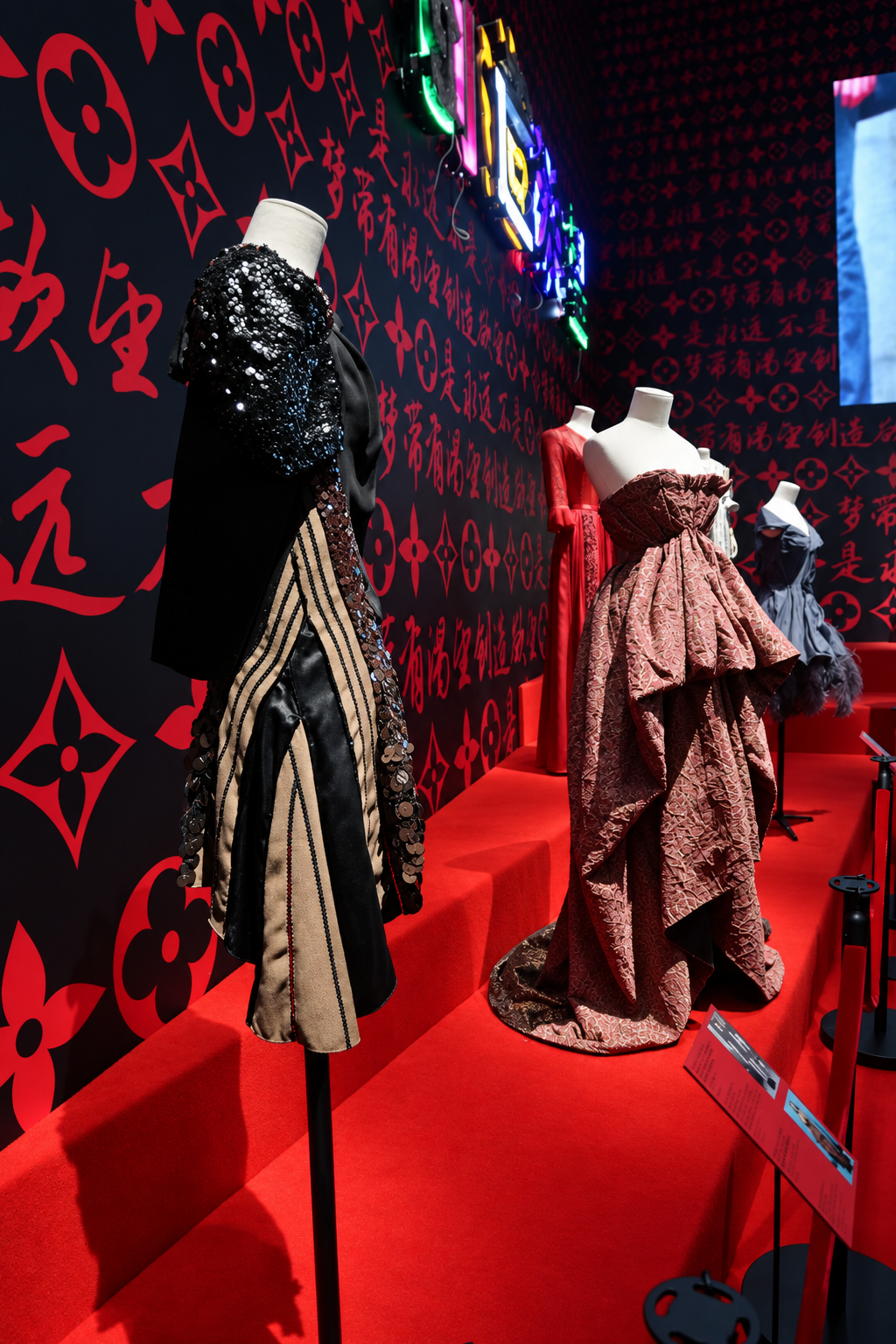
The fashion era of the house begins, in most accounts, in 1997, when Marc Jacobs was appointed creative director and introduced ready-to-wear for the first time in the brand’s history. What followed was a sequence of interpretations by successive creative directors, among them Jacobs, Nicolas Ghesquière, Virgil Abloh and Pharrell Williams, each of whom read the house differently. What stayed legible across those readings was the Monogram, the logic of the trunk and the narrative of travel.
The Monogram itself was the proving ground. Under Jacobs, the house invited artists to rework it. Stephen Sprouse’s graffiti collection of Spring/Summer 2001 was, by contemporary accounts, the first time the pattern had been visibly defaced, a notable act for a house that had treated the pattern as inviolable. A few years later, W Magazine’s account of the Murakami collaboration describes a partnership that stayed in production, with variations added, until Jacobs left the brand in 2014, and it frames the artist’s irreverent tinkering as exactly what the house had been lacking for younger audiences’ approval.
Interpretation: this is evidence of brand-system strength, not of brand weakness. A fragile code collapses when it is altered, because its value depends on being untouched. A strong one absorbs the alteration and returns to itself. The editorial question about the Monogram is therefore not why it survived unchanged. It is why it could change so often without becoming anonymous.
Expansion works when the system underneath is coherent enough to be recognised in every new form.
Louis Vuitton now operates as a fashion house, a luggage maker, a cultural collaborator, an architectural patron, an exhibition producer and a symbol of global luxury. That breadth would dilute a weaker brand, and a reader should hold both possibilities in mind: the same expansion that demonstrates strength also creates the risk of over-licensing an identity until it means very little. The house’s resilience, so far, rests on its habit of returning to the same small set of themes however far it travels.
It also rests on its place in the wider culture, where the house has become a recurring character in the story of fashion’s power structures. That is the territory explored in The Devil Wears Prada and the shift of fashion power, and in the account of how institutions confer authority in the Met Gala and the movement of fashion’s centre of gravity. In both, the pattern is the same: the houses that hold attention across decades are the ones whose meanings have been renewed by the cultural conversation around them, not merely by their own advertising.




Why Technology Makes Provenance More Valuable
Technology can accelerate creation. It cannot accelerate provenance.
Digital production, generative tools, rapid manufacturing, global e-commerce and social platforms have dramatically reduced the cost of producing images, products, narratives and even convincing brand identities. A new label can now present a heritage-style story, a polished archive-style image set and a coherent visual identity in weeks. What it cannot present is the past those materials refer to. No system can retroactively manufacture 170 years of institutional memory, a workshop in continuous use, or a founder whose existence is documented in records other people kept.
This is the contemporary thesis of the essay, and it is worth stating carefully because it can be mistaken for anti-technology nostalgia, which it is not. Legacy houses have always adopted new tools: Louis Vuitton’s own founding story is the story of adopting new materials for new modes of transport. The point is narrower. As the cost of imitation falls, the value of what cannot be imitated rises, and provenance, meaning the verifiable history of where an object, a technique or a house comes from, is one of the few things that remains expensive by nature. Time is the one input that cannot be bought on a platform.
Will legacy brands become more valuable in the age of AI? They may, but not automatically. If generative tools make imagery, product design and brand narratives easy to produce, then verifiable provenance, human authorship and material credibility become more distinctive. That advantage still has to be earned in the present through product and service, because a long history is an asset only while the house continues to deliver.
The New Scarcity Is Time
Luxury has always sold scarcity. The scarcest ingredient is now the one nobody can produce on demand.
Luxury historically relied on scarce materials, difficult craft and limited access. Each of those scarcities is under pressure from technology: materials can be substituted or simulated, craft can be partially automated, and access can be widened or faked by digital distribution. In a future where product aesthetics are easier to imitate and content is generated instantly, time itself becomes a defensible asset, and the house with a real archive, an old workshop, a documented founder and generational know-how holds assets that younger competitors can approximate but not credibly simulate.
The chart below makes the point in the simplest possible way, by counting years in continuous use for five elements of the Louis Vuitton system, measured to 2026. It is not a measure of value, only of accumulated time, and the shortest bar is included deliberately: the fashion era is a recent layer on a much older foundation.
Years in continuous use, as of 2026
Years are calculated from the dates given in the house’s heritage pages and LVMH (2026) to the year 2026. Bar widths are proportional to the longest bar. Years elapsed measure continuity, not market value or quality.
The Archive as a Competitive Advantage
The archive is not storage. It is a design engine.
Archives are often treated romantically, as rooms of beautiful objects to be visited. They are also strategic infrastructure. A mature archive gives designers references, materials, proportions, graphics, product histories, client stories and a body of cultural memory to reinterpret. A younger brand has to invent its references forward; a legacy house can move backward and forward simultaneously, and it can do so with authority, because the sources are real.
The 2026 anniversary of the Monogram offers a neat illustration of the mechanism. Press coverage of the anniversary collections describes the first of them as revisiting the 1896 design in a newly developed linen-and-cotton jacquard in soft pastel tones, and other coverage ties the palette to an archival client register. The designers did not invent a past. They consulted one. The commercial logic is that the material is distinctive and difficult for a competitor to match, because the competitor does not hold the original.
The same logic applies at smaller scale to any object that carries its own history. In fine jewellery, for instance, provenance, maker’s marks and documented ownership are a large part of what separates an heirloom from a recent piece, a principle explored in the Dower Hall guide to fine jewellery as an investment. Whatever the category, the archive is the evidence that makes the object more than its materials.
Craftsmanship as Organisational Memory
Complex luxury production depends on tacit knowledge that lives in people and processes, not only in design files.
LVMH has described leather-bag production at Louis Vuitton as requiring an average of around 250 separate operations, and has described the Asnières workshops as bringing together different trades under one roof. The exact number matters less than the principle it illustrates. A product assembled through hundreds of steps, by people with different specialisms, depends on knowledge that cannot be fully written down: the feel of a seam under tension, the sound of a lock closing correctly, the judgement that a piece of wood is right for a particular panel. That knowledge is held in people, and it is transmitted by working beside them.
Interpretation: this is why craft is better understood as organisational memory than as decoration. A company can lose a design file and recreate it; it cannot easily recreate a team that has forgotten how to make the product. The trades of the workshop, woodworking, leatherwork, casemaking and lock-fitting, are the physical form of institutional memory, and their continuity is the practical reason the house can make claims about its history that its competitors cannot.
Why is craftsmanship important in luxury? Because it is the part of luxury that carries knowledge across time. Craft embeds judgement, materials expertise and quality control in people and processes, and when it is transmitted from one generation to another it becomes a form of organisational memory that cannot be reproduced on demand.



Why Legacy Is a Trust System
Legacy becomes commercially valuable when history is supported by present-day competence.
Business analysis should move beyond emotion. Legacy reduces uncertainty, and uncertainty is expensive for buyers of costly objects. A customer may trust a house because it has survived multiple economic cycles, creative transitions and changes in consumer behaviour, and that survival functions as evidence. It is a signal that the house has been tested.
That does not mean an old brand is automatically good. Continuity operates as evidence only while the house continues to deliver, and the evidence is withdrawn the moment quality slips. The trust system is therefore two-sided: history gives the house credit, and present performance determines whether that credit is spent or renewed.
History is an asset. Stewardship determines whether it remains one.
Legacy is powerful, but it is not invincible, and an honest account has to say so. Historic houses can decline when they rely on name recognition in place of product standards, when they license their identity too widely, or when they mistake nostalgia for relevance. The pattern repeats across industries: a name that once guaranteed something is gradually asked to guarantee less, until the guarantee no longer holds.
The stronger argument, and the one this essay defends, is that genuine legacy creates unusual resilience, provided the house keeps renewing the reasons people cared in the first place. That means keeping the craft alive, keeping the archive in active use, letting the codes be reinterpreted by people with something to add, and refusing the short-term gains that spend the name faster than it can be earned. No house is immortal. Some are simply better stewards of what they inherited.
What New Brands Can Learn
Provenance takes time and cannot be growth-hacked.
None of this is an argument that only old houses can succeed. It is an argument about which assets compound, and it is useful to founders as well as to readers. Seven principles follow from the case, offered as durable ideas rather than as a checklist:
Solve a real problem before inventing mythology. The house’s story began with a stackable trunk, not with a narrative. Build a visual code strong enough to survive reinterpretation. A code that cannot be altered is a logo; one that can be reworked and remain itself is a language. Treat craft as infrastructure, not as content. What is made and who makes it should be real before it is filmed. Protect institutional memory. Write down what can be written down, and keep the people who hold what cannot. Use collaboration to expand meaning, not to replace identity. The best collaborations tell the audience something new about the house while the house stays recognisable. Design for continuity rather than permanent novelty. A catalogue of launches is not a legacy. Accept that provenance takes time. The calendar cannot be skipped, only used well.
Legacy culture does not reject the future. It offers the future something technology struggles to generate on demand: depth.
Contemporary culture is saturated with speed: endless launches, algorithmic trends, fast cycles of relevance and an expanding volume of synthetic media. In that environment, objects and institutions with proven continuity become psychologically attractive, because they offer friction, memory and permanence. They are slower to arrive and slower to leave, and that slowness is the feature. It is no accident that houses with real history have been investing in their own heritage, from anniversary exhibitions to the restoration of workshops and family homes, at the same moment that digital tools have made novelty cheap.
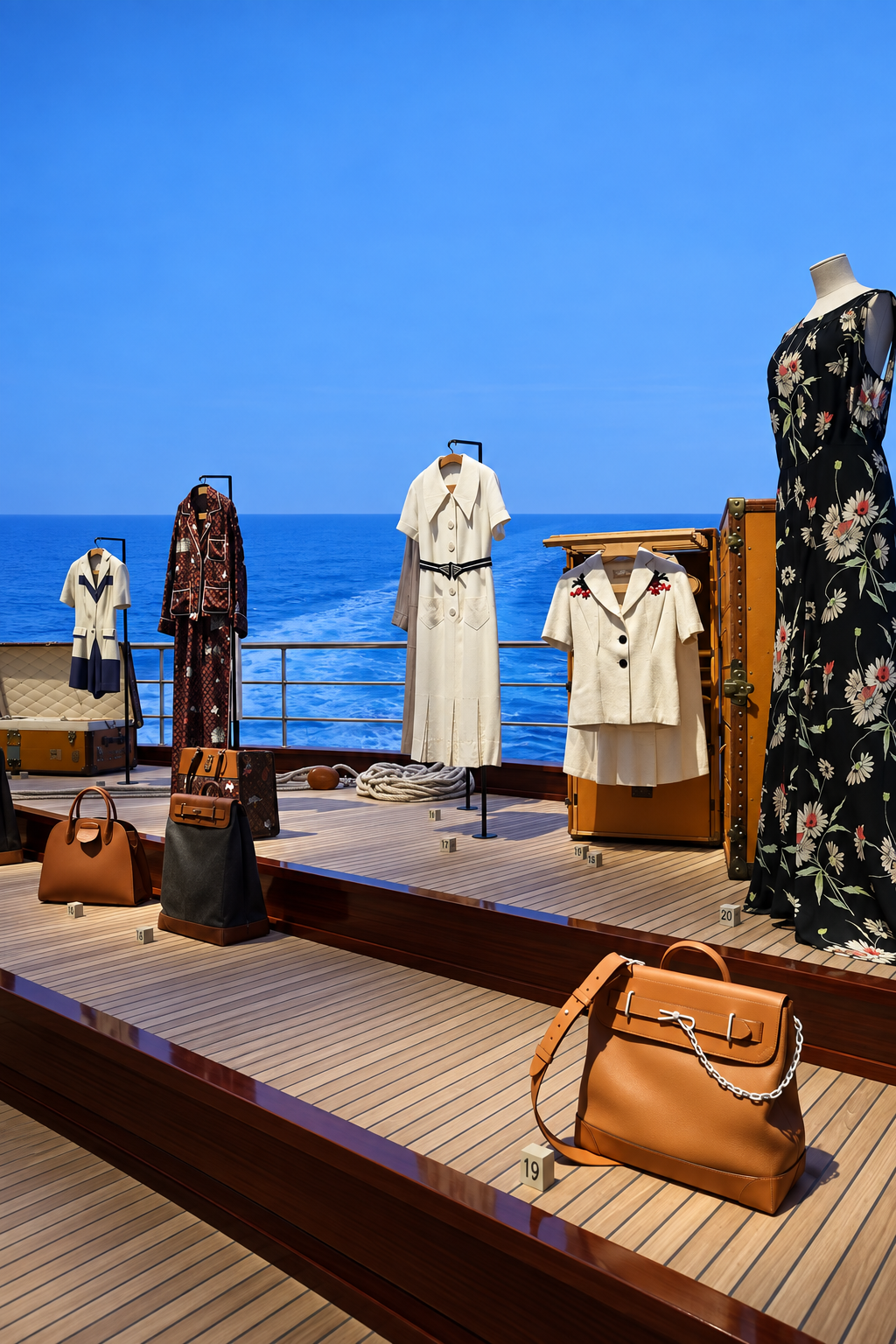
A Vuitton trunk can now signify nineteenth-century rail travel, aristocratic packing, twentieth-century jet-set mobility, fashion collaboration, celebrity culture, contemporary design and global luxury, all at once. That accumulation is cultural memory. The object is not unchanged; its meanings have multiplied. This is perhaps the most distinctive property of a legacy object, and it is the one that a newly made object, however beautiful, cannot yet have.
Why do heritage brands last? The ones that last combine real craft, recognisable codes and an archive with the discipline to keep renewing the reasons people cared. Heritage by itself does not preserve a brand; stewardship does.
The future Angle: Provenance as a Cultural Signal
The deepest advantage of a legacy house may be the one resource the digital economy cannot compress: accumulated time.
The future-facing argument remains structural, and it is offered as a framework, not a forecast. As generative technologies make visual production faster and brand creation easier, consumers may become more sensitive to provenance, human authorship and material credibility, and may begin to ask, of any object, who made it, where, and over how long. Houses with answers to those questions will have an advantage that is difficult to copy. Houses without them will have to build the answers, patiently, with the same raw material as everyone else: time.
Legacy houses will still have to compete on relevance, product and service. Nothing in this argument excuses a house from the ordinary obligations of making something worth buying. What it suggests is that the competitive terrain is shifting toward the things that are slow to build, and that the value of the slow things will be easier to see once the fast things are abundant.
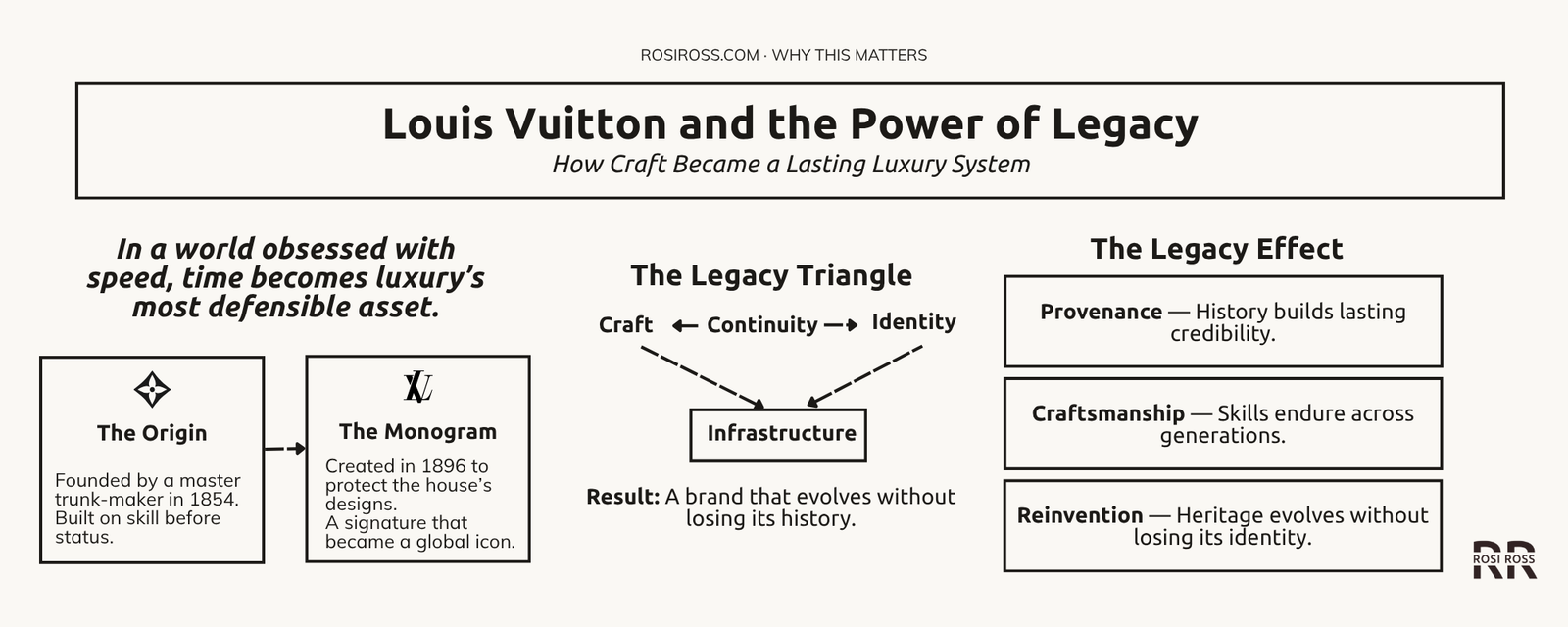
Craft, Memory and the Question of Time
The house became global because the craft survived the journey.
Return, finally, to the workshop at Asnières, and to the person who first arrived in Paris at sixteen to learn how to pack other people’s belongings. Nothing in that beginning predicted a global house. What it contained was a habit: look at the problem, solve it carefully, make the solution good enough to be wanted, and pass what has been learned to the next person. The Monogram, the fashion house, the exhibitions and the collaborations are all downstream of that habit.
The story is not that Louis Vuitton is iconic because it has been around for a long time. The story is how a nineteenth-century trunk maker turned practical craft into one of fashion’s most durable cultural systems, and why, in a technological age capable of producing infinite novelty, real history, human skill and accumulated provenance may become luxury’s most defensible assets. Legacy is not inherited prestige alone. It is the disciplined preservation of meaning across time.
“The logo came later.
The skill came first.
Technology can accelerate creation,
but it cannot accelerate provenance,
and a house that carries its past forward
has something time alone can give:
the disciplined preservation of meaning.”

