
On the four distinct dermatological conditions hiding behind one visual pattern, the ingredient science separating them, and why the body lotion that clears one type actively worsens another
Strawberry skin is not one condition. It is four distinct dermatological situations sharing a single visual presentation — and the reason most people who have tried to treat it have failed is not that they chose a bad product. It is that they never knew which of the four they were actually treating.
This guide corrects that. Every product discussed here was selected because it illuminates a specific point in the diagnostic framework — not because it is trending or aesthetically photogenic. The goal is not to tell you which lotion to buy. It is to give you the framework to know, before you buy anything, which type you have.
What strawberry skin actually is
Strawberry skin — enlarged, darkened follicle openings on the legs and upper arms, resembling the seed pattern of a strawberry — is one of the most searched body skincare terms globally and one of the least correctly explained. Not because the underlying science doesn’t exist; it exists in dermatology literature in considerable depth. It’s because mainstream beauty content has consistently collapsed it into a single condition with a single solution, and that simplification has consistently failed the people who have it.
Before any product can be usefully evaluated, the four underlying mechanisms need to be understood, because the correct ingredient for one actively worsens another.
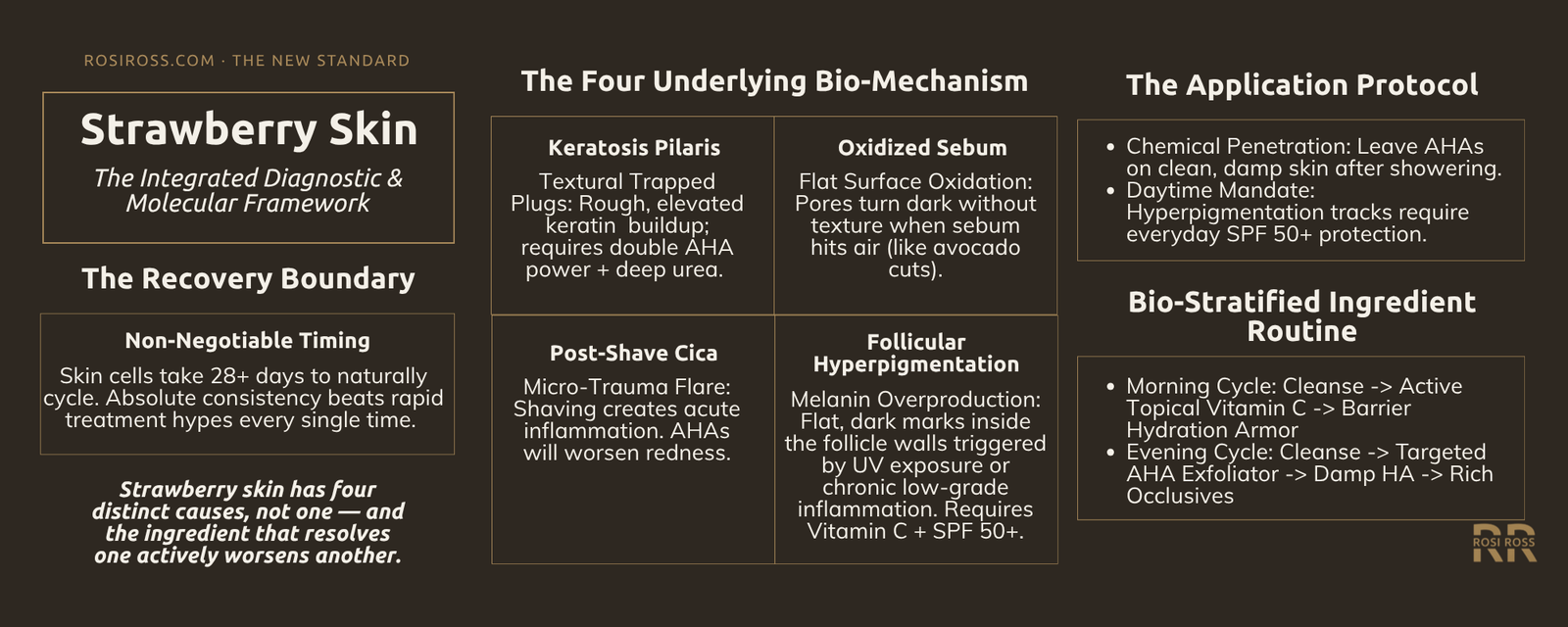
A genetic condition affecting roughly 40% of adults, in which excess keratin accumulates in the hair follicle and forms a plug that pushes the follicle wall outward. Has texture — you can feel the bumps as well as see them. Not caused by hygiene or shaving practice. Correct response: AHA exfoliation plus urea, applied consistently over four to six weeks.
Sebum exposed to air at a wide follicle opening oxidises the same way a cut avocado darkens. Colour without texture — smooth skin with darkened pores. Not a cleanliness issue. Correct response: gentle AHA exfoliation combined with antioxidant application to slow oxidation.
Mechanical hair removal creates micro-trauma at the follicle; the inflammatory response can leave temporarily darkened openings as it resolves. Redness is the primary feature. AHA worsens this condition significantly. Correct response: centella asiatica and barrier repair, with a complete rest from exfoliation.
Chronic low-grade inflammation or UV exposure causes melanocytes in the follicle wall to overproduce melanin. Flat, dark, and the slowest to resolve — most often dismissed as simply “dark pores.” Correct response: vitamin C, AHA, and consistent SPF, over eight to twelve weeks.
Strawberry skin is a visual pattern, not a single diagnosis. It describes darkened, enlarged follicle openings on the legs and upper arms produced by one of four distinct mechanisms: keratosis pilaris, oxidised sebum, post-shave inflammation, or follicular hyperpigmentation. It is common to have more than one type simultaneously, which requires a layered rather than a singular ingredient approach — the reason a single product so rarely resolves the full picture on its own.

The AHA argument
Alpha hydroxy acids work by disrupting desmosomes — the protein bonds that hold dead skin cells to each other and to the skin’s surface. At the follicle level, this dissolves the keratin plug that produces keratosis pilaris and clears oxidised material from open follicles. It’s a chemical process that continues working for hours after application, which is why AHA body products should be applied after showering and left on rather than rinsed off.
Glycolic acid, with the smallest molecular weight of the AHAs, penetrates most deeply and quickly. Lactic acid penetrates more slowly, is more hydrating, and is better tolerated by sensitive skin. The most common mistake in this category isn’t product choice — it’s inconsistency. A full skin cell turnover cycle takes roughly twenty-eight days in young adult skin, longer as skin ages, so AHA body products need application every two to three days for a minimum of four to six weeks before results become visible. This is the same evidence-over-hype discipline that is reshaping how the beauty industry earns repeat purchase more broadly: named actives, effective concentrations, and a timeline honestly stated rather than a promise of results by next week.
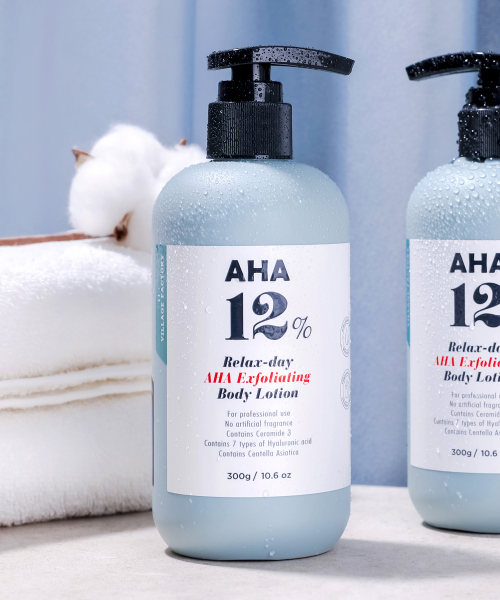
Dual AHA system — glycolic and lactic acid — in a high-moisture base that addresses exfoliation and hydration simultaneously, which is exactly the combination that prevents the most common cause of AHA-related sensitivity in body application. The primary treatment anchor in this framework for keratosis pilaris and oxidised sebum.

A microdermabrasion-inspired cream combining physical exfoliation — fine particles that address the bumped surface texture immediately — with chemical exfoliation that keeps working at the follicle level after rinsing. The clinical anchor for keratosis pilaris specifically, since the roughness is noticeably smoother after a single use while the acid continues clearing the plug beneath it.
Yes, for two of the four causes — keratosis pilaris and oxidised sebum — where AHA dissolves the keratin plug and clears the follicle opening over four to six weeks of consistent use. It should never be applied to active post-shave inflammation, where it worsens redness and can produce post-inflammatory hyperpigmentation; centella asiatica and barrier repair are the correct response for that type instead.
The barrier repair response
The skin barrier — the stratum corneum’s lipid matrix that prevents water loss and protects against irritants — is compromised to some degree in all four types of strawberry skin. In keratosis pilaris, abnormal keratin disrupts the barrier’s structure. In oxidised sebum, open follicles are literal gaps in it. In post-shave inflammation, hair removal damages it directly. In follicular hyperpigmentation, chronic low-grade inflammation degrades it over time.
The practical consequence: AHA exfoliation without simultaneous barrier repair produces temporary improvement followed by increased sensitivity and dryness, sometimes worsening the condition as the compromised barrier lets the acid penetrate more deeply than intended. The correct approach is AHA on exfoliation days followed by intensive barrier repair, and barrier repair alone on the days in between. It’s the same logic behind the occlusive, humectant, and emollient framework used to evaluate lip care — a treatment active is only ever as good as the barrier support layered around it.

Argan oil, shea, cocoa, and mango butters with hyaluronic acid — the richest barrier repair product in this framework, combining emollients that smooth and fill the gaps between cells with a humectant that draws moisture in. The correct occlusive final layer on intensive treatment nights.

The lighter-texture counterpart to the body butter — argan, avocado, and macadamia oils with squalane in a whipped, fast-absorbing format. Better suited to morning application or warmer climates, where the richer butter becomes excessive for daytime wear.

A format built for the post-shave type specifically: applied to wet skin before rinsing, it deposits shea butter, aloe vera, and vitamin E without requiring additional post-shower steps or the mechanical contact irritated follicles don’t need. Delivers barrier repair at the moment skin is most receptive — immediately after warm water has opened the follicles.
The brightening dimension
Follicular hyperpigmentation is the most persistent of the four because it most closely resembles a structural change rather than a surface condition. Once melanin is deposited by melanocytes in the follicle wall, it sits below the layer that exfoliation alone removes — which is why AHA on its own never fully resolves this type.
Vitamin C — specifically L-ascorbic acid or its more stable derivatives — inhibits tyrosinase, the enzyme that catalyses melanin production, a mechanism confirmed across the clinical literature on topical vitamin C for pigmentation. Applied consistently, it slows new melanin production at the source rather than simply removing already-pigmented cells from the surface. The timeline matters here more than almost anywhere else in this framework: eight to twelve weeks of consistent use is the minimum before measurable improvement appears, longer than most product claims prepare a reader for, and the reason this category is so often abandoned before it has had time to work — the same case study in patience that performance-led formulation makes elsewhere in skincare: results that compound rather than results that are promised overnight.

Vitamin C combined with AHAs — tyrosinase inhibition and cellular turnover acceleration in a single formula, with cupuaçu butter to prevent the acid from creating dryness and plum extract for additional antioxidant support. The most direct treatment in this framework for follicular hyperpigmentation.

Vitamins C and E in combination, applied as a daily morning layer rather than a treatment: vitamin E is regenerated by vitamin C after it oxidises, extending the protective duration of both. Operates on prevention’s timeline — reducing new pigmentation rather than resolving what’s already present — which makes it the essential companion to a brightening treatment, not a substitute for one.

The only product in this framework that directly addresses the UV dimension of follicular hyperpigmentation — the most underacknowledged aggravating factor in the condition. Buriti oil, exceptionally high in beta-carotene and tocotrienols, provides antioxidant protection at the follicle level; the after-sun calming complex reduces the post-UV inflammatory response that worsens hyperpigmentation.
The overnight protocol
The skin’s repair mechanisms run on a circadian rhythm. Cell division — the process by which new skin cells replace damaged ones — peaks in the late evening and early night, at rates shown in the dermatological literature to run considerably higher than during the day, while cortisol, which suppresses cell proliferation, is at its lowest during sleep. These are measurable biological events, not marketing language, and they determine when topically applied ingredients are actually most effective — the same overnight biology that makes consistent sleep-window application the differentiator in a well-built evening routine, not an afterthought to it.

A clinically relevant topical magnesium dose in a shea, aloe, and multi-oil base with a lavender, chamomile, and patchouli blend that supports the cortisol-suppression side of the same equation. Magnesium is a cofactor in several hundred enzymatic reactions, including barrier repair and inflammatory regulation — positioned as the final step of the evening routine, applied during the skin’s peak repair window.

The hyaluronic acid layer applied before the body butter, morning and evening. Too large a molecule to reach the dermis topically, but its surface-level moisture-binding is exactly what AHA-exfoliated skin needs to function without irritation — fast-absorbing enough not to interfere with what’s layered over it.

Asiaticoside, madecassoside, and asiatic acid — active compounds with documented anti-inflammatory and wound-healing activity at the follicle level. The most ingredient-precise product in this framework, and the correct primary treatment for the post-shave type, replacing AHA entirely during the active inflammation phase. Applied in the evening after hair removal, during peak repair activity, it reduces the inflammatory signalling that, left unaddressed, produces the post-inflammatory hyperpigmentation that is the fourth cause of strawberry skin.

Niacinamide, panthenol, and ceramides in a fragrance-free formula — the dermatologist-standard baseline for skin too reactive to tolerate the more active products in this framework. Niacinamide’s dual role, regulating sebum and inhibiting melanin transfer, makes it relevant to two of the four causes at once.
The routine sequence
The most common reason a strawberry skin routine fails isn’t product selection. It’s sequence. AHA applied to unwashed skin makes less contact with its target layer. Barrier repair applied before AHA blocks penetration. SPF applied after vitamin C in the morning alters the vitamin C’s oxidation rate and reduces its efficacy. These aren’t minor inefficiencies — they’re the difference between a routine that works in four weeks and one that shows nothing in twelve.
Morning: cleanse or shower, AHA on exfoliation days applied to damp skin, five to ten minutes to allow penetration, then barrier repair over the top. On non-exfoliation days: cleanse, vitamin C, then hydration. Evening: cleanse to remove the day’s buildup, a second AHA application on KP or oxidised-sebum nights, hyaluronic acid while skin is still damp, then body butter as the occlusive final layer. SPF belongs in the morning routine without exception — follicular hyperpigmentation is UV-aggravated, and this is the step most frequently skipped, and most likely to stall the exact result the rest of the routine is working toward, however correctly everything else is done.
Timelines vary by cause: oxidised sebum can clear in one to two weeks but reforms without maintenance, post-shave inflammation resolves in two to four weeks with correct aftercare, keratosis pilaris shows measurable improvement in four to six weeks of consistent AHA use, and follicular hyperpigmentation requires eight to twelve weeks of vitamin C, AHA, and daily SPF before pigmentation visibly lightens. The reader who understands these timelines persists. The reader who expects transformation in a week abandons a routine that would have worked — the same discipline of consistency over immediacy that separates any considered formulation choice from a trend bought on impulse and abandoned before it had time to prove itself.
None of this is about memorising twelve product names. It’s about recognising, before you spend anything, which of the four mechanisms is actually producing what you’re looking at — the same discipline that makes choosing the right tool for the job, consistently, over time more valuable than owning more tools. Once you know which type you have, the correct ingredient stops being a guess.
“The reader who knows which type of strawberry skin they have
will resolve it.
The reader who does not
will spend money on products
that work for a different type,
conclude that nothing works,
and live with a condition
that was entirely addressable
with the correct information
all along.”

