
On the end of the traditional photoshoot as the primary unit of beauty communication, the emergence of prompt engineering as a creative discipline, the business case that L’Oréal, Estée Lauder, Unilever, and the world’s most sophisticated beauty companies are already building on, and what it means for every brand that competes on imagination
Before a product reaches the consumer, it exists as a vision. A campaign concept. A colour story. A fantasy. A feeling. For most of the history of the beauty industry, translating that vision into imagery required something no amount of creative ambition could accelerate: time, physical infrastructure, and the coordinated labour of photographers, studios, models, retouchers, and production teams working across weeks and months. Generative artificial intelligence has not simply shortened that process. It has changed its fundamental architecture.
The beauty industry has always been built on imagination. What generative AI has introduced is not a faster route to the same destination but an entirely different kind of creative territory — one where the distance between a concept and its visual realisation has collapsed to almost nothing, where hundreds of possible campaign directions can be explored before a single production budget is committed, and where the creative constraint is no longer the availability of a studio or a photographer but the quality of the idea and the intelligence with which it is expressed. The question the beauty industry is now asking itself is not how to use these tools. It is how to think with them.
This is an analysis of that question — and of the structural transformation it is producing in how beauty communicates, competes, and imagines itself into the future.
The end of traditional beauty production — from the photoshoot to the prompt
The editorial beauty photograph, as it was understood through most of the twentieth century and into the twenty-first, was a specific kind of industrial event. A team of significant size — photographer, art director, stylist, makeup artist, model, lighting technician, set designer, digital operator, post-production editor — assembled in a specific physical location to capture a specific visual story that a brand had spent weeks or months developing through mood boards, reference sheets, creative briefs, and client approvals. The final image — the one that appeared on the billboard, in the magazine, on the digital campaign — was the product of this entire apparatus, and its cost reflected the scale of what it required.
The digital content era complicated this model without fundamentally changing it. Social media increased the volume of visual output that beauty brands were expected to produce to a degree that the traditional photoshoot infrastructure was never designed to handle. Where a campaign once required one hero image and a handful of supporting assets, the social media era required a continuous stream of high-quality visual content across platforms with different format specifications, different audience expectations, and different aesthetic codes — produced not quarterly but weekly, daily, sometimes hourly. The photoshoot became a production line, and the production line began to buckle under the weight of the demand placed on it.
Generative AI does not simply solve this efficiency problem. It reframes it. The workflow it introduces — Concept to Prompt to Visual Exploration to Refinement to Brand Application — is not faster photography. It is a different creative process with different inputs, different outputs, and a different relationship between the idea and the image. In the photographic model, the image is the end product of the creative process. In the generative AI model, the image is a starting point for exploration — one of potentially hundreds of visual directions that can be generated, evaluated, refined, and developed before a single production resource is committed. The creative decision-making moves earlier in the process, and the production infrastructure becomes a destination rather than a constraint.
This shift has been building for several years, but the pace at which the industry’s largest players are formalising it as strategy indicates that the exploratory phase is over. L’Oréal has partnered with Google to deploy Veo and Imagen generative AI models through its CreAItech platform, enabling creative teams to generate high-quality visuals and video content aligned with brand specifications through simple prompts — a system designed not to replace creative direction but to dramatically expand the range of visual territory that can be explored before production resources are committed. The same logic applies across the industry: the photoshoot remains, but its position in the creative hierarchy has changed. It is no longer the first expression of a creative idea. It is increasingly the confirmation of one.
Generative artificial intelligence refers to AI systems capable of creating new content — images, text, video, audio — by learning patterns from vast datasets and generating novel outputs based on those learned patterns. Unlike analytical AI, which processes and interprets existing content, generative AI produces content that did not previously exist. In beauty, generative AI systems can create campaign imagery, product visualisations, lifestyle environments, and brand aesthetic concepts from written descriptions alone. The most significant generative AI image platforms currently deployed across the beauty industry include Midjourney, Adobe Firefly, DALL-E, Stable Diffusion, and Google’s Imagen — each with different strengths in photorealism, artistic stylisation, brand consistency, and commercial licensing.
The AI beauty studio — what generative intelligence actually enables
The phrase “AI image generation” tends to produce a reductive mental image: a machine producing photographs automatically, removing the need for human creative input. This is not what the most sophisticated deployments of generative AI in beauty look like. What they look like, in practice, is a new form of creative infrastructure — one that enables a level of visual exploration, experimentation, and conceptual development that the traditional production model could not support at comparable speed or cost.
Consider what it means for a beauty brand’s creative director to be able to generate fifty distinct visual interpretations of a campaign concept in an afternoon. Not fifty identical images with minor variations, but fifty genuinely different explorations of a visual direction — different lighting, different textures, different emotional registers, different colour relationships — each of which reveals something about the concept that the creative director could not have seen without seeing the image. This is not production. It is thinking. It is a form of visual ideation that was previously impossible because the cost of producing each image was too high to support the kind of iterative, exploratory, wrong-direction-pursuing process that good creative work actually requires.
The data from early adopters in the beauty industry supports this framing. Lottie London, the Gen-Z makeup brand within Brand Agency London’s portfolio, used Midjourney to create the visual assets for a Halloween campaign. The results were not simply efficient: compared to previous campaigns, the AI-generated visuals produced a 710% increase in engagement and a 180% increase in interactions with high social sentiment. These are not the numbers produced by faster or cheaper content. They are the numbers produced by more distinctive, more precisely targeted, more creatively coherent content — content that looked different because it was conceptualised differently, using a tool that enabled a level of visual exploration unavailable through traditional methods.
The capabilities that generative AI introduces to the beauty brand’s creative arsenal extend well beyond campaign imagery. They include: rapid product environment conceptualisation, in which dozens of possible settings, textures, and visual contexts for a product can be explored before a production set is designed or a location is sourced; editorial aesthetic development, in which brand visual languages can be tested and refined in real time; social media asset creation adapted to multiple platform specifications from a single concept direction; and experimental aesthetic research, in which visual territories that would be too expensive or logistically complex to explore through traditional photography can be investigated as genuine creative options.
The Estée Lauder Companies’ partnership with Adobe, formalised in March 2025, exemplifies how this capability set is being integrated into the creative operations of the world’s most sophisticated beauty conglomerates. ELC’s adoption of Adobe Firefly across its portfolio — which includes Clinique, Jo Malone London, La Mer, MAC Cosmetics, and nearly twenty other brands operating across approximately 150 countries — is specifically designed to enable creative teams to focus more on ideation and concept development by removing the production friction that previously prevented designers from pursuing the most ambitious version of a creative direction. The generative AI does not make decisions. It makes more decisions possible.





Prompt engineering — the new creative language
The most consequential professional shift produced by generative AI in the creative industries is not the displacement of photographers or art directors. It is the emergence of a new creative discipline — one for which no established training pipeline exists, which cannot be adequately described by any existing job title, and which is becoming one of the most valuable capabilities in visual brand communication. It is the ability to translate creative vision into language precise enough to guide an AI system toward a specific aesthetic outcome. It is called prompt engineering, and it is harder than it sounds.
A prompt is not a description. A description of a beauty campaign image tells an AI system what the image contains. A prompt tells it what the image means — its emotional register, its cultural references, its lighting quality, its relationship to a specific brand aesthetic, its intended audience, and the visual language it should deploy to communicate all of this. The difference between a prompt and a description is the difference between telling a photographer “I want a picture of a woman with red lipstick” and providing a full creative brief that specifies the lighting references, the skin quality, the specific shade of red and what it should evoke, the background environment and what it should imply about the woman’s life, the crop, the emotional atmosphere, and the brand identity that the image should both express and extend.
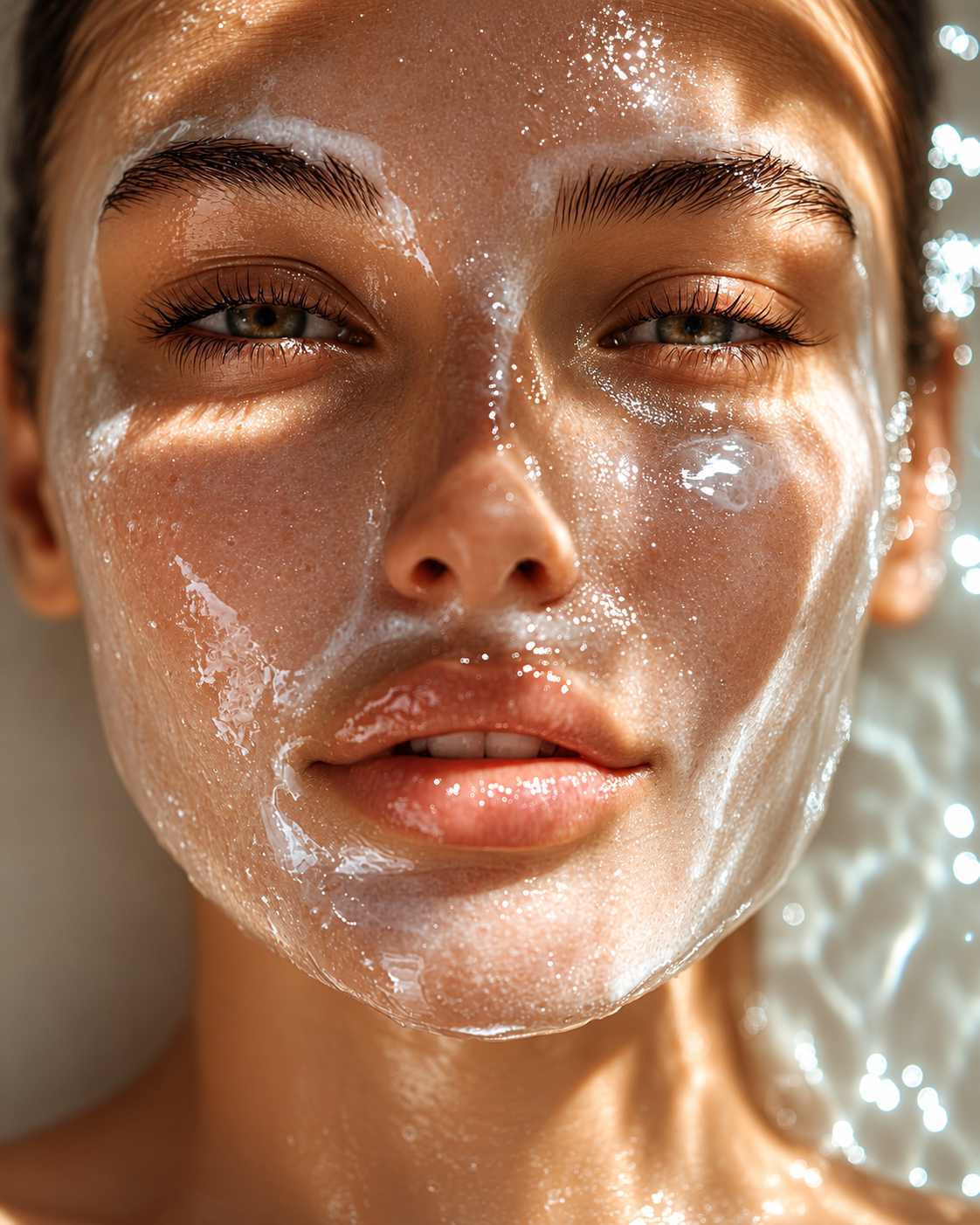
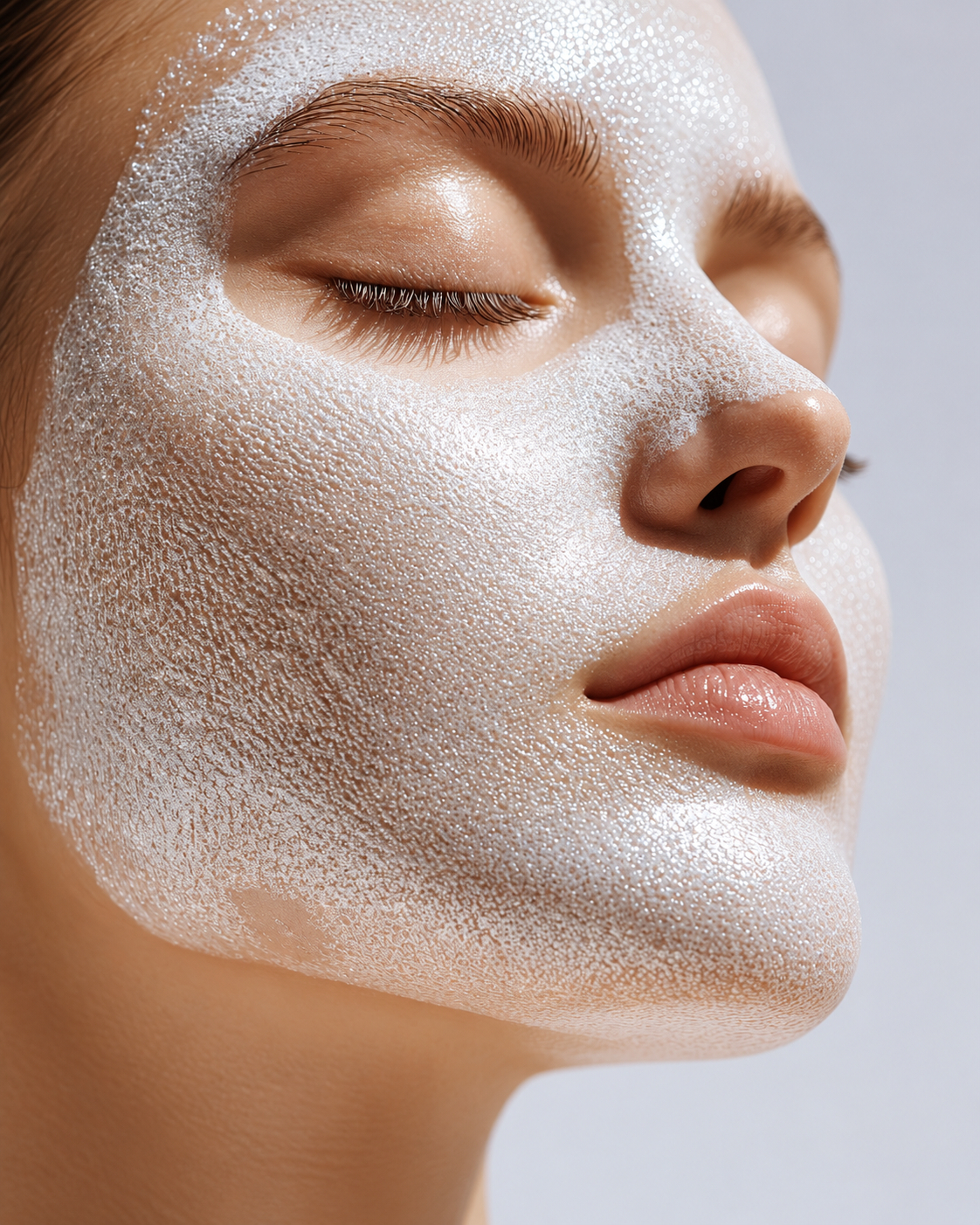
Effective prompt engineering for beauty brands requires a specific combination of capabilities that sits at the intersection of creative direction, cultural intelligence, and technological literacy. The best prompts draw on visual references — named photographers, specific film stocks, particular artistic movements — and translate them into language that an AI system can interpret. They specify lighting not as “good lighting” but as “Rembrandt lighting with a soft fill from camera left and a warm practitioner in the background.” They describe materials not as “luxurious” but as “brushed satin with the specific micro-texture of a pre-worn garment, catching ambient light at 45 degrees.” They encode brand identity not as a colour or a logo but as an entire aesthetic vocabulary — the specific quality of restraint in a luxury skincare campaign, or the specific quality of exuberance in a Gen-Z lip product’s visual world.
Prompt engineering is the practice of crafting precise written instructions — called prompts — that guide AI image generation systems toward specific creative outcomes. In beauty and luxury brand applications, effective prompt engineering requires the simultaneous mastery of visual language (lighting, composition, texture, colour theory), brand identity (aesthetic codes, cultural positioning, target consumer psychology), technical AI literacy (understanding how different systems interpret different kinds of language), and cultural intelligence (the ability to reference and contextualise visual traditions that the AI system has learned from). A well-engineered prompt is functionally equivalent to a creative brief: it contains not just what the image should show but what it should feel like, what it should mean, and what brand story it should advance.
The strategic implication of this for beauty brands is significant. The future creative professional — whether working in-house at a major beauty company or as a freelance creative director — will need to develop aesthetic intelligence and technological literacy as a unified capability rather than as separate skills. The creative director who cannot translate a visual reference into precise AI prompt language will be at a competitive disadvantage relative to one who can. The art director who understands how different generative AI systems interpret different descriptive vocabularies will be able to produce more precise, more brand-coherent, more creatively ambitious outputs than one who does not. The creative value chain is being restructured around conceptual precision rather than production execution, and the skills required to operate at the top of that chain are evolving accordingly.
This does not mean that photography, styling, and production craft are becoming obsolete. It means that their role in the creative hierarchy is changing. The most sophisticated beauty brands are likely to develop a new creative workflow in which AI-generated visual exploration informs and refines creative direction before production resources are committed — and in which the final photographic production is elevated by the clarity of vision that the generative exploration has produced. The photographer and the prompt engineer are not competitors. They are collaborators at different stages of a more sophisticated creative process.
Building a beauty brand universe — beyond product photography
The most enduring limitation of traditional beauty photography — the one that no increase in production budget could fully overcome — was its relationship to physical reality. A campaign image could be beautifully lit, perfectly composed, and technically flawless, but it was always, at some level, constrained by what could be physically assembled in a studio or captured at a location. The background had to exist. The model had to be present. The product environment had to be built or sourced. The world surrounding the product was always, in some sense, the real world, however carefully selected and manipulated.
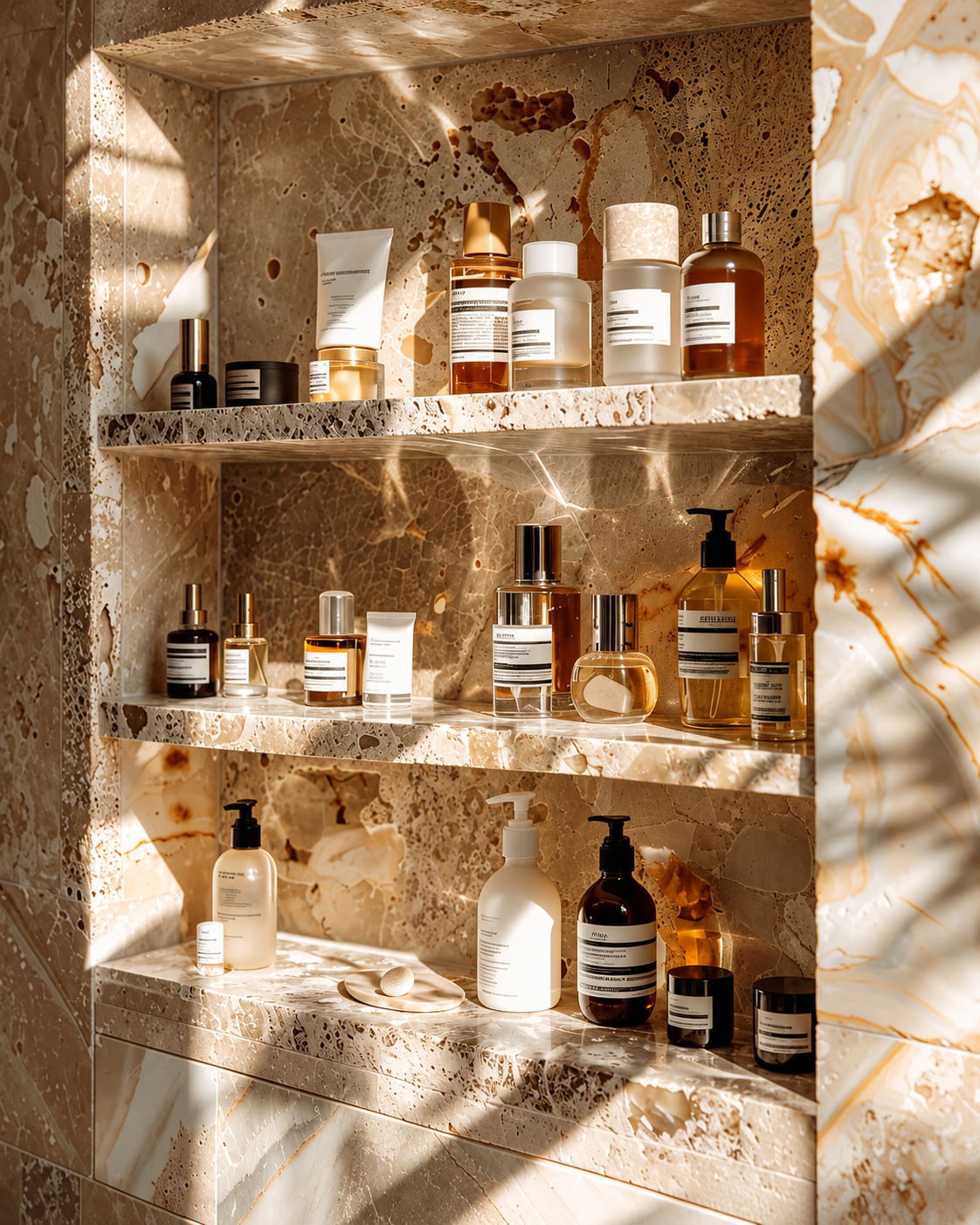
Generative AI removes this constraint entirely. The world surrounding the product no longer needs to exist before it can be photographed. It can be imagined, specified, and generated — and it can be imagined at a scale and with a specificity that no physical production could match. A brand can place its hero product in a landscape that has never existed, in a quality of light that has never been captured, in a material environment that has no physical analogue, in a visual world that is entirely its own. This is not special effects applied to photography. It is world-building as a brand communication strategy.
The most forward-facing beauty brands have already identified this capability as a competitive differentiator. Fenty Beauty’s visual positioning has always been defined not just by its products but by the specific cultural world its imagery inhabits — a world with distinct aesthetic codes, cultural references, and emotional register that communicate the brand’s identity as powerfully as any product claim. Rare Beauty’s visual language is built around emotional authenticity and a specific quality of warmth and vulnerability that distinguishes it from every other luxury makeup brand. YSL Beauty’s campaign aesthetics encode a particular Parisian luxury sensibility that is as much a function of the visual environment as of the product itself. For each of these brands, the world surrounding the product is as important as the product — and generative AI provides the means to build, refine, and extend that world with a consistency and creative ambition that traditional photography cannot sustain across the volume of content that modern brand communication requires.

AI-assisted creative direction describes the collaborative process in which a human creative director uses generative AI tools as an integral part of the creative development process — not as a production tool operating at the end of a creative process, but as a thinking tool operating throughout it. In practice, this means using AI image generation to explore visual concepts before they are committed to production, to test creative directions before briefs are written, to develop brand aesthetic vocabularies by generating and evaluating hundreds of possible visual interpretations of a brand identity, and to refine the specific visual language of a campaign through iterative generation rather than through physical experimentation. The creative director remains the author of the aesthetic vision; the AI becomes an instrument of its exploration. The most sophisticated beauty consumers already apply this intelligence to ingredient selection — the same analytical precision is now entering how brands construct the visual intelligence around those products.
The beauty industry’s move into gaming environments, virtual platforms, and digital-native brand experiences extends this logic further. Beauty brands entering Roblox, exploring Web3 brand expression, or developing virtual influencer strategies are not building extensions of their physical product lines. They are building entire alternative aesthetic universes — worlds in which their brand identity can be expressed through digital fashion, virtual environments, avatar aesthetics, and interactive experiences that have no physical equivalent. Generative AI is the primary creative tool that makes building and populating these universes at scale a realistic strategic option rather than a resource-prohibitive experiment. The brands that understand this are already operating on a different creative timeline from those that do not.
The new economics of beauty content — where creative value is being restructured
The economic argument for generative AI in beauty is frequently made in terms of cost reduction: AI is cheaper than photoshoots, faster than traditional production, and requires fewer people. This framing is not wrong, but it is incomplete in ways that matter strategically. The more important economic argument is not about what AI eliminates from the production process but about what it makes possible that was previously impossible — and about how that changes where competitive advantage is created and captured in the beauty industry’s creative economy.
The traditional production model had a specific economic logic: large budgets produced large campaigns that generated high-quality visual assets that could be deployed across platforms and markets for the duration of the campaign cycle. The per-asset cost was high, which meant that the number of creative directions that could be explored before a campaign was committed was limited by the cost of exploring them. Experimentation was expensive. Creative risk was financially penalised. The brands with the largest production budgets could explore more creative territory than those with smaller ones — and the gap between the most visually sophisticated beauty campaigns and the least sophisticated was largely a function of production investment.
Generative AI restructures this logic in two ways that are independently significant and jointly transformative. First, it reduces the cost of creative exploration to near zero — which means that the number of creative directions a brand can explore before committing to production is no longer a function of budget but of creative vision and strategic intelligence. Second, it makes high-quality visual content production accessible at a price point that was previously inaccessible to the majority of beauty brands — which means that the competitive advantage that the largest brands derived from production budget is progressively eroded, and the competitive advantage that matters most becomes the quality of the creative thinking rather than the scale of the production resource behind it.
The evidence from early deployments supports both claims. Unilever’s Beauty & Wellbeing teams in Southeast Asia deployed AI-generated content to produce marketing assets that achieved a 23% increase in ad recall and a 7% increase in purchasing intent relative to non-AI-generated comparators. L’Oréal’s ModiFace technology, which uses AI to enable virtual try-on experiences, has demonstrated a 21% increase in conversion rates for brands that have integrated it into their e-commerce environments. These are not efficiency metrics. They are effectiveness metrics — and they indicate that AI-assisted creative production, when deployed with strategic intelligence, produces better commercial outcomes, not just faster or cheaper ones.
The strategic implication for beauty brands is direct: the question is not whether generative AI will change the economics of beauty content production. It already has. The question is whether brands are building the creative and strategic capabilities required to capture the value that this change creates. Too Faced’s creation of its first fully AI-assisted ad campaign through Adobe Firefly — the first within the Estée Lauder Companies’ portfolio to test this capability at scale — is the marker of a company building those capabilities deliberately rather than reacting to them. The brands that understand AI as a creative strategy rather than a production efficiency will be the ones that capture the most significant competitive advantage from this transition.
This does not mean that the photographer, the creative director, the makeup artist, or the production team are becoming obsolete. It means that the value they create is shifting. The same dynamic that has restructured creative value in design and technology is restructuring it in beauty: the premium is moving from execution toward conception, from production volume toward conceptual intelligence, from technical skill toward strategic vision. The most significant creative professionals in the beauty industry of the next decade will not be defined by what they can produce. They will be defined by what they can imagine precisely enough to guide an AI system toward an image that has never existed but that looks exactly right.




The future beauty consumer between reality and imagination
The structural transformation that generative AI is producing in beauty content creation is the visible surface of a deeper shift in the relationship between beauty brands and the consumers they serve. The consumer who interacts with beauty in 2030 will not experience a clear boundary between physical beauty products and digital beauty experiences. They will experience both simultaneously — and the brand that cannot operate fluently across both registers will be operating with a structural disadvantage that no amount of product quality or physical retail presence can fully compensate for.
The signals of this transition are already present and measurable. Virtual influencers — AI-generated figures with distinct visual identities, aesthetic sensibilities, and social media presences — are building followings in the beauty space that some physical influencers cannot match. AI-generated campaigns are reaching audiences that traditional photography never reached, through visual aesthetics that traditional photography could never produce. Augmented reality try-on experiences, powered by AI systems like L’Oréal’s ModiFace and similar platforms, are changing the consumer’s relationship to product discovery — from a tactile, in-store encounter to a personalised, AI-mediated exploration that can occur at any moment, in any context, on any device.
L’Oréal’s launch of Beauty Genius in 2025 — a 24/7 personal beauty assistant powered by agentic AI and accessible through WhatsApp, capable of personalising skincare routines based on facial scans and providing expert guidance across the company’s entire product portfolio — represents the most complete available expression of what the AI-mediated beauty experience looks like at consumer scale. It is not a chatbot with a beauty skin. It is an AI system that combines decades of accumulated beauty expertise with the personalisation capability of a system that understands each individual user’s specific skin, concerns, and preferences. The consumer who interacts with it is not interacting with a technology product. They are interacting with a beauty intelligence.

The gaming and virtual environment dimension of this transition extends the logic further. Beauty brands that have entered Roblox, developed digital fashion lines for virtual platforms, or created avatar aesthetic systems are not pursuing experimental marketing strategies. They are building relationships with consumers in the environments where those consumers spend significant portions of their time — environments where the brand’s visual identity, its aesthetic intelligence, and its cultural positioning are as important as in any physical retail context, and where the ability to generate, adapt, and deploy compelling visual content at scale through AI is not an advantage but a prerequisite for meaningful participation. The most culturally resonant beauty brands have always understood that their universe is larger than their products — digital environments simply make that universe literal.
The consumer who grows up with these experiences will not understand the distinction between physical beauty and digital beauty in the way that earlier generations did. Beauty, for this consumer, will always have had a digital dimension — will always have included AI-mediated product discovery, virtual try-on, personalised recommendation, and digital aesthetic expression. The brands that have built the creative and technological infrastructure to serve this consumer fully, across both physical and digital registers, will be the ones that define what beauty means in the next decade. The brands that have not will be defining what it meant in the previous one.
Midjourney is an AI image-generation platform that converts written prompts into high-quality visual images. Unlike photography-based content tools, Midjourney generates images from language descriptions entirely — the images it produces have no camera, no studio, no physical set, and no model unless specified. In professional beauty brand contexts, it is used primarily for three purposes: creative concept exploration (generating multiple visual interpretations of a campaign direction before committing to production), brand aesthetic development (building and refining the visual language of a brand identity through iterative image generation), and content production (creating finished social media assets, product environment imagery, and editorial visuals). Its relevance to the beauty industry is significant because beauty is a visual category that has historically required extensive physical production to communicate effectively — and Midjourney, alongside platforms like Adobe Firefly, Google’s Imagen, and DALL-E, provides a visual production capability that does not depend on physical assembly.

The intelligence advantage — what separates the brands that will lead
The question that the beauty industry’s most strategically sophisticated brands are now attempting to answer is not whether generative AI will be important to their creative and commercial futures. That question has been answered by the investments of L’Oréal in its Nvidia and Google partnerships, by Estée Lauder’s deployment of Adobe Firefly across its portfolio, by Unilever’s integration of over 500 AI-powered tools across its value chain, and by the commercial results that early adopters are already reporting. The question is what separates the brands that will use AI to build genuine competitive advantage from those that will use it to produce cheaper content at higher volume.
The answer, from the evidence of the deployments that have produced the most significant results, appears to be creative intelligence — the ability to deploy AI as a thinking tool rather than a production tool, to use it to explore creative territory rather than to execute predetermined creative directions, and to build the organisational capabilities required to integrate AI into a genuinely strategic creative process rather than treating it as a department within a production workflow.
The brands that are leading the transition are not the ones that have simply purchased AI tools and integrated them into existing workflows. They are the ones that have restructured the creative process itself — moving creative decision-making earlier in the process, investing in the prompt engineering capability required to deploy AI with precision and brand fidelity, building the curatorial intelligence required to evaluate AI-generated outputs against brand strategy rather than simply against technical quality, and developing the organisational culture required to treat AI as a creative partner rather than a production substitute.
The competitive landscape that emerges from this transition will be characterised by a new form of creative inequality: not between brands with large production budgets and brands with small ones, but between brands with strong creative intelligence and brands that lack it. The democratisation of production capability that generative AI provides — the fact that a small brand with a strong creative vision can now produce visual content of a quality that previously required significant production infrastructure — means that the advantage of scale is progressively eroded. What replaces it is the advantage of imagination: the ability to see what a brand could look like, to specify it precisely enough to bring it into existence through AI, and to deploy it with the strategic coherence that builds a visual identity that compounds in recognition and authority over time.
The future of beauty will not belong only to brands with the largest production budgets. The same logic that defines value in the most considered luxury categories — that the most enduring competitive advantage belongs to those who understand what they are making deeply enough to make it with genuine intention — applies to beauty brand communication in the AI era with particular force. The brands that build that understanding, and develop the creative and technological capability to act on it, will define what beauty looks like in 2030. The ones that treat generative AI as a production efficiency will produce more content. The ones that treat it as a creative intelligence will produce more meaning.
That distinction will determine everything.
“The beauty industry has always been built on imagination.
What generative AI has changed
is not the importance of imagination
but the speed at which it becomes visible.
The brands that will define beauty in 2030
are not the ones producing the most content.
They are the ones imagining the most precisely —
and building the intelligence
to translate that precision into a world
that has never existed
but that looks exactly right.”

