
On the convergence of fashion houses and hospitality architecture, the Italian minimalist design language of ACPV Architects Antonio Citterio Patricia Viel, the role of Michelin-starred gastronomy in luxury destination identity, and what Bvlgari Resort Dubai proposes about the future of travel by 2030
Luxury travel has entered a new era — one in which the question a guest asks upon arrival is no longer “where will I sleep?” but “what world am I entering?” The most consequential shift in contemporary hospitality is not a shift in amenity or service standard. It is a shift in the fundamental proposition of the luxury hotel itself: from accommodation to immersion, from stay to identity, from a place that provides a service to a place that extends a philosophy. Fashion houses have understood this shift with particular clarity — and in extending their creative languages from jewellery, couture, and design into architecture and hospitality, they have produced the most architecturally serious, most conceptually coherent, and most intellectually ambitious hotels in the world.
Bvlgari Resort Dubai is the fullest expression of this proposition that the Italian maison has yet built. Opened in 2017 on Jumeira Bay — the seahorse-shaped private island created by the Meraas development group as Dubai’s most exclusive luxury residential address, accessible via a 300-metre dedicated bridge — the resort occupies a 1.4-million-square-foot site on which ACPV Architects Antonio Citterio Patricia Viel, who have designed every Bvlgari Hotels & Resorts property since the brand entered hospitality in Milan in 2004, have produced a building that is simultaneously Italian in its material intelligence, contemporary in its spatial logic, and specific in its response to its location above the Arabian Gulf. It is one of the most considered buildings in Dubai. It is one of the most considered luxury resort buildings anywhere.
This editorial examines Bvlgari Resort Dubai not as a hotel to be reviewed but as a case study in the future of luxury hospitality — in the specific question of what it means when a fashion house decides to build a world rather than a hotel, and what that world can communicate about architecture, craftsmanship, gastronomy, wellness, and the evolving definition of what contemporary luxury travel is for.
When fashion houses become hospitality houses — the architecture of brand immersion
The relationship between luxury fashion and luxury hospitality is not an accident of diversification strategy. It is the logical extension of a set of values — craftsmanship, material intelligence, attention to proportion, the conviction that the detail carries meaning — that have always been intrinsic to both disciplines. As Harper’s Bazaar’s analysis of fashion-branded hospitality observes, this is “more than diversification — it’s a new form of creative expression. Fashion becomes space. Design becomes lifestyle.” The fashion house that builds a hotel is not extending its brand into a new category. It is discovering that its brand — the specific visual and material language it has developed over decades of product creation — can be applied to the design of space with the same rigour, the same specificity, and the same communicative power that it applies to jewellery, or to leather goods, or to couture.
Bvlgari’s entry into hospitality is the most architecturally serious of the fashion-branded hotel category. When the maison announced its first hotel — the Bvlgari Hotel Milano, opened in 2004 — a Morgan Stanley analyst described the move as “an unnecessary risk.” That analysis has been comprehensively revised. The brand now operates nine hotels globally, with properties in London, Dubai, Beijing, Shanghai, Bali, Tokyo, Paris, and Rome, and forthcoming openings in Miami Beach and the Maldives. Its Executive Vice President Silvio Ursini has articulated the brand’s strategic rationale with unusual precision: “Hotels are a great way to showcase the design philosophy of a brand, to entertain its customers, and to project a lifestyle that goes beyond products.” The hotel is not a marketing exercise. It is the most complete possible expression of what the brand believes luxury means — expressed not in a product that can be worn or carried but in an environment that can be inhabited.
The distinction that separates Bvlgari’s hospitality strategy from most of its fashion-house competitors is its commitment to architectural restraint. Where Palazzo Versace deploys the brand’s baroque maximalism and Armani Hotel Dubai expresses the designer’s refined minimalism within the vertical logic of the Burj Khalifa, Bvlgari’s approach — consistent across every property and inseparable from the involvement of ACPV Architects Antonio Citterio and Patricia Viel — is one of what might be called luxurious sobriety: the deployment of exceptional materials and rigorous spatial thinking in the service of an atmosphere that communicates quality through restraint rather than through display. The Bvlgari guest does not encounter wealth as spectacle. They encounter it as the specific quality of a travertine surface, the weight of a bronze door handle, the proportion of a corridor that has been thought about with the same seriousness as the proportion of a bracelet.
Brand hospitality describes the strategic and creative practice through which luxury brands translate their aesthetic philosophy, material values, and creative identity into physical experiences — hotels, restaurants, residences, and lifestyle environments — that allow guests to inhabit the brand’s world rather than simply encounter its products. The practice emerged formally with Versace’s first Palazzo in 2000 and was significantly advanced by Bvlgari’s Milan hotel in 2004. It differs from standard luxury hospitality in that every design decision — architectural material, spatial proportion, service ritual, culinary concept, wellness programming — is understood as a communication of brand values rather than a response to generic hospitality standards. The most successful examples of brand hospitality, of which Bvlgari is widely considered the most architecturally rigorous, create environments in which the brand’s identity is more legible and more complete than in any other context, including its retail spaces.




Architecture as luxury signature — the design language of Bvlgari Dubai
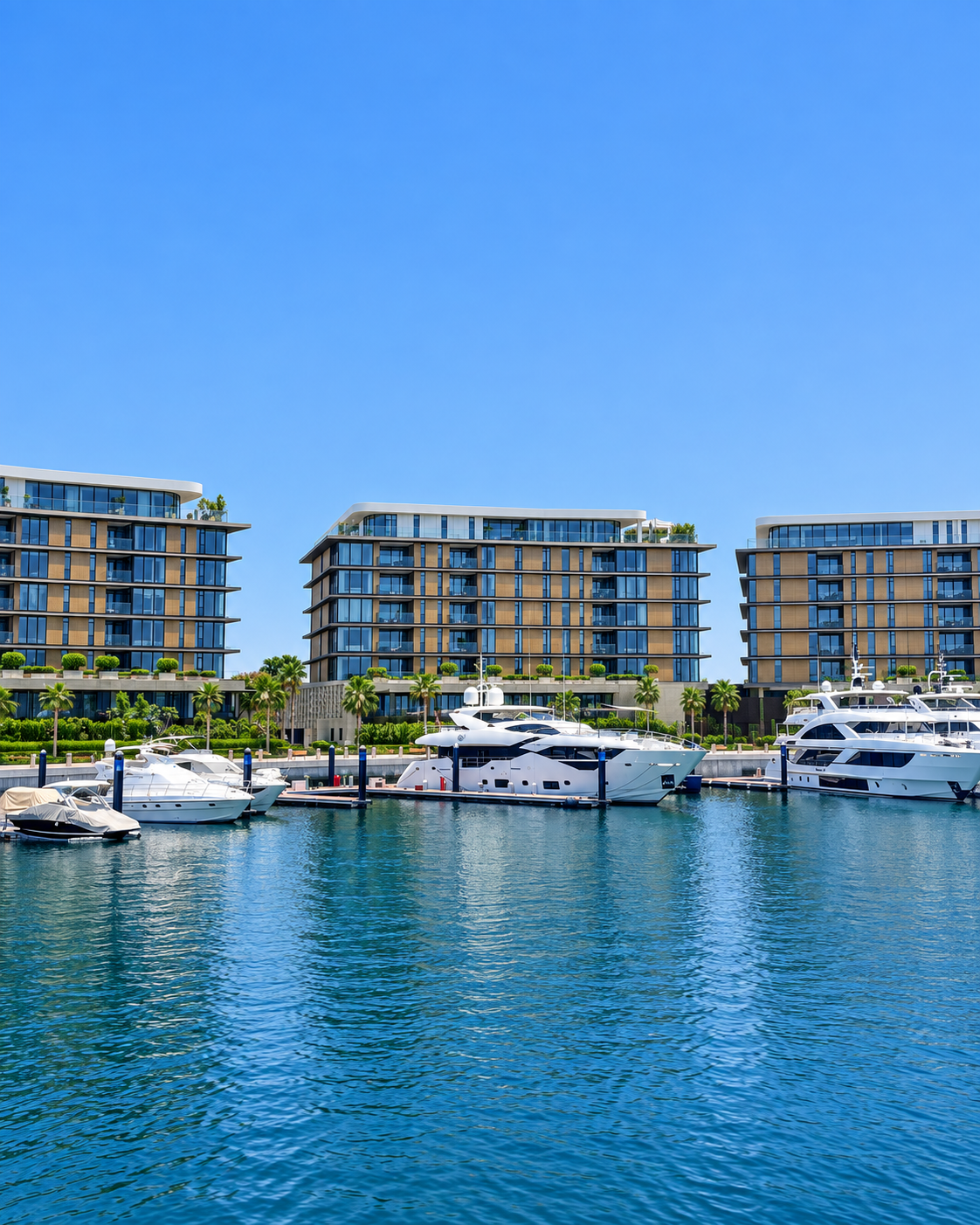
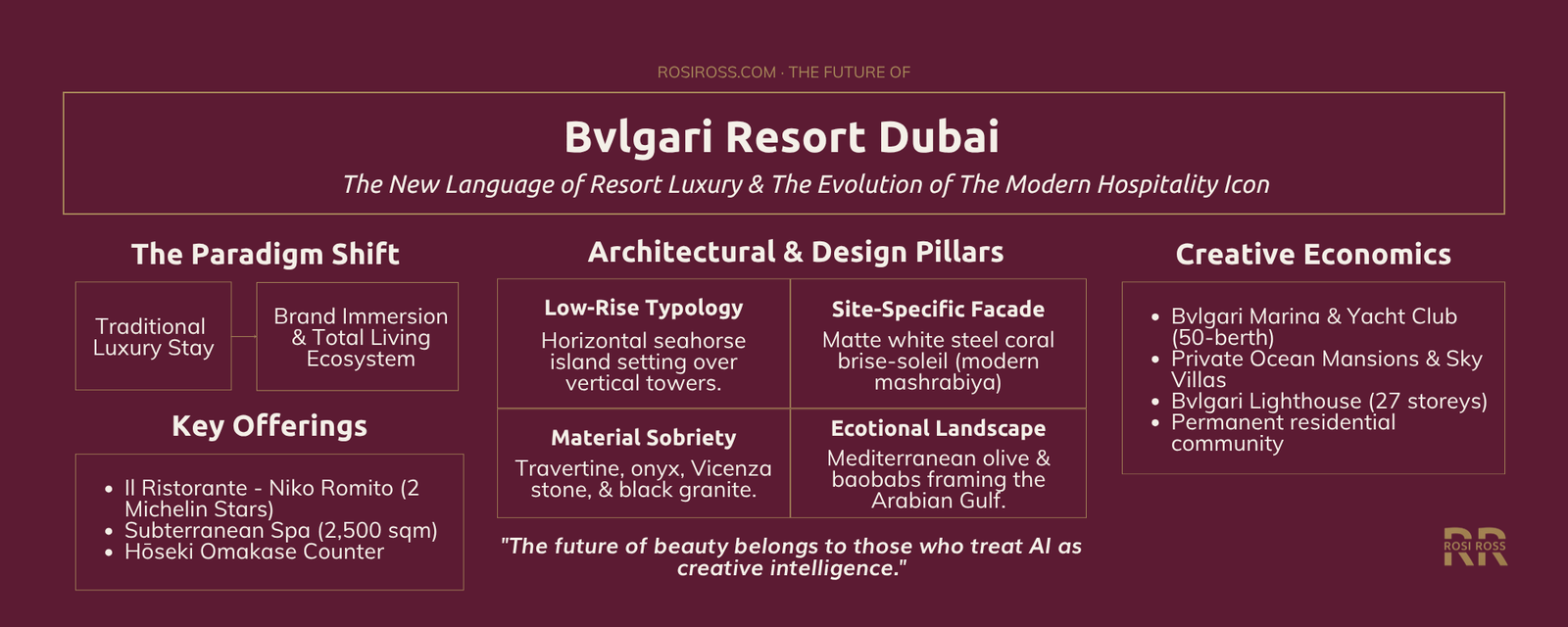
The first and most consequential architectural decision made by ACPV Architects Antonio Citterio Patricia Viel at Bvlgari Resort Dubai was one of typology: this would not be a tower but a resort — a low-rise building that settles into its island setting rather than asserting itself above it. In a city whose hospitality skyline is defined by vertical ambition, this horizontal gesture carries the weight of a manifesto. The building does not compete with Dubai’s skyline. It turns its back on it — or rather, it turns its face toward the sea, orienting its 101 rooms and suites, its twenty hotel villas, its restaurants and spa and marina toward the Arabian Gulf and the specific quality of light that falls on water from this particular angle of the Jumeira Bay coastline.
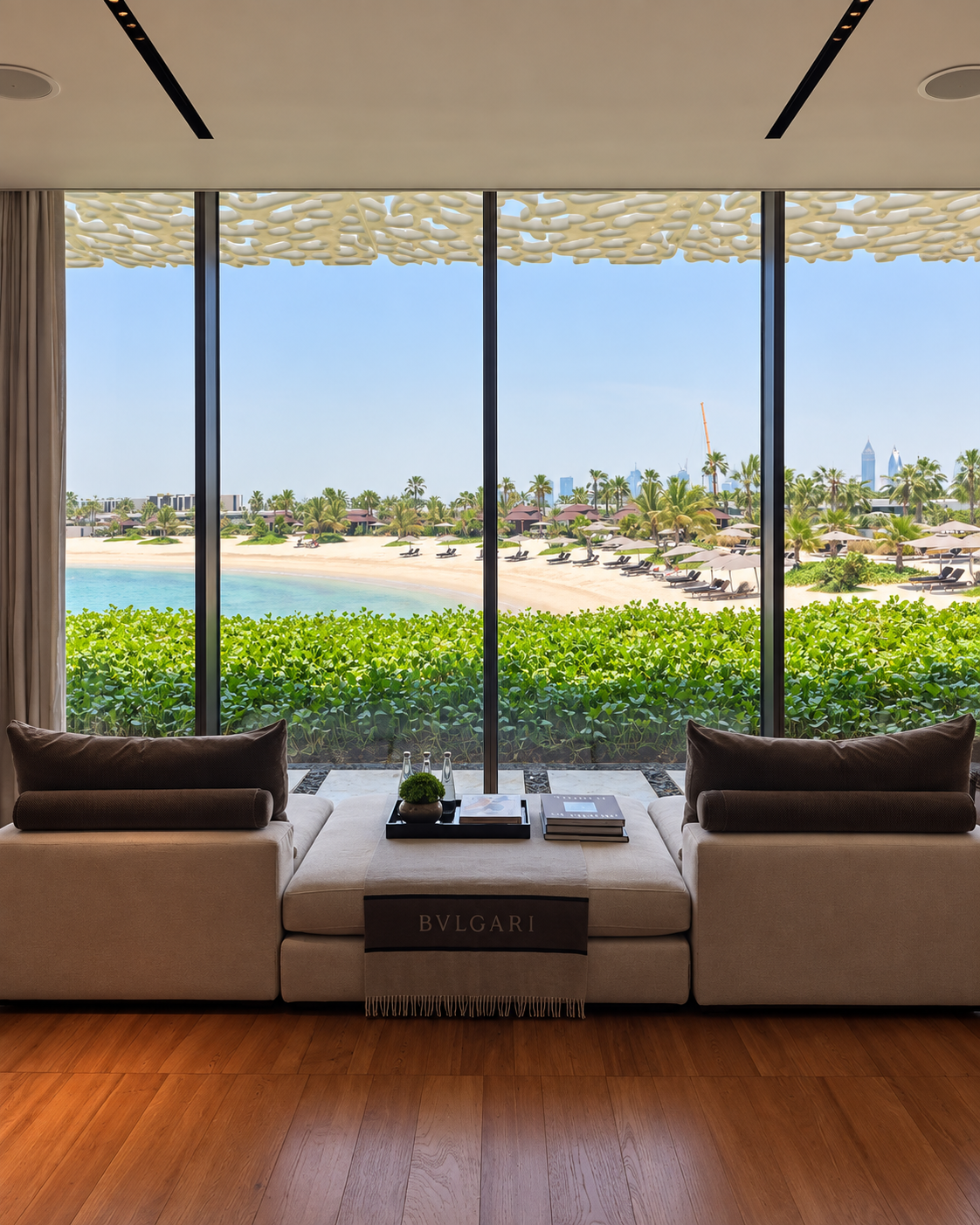
The building’s most distinctive formal element — the coral-inspired brise-soleil that wraps the façade in matte white lacquered steel — performs three simultaneous functions that exemplify the design intelligence of Citterio and Viel’s approach. Structurally, it provides shade from the Gulf sun. Formally, it gives the building a surface texture that references the organic geometry of marine life rather than the geometric precision of conventional architecture. And culturally, it echoes the mashrabiya — the carved wooden latticework screen that has filtered light and air in Middle Eastern domestic architecture for centuries — in a material vocabulary that is unmistakably contemporary without being disconnected from the specific place the building occupies. The façade is, in the most precise sense of the term, site-specific: it could not have been designed for any other location, because its formal logic is an argument about the specific relationship between light, heat, sea, and privacy at this particular point on the Arabian Gulf coastline.
The material vocabulary of the interior confirms and extends this dialogue between Italian tradition and Arabian context. Italian onyx, travertine marble, grey Vicenza stone, and Shanxi black granite provide the primary surface language — materials chosen not for their costliness alone but for their specific visual and tactile properties in the light that enters these spaces through the brise-soleil screens. Oak wood planks reference the deck of a ship, appropriate to a building sited above its own marina. The landscape design — which introduces hundreds of trees to the island, including Australian baobab alongside Mediterranean olive, lemon, rosemary, and palm — creates what the architects describe as a Mediterranean garden in the middle of the Arabian Sea: an ecotonal environment that refuses to choose between its Italian heritage and its Gulf setting, and is more complex for its refusal.
The hidden garden known as La Limonaia — the “lemon garden” — exemplifies the resort’s capacity for quiet discovery. Sculpted as a geometric Italian garden with a birch walkway and framed by Arabescato marble, it references Roman garden design while being populated by the specific wildlife of its island setting. Lanterns bearing the Maglia Pantheon design — one of Bvlgari’s most recognisable jewellery motifs, here translated into architectural lighting — subtly illuminate the walkways. The motif is so restrained that many guests will pass through the garden without consciously registering that they are walking through a piece of jewellery. This is precisely the point. The most architecturally considered luxury properties in Dubai achieve their effects through accumulation rather than announcement — through the compound interest of details noticed slowly rather than the immediate impact of gestures designed to impress at first sight.
03. The art of the hospitality ritual — why details define modern luxury
The future of luxury hospitality is not being written in amenity lists or star ratings. It is being written in the specific quality of the moment between arrival and check-in — in what happens in the interval between stepping out of a car and understanding that the environment one has entered has been thinking about this arrival in advance. The most significant development in luxury service over the past decade is the shift from reactive service — responding to expressed requests — toward anticipatory service: the creation of experiences that guests did not know to request because they had not yet understood what was possible.
At Bvlgari Resort Dubai, the arrival experience is calibrated around the specific register of quiet confidence that the architecture establishes. The 300-metre bridge that connects Jumeira Bay to the Jumeira Beach Road does not merely separate the resort from the city; it creates a threshold — a measured transition in which the density and noise of Dubai gradually recedes and the specific atmosphere of the island gradually establishes itself. By the time a guest reaches the resort entrance, the psychological shift is already accomplished. The check-in — conducted in the lobby lounge with the same quality of unhurried attention that characterises the property’s approach to every guest encounter — is not an administrative procedure. It is the formal beginning of an immersion that the architecture has been preparing since the moment the bridge began.
The service philosophy at Bvlgari hotels is consistent with the brand’s material philosophy: it achieves its effects through precision rather than volume, through understanding rather than excess. The Michelin Guide’s assessment — that “every detail feels perfectly chosen and impossible to improve upon” — applies to the service character as precisely as it does to the architectural detail. This is the hospitality equivalent of the jeweller’s standard: nothing that does not need to be there, and nothing that should be there that is missing.
Experiential hospitality describes the design and programming of hotel environments around memorable, emotionally resonant experiences rather than around the transactional provision of accommodation and service. It represents the most significant shift in luxury hospitality since the introduction of the boutique hotel in the 1980s: where the boutique hotel responded to the standardised anonymity of chain hotels by offering individuality and character, experiential hospitality responds to the commodification of individuality itself by offering depth — experiences so specifically designed, so culturally coherent, and so emotionally precise that they cannot be replicated by any other property and cannot be understood through any medium other than direct physical encounter. Bvlgari Resort Dubai exemplifies experiential hospitality in its most architecturally rigorous form: every material choice, every spatial proportion, every service ritual, every culinary programme contributes to a single coherent experience of inhabiting the Bvlgari world.

The new Italian table — gastronomy as cultural storytelling
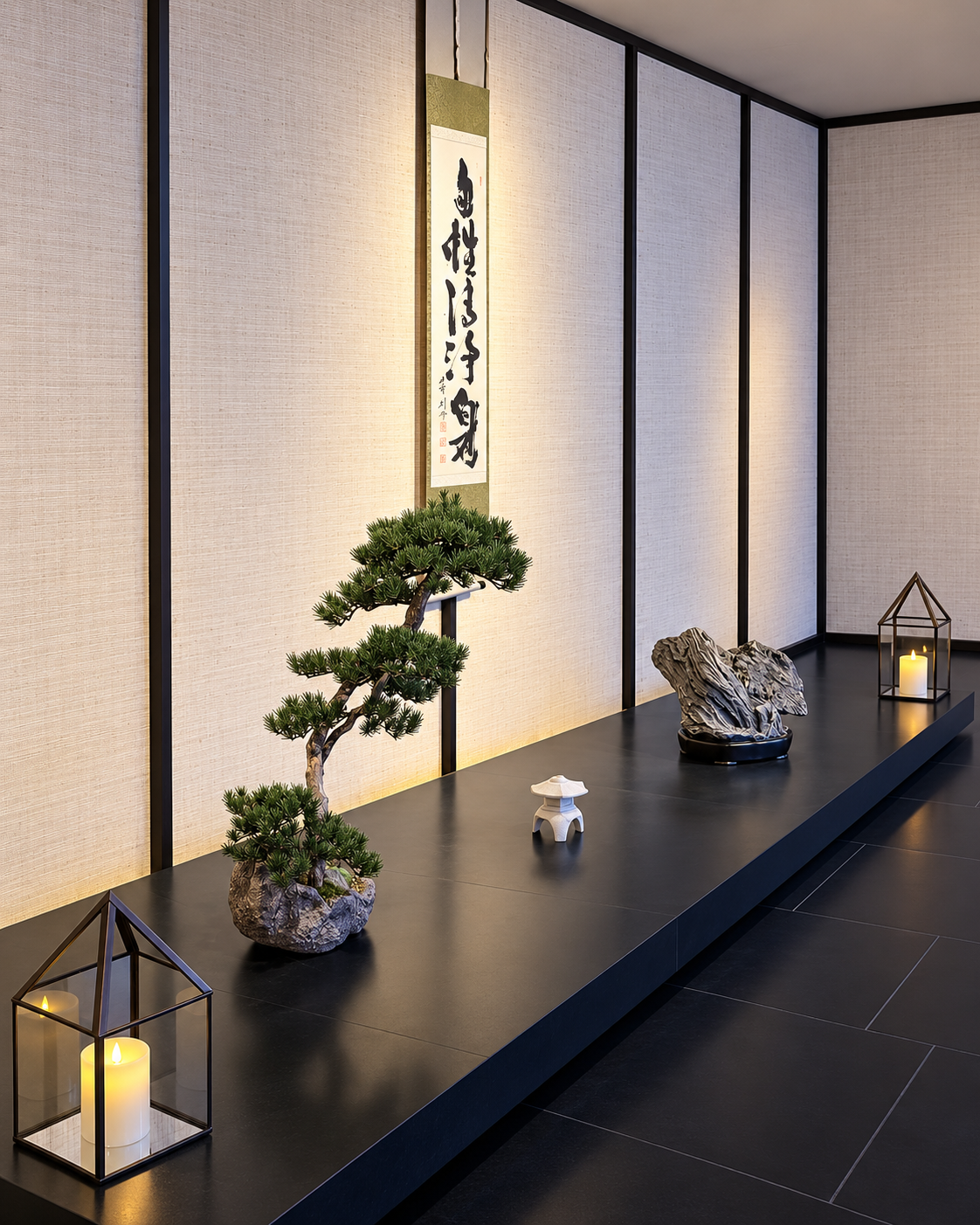
The culinary programme at Bvlgari Resort Dubai is the most intellectually ambitious restaurant portfolio operating within a single luxury property in the Gulf. It is anchored by Il Ristorante — Niko Romito, which has held two Michelin stars in the Michelin Guide Dubai for three consecutive years since 2022 — and extended by Hōseki, the omakase counter conceived by chef Masahiro Sugiyama, and by Il Caffè, the all-day dining restaurant whose marine-facing terrace frames the resort’s relationship to its island setting as consistently and as eloquently as any architectural gesture.
Niko Romito is one of the most significant figures in contemporary Italian gastronomy. His restaurant Reale, in the Abruzzo region of central Italy, holds three Michelin stars for a cuisine whose defining characteristic is what Romito himself describes as “simplicity as complexity” — the radical reduction of each dish to its essential ingredients, prepared with a technical precision that reveals rather than obscures the intrinsic character of those ingredients. The same philosophy governs Il Ristorante at Bvlgari Resort Dubai, where resident chef Giacomo Amicucci works from Romito’s framework to produce a menu that is simultaneously deeply Italian — rooted in the specific regional traditions and seasonal rhythms of Italian food culture — and precisely calibrated for the Arabian Gulf context in which it is served.
The design of Il Ristorante mirrors this philosophy. Raised banquettes orient diners toward the Arabian Gulf through full-height glazing. A dramatic black ceiling creates the impression of dining under the night sky, even during daylight hours — an interior architectural gesture that references Bvlgari’s jewellery heritage (the quality of dark settings that allow stones to illuminate) while achieving a spatial atmosphere of concentrated, focused intimacy. The wine programme, extending to over 700 carefully curated labels with a particular emphasis on Italian vintages, is managed with the sommelier precision that the culinary concept demands. The most considered dining experiences in Dubai understand that the restaurant’s environment is not the backdrop for the meal but its first course — and Il Ristorante demonstrates this understanding with the completeness of a room that has been thought about as seriously as any dish on its menu.
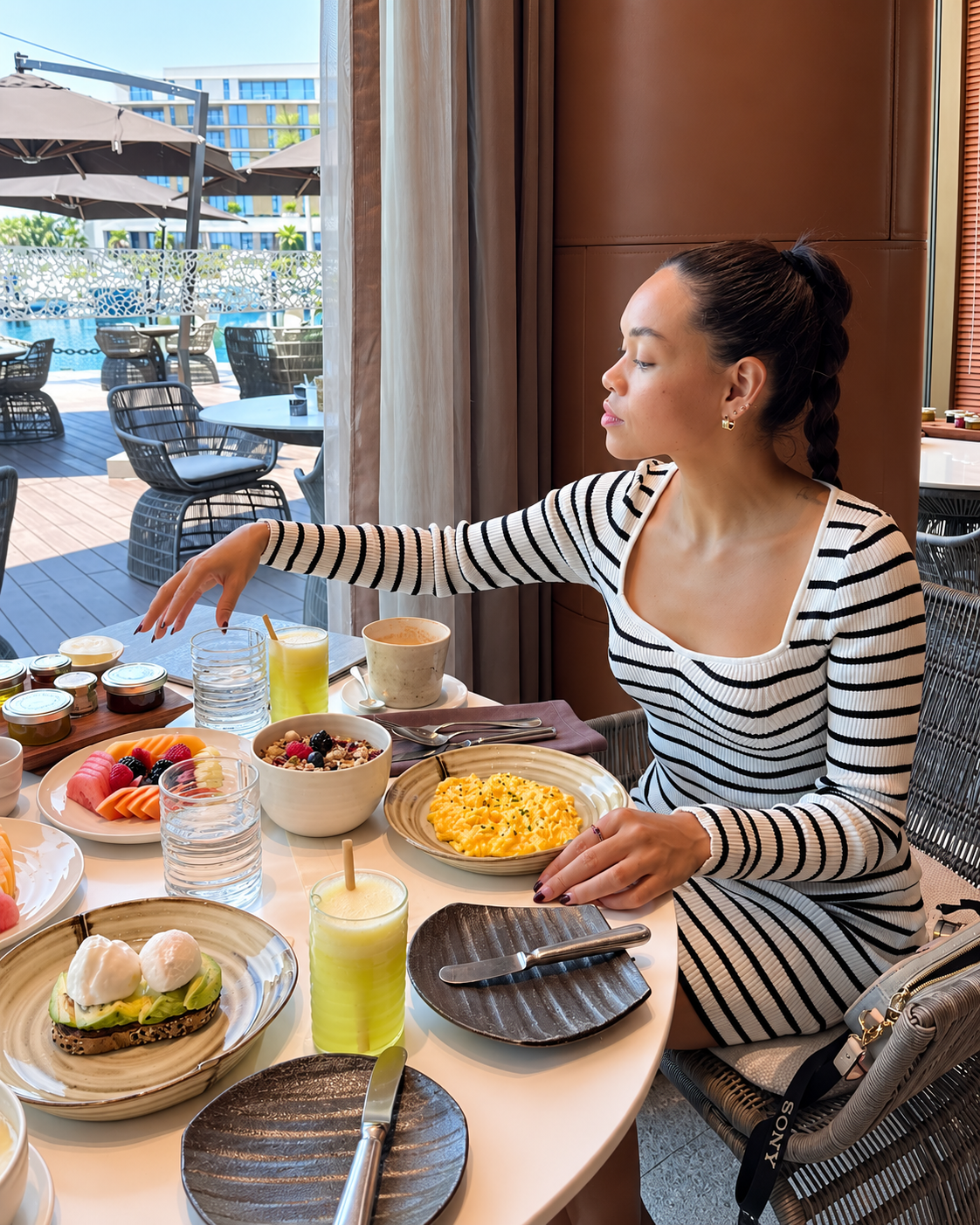
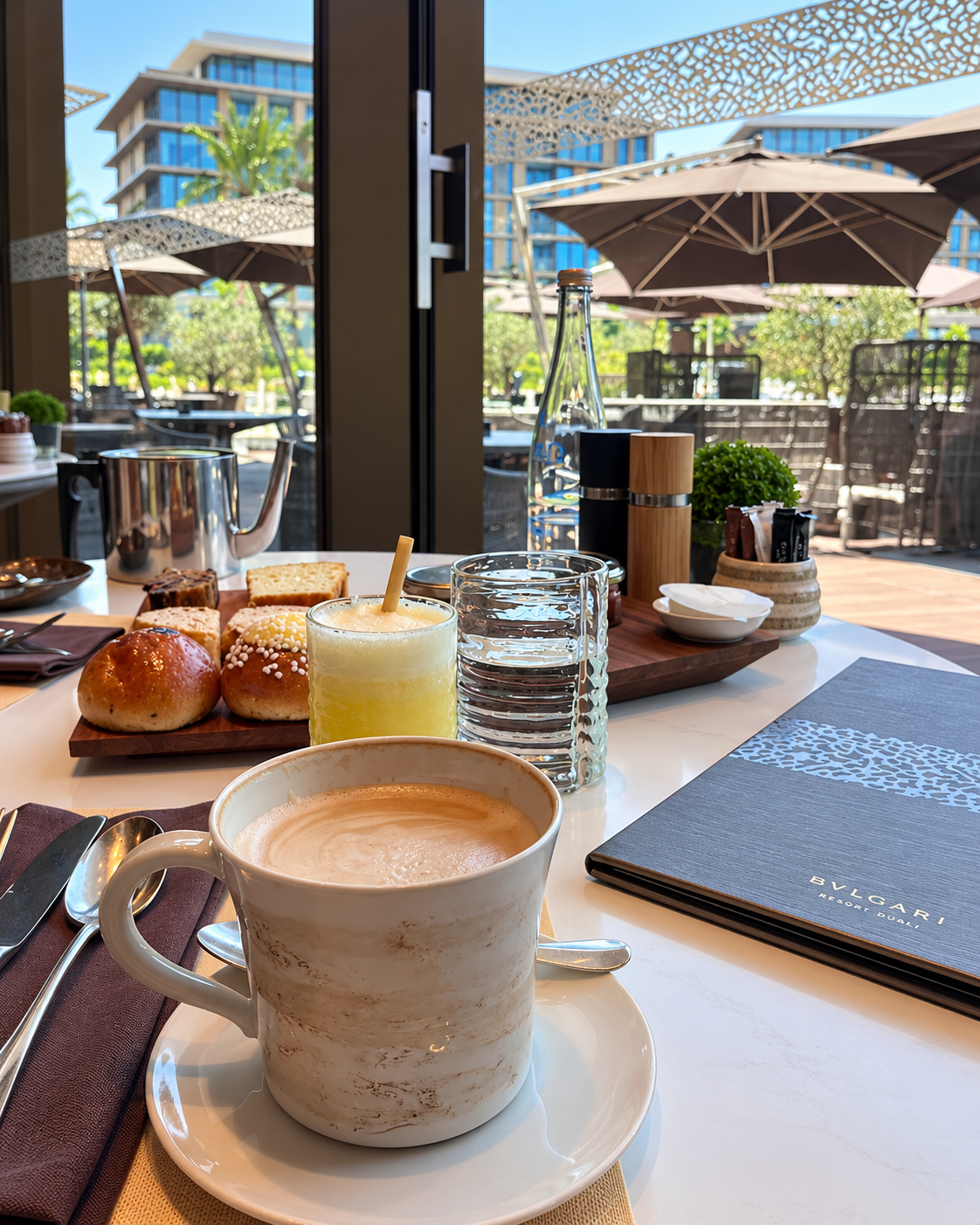
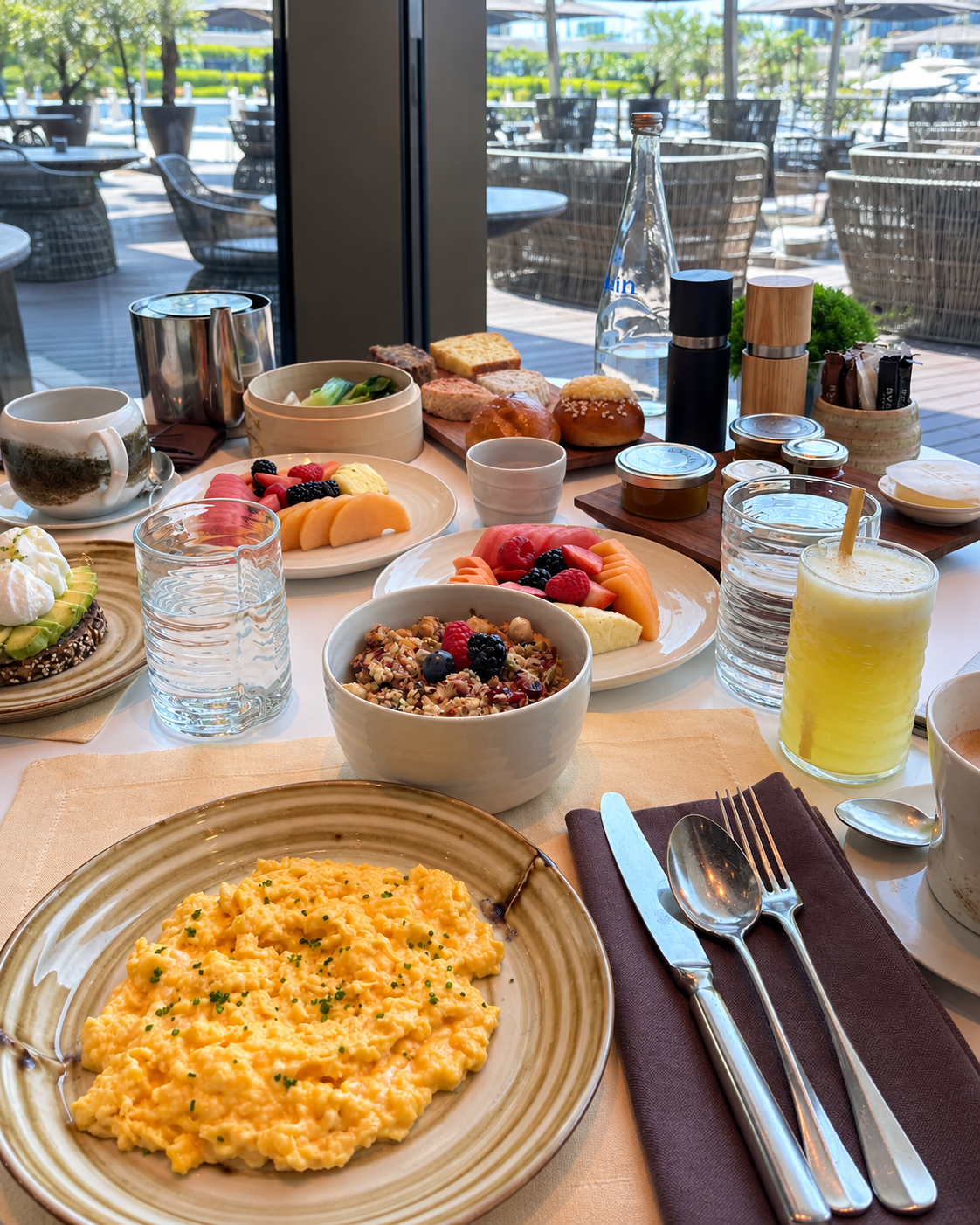
Il Caffè, by contrast, proposes a different and equally coherent argument: the transformation of the daily dining ritual into a Mediterranean ceremony. Its large deck terrace facing the marina provides the spatial frame for a breakfast that is not a meal but a considered beginning to the day — one in which the Mediterranean and Middle Eastern culinary traditions that converge in the resort’s broader identity appear simultaneously in the same spread, each specific to its own provenance, each contributing to a whole that is more than the sum of its individual dishes. The crockery is from the resort’s own collection, designed with the same material intelligence that governs the architecture. The coffee is prepared with the same precision that governs the kitchen. Nothing is incidental.





Wellness as the ultimate luxury — the architecture of restoration
The Bvlgari Spa is a 2,500-square-metre environment that occupies the resort’s lowest level with the architectural logic of a building designed to be discovered rather than advertised — a subterranean world in which the Gulf light filters through screens and water features with an atmospheric quality that is immediately distinct from the sun-saturated environment of the island above. It contains treatment rooms, changing facilities, a hydrotherapy circuit, sauna, steam room, and a 25-metre indoor pool that frames an uninterrupted view of the marina through a fully glazed end wall: water addressing water, interior space dissolving into exterior space through a single architectural gesture of extraordinary simplicity and extraordinary effect.
The evolution of the luxury hotel spa from an amenity to a destination — from something provided as part of a package to something sought as the primary purpose of travel — is one of the defining developments in contemporary hospitality. The traveller who books a three-night stay primarily to experience the Bvlgari Spa is not an unusual guest profile; they are an increasingly standard one. The most considered wellness experiences understand that restoration is not a service to be delivered but an environment to be inhabited — that the therapeutic effect of a spa is as much a function of its spatial quality, its material character, and its relationship to light and water as it is of the treatments provided within it.
The Bvlgari Spa’s design reflects this understanding with a consistency that extends from the macro-architectural scale — the decision to position the spa below grade, sheltered from the island’s ambient noise and light — to the specific material choices of its interiors: the same dialogue between Italian stone tradition and Gulf context that governs the resort’s architecture above ground, expressed here with a quietness commensurate with the spa’s function. The 25-metre pool’s relationship to the marina view is not incidental. It is the room’s primary spatial argument — an invitation to understand swimming laps as an act of orientation toward the water that constitutes the resort’s essential identity, and to understand restoration as something that happens not in isolation from the environment but in conscious relationship to it.
Modern luxury travel is defined by a structural shift away from material excess and toward experiences that provide privacy, personalisation, cultural connection, and emotional depth that cannot be replicated by any digital equivalent and cannot be purchased at any price point lower than the one that makes genuine bespoke attention economically viable. The contemporary luxury traveller — particularly among the millennial and Gen Z ultra-high-net-worth demographic that now constitutes the fastest-growing segment of luxury travel demand — is, as Harper’s Bazaar observes, “looking to be understood” rather than dazzled. The most significant luxury resorts of the 2020s are those that have translated this understanding into specific design decisions: the elimination of unnecessary scale in favour of genuine intimacy, the prioritisation of spatial quality over spatial quantity, the deployment of exceptional materials in contexts where they can be properly experienced rather than merely witnessed, and the creation of service environments in which anticipation — the sense that the guest’s needs have been considered before they were expressed — is the primary differentiator.
Beyond the stay — residences, yacht culture, and the new luxury ecosystem
The Bvlgari Resort Dubai is not a hotel in the conventional sense of an institution that provides temporary accommodation. It is the centrepiece of a complete luxury ecosystem in which the distinction between guest and resident, between temporary visitor and permanent inhabitant, is deliberately blurred — and in which the experience of inhabiting the Bvlgari world can extend from a single night to a lifetime.
The Bvlgari Marina & Yacht Club — with its 50-berth marina, the most operationally substantial luxury hotel marina in Dubai — establishes the resort’s relationship to the sea as something more than atmospheric. For guests with access to the water, the marina transforms the resort from a land-based destination into a nautical one: a point of departure for the Arabian Gulf, the starting point for a relationship to Dubai’s coastline that no land-bound experience can provide. The yacht club’s facilities and services are calibrated for owners and enthusiasts with the same precision that governs every other aspect of the resort’s programme.
The residential dimension of the Jumeira Bay development — which includes the Bvlgari Lighthouse, a 27-storey tower comprising 31 penthouses and a Sky Villa of nine bedrooms with a 13,000-square-foot terrace, alongside six residential buildings of sea-facing apartments and fifteen private ocean mansions — creates a permanent community on the island that shares the resort’s infrastructure and its design language. The Lighthouse’s façade, inspired by coral in the same way as the resort building, casts the Bvlgari jewellery tradition in a more explicitly vertical register — the intricate patterns of the architectural coral projecting soft shadows onto the black and gold Paonazzo marble of the building’s surface, referencing the play of light on precious stones. The relationship between collectible objects and permanent investment — between things acquired for their beauty and things chosen for the lives they make possible — is the same relationship that Bvlgari’s residential strategy proposes at architectural scale.
The private residences on Jumeira Bay are among the most expensive per square foot in Dubai — a reflection not of speculative excess but of the specific combination of island privacy, architectural quality, resort access, and brand identity that they provide. The resident of a Bvlgari Ocean Mansion does not merely own a property. They inhabit a philosophy — the same philosophy that governs the jewellery design, the hotel architecture, the culinary programme, and the spa — and they inhabit it not as a guest passing through but as a permanent participant in the world that the maison has created on this particular island in the Arabian Gulf.
Dubai as the global luxury laboratory — why the city continues to redefine hospitality
The decision to build Bvlgari’s most ambitious resort on a private island in Dubai is not accidental. It reflects a set of structural conditions that make Dubai the world’s most significant laboratory for luxury hospitality experimentation — conditions that no other city currently combines with the same comprehensiveness or at the same scale.
Dubai’s luxury consumer base is uniquely globalised — drawn from every luxury market simultaneously, culturally fluent across multiple aesthetic traditions, and accustomed to the highest standards available anywhere in the world. The city functions, for the global ultra-high-net-worth traveller, as a convergence point: a place where European architectural heritage, Middle Eastern hospitality tradition, and global contemporary design are expected to coexist not as competing influences but as a synthesis. This expectation is the specific creative challenge that Bvlgari Resort Dubai was designed to meet — and the specific reason that the coral brise-soleil is simultaneously Italian in its minimalist material logic and Mashrabiya in its cultural reference, why the landscape is simultaneously Mediterranean and Gulf, why the cuisine is simultaneously rooted in Abruzzo and calibrated for Dubai’s cosmopolitan dining culture. The resort does not choose between its Italian identity and its Arabian Gulf context. It proposes that these two things are, in the hands of sufficiently intelligent designers, not opposites but complements.
The most considered luxury experiences in Dubai share this quality: a refusal to treat the city’s cosmopolitan character as a problem to be resolved through stylistic compromise and a willingness to treat it as an opportunity for genuine cultural synthesis. Dubai’s evolution as a global luxury destination is most visible in the properties that have understood this synthesis most completely — and Bvlgari Resort Dubai, with its Italian-Gulf architectural dialogue, its Michelin-starred Italian gastronomy in an Arabian Gulf setting, and its complete luxury ecosystem on a private island created specifically for this development, is the most complete expression of that understanding in the city’s hospitality landscape.
The forthcoming Louis Vuitton hotel in Paris — expected in 2026, from the house whose entire brand identity is built around travel — will be the next major statement in the fashion-hospitality convergence that Bvlgari pioneered. The most significant luxury destinations are those that understand that travel is ultimately a form of cultural education — that the place we visit teaches us something about the world and about ourselves that we could not have learned in any other way. Bvlgari Resort Dubai teaches its guests something specific and not easily articulated: what Italian elegance looks like when it takes the Arabian Gulf seriously, when it responds to the specific quality of Gulf light and Gulf hospitality tradition rather than merely importing a European aesthetic into a Middle Eastern setting. The lesson is legible in the coral façade, in the travertine corridors, in the black ceiling of Il Ristorante, in the 25-metre pool’s relationship to the marina view. It is a lesson about how to make a place that is genuinely new while being genuinely itself.
A luxury lifestyle resort is a hospitality concept designed around the proposition of a complete way of living rather than the provision of accommodation and service. It is distinguished from a conventional luxury hotel by the integration of residential, recreational, culinary, wellness, and cultural programming into a single coherent environment — one in which every dimension of daily life is available at the highest possible standard, and in which the guest’s relationship to the property can develop across multiple visits and over extended periods into something approaching genuine belonging. Bvlgari Resort Dubai is a luxury lifestyle resort in this precise sense: its integration of hotel rooms, private villas, branded residences, a marina and yacht club, Michelin-starred restaurants, a 2,500-square-metre spa, and a landscape designed as a Mediterranean-Gulf garden creates an environment in which the full range of luxury living is available within a single property, governed by a single design intelligence, and expressing a single brand philosophy with the completeness that only total creative control can produce.
“The future of luxury travel
will not be defined by where we sleep.
It will be defined by what world we enter.
At Bvlgari Resort Dubai,
the coral brise-soleil filters Gulf light
through the same design intelligence
that cuts a stone in Rome.
Mediterranean garden meets Arabian sea.
Travertine meets Arabescato marble.
Niko Romito meets the horizon.
The maison has not built a hotel.
It has built a world —
and invited its guests
to understand
that the finest luxury
is always the luxury
of belonging somewhere
completely.”

