
On how a two-thousand-year-old philosophy of role, reciprocity, propriety and reputation still helps explain why hierarchy, trust and face matter inside modern Chinese business, and why reading them can change a deal without changing a single contractual term
Confucius never wrote a management manual, yet Chinese business still carries the imprint of a social philosophy built around relationships, roles and reputation.
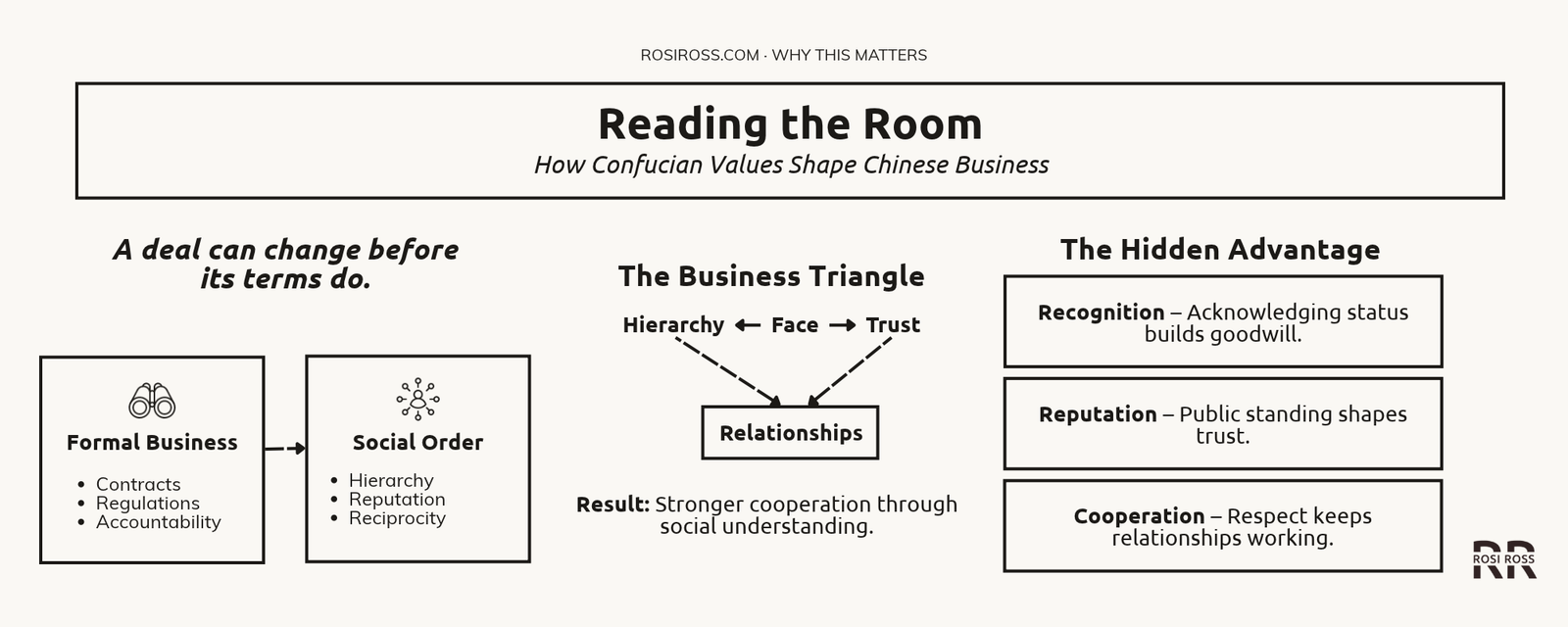
A negotiation can fail long before anyone says no. Sometimes the decisive moment is the one in which someone is corrected too publicly, bypassed too visibly, or made to lose face in front of the wrong people. Nothing in the contract changes. The temperature of the room does. The counterpart who was forthcoming a day earlier becomes courteous, correct and difficult to reach, and the foreign team, who heard every word and missed the signal, concludes that the other side has become unreasonable. (This scene is a composite, an illustration of a pattern and not a report of a single meeting.)
In Chinese business, social order can be part of the commercial infrastructure. That is the argument of this essay, and it carries a deliberate limit. It does not claim that every Chinese business practice descends from Confucius, that executives quote him in meetings, or that Chinese companies are simply “Confucian”. It claims something narrower and more interesting: that institutions can absorb philosophical assumptions so thoroughly that they keep shaping behaviour long after the original text has faded from view.
The question is how a philosophy more than two thousand years old can still affect the behaviour of modern firms. The answer is informal institutions. Law, contracts and regulation shape business formally. Culture shapes expectations about what competent, trustworthy and socially appropriate behaviour looks like, and those expectations are most visible when something is at stake. Face is where they become legible.
How to Read This Essay: Four Layers of Evidence
Philosophy explains the vocabulary. Research tests the claims. Neither describes every company.
The essay keeps four kinds of knowledge apart. The first is historical: standard accounts of Confucius and the concepts attributed to his tradition. The second is peer-reviewed management and psychology research on face, guanxi and trust, which is rigorous and limited to the samples it studied. The third is current corporate research that measures modern effects of Confucian culture. The fourth is interpretation, which is the argument this essay is making. Business interviews and market commentary, where they appear, are context and not universal truth. Where the layers disagree, or where a study cannot carry the weight placed on it, the text says so.
Who Was Confucius, and Why Business Still Cares
The business relevance is not that executives quote Confucius. It is that a social operating system can outlive its source.
Confucius lived from 551 to 479 BCE, during a period of political fragmentation in ancient China. His teaching concerned the practical construction of social order more than abstract metaphysics: ethical behaviour, proper roles, learning, ritual, reciprocity and moral leadership. His influence survived because Confucianism became embedded over subsequent centuries in Chinese education, administration, family organisation and elite political culture, long enough for its assumptions to feel less like a doctrine than like common sense.
The evidence for that persistence is more than anecdotal. Gu, Liang and Zhang’s study, “Shaped by Confucius: The Cultural Origin of Corporate Behavior”, published in the Journal of Financial and Quantitative Analysis in 2026, examines how Confucian culture operates as an informal institution, fostering relational contracts that substitute for formal legal frameworks in shaping corporate behaviour. Using data on historical Confucian academies near firms’ headquarters in China as a measure of cultural exposure, the authors find that greater exposure is associated with higher investment in stakeholder relationships, measured by social contribution, stakeholder protection, courtesy expenses, patenting and trade credit. It is an association and not a proof of mechanism, and the paper’s own framing is that culture supports trust-based governance when formal contracting is limited. Its implication is methodological and striking: cultural history can leave measurable economic traces centuries later.
How does Confucianism influence Chinese business? Mainly as an informal institution: a set of inherited expectations about roles, reciprocity, propriety, education and trustworthiness that shapes what counts as competent and trustworthy behaviour. A 2026 study in the Journal of Financial and Quantitative Analysis found that firms with greater historical exposure to Confucian culture invest more in stakeholder relationships. It is one explanatory layer among several, not the only influence on Chinese business.





The Five Relationships and the Architecture of Role
A society that defines its relationships in advance can spend its energy on substance.
Central to Confucian thought are the five constant relationships: ruler and subject, parent and child, husband and wife, elder and younger sibling, and friend and friend. Four of the five are hierarchical, and the fifth, friendship, is the exception, which is part of why friendship carries such moral weight. The idea underneath is that people live inside defined relationships, and that each carries duties in both directions: authority carries responsibility, and deference carries a claim to protection. Read as a rulebook for a modern firm it would be absurd. Read as an account of how a society learns to expect obligation from the people it is connected to, it explains a good deal.
Hierarchy of this kind is not the same as authoritarianism, and it is not irrational. Its social function is predictability: everyone knows the expected relationship between roles. In business that can show up as attention to age, title and seniority, to who speaks first and who is introduced first, and to who should not be contradicted casually. Hierarchy becomes most powerful when no one needs to announce that it exists. It also has an architecture of its own, one of form and proportion more than of volume, an idea explored in The Architecture of Power: How Sculptural Footwear Defines Modern Luxury.
Why is hierarchy important in Chinese business? Because Confucian thought gives strong weight to role differentiation, and hierarchy gives relationships predictability: everyone knows the expected relationship between roles. In business it appears as attention to age, title and seniority, to who speaks first and is introduced first, and to who should not be casually contradicted. Hierarchy is not the same as authoritarianism, and it varies by company, sector and region.
Confucianism as an Operating System
Translate the philosophy into behaviour without flattening it.
Five concepts do most of the work: ren, humaneness, the idea that leadership carries obligations toward others; yi, righteousness, the idea that decisions should be proper and not only profitable; li, ritual and role-appropriate conduct; zhi, wisdom and learning, which give education and competence their status; and xin, trustworthiness, the requirement that word and action agree. The 2026 study maps each onto a measurable corporate trace.
| Confucian virtue | Meaning | Business behaviour it points to | Corporate trace measured |
|---|---|---|---|
| Ren | Humaneness, benevolence | Leadership carries obligations toward others | Social contribution |
| Yi | Righteousness, appropriateness | Decisions should be proper, not only profitable | Stakeholder protection |
| Li | Ritual, propriety, role-appropriate conduct | Hierarchy and manner matter | Business courtesy expenses |
| Zhi | Wisdom, learning | Education, competence and self-improvement carry status | Patenting |
| Xin | Trustworthiness, integrity | Credibility depends on consistency between word and action | Trade credit received |
The mapping between each virtue and its corporate proxy follows Gu, Liang and Zhang. It shows an association between historical exposure to Confucian culture and firm behaviour, not that any company is simply “Confucian”.
What Mianzi Really Means
Face is not vanity. It is a social valuation system.
Mianzi is often translated simply as face, and the translation can sound superficial. The research treats it as a social self involving reputation, public image, capability, dignity and standing in the eyes of others. Chinese-language scholarship also separates it from lian. Following Hu Hsien-chin’s classic distinction in her 1944 article in American Anthropologist, which deals with the shades of meaning of the two terms for face, lien and mien, in different contexts, mianzi is more strongly associated with social reputation and status, often achieved through success, while lian is more closely tied to moral character and the confidence society places in a person’s integrity. The practical consequence is that a person can have mianzi without lian, and that losing lian is generally the graver injury.
It helps to keep face inside the wider relationship system and not to isolate it. The relationship creates access and obligation. Face helps preserve the social conditions in which the relationship can continue. Guanxi is the relationship. Mianzi is part of the social value circulating inside it. Renqing, the reciprocity that maintains guanxi, and xinren, trust, work alongside both.
What does mianzi mean in Chinese culture? Mianzi is usually translated as face, but the translation can sound superficial. It refers to social reputation and standing: public image, capability, dignity and status in the eyes of others. Scholars distinguish it from lian, which is more closely tied to moral character and the personal self. Face is therefore not vanity. It is a social valuation system, and it operates inside relationships.
What is face in Chinese business? In business, face is the social standing and reputation that people carry into every interaction, and that can be given, protected, contested or ignored. Interview research describes four face practices: giving face, protecting face, vying for face and not considering it. Because business takes place inside social hierarchies, face affects how willing counterparts are to cooperate, disclose information, compromise and champion a deal internally.
What is the difference between mianzi and guanxi? Guanxi is the relationship or network, carrying access and obligation. Mianzi is the social value circulating inside it: the standing that has to be given, protected and respected for the relationship to continue. Renqing, the reciprocity that maintains guanxi, and xinren, trust, work alongside both.
The Four Face Moves in Chinese Business
The final category is often where foreign managers create damage without understanding why the relationship has cooled.
A useful behavioural framework comes from interview research by Peter Cardon, “A model of face practices in Chinese business culture: implications for Western businesspersons”, published in Thunderbird International Business Review in 2009. The author interviewed 34 Chinese and 8 American businesspeople operating in major mainland Chinese commercial centres, who described 229 business incidents involving four face practices: giving face, protecting face, vying for face and not considering face.
| Face move | What it is | In practice |
|---|---|---|
| Giving face | Publicly recognising status, competence or contribution | Acknowledging a counterpart’s expertise in front of the right people |
| Protecting face | Avoiding unnecessary humiliation or the public exposure of mistakes | Correcting an error privately |
| Vying for face | Competing for prestige, recognition or social standing | Contesting who is credited, seated or introduced first |
| Ignoring face | Acting as though another person’s status or standing does not matter | Overriding seniority, or bypassing the person expected to be consulted |
The four practices are the categories described in interviews with Chinese and American businesspeople working in mainland China. A small interview sample describes patterns and does not measure how common they are.
The last category deserves attention precisely because it is the one least often chosen on purpose. Nobody sets out to ignore a counterpart’s standing. It happens when a junior colleague is promoted in a way that a senior stakeholder experiences as disrespectful, when a decision is announced without consulting the person expected to be consulted, or when a relationship is treated as transactional before trust exists. The protective instinct behind the second category has an everyday analogue in the idea that a barrier, once protected, lets everything built on it work, the logic behind the return of barrier beauty and why lanolin is the ultimate skin investment.






Why Public Correction Can Cost More Than the Error
The practical lesson is not to avoid honesty. It is to understand venue, hierarchy and timing.
The psychology is intuitive. If a manager is corrected harshly in front of colleagues, the factual problem may be solved while the relationship problem has only begun. Humans are acutely sensitive to reputation because cooperation depends on predicting how others will behave, and face systems make that logic unusually visible: public recognition reinforces status, and public humiliation threatens not only feelings but a person’s position within the network. That is why face-saving behaviours can persist even inside highly modern, data-driven companies.
It is also why so much of this business is conducted in settings built for privacy and for the slow work of trust: private dining rooms, tea, small tables. The role of atmosphere and setting in how people behave is explored in Inside the Atmosphere Economy: How NEOM Is Redefining Modern Home Wellness, and the same insight applies. A hard conversation held in the right room can achieve what the same words in the wrong room cannot.
How should foreign managers give feedback in China? Without lowering the standard, change the delivery. Correct privately where possible, avoid public contradiction, separate difficult feedback from public performance, and give counterparts a dignified route out of disagreement. The aim is not to avoid honesty but to understand venue, hierarchy and timing, and to build systems that make bad news easy to report.
How Face Changes Negotiation Outcomes
Face does not replace economics. It changes the social environment in which economic decisions are made.
The commercial mechanism is straightforward. A counterpart who loses face may become less willing to cooperate, disclose information, accept compromise or champion the deal inside their own organisation. Giving appropriate face can strengthen trust and increase willingness to invest in the relationship. Survey evidence is consistent with this. Yen and Barnes, in a 2011 study in Industrial Marketing Management based on over 200 Taiwanese trading firms, found that buyers’ perceptions of organisational trust, communication, cooperation, social bonding and the saving of face were higher in Anglo-Chinese relationships that ventured beyond the short term. The study cannot say which causes which, and it should not be stretched into a rule. It does suggest that face is part of what a durable relationship is made of.
| Area | How face can change the trajectory |
|---|---|
| Negotiation | Counterparts may concede differently depending on status and audience |
| Partnership | Trust can determine how much information is volunteered beyond formal requirements |
| Leadership | Public criticism can affect authority and loyalty |
| Supplier management | Relationships can influence responsiveness when circumstances change |
| Government and institutional relations | Credibility and shared trust may affect access and cooperation |
| Talent | Employees may respond differently to feedback, recognition and hierarchy |
| Reputation | One interaction can travel through a network faster than the contract does |
Illustrative consequences, not predictions. Practices vary by region, sector, ownership and individual.
Why is saving face important in negotiations? Because a counterpart who loses face may become less willing to cooperate, disclose information, accept compromise or champion the deal inside their own organisation, while giving appropriate face can strengthen trust and willingness to invest in the relationship. Face does not replace economics. It changes the social environment in which economic decisions are made.
Guanxi, Mianzi and Trust
One interaction can travel through a network faster than the contract does.
Research on knowledge transfer into China, by Tan, Buckley and Clegg in the Journal of World Business in 2006, concludes that the concepts of guanxi and mianzi are fundamentally important in understanding cultural interactions in China, and that foreign investors must be aware of them to establish better connections with local partners and government. A study in the Journal of International Business Studies adds a structural insight. Chua, Morris and Ingram’s comparison of Chinese and American managers’ networks, published in 2009 under the title “Guanxi vs networking”, found that affect-based and cognition-based trust were more intertwined for Chinese than for American managers, a pattern the authors link to Chinese familial collectivism. In plain terms: the personal and the professional are harder to separate, and what a partner thinks of you is not purely a calculation about competence.
That connects to the Confucian logic of reciprocity, though the line should not be drawn too straight. Confucian social thought assumes that relationships contain duties, and modern guanxi similarly works through reciprocal obligation, with introductions, favours, information, access and support creating expectations over time. It would be wrong to claim a one-to-one lineage. It is fair to say the logic rhymes, and that it helps explain why some Chinese business relationships extend beyond what a contract formally requires. Obligations accumulate meaning with time, much as an object chosen for meaning gains significance through repeated use, the principle behind the language of modern necklaces and the new codes of personal luxury.
Why Contracts and Relationships Must Work Together
The sophisticated strategy is not relationship instead of contract. It is relationship plus contract.
Contracts establish enforceable boundaries. Relationships influence what happens in the grey zones that a contract cannot predict. A supplier may technically satisfy an agreement while doing nothing beyond it, and a trusted partner may warn you before a problem becomes visible. That gap is where relational trust earns its place, and it is why the corporate-finance research frames Confucian culture as supporting trust-based governance where formal contracting is limited.
None of this makes relationships a substitute for governance. Guanxi cannot replace contracts, due diligence or compliance, and it is not corruption. The point is that contracts and relationships do different jobs, and the manager who can do both is the one who is not surprised.
Do contracts matter in Chinese business? Yes. Contracts establish enforceable boundaries, and relationships influence what happens in the grey zones a contract cannot predict. The sophisticated strategy is relationship plus contract, not relationship instead of contract. Guanxi and face cannot replace compliance, due diligence or legal advice.
Confucian Leadership and the Authority of Conduct
Legitimacy is built through conduct: competence, consistency, restraint, responsibility and the ability to fulfil one’s role.
The Confucian ideal of the junzi, the exemplary or cultivated person, offers a useful contrast with modern charismatic leadership. Authority rests less on personality than on reliability of conduct. A 2021 study by Tian, Tang and Tse, “Understanding corporate culture and business performance from a Confucian perspective” in the Asia Pacific Journal of Marketing and Logistics, turned the idea into a measurable business concept. The authors built an 18-item scale for a Junzi orientation with five dimensions, ren, yi, li, zhi and xin, found it reliable and valid, and found that it had a positive influence on companies’ performance, using firms in Hong Kong. The sample is regional and the measures rest on company self-reports, so the finding is suggestive and not decisive. The lesson it points to is that moral reputation can function as organisational capital.
Capital of that kind accrues slowly and cannot be bought, a principle familiar from objects whose value deepens with time and care, as in The Return of the Pearl: Inside the Quiet Luxury of Robert Wan. A reputation for consistency between word and action is built a day at a time, and lost much faster.
How does Confucian leadership work? The Confucian ideal of the junzi, the exemplary or cultivated person, builds legitimacy through conduct: competence, consistency, restraint, responsibility and the ability to fulfil one’s role, before charisma. A 2021 study of Hong Kong firms measured five dimensions of a Junzi orientation (ren, yi, li, zhi and xin) and found a positive association with company performance. Moral reputation can function as organisational capital.
What Western Business Often Misreads
The competitive advantage is not choosing the better culture. It is learning to read both systems.
The comparison needs to resist caricature. Western organisations also manage reputation and status, and nobody should suggest that Western business has no face concerns. The difference is often one of degree and explicitness. In some Western corporate cultures, disagreement can be framed as task conflict and separated relatively cleanly from personal standing. In Chinese settings the same exchange may carry more relational meaning, because public status is part of the interaction. A culturally intelligent manager changes the delivery without changing the standard.
Each system has its strengths. Western business systems often excel at formalisation: transparent process, explicit accountability, contracts and scalable governance. Chinese relationship systems can be exceptionally strong at contextual trust, informal coordination, reciprocity and long-term relational investment. The most effective global operator combines both.
The game of face also has a dysfunctional side, and a credible account has to say so. Face management can protect relationships, but excessive concern with status can discourage the reporting of bad news, honest feedback and productive disagreement. Understanding mianzi means knowing when to preserve dignity and when an organisation needs systems that make truth easier to speak. A mature cross-cultural manager respects face without allowing it to become an excuse for silence.
There is a subtler warning in the literature. Carl Hinze’s 2012 paper in the Journal of Politeness Research, “Chinese politeness is not about ‘face’: evidence from the business world”, argues that concern for mianzi and lian in Chinese business interaction is just as likely to engender acts of impoliteness as it is to link with politeness. The point is not that face does not matter. It is that face is a contest over standing as much as a courtesy, and that treating it as good manners misreads it. A manager who learns to be polite has not yet learned to read the room.
Intermediaries, Gatekeepers and the Limits of Borrowed Trust
An introduction can lend credibility. It cannot lend a relationship.
For foreign companies, a common route into an unfamiliar network is an intermediary: a local partner, adviser or trusted contact who can bridge the gap between Western and Chinese business practice. Used well, an intermediary offers insight into local custom, preference and market dynamics, and a credible introduction can shorten the distance to trust. The research on trust explains why this works. If trust is more intertwined with personal relationship, then a person who vouches for you is lending a portion of their own reputation, and that is precisely why they will care how you behave.
The risks are as real as the benefits. A borrowed reputation is a debt, and an intermediary who is bypassed, overruled or embarrassed will have lost face with the party they introduced. An intermediary should not stand in for due diligence on a counterpart, for a contract, or for compliance, and any arrangement that cannot be explained plainly to a compliance officer is not one worth entering. The sophisticated use of intermediaries is to use them intelligently when trust is incomplete, and to build the direct relationship until the borrowed credit is repaid.
The Five Face Errors Foreign Managers Make
None of these mistakes appears in a spreadsheet, yet each can change execution.
Foreign managers often arrive with strong technical or financial competence and weak social calibration. The gap produces expensive misunderstandings: the wrong person is bypassed, feedback is delivered too publicly, a junior employee is empowered in ways a senior stakeholder experiences as disrespectful, or a relationship is treated as transactional before enough trust exists. The five recurring errors, and the practices that replace them, are set out below.
| The five face errors | What to do instead |
|---|---|
| Publicly embarrassing a counterpart when private correction would achieve the same result | Map the hierarchy before the meeting |
| Ignoring seniority, or introducing people in a way that visibly lowers status | Know who needs recognition, not merely who has the title |
| Forcing an immediate public yes-or-no answer when a dignified exit is possible | Separate difficult feedback from public performance |
| Taking credit that another person needs to retain internal authority | Give counterparts a face-saving route out of disagreement |
| Mistaking polite ambiguity for agreement | Document agreements clearly after relational alignment |
| — | Use intermediaries intelligently when trust is incomplete |
| — | Treat respect as operational strategy, not etiquette theatre |
Respecting face does not mean avoiding the truth. It means choosing the venue, the timing and the hierarchy in which the truth is delivered.
A culturally inexperienced observer hears the words. A culturally experienced observer also sees the seating order, who interrupts whom, who is introduced first, who receives public credit, who is corrected privately and who is allowed to exit a disagreement with dignity. Those signals reveal the actual power structure. Face is not decoration around the negotiation. It is information about the negotiation. A fashion room offers the same lesson in miniature, as the shift of fashion power explored through The Devil Wears Prada shows: authority sits where the room defers to it, and the title on the door is only part of the evidence.
Why does understanding face improve business outcomes in China? Because face is information about the negotiation. A culturally experienced observer sees the seating order, who is introduced first, who receives public credit, who is corrected privately and who is allowed to exit a disagreement with dignity, and those signals reveal the real power structure. Understanding them lets a manager change the course of a deal without changing a single contractual term.
Why Confucian Influence Still Shows Up in Modern Firms
China is not a museum of Confucianism. Confucianism is most useful as one explanatory layer inside a larger social system.
Honesty requires stating the limits. Chinese business culture has also been shaped by socialism, market reform, regional diversity, global capitalism, digital platforms, law, migration and generational change. Not every hierarchical practice is Confucian, and not every Chinese manager values face to the same degree. Practice varies by context across Chinese societies, which is exactly why the better skill is reading context and not memorising Chinese rules.
Modernisation does not simply erase social norms. It adapts them. The likelier trajectory is that Chinese business becomes more formal, digital and globally integrated while retaining strong sensitivity to reputation, hierarchy and relationships. Artificial intelligence may automate transactions, but it will not eliminate the social question of whom people trust when a transaction becomes complicated. That makes Confucian concepts more interesting, not less: they explain the human layer that remains after the process is digitised.






The Evidence Ledger: What Each Study Can and Cannot Tell You
The strength of a claim depends on what the study actually measured.
| Study | What it found | Read with care |
|---|---|---|
| Gu, Liang and Zhang (2026) | Greater exposure to historical Confucian academies is associated with more investment in stakeholder relationships | An association, not proof of mechanism; a proxy for culture |
| Cardon (2009) | Four face practices described in 229 incidents | 42 interviewees; describes patterns, not frequency |
| Yen and Barnes (2011) | Trust, cooperation and saving face higher in relationships beyond the short term | Taiwanese importers; cannot show which causes which |
| Chua, Morris and Ingram (2009) | Affect- and cognition-based trust more intertwined for Chinese than American managers | Network survey of managers; a tendency, not a rule |
| Tan, Buckley and Clegg (2006) | Guanxi and mianzi are fundamental to cultural interaction in knowledge transfer | About foreign investors; two decades old |
| Tian, Tang and Tse (2021) | A Junzi orientation scale is reliable and positively related to company performance | Hong Kong firms; self-reported measures |
| Hinze (2012) | Concern for face is as likely to produce impoliteness as politeness in business interaction | A conceptual argument with examples, not a survey |
These are studies of particular samples and do not describe all Chinese businesses or individuals. Figures and findings are dated.
How to Use Cultural Intelligence Without Becoming Performative
Manipulative praise is not cultural intelligence. Face can be given without flattery.
The temptation, once face is understood, is to treat it as a technique. It is not. Giving face is recognising a counterpart’s expertise in front of the appropriate people, giving senior stakeholders appropriate visibility, letting another person present a solution they helped build, correcting errors privately where possible, avoiding unnecessary public contradiction, acknowledging introductions and relationship labour, and showing that someone’s contribution has status inside the project. Each of these is only worth anything if it is true. Authenticity is the entire difference between respect and performance.
The same applies to the visitor’s own identity. The most effective cross-cultural operators do not become someone else. They remain recognisably themselves while reading the room accurately, an instinct explored in the language of scent and how fragrance becomes identity in modern beauty, where identity is built through precise, layered choices and not through any single performance. Respect, treated as operational strategy and not etiquette theatre, is also simply more durable.
What Would Change This View
A thesis that cannot say what would revise it is a slogan.
The argument here is that Confucian-derived expectations of role, reciprocity and reputation persist as informal institutions, that face makes them legible, and that formal institutions and informal ones operate together. Each part has a condition under which it would need revising. If research with different samples and measures finds weaker links between historical Confucian exposure and corporate behaviour, the cultural explanation should be scaled back. If formal institutions continue to strengthen and digital platforms keep replacing introductions as the source of trust, the role of face in commercial decisions may narrow to the high-value, private and cross-border settings where it already matters most. And if a generation raised on global platforms and global workplaces recasts hierarchy altogether, then the patterns in this essay will describe a period and not a permanent condition. Treat the framework as a way to ask better questions, not as a map of every room.
What remains after the process is digitised is the human layer.
The future of Chinese business will likely become more formal, digital and globally integrated while retaining strong sensitivity to reputation, hierarchy and relationships. Transactions will be automated, and contracts will be drafted and checked by software. The question that remains, when a transaction becomes complicated, is whom people trust, and that question has always been answered in part by status, standing and conduct. This is the 2030 angle: not that tradition survives untouched, but that the problem it was built to solve, how strangers become dependable partners, is permanent.
What Remains Defines the Deal
Face is not etiquette around the deal. It is part of the information inside the deal.
The story is not that Chinese business is Confucian and so one must remember to save face. It is how a two-thousand-year-old philosophy of role, reciprocity, propriety and moral reputation still helps explain why hierarchy, trust and mianzi matter inside modern Chinese business, and why understanding these invisible social rules can change how a negotiation, a partnership or a career develops.
Face is who has status, who feels exposed, who needs recognition, and where the real decision-making power may sit. Read that, and the temperature of the room stops being a mystery.
“A negotiation can fail
before anyone says no.
Face is not etiquette around the deal.
It is part of the information inside it —
who has status, who feels exposed,
who needs recognition,
and where the decision
actually sits.”

