
On the second floor of one of Dubai’s biggest shopping malls, someone planted live olive and palm trees, rosemary, sage, and laurel, and built a French brasserie of genuine ambition inside them — the intelligence guide to why the most surprising discovery in the city’s dining landscape is hiding in plain sight
Dubai’s luxury dining logic runs almost entirely on advance warning: the view, the tower, the waterfront, the spectacle promised before you arrive. Eugène Eugène breaks that logic by hiding inside the least likely building in the city to contain it — the second floor of the Kempinski Hotel at Mall of the Emirates, a retail landmark associated with shopping circulation, not horticultural ambition. Nothing about the approach prepares a guest for what’s actually there.
The address — why a mall hotel is the most confident design decision here
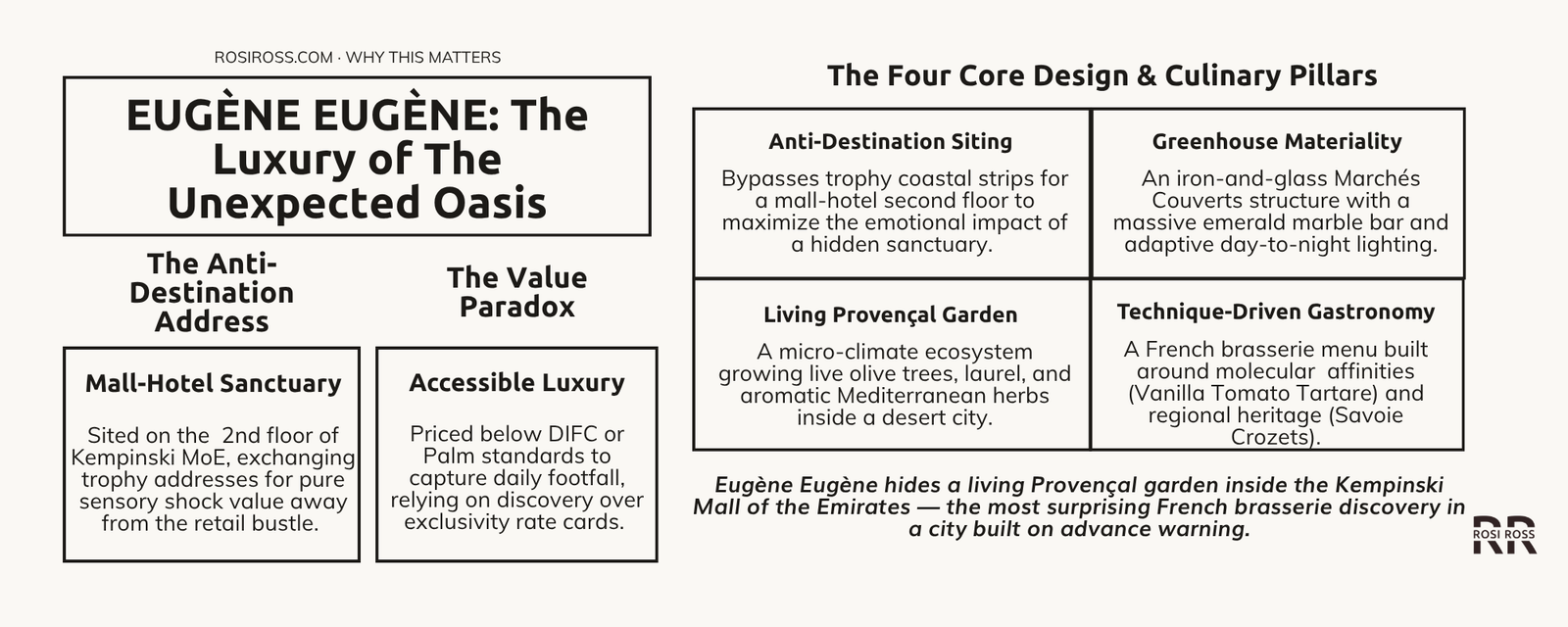
Al Barsha is not, in Dubai’s luxury geography, a dining destination. It has no waterfront, no skyline position, no place in the marketing rotation that covers the Palm, DIFC, and Downtown. It is where the Mall of the Emirates sits — one of the busiest retail complexes in the city, built for footfall and circulation rather than culinary discovery. That the Kempinski Hotel occupying part of that complex would house a genuinely ambitious French brasserie is not the obvious commercial play; a restaurant that opens on the Palm or in Downtown inherits an audience that has already decided to go somewhere interesting. A restaurant on the second floor of a mall hotel inherits shoppers.
RIKAS Hospitality Group — the operator behind Chez Wam, La Cantine du Faubourg, Mimi Kakushi, and Tagomago — chose this address anyway, which is either an oversight or a deliberate wager that the concept is strong enough not to need a destination address to justify itself. Kempinski’s own framing of the restaurant leans directly into this tension, describing it as a sanctuary “away from the bustle of the Mall” rather than an extension of it — an admission that the address does none of the concept’s marketing work, and that the room has to earn its own audience.


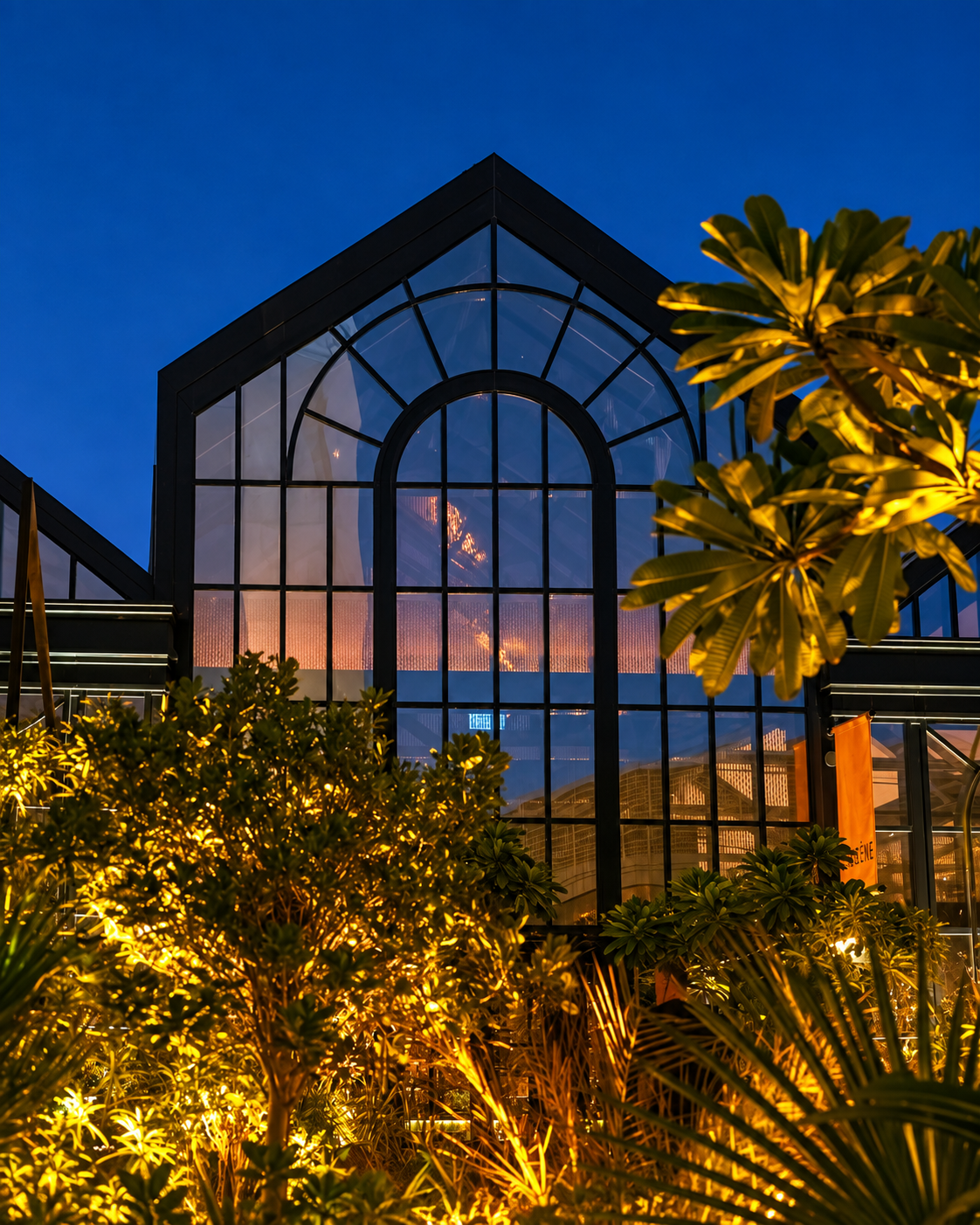


The garden — what it takes to grow a living Provençal garden inside a Dubai mall
A garden inside a climate-controlled hotel floor is not a garden exposed to Dubai’s open air, and that distinction matters more than it first appears. The plants at Eugène Eugène — live palm and olive trees, laurel, sage, rosemary — are Mediterranean species that would struggle against Dubai’s 45-degree summers and saline exterior conditions if planted outdoors without heavy intervention. Housed instead within a glass-roofed conservatory structure with an adjoining terrace, they’re growing in a controlled light and irrigation environment that makes their survival less a horticultural miracle than a design commitment: sustained care, appropriate substrate, and light management calibrated to species that were never meant to live in a desert city, whether under glass or in the open air of the terrace.
The greenhouse and market hall references the design draws on — the nineteenth-century Paris halles, the iron-and-glass marchés couverts that combined botanical density with public gathering — are architecturally precise rather than decorative. What that precedent produces here is a specific, disorienting sensory experience: standing inside a cultivated, aromatic, Provençal-feeling room, with the retail hum of one of Dubai’s largest malls entirely absent from the immediate field of vision, despite being two floors above it. The gap between what the building is and what the room delivers is the entire design argument.


The interior — greenhouse architecture at the material scale
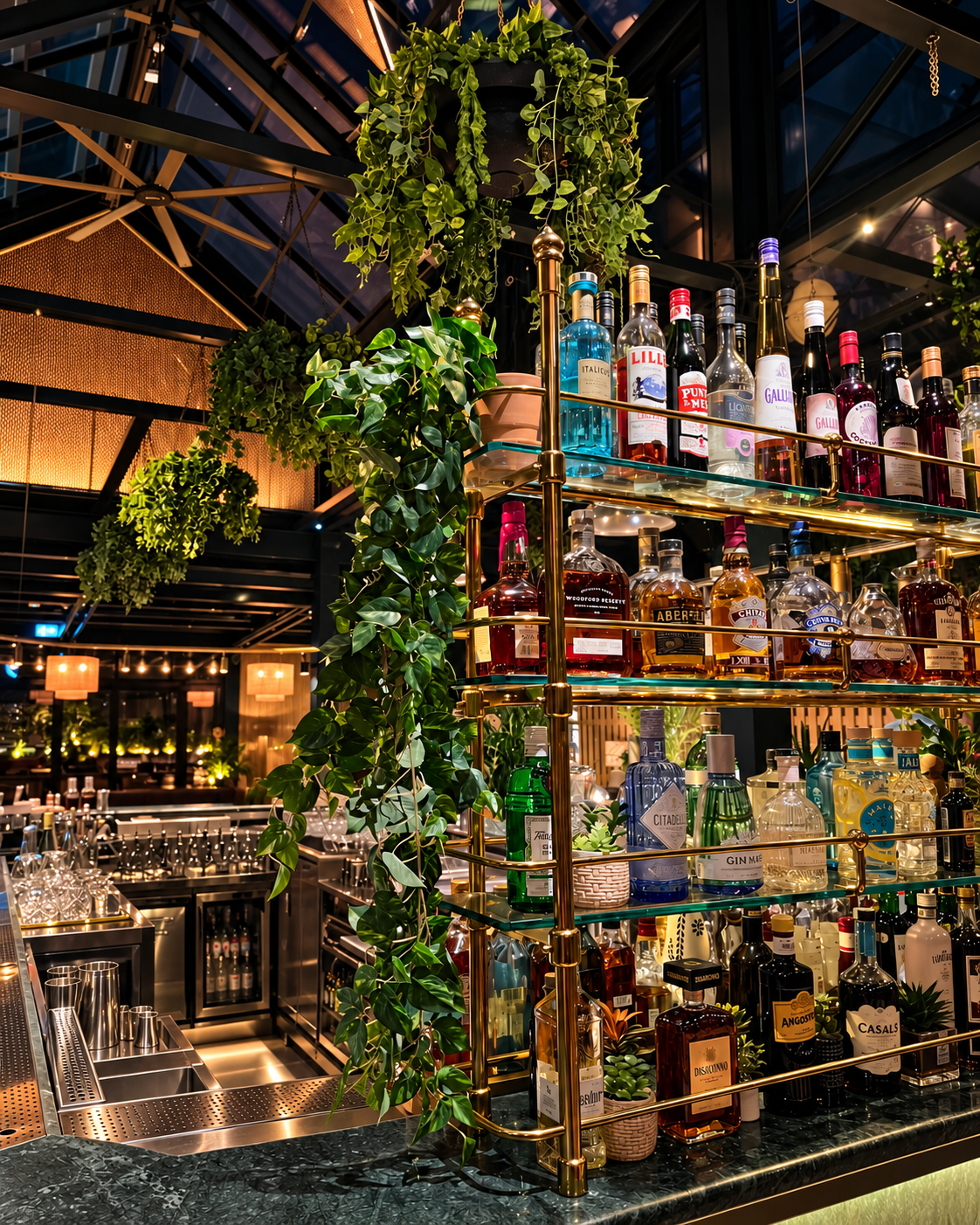
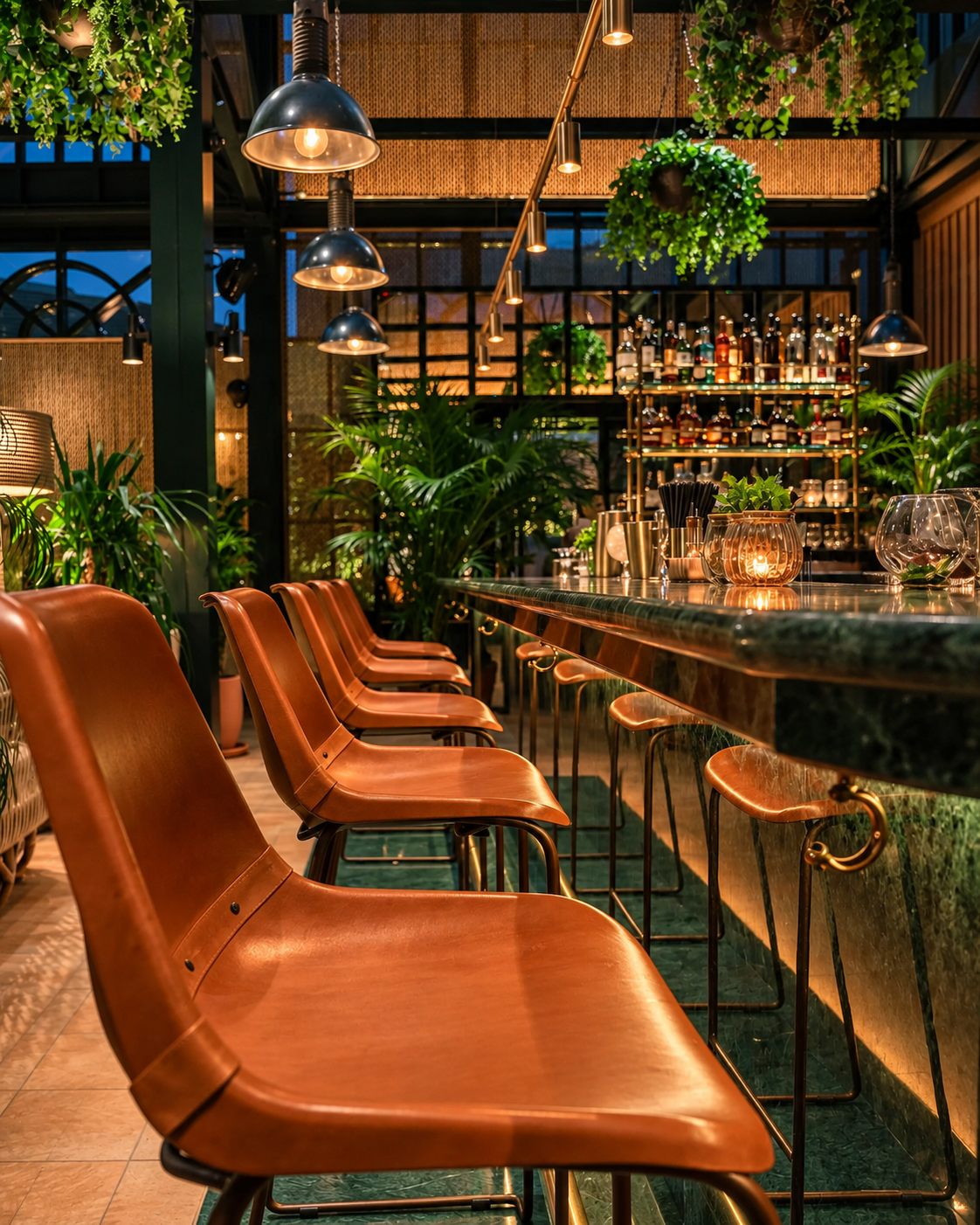
The room’s material language operates at two scales simultaneously. At the botanical scale, it’s the trees and herbs described above. At the furniture and finish scale, it’s an emerald-green marble bar as the room’s central object, woven cushions, and armchairs deep enough to signal a different pace of dining than a ninety-minute mall lunch cycle typically allows — seating designed for lingering rather than turnover. Red booths wrapped in plants create smaller, enclosed nooks around the perimeter; a spacious terrace at the back extends the greenhouse logic into partial open air.
The lighting intelligence is where the room’s design depth is most legible: a glass roof floods the space with natural light through the day, then the room recalibrates for a candle-lit, more intimate register by night — the same physical space reading as an airy garden lunch spot at noon and a considered dinner room after dark, without a wholesale redesign to manage the transition. That’s the harder design problem, and the more interesting one to solve well.


The cuisine — a French brasserie built to match the room’s ambition
A garden this considered sets a demanding culinary bar: a kitchen that doesn’t match the room’s investment produces the specific disappointment of a promise half-delivered. Eugène Eugène’s menu, overseen by RIKAS corporate chef Gilles Bosquet and originally curated by head chef Yannis Sgard, draws on French technique with Mediterranean and border-cuisine inflections rather than a generic brasserie checklist.
The Vanilla Tomato Tartare is the opening dish that signals the kitchen’s temperament — a classical tartare preparation with a single contemporary addition that works because vanilla and ripe tomato share the aromatic compound 4-hydroxybenzaldehyde, producing genuine flavour affinity rather than a jarring contrast. The Crozets à la Truffe is the most regionally specific dish on the menu: small buckwheat pasta squares from the Savoie, whose earthy, nutty character holds truffle in a way most pasta shapes don’t, since the two earthinesses complement rather than compete. The Seabream à la Plancha depends on a narrow technical margin — high heat, rapid cooking, a matter of seconds between correctly caramelised and overcooked — and is the dish most likely to reveal whether the kitchen is paying close attention. The Truffle Artichoke Spinach Salad is the most season-dependent, since artichoke at genuine peak carries a mineral sweetness that preserved or out-of-season artichoke simply doesn’t have. Desserts run through a red fruit pavlova, classic French pastry (tarte tropézienne, choux, tiramisu), and a live crêpe station that turns dessert into a small piece of theatre rather than a plated afterthought — and the weekly Greenhouse Brunch extends the same French sourcing discipline into a more relaxed, family-oriented format built around a raw bar, French cheeses, and shaved-truffle scrambled eggs. The same shift toward chef-driven, ingredient-literate dining reshaping Dubai’s restaurant landscape more broadly is fully present in this menu, condensed into a room most guests never expected to contain it.



Accessible rather than exclusive, and what that signals
Eugène Eugène is priced closer to a considered neighbourhood lunch than a destination tasting menu — noticeably below what a comparable design investment and culinary ambition would command in DIFC, on the Palm, or in Downtown Dubai. That positioning is a legible design decision in its own right, not an incidental fact: it keeps the room accessible to the mall’s actual daytime population — shoppers, hotel guests, the residents and professionals who live in Al Barsha — rather than reserving it for a destination-dining audience who booked specifically because they’d heard about it.
That’s a different kind of luxury position than most of Dubai’s dining landscape offers. The same logic that led Dorchester Collection to open its Gulf debut in an unglamorous business district rather than an already-finished trophy corridor is visible here at a different scale: value and confidence expressed through restraint on price and address, rather than through a rate card built to signal exclusivity on its own.
The discovery — what it means when quality exceeds its address
Dubai is unusually good at fulfilling expectations. The Burj Al Arab delivers the silhouette it promises from thirty kilometres out; the rooftop restaurant with the Burj Khalifa view delivers exactly that view. What the city offers far less of is the gap between low expectation and genuine discovery — the specific pleasure of arriving somewhere with no advance signal and finding the understanding of what’s possible quietly revised. Manufactured spectacle is not in short supply in Dubai’s leisure landscape; a garden that earns its own reputation through discovery rather than address is rarer.
Eugène Eugène is a French brasserie on the second floor of the Kempinski Hotel at Mall of the Emirates, Al Barsha, Dubai, operated by RIKAS Hospitality Group. The greenhouse-and-market-hall-inspired interior houses live palm and olive trees, laurel, sage, and rosemary alongside a marble bar, woven cushions, and an outdoor terrace. The menu, overseen by corporate chef Gilles Bosquet, spans French classics with Mediterranean inflections, including Crozets à la Truffe and Seabream à la Plancha, alongside a weekly Sunday brunch.
What Eugène Eugène ultimately argues is that the most sophisticated luxury available in a saturated market isn’t the most spectacular view — it’s the room the address gave you no reason to expect, built well enough to earn the discovery entirely on its own terms. The same sensory attentiveness that defines the most considered work across every luxury category — the specific smell of rosemary catching a shoulder mid-afternoon, the quality of light through a glass roof at different hours — is what separates a genuinely designed room from a merely decorated one.
“Dubai has perfected the art of expected luxury.
Eugène Eugène is something rarer —
the unexpected one.
The garden above the mall’s second floor
is not there despite the address.
It is extraordinary because of it —
because nothing in the approach prepared you,
and everything inside the garden
rewards having arrived.”

