
On Pearl Jumeirah’s most iconic beach club, the architecture of a manufactured paradise, the global philosophy behind it, and what the quality of a day well spent actually requires
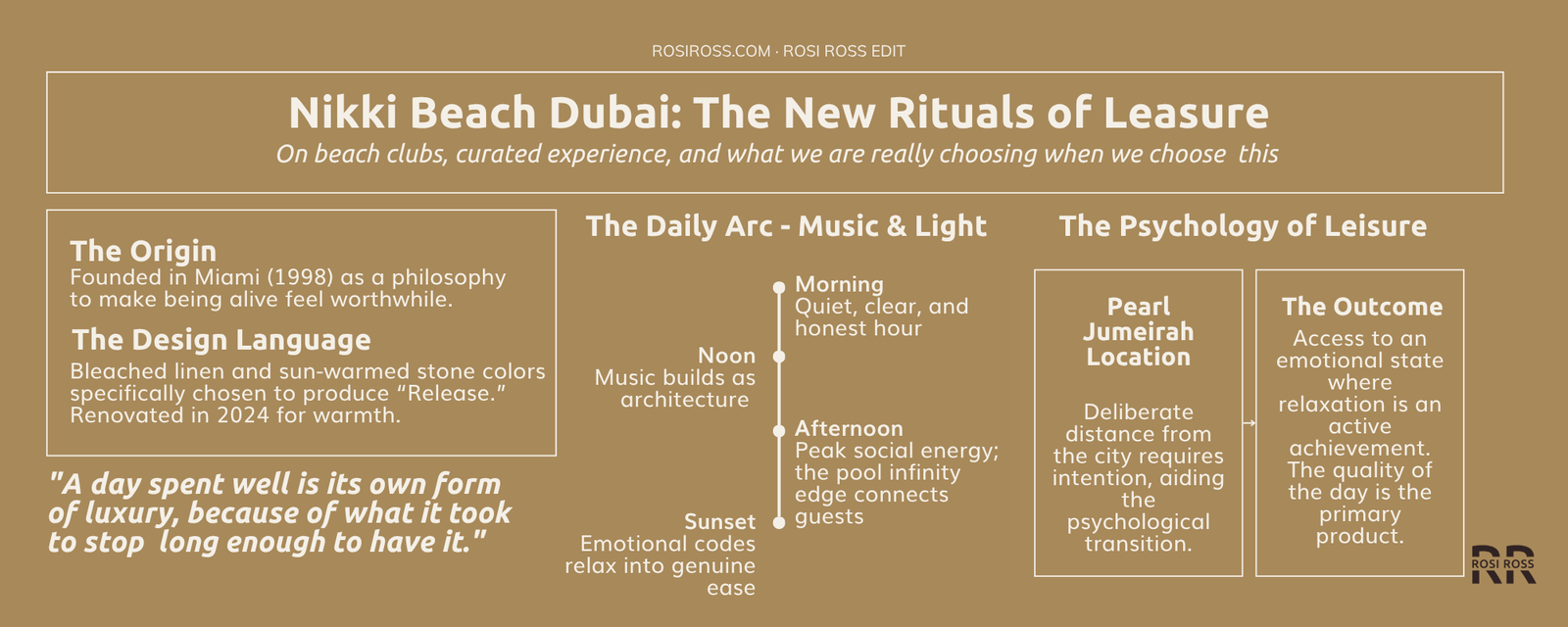
Leisure, at its most considered, is not the absence of effort. It is a different kind of effort — the deliberate construction of conditions under which a day can feel like something chosen rather than something endured. A day spent well is its own form of luxury. Not because of what it costs, but because of what it took to stop long enough to have it.
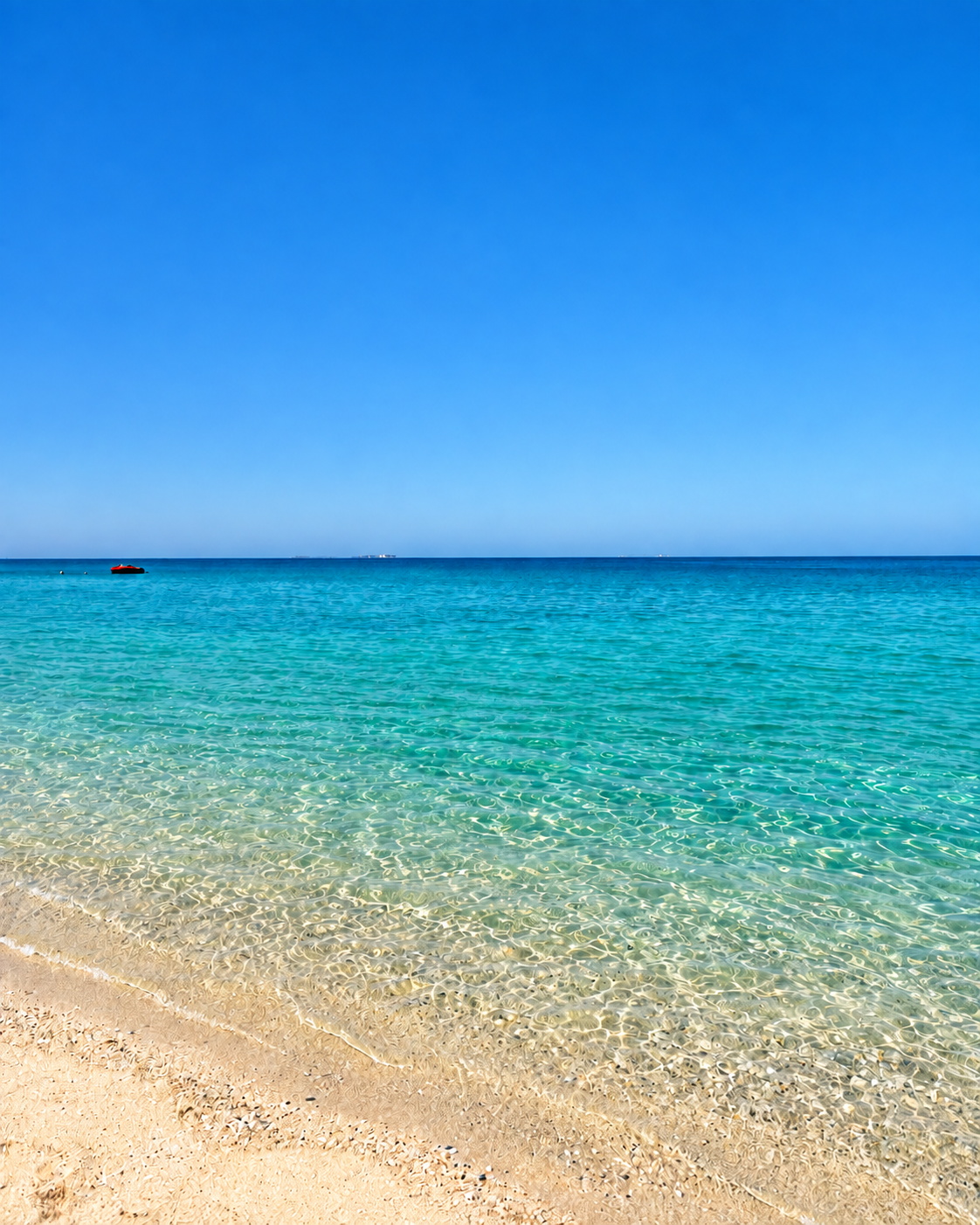
The Arabian Gulf appears before the building does. Arriving at Pearl Jumeirah from the city, you follow a road that deposits you at the edge of something unexpectedly still — a shoreline that holds a quality of light the rest of Dubai rarely offers. White architecture against the blue-green of the water. The ratio of sky to structure shifting decisively in the sky’s favour. By the time you have handed over the car and walked through into the space itself, the city has receded in ways that have nothing to do with distance.
This is not an accident of geography. Pearl Jumeirah did not exist a generation ago. It is reclaimed land — engineered from the seabed through one of the defining feats of Dubai’s modern coastline, in the same lineage as the neighbouring Palm Jumeirah, whose reclamation extended Dubai’s coastline by tens of kilometres using techniques that have only grown more ambitious in the decades since. The distance between downtown Dubai and Pearl Jumeirah is short. The atmospheric distance is engineered to feel much greater — and that gap between physical proximity and psychological remove is not incidental to the experience. It is the product the island was built to deliver.
Nikki Beach traces its origins to Miami in 1998, when Jack Penrod — together with his wife and business partner, Lucia — created Café Nikki: a small garden café built in tribute to Jack’s daughter, Nicole, who died in a car accident at eighteen. What began as an intimate space to honour her memory grew, almost by accident, into a global hospitality phenomenon, expanding from that original Miami garden into beach clubs and resorts across more than a dozen countries. That origin is not incidental. It is structural. A brand built around the idea that the right circumstances can make the act of being alive feel deliberate and worth celebrating tends to design itself differently from one built around maximising covers or optimising spend per head. The philosophy persists across the brand’s global locations — from Saint-Tropez to Marbella, Ibiza to Koh Samui — with the same governing principle: the destination is secondary to the quality of time spent within it.
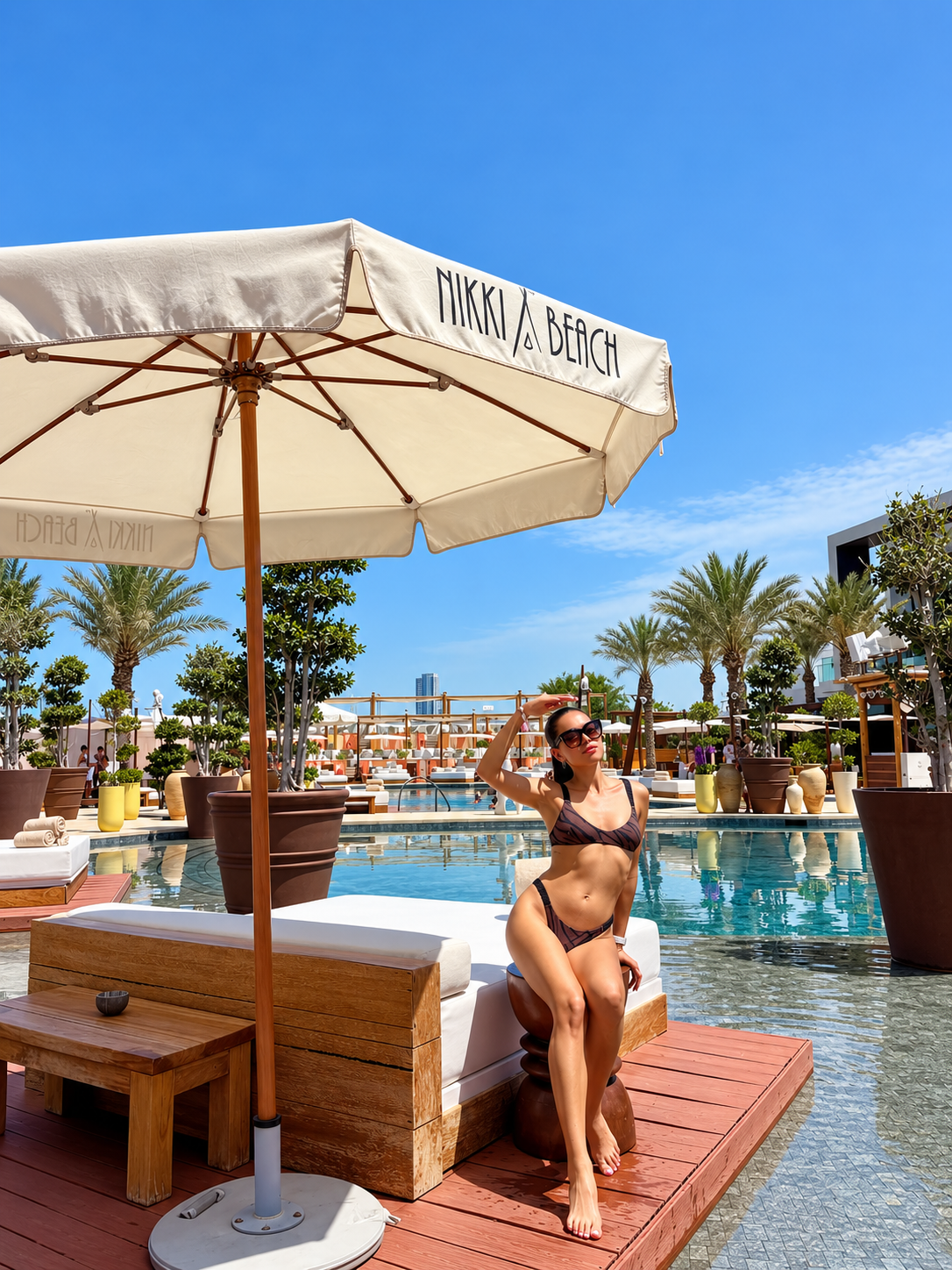
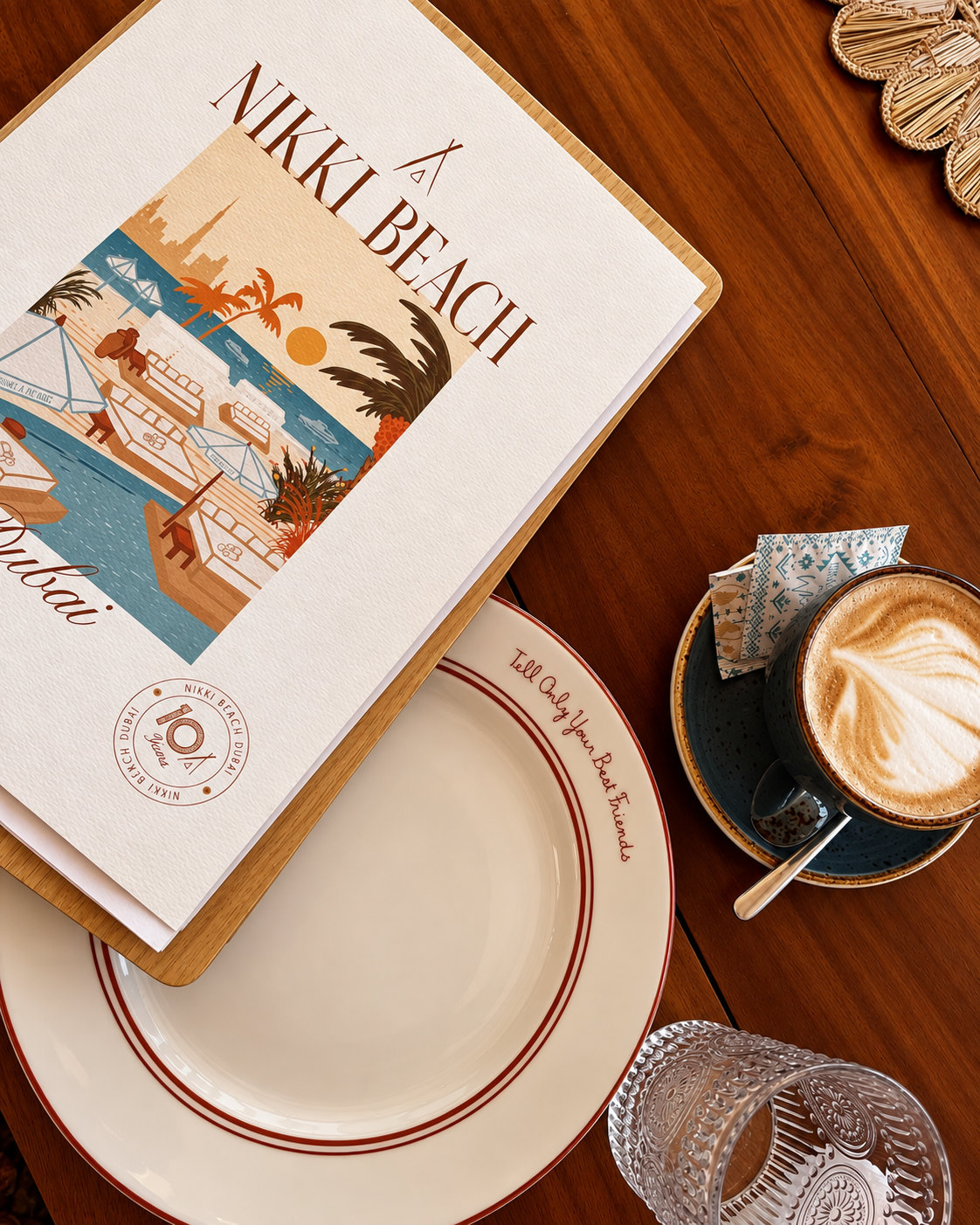
In Dubai, Nikki Beach occupies Pearl Jumeirah — an island that sits at a deliberate remove from the city’s denser hospitality corridors. Getting here requires intention. The journey separates. By the time the white-washed space opens up around you — the oversized daybeds, the infinity pool, the long sightlines to the water — you have already, without quite knowing it, made the psychological transition from the city that surrounds you to the day you are about to spend.
As Condé Nast Traveller India’s survey of Dubai’s beach clubs observes, the city’s beach clubs offer everything from the style and glamour of the French Riviera, with private beaches and Champagne service, to the whitewashed elegance of seaside spots more typically associated with Miami or Mykonos. Nikki Beach Dubai sits precisely at that intersection — a global brand executed, on this particular stretch of manufactured coastline, with a completeness that few of its sister properties can match.



For those drawn to Dubai’s wider tradition of considered hospitality, the same instinct for atmosphere over spectacle defines other corners of the city’s leisure landscape — including Nette Al Barari, where Dubai slows down, a garden café built around stillness rather than social energy. Understanding what Nikki Beach is requires understanding what it has deliberately chosen not to be. Both are valid, fully formed expressions of a city with more registers than its international profile tends to suggest.
The philosophy beneath the architecture
What Dubai did with the Nikki Beach concept is instructive. The city did not simply license a global hospitality brand and place it on an existing beach. It gave the brand a setting — reclaimed land, engineered sightlines, a coastline built specifically for the purpose — that could execute its founding philosophy with a completeness few of its other locations allow. Where Saint-Tropez or Marbella offer Nikki Beach an inherited coastline, shaped by centuries of geography that came before the brand arrived, Dubai offered something closer to a blank canvas. The result, on Pearl Jumeirah, may be one of the most architecturally pure expressions of the brand’s founding idea anywhere in its global portfolio.
This is consistent with how Dubai approaches hospitality more broadly. The city’s most internationally recognised properties — the kind that consistently appear on Condé Nast Traveler’s lists of the world’s best hotels — share a common trait: they are not adaptations of an existing template to local conditions, but ground-up executions of an idea with resources and intention rarely available elsewhere. Nikki Beach Dubai belongs to that same lineage, even within a category — the beach club — that is often treated as inherently casual.
Engineering as design language
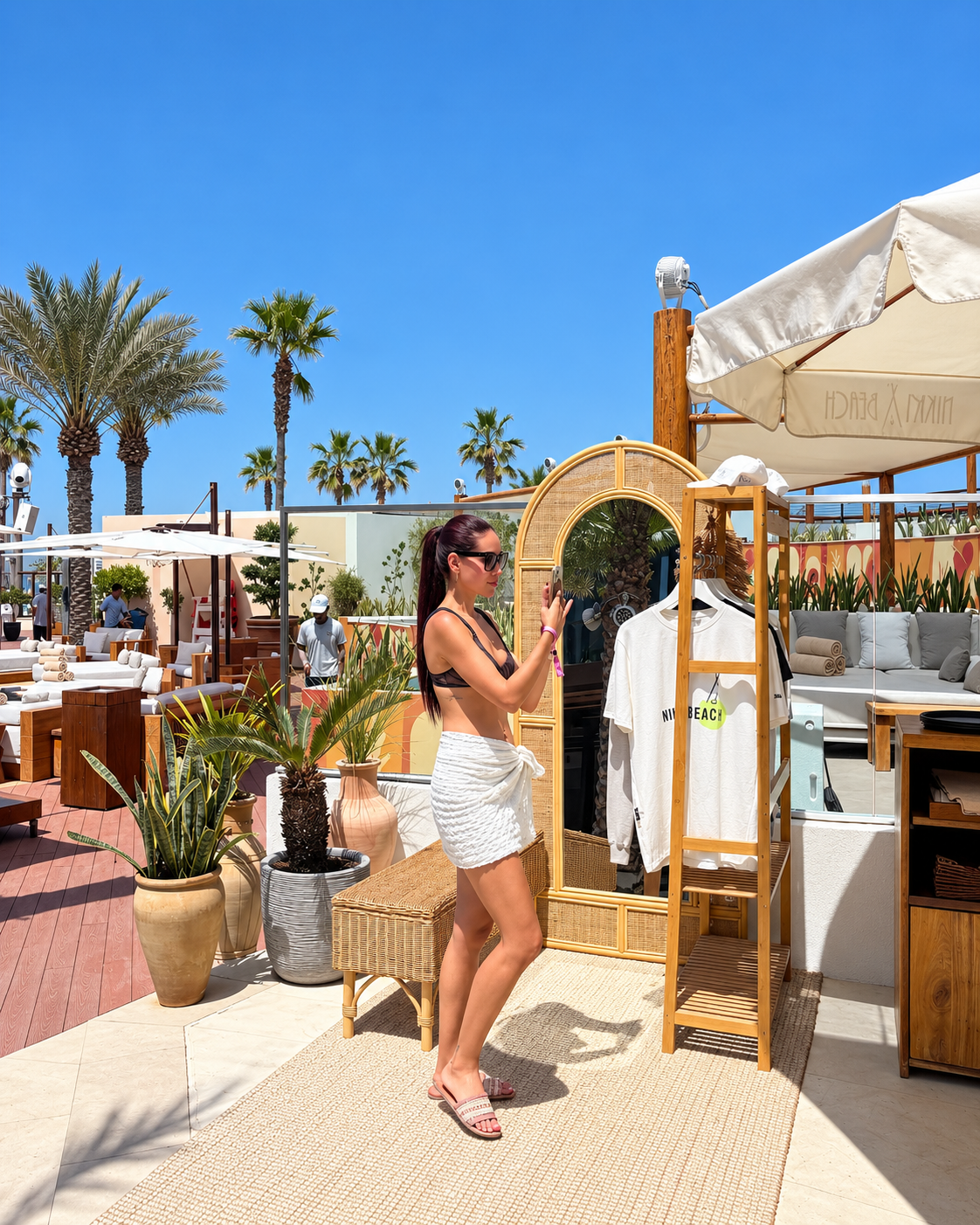
The design logic of Nikki Beach Dubai operates through principles that are instantly legible and yet never quite announced. White is the dominant tone — not the white of clinical environments, which produces anxiety, but the white of bleached linen and sun-warmed stone, which produces release. The palette communicates a simple thing: this space has been considered, and the consideration was not for show.
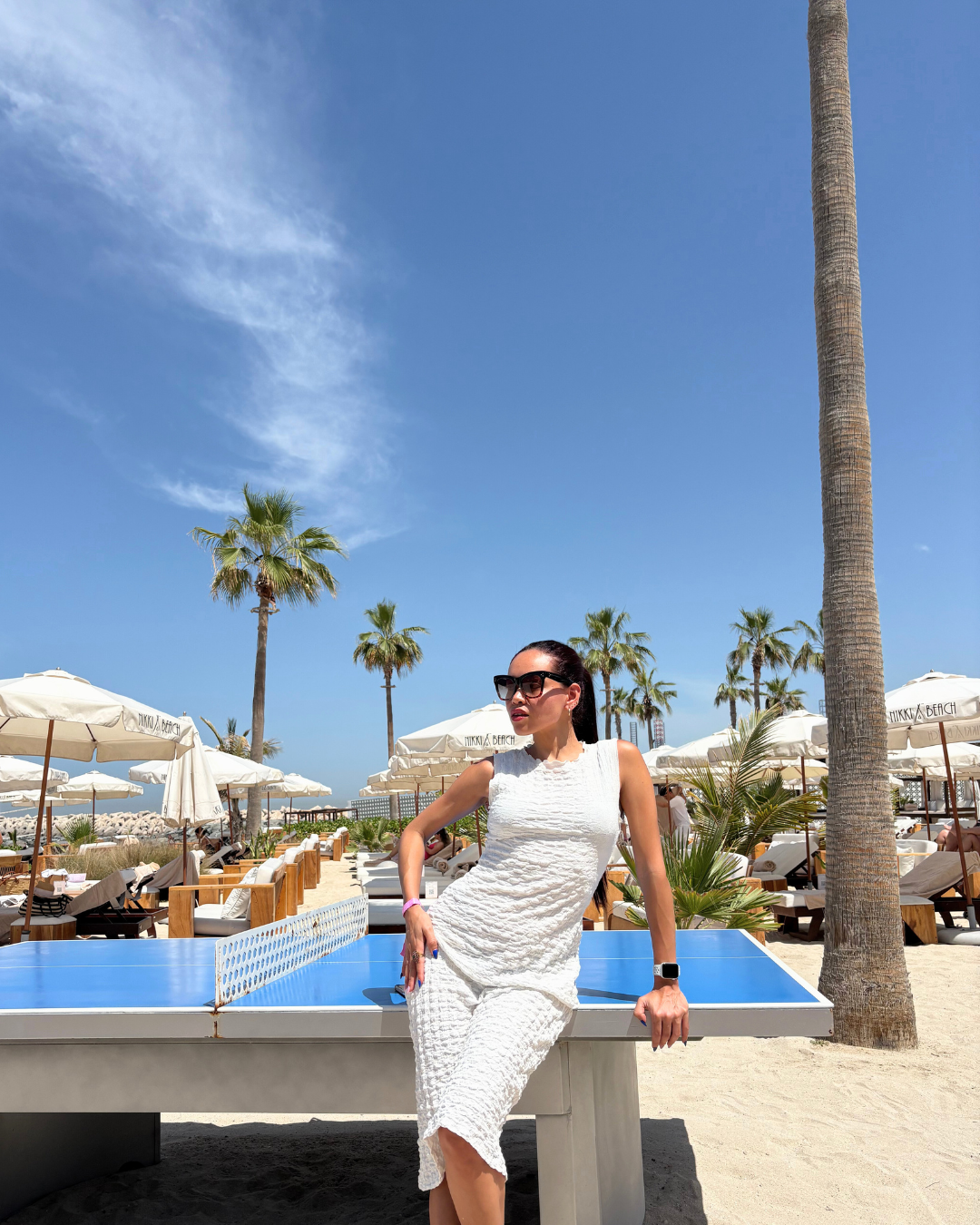
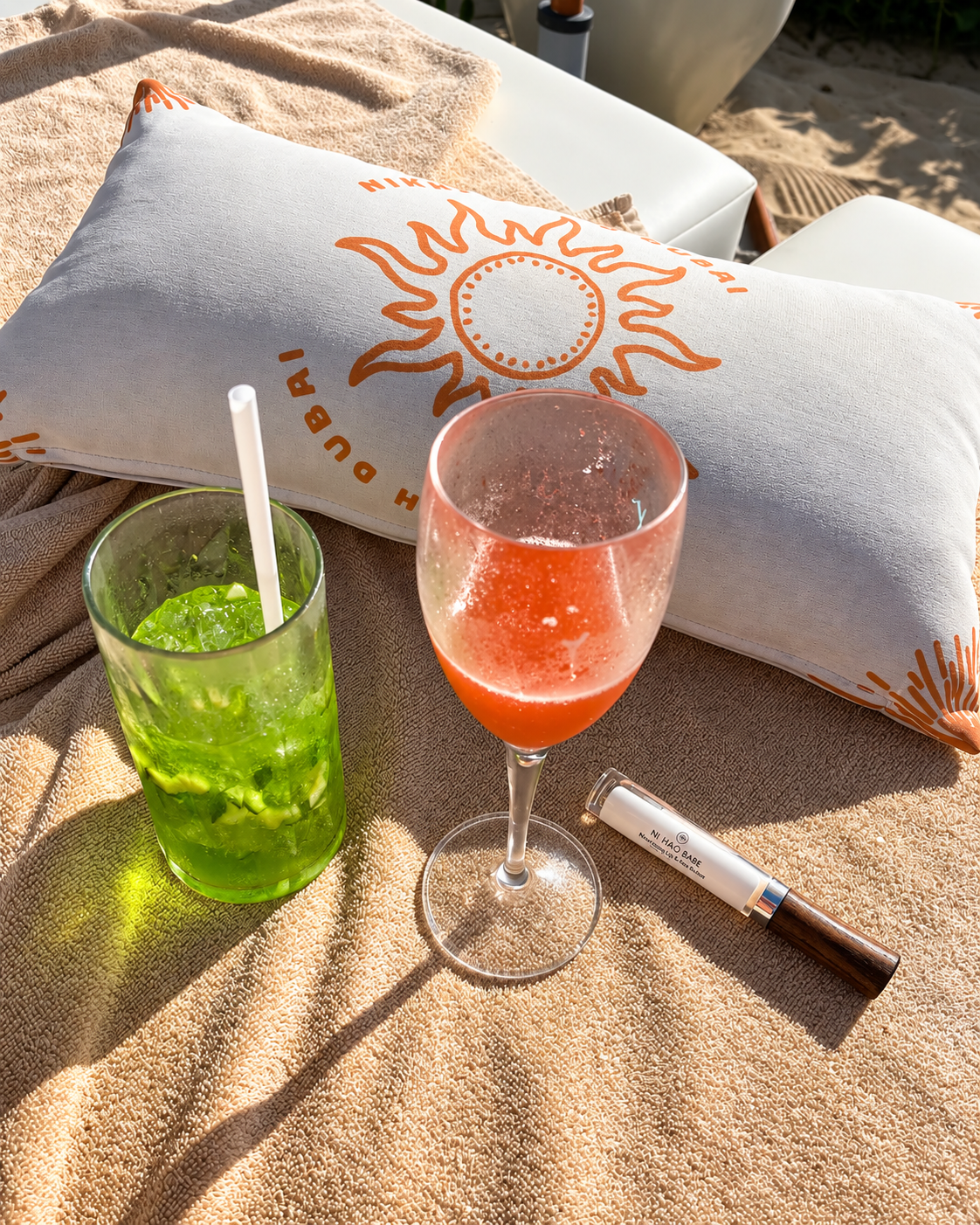
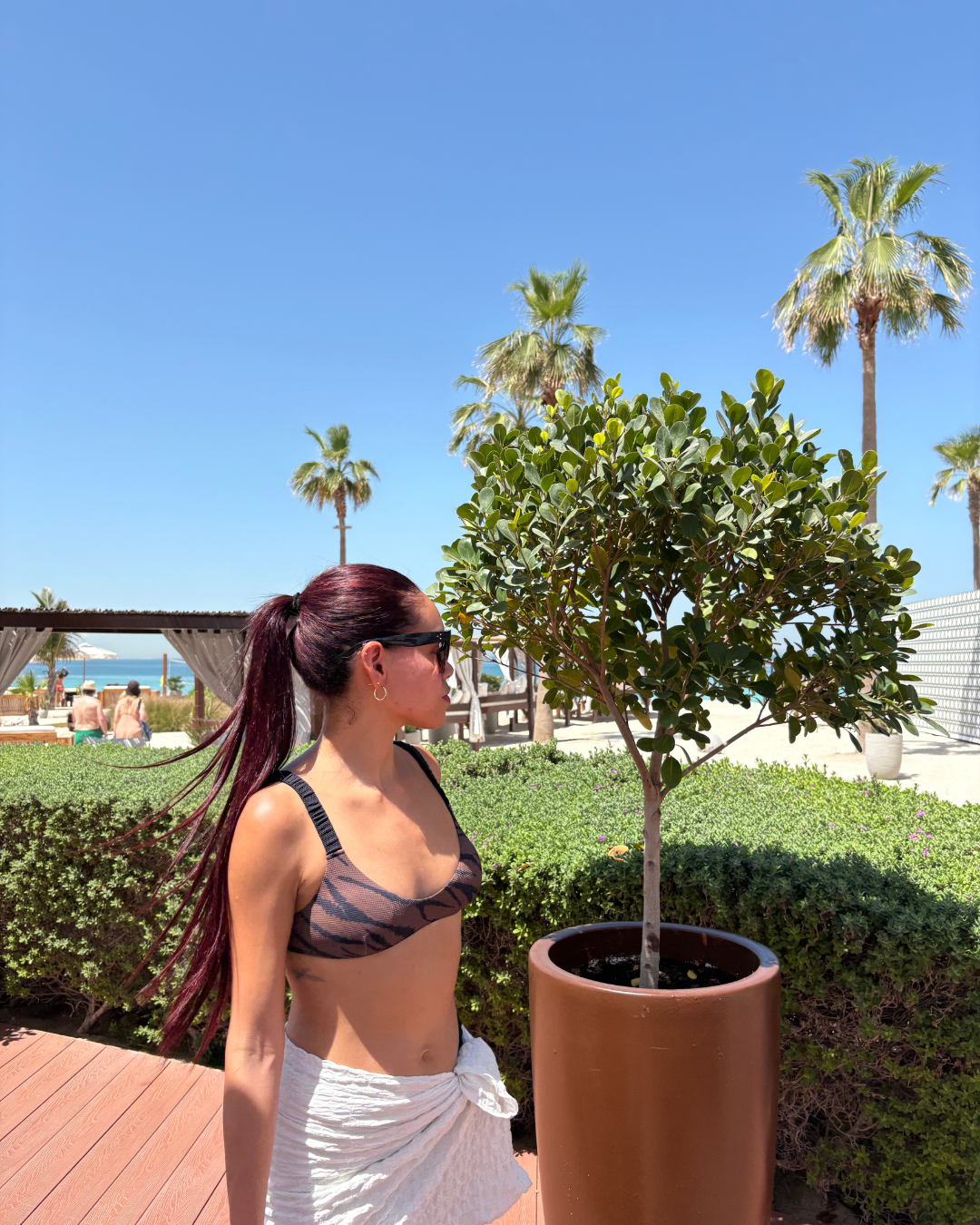

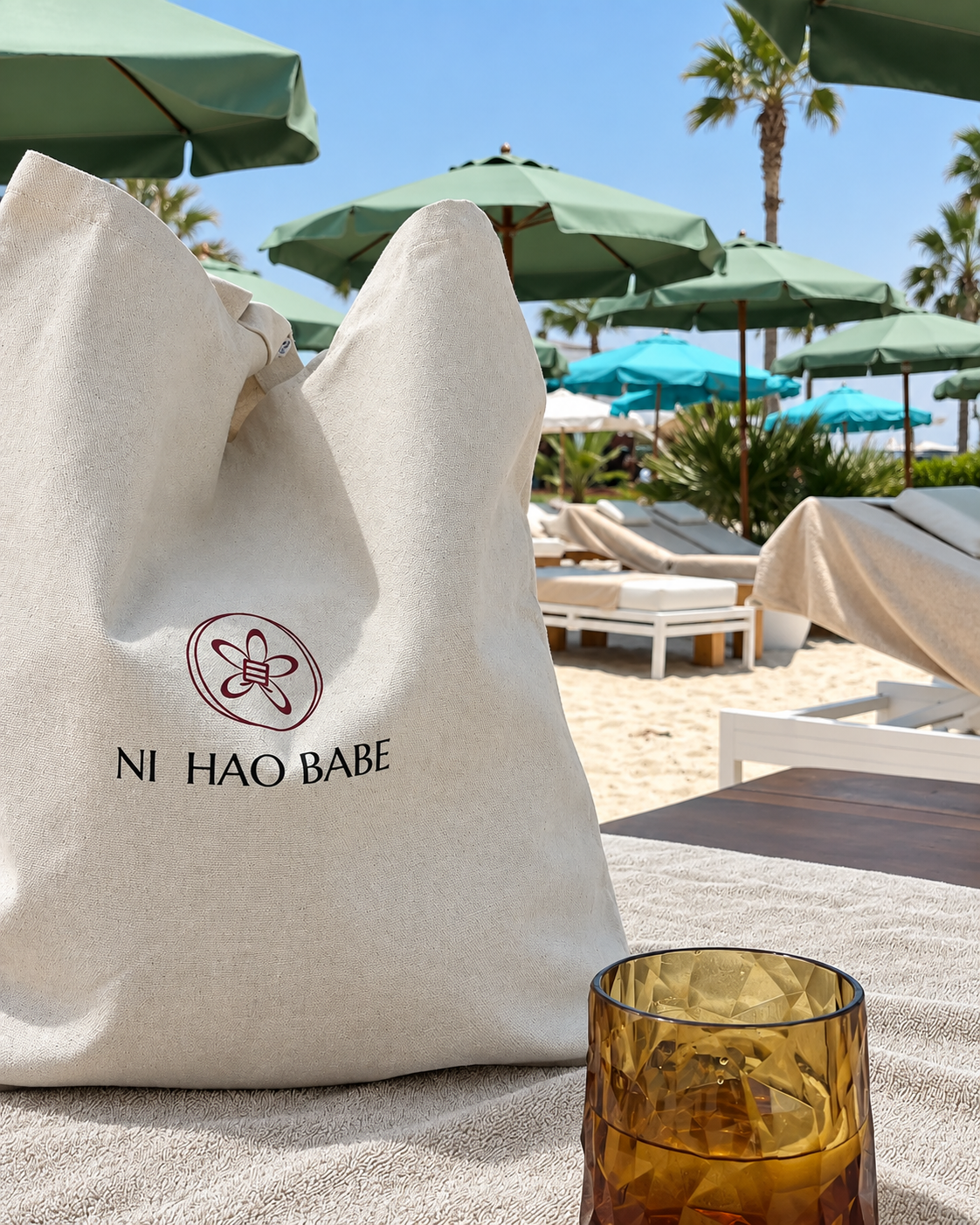
The spatial design — refreshed and deepened through the club’s most recent renovation — manages sightlines with a sophistication that its hospitality function requires but that its aesthetic register conceals. Cabanas provide privacy without enclosure. The pool terrace offers visibility without exposure. The beach itself — private, palm-strewn, carrying the particular quality of sand that has been maintained rather than merely permitted — provides a zone of retreat from the curated social atmosphere of the pool area, available to anyone who wants to step out of the frame rather than remain within it.
Against the dominant white, terracotta accents and sculptural daybed forms introduced in the recent renovation register as warmth rather than colour — a chromatic decision calibrated to the specific quality of late-afternoon Gulf light without competing with it. Floor-to-ceiling glass at the restaurant deepened the connection between indoor dining and outdoor living, so the pool deck remains visible at every meal — always present as the frame through which the day continues to unfold.
The DJ pavilion, also rebuilt to function as a focal point rather than a peripheral convenience, sits at the heart of the space’s social architecture. From it, the day’s emotional arc is managed with an intelligence that is easy to mistake for coincidence. The music is not background. It is infrastructure. It determines the pace of movement, the register of conversation, the energy with which people occupy their daybeds and pool edges and table corners. The transition from the softness of mid-morning to the more assertive energy of midday is never announced. It accumulates — one track resolving into another, the tempo lifting by a degree that registers physically before it registers consciously.
The pool itself carries this function with particular efficiency. Its scale allows for genuine distance between groups while maintaining the sense of a shared experience. The infinity edge does not merely create a visual effect — it produces a single Gulf horizon that every person in or around the water can orient toward simultaneously, generating a collective relationship with the view that individual experience would not otherwise produce. Looking out at the Gulf from this pool is a social act. That is not a paradox. It is the design intention.
For those interested in how Dubai applies this same intelligence to dining rather than leisure, the city’s evening rituals carry an equivalent precision. Why Lah Lah in the Greens is Dubai’s most considered girls’ night explores how a Bangkok-inspired dining room in The Greens engineers intimacy with the same deliberateness Nikki Beach brings to the open expanse of a beach club. Both understand that the people who share a space with you are as much a part of the experience as anything the venue provides directly.
What the morning reveals
Before the crowd assembles and the music finds its register, Nikki Beach reveals the quality that sustains everything built on top of it. The morning is the space’s most honest hour — the one in which the architecture has not yet been activated by people, and so can be assessed on its own terms.

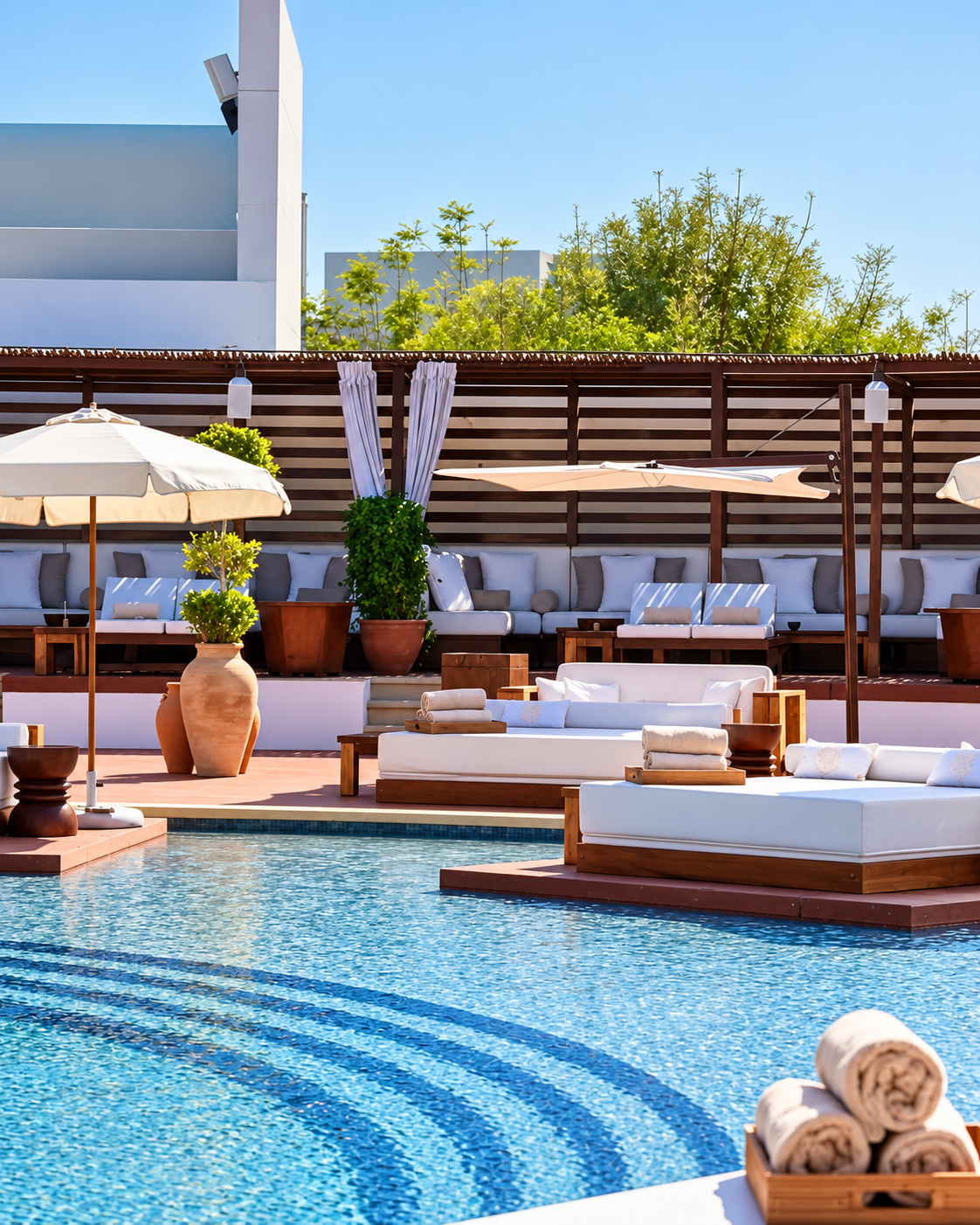


The sunbeds hold the clean geometry of objects that have not yet been claimed. The pool reflects the sky with the particular clarity that only still water before midday offers. The Gulf beyond is present rather than backdrop — a body of water doing what water does in the early part of a day, which is to exist without performing. Staff move through the space with the efficiency of people who understand the arc of what is coming and are preparing for it without revealing the preparation.
There is a specific value in encountering a space designed for collective pleasure before it has fully assembled itself — a moment at which engineered leisure is most visible as engineering, and, somewhat counterintuitively, most convincing as a result. A space this considered does not require a crowd to justify its design. The design holds on its own.
The afternoon as social instrument
By early afternoon, without announcement, the day crosses a threshold. A beach club at peak hours functions as a social instrument — producing a collective experience that is carefully engineered to feel spontaneous, neither anonymous nor intimate but something deliberately positioned between the two.
People arrive in configurations that tell their own stories. Groups whose coordination of white linen and gold jewellery suggests this is not their first time here, or that they thought carefully about what arriving here well-dressed means. Couples who chose Pearl Jumeirah for a reason they may not have articulated even to each other — the proximity to water, the permission to stop being productive, the specific social neutrality of a space that is neither work nor home. Solo visitors who brought books they will probably not read, because the point was never the book.
This is one of the few categories of space that successfully holds both rest and visibility at once — where lying still and being seen exist in conversation rather than contradiction. That is not an accident of programming. It is the product of a design philosophy, refined across decades and global locations, sophisticated enough to function even when no one in the space is consciously registering it.
Dubai’s relationship to this kind of engineered gathering extends well beyond its beach clubs. The same instinct — that proximity to the right people in the right conditions produces something individual experience cannot replicate — shapes how the city designs its professional environments as well. Money, culture, and capital: inside the event that shaped Dubai’s Web3 elite documents how shared space and shared energy generate outcomes that remote engagement never can. A day at Nikki Beach and a morning at a professional gathering are not the same thing. But both understand that human beings in proximity, oriented toward a shared experience, produce something individual experience does not replicate.
Dubai’s relationship with the rituals of gathering carries a depth that the city’s international profile does not always surface. The best Iftar experiences in Dubai documents one of its most profound expressions of that understanding — breaking fast at sunset with others, carrying the full emotional weight of shared time and deliberate presence. Nikki Beach and the Iftar table are not the same register of experience. But both are expressions of a city that has always understood how time is spent matters as much as how much of it there is.
Manufactured paradise as a serious idea
There is a tendency to treat the word “manufactured” as a diminishment — to assume an engineered experience is somehow less authentic than one that occurred by accident of geography or history. Dubai’s relationship to leisure argues the opposite. A coastline that exists because a city decided it should, designed with total intention from the seabed up, is not a lesser form of paradise. It may be a more honest one — because nothing about it pretends to have happened by chance.
This is the deeper argument Nikki Beach Dubai makes, almost without meaning to. The white architecture, the managed sightlines, the DJ pavilion engineering the emotional arc of an afternoon, the reclaimed island beneath all of it — none of this occurred. All of it was decided. And the decision, examined closely, reveals something true about how Dubai understands leisure more broadly: not as a resource to be discovered, but as an outcome to be designed, with the same seriousness the city brings to its skylines, its financial infrastructure, and its cultural ambitions.


The shift toward intentional leisure — toward choosing experiences for what they produce in terms of feeling and memory, rather than for their social media coordinates — runs parallel to a broader cultural movement reshaping luxury consumption across categories. In fashion, the same instinct produces a preference for pieces chosen for how they hold over time rather than how they read in a single moment. The new language of quiet luxury explores how restraint and considered choice now signal sophistication in ways that loudness once did. A day at Nikki Beach Dubai operates within this same shift: the curated choices of dress, pace, and presence communicate values, taste, and self-knowledge as clearly as any wardrobe decision.
Pearl Jumeirah, where Nikki Beach sits, carries its own relationship to this logic. It is an island that was made rather than found — an expression of Dubai’s willingness to manufacture the conditions for the kind of leisure it wants to offer. The waterfront access that guests take for granted is the product of an engineering ambition translated, eventually, into a strip of private beach and the Gulf that lies beyond it. As the Penrod family’s own account of the brand’s origins as a Miami garden café makes clear, Nikki Beach was never conceived as a hospitality formula to be replicated identically — it was conceived as a feeling, one its founders trusted could be translated faithfully into very different physical settings. Nearly three decades after that first Miami garden, Pearl Jumeirah may be where that translation has been carried furthest — fully realised, on a coastline that exists because the city decided it should.
For those drawn to the broader question of how this kind of considered presence shapes a personal aesthetic, Robert Wan and the world of investment-grade pearls explores a parallel instinct — the recognition that what is chosen deliberately, and understood properly, carries a different weight than what is simply acquired. Both pearls and a day spent well share the same underlying logic: value that compounds through intention rather than through price alone.
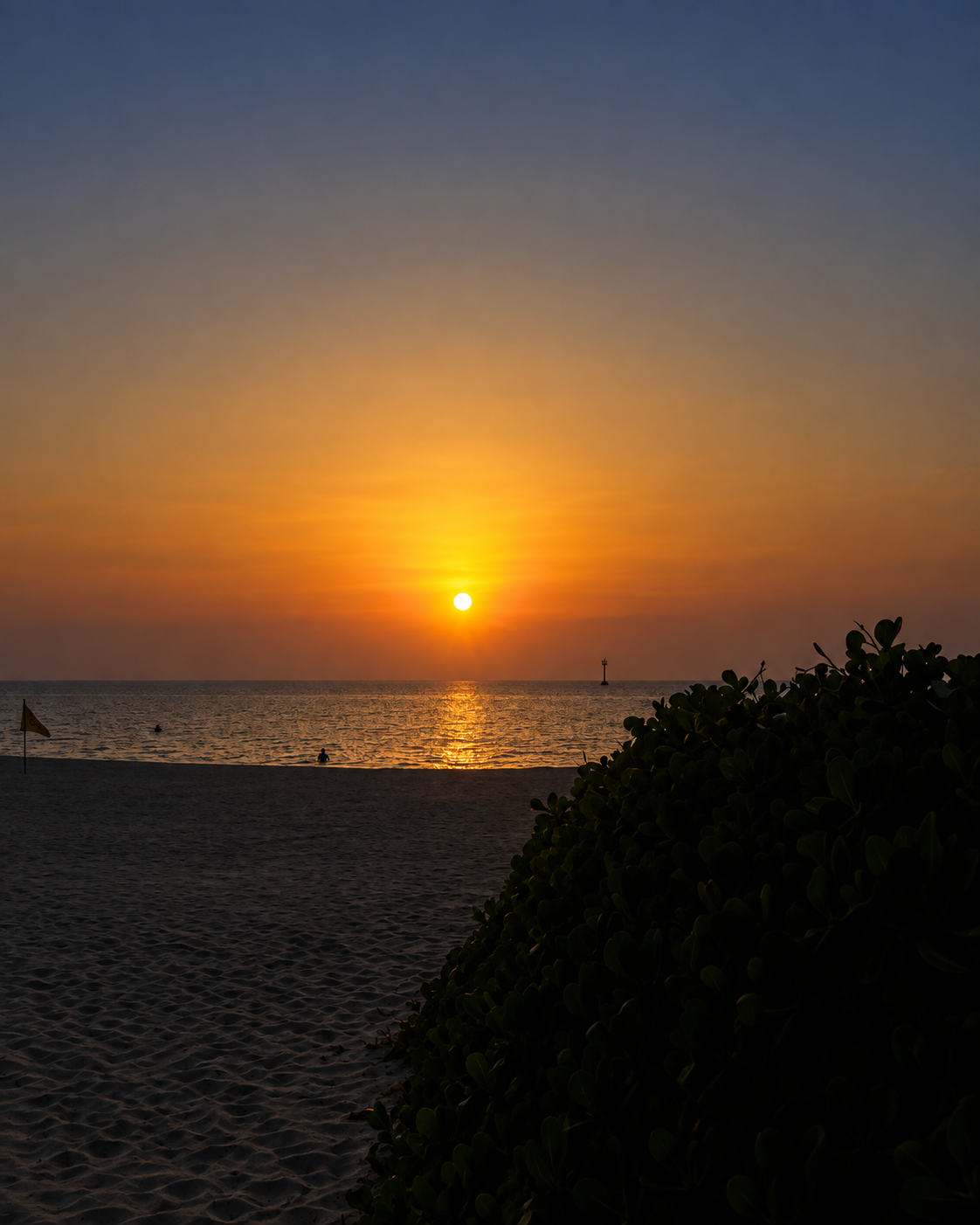
The light changes in the late afternoon in ways the morning light did not anticipate. It turns golden and directional, finding the surfaces of the pool at an angle that makes the water look like something other than water, revealing textures in the white architecture that flat midday light conceals. The music follows the light into a more reflective register. People begin making the calculations that the end of a day like this requires.
What remains, once the specific afternoon has ended, is the argument the place was always making.
“A paradise built with total intention
is not a compromise.
It may be the only kind of paradise
a city like Dubai
was ever going to be able to offer —
and, on its own terms,
the only kind worth taking seriously.”

