
On fatty acid chemistry, hair porosity, hygral fatigue, and the clinical trial that put rosemary oil alongside minoxidil — the ingredient intelligence guide to a category most people buy by marketing and lose by mismatch
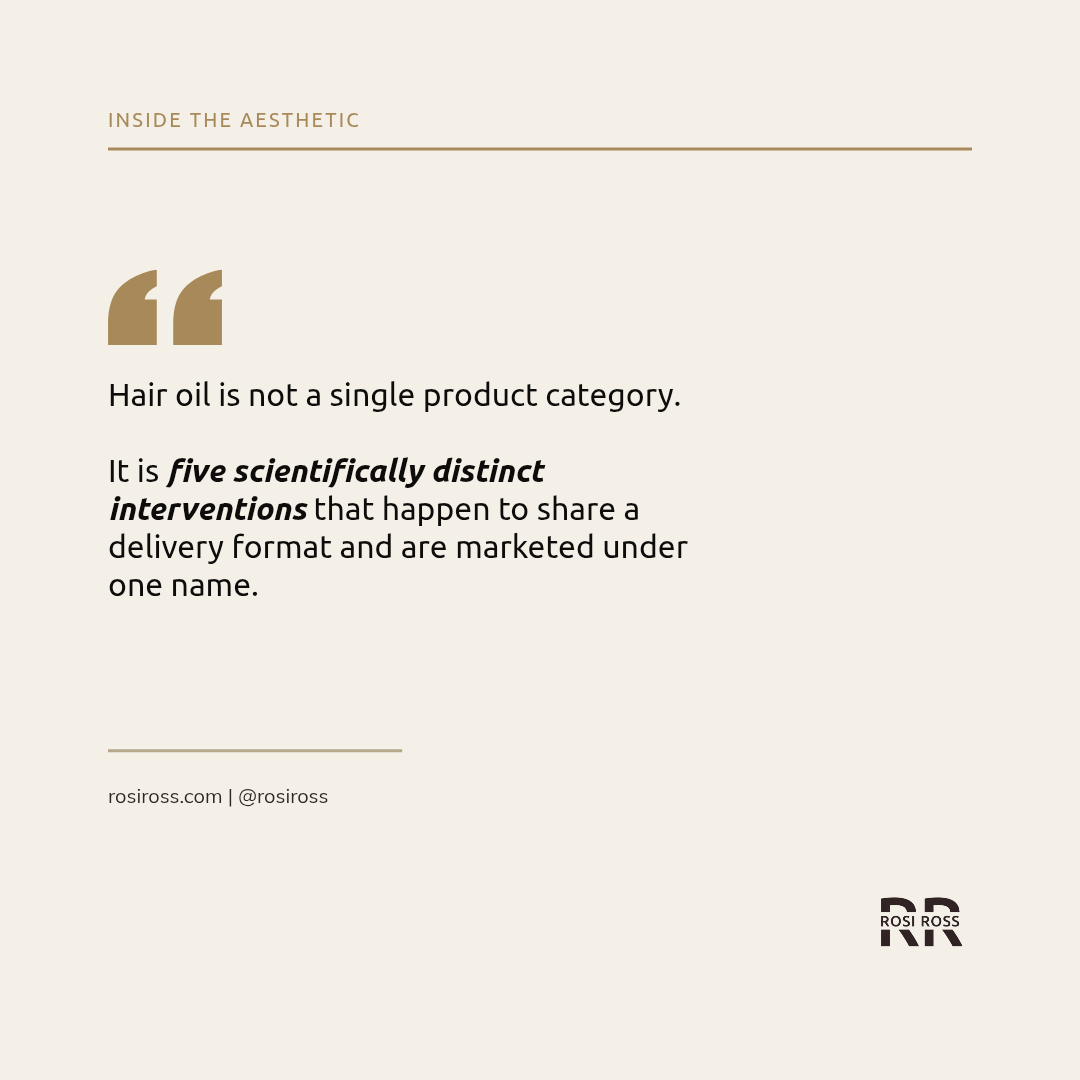
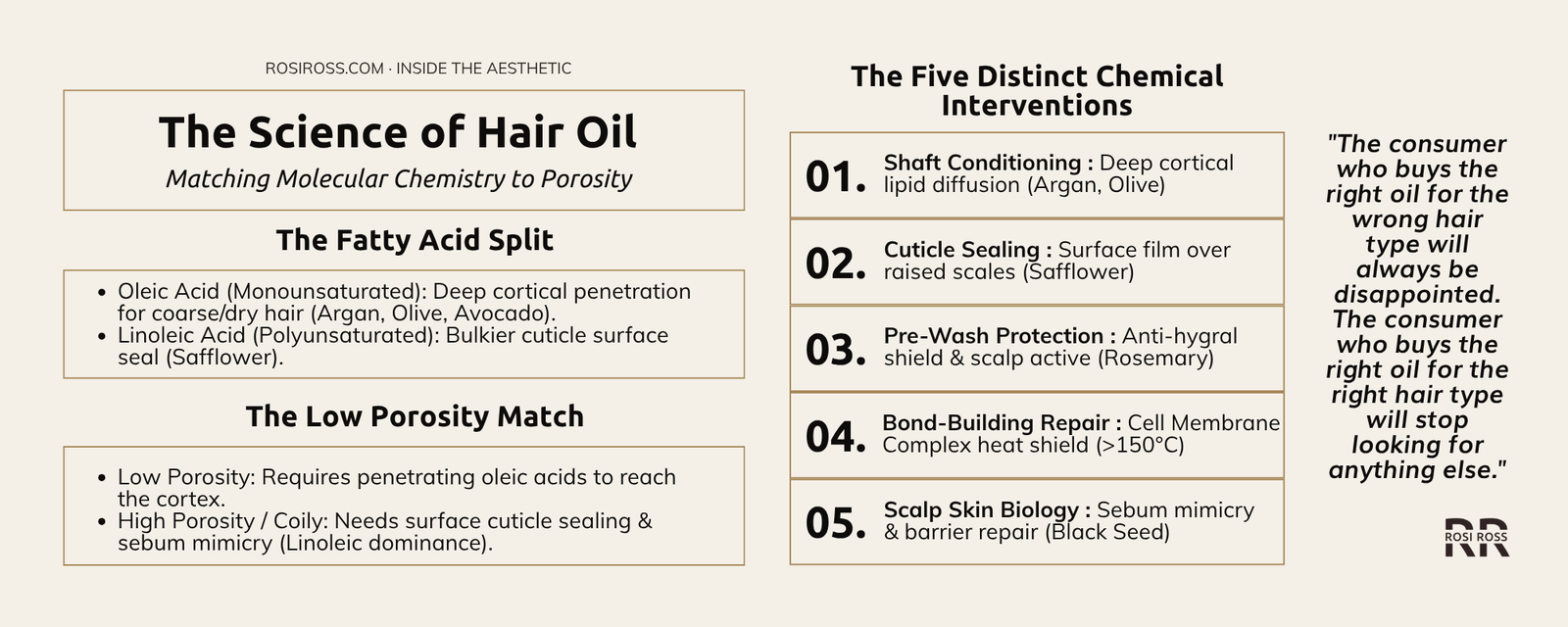
Hair oil is not one product category. It is five distinct chemical interventions — shaft conditioning, cuticle sealing, pre-wash protection, bond-building, and scalp treatment — that happen to share a delivery format and are marketed under the same word. The consumer who buys the right oil for the wrong hair type will always be disappointed. The consumer who understands which of the five they actually need will stop looking for anything else.
The fatty acid framework
Almost no hair oil marketing mentions fatty acids, and that omission is the single largest source of disappointment in the category. Every plant-derived hair oil is composed primarily of fatty acids, and their proportions determine what an oil actually does: how deeply it penetrates the shaft, whether it seals or opens the cuticle, whether it conditions or simply weighs hair down.
Oleic acid, a monounsaturated fatty acid, is the dominant fatty acid in argan, olive, and avocado oil. Linoleic acid, a polyunsaturated fatty acid with a bulkier molecular structure from its additional double bond, dominates safflower and sunflower oil. The formulation industry’s working heuristic — oleic acid for deeper shaft conditioning, linoleic acid for lighter cuticle-surface sealing — is a genuinely useful starting framework, though the underlying penetration science is more layered than that shorthand suggests. Classic comparative research on oil penetration found that molecular size and chain structure, not simply the oleic/linoleic distinction, are what determine how deeply an oil actually reaches into the shaft: comparative studies on oil penetration found that oils with smaller, straighter fatty acid chains penetrate the cortex more readily than bulkier, more unsaturated ones — a nuance more recent confocal imaging work has refined further, showing that argan and avocado oils do diffuse into the cortical region alongside coconut oil, even where older, less sensitive methods suggested only coconut oil reached that deep.
What this means practically hasn’t changed even as the exact mechanism has been refined: an oil rich in oleic acid tends to penetrate and condition from within, which is transformative for coarse, dry, and damaged hair and can overload a fine hair shaft that’s already near its lipid-carrying capacity. A linoleic-dominant oil tends to sit closer to the cuticle surface, sealing rather than saturating — the more useful choice for fine hair and for high-porosity, coily textures where surface moisture retention, not deep conditioning, is the actual problem. Every product in this guide traces back to one side of that distinction or the other.
The argan benchmark
Moroccanoil Treatment Original, introduced in 2006, effectively created the mainstream argan oil haircare category. Argan oil (Argania spinosa kernel oil) runs roughly 43–49% oleic acid and 29–36% linoleic acid, with meaningful tocopherol content — the antioxidant vitamin E forms that protect hair’s structural proteins against UV and oxidative damage from colour treatment and heat styling. That combination — a majority-oleic fatty acid profile plus antioxidant protection — is why argan oil reads as more than simple conditioning: it’s shaft penetration and oxidative defence in a single ingredient.

The benchmark formula for coarse, dry, damaged, and colour-treated hair — the product that made argan oil the reference ingredient every subsequent hair oil is measured against. Moroccanoil’s own published testing cites a 118% increase in shine, attributed to oleic acid’s cortical penetration changing how light reflects off the hair surface; that figure comes from the brand’s independent lab studies rather than a peer-reviewed trial, and is worth reading as strong brand-commissioned evidence rather than an externally replicated fact.

The same argan chemistry, reformulated to a lower viscosity for fine, light-coloured, and platinum hair. Fine hair has a smaller shaft diameter and a higher ratio of cuticle surface to cortex volume, so a standard oleic acid payload is more likely to overfill the cortex and produce a flat, heavy feel. The Light formula delivers a smaller oleic acid dose per application — a recalibration for shaft geometry, not a diluted version of the original.

The same argan chemistry delivered as a fine, alcohol-free aerosol rather than pressed from the palm — which changes the distribution, not just the format. A pressed oil concentrates at the points of heaviest contact, typically mid-length and ends; a mist coats every strand more evenly, which the brand’s own testing links to a 141% shine increase over the pressed application. The practical case for the format: refreshing second-day hair, reviving curls and coils without added weight, and giving fine hair a way to access argan’s benefits without the payload a pressed oil delivers.
The frizz science
Frizz is a moisture event, not a styling failure. The hair cortex is hygroscopic — it absorbs atmospheric moisture — and because the cuticle isn’t uniform along the shaft, humidity-driven swelling happens unevenly, producing uneven curvature. That’s what frizz looks like at the structural level. Conventional conditioning smooths the cuticle, which slows moisture absorption, but doesn’t stop it; what actually prevents frizz in humid air is a genuinely hydrophobic layer that repels water rather than merely reducing the rate it’s absorbed.

Moroccanoil’s HydroResist Technology wraps each strand in a hydrophobic veil intended to block moisture entry outright rather than simply condition the cuticle surface — the brand cites internal lab testing at 90% humidity protection under controlled conditions. The formula is most effective applied before blow-drying, since heat opens the cuticle slightly and lets the film-forming ingredients bond more completely — meaning a single pre-heat application does double duty as both frizz prevention and thermal protection.
The pre-wash category
Pre-wash oil treatment is the most evidence-supported and least understood application method in the entire category. Most people apply oil after washing, once hair is already clean and the cuticle is temporarily swollen from warm water and shampoo alkalinity. Pre-wash oiling works on an entirely different principle: reducing hygral fatigue, the cumulative structural damage caused by repeated wet-dry swelling and contraction cycles. Research reviewing traditional pre-wash oiling practices and the foundational comparative studies behind it found that oil applied before shampooing measurably reduces the amount of water entering the shaft during washing — meaning the intervention isn’t about conditioning finished hair, but about protecting the shaft before it’s stressed at all.

Built on jojoba oil, which is technically a liquid wax ester rather than a triglyceride — a molecular structure unusually close to human sebum. Applied dry, before shampooing, it integrates into the cuticle’s existing lipid structure rather than simply coating the shaft, which is why it’s a more biologically compatible pre-wash treatment than a standard plant oil.

Built around rosemary essential oil (Rosmarinus officinalis) — the most clinically evidenced ingredient in this entire selection. A 2015 randomised comparative trial published in SKINmed assigned 100 patients with androgenetic alopecia to either rosemary oil or 2% minoxidil, twice daily, for six months. Both groups showed a significant increase in hair count at six months with no statistically significant difference between them — and scalp itching was significantly more frequent in the minoxidil group than the rosemary group. It’s a single trial rather than a large evidence base, and minoxidil remains far more extensively studied overall, but the comparison itself is genuine, peer-reviewed, and worth taking seriously rather than dismissing as folk remedy marketing. The same attentiveness to what a specific aromatic compound actually does, rather than treating scent as decoration, is what separates rosemary’s inclusion here as an active ingredient from rosemary as a fragrance note.
A 2015 randomised comparative trial in the journal SKINmed (Panahi et al.) found that rosemary oil produced a comparable increase in hair count to 2% minoxidil over six months in patients with androgenetic alopecia, with significantly less scalp itching in the rosemary group. The study had 100 participants split evenly between groups — a genuine, peer-reviewed comparison, though a smaller evidence base than exists for minoxidil, which remains the more extensively studied treatment overall.

Sweet orange oil and ascorbic acid applied dry before washing, creating a temporary antioxidant window that neutralises UV- and pollution-generated free radicals before shampooing washes the oil layer away — a preventive rather than reparative intervention, most relevant for colour-treated hair, where oxidative stress accelerates fade, and for hair with frequent sun exposure.
The porosity argument
Porosity — how readily the cuticle absorbs and retains moisture — is the single most important variable in matching an oil to a person’s hair, and the one mainstream coverage addresses least. Low-porosity hair, with tightly closed cuticle scales, resists moisture absorption and benefits from oils that penetrate rather than sit on the surface. High-porosity hair, common in coily and 4C textures and in chemically processed or heat-damaged hair, absorbs moisture rapidly but loses it just as fast, because the raised scales can’t retain what they’ve taken in.
Coily hair’s spiral geometry is structurally why this happens: the tight helical curve creates natural stress points where the cuticle is more likely to lift, and it also physically prevents scalp sebum from travelling down the shaft the way it does on straight hair — meaning coily hair is often simultaneously oily at the root and starved of natural lipid at the length and ends. The correct response leans toward cuticle-sealing rather than shaft-penetrating: linoleic acid over oleic acid as the primary functional fatty acid.

A kakadu plum oil base — kakadu plum carries an exceptionally high natural vitamin C content — paired with safflower oil, which runs roughly 70–80% linoleic acid, among the highest concentrations of any oil in common cosmetic use. It seals the raised cuticle of coily and high-porosity hair without adding the oleic acid weight that would flatten the curl pattern.

Mango oil, black seed (Nigella sativa) oil, Jamaican black castor oil, and coconut oil, formulated explicitly around sebum mimicry — replicating the fatty acid distribution coily hair’s structure prevents scalp sebum from delivering naturally along its own length. The black seed oil additionally contributes thymoquinone, a compound with documented anti-inflammatory relevance to scalp health.
The specialist categories and the routine sequence
Three final categories sit outside the shaft-conditioning and cuticle-sealing framework entirely: bond-building lipid protection before heat, scalp treatment as skin biology rather than hair treatment, and a pure baseline oil that lets the reader understand every formulation above by comparison.

Applied before heat tools, it targets the cell membrane complex — the lipid-protein matrix surrounding each cortical cell that heat above roughly 150°C progressively disrupts with every styling session. The fast-absorbing formula is the delivery vehicle; the lipid replacement is the actual intervention, working one structural layer deeper than either a cuticle sealant or a shaft conditioner. The same principle of protecting a structure before it’s stressed, rather than repairing it afterward, is what makes pre-heat lipid protection more effective than any amount of post-styling repair treatment.

The scalp is skin, and this formula treats it as such: avocado, olive, jojoba, and castor oils address barrier function, panthenol supports keratinocyte turnover, and a shea complex addresses the inflammatory component of scalp dryness. The same evidence-led logic reshaping facial skincare more broadly applies directly here — the scalp deserves the same analytical treatment as the rest of the skin, not a separate, less rigorous category.

100% cold-pressed, fragrance-free argan oil with nothing added and nothing removed — the control condition against which every other formulation in this guide can be understood. Once you know what pure argan oil does on its own, every other product here reads as a specific, legible argument about what to add to it, or what to use instead.
What order should I apply hair oils in?
On wash days: a pre-wash oil (jojoba or rosemary-based) applied to dry hair 20–30 minutes before shampooing. Post-wash, on damp hair: an argan oil treatment weighted to hair type, or a linoleic-dominant oil for coily textures. Before heat styling: a bond-builder lipid oil or a frizz-shield spray, depending on whether heat damage or humidity is the primary concern. On non-wash days: a dry oil mist to refresh second-day hair. The sequence matters because these are additive interventions — applied out of order, the same products can cancel each other out rather than compound.
The consumer who buys the right oil for the wrong hair type will always be disappointed. The same biomimetic logic that makes an ingredient like lanolin so effective for skin — matching a compound’s molecular structure to the biology it’s treating, rather than just its reputation — is exactly what separates a transformative hair oil from an expensive disappointment. Performance, in every category, comes from matching mechanism to need, not from buying whatever the market happens to be talking about loudest — the same discipline that separates a considered purchase from an impulsive one in any category, applied here to a shelf most people have never actually evaluated on its own terms.
“The consumer who buys the right oil
for the wrong hair type
will always be disappointed.
The consumer who buys the right oil
for the right hair type
will stop looking for anything else.
The difference between those two outcomes
is not ingredient quality.
It is information.”

