
How the Adriatic became the inspiration behind a new era of beauty — on fjaka as a philosophy rather than a marketing word, why the coast’s minerals and botanicals are becoming a legitimate ingredient category, and what it means when skincare stops correcting and starts restoring.
The future of beauty may not be found in adding more steps to a routine. It may be found in rediscovering rituals that existed long before modern skincare did: the body responding, as it always has, to its environment.
Across generations and coastlines, cultures have used plants, minerals and sea salt not only to care for the skin but to create moments of restoration, a use of ingredients that had as much to do with the nervous system as with the complexion. The bath, the salt pan, the herb gathered on a hillside: none of these was ever a “routine”. They were pauses, built into the day by people who understood that how a ritual feels is part of what it does.
Saint Iris Adriatica, a London-based body-care brand founded by Sanela Lazic, brings that older understanding into contemporary skincare. It treats the Adriatic coastline not as a backdrop but as a formula: mountain botanicals, mineral-rich sea-salt basins and a long tradition of thermal wellness, folded into a range built as much around feeling as around visible result. This editorial looks at what that proposition means, what the evidence can and cannot support, and why it says something larger about where luxury beauty is heading.
The New Definition of Luxury Beauty
For two decades, beauty innovation prized stronger actives, faster results and measurable outcomes. That era produced real science, and it is not ending. Retinoids, peptides and vitamin C remain the backbone of serious skincare. But what consumers increasingly want now runs alongside that science rather than in place of it: emotional benefit, sensory pleasure and a credible connection to nature and place.
The shift is visible in how the category talks about itself. The language of the performance era was clinical and comparative: percentages, pH, penetration, “visible results in four weeks”. The language emerging now is closer to hospitality: ritual, restoration, atmosphere, pause. Neither vocabulary is dishonest. They simply answer different questions, and for a growing number of consumers the second question has become the one that decides whether a product earns a place on the shelf.
Luxury, in this context, is becoming less a matter of excess and more a matter of intention. Provenance, craftsmanship and genuine experience are taking precedence over the sheer concentration of an active ingredient. A formula can be technically impressive and still feel like homework. A formula can be modest in its chemistry and still become the part of the day a person looks forward to. The quiet change is in the question being asked at the counter. It used to be “what percentage?” It is increasingly “what does this do to my day?”
There is a practical reason for this, beyond sentiment. Skincare works through repetition, and repetition depends on pleasure. The most advanced serum in the world delivers nothing if it lives in a drawer because the texture is unpleasant, the scent is harsh or the routine feels like a chore. Brands that design for the experience of use are, in effect, designing for adherence, and adherence is where results are actually made. The emotional case and the efficacy case are less opposed than the performance era assumed.


It also changes what “natural” is asked to mean. A decade ago the word was a badge, a promise of absence: no parabens, no sulphates, nothing synthetic. The more demanding reader now asks for presence instead. Which plant, from which place, harvested how, and what is it actually there to do? A named mountain botanical or a hand-harvested sea salt carries more weight than a generic “botanical blend”, because it can be traced, questioned and, if the brand is honest, explained. Specificity has become the new proof of seriousness.
Saint Iris Adriatica sits inside this shift. Its formulas are positioned as evidence-backed rather than purely folkloric, but its identity rests on something the performance era of skincare rarely bothered with: the idea that beauty is inseparable from lifestyle, environment and the emotional state a ritual is capable of producing. The brand does not ask the reader to choose between science and sensation. It asks her to accept that a body-care product can be judged on both, and that a ritual designed around feeling is not a lesser kind of skincare, only a differently measured one.
That is also the point at which the argument should be held to account. A philosophy of feeling is easy to claim and hard to audit, so the fair standard is to separate what can be verified (ingredient lists, certifications, what a formula leaves out) from what is personal (calm, restoration, pleasure). The same argument, made from the opposite direction, runs through the case for matching serum science to skin type and age: the best results come from fit, not force. Where that piece asks whether a formula suits the skin in front of it, this one asks whether a ritual suits the life around it. Both rest on the same conviction, that skincare succeeds when it is chosen with intelligence rather than chased with intensity.
Why Place Matters in Modern Skincare
The most credible beauty brands increasingly understand that ingredients carry stories, and that those stories are part of the product’s effect, psychological as much as biochemical. The sensory experience of a formula, including its scent, texture and the few minutes it asks of you, shapes whether it becomes a habit. A habit, in turn, is where any skincare benefit actually accumulates.
The Adriatic offers an unusually rich foundation for this argument. Mediterranean biodiversity, coastal mineral deposits, a centuries-old botanical pharmacy and a thermal-spa culture that treated the sea itself as therapeutic long before “marine skincare” became a category all sit within a single stretch of coastline. Few shorelines carry this density of tradition, which is why a brand built around it has something more specific to say than the average clean-beauty label.
That specificity is also the discipline required of the reader. “Place” can be a real source of formulation knowledge or a decorative adjective. The test is whether the named ingredients actually come from the named place, and whether the brand is willing to say what they do and what they do not do. This editorial applies that test throughout.
Saint Iris Adriatica was founded by Sanela Lazic, whose Croatian heritage runs directly through the brand’s name and formulation logic. The Iris in Saint Iris refers to the Dalmatian iris, traditionally offered to goddesses and saints for the protection of spice cargoes moving between East and West along Adriatic trading ports — a lineage the brand treats as knowledge rather than decoration. Lazic, who spent over a decade consulting for beauty and fashion brands before launching her own, has described building the range around a simple conviction: that the body is a powerhouse that keeps us grounded and strong, and once we take care of ourselves, we are able to give back to the world and take care of each other, a philosophy she and her team call Fjaka, as detailed in Beauty Independent’s coverage of the brand’s expansion. This is heritage functioning as a modern luxury asset — not nostalgia, but a genuine source of formulation knowledge, paired with clinical validation and responsible sourcing.


The Fjaka Effect: When Beauty Becomes a State of Well-Being
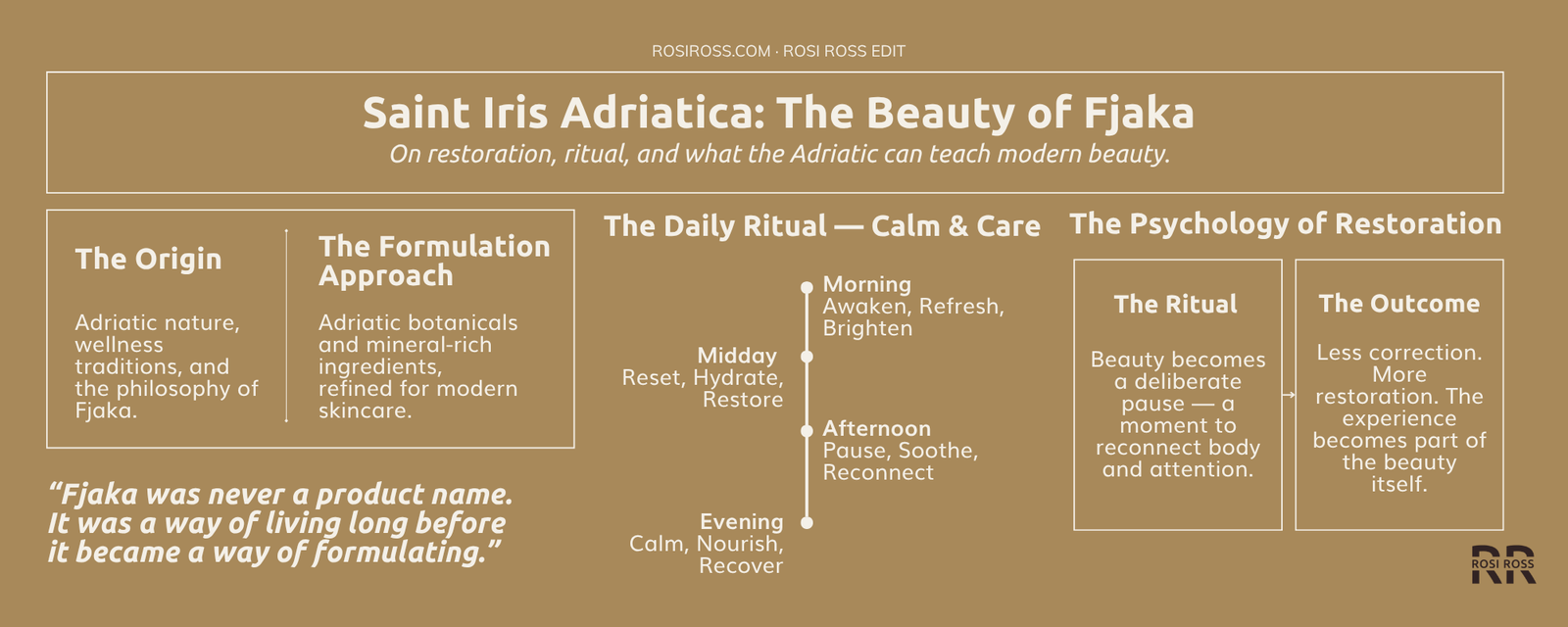
Fjaka is not a product feature. It is a state of calm, presence, and unhurried enjoyment — mindfulness in action, arrived at not through discipline but through simply living in the moment and allowing the feeling to stay.
Modern consumers are managing digital overload, urban stress, and a level of constant stimulation that earlier generations of skincare were never designed to address. Against that backdrop, beauty is increasingly functioning as a form of recovery rather than correction — the ritual itself becoming a deliberate pause, a moment of reconnection between body and attention. This reframes the question a beauty consumer is asking. It is no longer only “does this product work.” It is, with growing frequency, “how does this product make me feel” — and Fjaka is Saint Iris Adriatica’s answer to that second question, built directly into the sensory profile of every formula.
Ingredient Intelligence: The Adriatic Pharmacy
Saint Iris Adriatica’s formulas draw from a specific regional ingredient set rather than a generic “natural” ingredient list, and each carries a distinct functional role.
Adriatic Mountain Daisy sits at the meeting point of traditional herbal knowledge and modern antioxidant science, offering environmental stress support and a brightening effect that reflects generations of folk use now given clinical grounding. Flower of Salt, hand-harvested from Dalmatian sea salt basins, represents the brand’s most literal expression of place: a mineral-rich harvest containing more than seventy-five trace minerals, including magnesium, which research published in the peer-reviewed literature has associated with improved sleep quality and reduced likelihood of short sleep duration — a mineral link that positions the ocean as one of contemporary beauty’s more credible emerging ingredient sources. Dalmatian sage contributes the brand’s aromatic register, chosen for its role in Mediterranean herbal tradition and its documented association with elevated mood, while the range’s fermented botanical extracts reflect a wider movement in formulation science toward bioavailability and microbiome-conscious skincare, translating a genuinely old process — fermentation — into a genuinely current ingredient strategy.


The SIA Ritual: Body Care Reimagined
Rather than functioning as a product catalogue, the Saint Iris Adriatica range is structured as a sequence of rituals, each addressing a different register of the day.
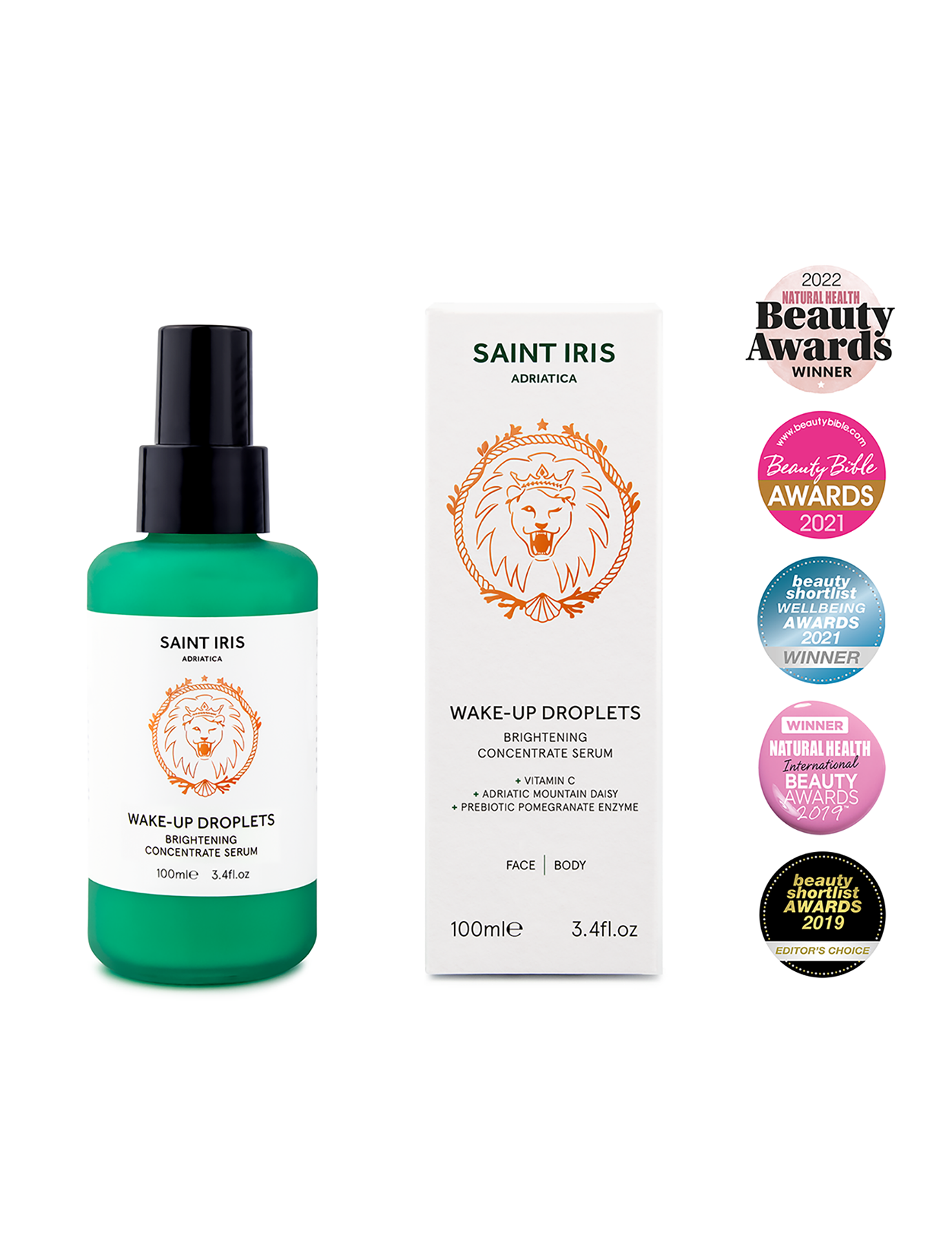
Every Body Wake-Up Droplets is the morning activation ritual — a revitalising concentrate built around Adriatic Mountain Daisy, vitamin C, and a probiotic pomegranate enzyme, formulated as a silky gel-in-serum that feels dry to the touch while remaining cooling and deeply hydrating against the skin. Its role is less about masking dullness than about polishing away the visible residue of a poor night or too much sun, restoring an even, brighter tone before the day begins.
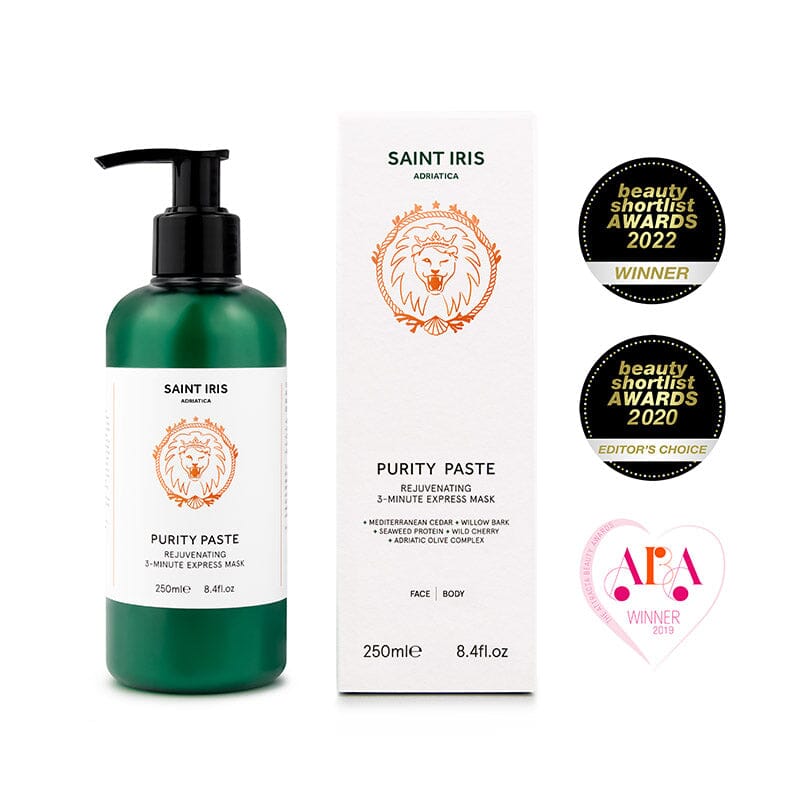
Every Body Purity Paste represents the transformation ritual: a three-minute, earthy, naturally warming mask that gently exfoliates and lifts impurities, suitable for both face and body. It functions as a modern interpretation of the double-duty cleansing rituals long practised across the Mediterranean, where a single preparation was expected to do more than one job well.
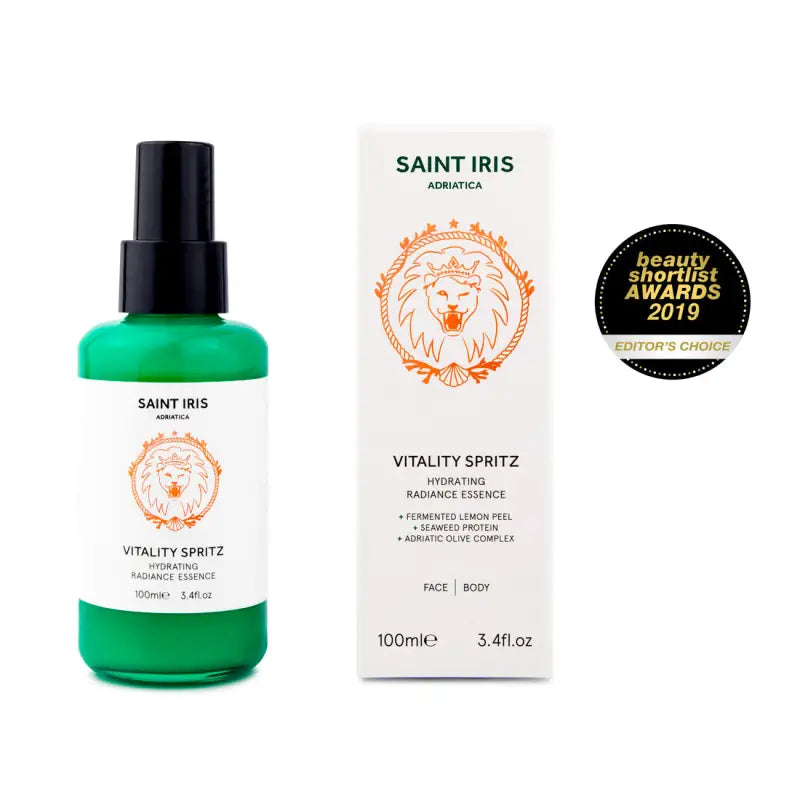
Every Body Vitality Spritz is the sensory reset — an Adriatic radiance mist built on pea peptides, seaweed proteins, fermented lemon extract, and wildflower essences, designed to refresh and hydrate on the go while lifting mood as readily as it lifts moisture. This is beauty conceived as portable wellness: a formula meant to interrupt a stressful afternoon rather than simply finish a morning routine.
The Neglected Surface: Why the Body Is Beauty’s Unfinished Canvas
The skin is the body’s largest organ, and for most of modern beauty’s history it has been treated as its least interesting one. The serious formulation science, the clinical language and the premium pricing have gathered above the neckline, while the body has been served by simpler, less differentiated products: a lotion, a wash, a scrub, sold largely on scent and volume. The imbalance is old enough to feel natural. It is not, and it is beginning to correct itself.
The reason is partly practical and partly philosophical. Practically, the body is where skin spends most of its day exposed to heat, friction, water, fabric and weather, and it is where the evidence of that exposure accumulates quietly. Philosophically, the idea that the face deserves rigour and the body deserves convenience is a hierarchy inherited from a beauty industry organised around the mirror. A more modern view starts from the skin itself: one organ, one barrier, one set of needs, applied at different scales.
Saint Iris Adriatica’s founding premise follows that view: a face-grade approach extended across the entire body. Every product in the range is formulated for use on both face and body, a structural decision that treats the body’s skin as deserving the same rigour rather than a diluted version of it. This is a more consequential choice than it sounds. It removes the category boundary that has let body care stay undemanding for so long, and it makes the brand accountable to the same standard of formulation on a forearm as on a cheekbone.
After the Trend Cycle: What Makes Beauty Last
Categories in beauty rise and exhaust themselves with remarkable speed. Each new vocabulary, whether clean, clinical, wellness or ritual, begins as a correction to the last and ends as a marketing reflex. The useful question for a reader is therefore not which word a brand uses, but what remains true of it once the word has been worn out. Four qualities tend to survive: specificity, verifiability, restraint and a reason to exist beyond the season.
Specificity is the difference between a named place and a decorative adjective. A mountain botanical and a hand-harvested sea salt from identified Dalmatian basins can be traced, questioned and explained; a generic “natural blend” cannot. Verifiability is the discipline of separating what can be checked from what is felt. Saint Iris Adriatica is certified by Cruelty Free International’s Leaping Bunny programme and formulated without parabens, mineral oils, silicones or sulphates. Those are claims a reader can confirm, and they are a different kind of claim from calm or restoration, which are personal and should be judged by the person using the product.
Restraint is the quietest of the four and the one luxury has always depended on: a short range built as a sequence of rituals rather than a catalogue of fixes, and a philosophy, fjaka, that is defined by doing less. Purpose is the test of whether the brand has something to say that outlasts its launch. Here the Adriatic matters, not as a mood board but as a body of tradition in bathing, botanicals and sea salt that existed long before beauty became an industry, and that gives the brand a source to draw on that cannot be copied by changing a label. This is also the shape of the argument the wider beauty press keeps circling: that credibility in the next phase of the category will belong to brands whose stories can survive scrutiny.
The same logic runs through other corners of considered living. It is the logic of a base-makeup philosophy built around enhancing the skin rather than concealing it, of a nocturnal routine that works with the body’s own circadian repair systems rather than overriding them, and of objects chosen for what they hold rather than what they cost, the instinct explored in the case for precisely chosen personal luxury. In each, value comes from fit and intention rather than intensity.
Saint Iris Adriatica belongs to this tradition, extended to the whole body. Its significance is not that it has found a new category, but that it applies old, durable standards, specificity, rigour, restraint and a real sense of place, to the one surface beauty has most consistently under-served. Trends will move on from the vocabulary. The principle underneath it, that the body is owed the same intelligence as the face, will not need to.
“Fjaka was never a product name.
It was a way of living
long before it became
a way of formulating.
The sea salt was gathered
before it was marketed.
The sage was picked
before it was studied.
Saint Iris Adriatica did not invent
this feeling of being restored.
It simply remembered
where to find it —
and had the discipline
not to improve it
past recognition.”

