
On what happens when a city where Christianity represents a small fraction of the population decides to build its own version of the holiday anyway, and why traditions survive not by staying fixed but by being genuinely reinterpreted
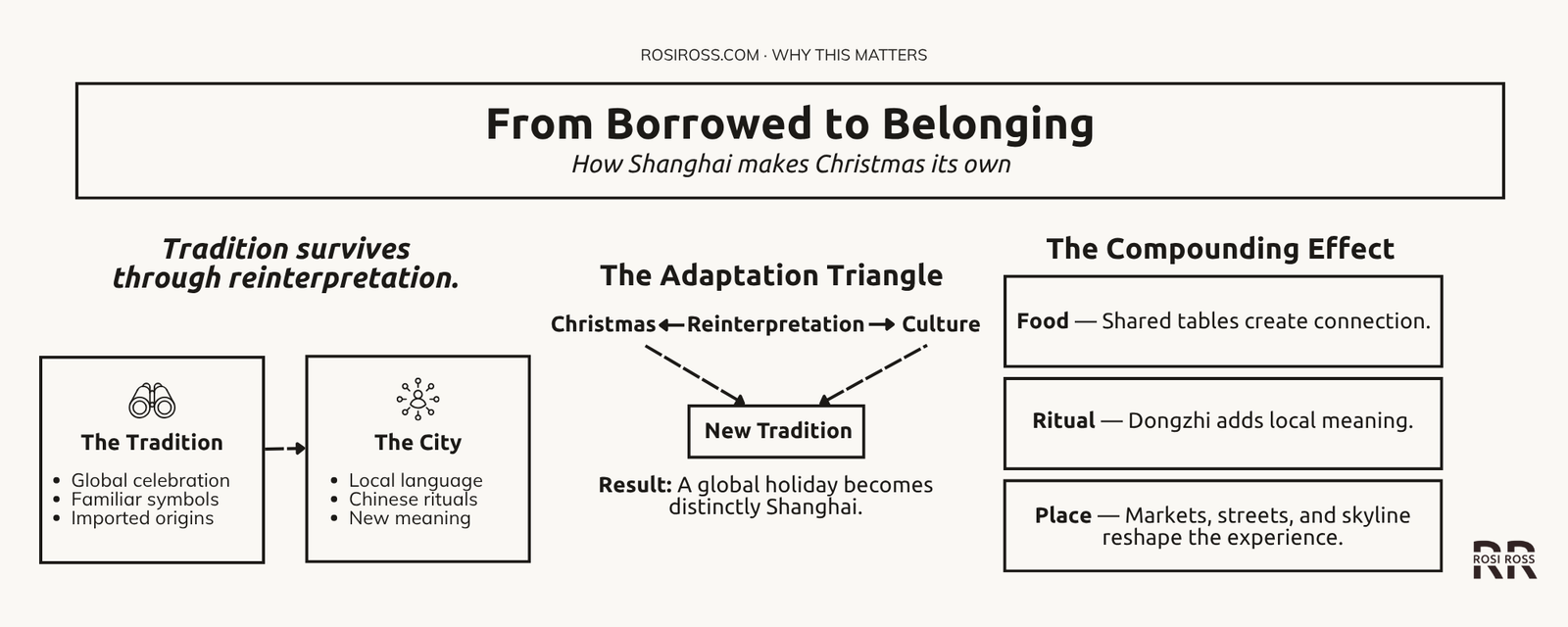
Christmas in Shanghai is not about recreating home. It is about discovering how another culture interprets a global tradition — proof that traditions are not preserved by staying unchanged. They survive because they evolve.
Shanghai is a city built on contrast as a matter of course. Ancient temples stand within view of futuristic towers. Centuries-old family ritual coexists comfortably with a generation moving at the speed of the latest platform update. During December, that contrast becomes considerably more visible — because Christmas is not, in any traditional sense, a Chinese holiday, and yet Shanghai has spent years absorbing it, reshaping it, and turning it into something that belongs unmistakably to the city rather than simply borrowed from elsewhere.
Two Clocks on the Last Night of the Year
On the last night of December, Shanghai keeps two clocks. One is the Gregorian calendar, the one printed on phones and airline tickets, by which the year ends at midnight on December 31 in the same moment as in London or New York. The other is the lunar calendar, by which the year that matters, the one that closes with the family reunion dinner and the return of millions of people to the towns they came from, ends weeks later. Most of the world’s great cities live by one clock. Shanghai, which has spent nearly two centuries at the meeting point of East and West, is among the few that live by both, and nowhere is the arrangement more visible than in the way its residents see the year out.
A City Built by Two Worlds
The explanation begins with history. After the First Opium War, the Treaty of Nanking of 1842 opened Shanghai, along with four other ports, to foreign trade, and in the years that followed, British, French and American communities established foreign-administered settlements on the land beside the Huangpu River. The British and American areas later merged into the International Settlement, while the French Concession kept its own administration, and together they shaped the city’s skyline, street plan and social life until the 1940s. The Bund’s row of neoclassical banks and trading houses, the plane-tree-lined avenues of the former French Concession and the Western-style churches that remain in the city are all products of that era.
That inheritance is complicated. It was imposed by treaties that Chinese historians and residents treat as an episode of foreign domination, yet it also made Shanghai the most cosmopolitan city in Asia for much of the twentieth century, a place where Western commerce, Chinese enterprise and refugee communities from Europe mingled in the same streets. Christmas arrived with that world. It was celebrated in churches, in foreign clubs and in the department stores that catered to the settlement communities. After 1949, such observances were curtailed, and it was only with the city’s reopening in recent decades that the holiday returned, this time not as a colonial import but as a commercial and cultural phenomenon taken up by Chinese urban consumers themselves.
The distinction is essential. The Christmas that Shanghai celebrates today is not the Christmas of the concessions. It is a newer, local reinterpretation, built by a generation for whom the holiday is a seasonal atmosphere rather than a religious occasion or a colonial memory.
The Taste of Winter: Discovering Chinese Cuisine During the Holiday Season
Any real understanding of Shanghai’s December begins at the table rather than beneath a tree. Chinese cuisine, at its foundation, is a philosophy built around the interplay of aroma, colour, texture, and seasonality rather than a fixed set of recipes — and winter dishes in particular reveal what the culture actually values: warmth, gathering, and a kind of prosperity measured in shared abundance rather than individual portion size. A bowl of chicken and sweet corn soup functions as the season’s most unpretentious comfort; dim sum operates less as a meal than a social ritual, unfolding across a table shared by everyone present; Peking roasted duck carries an imperial culinary lineage stretching back centuries; dumplings, closed carefully at the seam, symbolise prosperity and reunion in nearly every regional tradition across the country. Ma po tofu brings Sichuan’s characteristic complexity and heat into the mix, while Kung Pao chicken remains one of the more globally recognisable ambassadors of regional Chinese flavour — evidence, taken together, that winter dining in Shanghai treats a shared table as the actual centre of the season, considerably more than any single dish served on it.


Dongzhi Festival: China’s Winter Solstice Tradition
Long before Christmas lights appeared on Nanjing Road, China had already built its own winter celebration around the solstice itself. What is Dongzhi Festival? Marking the year’s longest night, Dongzhi celebrates balance, family reunion, and the quiet promise of returning daylight — a seasonal ritual considerably older than Christmas and, in its own cultural register, every bit as significant. In southern China, families gather to roll and share tangyuan, glutinous rice balls whose round shape symbolises completeness and the closing of a family circle; in the north, the tradition shifts toward dumplings, standing in for prosperity and protection through the harshest stretch of winter. The specific dish changes by region. The underlying instinct does not: cultures everywhere build rituals to draw people together during the year’s darkest days, and Dongzhi is China’s own long-standing answer to that same universal impulse — an observance well documented by cultural institutions such as Asia Society, and among the most enduring seasonal rituals in the Chinese calendar.
Heritage and Import: How the City Holds Both
The relationship between Shanghai’s heritage and its Western influences is best understood as a division of labour rather than a contest. The deep, structuring rituals of the year, the solstice, the family reunion, the lunar new year, remain Chinese, and they are kept with a seriousness that no imported festival has displaced. The imported celebrations, Christmas among them, occupy a different register: they are about atmosphere, novelty, gifting, gathering with friends and the pleasure of a decorated city. One carries obligation and belonging; the other carries leisure and display.
This arrangement explains why Shanghai does not experience the two traditions as rivals. A resident can attend a Dongzhi dinner with family, join colleagues for a Christmas market on a weekend evening and spend the lunar new year at a parent’s table, without feeling that any of these contradict one another. The calendar simply holds more than one kind of occasion, and a city shaped by trade and migration has long been practised at holding more than one thing at once.
Two New Years: The Calendar the World Keeps and the One Shanghai Keeps
The clearest illustration is the New Year itself. The Gregorian new year on January 1 is observed in mainland China as a public holiday, and in a city as outward-looking as Shanghai, the night before is marked with countdowns, restaurant dinners, hotel events and gatherings among friends. Yet the festival that carries real weight is the lunar new year, known as the Spring Festival, which falls between late January and mid-February and is celebrated with a long public holiday. It is the occasion for the family reunion dinner, for red envelopes of money passed between generations, for temple visits and for the largest annual movement of people in the country. By any measure of social significance, Spring Festival is the new year, and January 1 is the visitor.
That ranking is rarely stated aloud, but it shapes behaviour. Many residents treat the Gregorian new year as a pleasant occasion for friends and a night out, and the lunar new year as the date on which family obligations fall due. For a visitor, the practical consequence is a useful one: the intensity that a Western traveller expects from December 31 is in Shanghai reserved, in spirit, for several weeks later.
How Locals Celebrate
For Shanghai’s residents, the end of the Gregorian year is typically a social rather than ceremonial occasion. It is a night for dinner with friends or colleagues, often at a restaurant or a hot-pot table, followed by karaoke, a drink somewhere with a view or a quiet evening at home. Younger residents, in particular, have embraced the countdown and the idea of a shared midnight, carried by social media and by a generation comfortable with international rituals. Shopping districts and cultural venues stage seasonal programming, and the days around New Year’s Day offer a short break that many residents use for travel or rest.
The deeper rhythm of the local calendar returns at the lunar new year. Families gather for the reunion dinner, with dishes chosen for their symbolism, among them fish, dumplings and rice cakes, each associated with prosperity, abundance or progress. Temples draw visitors who come to offer incense and ask for good fortune in the coming year, and Longhua Temple, one of the city’s oldest, is traditionally associated with the sounding of its great bell at the turn of the lunar year. Public celebrations in the urban core have also changed over time: the city has placed restrictions on fireworks in central districts, and large crowds on the Bund are now managed far more cautiously than they once were, following the tragic crowd crush on New Year’s Eve 2014, in which thirty-six people died. The episode reshaped how the city thinks about large public gatherings and remains part of the context for how its New Year events are organised today.
How Foreigners Celebrate
For Shanghai’s international residents and visitors, the New Year looks more familiar and is organised around the venues the city built for them. Hotels and rooftop restaurants stage countdown dinners and parties, the city’s historic hospitality addresses draw visitors for a classic evening, and private gatherings in apartments and houses continue the tradition of home-away-from-home celebration noted earlier in this piece. For many members of the expatriate community, the night is a chance to mark the year with friends who function as an adopted family, particularly when relatives are thousands of kilometres away.
What distinguishes the foreign experience of Shanghai is how readily it expands beyond December 31. Many long-term foreign residents describe the lunar new year as the festival they come to anticipate most, drawn by its food, its ritual and the unusual quiet that settles over a normally relentless city as millions travel home. Visitors who arrive expecting a single midnight often leave with a more interesting impression: that the city has two seasons of celebration, and that the second reveals more about it than the first.
Where the Two Meet
The most interesting development is the quiet convergence between the two groups. Younger Chinese residents adopt Western festival customs, Christmas gifts, countdown parties and winter markets, and treat them as elements of a modern urban lifestyle. International residents, in turn, take up Chinese traditions: they learn to make dumplings for Dongzhi, accept red envelopes with a clearer understanding of their meaning and plan their own reunion dinners. The result is a hybrid calendar that no single culture designed, assembled from the preferences of millions of people choosing what to keep.
This is the real answer to the question the article started with. Shanghai did not choose between heritage and Western influence. It built a way of living in which each does a different job: heritage carries meaning, obligation and continuity, while the imported celebrations carry festivity, novelty and openness. A city that can hold both without strain is not diluted by either. It is, in a precise sense, more fully itself.
Shanghai After Dark: Festive Experiences Beyond the Dinner Table
Much of Shanghai’s Christmas identity plays out socially rather than religiously. Among the city’s international community, private house gatherings have become a genuine December fixture — potluck brunches, holiday-film marathons, the specific comfort of familiar company assembled somewhere far from home. For a livelier register, karaoke remains one of the more essential expressions of Chinese social life, and Shanghai’s venues take the format seriously: V-Show, with its elaborately themed private rooms, turns an evening of shared singing into something closer to genuine spectacle, set against the backdrop of the city’s own illuminated skyline.







Walking Shanghai: The City as a Winter Experience
December transforms Shanghai’s streets into something closer to a cinematic set piece — department stores dressed in elaborate seasonal display, public squares anchored by towering illuminated trees, the western districts’ boutiques and cafés glowing against the winter dark. Shanghai Disneyland extends this into full spectacle, reframing the holiday as a genuinely global fantasy rather than a culturally specific observance, its scale matched by few winter attractions anywhere in Asia. The pleasure here is almost entirely pedestrian: Shanghai’s own particular version of Christmas reveals itself most clearly to anyone actually willing to walk it rather than view it from a car window.




Shanghai’s Christmas Markets: Where Cultures Meet
Shanghai’s open-air Christmas markets are not attempts to replicate Europe. They are the city’s own interpretation of the format, each carrying a distinct personality. The Jing’an Christkindlmarkt, staged at Paulaner Brauhaus near Fenyang Lu, leans into genuine German tradition — mulled wine, handmade crafts, and an atmosphere close enough to Bavaria to feel authentic rather than costumed. The Archwalk Christmas Shindig on Maotai Road takes the opposite register entirely, built around live performance and family-oriented entertainment for a younger, more energetic crowd. Jiashan Market’s Christmas edition leans into independent, handcrafted goods and genuine local creativity, while Commune Market’s holiday showcase, set against Yongjia Lu’s historic architecture, curates a more refined register entirely — gourmet products and design objects for a considerably more design-literate visitor. Taken together, these four markets make the argument on their own: Shanghai’s Christmas was never a single imported tradition. It is several, running in parallel, each interpreted through a different lens.
The Huangpu River: Seeing Shanghai Through Its Most Iconic View
No proper account of Shanghai in December is complete without the river. A cruise along the Huangpu — whether the full three-hour, sixty-kilometre voyage toward the mouth of the Yangtze or the condensed hour-long route between the Yangpu and Nanpu bridges — delivers the clearest possible read on the city’s own central contrast: the Bund’s colonial-era buildings on one bank, Pudong’s futuristic skyline glittering directly across from them on the other. Departing from Shiliupu Wharf just south of the Bund, the journey functions less as sightseeing than as a genuinely cinematic framing device for everything the rest of the city has been arguing all along — that history and ambition here were never meant to be viewed separately.


Winter Escapes: Beyond the City Limits
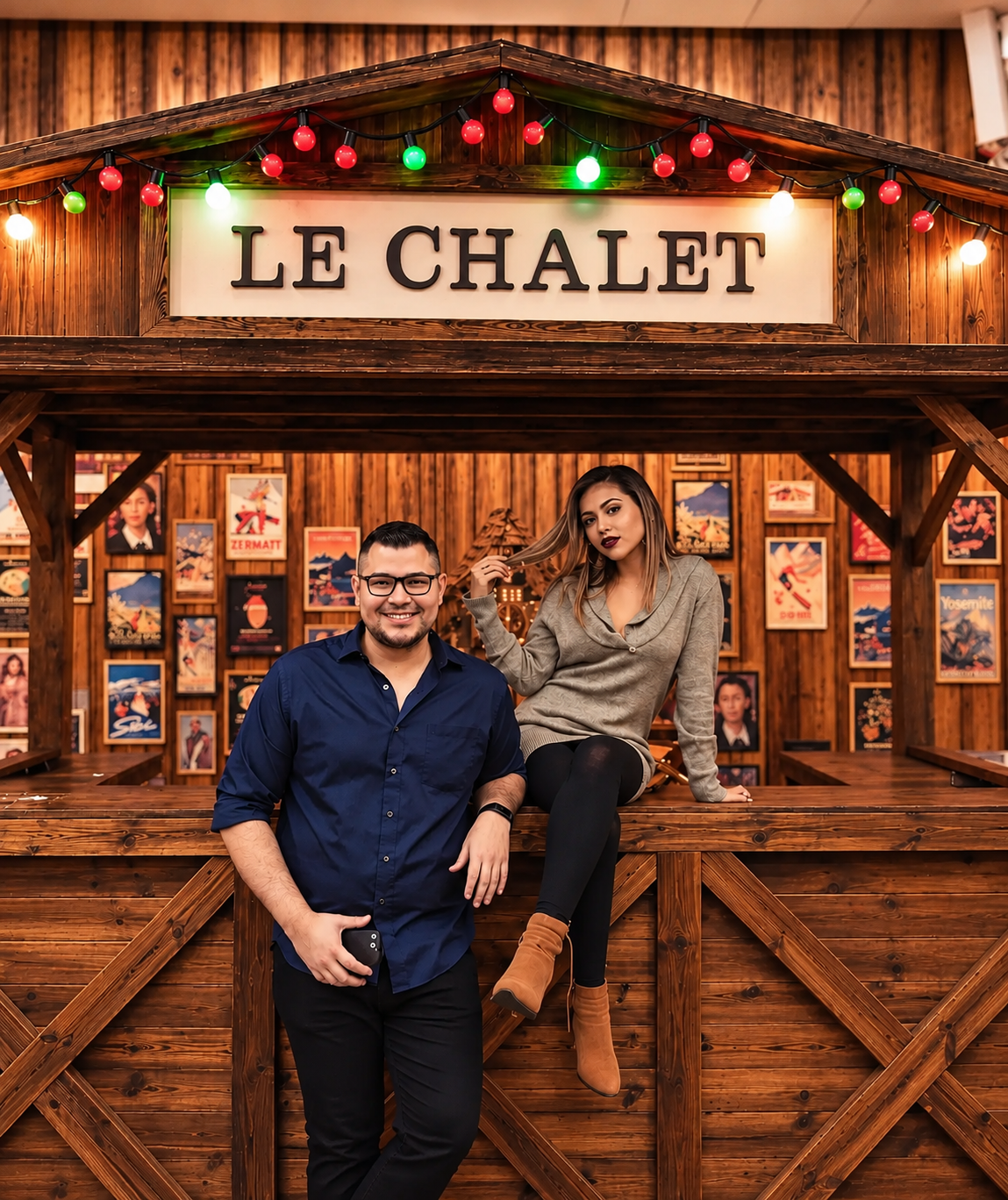
Shanghai’s winter identity extends well past its own borders. Lin’an Daming Mountain, roughly a hundred and fifty kilometres away in Zhejiang province, is promoted as one of eastern China’s largest ski resorts — evidence of a genuinely growing domestic winter sports culture among younger Chinese travellers rather than a novelty imported wholesale from Europe or North America. Divided between a dedicated skiing area and a considerably calmer relaxation zone threaded through the surrounding Jiangnan Tianchi scenery, the resort captures a version of Chinese winter leisure that has almost nothing to do with Christmas and everything to do with a broader, more recent embrace of outdoor recreation as lifestyle rather than exception.



Shanghai From Above: The City’s Future Seen From the Sky
Completed in 1995, the Oriental Pearl Tower remains Shanghai’s clearest symbol of its own transformation into a global metropolis, its glass-bottomed observation deck offering a genuinely vertiginous read on Lujiazui’s skyline and the Huangpu curling beneath it. A revolving restaurant turns dinner into a slow three-hundred-and-sixty-degree survey of the city, while the Shanghai History Museum at its base supplies the context the view alone cannot: how this specific skyline came to exist at all. A short distance away, the Shanghai World Financial Center’s Sky Walk 100 — a hundred floors up inside the building locals have long nicknamed “the bottle opener” — delivers an even higher vantage, its ticket extending across three separate observation levels and, after dark, a genuinely spectacular read on the city’s illuminated skyline. This same instinct toward altitude as a form of urban understanding runs directly parallel to Hong Kong’s own rooftop culture, a different city reaching an identical conclusion: the clearest way to actually see a place is often to rise a considerable distance above it first.




Shanghai’s Interpretation of Christmas
A global city does not simply adopt a tradition. It reinvents it — and the reinvention itself is usually the more interesting story.
The adaptation begins at the level of language. “Merry Christmas” becomes Sheng Dan Kuai Le (圣诞快乐), which translates roughly to “Holy Birth Happiness” — a phrase that carries the season’s warmth without importing its specific theology. Santa Claus, meanwhile, arrives in Mandarin as Sheng Dan Lao Ren (圣诞老人), “the old Christmas man,” a gently practical rendering that says everything about how the figure has been absorbed: recognisable, welcomed, and quietly detached from any doctrine that might otherwise have limited his reach. Is Christmas celebrated in China? Not as a public holiday, and not, for the vast majority of residents, as a religious observance — but in cities like Shanghai, it has become a genuine fixture of urban lifestyle culture: community, light, gathering, and the specific pleasure of giving, detached from any requirement of belief.
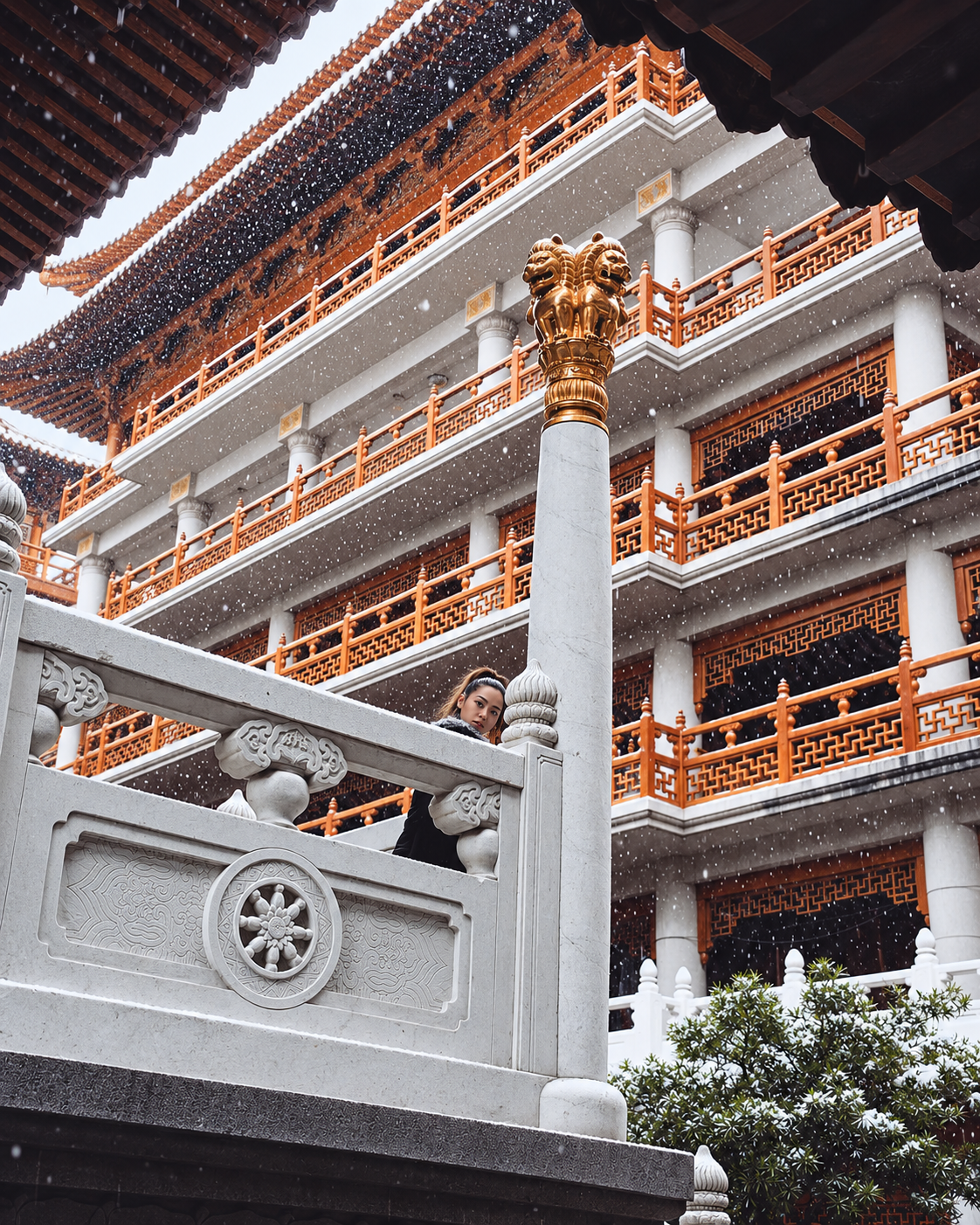
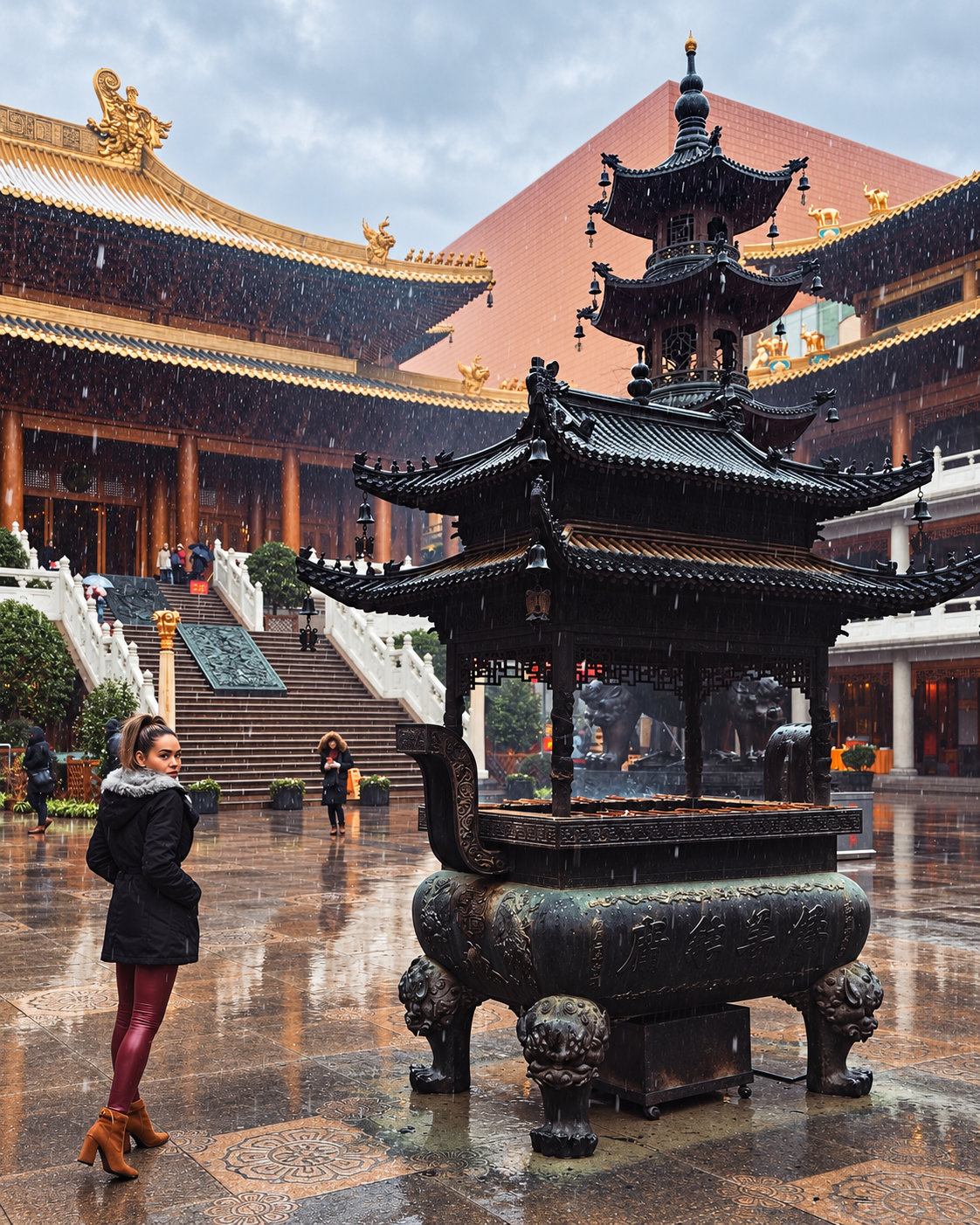
Religious observance does exist, quietly. Christians in Shanghai, who are a small fraction of the population, attend services at the city’s churches, including Xujiahui Cathedral, a Gothic Revival building from the early twentieth century that remains an active place of worship. The contrast between a crowded Christmas Eve service and the glitter of the commercial districts a few kilometres away is itself an accurate portrait of the city: a sacred tradition kept faithfully by a few, and a secular one enjoyed freely by many.
Why Shanghai’s Christmas Matters
Christmas in Shanghai was never a story about recreating home for the international community that celebrates it, nor a story about a foreign tradition simply grafted onto a city that had no prior use for it. It is a case study in cultural adaptation, and the more useful measure of a cosmopolitan city is not how faithfully it replicates an imported custom, but how confidently it makes that custom its own. Travel and design publications such as Condé Nast Traveler and Monocle regularly examine cities through this lens, and the Shanghai Municipal Tourism Administration presents the city’s winter season as an addition to the festivals the city already keeps rather than an imitation of a Western holiday.
This same logic — heritage surviving specifically because it kept adapting rather than staying fixed — runs through other traditions this editorial series has traced: an ancient Indian painting tradition that moved from mud walls to silk without losing its line, temples standing directly beneath this same city’s skyline that remain active rather than merely preserved, and an island where ancient ritual and daily agricultural life have never actually separated. The same principle, applied to personal practice rather than civic celebration, runs through the case for ritual as identity built through repetition — and Shanghai’s own reinvented December, layered from Dongzhi’s ancient solstice logic through to a German-style mulled wine stall in Jing’an, is simply that same principle performed at the scale of an entire city.
Christmas in Shanghai was never about finding a replacement for a tradition carried from somewhere else. It is about watching one of the world’s most genuinely dynamic cities take hold of a global celebration and, without asking permission, decide exactly what it should mean here.
“Shanghai did not need
Christmas to already belong to it
before deciding
to celebrate it fully.
A tradition, held loosely enough,
was always going to become
something new
the moment it crossed
into a city
confident enough
to reshape it.
This was never
a borrowed holiday.
It was simply
a new one, arriving
in a language
the city already spoke.”

