
On why a four-thousand-strong community of central Indian storytellers understood ecological interdependence centuries before the term existed, and what a line drawn by hand can still teach a world that has automated almost everything else
A painting filled with forests, birds, animals and symbolic patterns is not simply decoration. It is a visual language reminding us that every living system is connected — an argument the modern world is only now beginning to relearn.
The modern world moves faster than it has at any prior point in its own history. Cities grow more automated. Consumption accelerates without much pause for consequence. Somewhere beneath that acceleration, though, sits a quieter and increasingly urgent desire: to reconnect with something older than any of it. Long before environmental movements became a global vocabulary, the Gond communities of central India had already built a visual language around a single, unshowy premise — that a hill, a river, a tree, and the person standing beside them are not separate categories of being, but participants in the same continuous relationship.
The Origins of Gond Painting: An Art Form Born From the Forest
The geography of an art form often explains its philosophy before a single painting is examined. Gond art emerged from landscapes where forests, animals, and seasons did not decorate daily life — they structured it.
The name Gond derives from the Dravidian expression Kond, meaning “green mountain,” a linguistic root that already tells most of the story before any brushstroke enters the frame. The Gond are among the largest tribal communities in central India, with a documented history stretching back roughly fourteen hundred years and a present-day population estimated at over four million, according to India’s official cultural heritage archive. While the tradition is most closely associated with Madhya Pradesh, and specifically the village of Patangarh in the Dindori district, its practice extends across Maharashtra, Chhattisgarh, Andhra Pradesh, and Odisha — a geographic spread wide enough that the Government of India has taken formal steps to preserve the form for future generations rather than leave its continuation to circumstance alone.
Where did Gond art originate? In the domestic life of Gond households themselves, long before it reached a canvas — painted directly onto the mud-plastered walls and floors of homes, refreshed with each reconstruction, using pigments drawn straight from the surrounding land.

Who Are the Gond? A Short History
The Gond are one of the largest tribal communities in India. Census-based figures put their population at roughly thirteen million, spread mainly across Madhya Pradesh, Chhattisgarh and Maharashtra, with communities in Telangana, Andhra Pradesh and Odisha as well. They speak Gondi, a Dravidian language closely related to Telugu, which makes their linguistic roots southern rather than the Indo-Aryan family of the surrounding north. It is a detail that quietly signals how old and distinct the community’s presence in central India is.
Gond history is not only a history of forest villages. Scholars believe Gond dynasties ruled a wide region known as Gondwana between roughly the thirteenth and nineteenth centuries, with kingdoms centred on Chanda, Garha-Mandla, Kherla and Deogarh. The best known figure of that period is Rani Durgavati of Mandla, the warrior-queen who resisted the Mughal advance under Akbar and died in battle in 1564. The kingdoms later fell, first under the Mughals and then largely to the Marathas in the eighteenth century, and Gond communities were gradually pushed back toward the forests and hills of the central highlands.
This matters for how the art is understood. Gond painting is not the folk craft of a people without a history; it is the visual culture of a community that once held political power, lost it, and kept its cosmology intact in the landscape it retreated into. The forest is not only the subject of the paintings. It is the place where the tradition survived.
From Mud Walls to Gallery Canvas
For most of its history Gond art was domestic and seasonal. Painted on the mud-plastered walls and floors of homes, it marked festivals and rites of passage, and it was refreshed rather than preserved, redrawn each time a wall was replastered. Nothing about it was designed to be collected. That changed in the early 1980s, when the painter Jangarh Singh Shyam, a Pardhan Gond from Patangarh, came to the attention of the artist and museum director Jagdish Swaminathan at Bhopal’s Bharat Bhavan.
Shyam’s decision to work on paper and canvas opened the tradition to a wider world, and exhibitions abroad followed. The lineage he established, known as Jangarh Kalam, produced a generation of Pardhan Gond painters, among them members of his own extended family, who work in galleries and markets far beyond their villages. The transition was not without tension. A tradition made to be repainted had to learn what it meant to be fixed, signed and sold, and the question of how a living practice survives that translation remains open. It is also the question that makes the form relevant beyond India, because it is the same question facing every craft tradition that meets a global market.
Gond art comes from the Gond people of central India, a community of roughly thirteen million people whose ancestors ruled the Gondwana kingdoms between about the thirteenth and nineteenth centuries. The painting tradition began as domestic wall and floor decoration tied to festivals and rites of passage. It reached galleries in the 1980s through Jangarh Singh Shyam, a Pardhan Gond artist from Patangarh, whose lineage, known as Jangarh Kalam, shaped the contemporary form.
Why It Matters Now
The relevance of Gond art is easy to misread as a matter of aesthetics or nostalgia. It is more practical than that. The tradition encodes a way of seeing in which a hill, a river, a tree and a person are participants in the same system, and that is exactly the framework contemporary conservation has been working to articulate. The difference is that for the Gond it is not a framework. It is an inheritance.
Its survival also carries a cultural argument. Gondi, the language that carries the community’s songs and stories, is spoken today by a minority of Gonds and is considered under pressure. The paintings, many of which began as visual translations of the oral songs the Pardhan Gonds performed, have become one of the ways a story-world continues when the language that carried it begins to thin. In that sense Gond art is not only a style to admire. It is an archive that happens to be beautiful.
For the contemporary reader, this is the reason the form has become a case study in what lasting culture looks like: handmade, tied to a place, answerable to a community, and capable of adapting its materials without abandoning its grammar. It asks a question that applies well beyond painting: what is worth carrying forward when a tradition meets the modern world, and who decides?


Why Nature Is the Central Character of Gond Art
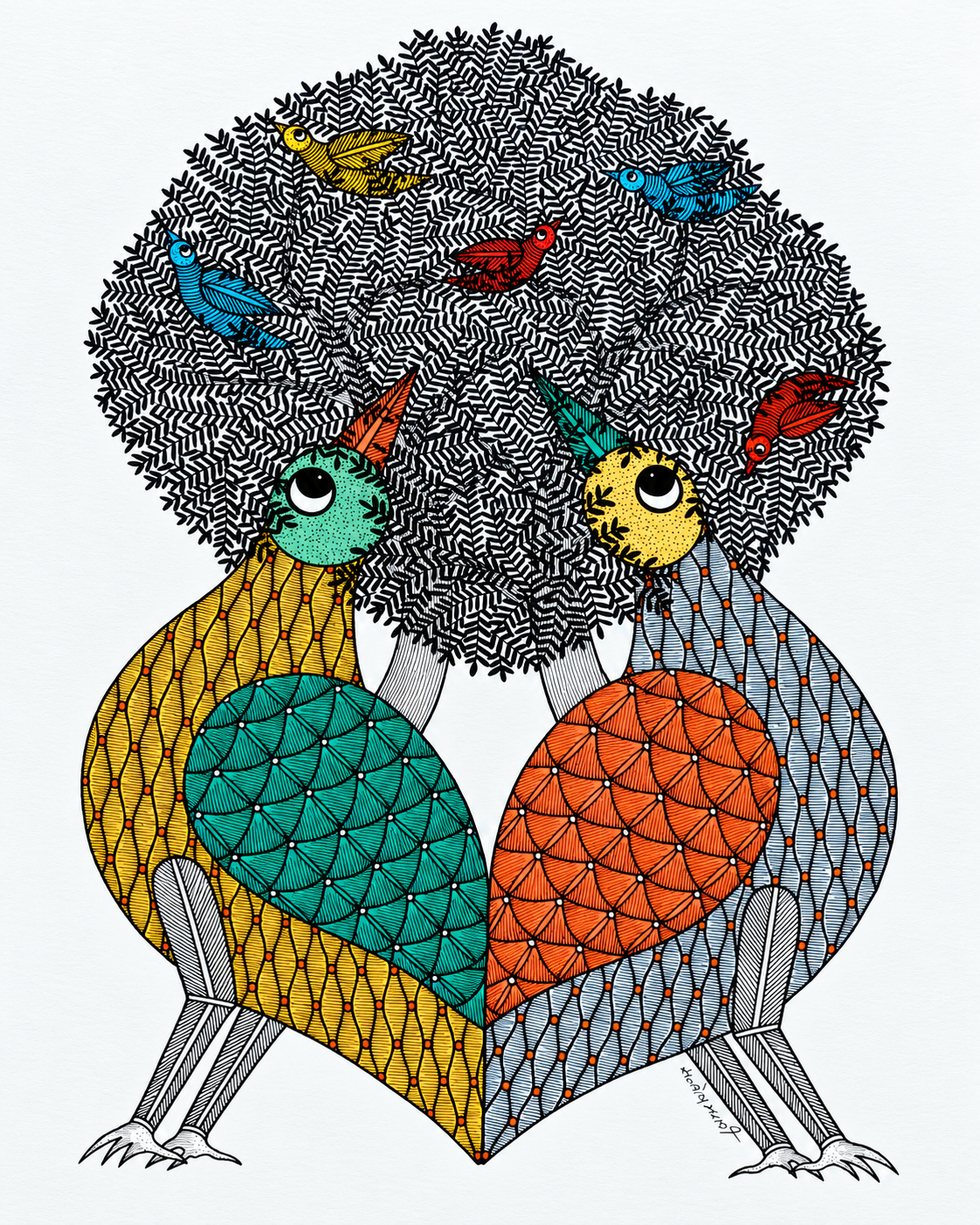
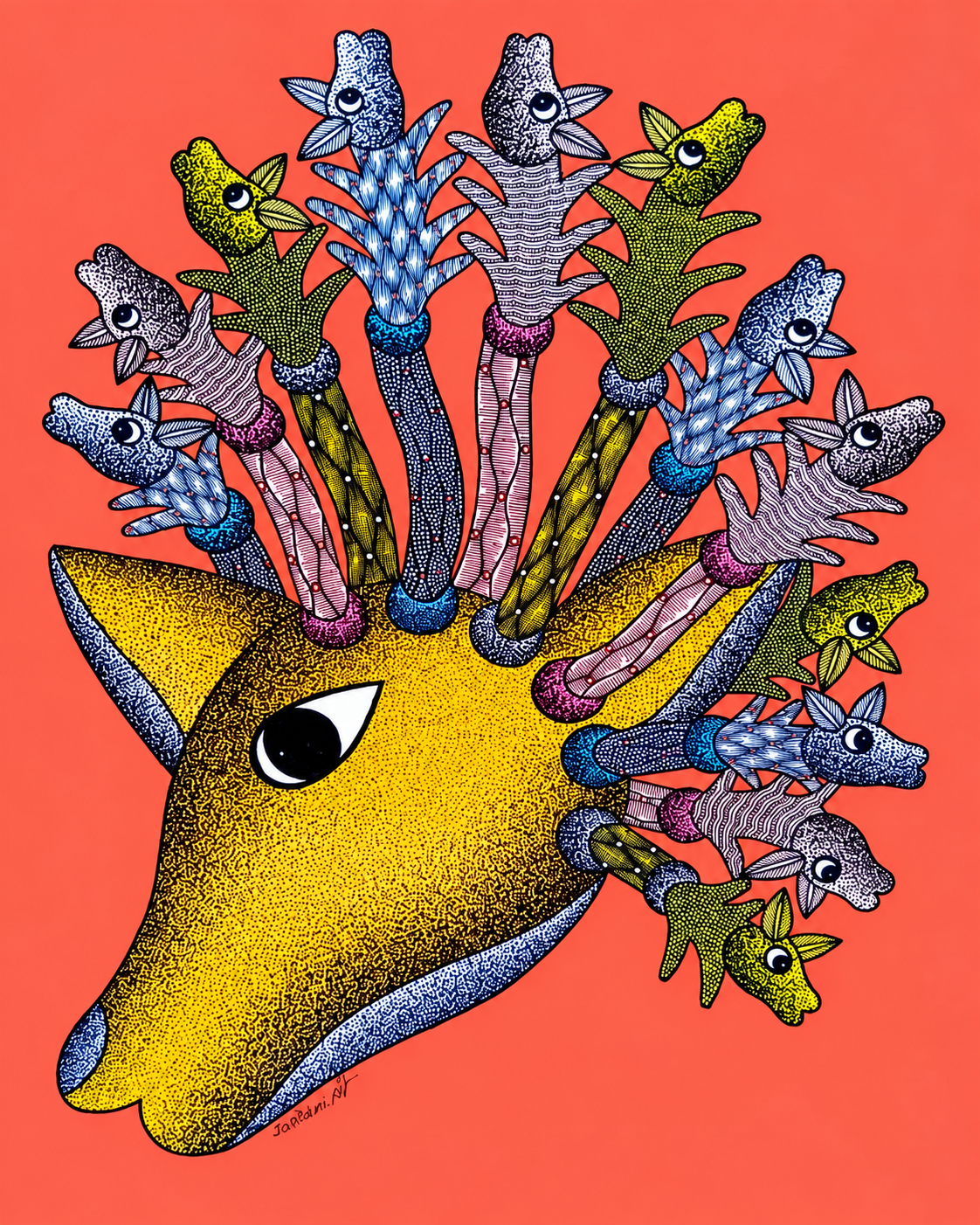
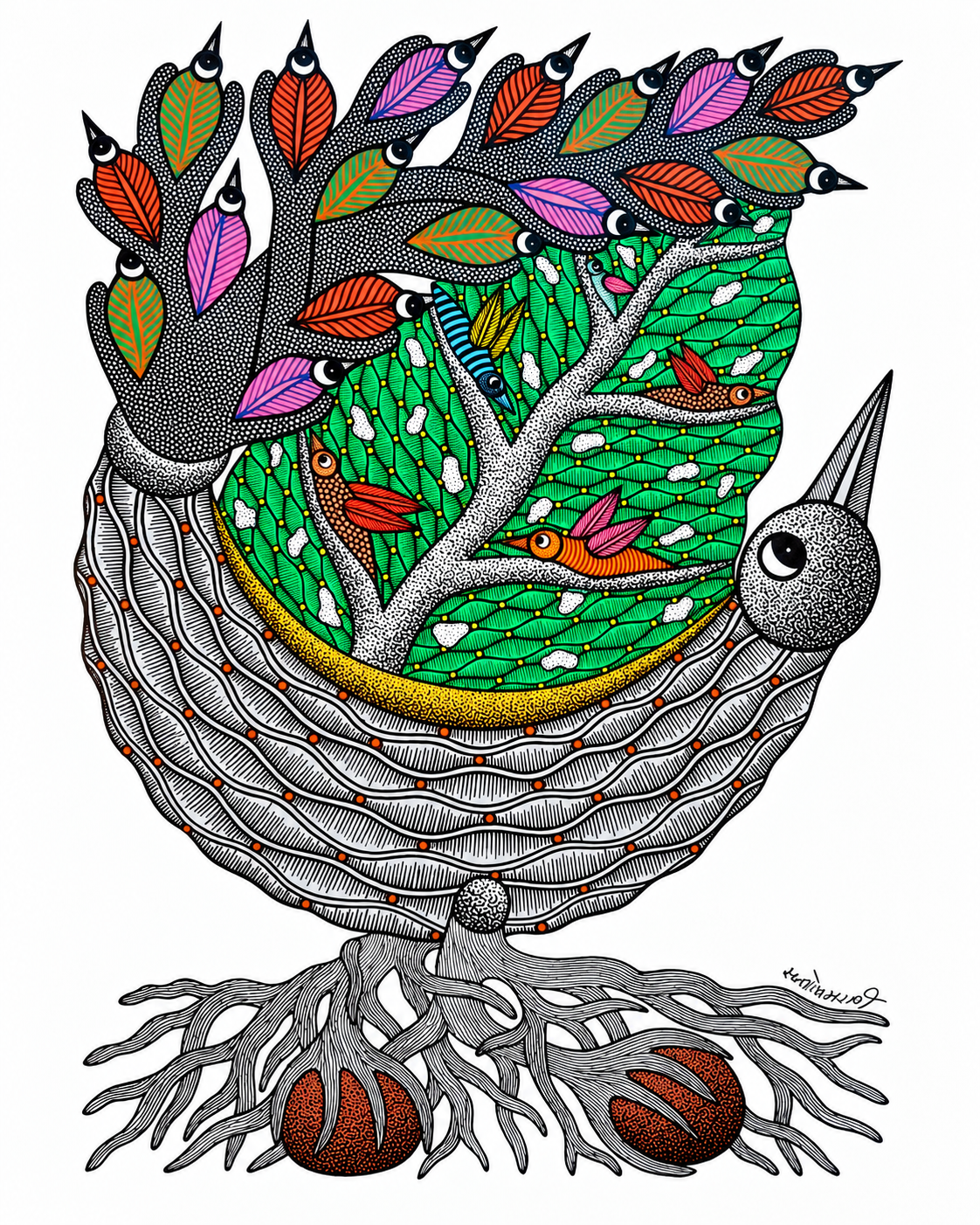
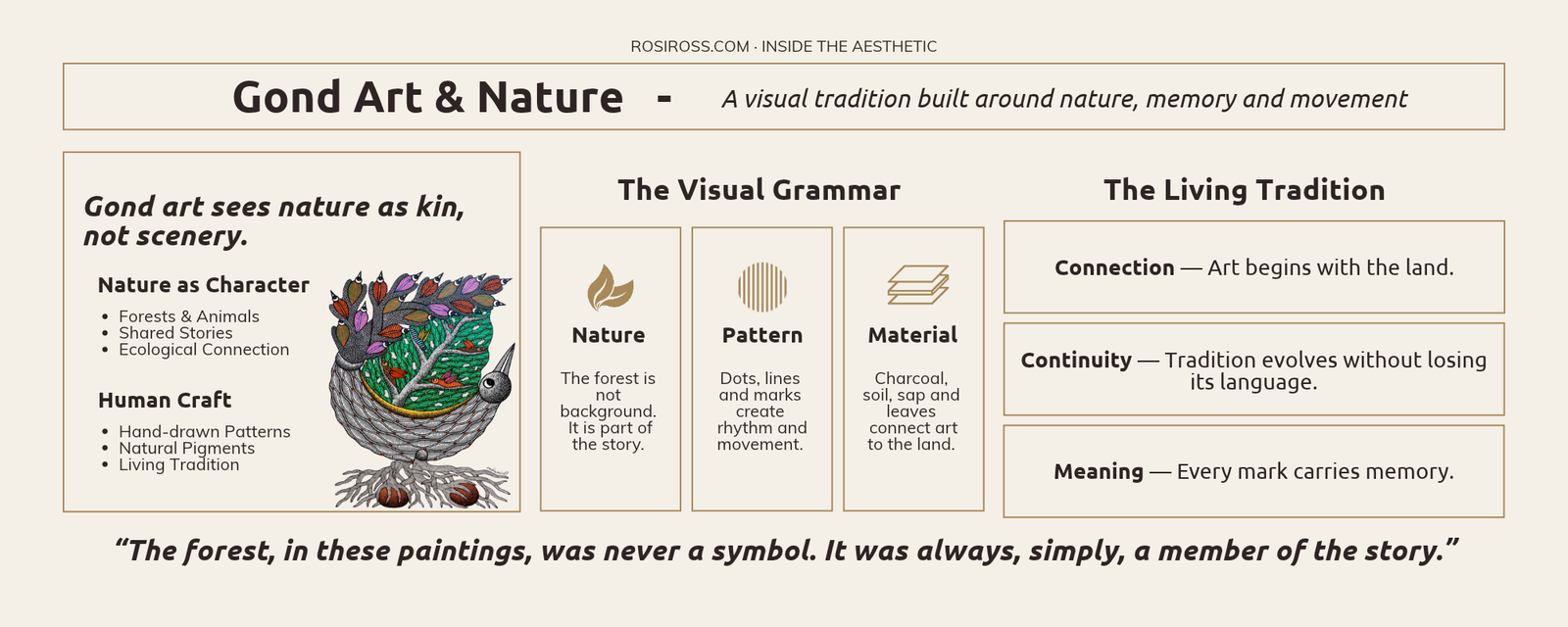
Within Gond cosmology, every hill, river, rock, and tree is understood to be inhabited by spirit, and therefore sacred — which means the animals, birds, and landscapes that populate a Gond painting are never simply decorative subjects chosen for visual interest. They are participants in a shared narrative, painted as an act of reverence rather than observation. This is the distinction worth sitting with: the forest in a Gond painting is not background. It is a character with agency, memory, and voice, in precisely the way contemporary ecological thinking is only now attempting to formalise through frameworks like biodiversity and interdependence.
Why is Gond art connected to nature? Because the tradition never separated the two to begin with. A Gond painting does not depict a relationship between humanity and the natural world — it proceeds from the assumption that no such separation exists.
Who are famous Gond artists? The tradition’s modern visibility is owed largely to Jangarh Singh Shyam, a Pardhan Gond artist from Patangarh whose wall paintings caught the attention of Jagdish Swaminathan, then director of Bhopal’s Bharat Bhavan museum, in the early 1980s. Shyam became the first Gond artist to translate the form onto canvas and paper, exhibiting in Tokyo and Paris and establishing what is now known within the tradition as Jangarh Kalam — a lineage that gave rise to a wider generation of Pardhan Gond painters working in galleries and markets far beyond the villages where the form began.
Gond painting is, in the most literal sense, a drawn practice — every internal pattern and outer contour built with a level of care that gives the finished line an almost audible rhythm. Artists construct their compositions from intricate networks of internal detail, repeated marks, and rhythmic dots and dashes that do more than fill space: they generate the sensation of movement inside an otherwise still image, so that a painted deer or bird appears to be caught mid-motion rather than fixed in place. This is a technical discipline as much as an aesthetic one, closer in spirit to musical notation than to illustration — patterns that behave, on close inspection, less like ornament and more like breathing.


The Artists Keeping Gond Traditions Alive
Traditional Gond paintings were made entirely from what the land itself provided: charcoal, coloured soil, plant sap, leaves, and cow dung, pigments chosen for availability rather than symbolism, though their materiality quietly reinforces the tradition’s larger argument about origin and belonging. Contemporary Gond artists have expanded their material vocabulary to include acrylics, canvas, and paper without abandoning the visual grammar that defines the form — a negotiation between heritage and innovation rather than a replacement of one by the other.
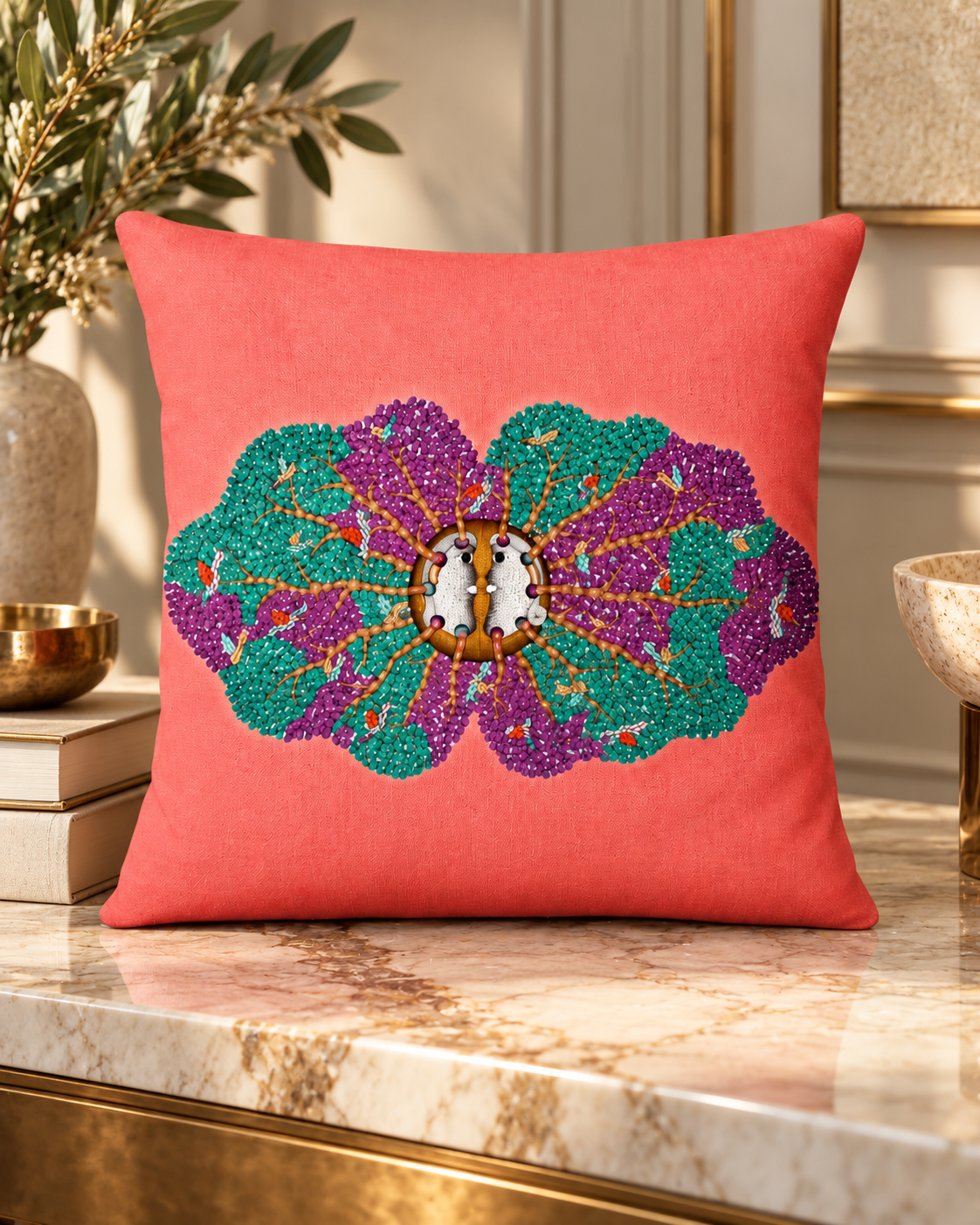
Santosh Maravi represents this negotiation at its most contemporary and urgent. A Gond artist working within the tradition’s established visual language, Maravi has turned his attention specifically toward disappearing forests and animals losing their habitats, using centuries-old technique to narrate a distinctly present-day crisis. His collaboration with the textile house Tales on Silk extends the tradition into a further register entirely — bringing Gond visual language onto silk in a partnership that functions less as a licensing arrangement than as a genuine act of preservation, introducing the form to audiences who might otherwise never encounter it, while returning recognition and income directly to the artists sustaining it.
The future of luxury increasingly rewards exactly what a Gond painting embodies: craftsmanship, provenance, human skill, and cultural meaning that mass production structurally cannot replicate. When a traditional art form enters a contemporary design space — a silk scarf, a gallery wall, a considered interior — the exchange runs in both directions. New audiences discover a visual language centuries in the making, the artists behind it gain recognition and a broader market, and the knowledge itself continues rather than calcifying into a museum artefact. This is the version of luxury that matters most in the present moment: not excess, but the traceable presence of a human hand.
A piece of art can become a conversation, a memory, a connection to another culture, a reminder of values held quietly rather than announced. In a world increasingly furnished by disposable objects, that kind of meaning has become the rarer commodity.
With a genuine work of art, the time, effort, and skill behind its creation remain sensible in the object itself — sometimes because the story behind it was heard directly from the artist, sometimes simply because a brushstroke or a fingerprint left in the paint carries the unmistakable evidence of a specific human hand, a point the Artwork Archive has made in its own writing on the emotional durability of collected art. A Gond painting hung in a home rarely goes unremarked upon, and the resulting conversation — about where it came from, what it depicts, why it was chosen — is itself part of what the object was made to do.
The Future of Indigenous Art and Environmental Storytelling
Environmental crises are rarely solved through information alone. They require emotional connection, and art has always been one of the more reliable instruments for producing it — a painting of a vanishing forest communicates differently, and often more durably, than a statistic ever could, because it asks for feeling rather than comprehension. As conversations around biodiversity, sustainability, and indigenous knowledge continue to gain ground globally — a shift UNESCO’s own framework for intangible cultural heritage has spent decades formalising — traditions like Gond painting are being recognised not as decorative curiosities from a vanishing past, but as intact systems of ecological knowledge that never stopped being relevant. Traditional art forms rarely survive by staying frozen. They survive, as Gond painting has, by continuing to say something artists and audiences alike still need to hear.
This same instinct — toward craftsmanship with provenance, toward objects and places that carry genuine continuity rather than performed novelty — runs through other corners of considered culture as well: a city whose layered history has never actually stopped being lived in, an island where ancient temples still stand inside working farmland, a jewellery philosophy built around objects chosen for what they communicate rather than what they cost, and a beauty ritual rooted in a specific coastline’s own inherited knowledge. Gond painting belongs unmistakably to this same lineage, expressed through pigment and line rather than architecture or fragrance: the conviction that what endures is more valuable than what merely impresses, and that the oldest knowledge is frequently the knowledge a fast-moving world most urgently needs back.
A handful of further details make the tradition’s living character difficult to mistake for folklore alone. The Pardhan Gonds, historically the community’s singers and storytellers, produced many of their paintings as direct visual translations of song — image functioning as a second register of the same oral tradition. The work is closely tied to major festivals such as Holi and Diwali, timed to community rhythms rather than a commercial calendar. A well-made Gond painting is also, by report, remarkably durable, capable of lasting two decades or more without external intervention — a fact rarely mentioned about work so frequently, and mistakenly, filed under the word “folk.” And observers have long noted a visual kinship between Gond painting and Aboriginal Australian art, two entirely unconnected traditions arriving, independently, at strikingly similar conclusions about how a dotted line can hold a landscape’s memory.
Gond art is not a memory of the past that contemporary audiences are being invited to admire from a respectful distance. It is an active conversation about the future, conducted in a visual language that was already fluent in ecological interdependence long before the rest of the world found a name for it. The forest, in these paintings, was never a symbol. It was always, simply, a member of the story.
“Long before anyone
needed to argue
that humans belong to nature
rather than above it,
a community in central India
was already painting the proof —
in charcoal, in coloured soil,
in a line drawn carefully enough
to make a still forest breathe.
Gond art was never
trying to remind the world
of something new.
It was simply still holding
what the rest of us
had somewhere let go of.”

