
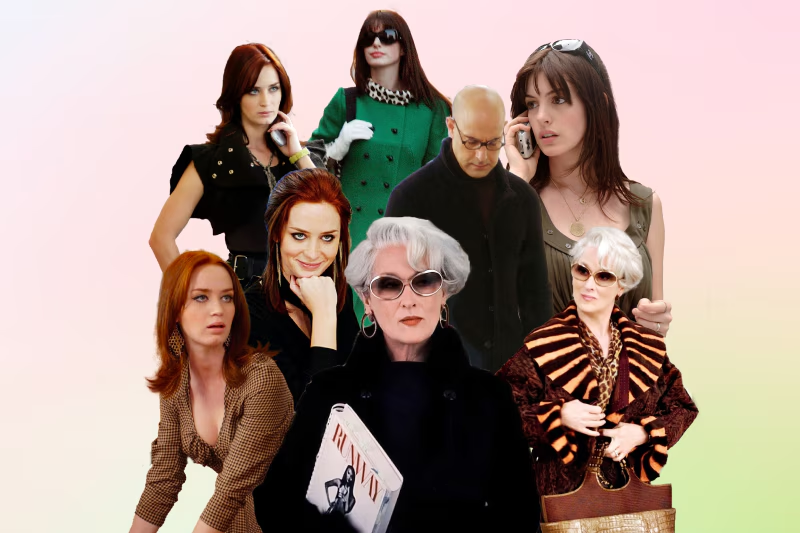
On the restructuring of fashion media, print versus digital authority, the algorithm as gatekeeper, and why the institutions that will matter are those that learn to hold both legacy and disruption simultaneously
A sequel arrives twenty years later not to continue a story, but to hold a mirror to an industry that has been quietly unrecognisable for years — and to ask whether the structures that defined authority in fashion have survived the transformation, or simply learned to perform survival. Fashion and media are not being replaced. They are being restructured.
The Devil Wears Prada 2 is in cinemas. Twenty years after the original film encoded the mythology of fashion authority into popular culture — the cold-voiced editor, the sacred masthead, the hierarchy that decided what was beautiful and who was allowed to say so — the sequel arrives into a landscape where almost every structural assumption that made that mythology possible has been dismantled, renegotiated, or migrated to a platform that charges a monthly subscription fee.
What the sequel is actually about, in its most resonant reading, is not nostalgia. It is reckoning. Miranda Priestly navigating a failing legacy media industry. Andy Sachs returning to Runway not as an assistant but as Senior Editor, shaping fashion content for the algorithm rather than the page. The detail in published reviews that cuts deepest: Andy no longer writes columns for print media but to fit the Instagram format. Twenty years of the fashion industry’s transformation compressed into a single character arc. A film that is, in its most essential function, a diagnosis of an industry that has been watching the same symptoms accumulate for two decades.
The significance of The Devil Wears Prada 2 is not in what it shows about fashion. It is in what it chooses to show — and what that choice reveals about where the fashion industry’s self-awareness has arrived. When a mainstream sequel builds its central conflict around print versus digital media, around legacy fashion authority versus algorithmic relevance, around who controls the narrative of taste in an era when anyone with a phone can produce it — it is not making entertainment. It is making a cultural document. And the industry it is documenting has been living the restructuring the sequel dramatises for longer than it has been willing to admit.
The structural conditions the film dramatises are confirmed by real fashion industry data. As the McKinsey and Business of Fashion State of Fashion analysis consistently identifies, the central fashion industry challenge is adapting to an environment where consumer behaviour and technology remain in rapid flux — and where brands agile enough to operate across legacy and digital registers emerge as the dominant players. The Devil Wears Prada 2 is fiction. The restructuring it describes is not.
The cultural moment the sequel enters is one already shaped by the collision of traditional fashion authority with digital disruption at every level. That contest is visible across the technology-driven fashion landscape explored in Fashion Meets Web3 at DGISLAND, where the intersection of digital ownership and physical luxury raises exactly the same question the sequel dramatises: what survives of fashion’s legacy codes when the infrastructure that supported them shifts entirely?

The new guard versus the old guard — what fashion authority actually means now
The generational shift in fashion authority is not a transfer of power from one age cohort to another. It is a shift in the fundamental grammar of what authority means — from institutional credibility to audience-verified relevance. These are not the same thing dressed differently. They are structurally distinct propositions about how cultural power works.
The original Devil Wears Prada was a mythology of institutional fashion power. Miranda Priestly’s authority was absolute not because she was loud, but because she was the gatekeeper. What appeared in Runway defined what was beautiful. What didn’t appear didn’t exist. The hierarchy was vertical, decisions were unilateral, and cultural impact flowed in one direction: from the editor’s desk outward. That model worked because information was scarce, fashion media access was controlled, and the mechanisms for producing cultural consensus were held by a very small number of people in very specific rooms.
None of those conditions exist in the same way now. The digital-native fashion creator does not need Miranda Priestly’s approval to reach millions. But they are not free of hierarchies. They have traded one form of institutional dependency for another — platform algorithms, brand deal structures, attention economics — and the new dependencies are in many ways more opaque and less accountable than the editorial ones they replaced. What has genuinely changed is the speed of consensus formation and the distribution of the capacity to shape it. A single fashion image can move from creation to cultural reference in hours. The curation cycle that once operated in months now operates in days.
This compression does not merely accelerate fashion. It changes what fashion is for. The slow accretion of cultural meaning that once gave luxury fashion its authority cannot survive at the speed the algorithm demands. Something is lost in that compression, and the fashion industry is still working out whether what is lost matters more than what is gained.
The fashion brands that have navigated this transition most successfully understood early that luxury’s deepest value has always been its resistance to speed. The pieces that hold relevance across decades were never designed for the moment. The New Language of Quiet Luxury: Inside the Timeless Wardrobe of Apparis explores this through the lens of material permanence — the argument that what endures in fashion is precisely what cannot be accelerated, what cannot be replicated by the viral cycle, what requires slow attention that the algorithm cannot reward. The old guard’s deepest fashion asset was always this: the capacity to choose for time rather than for the moment.
Technology and the rewiring of fashion power — from editorial taste to algorithmic gatekeeping
The decentralisation of fashion authority was never about democratisation. It was about the redistribution of gatekeeping — from editors to algorithms, from fashion institutions to platforms, from taste to data. The gates are still there. They just have different guardians who answer to different stakeholders.
The most significant structural shift in fashion over the past two decades is not the rise of the influencer or the decline of print media. It is the emergence of data as the authoritative language of the fashion industry — the replacement of editorial intuition with metrics, of taste formation with engagement optimisation, of the slow cultivation of cultural meaning with the real-time measurement of what is producing clicks. This is the shift the sequel’s most resonant detail captures: Andy writing fashion content to fit the Instagram format rather than the column. It is not merely a change in medium. It is a change in the governing logic of what fashion writing is for.
Editorial fashion writing, at its best, was designed to accumulate — to build an argument, develop a perspective, reward reading at the pace the subject required. Algorithmic content is designed to perform — to signal within the first three seconds, to deliver the payoff before the scroll, to optimise for sharing over understanding. These are not the same intellectual project in different clothes. They are different propositions about what the relationship between fashion authority and its audience should be.
Social platforms have become the new fashion gatekeepers not because they produce better taste than editors did, but because they control access to attention at a scale no editorial institution can match. The fashion brand that ignores them forfeits the conversation. But the fashion brand that optimises entirely for them forfeits something harder to name and harder to recover: the accumulated cultural weight of a considered point of view, expressed consistently over time, that is the actual foundation of luxury fashion brand value. The platforms can distribute fashion influence. They cannot manufacture the depth that makes influence worth distributing.
As McKinsey’s analysis of luxury fashion in the age of digital transformation argues, the winning strategy is not choosing between digital and fashion legacy but developing ecosystems that source cutting-edge digital competencies while preserving the irreducible qualities that make luxury worth pursuing. The fashion brands that survive the technology shift are those that remain recognisably themselves while operating fluently in the new infrastructure. The ones that don’t are those that confuse the medium with the message.
The pattern visible in fashion media’s restructuring — where the established system does not collapse but is reorganised around new infrastructure — is legible across every industry undergoing comparable disruption. In the Web3 ecosystem, the moment when a market stopped positioning itself as a participant in digital transformation and started functioning as its infrastructure is documented in Inside Token2049 Dubai: The Infrastructure Era of Web3. The principle is identical in fashion and in blockchain: the institutions that survive are those that build the structural conditions within which the next form of authority operates, rather than defending the structures through which the previous form operated.

The case for print — permanence in an age of algorithmic noise
Print fashion media is not a dying format. It is a luxury format — one that offers what the digital environment cannot manufacture: depth, permanence, the cognitive experience of slow reading, and the authority that comes from a decision made about what is worth the ink. In a media landscape defined by the industrialisation of distraction, slowness is not a limitation. It is a luxury.
The argument for print in the contemporary fashion media landscape is not nostalgic, and it is not aesthetic. It is epistemological: print produces a different quality of knowledge than digital fashion content does, because the conditions of its production and consumption are fundamentally different. A printed fashion editorial requires a decision — this, and not something else, merits the space, the photography, the considered layout, the physical object that will persist beyond the news cycle. That decision is an act of curation, of editorial judgment, of the application of a point of view to the infinite available material. It is, in the most precise sense, an act of taste.
Digital fashion content does not require that decision in the same way. The economics of digital publishing reward volume and velocity over curation and depth. The incentive structures of algorithmic distribution reward engagement over quality, shareability over substance, emotional impact over intellectual coherence. These are descriptions of governing conditions, which produce different outputs than the conditions that govern print. What is lost when a fashion media industry migrates entirely to digital is not the page. It is the mode of attention the page demands.
Reading a printed fashion editorial — following an argument through a spread, sitting with an image rather than scrolling past it, experiencing the physical weight of a magazine as a signal of what it contains — is a different cognitive and emotional experience from consuming digital fashion content. It is slower, more embodied, more demanding of patience. And in a fashion media landscape defined by the industrialisation of distraction, that patience is not a limitation. It is the condition of the most durable form of cultural influence.
The technological transformation accelerating beyond social media makes the case for fashion editorial depth even more urgent. As McKinsey’s analysis of AI reshaping fashion’s next chapter documents, AI is shifting from a competitive edge to a business necessity — with brands deploying it across content creation, consumer search, and product discovery, while shoppers increasingly turn to large language models to compare offerings and receive recommendations. In this environment, the editorial fashion voice that cannot be algorithmically synthesised — the considered point of view built through accumulated expertise, human relationships, and genuine aesthetic conviction — becomes more valuable, not less. What AI cannot replicate is the thing print fashion media was always best at producing: a perspective with something at stake.
The cultural turn toward slow luxury — the preference for depth over volume, for the accumulated return of the well-chosen over the immediate gratification of the new — is visible across categories beyond fashion media. In beauty, the same logic produces the barrier-first philosophy explored in The Return of Barrier Beauty: Why Lanolin Is the Ultimate Skin Investment: the understanding that what compounds over time outperforms what delivers immediately, that the ingredient with centuries of evidence outperforms the active with months of marketing. The case for print fashion media and the case for lanolin are structurally identical — both arguments for the value of slowness in an accelerated world, both claims that the oldest solution is sometimes the most sophisticated one.
The loss of physical fashion culture — what presence produces that digital cannot
Physical experience is not the opposite of digital fashion culture. It is its correction — the layer of embodied reality that gives meaning to the images, the relationships, and the influence that digital culture produces and requires. The original Devil Wears Prada was, among other things, a film about the texture of physical reality within fashion. The sequel navigates a landscape in which that physical texture has been partially abstracted — and what is lost in the abstraction is not merely atmosphere but a specific quality of knowledge.
The original film’s fashion world was a world you had to be physically present in to understand, and that physical presence was both the cost of entry and the primary reward of membership. The front row has been supplemented by the livestream. The fashion editorial meeting has its Zoom version. The experience of fashion week has become simultaneously more globally accessible and more mediated, more documented, more performed for a digital audience than inhabited for its own sake. What is lost is not atmosphere. It is the ability to read a room — to understand the unspoken dynamics of power and desire and aesthetic judgment that circulate in spaces where the people who shape fashion culture are gathered.
This knowledge cannot be streamed. It cannot be algorithmically approximated. It is produced by the experience of being there — and it is precisely the kind of knowledge that, in fashion as in any industry defined by relationships and reputation, constitutes the most durable form of competitive advantage.
The argument that physical presence is irreplaceable in industries that run on relationship and reputation is not limited to fashion. Across every professional ecosystem where trust and influence are the primary currencies, the gathering spaces that allow those currencies to develop remain structurally essential. Money, Culture, and Capital: Inside the Event That Shaped Dubai’s Web3 Elite makes precisely this case in the context of the crypto and Web3 ecosystem: that the most consequential exchanges happen in physical rooms, that proximity accelerates what distance cannot, and that the relational infrastructure built through repeated in-person engagement outlasts any number of digital interactions. Fashion knew this first. The fashion industry is relearning it now.

Relationships, reputation, and the fashion currency that outlasts technology
Technology changes the speed at which relationships form and the channels through which they operate. It does not change the fundamental economics of fashion reputation: that it accumulates slowly, degrades quickly, and is the primary asset that cannot be manufactured — only earned, over time, through decisions made consistently and well.
One of the most durable truths about fashion — one the original film encoded in narrative form and the sequel is forced to revisit — is that access and opportunity in the fashion industry have always been relational. Talent is necessary but not sufficient. The right mentor, the right introduction, the right room at the right moment: these are the mechanisms through which fashion careers are made, luxury brands are built, and taste is formed and distributed. This was true when Miranda Priestly’s approval was the highest form of fashion validation. It remains true now, even as the fashion institutions through which that validation was conferred have been disrupted beyond recognition.
Reputation, in this context, operates on a longer cycle than fashion influence. Influence can be purchased, manufactured, and temporarily inflated through platform spending. Fashion reputation is the accumulated record of decisions made over time — the quality of work produced consistently, the relationships maintained through difficulty as well as success, the judgment demonstrated in what is chosen and what is declined. In an environment defined by the velocity of digital fashion culture, reputation is precisely what the algorithm cannot fabricate and the attention economy cannot shortcut. It is the asset that compounds independently of any platform, survives any algorithm change, and remains valuable after every fashion trend cycle has exhausted itself.
What changes in the digital era is not the importance of fashion relationships but the architecture through which they operate. The digital creator with two million fashion followers has a form of access that would have required decades of institutional work to achieve by traditional routes. But that access is shallow unless it is underwritten by genuine relationships — by people who trust the creator’s fashion judgment, value their work, and are willing to extend the kinds of advocacy and opportunity that cannot be generated by an algorithm. The currency of the fashion industry has always been trust. The platforms have changed the exchange rate. They have not changed the currency.
What the next generation of fashion is building — synthesis over sides
The most interesting creative figures in contemporary fashion and media are not choosing between the old guard and the new guard. They are building fluency in both — using institutional fashion credibility to anchor digital influence, and digital reach to extend institutional access. The future of fashion authority lies in this synthesis, not in either position held alone.
The generation entering fashion and media now did not experience the original power structures as anything other than history. They have grown up in an ecosystem where the creator, the fashion editor, and the entrepreneur are often the same person — where the authority to publish and the authority to make things are not separated by institutional gatekeepers, and where the relationship between fashion content and commerce is more transparent than at any previous point in the industry’s development. This is not a diminished relationship with fashion. It is a differently configured one.
What this generation has gained is access and velocity. The ability to build a fashion audience without institutional permission, to test ideas without editorial mediation, to develop a voice in public rather than through years of private apprenticeship: these are genuine expansions of the possible. What has been more difficult to transmit across the generational shift is the depth that the slower fashion model produced — the understanding of fashion as a system with an intellectual history, a set of aesthetic principles with cultural roots, a relationship to craft and material culture that extends far beyond what is currently generating engagement on any platform.
The blending of creator, fashion editor, and entrepreneur roles that defines the most successful contemporary figures is not a compromise between old and new models. It is a synthesis — one that uses the credibility of editorial judgment to differentiate in a saturated fashion environment, and the reach of digital platforms to distribute that judgment at a scale print alone could never achieve. The figures who navigate this synthesis most effectively are those who understood early that the old versus new fashion debate was a false binary — that the industry’s future lies in building fluency across both registers simultaneously.
As McKinsey’s analysis of luxury fashion brands in the digital age established as a foundational principle, no luxury fashion brand can afford to ignore digital tools — but the luxury category that succeeds is the one that deploys digital in service of its core fashion identity rather than in replacement of it. The new guard has the tools. The old guard has the identity. The synthesis of both is what the fashion industry’s future is actively building — and the most consequential fashion figures of the next decade will be those who understand how to hold both without losing either.
What The Devil Wears Prada 2 is really saying — the cultural document beneath the film
The Devil Wears Prada 2 is a cultural document as much as it is a fashion film. Its central dramatic argument — that a fashion media industry built on print authority is navigating the disruption of its own foundations — is not a plot device. It is the precise condition of every major fashion media institution in the current moment.
The fashion magazines that once held Miranda Priestly’s kind of authority are not gone, but they operate in a landscape where that authority is no longer self-evident, where it must be continuously re-earned through relevance in an environment that was not designed for the kind of cultural work they were built to do. What the sequel captures is the emotional texture of that transition — the specific quality of loss that comes with watching a fashion institution you believed in navigate conditions that challenge its foundational assumptions.
This is not a feeling limited to fashion editors. It is the feeling of anyone who has built expertise, reputation, and identity within a system that is being restructured around them. The disruption is real. The fashion industry losses are real. And so is the possibility — for those willing to develop fluency across new boundaries — of building something that holds the depth of the old model within the reach of the new one. The sequel arrives at a moment when the fashion industry is doing precisely this work.
The transition from formation to infrastructure — the point at which a system stops being defined by its disruption and starts being defined by what it has built — is visible across every industry undergoing the kind of structural change that fashion and media are experiencing. In the Web3 ecosystem, that moment and what it means for those operating within it rather than observing from outside is documented in Inside Token2049 Dubai: The Infrastructure Era of Web3. The fashion industry is at the same inflection point. The question is not old guard or new guard. It is: who is building the fashion infrastructure that both will eventually depend on — and who is merely debating the terms of a disruption that has already happened?
The legacy fashion institutions are developing digital intelligence. The digital-native creators are developing editorial credibility. The most interesting fashion work is happening at the intersection — where the authority of curation meets the scale of distribution, where the depth of historical knowledge meets the speed of contemporary relevance, where the relationship between fashion maker and fashion audience is being renegotiated on terms that neither the original film nor its first audience could have predicted. The sequel is a mirror held up to that intersection. What you see in it depends entirely on where you are standing.
“Fashion and media are not being replaced.
They are being restructured.
The institutions that will matter are those that understand
how legacy and disruption are not opposites, but complements —
each giving the other what it cannot generate alone.
The future of fashion authority belongs to those
who can hold both.”

