
On why people still fasten a watch to the wrist when a phone keeps better time, what a young Taiwanese brand reveals about gifting, proportion and accessible watch culture, and why a small object can carry an unusually large emotional life
A watch does not make time slower. It makes the noticing of it a little more deliberate: a clasp fastened, a wrist turned, a glance that does not open a screen.
We live surrounded by clocks, yet people still fasten one to the wrist. Phones, laptops, cars and public screens all display the time, and all of them are more accurate than anything a strap can hold. That contradiction is the story. The watch now occupies one of fashion’s most interesting categories: an object that no longer has to justify itself through utility.
The smartphone did not kill the wristwatch. It freed it. Once accuracy became universal, a watch could compete on the things that were always its quieter strengths: design, memory, identity, ritual and the pleasure of wearing something chosen. Theodora is the lens here, not the subject. It is a young independent brand from Taiwan, and its relevance comes from occupying a space that the old hierarchy of watchmaking rarely describes well: between the disposable fashion watch and the collector’s mechanical piece, where meaning is built from design and symbolism rather than inherited prestige.
The Watch After the Smartphone
The modern watch is less like a clock and more like jewellery with a function.
For most of the twentieth century the wristwatch was an instrument. Today that function has been technologically demoted, and the object has migrated from necessity into symbolism. It can express taste, discipline, memory, affection, aspiration, fandom, design literacy, or simply the satisfaction of wearing something deliberate.
Why do people still wear watches? People still wear watches because the object has moved from necessity to meaning. A phone tells the time more accurately, but a watch expresses taste and identity, marks memories and occasions, completes an outfit like jewellery, and offers a small daily ritual that separates glancing at the time from opening a screen.
The pattern is not new. Porter’s reporting on why people still buy watches quotes an expert drawing an analogy to portraiture: it did not disappear with photography, it became more closely tied to the expression of personal identity, and the same may now be true of watches. Other interviewees describe a watch as more personal and intimate than the average luxury object, and as something people buy to mark an achievement. The logic is consistent. When a tool is replaced, the object that remains tends to be the one that meant something beyond the tool.
A Short History of Wearing Time
Every technological replacement of the watch has ended with the watch becoming more personal, not less.
The wristwatch has been through this before. For centuries, portable timekeeping meant a pocket watch, and the wrist was an unlikely place for it. Early wristwatches were often regarded as women’s jewellery, and the form is commonly associated with the early twentieth century, when Cartier made a watch for the aviator Alberto Santos-Dumont in 1904, so that he could read the time in flight without releasing the controls. Military use in the First World War is generally credited with making the wristwatch a masculine, practical, mainstream object. A century of mechanical craft followed.
Then came quartz. Electronic movements arrived in the late 1960s and 1970s, and cheap, accurate watches threatened the economics of traditional watchmaking, in what the industry still calls the quartz crisis. The mechanical watch survived by changing its meaning: it stopped being the most accurate way to tell time and became the most beautiful and meaningful way to wear it. The smartphone has pushed the same argument further. Each time the tool has been replaced, the surviving object has been the one worth wearing for its own sake.
Inside Theodora: A Young Taiwanese Watch Brand Built Around the Idea of Gifting
The name carries the story. It should be read as a narrative device, not as heritage.
Theodora’s, which the brand writes THEODORA’S and most people search for as Theodora watches, describes itself as a watch brand established in Taiwan in 2017 and devoted to designing and developing watches and jewellery. Its own account says it expanded its service into Southeast Asia in 2019, and its international sites list Taiwan, Malaysia, Singapore, Hong Kong and Macau among the places it serves. By the brand’s account, its first physical counter in Taiwan opened in 2022.
What is Theodora watches, and where is it from? Theodora (styled THEODORA’S) is an independent Taiwanese brand of watches and jewellery, founded in Taiwan in 2017 and expanded into Southeast Asia in 2019. Its name derives from the ancient Greek Θεοδώρα, which the brand translates as a present from heaven, and its collections are largely named after Greek mythology, including Hera and Apollo.
The brand links the name to the Byzantine empress Theodora, whom it describes as courageous, independent, determined and supportive of others, and builds the gifting idea into its identity: every customer, the brand says, should find a gift that belongs to them. That is brand mythology, and it should be read as such. It is a narrative device that gives a young label a point of view, not an inheritance from the history of watchmaking. The collections extend the device. Greek names run through the range, with Hera presented as a large-dial, simple-dial line and Apollo as a three-eye design offered in 41 and 37 millimetre sizes, according to Taiwanese fashion coverage.
Accessible Luxury Without Pretending to Be Haute Horlogerie
Accessible watches are best judged on design, finish and use.
Theodora should not be inflated into a luxury maison, and the article gains authority by refusing to. The brand’s own consumer language emphasises design quality, giftability and attainable pricing. A customer-feature page on its site says its watches are more affordable on average than many foreign brands, that its packaging is considered, and that its watches work as gifts. That makes the brand useful for a more interesting question: what does accessible luxury mean when the value comes from design, finish, symbolism, packaging and emotional use, not from scarcity, hand-finishing or proprietary movements?
What is accessible luxury in watches? Accessible luxury in watches means value that comes from design clarity, material feel, proportion and emotional meaning at an attainable price, rather than from scarcity, hand-finishing or in-house movements. It lets people take part in watch culture without entering the collector economy of high-end mechanical pieces, and it should be judged by how well the object is considered, not by how closely it imitates luxury.
Five questions make the idea testable. Does the object have a recognisable point of view? Does it feel considered on the wrist? Do the case, dial and strap sit well together? Does it carry meaning beyond its price? And will the wearer still want it after the trend cycle passes? None of these requires a certificate or a complication. They require attention, which is a better test of design than a spec sheet.
Why a Watch Makes Such a Powerful Personal Gift
Few gifts carry time both literally and emotionally.
A watch is unusually suited to gifting because it combines intimacy and duration. Clothes may stop fitting. Flowers disappear. A watch can remain attached to a specific birthday, relationship, graduation, departure or achievement for years. It is worn where the giver can imagine it, and where the recipient will see it many times a day.
Theodora builds this into its range. The Aeon line, for example, is presented in paired and limited gift sets, with GMT dive-style watches offered as couples’ pieces, and the brand says every gift box comes with its own paper bag so that giving needs no extra errand. Small, well-chosen objects are some of the most durable gifts there are, as a considered fragrance proves in another register.




The Genderless Potential of the Modern Watch
Its proportions, not a label, decide who it suits.
Few objects move beyond rigid menswear and womenswear categories as naturally as a watch, because scale, metal, colour and strap can all be interpreted personally. The brand describes its watches as mostly gender-neutral, suitable for different wearers, and notes that partners can buy two and swap. Taiwanese coverage of its solar-powered collaboration range likewise describes neutral styles meant to be worn by anyone, with jewellery pieces offered in both men’s and women’s sizes.
Are Theodora watches gender neutral? Theodora describes many of its watches as gender-neutral and suitable for different wearers, and Taiwanese coverage of its collaboration ranges describes neutral styling for all wearers. In practice, case size, metal, dial colour and strap determine how any watch reads on a given wrist, and the brand offers several sizes within lines such as Apollo.
That openness is a feature of the category, not a marketing flourish. A watch can adjust a look without announcing a gender.
Why Proportion Matters More Than Logos
Elegance is frequently a question of scale before it is a question of price.
The most sophisticated watches communicate through proportion: the relationship between case diameter, dial openness, bracelet width, crown, bezel and wrist. A watch changes the rhythm of an outfit in the same way eyewear, footwear or a belt does, and that is where fashion intelligence enters the conversation.
What makes a watch elegant? A watch reads as elegant when its proportions are resolved: case diameter, dial openness, strap or bracelet width and thickness sit in balance with each other and with the wearer’s wrist. Material feel and restraint matter as much as decoration, and a logo-free, well-scaled design usually communicates more than a prominent brand name.
Offering the same line in two sizes, as Apollo does at 41 and 37 millimetres, is a quiet acknowledgement of this. It treats the wrist as variable and the design as adaptable, which is a more useful definition of fit than size labels.
Building a Watch Wardrobe
The discipline is choosing fewer things for clearer reasons.
The idea of a watch wardrobe is not an argument for accumulation. It is a way of seeing how changing one small object can alter the tone of otherwise repeated clothing. A restrained everyday watch, a metal-bracelet piece, a darker or more architectural dial, a watch that works as jewellery, a mechanical piece for people who like movement and ritual, and a collaboration piece that functions as personal expression: together they form a small wardrobe rather than a single status purchase.
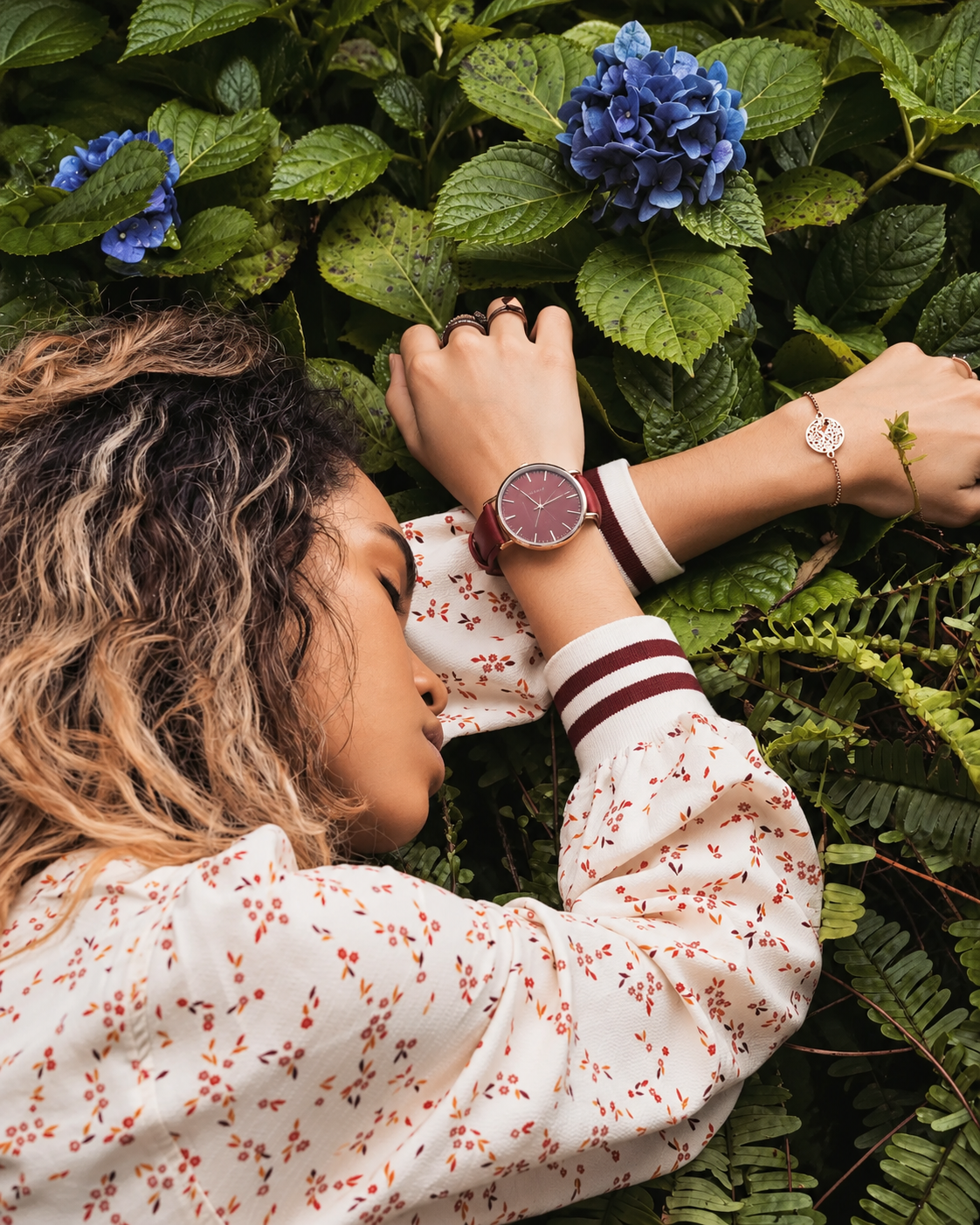
In that light, a young brand’s range matters less for its individual pieces than for how its pieces relate to one another. Wine red, dark blue and soft pink, as in the Hera, Zeus and Poseidon colourways shown here, are not three versions of one purchase. They are three tones that a wearer can alternate between depending on the day.


From Mechanics to Solar Power: Choosing the Relationship, Not the Hierarchy
The better question is what kind of relationship the wearer wants with the object.
Watch culture has a habit of ranking technologies, and the habit does not help most wearers. Mechanical watches offer ritual and a fascination with movement. Quartz offers accuracy and simplicity. Solar technology adds convenience and a different engineering proposition: Theodora’s solar-powered collaboration watches, for instance, are described in Taiwanese coverage as charging from light. A solar watch suits someone who wants the convenience of not thinking about it, much like travel gear built to remove small frictions. A mechanical piece suits someone who wants the ritual of attention.
This article makes no claims about where any component or movement is made, or about any certification, because the brand’s own materials do not support such claims at range level. That restraint is part of the argument: accessible watches are best judged on design, finish and use, and honest description is a form of respect for the buyer.


Collaborations, Fandom and the New Language of Collectability
The next generation of watch collectors may collect stories as much as movements.
Collectability used to belong to complications and rare metals. For newer audiences, cultural properties, nostalgia and fandom create a different kind of emotional scarcity. Theodora has worked with Warner Bros. through its DC properties: Taiwanese launch coverage records a limited run of 360 mechanical Batman watches sold only in Taiwan, and a Wonder Woman collection built around solar-powered watches with a steel case and leather strap, plus jewellery and small accessories. Marie Claire Taiwan’s report notes that the Wonder Woman watches use the character’s W emblem as a design motif and introduced the brand’s first luminous feature, which is the sort of detail that distinguishes a considered collaboration from printed merchandise.
The intelligence in the move is strategic. A licensed collaboration brings an existing story to a young brand, and the risk is the same as for any association: the brand must make the story its own through product. A look can be borrowed without the relationship behind it, and the difference between an association that is confirmed and one that is merely borrowed is exactly what these licences make visible.
Why Small Watch Brands Matter
Without centuries of history, they must build trust through the product itself.
The great names of watchmaking carry advantages that no young brand can copy: centuries of accumulated reputation, workshops that make their own movements, global service networks and the gravity of scarcity. A customer who buys from such a house is buying a lineage as much as an object, and the lineage is part of what the price pays for. That is a legitimate form of value, and it is worth stating plainly before praising anyone smaller. The question is not whether small brands are better than large ones. It is what small brands make possible that large ones, by their nature, find difficult.
The first answer is access. Independent and digitally native watch brands have helped democratise watch design. A person who loves the idea of a considered watch, but who is not ready to enter the collector economy of high-end mechanical pieces, can now find something with a point of view at a lower entry price. Participation in watch culture no longer requires a large budget or an introduction to a boutique, and it begins earlier in a person’s life, which is how a lasting relationship with the category is formed.
The second answer is speed and voice. A large house plans its collections years ahead and protects an identity built over generations, which makes bold experiment risky. A small brand can respond within a season, try an unexpected colour, collaborate across culture, speak directly to a niche community and learn from its customers in public. Where the great houses are institutions, independent brands behave more like studios: faster, more personal and more willing to be wrong in the open.
A word of care about the term. The watch world also has a celebrated tradition of independent watchmakers, craftspeople who build extraordinary mechanical pieces in tiny numbers and often sell them at very high prices; the Académie Horlogère des Créateurs Indépendants, founded in 1985, is the best-known association of that kind. That tradition is a different thing from the accessible, design-led, digitally native brand discussed here, and the two should not be confused. One earns its authority through rarity and handwork. The other earns it through clarity of design, honesty of description and consistency of delivery.
What makes an independent watch brand interesting? Independent watch brands are interesting because they can move quickly, collaborate across culture, address niche audiences and offer distinctive design at accessible prices. Their credibility depends on consistency, service and honest storytelling, since without long heritage they earn trust through the product itself.
That last point is where the difficulty lies. Without centuries of history, a small brand has no reputation to lean on, and trust has to be assembled from smaller things: a product that matches its photographs, a strap that holds, a clasp that closes cleanly, a return or repair that is handled without argument, and a design language that is recognisable from one release to the next. After-sales credibility is the quietest of these and often the most decisive, because a watch is worn for years and the relationship continues long after the purchase. A big name can survive an occasional lapse on the strength of its past. A young brand cannot.
This is where heritage and storytelling need separating. Heritage is accumulated through time; storytelling can be created immediately, and a young brand should not confuse the two. Theodora’s Byzantine naming story is useful as brand mythology, but it is not watchmaking heritage, and the brand is better served by presenting it as the former. A young watch brand earns longevity by turning a story into consistent product, not by borrowing the appearance of age. The same principle governs trust in other categories, where attention is easy to buy and credibility is earned. The honest position for a small brand is also the strongest one: to say what it is, to describe what it makes without inflation, and to let the years do the rest.
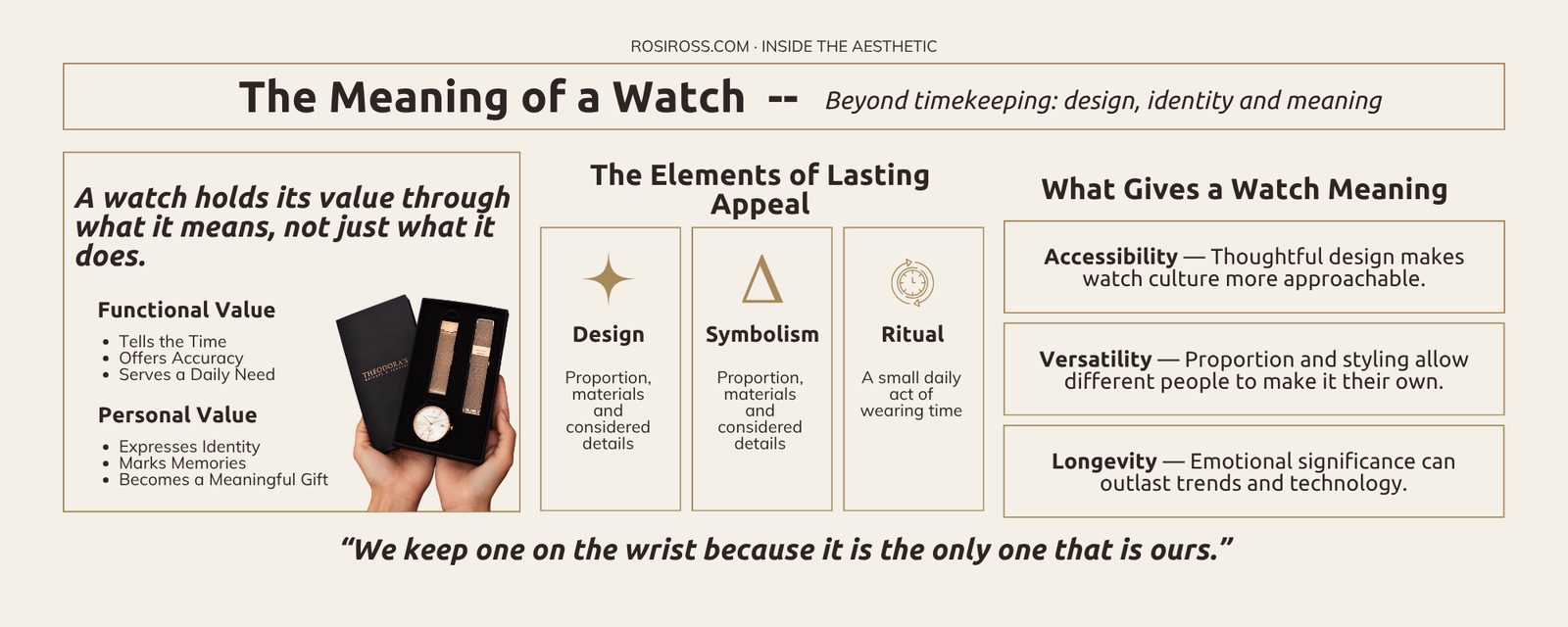
The Ritual of Wearing Time
The action creates a tiny boundary between information and attention.
Return to the paradox. The phone on the table and the screen on the desk both keep better time than any watch, and yet people continue to buy watches, collect them, give them as gifts and talk about them with an affection they rarely feel for the other devices that tell time. The reason is that the wristwatch is no longer being asked to be a clock. It is being asked to be something a person chooses, wears and looks at deliberately, and those are different jobs.
Putting on a watch is a small daily ritual: fastening a clasp, winding a mechanical movement, changing a strap, checking the wrist instead of opening a phone. Like any short routine that rewards care, such as a small daily ritual like a lip balm habit, it makes an ordinary moment slightly more deliberate. The phone asks for attention and then keeps it, with notifications and messages waiting behind every glance. A watch answers the question and releases the glance. It is one of the few time-telling objects that does not invite the user to stay.
There is also the matter of the object itself. Those who love watches often speak of the art of watchmaking: the engineering of a movement, the small mechanical decisions that make a case, a dial and a hand feel resolved, and the knowledge that a tiny assembly of parts is doing its work on the wrist. The craft has been recognised beyond the trade. In December 2020, UNESCO inscribed the craftsmanship of mechanical watchmaking and art mechanics, a practice shared by Switzerland and France, on its Representative List of the Intangible Cultural Heritage of Humanity. Whether or not a particular watch contains a complicated movement, the culture around it respects the idea that time can be made, finished and worn with care.
Originality and aesthetics carry the rest of the appeal. A screen is uniform: the same typefaces, the same icons, the same interface, whatever the brand of the device. A watch is a small piece of design in which a wearer can see taste, proportion and intention, and by which others can read something about the person wearing it. A dial that is quiet or bold, a case that is slim or architectural, a strap that is worn or crisp, all say something that a phone cannot. In a world where almost every object arrives in the same rectangle of glass, the watch is one of the last places where an everyday tool is allowed to be individual.
That deliberateness is also why a smaller, independent watch can signal restraint rather than status. In a period when consumers increasingly distinguish between recognisable branding and personal style, an object that is not immediately legible as a flex says something quieter and often more specific: that its wearer chose it. The choice is the message. It says that the wearer paid attention to a design, found it right, and wanted to be reminded of that every time they glanced at their wrist.
A watch no longer needs to justify its place by telling time. A watch does not make time slower. It can make the act of noticing time more intentional, and its value is in what time comes to mean around it.
“A watch does not make time slower.
It makes the noticing of it
a little more deliberate —
a clasp fastened,
a wrist turned,
a glance that does not
open a screen.
We have clocks everywhere.
We keep one on the wrist
because it is the only one
that is ours.”

