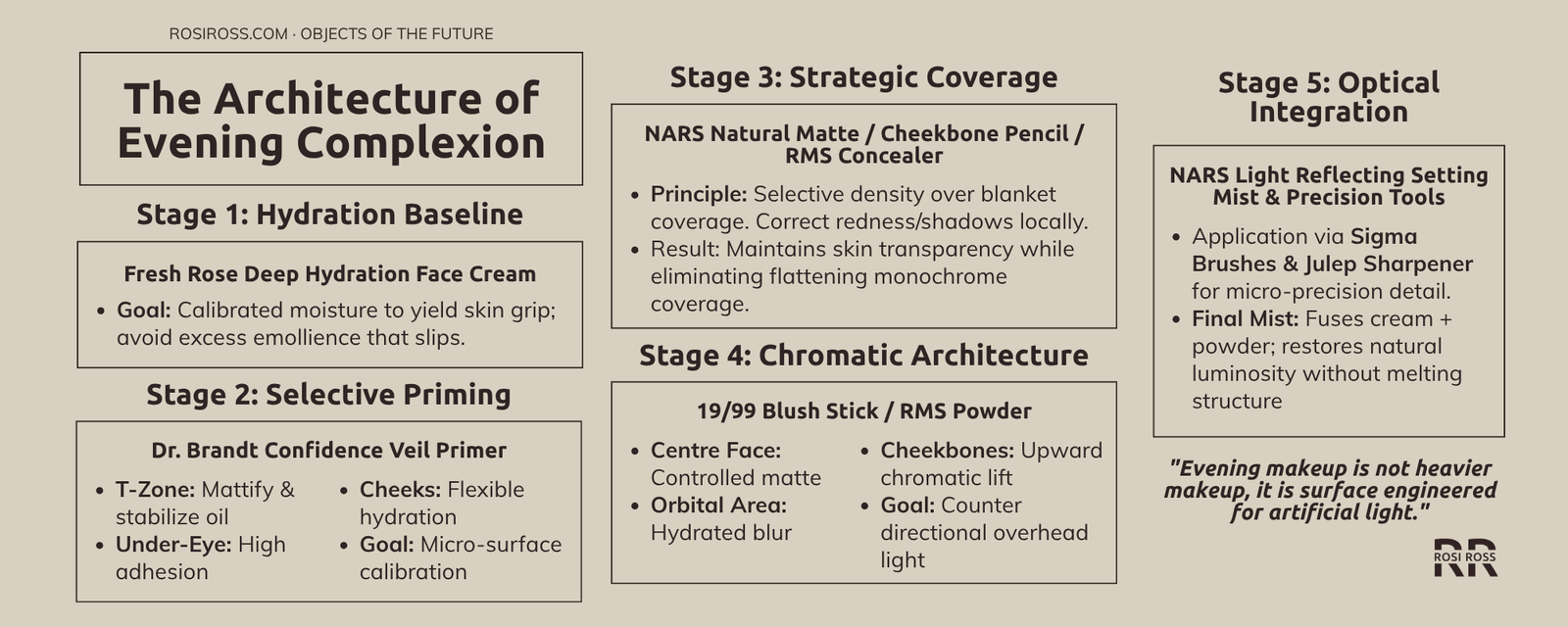
On why evening makeup is not heavier makeup but makeup engineered for a different visual environment, the five principles that govern complexion performance under artificial light, the distinction between coverage and camouflage, the new mathematics of matte and glow, and why the most sophisticated evening face is always the most precisely controlled one
The best evening makeup is not necessarily heavier makeup. It is makeup engineered for the conditions of the night. After dark, the face enters a different visual environment: artificial light can flatten dimension, photography can exaggerate shine and texture, long hours can cause complexion products to separate or migrate, and the specific combination of warmth, humidity, and movement creates conditions in which formulations designed for morning wear begin to perform inconsistently.
The modern approach is therefore less about adding more product and more about controlling what light sees — a discipline of surface management rather than application volume. Five principles govern this: preparation determines performance; coverage should be strategic rather than indiscriminate; texture creates dimension; colour placement changes facial architecture; and longevity is a formulation and layering problem, not simply a setting-spray problem.
The face has already lived through the day: sunlight, air conditioning, heat, movement, conversation, several hours of wear. Then the environment changes. The light becomes artificial. Dinner begins. Cameras appear. Skin encounters heat, humidity, dining, drinks, and the specific friction of hours spent doing things rather than sitting still. This creates the central editorial question that no makeup tutorial has ever adequately answered: what does makeup need to do differently once the sun goes down? The answer is not “more.” It is “differently” — and understanding the difference is the beginning of a genuinely intelligent relationship with evening makeup.
The skin comes first — why preparation determines the finish
Every complexion problem that becomes visible during an evening — the foundation that has separated, the concealer that has settled into creases, the highlight that has migrated into areas where it was not placed — has its origin not in the products applied but in the surface on which they were applied. Skin that is inadequately hydrated produces foundation that pulls and flakes. Skin that is over-moisturised produces a surface too slippery for product adhesion, causing complexion makeup to slip and migrate within hours. The correct baseline is not the maximum amount of skincare but the right amount — sufficient hydration to create a surface with appropriate grip and flexibility, insufficient emollience to compromise the structure of everything applied above it.
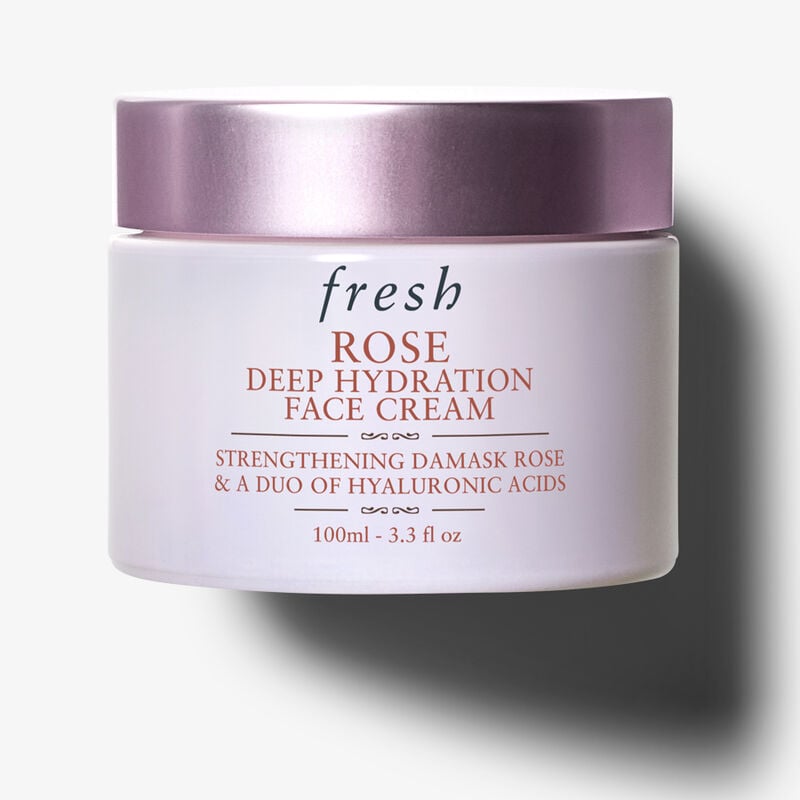
This distinction matters more in an evening context than in a daytime one because the wear duration is longer, the environmental conditions are more varied, and the consequences of a complexion that has degraded are more visible in the specific conditions of artificial light and close social proximity. The Fresh Rose Deep Hydration Face Cream addresses the skin preparation requirement with the specific intelligence of a formulation designed around hydration rather than occlusion: it provides the moisture level that allows subsequent complexion products to move and blend with ease, without the excessive emollient content that would make the skin’s surface too mobile for the layers above. The principle — hydration rather than excess richness, preparation rather than barrier — governs all subsequent decisions about what goes on top. The same barrier-first skin intelligence that defines the most considered skincare approach is the foundation from which a lasting evening complexion is built.
Primer as surface engineering — the intermediary layer
Primer is among the most misunderstood products in the complexion system, primarily because it is typically positioned as an insurance policy — something applied uniformly to make everything else last longer. The more accurate understanding is that primer is a surface engineer: a formulation whose primary function is to create a specific interface between the skin’s surface and the complexion products applied above it, with properties specifically calibrated to address the particular challenges of that skin in that environment at that moment.
The concept of selective priming follows from this understanding. Different areas of the face have different surface requirements: the T-zone may produce excess oil that requires a mattifying primer to reduce mobility; the cheeks may benefit from a more flexible, hydrating finish that allows the complexion product above them to move naturally; the under-eye area requires a primer with specific adhesion properties to prevent concealer from creasing. Applying a single primer uniformly across all of these different surface environments is the equivalent of applying a single foundation formula to skin that has different needs in different areas — a form of averaging that optimises nothing. The Dr. Brandt Confidence Veil Primer provides the optical diffusion and texture management that creates a smoother canvas for evening complexion, while its formulation allows for the selective application approach that addresses the face’s varying surface needs rather than treating it as a uniform plane.

Moisturising and priming serve different functions in the complexion system. Moisturising addresses skin hydration — it replenishes the skin’s water content and supports barrier function, creating a healthy baseline surface. Priming addresses the interface between skin and makeup — it creates a specific surface character (smoothed texture, controlled oil production, increased adhesion, optical diffusion) that optimises how complexion products are applied and how they perform over time. The two are not interchangeable: a moisturiser applied without primer can create an overly mobile surface that reduces complexion longevity; a primer applied without adequate prior moisturising cannot compensate for the adhesion and performance problems caused by inadequately hydrated skin. For evening wear, the sequence — appropriate hydration, then targeted primer, then complexion product — is the foundation of a lasting result.


Coverage that corrects rather than conceals — the architecture of the modern complexion
The most common error in evening complexion construction is the conflation of coverage with sophistication. The intuition that more coverage equals better evening makeup — that applying a heavy, full-coverage foundation across the entire face creates a more polished result — produces the opposite of what it intends. Under artificial light, a uniformly covered face loses the dimensional variation of real skin: the subtle tonal difference between the nose and the cheek, the natural transparency of the orbital bone area, the specific warmth of the lip line. What remains is a flat, monochromatic surface that reads as heavily made-up from close proximity because its uniformity is itself the tell — real skin is never this consistently even.
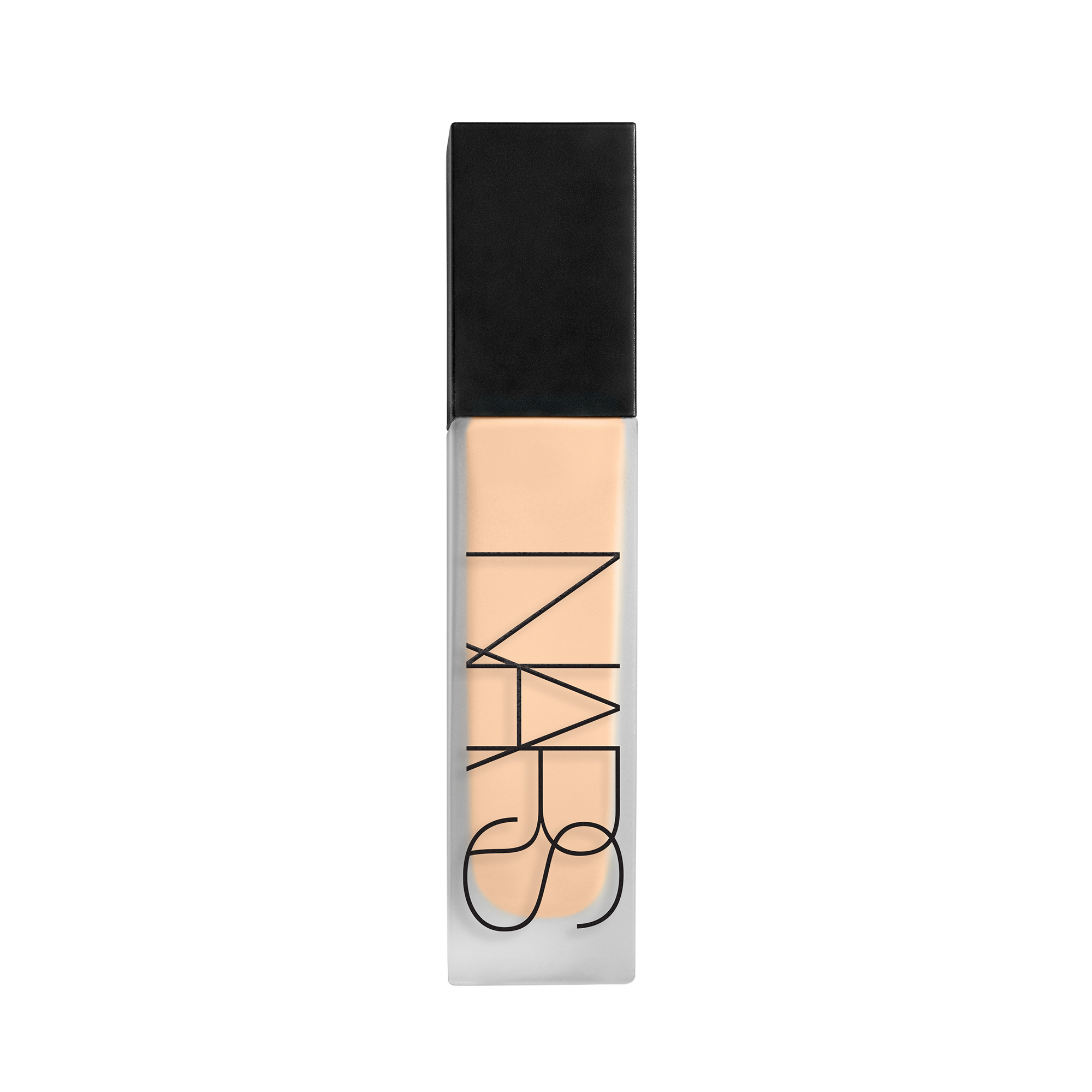
The NARS Natural Matte Longwear Foundation earns its position in the evening complexion system not through the promise of full coverage but through the specific qualities its formulation provides in extended wear conditions: a matte finish that controls excess shine without appearing flat or powdery, a longevity that maintains its surface character through the movement and environmental variation of an evening, and a natural matte that does not read as caked or heavy because its surface quality mimics the appearance of skin rather than obscuring it. Applied where coverage is needed rather than everywhere, it creates a complexion that looks considered rather than constructed.
The Cheekbone Beauty Unify Complexion Multi-Pencil and the RMS Beauty UnCoverup Concealer address the most important intelligence point in modern complexion construction: where you do not apply product is as consequential as where you do. The complexion pencil operates at the level of precision correction — addressing specific areas of redness, pigmentation, and the corners of the nose where shadow accumulates — without requiring the full face to be covered at the same density. The concealer provides the localised, targeted coverage that conceals without blanketing. Together, they create a complexion with selective density: deeper coverage where correction is required, transparency where the skin’s natural character is most legible and most beautiful. This is skin with architecture, not skin without texture.


The new mathematics of matte and glow — controlled reflectivity
The simplistic opposition between matte and luminous skin — the binary choice between a flat, shine-free complexion and an all-over glow — does not describe how sophisticated evening complexion actually works and should be discarded as a framework for decision-making. Modern evening skin is neither completely flat nor excessively luminous. It is controlled in its reflectivity — an arrangement in which different areas of the face have different optical finishes, calibrated to the specific relationship between those areas and the artificial light sources likely to illuminate them.
The centre of the face — the nose, the forehead, the chin — benefits from controlled shine because these are the areas most likely to catch overhead and direct artificial light. In a restaurant, it is the centre-face that directional lighting from above reaches most intensely; a completely matte finish here can appear flat and dry under the same lighting that makes a naturally oiled centre look healthy and dimensional. The cheekbones benefit from the kind of dimension that a light-reflective product provides not at their highest point alone but across the plane of the cheekbone: not a stripe of highlight but a wash of dimensional luminosity that creates the impression of a well-defined cheekbone structure. The under-eye area benefits from controlled luminosity — enough reflected light to prevent the orbital area from reading as dark and recessed, insufficient to make the area appear over-highlighted and powdery. The RMS Beauty ReDimension Hydra Setting Powder addresses this zone with its specific formulation intelligence: a setting powder that sets without mattifying, that controls product movement without reducing the skin’s appearance of luminosity, and whose hydra dimension maintains the skin’s natural quality of light reflection rather than eliminating it. The most intelligent complexion products work with the skin’s own optical properties rather than overriding them.

Evening makeup operates under three conditions that daytime complexion does not: artificial light sources (typically warmer, more diffuse, and multi-directional than natural daylight, which flattens facial dimension and makes subtle product decisions invisible); extended wear duration (four to eight additional hours of skin movement, heat, humidity, and potential product migration beyond the daytime wear period); and photography (camera flash and smartphone cameras interact with shimmer, texture, and coverage density in ways that daylight does not, potentially exaggerating shine, revealing powder buildup, or making coverage appear heavier than it reads to the naked eye). The adaptive complexion response to these conditions is: controlled matte in sebum-prone areas to manage artificial-light shine, selective luminosity in structural facial areas to restore dimension under flattening light, and formulation choices that prioritise longevity and compatibility across the extended wear arc.


Blush as facial architecture — chromatic placement
Blush is one of the most powerful structural products in the evening complexion system and one of the most consistently underestimated. Its function is not primarily to add colour — it is to direct the eye’s movement across the face, to manipulate the perceived relationship between features, and to introduce the specific quality of warmth and vitality that artificial light tends to reduce. A face without blush under restaurant lighting can read as drained — not unhealthy exactly, but lacking the warmth that natural daylight would have provided. Blush restores this warmth through a mechanism that the eye reads as biological rather than cosmetic: the specific flush of colour on the mid-cheek that the visual system interprets as the sign of vitality.
Placement is the variable that makes blush structural rather than merely decorative. Applied high on the cheekbone and blended upward and outward, blush lifts the face visually — drawing the eye upward and creating the impression of higher, more defined cheekbones. Applied on the apple of the cheek and blended inward, it creates a rounder, more youthful facial impression. Applied in a sun-kissed sweep across the nose and cheeks, it introduces the horizontal warmth of natural light. The 19/99 Cream Blush Stick in Bacca provides the specific advantages of a cream formula in the evening context: the blendability to achieve any of these placement approaches with precision, the natural skin-integration of cream pigment over cream and powder products applied beneath it, and the staying power of a formulation that bonds to the skin’s surface rather than sitting on top of it. The chromatic architecture of the evening face is determined by this kind of precise placement decision — not by the amount of colour applied but by exactly where it is placed and how far it is carried.

Brows, lips, and the precision effect — where the smallest details carry the most weight
The precision tools that most makeup routines treat as supporting cast — the pencil sharpener, the brow pencil, the lip liner — are frequently responsible for the difference between a finished look that reads as professional and one that reads as careful but slightly amateur. The reason is specific: precision in makeup is a function of the relationship between the instrument’s geometry and the face’s scale. A dull pencil produces inconsistent pigment deposition across its stroke, edges that vary in sharpness and density, and a mark that reads as imprecise even when the placement is correct. A sharp pencil produces consistent pigment density, controlled edges, and the specific quality of definition that makes a mark read as intentional rather than approximate. The Julep Torpedo Eye + Lip Pencil Sharpener addresses this prerequisite directly. Precision begins with the tool, and the tool begins with its edge.

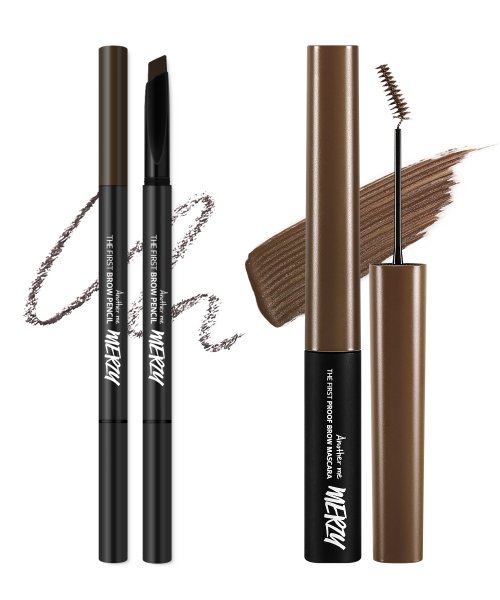
The brow is the face’s structural frame — the element that governs the perceived relationship between forehead and midface, that communicates the face’s emotional register before any other feature is read, and that under artificial light becomes more rather than less important because the reduction in ambient contrast makes the brow’s definition more consequential for the face’s overall readability. A brow filled in with strokes too dense, too horizontal, or too uniform reads as drawn on under the close observation of an evening social context. The correct evening brow is intentional and dimensional: hair-like strokes in the natural direction of growth, graduated from lighter at the inner head to slightly denser at the arch, and set with a brow mascara that adds the final dimension of texture. The Brow Pencil + Brow Mascara set provides the dual tool required for this approach: the pencil for individual stroke definition, the mascara for the finishing dimension that makes the completed brow look real rather than applied.
The nude lip requires more intelligence than any other lip colour because it lacks the drama that disguises imprecision. A bold lip carries its own visual momentum; the viewer’s attention is directed to the colour rather than to the precision of its application. A nude lip places the application itself under full observation — and an imprecisely applied nude is more conspicuous than an imprecisely applied red, because the nude’s proximity to the skin’s own tone makes every deviation from the vermilion border more legible. The same individual skin chemistry that changes how fragrance performs changes how nude lip colour reads — making the concept of the personal nude — the shade calibrated to the individual’s specific lip pigmentation, complexion undertone, and surrounding skin tone rather than to a universal “flattering beige” — is the most important intelligence point in lip selection. The Cheekbone Beauty Nude Lip Kit addresses this through the kit format: the pairing of liner and lipstick that allows the lip’s border to be defined before colour is applied, creating the precision architecture that makes a nude lip legible rather than simply present.

A personal nude is a lip colour calibrated to the individual’s specific lip pigmentation, skin undertone, and complexion rather than to a universal flattering shade. Because nude lies near the skin’s own colour temperature, it functions through contrast calibration — a shade slightly different from the natural lip creates definition without drama, while a shade too close to the natural lip disappears and a shade too far reads as bold rather than nude. Under warm restaurant lighting, which adds golden warmth to all tones, a shade that appears perfectly calibrated in natural daylight can read as either slightly pink or slightly greige, making undertone accuracy in nude selection more consequential than in bold colours, where the saturation carries the look independently of its relationship to skin tone. Nude requires precision in application for the same reason: without the drama of high saturation to direct the eye, the precision of the vermilion border definition becomes the primary visual element of the lip.