
On why a gated enclave built over an ancient Maya settlement can feel unusually calm inside one of Mexico’s most visited coastlines, and what the architecture, the law, the cenotes and the landscape say about the quieter Riviera Maya.
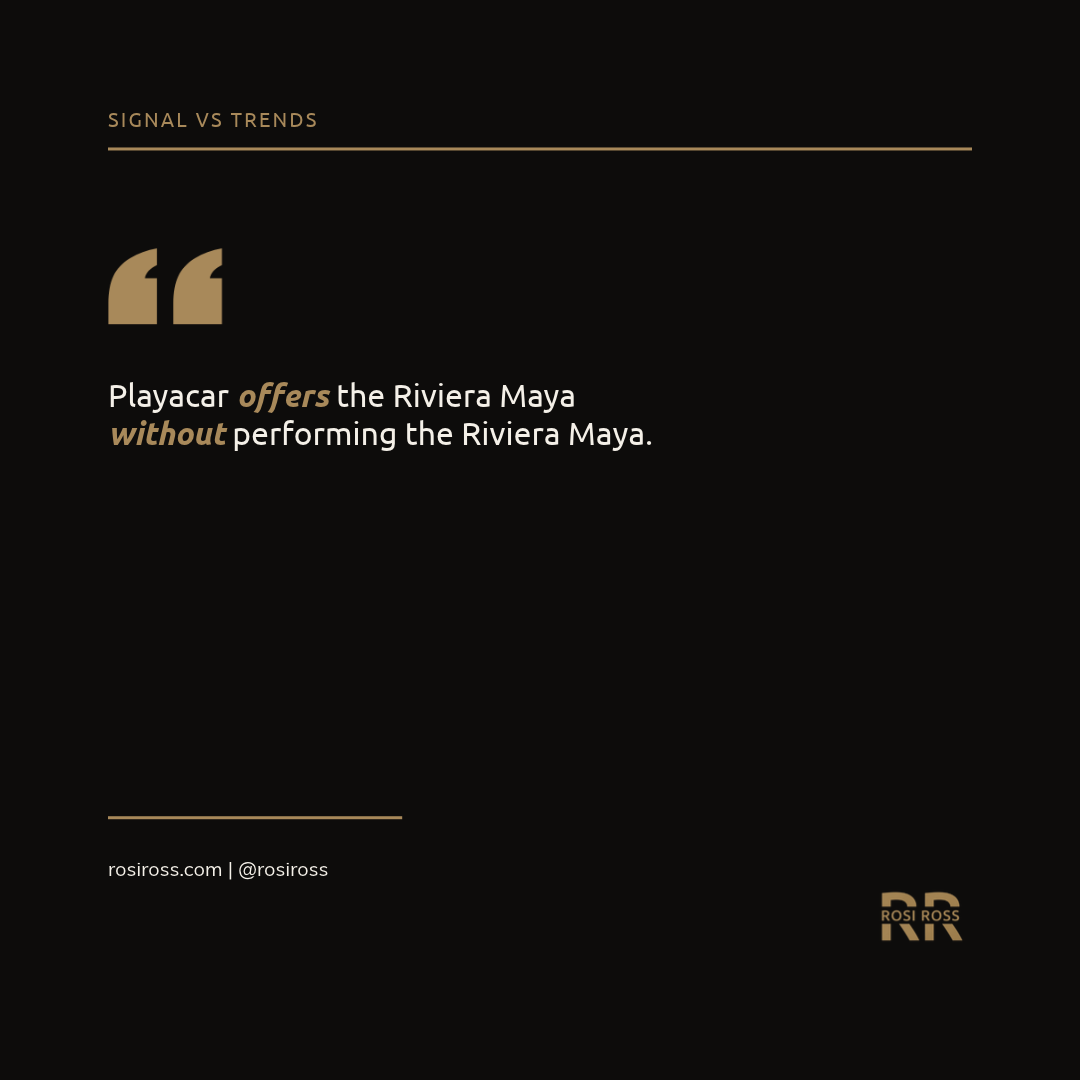
Playacar offers the Riviera Maya without performing the Riviera Maya.
The traffic fades before the Caribbean appears. Coming south from central Playa del Carmen, past the last of the busy blocks, the road widens, the vegetation thickens, the hotels step back behind trees, and somewhere in the green a low wall of old stone turns out to be Maya. Nothing announces it. That is the first thing a visitor notices about Playacar, and it explains the rest: the strangest thing about the place is how little it tries to prove.
This is not a hidden-beach listicle. It is an attempt to explain why Playacar can feel so calm, ordered and private within one of Mexico’s most heavily visited tourism corridors, and to read the place through what makes it durable: its planning, its architecture, the layers of history beneath it, and the extraordinary natural system that surrounds it, from the cenotes beneath the ground to the reef offshore.
The thesis is simple. Cancún and Tulum became global brands. Playacar remained a neighbourhood. That difference is its value: it offers white-sand coast, mature landscaping, substantial villas and access to Playa del Carmen’s restaurants and transport without asking residents or guests to live inside the visual economy of the better-known destinations. The luxury it offers is not isolation. It is a reduction in visual and social noise.
A Calm That Is Designed
Quiet of this kind is not an accident of location. It is a planning decision.
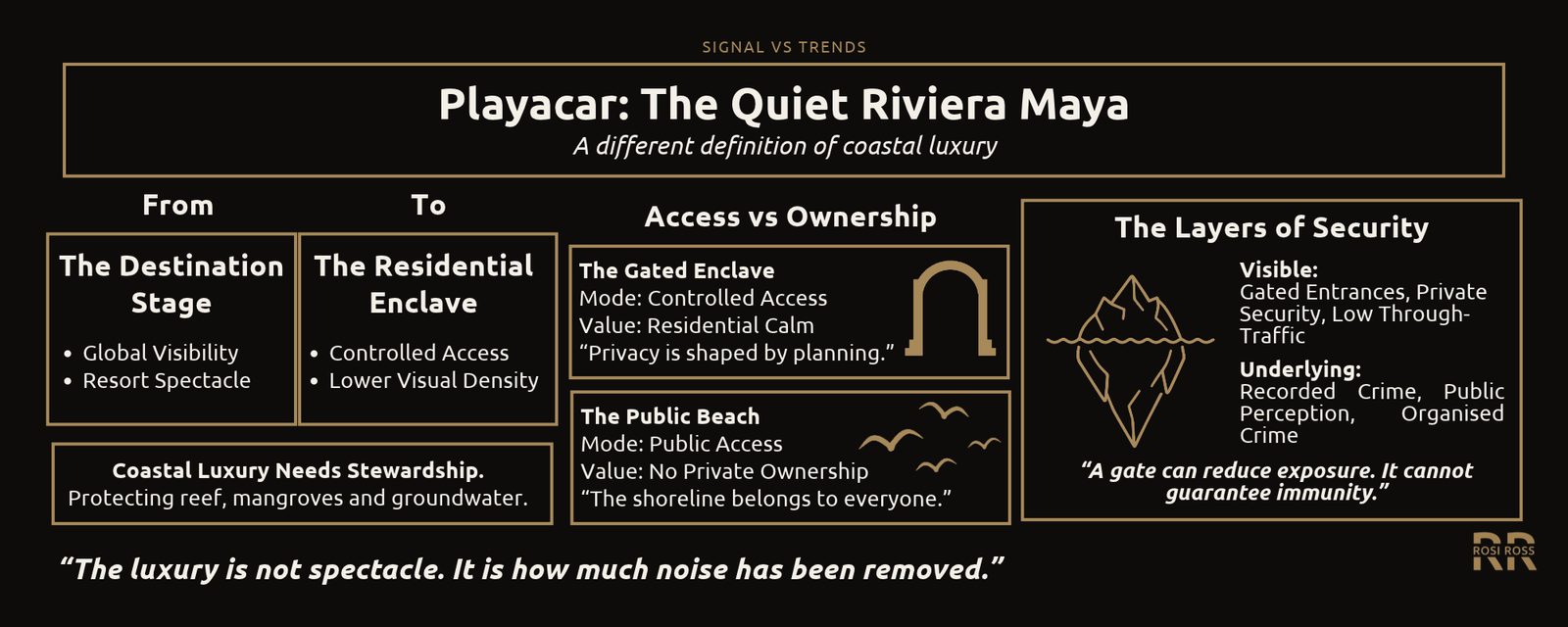
Is Playacar safe? Visitors tend to describe the enclave as calm and orderly, and the reasons are structural. Controlled vehicle entrances, a residential street pattern, low through-traffic and landscaped setbacks create an environment in which few people pass through who are not heading somewhere in particular. Compared with the commercial and nightlife blocks of the town beside it, the streets are slower and quieter, and the density of people, vehicles and noise is lower. Those are features of design, and they are what a guest or resident experiences as ease.
Like any destination, Playacar rewards ordinary good practice. Gated access is one layer of a sensible approach, along with the habits any traveller brings to a coastal city: checking current official travel advisories and local guidance before a trip, using reputable transport and following the advice of the property where one stays. The point is not caution for its own sake. It is that comfort is built from several layers working together, and the planning of the enclave is the first of them.
Why Playacar Feels Different
The psychological luxury is not legal isolation. It is a reduction in visual and social noise.
What is Playacar? It is a gated residential and resort development immediately south of central Playa del Carmen, on the Caribbean coast of Quintana Roo, in the municipality of Solidaridad. As Wikipedia’s entry describes it, Playacar is an upscale resort area of Playa del Carmen, and it is a gated community that has grown with Playa del Carmen, just south of its main urban area. It combines villas, condominiums, resort hotels, mature vegetation and the ruins of the Maya settlement of Xamanhá.
The development has two sections. Phase I offers by-the-sea secluded beaches and villas, very close to downtown Playa del Carmen. Phase II was built around a golf course designed by Robert von Hagge, and brings all-inclusive resorts and private villas into a more residential, resort-oriented setting. The course dates from 1994, which places the development’s formative years in the early 1990s, when Playa del Carmen was changing from a fishing village into a tourism hub.
The scale of that change is worth pausing on. Playa del Carmen’s tourism boom came in the 1980s and 1990s, and the town rapidly transformed from a sleepy village into one of Mexico’s fastest-growing cities. Playacar is a planned response to that growth: low-rise buildings, landscaped roads, generous setbacks and a street pattern that keeps through-traffic low. It is a place designed by people who understood that what a town gains in energy it can lose in calm.
| Phase I | Phase II | |
|---|---|---|
| Where | Immediately south of central Playa del Carmen, beside the sea | Further inland and south, wrapped around a golf course designed by Robert von Hagge |
| Character | Lower-density, beach-first, secluded-feeling villas and condominiums with mature vegetation | Larger, more residential and resort-oriented, with condominiums, villas and all-inclusive hotels |
| Relationship to town | A short walk to the start of Quinta Avenida, the shops and the Cozumel ferry | A short drive or bike ride to the coast and town |
| Access | Controlled vehicle entrances through a gated, master-planned street system | The same system of controlled access |
A planning description drawn from public descriptions of the development.
Is Playacar a gated community? Yes. It is a gated master-planned community with controlled vehicle entrances. The gates govern the streets, and not the shoreline: the beach itself is public, a point examined below.
Xamanhá: The Maya Settlement Under Modern Playacar
In Playacar, luxury housing did not arrive on empty land. It arrived on an old coastal settlement.
What are the Xaman-Ha ruins? Playacar sits directly over part of the pre-Hispanic settlement of Xamanhá. Mexico’s National Institute of Anthropology and History places the archaeological site in the Playacar subdivision, and records that to date 19 groups of civic and religious buildings have been identified, with the rest of the settlement surrounding these structures. The name means water from the north. The institute notes that it was one of the first Maya settlements seen by the Spanish conquistadors in 1518, opposite the island of Cozumel, and a destination guide gives its period of occupation as from about 1200 to 1500 CE.
The surviving architecture has a particular character. The coastal area has the main architectural groups and the plots with the highest density of structures, while the inland plots had significantly fewer buildings. The best-preserved buildings are in groups B, C and D, particularly Structure C-1, the largest, which conserves fragments of mural painting including one of the latest known calendar dates in the Maya region. Group C also has a U-shaped wall surrounding a complex of principal structures. These are not monuments on the scale of the great inland cities. They are small, low and close to the sea, which is exactly why they sit so comfortably inside the modern landscape.
The location was no accident. Xamanhá faced Cozumel, home to the sanctuary of the goddess Ixchel, and it is widely understood to have been an important commercial port and an embarkation point for pilgrims travelling by canoe to the shrines of Cozumel. A settlement of that kind was a threshold: a place where the land ended and a sacred crossing began. Playacar’s sense of being a threshold, between town and sea, between busy and calm, has a very old precedent.
| About Xamanhá | What is known |
|---|---|
| The name | Maya for “water from the north” |
| When | Occupied from about 1200 to 1500 CE, in the Postclassic period; INAH also notes signs of earlier occupation |
| Where | On the mainland opposite Cozumel, within the Playacar subdivision |
| Why it mattered | Likely an embarkation point for coastal Maya navigation and pilgrimage to Cozumel |
| What survives | At least 19 groups of civic and religious buildings are recorded; the best preserved are in groups B, C and D, with mural fragments in Structure C-1, the largest |
| Seen by Europeans | One of the first Maya settlements sighted by the Spanish, in 1518 |
Drawn from Mexico’s National Institute of Anthropology and History (INAH). INAH’s visitor page has listed the site as temporarily closed, so check its current status before planning a visit.
What changes the mood is scale. The ruins are small enough to disappear into the trees and roads, so contemporary villas, palms, forest and Maya remains share the same visual field. It is intimate and not monumental, and it gives Playacar historical depth without pretending that the modern development is itself historic. A place that holds meaning in layers, where what was built long ago continues to shape how the present is read, has the quality that makes certain objects matter beyond their material, a theme explored in The Language of Modern Necklaces: Metals, Stones, and the New Codes of Personal Luxury.
The Architecture of the Enclave
Playacar’s strongest architecture tends to recede into vegetation.
Playacar is defined less by a single style than by planning: low-rise buildings, villas, condominiums, resort compounds, landscaped roads and large setbacks. Where Cancún’s Hotel Zone announces itself through scale, and Tulum’s design economy often announces itself through highly stylised hospitality, the strongest buildings here tend to withdraw into the green. That reserve is part of the appeal. It is a different register from the architecture of display, in which form asserts authority and status, and the contrast is instructive: some luxury is built to be seen, and some is built to disappear.
Three features account for most of the effect. The first is the setback: buildings sit well back from roads and from one another, so that vegetation and not facade dominates the view. The second is height. The low-rise massing keeps rooflines below the canopy in many places, which is why the enclave reads as a garden with buildings in it and not a skyline with gardens. The third is the retained landscape, with mature trees and palms that predate much of the construction and that give the streets a shade and depth no new planting can match for decades.
The golf course in Phase II adds a particular kind of open space. Whatever one thinks of golf as a pastime, a large fairway landscape works in planning terms as a green lung, a buffer that lowers density and gives the surrounding villas and condominiums distance from one another. It is part of why Phase II feels residential and unhurried, and why the development reads as a settled neighbourhood and not a resort strip.


Why the Beach Feels Private, Even Though It Is Not
Playacar’s exclusivity comes from the gated urban fabric around the coast, not from ownership of the shoreline.
Are Playacar beaches private? No. Mexican beaches are public by law, and the legal point has to be made plainly because the phrase “private beach” is both common and wrong. The federal maritime-terrestrial zone is the strip of beach spanning 20 metres from high tide, which belongs to the Mexican people. A 2020 reform to the General Law on National Assets set fines ranging from 260,640 to 1.04 million pesos for owners of coastal properties who prevent, restrict, obstruct or place conditions on access to beaches. The principle was restated and strengthened in 2025, when lawmakers approved a reform establishing that access to maritime beaches and the adjoining federal zone must be free, permanent and without distinction of origin, nationality or social status, with concessions required to guarantee public access.
Beachfront hotels and clubs may hold concessions, but a concession is a lease and not ownership. What Playacar offers, then, is not a private shoreline but something subtler: a calmer pattern of access. The streets that lead to the coast are controlled, the shoreline is lined by residential buildings and low-key resort frontage and not a continuous row of beach clubs, and the experience of the sand is correspondingly quieter. The beach is public. The neighbourhood around it has a different rhythm. One is law and the other is planning.
For many travellers this is the actual luxury. The coast can be experienced through walking, swimming and residential beachfront, and not only through reservations, minimum spends and branded day beds. It is a beach economy without the beach-club economy, and its appeal is the absence of a transaction between the visitor and the water.
Playacar Vs Cancún or Tulum
Cancún’s strength is infrastructure and scale. Playacar’s appeal is controlled intimacy.
Cancún was deliberately developed as a large-scale tourism destination beginning in the 1970s, and its Hotel Zone is linear, resort-heavy and internationally programmed. Playacar is smaller, more residential and physically joined to Playa del Carmen, roughly a 40 minute drive from Cancun. The comparison is not a judgement. A traveller who wants airport proximity, large-scale infrastructure and a programme of resort entertainment will find it in Cancún. One who wants a residential rhythm beside a real town will weigh the other way.
Tulum’s success created development pressure, pricing pressure and intense visibility. Playacar’s absence of them can be a feature.
Tulum combines Maya archaeology, coastline, boutique hospitality and one of the world’s most influential tropical design aesthetics. That success brought visibility and costs. Playacar offers fewer destination restaurants and fewer high-concept hotels, and for travellers who want the Caribbean without constant scene-making, that absence is the point. It would be wrong to call Tulum or Cancún overrated in any objective sense. Some travellers make that criticism of saturation, high prices and image-driven tourism, and it should be reported as their view.
Is Playacar better than Tulum or Cancun? Better is the wrong measure. Cancún offers scale and infrastructure, Tulum offers cultural visibility and design influence, and Playacar offers a quieter, lower-density residential setting beside a working town. Which is better depends on whether a traveller wants spectacle, scene or calm.
| Cancún | Playa del Carmen | Tulum | Playacar | |
|---|---|---|---|---|
| Model | A planned resort destination developed from the 1970s | A town that grew from a fishing village into a hub | Maya ruins, coast and boutique hospitality | A gated residential and resort enclave beside a functioning town |
| Strength | Infrastructure and scale | Restaurants, ferries and a mixed local and international life | Cultural visibility and design influence | Controlled intimacy and low visual density |
| Trade-off | Linear, resort-heavy and internationally programmed | The busiest blocks are dense and noisy | Development and price pressure, intense visibility | Fewer destination restaurants and high-concept hotels |
| Best read as | Scale | The city | The brand | The neighbourhood |
Comparative observations, not rankings. Some travellers criticise saturation and image-driven tourism in better-known destinations; that is a preference, not a verdict.
Why Families and Younger Luxury Travellers Both Fit Here
The common denominator is not age. It is a preference for control without complete isolation.
Playacar serves groups that luxury travel writing often separates. Families value gated streets, larger residences, beach proximity and access to central Playa del Carmen. Younger travellers get walkable access to the restaurants, ferries and social life of the town without sleeping in its busiest blocks. Long-stay travellers get kitchens, villas, condominium inventory and a residential rhythm that pure resort zones lack. What they share is a preference for an environment that reduces noise without cutting them off.
That is also what makes the place less hermetic than many all-inclusive zones. Central Playa del Carmen supplies restaurants, services, shopping, a highly international resident population and the ferry to Cozumel, all reachable from the enclave. The traveller does not have to choose between resort life and local life. The atmosphere that results, shaped by shade, distance and the absence of constant stimulation, is the kind of designed calm that hospitality increasingly treats as a product in its own right.
Why is Playacar considered upscale? Because of its planning and its setting: controlled access, low-density streets, mature landscaping, larger residences and beachfront villas, and proximity to central Playa del Carmen. It is not cheap. Its value is relative, in what the traveller gets around the room.


The Nature Beyond the Gates
Playacar belongs to the ecological context of Quintana Roo. It is not an isolated, manicured island.
What wildlife exists in Quintana Roo? A great deal, and the best way to see it is to look at the largest protected area on the coast. Sian Ka’an, south of Tulum, is one of Mexico’s largest protected areas, established to manage 528,148 hectares of intricately linked marine, coastal and terrestrial ecosystems, with roughly 120 kilometres of coastline. UNESCO notes that in the language of the Maya peoples who once inhabited the region, Sian Ka’an means “Origin of the Sky”, and that the biosphere reserve contains tropical forests, mangroves and marshes, as well as a large marine section intersected by a barrier reef.
The fauna is remarkable. The World Heritage case study describes the property as providing a home for numerous charismatic species such as jaguar, puma, ocelot, Central American tapir and manatee. The Ramsar listing records endangered species including green, loggerhead, hawksbill and leatherback turtles, American and Morelet’s crocodiles, Baird’s tapir, jaguar, puma and the American manatee. The IUCN’s World Heritage Outlook counts 373 bird species recorded, many of them aquatic and migratory, and, within the reserve’s portion of the Mesoamerican Reef, 87 recorded species of reef-building coral and more than 400 species of fish.
The flora is as important as the fauna, because it is the foundation of the system. The property includes tropical forest, mangroves, marshes and, in the wider Ramsar area, swamps, marshes, mangroves and low flooded forests. Mangroves in particular do quiet work: they stabilise shorelines, filter water and nurse young reef fish, so a visitor swimming over a healthy reef is benefitting from forest that grows in salt water out of sight.
None of this should be read as a promise about Playacar itself. These animals live in the wider landscape and not inside the enclave, and sightings are never guaranteed. What the enclave does offer is proximity to a landscape of unusual richness, and one tangible local expression of it. The municipality of Playa del Carmen has 87 kilometres of coastline, where four species of sea turtle, loggerhead, green, hawksbill and leatherback, arrive each year to nest. In the 2026 season, authorities recorded more than 2,000 nests of loggerhead, green and hawksbill sea turtles along the municipality’s beaches, and the green turtle is the predominant species.
| Wider Quintana Roo | What lives there | Context |
|---|---|---|
| Tropical forest | Jaguar, puma, ocelot and Central American tapir | Protected forest systems such as Sian Ka’an, not the enclave itself |
| Mangroves, lagoons and marsh | West Indian manatee, wading birds and crocodilians | Nurseries for reef species; they trap sediment and filter water |
| Coast and reef | Nesting sea turtles; 87 recorded species of reef-building coral at Sian Ka’an | Part of the Mesoamerican Reef, which shelters the shore |
| Birds | 373 species recorded at Sian Ka’an | A fraction of the region’s bird life |
Sian Ka’an, south of Tulum, protects roughly 528,000 hectares. None of these animals should be assumed to roam Playacar itself.
The Cenotes: The Water Beneath the Coast
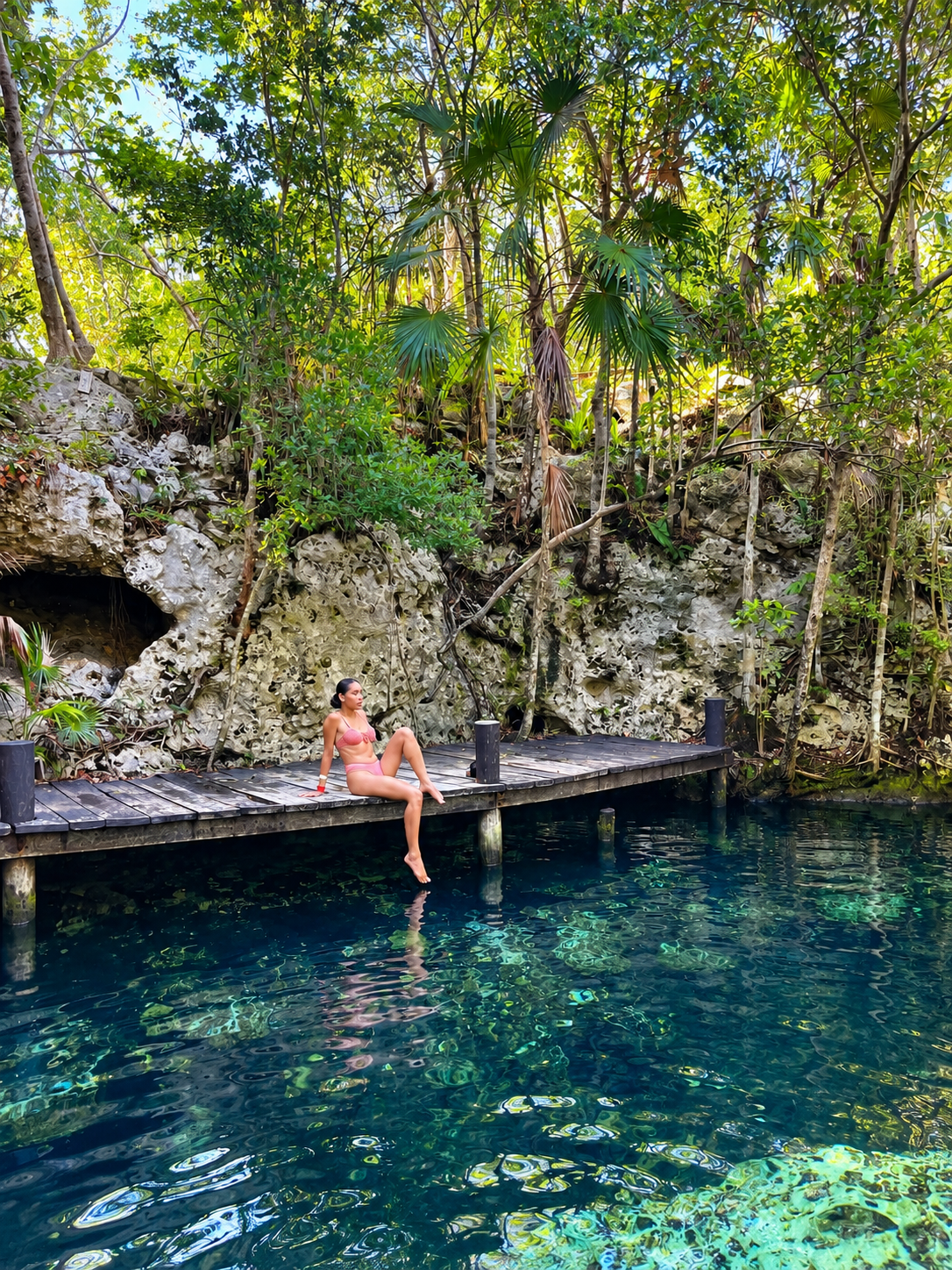
The most extraordinary landscape of the Riviera Maya is the one that cannot be seen from the beach.
Beneath the forest floor of the Yucatán Peninsula lies a different landscape: a limestone plateau honeycombed with caves, filled with fresh water that has moved slowly towards the sea for millennia. The cenotes are its surface expression. As one hydrogeological study puts it, cenotes are the surface expression of the Great Mayan Aquifer, which serves as both a water resource and a cultural and ecological landscape. The word comes from the Maya, who commonly used cenotes for water supplies, and occasionally for sacrificial offerings.
The scale of what lies beneath is difficult to overstate. The National Academies record that cave divers have, over twenty years, discovered, explored and mapped more than 108 submerged cave systems and 450 cenotes and coastal lagoons in the area of the Riviera Maya. Further north along the coast, the Sac Actun system near Tulum extends for more than 368 km and is the longest underwater cave system in the world, and collapses in various roof sections have formed over 220 cenotes in the Tulum area alone. Cenotes along the Caribbean coast, as the reference literature notes, often provide access to extensive underwater cave systems.
Why are they worth visiting, and not merely worth photographing? Because a cenote is a different kind of swimming. The water is exceptionally clear, the light falls in shafts through openings in the rock, and the surrounding vegetation hangs into the pool. Some are open to the sky, some partly covered, some entirely underground, and each has its own temperature, atmosphere and fauna. Hotel groups and travel writers regularly point visitors to options such as Cenote Azul at Puerto Aventuras, one of the most versatile in the Riviera Maya, and Dos Ojos near Tulum, part of the Sac Actun system. From Playacar, such places are a short drive away, which is part of the enclave’s value: calm at the doorstep and one of the world’s great freshwater landscapes within reach.
The cenotes also explain why the region demands care. The same porous limestone that makes them beautiful allows surface water to move quickly underground, so the aquifer is vulnerable to anything that enters the ground above it. The lesson for visitors and developers is the same: the clarity of the water below depends on the discipline of what happens above it. A landscape this finely balanced rewards treatment as a living system and not a backdrop.




The Reef Is Part of the Asset
Luxury here depends on ecological health more than on architecture.
The coast belongs to the Mesoamerican Reef region, one of the most important reef systems in the Western Hemisphere, and UNESCO notes that the Sian Ka’an property protects a barrier reef that runs along its roughly 120 kilometres of coastline. The reef shelters the shore, and the colour of the water, the beach economy, the diving culture and the marine tourism that made the Riviera Maya desirable all depend on it. The sequence is worth stating in order: the reef breaks the waves, the mangroves and seagrass behind it trap sediment and nurse young fish, the clear water that results is what the visitor sees from the sand, and the beach is what keeps the visitor coming.
A system of that kind works through layers of protection, each one sheltering the next, in the way that barrier beauty protects skin through a surface layer that does quiet, essential work, as The Return of Barrier Beauty: Why Lanolin Is the Ultimate Skin Investment explains. Lose one layer and the others are exposed. That is the strongest argument for treating ecological health as part of the luxury itself and not as an optional extra.
Why Relative Value Matters More Than Cost
The value is what the traveller gets around the room.
Playacar is not cheap, and describing it as such would be false. It is an upscale area, and beachfront villas can be expensive. The stronger argument concerns relative value: compared with heavily branded boutique hospitality or premium resort inventory elsewhere on the coast, it can offer more residential space, lower visual density and direct access to the everyday life of a working town. The neighbourhood, the beach, the archaeological context and the proximity are the product. Whether any of this is cheaper or dearer than the alternatives depends on a defined price comparison, and none is claimed here.
The value is also cumulative. A visitor who stays in an enclave of this kind gains, in a single address, access to a beach, a town, a ferry to Cozumel, a Maya site, a golf course, nearby cenotes and one of the great reef systems of the Caribbean. Few destinations assemble so many different kinds of interest within so short a distance, and few do it without making the traveller manage the logistics.
The Riviera Maya Without the Social-Media Stage
A destination can be highly developed and still under-discussed.
Tulum and Cancún are among Mexico’s most internationally recognisable tourism brands, and that visibility has produced vast hotel, restaurant and lifestyle ecosystems and an expectation that the place itself performs for the camera. Playacar’s advantage is comparative understatement. It can feel luxurious without turning every meal, beach club or room into a spectacle.
The word hidden deserves care. Playacar is not undiscovered, and it is a mature gated residential and resort development. What makes it feel hidden is that it is overshadowed internationally by the brands of its neighbours. The difference between an identity built on performance and one built on a quiet, consistent signature is the difference described in The Language of Scent: How Fragrance Becomes Identity in Modern Beauty, where a recognisable presence is built from small, repeated choices and not from volume.
That consistency is also why residential enclaves can age better than destinations that depend on being fashionable. They rest on enduring fundamentals: location, beach access, vegetation, space and proximity to an actual city. It is the same durability that makes well-made, classic pieces last in a wardrobe, the argument behind timeless luxury fashion pieces: an object or a place earns its longevity by being recognisable across changing tastes.
The Environmental Cost of Luxury
The coast’s economic value ultimately depends on ecological resilience.
Playacar is not environmentally frictionless, and no honest account of the Riviera Maya can pretend otherwise. The wider coast faces coastal erosion, sargassum, pressure on groundwater, stress on reefs and continuing development pressure. Sargassum has been the most visible. Mexico News Daily reports that 2026 has been the worst sargassum year ever recorded in the Riviera Maya, and that the arrivals decline gradually between August and October. Travel trade reporting counted more than 124,000 tons removed from the Mexican Caribbean in 2026, with Playa del Carmen the hardest-hit destination, at 42,063 tons collected.
The response has been practical and sizeable: the municipality launched a Sargassum Challenge with a 5-km double barrier to contain the seaweed and cleanup personnel at 15 locations, and has said it will allocate 100 million pesos to fight sargassum in 2027, up from 80 million this year. Even so, authorities have reported that sargassum does not appear to be affecting sea turtle arrivals or nesting, a reassuring sign for the coast’s wildlife. The honest conclusion is that this is a problem being managed, with visible effort, and that the coast is a living system whose health cannot be assumed.
Any argument for luxury here has to recognise that the value of the coast is a function of the health of the ecosystem that produces it. The next generation of Caribbean luxury travel may value controlled density more than maximum spectacle. If Cancún represents scale and Tulum represents cultural visibility, places like Playacar represent a third model: residential luxury embedded beside a functioning city. That model may become more valuable as travellers tire of destinations designed primarily for content production, and it will remain valuable only if the landscape that surrounds it does.
The hidden gem was never hidden. It was simply quieter.
The story is not that Playacar is a private beach paradise that is cheaper than Tulum. It is how a gated residential enclave, built over part of the ancient Maya settlement of Xamanhá, offers a quieter, lower-density version of the Riviera Maya, with controlled access, archaeological depth, Caribbean coast and proximity to Playa del Carmen, set within one of the richest natural systems in the Caribbean. It is a cultural discovery precisely because it is less interested in performing luxury than many of its more famous neighbours.
The luxury is not spectacle. It is how much noise has been removed, and how much is left once it has gone: a low wall of old stone among the trees, a beach that belongs to everyone, a reef offshore that has been shaping this coast far longer than any development, and beneath it all a freshwater world of caves and cenotes that few places on earth can match. The hidden gem was never hidden. It was simply quieter.
“Playacar offers the Riviera Maya
without performing the Riviera Maya.
The strangest thing about it is how little it tries to prove.
The luxury is not spectacle.
It is how much noise has been removed.
The hidden gem was never hidden.
It was simply quieter.”

