
On why a young Dubai hotel built on a century-old film studio’s memory shows that luxury does not always need to look new to feel relevant: how legacy, restraint and recognisable codes can outlast the next design cycle, and what happens when intellectual property becomes space.
Luxury does not always need to look new to feel relevant.
Most new hotels have to invent a mythology. Paramount arrived with one already written. The mountain, the stars, the black-and-white photography, the Godfather references, the dressing-room mirrors and the language of scenes and stages all existed culturally before a guest entered the building. The hotel is young. The memory it trades on is not.
This is an essay about a question hospitality keeps asking and rarely answers: why do some luxury codes survive while fashionable hotel concepts date almost immediately? Hotels are unusually exposed to trend cycles. Lobby aesthetics, lighting, music, restaurants and the prevailing definition of cool can age within a few years, and a property built to look new is, by definition, a property with a short window in which it does. Legacy works on a different clock. A recognisable cultural archive gives design something deeper than a trend to refer to, and Paramount Hotel Dubai is a useful case because it sits where two ideas meet: the contemporary city hotel and the inherited cultural power of classic Hollywood.
Its strongest asset is not that it is movie-themed. It is that the movies hand the hotel a visual language that already exists. The interesting question is what a property does with that gift, what it cannot do with it, and what the answer reveals about luxury more broadly, in a market that rewards novelty loudly and durability quietly.
The Screening Room and the Ritual of Watching
The strongest themed hospitality turns narrative into behaviour.
Does Paramount Hotel Dubai have a cinema? Yes, and it may be more important to the concept than any suite. The Screening Room is a private dine-in cinema, and The National’s opening coverage records that it seats 60 people. The hotel describes it as a time capsule and a stage for live entertainment inspired by Paramount classics. Its value is functional. Cinema is not simply printed onto the walls; guests can actually watch films in a room built around the ritual of screening.
That converts a theme into a habit, which is the difference between a hotel that looks like a film and one that behaves like a place where films are watched. The room also carried a civic ambition from the start. It launched with a private screening of a UAE-produced film, and the stated aim of the Paramount Screening Rooms was to support, recognise and celebrate the regional film industry as well as young and independent filmmakers. Whatever the commercial logic, that gesture ties an imported mythology back to the city that hosts it, which is the step most branded concepts omit.
The deeper lesson is about attention. A screening is one of the few shared experiences that still asks a group to sit in the dark and look at the same thing for the same length of time. A hotel that builds a room for that is making a quiet argument against distraction. The quality of that atmosphere, the dimming of light, the hush, the plush seat, is the kind of designed environment explored in Inside the Atmosphere Economy: How NEOM Is Redefining Modern Home Wellness, where mood is treated as part of the product and not as decoration around it.
A Young Hotel With a Century of Cultural Memory
The hotel is young. The memory it trades on is not.
A correction first, because the premise matters. Paramount Hotel Dubai is not a century-old hotel. By the account of its opening announcement, it set the stage for an “Avant Premiere” before rolling out the red carpet in January 2020 for the grand opening, and it was described as the first Paramount property in the region. So, when did Paramount Hotel Dubai open? It began welcoming guests in the closing weeks of 2019, with the formal opening scheduled for the start of 2020. What it inherits is more than a century of Paramount Pictures storytelling and visual culture, and the distinction between the two is the hinge on which the whole essay turns.
The studio’s own history is generous with material. Paramount Pictures dates its existence from the 1912 founding date of the Famous Players Film Company, established by Adolph Zukor on a slogan that doubled as a mission statement: famous players in famous plays. Two years later, in 1914, a distribution company called Paramount Pictures Corporation was organised by the Utah theatre owner W.W. Hodkinson to release the films of Famous Players, the Lasky company and others, and in 1916 Zukor engineered the merger that brought the three together. Hodkinson is also credited with the emblem that outlived all of them. He first designed the Paramount logo in 1914, and the studio’s own history says the mountain peak he remembered from his childhood in Utah inspired the logo.
Even the mark carries an instructive footnote. The hotel’s opening materials describe the Paramount mountain surrounded by 22 stars. Other accounts say 24, and the reconciliation is simple: Zukor is recorded as having put 24 actors and actresses under contract and honoured each with a star on the logo, and in 1967 the number of stars was reduced to 22. A discrepancy that looks like an error is a layer of history, which is exactly the kind of depth a young hotel cannot manufacture and an old studio cannot help but possess.
The right description is therefore a legacy entertainment brand translated into hospitality, and not a legacy hotel chain. The distinction is not pedantic. It decides what the hotel can claim and what it has to earn.
| Year | Paramount the studio | Paramount the hotel |
|---|---|---|
| 1912 | Adolph Zukor founds the Famous Players Film Company | |
| 1914 | W.W. Hodkinson organises Paramount Pictures Corporation to distribute films; he designs the mountain logo | |
| 1916 | Famous Players merges with the Lasky company; the three companies are consolidated | |
| 1967 | The stars in the logo are reduced from 24 to 22 | |
| 1972 | The Godfather is released | |
| 2012 | Paramount Hotels & Resorts is registered in Dubai and secures a licence to use the Paramount name for branded hotels | |
| March 2013 | DAMAC Properties and the licensee announce “DAMAC Towers by Paramount” in Dubai | |
| 2019 | Paramount Hotel Dubai opens with an Avant Premiere | |
| January 2020 | The formal grand opening is scheduled |
The studio column follows Paramount’s own history and reference histories; the hotel column follows the 2013 and 2019 announcements cited in the text.
The studio’s century belongs to Paramount Pictures. The hotel inherits it under licence, and that sentence is the most honest way to hold the entire story.
Why Dubai Was the Right Stage
Dubai and Hollywood share an instinct for spectacle, aspiration and image.
Dubai was already one of the world’s most hotel-saturated luxury markets when the property opened, so a new arrival needed an identity stronger than generic five-star polish. The city also suits the idea. It has long been a place where fashion, entertainment, automotive and lifestyle identities move into real estate and hospitality, and the hotel belongs to that era of branded luxury. Paramount’s own announcement framed the concept as Hollywood’s indulgent charm and glamor brought into the world of hospitality, with a Californian lifestyle layered on top.
Location reinforces the premise. Among luxury hotels in Business Bay, this one stands just over the Dubai Water Canal from Downtown Dubai, which gives its rooms views of the skyline that the brand can use as a contemporary counterpoint to its black-and-white archive. The tower is large: 823 rooms and suites spread across 69 floors. That scale matters to the argument, because a concept has to work at the scale of a city hotel and not that of a boutique, where intimacy can excuse a great deal. At 823 keys, the theme either becomes a coherent operating language or it becomes wallpaper.
A Hollywood hotel in Dubai is less incongruous than it sounds. Both places built their reputations on the production of aspiration. One manufactures it on screen; the other manufactures it in glass, water and light. The hotel stands where the two industries recognise each other.
A note on names avoids confusion for anyone searching for the property. There are two Paramount hotels in Business Bay, and the Paramount Hotel Midtown is a separate property close to Sheikh Zayed Road. This essay concerns the original hotel by the canal.
Turning Film Language Into Hotel Design
The naming system is one of the property’s smartest design decisions.
The vocabulary does a great deal of work. Rooms are grouped into Scene and Stage Guest Rooms, Premiere Suites and Paramount Suites, and themed suites taking inspiration from Paramount Pictures movies. There is a Screening Room, a speakeasy called Flashback, a Californian restaurant called Pacific Groove and a poolside space called Malibu Deck, and even staff titles borrow from cinema. This keeps the cinematic world coherent without asking every surface to become literal movie memorabilia, which is exactly where themed hotels tend to fail.
The restraint is a form of intelligence. A themed environment that insists on its theme at every glance exhausts its guests, because the theme has to be decoded constantly. A vocabulary does the opposite. It supplies a frame once, in the language of the names, and then lets materials, light and service do the rest. The guest who is told that they have booked a Premiere Suite understands the hierarchy without needing a plaque, and the hierarchy is expressed in film ritual and not only in square metres.
| Name | What it refers to | What it does |
|---|---|---|
| Scene Rooms and Stage Rooms | The language of making a film | Gives ordinary room categories a coherent narrative |
| Premiere Suites and Paramount Suites | The event of a release; the studio itself | Signals rank through film ritual and not only size |
| The Screening Room | The act of watching | Turns the theme into a place guests actually use |
| Flashback | Cinematic memory, a speakeasy bar | Gives nostalgia a social setting |
| Pacific Groove | The Californian half of the brief | Carries the coastal, relaxed register into dining |
| Malibu Deck | The Californian shoreline | Extends the vocabulary to the pool and the daytime hours |
Names follow the hotel’s announcement and The National’s opening coverage.
The Californian half of the concept deserves attention because it solves a problem Hollywood alone cannot. Old Hollywood supplies drama, formality and glamour, and a hotel built only on those would feel like a costume. California supplies ease, daylight and the sense of a place where glamour is worn lightly. The pairing is deliberate, and it is one reason the design can host both an evening in a speakeasy and a morning at the pool without a seam.
Scene Rooms: Cinema Without the Costume
The most successful themed design references a world rather than copying it.
What are the movie-themed rooms at Paramount Hotel Dubai? The honest answer begins with the standard rooms, which are not themed to a single film. They lean into Californian glamour and the culture of the dressing room, and the hotel’s own room pages describe plush seating and stage lighting, and a superior entertainment system for a Paramount movie night. Independent guides to the property add details such as stage-lit vanity mirrors and decor referencing the Paramount Pictures archive. The theme is carried by devices that invite behaviour: a guest dresses at an illuminated mirror, plays with the light, and watches a film in a room designed for it.
This matters because the Scene Room is where most guests will actually meet the concept. The suites are the headline, but the standard category is the proof of whether a theme has been integrated or merely applied. A themed suite can be spectacular and still sit on top of an indifferent room. When the vanity, the lighting and the entertainment system in the ordinary room are the theme, the idea has reached the level at which people live.
The reference to a dressing room is particularly well chosen. A dressing room is a backstage space, where the performance is prepared and the person is not yet in character. Placing it at the centre of a hotel room reverses the usual logic of luxury, which presents the finished result. Here the guest is invited into the preparation, and the glamour is something one steps into, not something one is shown.


Inside the Don Corleone, Charleston and Carole Suites
At the top of the range the hotel becomes less about one film and more about studio mythology.
What is the Don Corleone Suite? It is the hotel’s Godfather-themed suite, and it is the most explicit use of film mythology on the property. The Godfather, released by Paramount in 1972, has long since become part of twentieth-century visual culture, and Visit Dubai describes a suite filled with Godfather designs. The hotel’s own description lists dark leather Chesterfields, a cocktail bar, a barber room and a steam shower. The suite works because it translates the film’s visual codes into hospitality, with the weight of dark leather, the privacy of a barber’s chair and the ceremony of a bar, rather than printing logos on a wall.
The Charleston Suite is the counterpoint. It takes its cues from The Great Gatsby and the Roaring Twenties, and it references a broader cinematic era instead of one single title. That choice opens a larger observation about Art Deco, one of luxury’s most durable visual languages: geometry, symmetry, polished materials and an association with modernity, wealth and nightlife that has survived several revivals. It is the same logic by which precise geometry and finish carry meaning in the jewellery examined in The Language of Modern Necklaces: Metals, Stones, and the New Codes of Personal Luxury, where a clean line and a considered setting do the work that ornament once did.
The Carole Suite is named for Carole Lombard, a Paramount star of the 1930s, and is inspired by her. Its relevance is less about celebrity fandom than about treating the movie star as an interior archetype: vanity, dressing, entertaining, performance. At the top, the Paramount Suite, with its memorabilia and views over Downtown, turns the studio itself into the theme. The progression is quietly logical. A film, an era, a person, an institution: each suite moves one step further from a single story towards the mythology that contains all of them.
| Suite | Reference | What to notice |
|---|---|---|
| Don Corleone | The Godfather, released by Paramount in 1972 | Dark leather, bar and barber-room codes translated into hospitality |
| Charleston | The 1920s and The Great Gatsby | Art Deco geometry, curated art and a sense of occasion rather than one film |
| Carole | Carole Lombard, a Paramount star of the 1930s | The movie star as interior archetype: vanity, dressing, entertaining, performance |
| Paramount | The studio itself | Memorabilia, entertaining space and views over Downtown Dubai |
Suite descriptions follow the hotel’s room pages, Visit Dubai and The National’s coverage, and may have changed since publication.
Why Archive Matters More Than Theme
The hotel becomes partly gallery, partly memory machine.
What is unique about Paramount Hotel Dubai? A great deal of the answer sits in its walls. At opening, the hotel placed exclusive, never-seen-before behind-the-scenes photography from the studio’s films on each floor, and Gulf News described the floors as decorated with imagery taken during production, offering a Hollywood studio atmosphere. That archival layer is more interesting than generic posters because it gives guests access to the production culture around films, and not only their finished marketing images. A corridor becomes a small exhibition of how a film was made, and the photograph does the work of a story.
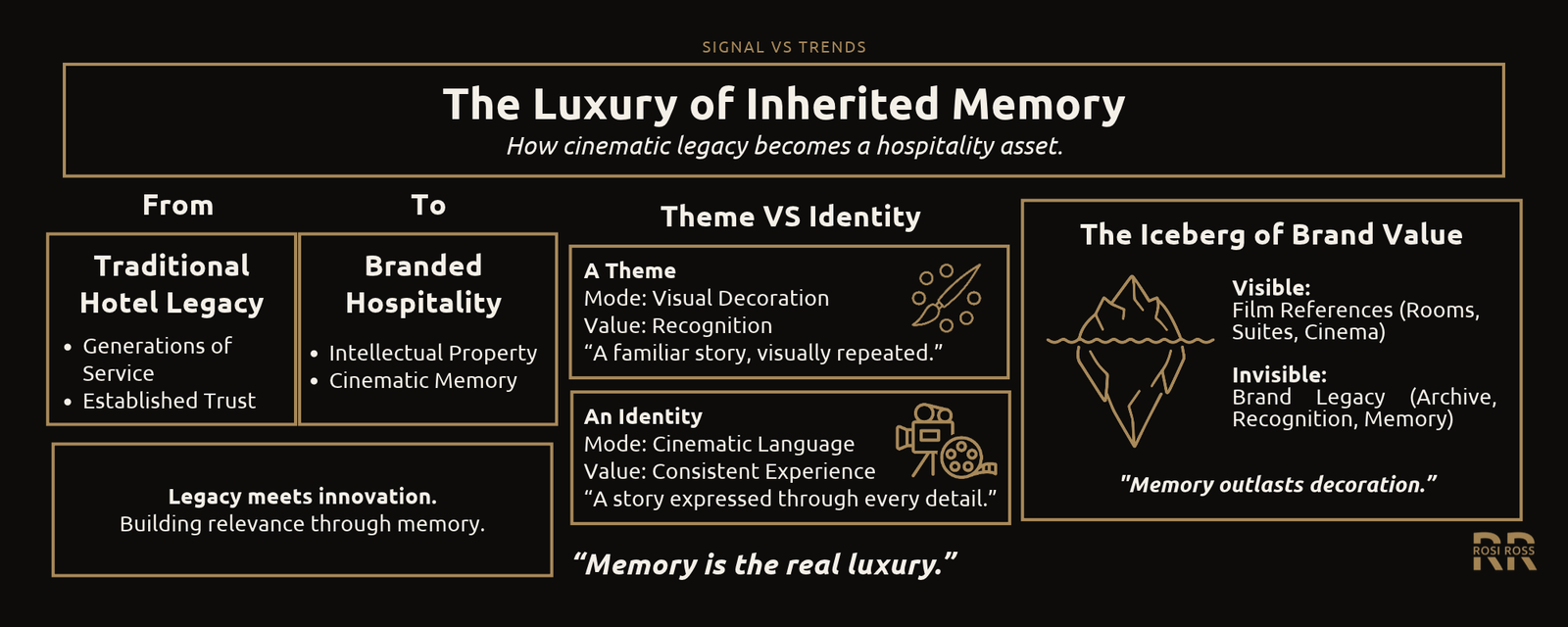
The difference between a theme and an identity is worth making explicit, because it is the difference between decoration and operation.
| A theme… | An identity… |
|---|---|
| Is placed onto a hotel | Shapes how the hotel names its spaces |
| Lives on surfaces: props, logos, posters | Lives in rooms, rituals and service |
| Becomes kitsch when literal | Can survive reinterpretation |
| Is consumed once | Is used repeatedly, as a screening is |
| Needs constant novelty | Draws on an archive |
Paramount is strongest when cinema becomes the operating language and not the surface decoration.
How does the hotel use Paramount film history in its design? Through layers, and the layers are ranked by durability. The archive photography is the deepest, because it cannot be bought by a competitor. The naming system comes next, because it organises the experience. Then come the suites, which dramatise it, and the Screening Room, which makes it a practice. The theatrical dressing-room mirrors and the immersive lobby video walls reported at opening sit at the surface, and they are the most replaceable elements, which is as it should be.
Entertainment-themed hotels carry a genuine risk. Literal references can become kitsch, technology can age quickly and cultural references can lose relevance. The defence is restraint: archival photography instead of cartoon props, material references instead of constant branding, and functional entertainment spaces instead of novelty alone. That restraint is also why the same story can be read as heritage and not as costume.
The Difference Between Legacy and Nostalgia
History is not relevance. It is material from which relevance can be built.
The argument widens here from one hotel to the luxury market. Established brands possess what new entrants have to spend years creating: recognition, ritual, visual codes, stories and inherited trust. Legacy does not guarantee relevance, but it supplies raw material that can be reinterpreted rather than invented. A new brand must first make itself known and only then make itself loved. A legacy brand begins with the knowing and can spend its effort on the loving.
Nostalgia, similarly, is not automatically backward-looking. In a market dominated by newly built glass towers and globally similar interiors, it can provide emotional texture, and the real question is whether it hardens into caricature or helps a guest feel connected to a cultural archive. The test is whether the reference teaches the guest something or merely reassures them. A photograph from a production that reveals how a scene was lit is education. A cartoon of a movie camera is a souvenir.
The word most abused in this territory is timeless. Nothing is literally outside time. What survives are designs and rituals that can absorb changing tastes without losing their identity, and not every movie reference qualifies. Hollywood glamour has already been reinterpreted across several generations, and the hotel participates in that reinterpretation, which is a more modest and more defensible claim than permanence. Durability is not an absence of change. It is the capacity to change without ceasing to be recognisable.


Why “Hip” Hotels Date So Quickly
Hospitality often confuses cultural relevance with visible trend participation.
A property can be fashionable because it uses the current furniture silhouette, the current soundtrack, the current cocktail language or the current social-media aesthetic, and still date within a few years. Visible trend participation is a loan taken against the future: the hotel borrows attention now and repays it when the trend turns. The photogenic moment that fills a feed in the opening year becomes the dated detail that a guest notices in the fifth.
Reserved luxury follows a different logic: proportion, material quality, privacy, service, acoustics, consistency and cultural memory. It would be wrong to argue that the classic is objectively superior. The more defensible claim is that some travellers value durability over novelty, and that when every new hotel chases casual minimalism, muted beige and the moment worth photographing, classic glamour can begin to feel distinctive again.
Luxury cycles. Restraint becomes countercultural after excess, ornament returns after minimalism, formality feels fresh after relentless casualisation. That cyclical quality is why legacy codes can return without ever quite disappearing. They do not need to be revived, only rediscovered, and the properties that kept them intact are positioned when the pendulum swings. This is why classic luxury hotels in Dubai, a city that reinvents its skyline constantly, can read as the more radical choice.
Reserved Luxury and the Old-Money Aesthetic
The highest-status object is often the one that does not need to announce that it is new.
“Old money” is best used as cultural shorthand and not as a claim about every wealthy traveller, or as a measured customer segment. The aesthetic associated with inherited wealth tends to prefer signals that do not need constant explanation: dark timber, tailored proportions, historic references, good linen, privacy, familiar rituals and quiet service. It helps explain why heritage hotels and conservative luxury houses stay desirable even while hyper-modern properties dominate editorial cycles. It is a taste for accumulated provenance, a preference for the object that has already survived a judgement.
The identity that these signals build is a coded one, a personal signature assembled from small, consistent choices, which is how a scent becomes a recognisable presence in The Language of Scent: How Fragrance Becomes Identity in Modern Beauty, and why a place that gets its codes right can feel familiar to someone who has never stayed there before. Familiarity of that kind is not accidental. It is the result of repetition across every touchpoint, until the code reads as character.
| A reserved luxury checklist | Why it matters |
|---|---|
| A recognisable point of view | Rather than an accumulation of trends |
| Materials that age with dignity | Leather, timber, stone and metal improve with use |
| Rooms designed for comfort before photography | The guest, not the feed, is the audience |
| Service that protects privacy | Discretion is part of the product |
| Public spaces with ritual and purpose | A screening, a drink, a gathering |
| A story deeper than the design cycle | Memory outlasts fashion |
| Technology that does not dominate the room | Modern systems stay invisible |
| Consistency across markets without sameness | Recognisable codes, local relevance |
A framework for why classic or restrained hotels can remain desirable. It is not a claim that classic luxury is better than contemporary luxury.
The checklist is deliberately a framework and not a verdict. A hotel can fail every item and succeed commercially, and a hotel can meet every item and still be dull. What the list describes is the set of conditions under which a classic proposition has a fair chance of lasting.
Classic Does Not Mean Frozen
A classic hotel that refuses to evolve becomes a museum.
The challenge is to modernise the invisible systems, technology, wellness, sustainability and service logistics, while protecting the visible codes guests associate with the brand. Paramount’s theatrical in-room systems and its lobby video walls illustrate the tension: the reference is old Hollywood, the delivery is contemporary. The hotel’s own description of its rooms leads with a superior entertainment system, which is a modern sentence about a nostalgic idea, and its spa adds a sauna, a gym and a Moroccan hammam to a cinematic frame. Hollywood itself has always worked this way, adopting every new technology to deliver an old promise.
Old materials and ingredients can be revived the same way, by keeping the original idea and renewing the formulation, as lanolin has been in beauty, the story told in The Return of Barrier Beauty: Why Lanolin Is the Ultimate Skin Investment: a heritage substance made relevant again without being turned into a museum piece. The principle travels across categories. Wardrobes follow it too, which is the argument of timeless luxury fashion pieces that hold their value because the silhouette is settled and the construction is improved quietly, year after year.
The practical test of a heritage concept is therefore not how faithfully it preserves the past but how invisibly it upgrades the present. A guest should never feel that they are in a reconstruction, and never feel that the film reference has been compromised by an inconvenient system. When the old idea and the new delivery are indistinguishable in use, the design has done its job.


How Legacy Travels Across Markets
Cinema is unusually exportable.
Paramount’s films and visual language circulated globally long before the hotels existed, which gave the hospitality brand recognition among very different traveller markets. Trade coverage of the 2019 launch reported that management discussed demand from the Gulf, China, India and beyond: audiences with different travel behaviours but overlapping familiarity with Hollywood. The point is not that every market consumes luxury in the same way. It is that storytelling provides a shared entry point.
Why do classic luxury hotels remain popular? Because in luxury, familiarity can reduce perceived risk. Travellers who book at this price often buy confidence as much as space: confidence in service, location, food, maintenance and the social meaning of a name. A recognisable code, whether a mountain and stars or a heritage house crest, answers the question of what to expect before the traveller has asked it. For a guest arriving from a country where the brand is known only through its films, the familiarity is emotional and not operational, and it lowers the cost of trying something new.
There is also a cultural reason that goes beyond risk. Cinema is the most widely shared visual education of the twentieth century. A guest in Business Bay who has never visited California carries a detailed mental picture of a dressing room, a barber shop and a ballroom because films installed those pictures. The hotel does not need to teach the code. It needs only to honour it.
Branded Hospitality: When Intellectual Property Becomes Space
This is not merchandising in the traditional sense. It is experiential licensing.
Is Paramount Hotel Dubai owned by Paramount Pictures? Not in the sense of a traditional hotel owner. The structure behind the hotel is as revealing as its decor. Paramount Hotels and Resorts, created by a group of investors in Dubai in 2012, holds a licence from Paramount Pictures to build a chain of branded hotels and homes, and when the first project was announced in March 2013, the global launch of “DAMAC Towers by Paramount” marked the licensee’s first venture into the hotel and real estate industry. DAMAC Properties was the developer. Reporting at the time was explicit about the studio’s role: Paramount would have no investment in the scheme, and the hotel chain had signed a licensing agreement to use the film giant’s name.
So the answer to who owns the hotel is not the studio. Paramount is the licensor of a brand, the concept was developed with Paramount Pictures’ creative heritage as its reference, and the property sits within Dubai’s branded-hospitality economy, where developers partner with fashion, entertainment and automotive names to differentiate real estate. A Dubai government hotel listing states the claim carefully: the hotel was developed using the creative process perfected over Paramount Pictures’ history, under the line “For the Creatives by the Creatives”. Current ownership and management arrangements should be confirmed with the property, since such structures change.
The scale of the project also shifted between announcement and opening. The 2013 plan described four towers costing about one billion US dollars, with a 540-room hotel in one tower and serviced residences in the others. The hotel that opened in 2019 had 823 rooms and suites. A long project passes through several versions of itself, and the story that survives is the one the brand can still tell: a studio’s memory, made into a place. Intellectual property is becoming spatial. A story becomes a room, an archive becomes a corridor, a film ritual becomes a screening room.
| Traditional legacy hotel group | Branded hospitality such as Paramount | |
|---|---|---|
| Where legitimacy comes from | Generations of hotel operations | Intellectual property, storytelling and cinematic memory |
| What it brings | Service systems, trust, institutional continuity | A visual language and an audience that already exists |
| Typical model | Owned or managed by hotel companies | Licensed brand, developed with a real-estate partner |
| Main risk | Fatigue, inflexibility | Kitsch, if the theme outruns the service |
| Closest cousins | Heritage hotel dynasties | Fashion- and automotive-branded hotels |
A framework for comparison, not a ranking. Neither model is superior; each has a different failure mode.
Paramount is a different kind of legacy. Its legitimacy comes from its archive, and not from a century of running hotels. That makes it closer to fashion- or automotive-branded hospitality than to a traditional hotel dynasty, and the distinction should govern how the property is judged. A heritage hotel is asked whether it has preserved something. A branded hotel is asked whether it has translated something, faithfully and usefully, into a form people can inhabit.
Why the Hotel Still Needs Hospitality to Work
The movie concept creates interest. Hospitality decides whether the interest converts into loyalty.
No amount of brand recognition can compensate indefinitely for weak service or poor operations. A famous name buys the first booking, and only the experience buys the second. The risk is acute for any licensed concept, because the guest arrives with expectations set by a studio’s reputation and not by a hotelier’s. Every inconsistency is therefore felt twice, once as a service failure and once as a betrayal of the story.
This is the discipline that protects an essay about legacy from becoming brand mythology. The archive, the names, the suites and the screening room establish a point of view. Whether that point of view lasts depends on unglamorous things: how quickly a room is serviced, how quietly a request is handled, how consistently the standards of the opening year are maintained in the tenth. A theme that outruns the service becomes the kitsch it was designed to avoid. A service that matches the theme turns it into a reputation.
It is a useful standard to apply to any hotel that borrows a story. The question is not how impressive the borrowed material is. It is whether the daily operation is good enough to deserve it.
Why Memory May Become More Valuable in the AI Era
In an age of infinite inspiration, ownership of memory becomes a luxury asset.
As artificial intelligence makes visual trend production faster, hotel aesthetics may become easier to imitate and quicker to saturate. A competitor can now generate a convincing mood board in minutes, and a trend can travel from invention to saturation in a season. In that environment, the value of design that anyone can reproduce falls, and the value of material that no one else can license rises.
Brands with archives hold an advantage because they can draw on proprietary history and not on the same public mood boards. The future value of a concept like Paramount’s may therefore lie less in movie-themed novelty and more in controlled access to a century of imagery, characters, design codes and storytelling. A visual language that no one else can license is a form of scarcity that design alone cannot create. The principle applies well beyond hotels. The architecture of such recognisable codes, the way form signals identity at a glance, is a theme that runs through the study of sculptural design in The Architecture of Power: How Sculptural Footwear Defines Modern Luxury.
What would change this view is instructive. If archive-based brands begin to lean on novelty and neglect their operations, the advantage dissolves. If audiences lose their familiarity with the films that carry the codes, the shared entry point narrows, and a heritage built on one medium may need a new one. If the licensing structures behind such hotels prove fragile, the story of a studio in a building becomes harder to tell. The argument is conditional, as any argument about an evolving market should be, and it holds best where the archive is treated as material to be reinterpreted and not as a monument to be protected.
What the Memory Carries
The rarest luxury may be a story people already know, told well enough to feel new.
The story is not that Paramount is a glamorous movie-themed hotel in Dubai. It is how a young hotel uses the inherited cultural capital of a century-old film studio to build a form of luxury that sits between entertainment, archive, design and nostalgia, and why, in a market obsessed with the next new aesthetic, recognisable classic codes can remain unexpectedly powerful.
The reader should leave thinking about luxury differently: not as whatever is newest, but as whatever has enough identity to survive being reinterpreted. A hotel can be young and still hold a deep memory. A design can be classic and still be modern in delivery. And a code, once recognised, can lower the distance between a guest and a place faster than any amount of novelty. That, finally, is what a recognisable luxury code does. It lets a building feel familiar on the first night.
“Most new hotels have to invent a mythology.
Paramount arrived with one already written.
The hotel is young. The memory it trades on is not.
History is not relevance.
It is material from which relevance can be built.
In an age of infinite inspiration,
ownership of memory becomes a luxury asset.
The rarest luxury may be a story people already know,
told well enough to feel new.”

