
On water as the ingredient beauty forgot: how hair fibre, municipal infrastructure and the booming shower-filter market connect, what the evidence on hard water and chlorine actually shows, and why Dubai and Malta make revealing case studies.
The next frontier of haircare may begin before the shampoo touches the scalp.
We obsess over what is inside the bottle and almost never ask what is coming out of the tap. A person can use an expensive mask, a bond-repair treatment and a carefully chosen shampoo, then rinse everything through water carrying minerals, disinfectants or plumbing residues that may change how the fibre feels and behaves. We audit every ingredient in the bottle and rarely audit the water used to rinse it away.
This is not a product endorsement, and it is not another warning that hard water ruins hair. It treats water as what it increasingly is in beauty: an environmental exposure that sits upstream of shampoo, conditioner, masks, bond builders and styling. The piece connects three systems that beauty coverage usually keeps apart: the science of the hair fibre, the infrastructure that delivers municipal water, and the fast-growing consumer market for shower filtration. Dubai and Malta are the case studies, because both rely heavily on treated or desalinated water while exposing hair to a demanding combination of heat, sun, humidity, wind and frequent washing.
The larger question is a simple one. What if a large part of the hair routine happens before any cosmetic product is applied? Hair is a keratin fibre in continuous contact with water, humidity, ultraviolet radiation, heat, friction and chemical treatment. Water changes how the fibre swells, how its bonds behave and how shampoos and conditioners interact with it. That makes the shower a source of exposure, not just a delivery mechanism, and it also demands more rigour than the category usually offers. The evidence is real but uneven, the marketing is often ahead of the science, and several of the most repeated claims are wrong.
Four systems meet in a single shower. The fibre is a material with a history. The water is the product of geology, treatment and plumbing. The infrastructure behind it is a very large and increasingly financial enterprise. And the market is a new class of consumer object that sits at the end of all three. A shower filter for hair is a small thing attached to a very large chain, and the chain is the story.
Damaged Hair Keeps the Evidence
A fibre keeps a record of every exposure, and treated hair keeps the longest.
The 2011 finding about calcium and magnesium uptake has a consequence that the public conversation tends to miss. If the amount of hardness metal a fibre collects depends on its condition, then two people showering under the same tap are not having the same experience. A virgin, healthy fibre with an intact cuticle may take up very little. A bleached or heavily treated one, its cuticle lifted and its surface roughened, may collect a good deal more, and the minerals settle precisely in the cuticle layers that govern slip, shine and style retention.
That helps explain why testimony about water conflicts so sharply. One person describes a shower filter as transformative, another notices nothing, and a third swears the problem was never the water at all. All three may be right about their own hair. The experimental literature compounds the effect, because laboratory studies tend to use hair samples chosen for uniformity, while real heads carry a decade of colour, heat, sun and friction. The unevenness of the evidence is partly an honest reflection of how much the fibre’s history shapes what water can do to it.
It also suggests a more careful habit of attention for anyone considering a change. The useful question is not whether hard water is bad for hair in general, but what a particular fibre, in a particular condition, is picking up from a particular supply. That is a question about a person and a place, which is exactly why a single universal claim about water and hair cannot be trusted in either direction.
Hair Is a Material: The Science of the Fibre
Frizz is not simply cosmetic failure. It is fibre chemistry responding to the atmosphere.
Structure comes first. The cuticle is the protective outer layer of overlapping cells. The cortex beneath carries most of the fibre’s mechanical strength and pigment. The behaviour of the keratin proteins is commonly attributed to hydrogen, disulfide and ionic or salt bonds, a framework set out in recent review literature on hair anatomy and chemical bonds, which describes hydrogen bonds as relatively weaker than disulfide bonds but essential to stabilising the keratin structure, and as the bonds responsible for the fibre’s moisture exchange with its environment, since they can stretch and reform simply by wetting the hair.
That is the point at which water enters. Hair absorbs and releases moisture according to relative humidity, which is why a style made in air conditioning can behave very differently once it meets humid air outdoors. Chemical treatments such as bleaching increase porosity and make environmental exposure more consequential. A fibre is a material with a history, and every wash, every humid day, every hour of sun and every pass of the heat tool adds to it. Water is the one exposure that is present in every case.
| Part of the fibre | What it does | What stresses it |
|---|---|---|
| Cuticle | The protective outer layer of overlapping cells | Friction, heat, bleaching and oxidation; mineral deposits can sit on its surface |
| Cortex | Carries most of the fibre’s mechanical strength and pigment | Ultraviolet light and chemical treatment can alter protein and pigment |
| Disulfide bonds | Strong, cross-linking bonds within keratin | Broken by chemical treatments, heat and UV |
| Hydrogen bonds | Weaker bonds that respond quickly to water | Shift with humidity and washing, which is why styles change in damp air |
| Ionic bonds | Salt bridges sensitive to pH | Affected by treatments that change the pH of the fibre |
A simplified model. Keratin behaviour is described in the literature as the result of hydrogen, disulfide and ionic bonds, and the picture is less uniform than the textbook version.
Humidity also explains frizz. When atmospheric moisture changes the hydrogen bonds that hold a set shape, the fibre relaxes, swells and loses the style it was given. That is not a failure of the product used that morning. It is a material responding to its environment, and it is one reason the conversation about haircare is moving from the bottle to the air and the water around it.
What Hard Water Actually Does
The correct language is that hard water can contribute to mineral deposition and may weaken hair under repeated exposure.
Does hard water damage hair? Possibly, under repeated exposure, but the evidence is mixed. Hard water carries higher concentrations of dissolved calcium and magnesium. A 2018 study comparing hair treated with deionised water and with hard water reported a significant result for the hard-water group (P = 0.001, against 0.609 for deionised water) and concluded that hard water decreases hair strength and thus increases breakage. A 2016 study of young male volunteers in Pakistan, framed around weakening and breakage and explicitly not hair loss, pointed the same way.
The evidence is not uniform. An earlier 2013 study found no statistically significant difference in tensile strength between hair treated in hard water and hair treated in distilled water, with means of 105.28 and 103.66 and a P value of 0.858, and concluded that hardness did not interfere with strength or elasticity. A scanning electron microscopy study in the Indian Journal of Dermatology, Venereology and Leprology, published in 2017, examined hair from twenty healthy volunteers in Saudi Arabia where brittleness and breakage are common complaints, and found more magnesium on hair washed in hard water but no significant difference in calcium deposition or in visible surface damage. A separate small electron microscopy study in the International Journal of Dermatology reported a ruffled surface, higher calcium and magnesium deposition and reduced thickness in hair treated with hard water compared with distilled water.
| Study | What it found | Caution |
|---|---|---|
| 2013, International Journal of Trichology | No significant difference in tensile strength or elasticity between hard-water and distilled-water hair | An early finding that does not support a simple story |
| 2016, male volunteers | Hard water linked to weakening and breakage of the shaft, framed explicitly as not hair loss | Laboratory exposure of hair samples, not daily life |
| 2018, International Journal of Trichology | A significant reduction in strength for the hard-water group against deionised water | Laboratory exposure; compared hair samples, not people over years |
| 2017, scanning electron microscopy, IJDVL | More magnesium on hard-water hair; no significant difference in calcium or in surface damage | Deposits did not necessarily translate into visible structural damage |
| 2016, scanning electron microscopy, International Journal of Dermatology | Ruffled surface, higher calcium and magnesium deposition and reduced thickness after hard-water treatment | A small laboratory comparison |
The evidence is suggestive but not uniform. It concerns the hair shaft and does not establish that ordinary hard-water exposure causes follicular hair loss.
A further finding sharpens the picture. A 2011 study in the International Journal of Cosmetic Science reported that human hair can extract significant levels of calcium and magnesium from tap water, that the uptake is primarily a function of the condition of the hair, and that, depending on the extent of chemical damage, hair can extract notable amounts of these hardness metals even from soft water. The metals concentrate primarily in the cuticle layers. This suggests that hard water is not an equal-opportunity exposure: bleached and chemically treated hair, with its more open cuticle, may collect more of whatever the water carries.
What does hard water do to hair in practice? The plausible cosmetic consequences are the ones consumers describe: dullness, roughness, reduced slip, and the sense that conditioning products no longer work as well. Those are reasonable consequences of mineral deposits on the cuticle and of minerals interacting with cleansing systems, and they are not universal outcomes. For people searching for answers about hard water hair damage or hard water hair breakage, the honest summary is suggestive and not settled: hard water can contribute to mineral buildup on the hair and may weaken the fibre under repeated exposure, and hair in poor condition is the most exposed.
Hair Loss vs Hair Breakage
A damaged fibre can snap without the follicle being diseased.
Can hard water cause hair loss? The research does not show that, and the distinction at stake is the one most often blurred. Hair loss usually refers to shedding from the follicle or impaired growth. Hair breakage occurs along the shaft. The follicle is living tissue below the skin, influenced by genetics, hormones, inflammation, nutrition, disease and other biological factors. The visible shaft is non-living keratin, directly exposed to water, minerals, UV, friction and cosmetic chemistry.
The hard-water research discussed here concerns the shaft, mineral deposition and tensile strength. It does not establish that ordinary hard-water exposure causes follicular hair-loss disorders, and no discussion of filtration should imply that it does. A fibre can snap halfway along its length with the follicle entirely healthy, which is why a person can have more short hairs in the brush and still have a normal rate of shedding. Persistent shedding, thinning or scalp symptoms are matters for a doctor, and filters are plausibly tools for managing exposure at the surface of the scalp and along the fibre, not proven treatments for genetic or medical hair loss.
Chlorine Is Not Hardness
Hardness and chlorine are chemically different, and they are often collapsed into one idea called bad water.
Does chlorine damage hair? High or repeated exposure can, with the best documentation coming from swimming pools, where chlorine can oxidise pigment and keratin, compromise the cuticle and contribute to weathering. But household chlorine concentrations are far lower than a pool’s, so pool research cannot be treated as direct proof about the shower. In Malta, for instance, the water utility reported a chlorine dose of about 0.8 milligrams per litre after reducing it by 30 percent. The relevant beauty question is narrower and more practical: does reducing residual disinfectant improve comfort or hair feel for a particular person? Some people report that it does. That is a useful observation, and it is not evidence that the previous water was unsafe.
The distinction matters because the two problems have different solutions. Chlorine is added to municipal water to disinfect it, and what a shower filter can plausibly address is the residual disinfectant. Hardness is a matter of dissolved calcium and magnesium, and it is addressed by a different technology. A shower can have one problem, both or neither, and a person who treats them as the same will buy the wrong product for the right reason.
Filtered Is Not the Same as Softened
If the problem is hardness, buy a solution for hardness. If the problem is chlorine, buy a solution for chlorine.
What is the difference between a shower filter and a water softener? A shower filter typically uses media such as activated carbon or KDF to reduce chlorine and some other compounds, while a water softener removes calcium and magnesium, usually by ion exchange. This may be the most useful educational reveal in the category. Activated carbon is commonly used to reduce chlorine, taste and some organic compounds. KDF-type media are marketed for chlorine and certain metals. Sediment filters target particles. True softening requires removing or exchanging calcium and magnesium ions, typically through ion exchange. A filtered shower head that reduces chlorine may still leave hard-water minerals in the water, and many products with hard water on the box are, in practice, chlorine-reduction devices.
| Technology | What it targets | What it does not do |
|---|---|---|
| Activated carbon | Chlorine, taste and some organic compounds | Does not remove calcium or magnesium |
| KDF-type media | Marketed for chlorine and certain metals | Not a softener |
| Sediment filter | Particles | Does not change hardness or disinfectant |
| Ion-exchange softening | Calcium and magnesium, swapped for sodium or potassium | Does not remove chlorine on its own |
Shower-filter performance for chlorine is covered by NSF/ANSI 177. Softening is a separate technology with its own standard.
Do shower filters remove calcium and magnesium? Standard shower filters generally do not. Their independent yardstick is narrow. NSF/ANSI 177, the standard for shower filtration systems, is titled Aesthetic Effects and was developed to verify claims about reducing free available chlorine. As described in trade coverage of the standard, a system making that claim must reduce a challenge of 2.0 milligrams per litre of chlorine by 50 percent during testing. The standard says nothing about hardness. Words such as purified, detox, mineral-balancing or beauty water are not performance claims, and the category’s most important correction is that a shower filter for hair and a softener are different objects solving different problems.
Why Shower Filters Became a Beauty Business
Beauty consumers are beginning to treat household infrastructure as part of personal care.
Water filtration is moving from the kitchen into the bathroom, and from utility into wellness. The scale depends on whom one asks. Grand View Research puts the global home water-filtration-unit market at about US$20.3 billion in 2024 and projects roughly US$50.9 billion by 2033, while another research firm puts the 2024 figure near US$6.6 billion. The difference is definition, which is why such numbers are best treated as directional and not as audited totals.
The brand stories are clearer. The London-based brand Hello Klean, as Beauty Independent reports, generated US$14.7 million in revenue in 2025 and projects US$27 million for 2026, and the German water-filtration group Brita took a minority stake in it in 2026, its first investment in beauty, with an option to buy a majority position over time. Trade reports put Hello Klean’s revenue at about £900,000 in 2022, and its founders describe the strategic move as treating shower filters as a beauty product at a time when they were considered a plumbing accessory. Jolie, a filtered-showerhead company founded in 2021, has reported rapid growth in the same period. The strategic insight is wider than any one brand: hard water, long treated as a plumbing problem, has been reframed as a beauty variable.
| Signal | Figure | Caution |
|---|---|---|
| Home water-filtration units, global | Grand View Research: about US$20.3 billion in 2024, rising to about US$50.9 billion by 2033 | Another research firm puts the 2024 figure near US$6.6 billion, so the number depends on definition |
| Hello Klean, UK shower-filter brand | From about £900,000 in 2022 to US$14.7 million in 2025, with a projection of US$27 million for 2026 | Company-reported; Brita’s stake is its first beauty investment |
| Water as a financial risk | CME listed futures on the Nasdaq Veles California Water Index in December 2020, financially settled with no physical water | These contracts track water-rights transactions, not water itself |
Market estimates are directional. They vary by firm, definition and year.
The commercial logic is the logic of a new category forming at the intersection of two older ones. Beauty has always sold chemistry inside a bottle. Water treatment has always sold performance inside a pipe. The shower filter is the first object that both industries can claim, and its rise says as much about the beauty consumer’s growing curiosity about the conditions around a product as about the product itself.
From Plumbing Accessory to Subscription Ritual
The shower filter is a consumable, and a consumable is a relationship.
Hello Klean’s founders describe the commercial shift in plain terms: shower filters already existed and could be bought from Amazon, but they were a plumbing accessory, whereas in Korea they were already treated as beauty products, so the company chose to position them as a beauty product that solves a beauty problem. That reframing carried more than a marketing angle. A beauty product is bought, replaced and discussed in a way that a piece of plumbing is not, and the category inherited the habits of skincare and haircare, including the habit of replenishment.
The economics follow the habit. Trade reports say that around three-quarters of Hello Klean’s sales come from subscriptions, and that its products have sold in the millions of units, which is the pattern of a refill business and not of a one-off appliance. Filters are consumed, cartridges expire, and the replacement cycle is what turns a gadget into a recurring relationship. The company has also moved toward app-connected hardware, launching a shower head in April 2026 that monitors water consumption and signals when a filter change is due, and a tap attachment connected to its app later in the year. Water, in this account, becomes a measured and managed household input, with a dashboard.
The strategic interest of a company such as Brita in a young beauty brand is easy to read from here. A water-filtration group understands cartridges, certification and municipal water. A beauty brand understands desire, ritual and communication. The partnership joins two kinds of authority, and it suggests that the category’s future will be shaped by whoever can combine technical credibility with a convincing account of why a person should care about their water at all.
Water Scarcity and the New Water Economy
Water is still a human necessity first. But scarcity has made its price, infrastructure and risk increasingly financial.
The story widens quickly from the bathroom to the economy. UN-Water’s water-stress indicator treats a territory that withdraws a quarter or more of its available renewable freshwater as stressed, and scarcity has become material enough that, in December 2020, CME Group began listing futures on the Nasdaq Veles California Water Index. A correction is important: those contracts do not mean physical water is traded like a barrel of oil. CME’s own announcement stresses that the contract is financially settled, meaning no physical water will be traded, and the benchmark uses rights leases and sales transactions across the five largest and most actively traded regions of California to produce a volume-weighted average price. Each contract represents ten acre-feet of water, and the index tracks the price of water rights and not of water in a pipe.
Water security now shapes cities, real estate, agriculture, energy and household technology, and the beauty industry sits downstream of all of it. As more people live in arid or water-stressed regions, desalination, recycling and point-of-use treatment become ordinary parts of daily life. A shower filter is a small consumer object attached to a very large economic transition, and it is a reminder that the infrastructure beneath a daily ritual is itself a changing asset.
Dubai: Haircare in a Desalination City
Do not blame desalination for everything.
Dubai is an unusually clear case because desalinated seawater is fundamental to urban life. The Dubai Electricity and Water Authority has said it plans to raise its desalination capacity to 735 million imperial gallons a day by 2030, from 495 million today, and its first phase at Hassyan, a seawater reverse-osmosis project of 180 million imperial gallons a day, is one of the largest of its kind, scheduled for completion in 2027. A second phase of about 60 million imperial gallons a day was signed in November 2026, which, as Khaleej Times reported, brings the Hassyan complex to 240 million. The utility says reverse osmosis requires less energy than older thermal methods, and it aims to produce all of its desalinated water from a mix of clean energy and waste heat by 2030.
The beauty question is not whether Dubai tap water is unsafe. It is how treatment, building storage, plumbing and climate combine at the point of use. A common expatriate belief holds that desalinated water is hard. It is not automatically so. Reverse osmosis removes large amounts of dissolved salts, and what reaches a particular shower is shaped by remineralisation, distribution, building tanks, pipes and maintenance. Is Dubai tap water hard? It depends on the property, and desalination alone does not make water hard. Does desalinated water damage hair? The research reviewed here does not show that desalinated water as such damages hair; what affects hair more directly is the combination of the water at the tap, strong UV, heat, humidity and repeated washing. A responsible approach to Dubai shower filter hair questions is to test the water at the specific property and not to diagnose a city from internet anecdote.
There is a quieter point about scale. A city that treats its water supply as engineered infrastructure, with capacity targets, energy sources and procurement models, has made water visible in a way that older cities rarely do. Residents of such a city are more likely to ask what is coming out of the tap, and that curiosity is part of what the shower-filter market is selling to.
Malta: Hardness, Desalination and Island Water
Water quality is the product of geology, desalination, blending and infrastructure, not a single source.
Malta offers a different but equally revealing model. It has no surface water, and its supply blends groundwater from a limestone island with water from reverse-osmosis plants. The Water Services Corporation reported, in its 2023 annual report as covered by MaltaToday, that 64 percent of potable water came from reverse osmosis and 36 percent from groundwater, and that average chlorides had been reduced to 350 milligrams per litre from 500 in 2021, alongside a 30 percent reduction in chlorine. The corporation has since said that about 70 percent of the supply is now reverse osmosis.
Hardness at a given Maltese tap therefore depends on the blend and the zone. Is Malta water hard? A limestone aquifer makes mineral content a more credible haircare conversation than blanket claims about desalination, but it varies. The corporation’s chief executive has said that Malta previously had eight or nine quality zones, with some residents receiving water directly from reverse-osmosis plants and others a blend, and that the aim is a more uniform quality across the island. Anyone asking about Malta hard water hair should consult the utility’s published parameters for their zone and test at the tap.
The country is also redesigning its relationship with tap water. In 2025 the government launched a campaign to encourage drinking tap water, and the Regulator for Energy and Water Services offers a grant of 60 percent of the cost of an activated-carbon tap-water filter, up to €100. The programme is about taste and residual chlorine and about reducing plastic bottles, not about hair, but it shows household filtration becoming part of public water strategy.
| Dubai | Malta | |
|---|---|---|
| Where the water comes from | Desalinated seawater: 495 million imperial gallons a day installed, planned to reach 735 million by 2030, with a growing share from seawater reverse osmosis | A blend of reverse-osmosis water and groundwater: 64% reverse osmosis in 2023, about 70% in the utility’s 2025 account |
| What shapes the water at the tap | Treatment and remineralisation, distribution, building tanks, pipes and maintenance | Limestone geology, the groundwater share, blending, disinfection and local plumbing |
| Climate multiplier | Strong UV, heat, frequent washing and coastal humidity | Sun, salt air, warm summers and hard-working showers |
| What matters for hair | Testing the water at the specific property | Checking the utility’s published parameters for the zone and testing at the tap |
Neither case supports a claim that city water is unsafe. The beauty question is how treatment, storage, plumbing and climate combine at the point of use.
Both locations force consumers to think about water as engineered infrastructure and not as an invisible natural constant, and both combine water-treatment systems with climate stress. That is what makes them good laboratories for a question that applies far beyond them: what is the water at this tap, where did it come from and what has happened to it on the way?
Heat, Humidity and UV: The Climate Multiplier
Even when the water is within specification, the climate is a separate hair challenge.
Both places combine water treatment with climate stress. Strong ultraviolet exposure damages hair: published photobiology research links UV with protein loss and pigment change, and lighter hair shows colour change most visibly. Heat means more air conditioning and more frequent washing. High coastal humidity shifts hydrogen bonding and encourages frizz. Chemically treated or bleached hair is generally more vulnerable to environmental stress. A recent critical review in the Journal of Photochemistry and Photobiology, from the University of the Arts London, concerns how oxidative damage to hair from solar radiation and pollution is measured, a sign that the science of environmental hair damage is maturing.
This is why the climate and the water have to be considered together, and why a filter, however good, cannot protect against a day in the sun. The feel of a wash, the sensory memory of a routine, is shaped by small environmental variables, which is part of why scent and ritual are so persuasive, as The Language of Scent: How Fragrance Becomes Identity in Modern Beauty explores.
Choosing a Filter Without Falling for Marketing
The future of beauty filtration should be measured in performance claims, not adjectives.
What kind of shower filter is best for hard water? For hardness, the answer is a genuine softening or ion-exchange product and not a generic shower filter, which is mainly built to reduce chlorine. If chlorine is the concern, independently tested chlorine reduction, such as NSF/ANSI 177, is the relevant yardstick. Beauty marketing can make filtration sound mystical, and the corrective is a sequence of decisions that starts with the problem and not the product.
| Step | What to do |
|---|---|
| 1. Identify the problem | Test or establish whether the issue is hardness, chlorine, sediment, metals or plumbing |
| 2. If hardness is high | Choose genuine softening or ion-exchange capability, not a generic shower filter |
| 3. If chlorine is the concern | Choose independently tested chlorine-reduction performance, such as NSF/ANSI 177 |
| 4. If pipes are old or sediment is visible | Needs differ again; a filter may not be the right tool |
| 5. Track outcomes | Over several wash cycles, note feel, tangling, breakage, scalp comfort and colour behaviour |
| 6. Interpret results with care | An improvement is not proof that the previous water was unsafe |
A framework for deciding, not a guarantee of results. Seek medical advice for persistent shedding or scalp symptoms.
Certification matters more than wellness language. Independent performance standards and contaminant-specific testing are the evidence, and any claim that a shower filter removes every contaminant is a claim to treat with scepticism. The design of the object itself, a well-made showerhead photographed like beauty technology, is not a performance claim either, however seductive, a point the analysis of sculptural design in The Architecture of Power: How Sculptural Footwear Defines Modern Luxury makes more broadly: how an object looks is separate from what it does.
The Vitamin Shower Filter Edit: Six Scents
A shower filter is judged by the water first and the fragrance second, but the fragrance is what makes it a ritual.
The vitamin shower filter is the category in its most visible form: a small cartridge that sits in the shower arm or head, marketed on chlorine reduction, a vitamin C formulation and a scent that is released with the warmth of the water. Enriched Filters, a Korean-formulated line, treats the cartridge almost as a fragrance wardrobe, with each scent given its own box, mood and name. The packaging claims are modest in the way the section above recommends reading them: the Orange Mirage and Oud Mood boxes say “helps reduce chlorine”, “softer-feeling hair” and “aromatherapy ritual”, and Bali Babe lists vitamin C, vitamin E, coconut oil, collagen and plant extracts. The brand advises replacing a cartridge about every two to three months, depending on water flow and usage. The honest framing is that a vitamin cartridge reduces chlorine and adds a scent, while the hardness questions raised earlier remain a separate matter.
The six below run from soft and creamy to resinous and tropical. Angel Pudding is described by the brand as fresh and feminine at first, then a creamy, warm embrace. Amber Croissant is a limited edition. Bali Babe and Lagoon Milk are the tropical pair, staged by the brand around pool water and a coconut shell. Orange Mirage is the bright citrus of the set, and Oud Mood is the deepest, built on the smoky wood that Dubai already understands better than most cities.


What Filtration Can and Cannot Fix
A filter can be one layer in a haircare system. It should not become a universal explanation for every hair problem.
Can a shower filter help frizzy or colour-treated hair? It may help some people, depending on what is in their water, but a filter is one layer and not a cure. Frizz is largely fibre chemistry responding to humidity, and colour-treated or bleached hair is more porous and more affected by exposure. A filter that reduces chlorine may improve feel for some users, but UV, heat styling and chemical damage are separate causes, and improvement is not proof that the previous water was unsafe.
A filter cannot fix genetic hair loss, androgenetic alopecia, traction alopecia, iron or thyroid deficiency, severe scalp disease, ultraviolet exposure, mechanical damage from heat styling or poor bleaching technique. It does not replace dermatological care, and persistent shedding or scalp symptoms need medical assessment. What may still matter after filtration is a familiar list: periodic chelating or clarifying where mineral buildup is relevant, conditioning and lubrication of the cuticle, UV protection for colour and fibre integrity, humidity-resistant styling, and gentle detangling and heat management.
Water is also not experienced equally. Bleached hair is more porous and chemically altered. Curly and coily hair often depends on surface lubrication and controlled moisture. Fine hair may show buildup and lose movement quickly. Colour-treated hair may show mineral or oxidative effects as dullness or tone change. It would be wrong to claim a universal hierarchy of vulnerability without direct comparative evidence. The better point is that baseline fibre condition changes how any exposure is experienced. The protective layer of a healthy cuticle, like the barrier of healthy skin, is what lets everything else on it perform, the logic examined in The Return of Barrier Beauty: Why Lanolin Is the Ultimate Skin Investment.
The Evidence Still Missing
A category is only as credible as the study that could have embarrassed it.
The honest position on shower filtration is that the most persuasive evidence has not yet been gathered. The hard-water studies reviewed here are largely laboratory comparisons: samples of hair immersed in hard water or deionised water, then measured for tensile strength, surface appearance or mineral content. They are valuable, and they point in a consistent direction on mineral deposition, but they say little about what happens to a living head over months of ordinary washing, with real products, real heat styling and real sun.
A convincing study would compare filtered and unfiltered shower water in the same households, control for the shampoo and conditioner used, separate the effect of chlorine from the effect of hardness, and measure outcomes that matter to people as well as those that matter to instruments: breakage counted in a brush, combability, shine, tangling, scalp comfort. It would stratify by hair condition, because the 2011 evidence suggests that treated and untreated fibres behave differently. And it would be conducted independently of the manufacturers whose products it tests.
Such work would do something that no marketing can: it would tell consumers which of the category’s promises survive contact with a controlled trial. Some probably will. Some probably will not. The strongest brands of the next decade are likely to be those that welcome that test, and the weakest those whose claims depend on the absence of one.
Why Water May Become the Next Personalised Beauty Variable
The consumer no longer buys only a formula. They redesign the conditions in which the formula has to work.
Beauty traditionally sells chemistry inside products. The filtration category moves one step upstream and asks whether the environment itself can be modified, which creates a new class of beauty infrastructure: shower heads, filters, softeners, water testing, chelating products and environmental diagnostics. The modern luxury bathroom is increasingly about water quality, air quality, lighting, sleep and temperature, environmental variables rather than ornament, a shift in what luxury means that Inside the Atmosphere Economy: How NEOM Is Redefining Modern Home Wellness explores in the home. Luxury becomes the ability to control inputs most people once accepted as fixed.
The same logic runs through other categories where provenance and invisible conditions decide quality, as in the world of cultured pearls described in The Return of the Pearl: Inside the Quiet Luxury of Robert Wan , which depend entirely on the quality of the water in which they are grown. And minerals themselves, the metals and stones that carry value in jewellery, are the subject of The Language of Modern Necklaces: Metals, Stones, and the New Codes of Personal Luxury, a reminder that minerals, whether in a stone or in a glass of water, carry value and consequence according to where and how they are encountered. For readers who apply the same standard of provenance to what they wear, our guide to timeless luxury fashion pieces asks a similar question of a wardrobe: what still holds its worth when the season passes.
An honest piece must also hold one tension. Billions of people still face problems of water access, safety and affordability, and the beauty category sits at the privileged end of a much larger water crisis. That should make the writing more reflective, not more moralistic: the same resource can be discussed as a human right, municipal infrastructure, an agricultural input, a financial risk and a luxury beauty variable.
Beauty will probably become more environmental. Consumers may increasingly test water, air, humidity and UV exposure instead of treating hair and skin as separate from place, and the strongest filtration brands will have to become more scientifically precise as consumers learn the difference between chlorine reduction, heavy-metal reduction and actual softening. The future category is not clean-water beauty. It is personalised environmental beauty.
What the Water Carries
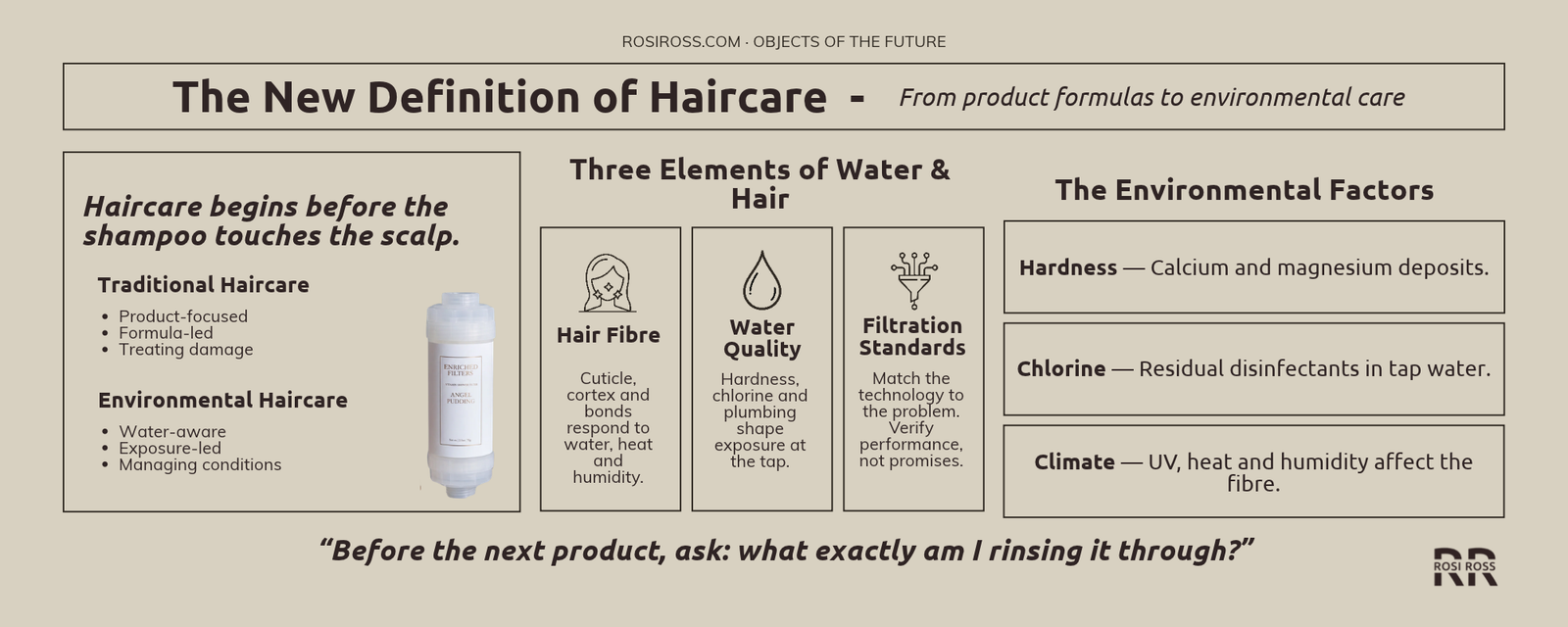
Before the next product, the question worth asking is a different one: what exactly am I rinsing it through?
The story is not that you should buy a shower filter because Dubai and Malta have bad water. It is how water quality, treatment infrastructure and climate interact with the hair fibre, and why the rise of shower filtration signals a larger shift in beauty, from treating damage after it occurs to controlling environmental exposure before it begins. The future of haircare may begin with understanding the environment the hair is being asked to survive.
The argument is conditional, as any argument about an evolving market and an uneven body of research should be. Larger and better-controlled studies could strengthen or soften the case that hard water weakens hair, and independent testing of filtration products could separate genuine performance from marketing. Changes in how cities treat and blend their water, as Dubai and Malta are both doing, will alter what reaches the tap. What is unlikely to change is the underlying shift: water has become a variable that people are willing to measure, and the industries around beauty and infrastructure are learning to meet them there.
“The next frontier of haircare
may begin before the shampoo touches the scalp.
Frizz is not simply cosmetic failure.
It is fibre chemistry responding to the atmosphere.
If the problem is hardness, buy a solution for hardness.
If the problem is chlorine, buy a solution for chlorine.
Before the next product, ask:
what exactly am I rinsing it through?”

