
On how geological scarcity becomes commercial value: why Sri Lanka occupies a distinctive place in the global market for exceptional coloured gemstones, and why the people who own the ground are not necessarily the people who own the price.
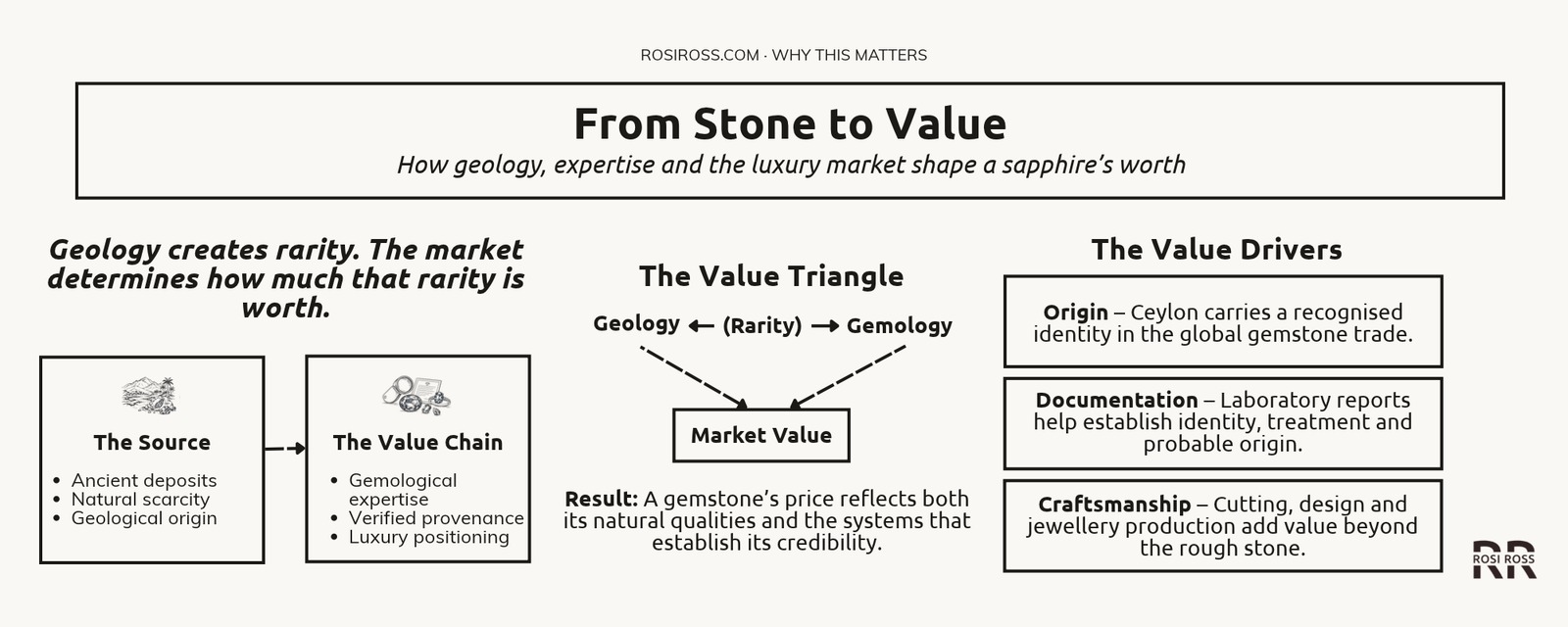
In the global gemstone economy, geology creates rarity, gemology establishes credibility, and the luxury market determines how much of that rarity can be monetised.
A parcel of rough stones lies on a dealer’s table in Ratnapura, grey-blue, abraded and unremarkable. Some of these pebbles will end up in ordinary jewellery. One might, after cutting, heating, testing and a long chain of introductions, become the centrepiece of a high-jewellery necklace. Nothing in the rough announces which. The price is not in the stone. It is in the system that will, over months or years, decide what the stone is.
This is not a consumer guide to buying sapphires in Sri Lanka, and it is not a romantic account of the island’s mining heritage. It is an examination of how a mineral extracted from the earth acquires dramatically different values depending on where it is sold, who authenticates it and which luxury narrative accompanies it. Sri Lanka is a revealing case because it combines ancient deposits, recognised gemological expertise, established trading networks and an origin name, Ceylon, that carries commercial weight in the trade.
The hypothesis is simple, and it is a hypothesis, not a verdict. Geology creates the scarcity. Laboratories and trade institutions establish credibility. And the luxury market decides how much of that scarcity can be turned into money, and for whom. The question beneath it is the one that matters: Sri Lanka has the sapphires, so who owns their value?
The Island That Never Needed to Be Discovered
Can one of the oldest names in gemstones gain new economic influence without becoming a new source?
Sri Lanka is not a newly discovered source. GIA’s expedition report notes that gemstone use in Sri Lanka dates back at least 2,000 years, and that the island was referred to in Sanskrit as Ratna Dweepa, the “Island of Jewels”. The same report lists the stones the island is remembered for, among them the 400-carat Blue Belle of Asia, said to have been found in a paddy field in the Ratnapura district in 1926 and described as having the highly desirable “cornflower” blue colour. Its gem gravels, worked around Ratnapura in the Sabaragamuwa Province, have supplied corundum to international markets for centuries, and the trade’s vocabulary still carries the colonial name.
Why is Sri Lanka famous for sapphires? Because its geology and its history both favour them. The island is underlain by ancient high-grade metamorphic rocks in which corundum formed, and weathering concentrated the sapphires in river gravels known locally as illam, which have been worked for centuries. Ratnapura is the traditional centre of the trade, and the name Ceylon remains embedded in gemstone terminology. The more interesting question is whether shifts in luxury consumption, towards provenance, documentation and stories that can be verified, are creating new commercial possibilities for an old industry that is nevertheless not new to anyone.
Ten Distinctions That Decide Whether a Statement About Sapphires Is Credible
Most of the confusion in the sapphire trade, and most of its marketing, lives in the gaps between these ideas.
The first distinction is chemical. Sapphire and ruby are both corundum, aluminium oxide. Red corundum is ruby; every other colour is sapphire. Colour comes from trace elements: iron and titanium in the case of blue, chromium in red. The second is between origin and quality. A Ceylon label does not by itself establish exceptional quality, and exceptional quality does not require a Ceylon label.
The third is treatment. Heat treatment is widely accepted when disclosed, and documented absence of heat can command a premium for fine stones. The fourth is between natural and laboratory-grown stones: shared chemistry does not mean shared scarcity or price. The fifth is between an origin report and a grading. An origin opinion is not an independent valuation. The sixth concerns vocabulary: royal blue and cornflower blue are commercial descriptions, not a universal grading scale.
The seventh is between rough and polished prices, because cutting involves weight loss, risk, skill and wide variation in results. The eighth is between wholesale, retail and auction: dealer quotations, asking prices and realised auction prices are not interchangeable. The ninth is between rarity and liquidity, since a rare stone is not necessarily easy to resell at an attractive price. The tenth is between traceability and origin identification: evidence of probable geological origin is not a chain of custody.
| Concept | The distinction |
|---|---|
| Sapphire vs ruby | Both are corundum. Red corundum is ruby; every other colour is sapphire |
| Ceylon origin vs quality | Origin does not by itself establish exceptional quality |
| Heated vs unheated | Heat treatment is widely accepted when disclosed, and documented absence of heat can command a premium for fine stones |
| Natural vs laboratory-grown | Shared chemistry does not mean shared scarcity or price |
| Origin report vs grading | An origin opinion is not an independent valuation |
| Royal blue and cornflower blue | Commercial descriptions, not a universal grading scale |
| Rough vs polished price | Cutting involves weight loss, risk, skill and wide variation in results |
| Wholesale vs retail vs auction | Dealer quotations, asking prices and realised auction prices are not interchangeable |
| Rarity vs liquidity | A rare stone is not necessarily easy to resell at an attractive price |
| Traceability vs origin identification | Evidence of probable geological origin is not a chain of custody |
Ten distinctions that decide whether a statement about sapphires is credible. Each is kept separate because the retail narrative tends to merge them.
Before There Was Luxury, There Was Geology
What does the geology make possible, and what cannot be explained by origin alone?
Sri Lanka’s corundum formed in ancient metamorphic rock. Gübelin Gem Lab notes that the source of most gem-quality sapphires in Sri Lanka are metamorphic rocks of the gneiss, granulite and charnockite types. Weathering liberated the crystals and rivers carried them into gravels that gemmologists call secondary deposits and Sri Lankans call illam. GIA’s field team described the same pattern: gemstone mining in Sri Lanka is mostly from secondary deposits, and the gravels, called illam, are some of the richest in the world. Almost everything else in the trade comes from the gravels, a fact that complicates every attempt to link a stone to a place, because a pebble that has travelled has lost its address.
The geology also gives the island range: blue, pink, yellow, violet, orange and green sapphires, star stones and padparadscha, the rare pink-orange variety named for the lotus blossom. The designation depends on a narrow colour balance, and laboratories apply it carefully, so a pink-orange stone is not automatically a padparadscha, and heat treatment is common, so disclosure matters. What makes Ceylon sapphires distinctive? The finest are prized for bright, luminous blues rather than inky darkness, and Sri Lankan stones often show rutile silk and colour zoning. GIA notes that the most commonly encountered inclusions in blue sapphire are rutile silk and particle clouds. But that is a description of the best stones and not a property of every stone from the island. Exceptional quality is uncommon even in productive ground, which is the first reason the label cannot carry the price alone.
Why does chemistry matter commercially? Because the same trace elements that colour a stone also fingerprint its origin, and the same impurities that make a rough pebble milky also make it a candidate for heating. The mineral is a record of the conditions under which it formed, and the market reads that record in two ways at once: as beauty, and as evidence.
Small-Scale by Design: How the Supply Is Dug
A rare stone begins its life in a pit dug by a small team on a licence from the state.
GIA’s field research describes an industry that is small-scale by choice and by design. Of the more than 6,500 licences issued in 2013, more than 6,000 were for pit-mining operations using traditional methods, and only about ten were issued for mechanised mining, and the report notes that many trade and regulatory bodies prefer traditional small mines as less harmful to the environment and a steadier source of employment. A typical pit is typically 15 to 25 feet deep and six to 14 feet wide, and miners dig below a lighter overburden to reach the gem-bearing gravels. The people involved receive a share of the proceeds from the sale of the gemstones, which means income depends on the find, not on a wage.
The state’s role is regulatory and financial. The National Gem and Jewellery Authority issues the licences, and GIA noted that because the NGJA collects a cash deposit when a licence is issued, there are hardly any unfilled, abandoned pits compared with gem mining in many African countries. Ratnapura is the centre of the activity: one study of a mining village notes that the district is where eighty percent of all mines in Sri Lanka are located. The structure matters for the argument. A supply base built from thousands of small licences produces stones in irregular parcels, sold into a market of dealers who see the rough before anyone else does, and that is where the first judgement about value is made.


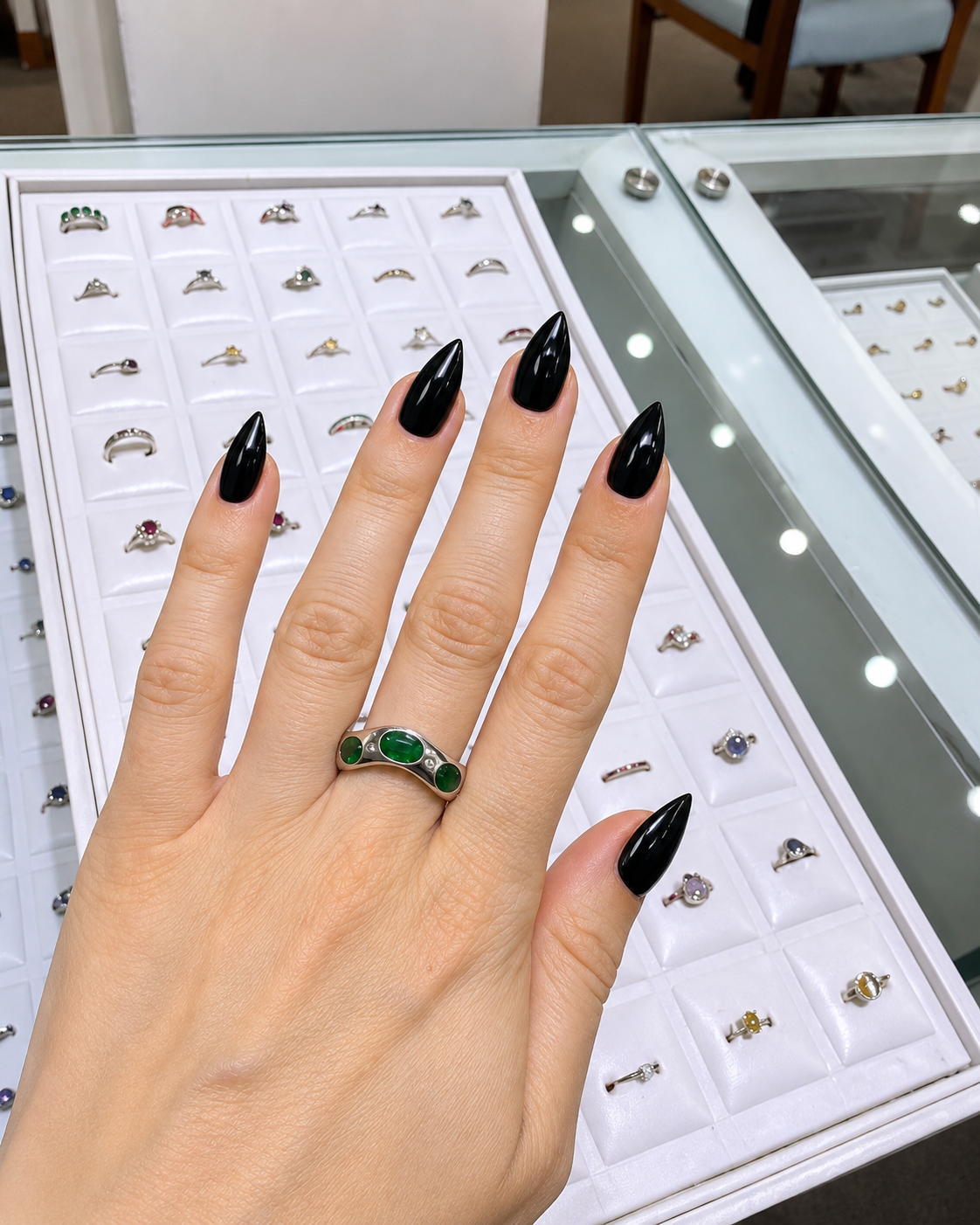


Why One Sapphire Is Worth More Than Another
Is a sapphire expensive because it is rare, or because the market has built a sophisticated system for identifying and pricing particular forms of rarity?
How is the value of a sapphire determined? By the market’s weighing of colour, clarity, cut, carat weight, treatment status, origin and documentation. Colour dominates, and it is a matter of hue, tone and saturation, so that a fine blue is a balance and not simply a dark stone. A good cut improves how a stone returns light. Size raises price steeply, but only when quality accompanies it. And treatment status is a price variable in its own right.
Why are some unheated sapphires more expensive? Because heat treatment is widely used and widely accepted when disclosed, so a fine stone with documented absence of heat is scarcer. How large the premium is cannot be stated honestly as a universal percentage, because it depends on the quality of the stone and the strength of the buyer’s preference. Unheated does not mean beautiful, and a fine heated sapphire can outperform an ordinary unheated one.
Treatment has a particular history in Sri Lanka. JCK’s trade report notes that “traditional heating” originated in Sri Lanka in the mid-1970s, with the heating of geuda sapphires, and that merely stating that a stone is Sri Lankan implies heat treatment, in part because the local rough is commonly colour-zoned and heating evens out the colour. Its history of the practice records that by 1977 almost all corundum was being heated, and that the effect on geography was dramatic: a dealer recalled that the gem industry in Bangkok replaced Colombo as the sapphire capital of the world. Treatment moved value as well as stones.
The deeper economic point comes from the gemologist Richard Hughes, who observes that far more geuda than gem-quality sapphire is produced in Sri Lanka, perhaps 100 times as much, and that the widespread adoption of effective treatments from the mid-1970s dramatically increased the availability of fine blue sapphire, resulting in a stagnation of sapphire prices that has continued for decades. That is a claim by an individual specialist and should be read as one informed view, not a market statistic. But it illustrates the logic of the whole system: a technology that turns a low-value by-product into a saleable gem lowers the price of the ordinary and raises the premium on the untouched, which is exactly the premium the unheated market now describes.
| What the market weighs | Why it matters |
|---|---|
| Colour: hue, tone, saturation | The principal driver of value; a fine blue is a precise balance, not simply “dark” |
| Clarity and transparency | Silk, zoning and inclusions affect brilliance; some inclusions are evidence of natural origin |
| Cut | A good cut improves light return; cutters often trade weight for colour |
| Carat weight | Size raises price steeply, but only when quality is also exceptional |
| Treatment status | Heated, unheated or undetermined; disclosure is essential |
| Origin | A prestige origin can add a premium that depends on laboratory confidence |
| Documentation | A credible report reduces uncertainty without guaranteeing price |
A framework, not a price list. No universal percentage premium for unheated or origin-certified stones can be defended.
The documentation row deserves its own sentence. A credible laboratory report reduces uncertainty by establishing facts about identity and treatment, which is why it is a form of protective layer around a transaction, the same logic by which a barrier supports everything that rests on it, as The Return of Barrier Beauty: Why Lanolin Is the Ultimate Skin Investment argues for skin. But a report is not a valuation and not a guarantee of price. It lowers the risk of being wrong about what the stone is. It says nothing about what someone will pay for it.
Three Auction Results and What They Cannot Prove
A record price describes an exceptional lot. It does not describe a market.
The market’s best-documented prices show how different the logics are, and also how little a record proves. The three public results below are not like-for-like and make no claim to be. The Blue Belle of Asia is the Ceylon benchmark. Christie’s sold it in Geneva on 11 November 2014, and the Guinness World Records entry describes an untreated 392.52-carat cushion-cut Ceylon sapphire set within a sapphire and diamond necklace, sold for 16,965,000 Swiss francs. Rapaport reported that it sold for $17,305,996, or $44,063 per carat, breaking the world auction record for any sapphire, and JCK’s account agrees on $17.3 million, a world-record price for a sapphire, with the buyer unnamed. The currency conversion explains small differences between published dollar figures, and several of them circulate.
A day later, Sotheby’s sold a Kashmir sapphire in Geneva. A 27.54-carat step-cut Kashmir sapphire in a diamond ring sold for US$5,984,474, and Sotheby’s noted that it was a world auction record for a Kashmir sapphire, ahead of the previous record of $5,093,000, or $180,731 per carat, for a 28.18-carat stone. That is about US$217,000 a carat, calculated, roughly five times the per-carat price of the Blue Belle. A dealer’s voice from Christie’s jewellery department told Rapaport that “Kashmir prices and Burmese ruby prices are still low”, a judgement about relative scarcity that cannot be tested from the outside.
The third result comes from the year before. Sotheby’s lists an unmounted Burmese sapphire from the mines of Mogok that sold for $7.2 million in 2013. The lot carried an SSEF letter stating that a natural sapphire from Burma of this size and quality is very rare and exceptional. At 114.74 carats, published totals of about US$7.14 million and US$7.22 million put it near US$62,000 to US$63,000 a carat, depending on the source and the exchange rate. The comparison teaches two things. A very large, fine stone and a small, perfect, historically scarce one are priced on different logics. And no honest analyst derives an origin premium from a table of record lots. Like-for-like quotations, for stones of matched colour, size, clarity and treatment, are what a real premium analysis would need.
| Documented sale | Stone | Result | Per carat (calculated or stated) |
|---|---|---|---|
| Christie’s Geneva, 11 November 2014 | The Blue Belle of Asia: a 392.52-carat cushion-cut Ceylon sapphire, described as untreated | About US$17.3 million; a world auction record for any sapphire at the time | US$44,063 as reported |
| Sotheby’s Geneva, 12 November 2014 | A 27.54-carat step-cut Kashmir sapphire in a diamond ring | US$5,984,474; a record for a Kashmir sapphire at the time | About US$217,000, calculated |
| Sotheby’s Geneva, November 2013 | A 114.74-carat natural Burmese sapphire, unmounted | About US$7.2 million; published totals differ slightly by source | About US$62,000 to US$63,000, calculated |
These are exceptional lots at record or near-record prices. They differ in size, origin, setting and sale, so per-carat comparison across them is illustrative and not like-for-like. They are not evidence of a typical origin premium, and an auction record is not a market price.
The Ceylon Premium: When Geography Becomes a Luxury Asset
When a buyer pays for Ceylon origin, how much belongs to the stone and how much to the market’s confidence in its history?
Provenance is a commercial fact before it is a scientific one. A name such as Ceylon, Kashmir or Burma can add to a price, but the evidence for it has to be produced by a laboratory, and the laboratories are candid about the difficulty. Can laboratories verify Sri Lankan origin? Often, but not always. GIA’s 2019 paper calls geographic origin determination one of the most pressing issues facing modern gemological laboratories, and especially challenging for blue sapphire. It explains that reliable origin determination requires careful analysis of a stone’s inclusions and trace element chemistry as well as spectroscopic data, and that in many cases there is significant overlap for blue sapphire from distinct geographic localities.
The paper’s reference data show how the problem is built. The trace element data were collected from 606 samples of metamorphic sapphires, including 124 from Sri Lanka, 263 from Madagascar and 219 from Myanmar, and the classical sources of Sri Lanka, Myanmar and Kashmir sit in the same metamorphic group as the more modern source of Madagascar. For Kashmir, it has not been possible in modern times to collect stones through the field programme, so the data come from historic stones and collections with verifiable provenance. Origin determination is generally more straightforward for non-classical deposits such as Montana and Tanzania’s Umba and Songea. The prestige origins are the hardest to prove.
Gübelin’s own discussion makes the point from the other side. Its case study compares blue sapphires from Sri Lanka with those from Ilakaka in Madagascar, and concludes that it is not always possible to determine the origin of gemstones with absolute certainty. It also observes that, despite coming from several secondary deposits in different parts of the island, the mineralogical and gemmological properties of Sri Lankan blue gem-quality stones submitted for origin determination are relatively homogeneous. In practice that means a laboratory can generally say Sri Lanka as a country but not subdivide the island, and an origin report establishes a probability supported by evidence. It does not establish a chain of custody.
That is the commercial point. The premium attached to a famous name is a premium on confidence, and confidence is produced and paid for. Someone requests the report, usually the seller or a serious buyer, and someone pays for it, and the result enters price negotiation as one input among several. Whether origin reflects a difference in quality or only a difference in reputation is the question this section cannot settle without transaction data, and which any honest buyer should ask.


Five Markets, Five Kinds of Value
Reputation and measurable quality are not the same thing, and the trade prices them separately.
Sri Lanka is the anchor of this analysis, but the story needs an international frame. Kashmir is a historic source whose small-stone auction prices are among the highest per carat, which shows how provenance can carry a premium. Myanmar is a traditional high-value source, useful for comparing legacy origin reputations. Madagascar is a modern metamorphic source with material from secondary deposits, sometimes processed in Sri Lanka, and a good test of assumptions about quality and origin. Thailand is a long-established centre for testing, treatment and trading, and so a place where downstream value is created. Switzerland and the auction centres are where laboratories, dealers and houses set prestige prices, and where authentication and final-market pricing meet.
| Market | Role in this story | Editorial purpose |
|---|---|---|
| Sri Lanka | Classical metamorphic source of mostly secondary deposits; also a cutting, treatment and trading centre | The primary case study |
| Kashmir | A historic source whose small-stone auction prices are among the highest per carat | Shows how provenance can carry a premium |
| Myanmar (Burma) | A traditional high-value source | Compares legacy origin reputations |
| Madagascar | A modern metamorphic source from secondary deposits, with material sometimes processed in Sri Lanka | Tests assumptions about quality and origin |
| Thailand | A long-established centre for testing, treatment and trading | Where downstream value is created |
| Switzerland and auction centres | Laboratories, dealers and houses that set prestige prices | Where authentication and final-market pricing meet |
Analytical categories, not a ranking of producing countries.
The links between these markets are physical as well as reputational. JCK’s trade reporting notes that Madagascar sapphires look and react the same way as Sri Lankan material when heated, which is why there are Sri Lankan experts in Madagascar and Madagascar sapphires in Sri Lanka. A stone dug in one country, treated in another and certified in a third has no single nationality, and the label on the box reflects a commercial choice about which part of its journey to emphasise.
From Ratnapura to the High-Jewellery Salon
Where is the most value created, and where is the most captured?
A sapphire’s journey is a sequence of hands, each of which adds something and takes something. It is mined, mostly in pits dug into the gravels, then sorted and sold as rough, cut, treated if the buyer wants it, tested, exported, wholesaled, set into a design and sold. GIA’s field team described a trade in Ratnapura that was mostly between Sri Lankan dealers, with some foreign buyers, and the Colombo workshops that complete the chain include gold jewellery manufacture. Each stage requires working capital and judgement, and each carries inventory risk, particularly cutting, which is a bet on what the rough will reveal.
The island is also a processing centre where foreign rough, notably from Madagascar, is handled alongside local stones. So a stone mined in Sri Lanka, a stone cut in Sri Lanka and a stone heated or traded in Sri Lanka are three different things, and the labels do not always tell the buyer which one is being sold. Whether miners get a small share of the final price or a fair one, and whether brand margins are excessive or earned, are empirical questions that cannot be settled by assertion. The structure of the trade suggests why the answer is hard to pin down: stones change hands several times as parcels and not as identified units, prices are negotiated privately, and a loose stone and a signed jewel are not the same product. What can be said is that value tends to be captured where trust and brand are strongest, which is why luxury houses and specialised dealers farther downstream may control more of the consumer-facing price than producers upstream.
| Stage | What happens | Where value and risk sit |
|---|---|---|
| Mining | Mostly small-scale, traditional pit mining in secondary gravels, licensed by the National Gem and Jewellery Authority | Labour, luck and local share systems; income is uncertain |
| Rough trading | Parcels are sorted and sold, often through Ratnapura and Colombo dealers | Dealer judgement of unseen potential |
| Cutting | Often to retain weight, balanced against colour and clarity | Weight loss, skill and risk |
| Treatment | Heating, where used, to improve colour and clarity | Disclosure and detection |
| Laboratory reports | Identification, treatment and, on request, origin opinions | Confidence in provenance; cost |
| Wholesale and export | Dealers and exporters to international markets; foreign-origin rough can also be processed in Sri Lanka | Working capital and inventory financing |
| Jewellery manufacture and retail | Design, setting, brand and the sales experience | Brand prestige and the final price |
A stone mined in Sri Lanka, a stone cut in Sri Lanka and a stone heated or traded in Sri Lanka are three different things. Evidence on who captures what share of the final price is limited and should be obtained, not assumed.
What the Export Figures Say About Who Captures Value
The island sells a great deal of stone and relatively little of the finished object where prestige is added.
Sri Lanka’s own export data show the structure of its participation. According to the Export Development Board, the gem and jewellery industry generated US$334 million in export earnings in 2025, split across gemstones at US$189 million, diamonds at US$127 million and jewellery at US$17.8 million. The diamond figure reflects re-exports, because the island has no diamond mines. The board adds that sapphire varieties alone account for close to 85 percent of the country’s gem export share, while finished jewellery accounted for about 5 percent of export earnings. The island sells a great deal of stone and relatively little of the finished object where prestige is added. The Board has set an industry target of US$1 billion in export earnings by 2030.
The series behind these numbers is unstable, and that instability is itself the finding. For 2024 the Board’s chairman gave US$202 million for the sector, while a trade supplement citing government data reported US$282.06 million in 2024, down from US$388.16 million in 2023. The two accounts of the same year differ by nearly US$80 million, and no single figure should be treated as definitive. Definitions of what counts as a gem export, how diamonds are treated and whether the Board estimates or measures all differ, and any headline that does not say which series it uses is not a fact so much as a preference.
The sector is also exposed to forces outside the pits. Trade press reported that, as of December 2025, Sri Lanka was facing a 20 percent tariff on gem and jewellery exports to the United States, a major market, and that in early 2025 the main international gem and jewellery trade bodies raised concerns over undisclosed irradiated rubies and sapphires entering the market. Tariffs move the margin. Disclosure scandals move trust. Both change what a Sri Lankan stone is worth without a single new deposit being found.
| Year | Reported figure | Source and caution |
|---|---|---|
| 2023 | About US$388 million | Government data as cited in a trade supplement; other accounts differ |
| 2024 | US$282 million by one account; US$202 million by another, given by the Export Development Board chairman | The two figures differ; definitions and sources are not aligned |
| 2025 | US$334 million: gemstones US$189 million, diamonds US$127 million, jewellery US$17.8 million | Export Development Board; sapphires about 85% of the gem export share |
| The structure | Sri Lanka has no diamond mines, so diamond figures are re-exports; finished jewellery was about 5% of 2025 earnings | Export Development Board |
The disagreement is the finding. Official series differ by definition and source, so any single headline figure should be read as one account of a trade that is hard to measure.
The Luxury Industry’s Relationship With Rarity
Does contemporary luxury reward geological scarcity, emotional storytelling, or the credibility of institutions able to combine both?
Synthetic sapphires reproduce the chemistry and appearance of natural ones, and they have for more than a century. That a natural stone remains desirable is therefore not explained by how it looks. It is explained by what it is claimed to be: a product of deep time, unmanufactured, individual, with a documented history. High-jewellery houses position natural origin, uniqueness, craftsmanship and exceptional colour as the point, and the retail experience carries the story. In that sense the market is buying a combination of four things, geological quality, provenance, craftsmanship and the prestige of the name on the box, and the proportions differ from one buyer to the next. A buyer who wants the stone and a buyer who wants the story are not the same buyer.
The same logic of stories that must be verified is what makes a necklace worth more than its material, as The Language of Modern Necklaces: Metals, Stones, and the New Codes of Personal Luxury examines for gemstones set as personal luxury. The pieces that stay relevant in a wardrobe do so because their quality is verifiable and their purpose does not depend on a trend, the argument of timeless luxury fashion pieces. Whether consumer interest in provenance and responsible sourcing is changing purchasing decisions at scale, or remains concentrated among collectors and the top of the market, has not been established here.
Are Sri Lankan sapphires a good investment? This article makes no investment claim. Natural sapphires are not exchange-traded, prices vary widely by quality, treatment and documentation, and a rare stone is not necessarily easy to resell at an attractive price. Auction records describe exceptional lots, not typical returns, and sapphires should not be described as uniformly appreciating or reliably liquid.
The Business Opportunity, and the Cost of Extracting Beauty
Can Sri Lanka raise the economic return from its gemstones without expanding extraction at the expense of communities and the environment?
The domestic opportunity is value addition: cutting, branding and finished jewellery that keep more of the final price in the country, and a certification and provenance system that gives buyers reasons to trust what they are buying. The industry’s own bodies have set ambitious export targets, but the figures that anchor those ambitions are unstable, as the table above shows, and the sector is sensitive to regulatory, fiscal and procedural change.
The cost side is real and should not be romanticised. A study of gem mining in Ratnapura found that tunnel, backhoe and river mining all have negative environmental impacts, including water contamination, soil erosion, deforestation, loss of biodiversity and animal habitats, and nutrient depletion, and argued that environmentally friendlier methods and government regulation are needed. The National Audit Office’s 2012 report examined the efficiency of the procedure for issuing licences for the gem industry and the effect of the gem industry, including abandoned mines, on the community and environment. And the field evidence has a counterweight: GIA found hardly any unfilled, abandoned pits, partly because of the cash deposit the regulator collects. Small-scale traditional mining is widely regarded as less destructive than mechanised extraction and a more distributed source of livelihoods, yet it is also precarious, and the people who dig the pits carry the geological and market risk.
The competing development models are therefore not obviously ranked: maximise exports of stone, support domestic craftsmanship, expand branded jewellery, or strengthen certification and provenance. They can reinforce one another, and they can also conflict. The test of any of them is whether the return to Sri Lanka rises without extraction rising with it. A country that sold the same number of stones at a higher price, because buyers trusted what they were getting, would be richer without digging more ground. That is the economic meaning of provenance: a way of earning more from the same earth.
Who benefits financially from the global gemstone trade? It depends on the stone and the stage, and evidence is limited. Miners, dealers, cutters, treatment specialists, laboratories, exporters, luxury houses and collectors all take a share. Value tends to concentrate where trust and brand are strongest, but how much each captures should be established with transaction data and not assumed.
The Future of Rarity Is Not Only in the Ground
Nature creates the stone. The market decides what rarity is worth.
Natural rarity cannot be manufactured. Its commercial value, however, depends on institutions, expertise, trust and demand, and these can be built, bought or lost. For Sri Lanka, the discovery of further deposits may matter less than the quality of verification, the credibility of provenance, the share of value added at home and access to discerning international buyers. There is a serious counterargument that this essay does not dismiss: no amount of branding or certification can create exceptional gem quality, abolish commodity-market fluctuation or guarantee future demand. A strategy built on brand alone would be built on air.
A sapphire does not leave the earth with a price attached. Its geological history determines the conditions under which it exists. Its colour, clarity and size shape its potential. Human expertise transforms it, laboratories establish certain facts about it, traders negotiate its value, and luxury institutions build the context in which it is finally sold. A name is part of that context, and like a scent it works by the identity it lends to its wearer, the mechanism explored in The Language of Scent: How Fragrance Becomes Identity in Modern Beauty.
This reading would change if the evidence did. If a premium for documented Ceylon origin proved, on matched transaction data, to be no larger than the premium for equivalent stones from other sources, the thesis about provenance would weaken. If domestic value addition proved impractical at scale, or if laboratories lost the ability to separate classical origins, the argument for certification as an economic strategy would weaken with it. If, instead, buyers keep paying for documented history and the share of value kept at home rises, it strengthens.
Sri Lanka has held the geological foundation of this economy for centuries, and the question is no longer whether its sapphires belong among the world’s most desirable stones. Exceptional examples already do. The more consequential question is how much economic authority a producing country can exercise over the resources that make the luxury industry possible. The most valuable question about a sapphire may not be where it was found, but where, how and by whom its value was established.
A note on sources and limits. Gemological statements follow GIA (its 2019 paper on blue-sapphire origin determination and its field research on Sri Lankan mining) and Gübelin Gem Lab’s discussion of the limits of origin determination, with treatment history from JCK and an individual specialist’s account of treatment economics. Auction results follow trade press (Rapaport, National Jeweler, JCK and Jeweller Magazine) and the auction houses for the Christie’s and Sotheby’s Geneva sales of November 2014 and the Sotheby’s sale of November 2013; the three results are not like-for-like and are not evidence of an origin premium, published dollar totals differ slightly by source and exchange rate, and some gemstone retailers’ reference pages misattribute the Blue Belle of Asia to the wrong auction house. Export figures follow the Export Development Board and trade-press accounts of government data; official series for the same year differ (for 2024, roughly US$282 million by one account and US$202 million by another), and no single figure is treated as definitive. Environmental findings follow a published study of gem mining in Ratnapura and the National Audit Office’s 2012 report. Sapphires are not described as investments and no price claims are made beyond the cited sales.
“A sapphire does not leave the earth
with a price attached.
Geology creates rarity.
Gemology establishes credibility.
The luxury market decides
how much of that rarity can be monetised.
Nature creates the stone.
The market decides what rarity is worth.”

