
On how an old Aegean peninsula, with ancient history, a deep Turkish summer culture, whitewashed architecture and a mature yacht economy, became newly legible to global luxury travellers, and how social media, international hotels and imported beach-club culture are changing the way that older lifestyle is consumed.
Bodrum was luxury before the algorithm. Social media simply taught the rest of the world how to recognise it.
White walls, bougainvillea, a small glass of rakı, fishing boats and low-rise houses. Then black SUVs, superyachts, internationally recognised hotel logos and sunset tables designed to be photographed. Both Bodrums exist on the same peninsula, sometimes on the same street, and the interesting question is not which one is real. It is how the second learned to sit on top of the first. Bodrum did not become beautiful when Instagram arrived. It became easier to sell.
This is a story about a destination, and not about three hotels. I stayed at Senses Hotel in İçmeler, which gave me a town-adjacent base. I went to The Bodrum EDITION for drinks and to Amanruya for dinner. I did not stay at either, and nothing here describes a night at them. They are used as three lenses on the peninsula, three different answers to the question of what luxury means here, and Bodrum itself remains the protagonist.
The proposition is one of historical proportion. For decades Bodrum drew Turkish artists, writers, affluent Istanbul families, sailors and an international bohemian set. What has changed is global visibility: luxury hotel groups, superyacht infrastructure, fashion-adjacent beach clubs and social-media circulation have made the peninsula legible to the same audience that once defaulted to Mykonos, Ibiza, Saint-Tropez or the Côte d’Azur. The danger in that visibility is that it can convert a local rhythm into a performance, and the work of this essay is to separate what was always there from what has been added, so that the reader can judge what is worth travelling for.
The Turkish Summer Before the Algorithm
Bodrum had its society long before it had its audience.
If the peninsula had no previous identity, the argument that social media invented its luxury would be easy to make. It had several. The first was literary. Cevat Şakir Kabağaçlı was sent to Bodrum in exile in 1925, went out with the sponge crews, and wrote about their lives under the name the Fisherman of Halicarnassus, and that writing gave this seafaring world a wider audience and helped popularise the coastal journeys that became known as the Blue Voyage. A study of the history of Turkish tourism describes how the Fisherman of Halicarnassus told his companions on the first voyages about the ancient cities of the coast and their mythological stories, and is known as the pioneer of tour guides in Türkiye. Intellectuals and artists followed, and a travel account says he gathered other artists and turned the place into a bohemian colony, decades before any international brand arrived.
The second layer was social. Condé Nast Traveller’s own history of the area notes that in the 1970s Mick Jagger and Rudolf Nureyev flocked to the sleepy fishing village of Türkbükü, lured by a boho B&B run by the flamboyant host Ayla Emiroğlu. The magazine’s later coverage adds that in the 1970s Bodrum emerged as the most glamorous spot in Turkey. Whatever one makes of the details, the evidence points in one direction. Affluent Turkish families, artists and an international set had been summering here for generations, which is why the peninsula can be described as a place with an established code, and not a blank screen onto which a trend was projected.
This is useful evidence against the idea that Bodrum’s luxury identity is a recent foreign import. The hotel groups arrived at a place that already had a social geography, a seasonal calendar and a sense of itself. What they brought was capital, standards of service and a global distribution network. What they found was a market that already understood what it wanted.
First: Bodrum Is No Longer Hidden
Bodrum is still less globally saturated than Mykonos or the French Riviera. It is no longer unknown.
Is Bodrum a luxury destination? Yes, and the phrase “hidden gem” should be used critically and not literally. Coverage reproduced from Condé Nast Traveller describes a Bodrum “back with a bang, booming like never before”, with sleek openings that have manicured great swathes of the peninsula into next-level hotels, and a Swiss hospitality-school feature quotes a long-time local on what is now called the “Bodrum Boom”, a chain reaction in which hotels, boutiques and restaurants have been flocking to the peninsula, beginning with the marina and one or two luxury hotel groups. The same local is careful to add that Bodrum is much more well-known than it was in the past but is not the most commercial place in the Mediterranean.
The national backdrop helps explain the timing. Turkish tourism revenue rose 8.3 percent in 2024 to a record $61.1 billion, according to the Turkish Statistical Institute, and a hospitality-design survey of the peninsula observes that the rise was helped by international visitors to places like Bodrum. A destination does not become newly visible without a market ready to see it, and Turkey’s tourism economy supplied one.
The fresher framing is that Bodrum was formerly under the radar for many global travellers and is now firmly on it. It was not undiscovered. It was discovered by different people, in a different language.




Halicarnassus Before the Beach Club
The contemporary luxury economy sits on top of a port culture more than two millennia old.
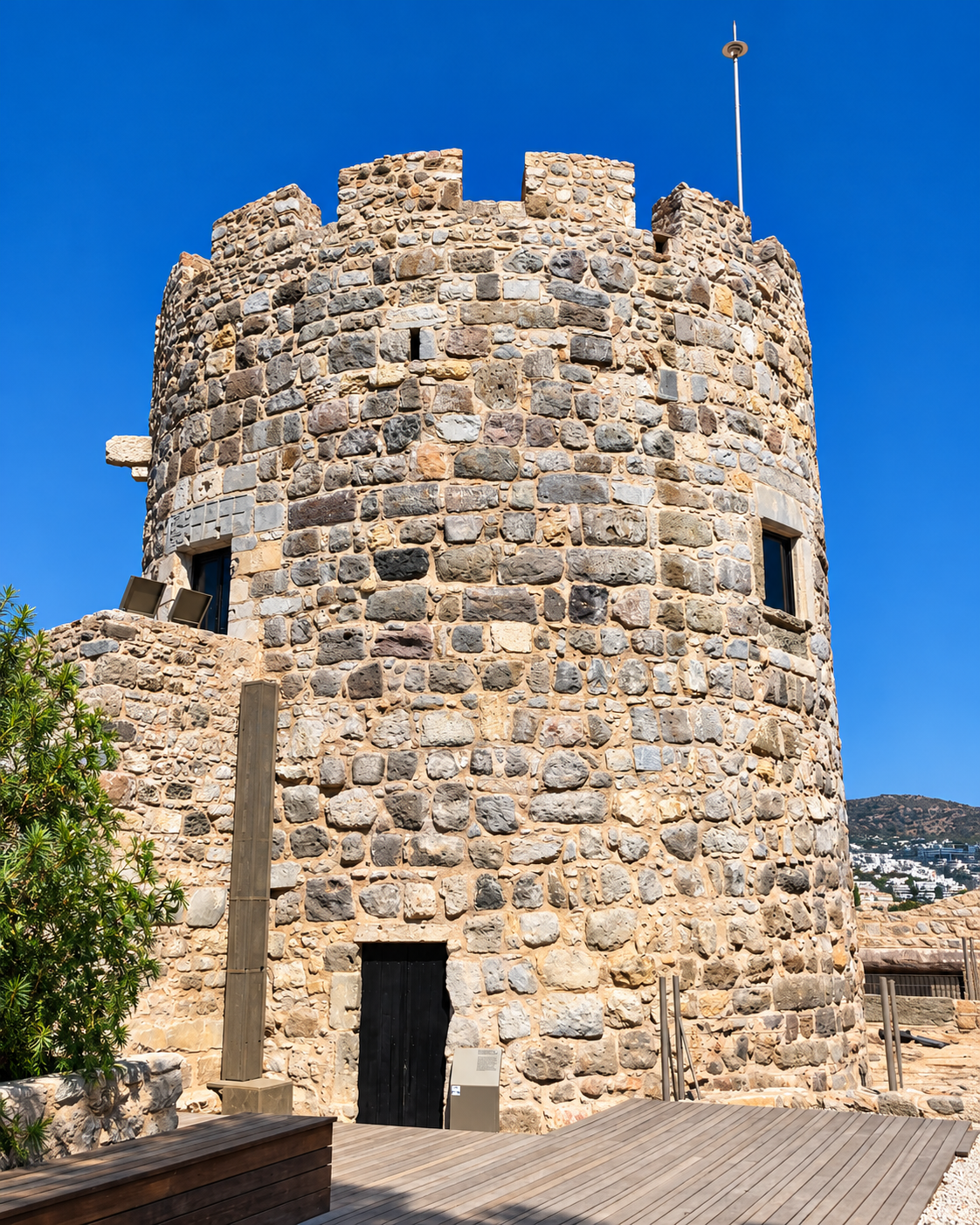
What is the history of Bodrum? Ancient Bodrum was Halicarnassus, the capital of Caria and the home of the Mausoleum built for Mausolus, who died in 353 BCE. The Ministry of Culture and Tourism’s own account records that the magnificent tomb that first defined the term “mausoleum” was built in Halicarnassus for the Carian satrap Mausolus, and that most of its marble blocks and polished stone became spolia for Bodrum Castle. The Mausoleum was one of the Seven Wonders of the Ancient World, and its reuse is the oldest example on the peninsula of a pattern that runs through this essay: older value rebuilt into something newer.
The Knights Hospitaller began the Castle of St Peter in 1402, according to standard references that describe it as built from 1402 onwards, using squared green volcanic stone, marble columns and reliefs from the nearby Mausoleum. The municipality dates the building period more broadly, between 1406 and 1522, and the tourism ministry says only that it was built by the Knights Hospitaller in the 15th century. The castle gave the town a new name: Lonely Planet records that the knights changed the city’s name from Halicarnassus to Petronium, recalling St Peter, the root from which the modern name Bodrum is generally held to derive. The castle today houses the Bodrum Museum of Underwater Archaeology, which received a special commendation in 1995 as European Museum of the Year.
The Hospitallers did not hold it for ever. Accounts differ by a year, but they agree on the cause: in 1523, when Suleiman the Magnificent conquered Rhodes, the knights’ position became untenable, and the municipality records that construction continued until the end of 1522. After that, the town became, like much of this coast, a working harbour. Bodrum was a quiet town of fishermen and sponge divers until the early twentieth century, and that is the layer that the glossy present rests on.
That depth matters because Bodrum’s value is not reducible to beach clubs. The glossy present is a late layer in a very old sequence, and a layer that has not erased the ones beneath. A place where the objects that survive keep acquiring meaning, a quarried tomb reborn as a castle wall, is the kind of layered value explored in The Language of Modern Necklaces: Metals, Stones, and the New Codes of Personal Luxury, where an object’s worth lies as much in its history of reuse as in its material.
| When | What happened | Why it matters |
|---|---|---|
| Antiquity | Bodrum is Halicarnassus, capital of Caria; the Mausoleum is built for Mausolus (died 353 BCE) | One of the Seven Wonders of the Ancient World gave the language the word “mausoleum” |
| Late antiquity to the Middle Ages | The Mausoleum falls, and its remains become a quarry | The ruin became building stone |
| From 1402 | The Knights Hospitaller build the Castle of St Peter, using stone and reliefs from the Mausoleum | The castle gave the town the name from which Bodrum derives |
| Early 1520s | Suleiman the Magnificent conquers Rhodes and the knights lose the castle (sources give 1522 or 1523) | Bodrum becomes a quiet Ottoman port |
| To the early twentieth century | A quiet town of fishermen and sponge divers | The working harbour that preceded the resort |
| From 1925 | The writer Cevat Şakir Kabağaçlı is exiled to Bodrum and writes as the Fisherman of Halicarnassus | The town begins to attract writers and artists |
| Early 1960s | The castle becomes the Museum of Underwater Archaeology (sources give 1962 or 1964) | A maritime memory made public |
| From the 1970s | Boutique hospitality and a fashionable social set gather at Türkbükü | Luxury before the algorithm |
| 2018 to 2026 | EDITION (2018); Scorpios and Maxx Royal (2024); further international brands announced | Bodrum becomes legible to a global audience |
Dates follow GoTürkiye, the Bodrum municipality and standard references; sources differ on the museum’s founding year and on the end of the knights’ tenure.
Why the White Houses Were Always Made for the Camera
Bodrum was photogenic before photogenic became an economic strategy.
Bodrum’s visual identity comes from low whitewashed houses, blue details, stone, flat roofs, narrow lanes and bougainvillea. Turkey’s official tourism material has long made the point: its regional guide describes a town filled with photogenic, historic whitewashed houses, and the Rough Guide settles on low-rise whitewashed houses and subtropical gardens as what make Bodrum the most attractive of the major Aegean resorts. This matters because the architecture already had what social media rewards: graphic contrast, a recognisable palette and an immediate sense of place.
It is a form of visual identity that a camera can read at a glance, much as a signature scent is recognised before it is analysed, the identity-through-sensation idea in The Language of Scent: How Fragrance Becomes Identity in Modern Beauty. Bougainvillea against a white wall is the Bodrum equivalent of a note that is recognised instantly. The point is a modest one but it protects the argument. Nothing about the peninsula was invented for the feed. The feed discovered what was already composed.


How Social Media Changed the Lifestyle
Social media changed Bodrum less through architecture than through behaviour.
The change shows up in how the day is organised. Sunset became programming and not simply a time of day. Restaurants became visual environments as much as dining rooms. Beach clubs became international brands, and the table, the daybed, the pool edge and the moment of arrival became surfaces for content. Hotel design had to communicate in a single image, and the peninsula was folded into a global circuit of summer destinations and not only a Turkish seasonal culture. The signature ritual of Scorpios, for example, is a nightly event that its Michelin Guide listing describes as a sunset ritual with dancing under the stars, which is exactly the conversion of a time of day into programming. This is cultural analysis, and it is not a claim that every visitor now travels for content.
The designed rhythm of a day, light managed and atmosphere composed, has always belonged to the hospitality business. What is new is the audience for it, which is no longer only the people in the room. A table is now laid for the guests who sit at it and for the guests who will see the photograph, and the second audience is larger.
| What social media changed | What social media flattens |
|---|---|
| Sunset became programming, not just a time of day | It makes the peninsula look like one continuous beach club |
| Restaurants became visual environments as much as dining rooms | It hides the difference between Bodrum town, Yalıkavak, Türkbükü and Gümüşlük |
| Beach clubs became international brands | It underplays ancient Halicarnassus and the maritime history |
| The table, daybed and pool edge became content surfaces | It over-rewards spaces designed to be photographed instantly |
| Hotel design had to communicate in a single image | It can turn an old seasonal culture into branded sunset moments |
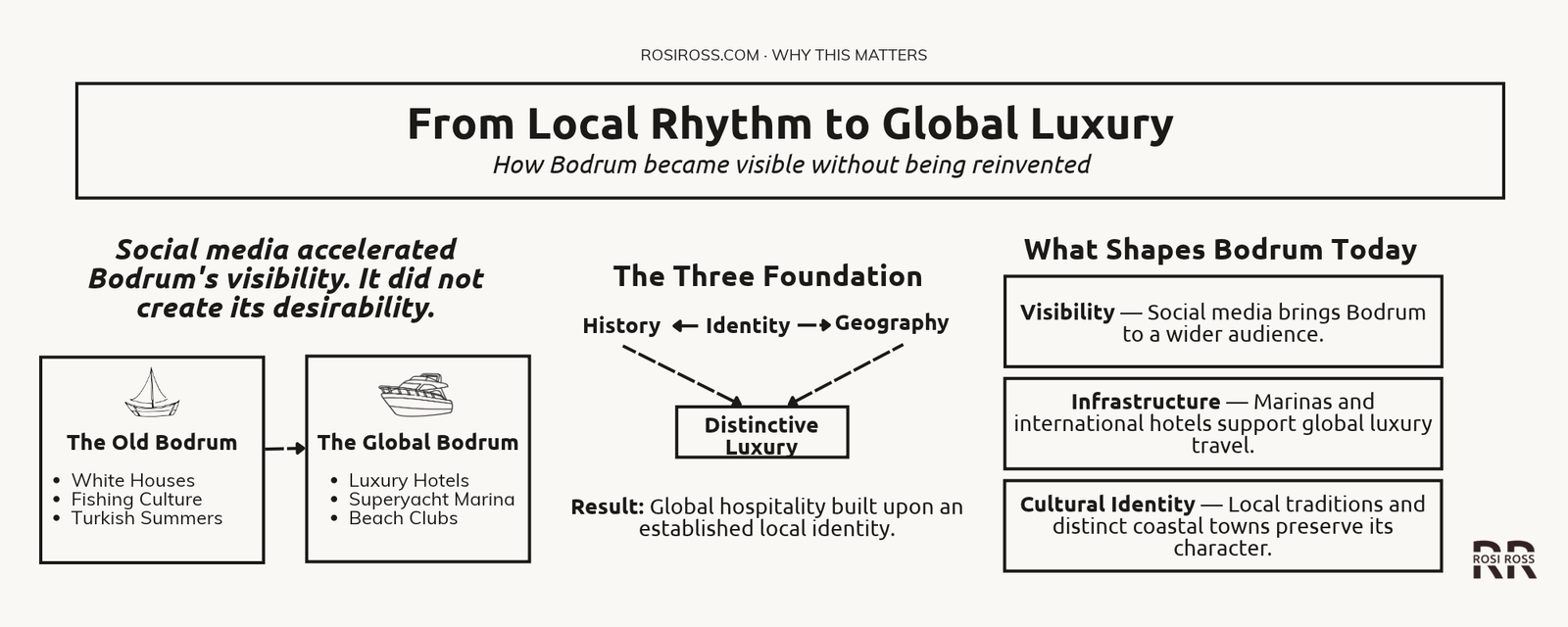
Cultural analysis, not a claim that every visitor travels for content. Social media accelerated Bodrum’s visibility. It did not create its desirability.
Why Bodrum Is Not the New Mykonos
Mykonos performs one highly recognisable fantasy. Bodrum gives you several summers on the same peninsula.
Is Bodrum the new Mykonos? No, and that is the point. Mykonos is the obvious comparator: white architecture, Aegean water, nightlife, high-end hotels and summer social visibility. The comparison breaks quickly. Mykonos is an island with concentrated visitor flows, and its modern luxury identity is heavily international and party-coded. Bodrum is a large peninsula of many towns, coves and social ecosystems, and its contemporary luxury sits beside a much deeper domestic Turkish summer culture.
The clearest market signal in the story is Scorpios. The Mykonos beach club, founded there in 2015, opened a second location on the peninsula, and the Michelin Guide records that a decade after opening Scorpios Mykonos, the lifestyle brand expanded to include a second location on the Bodrum Peninsula, on a clifftop partly surrounded by the turquoise waters of the Aegean. Its accommodation is deliberately small: twelve stone bungalows arranged in a circle, and the Soho House group is its owner. A trade publication quotes a designer describing the aim of a distinct departure from the vernacular language of Mykonos, which is the more instructive point. A travel-industry account describes the opening as the moment of change: on the Turkish Riviera, the moment a new arrival signalled that things had shifted was the arrival of Scorpios Bodrum.
But this should not become evidence that Bodrum is turning into Mykonos. It is evidence that the international luxury market now recognises Bodrum’s demand, and that a brand built for one Aegean fantasy found that the second one needed a different design.
The French Riviera Comparison
Where the Riviera expresses luxury through legacy, Bodrum can feel looser.
The Côte d’Azur comparison works at the level of yachting, seasonal wealth, coastal social life and the coexistence of old glamour and new money. But Bodrum still feels less institutionally formal. Where the French Riviera often expresses luxury through legacy hotels, grand villas and established social codes, Bodrum can be loose: grilled fish, bare feet, wooden jetties and local boats sit beside superyachts and global brands. A travel writer at PORTER describes the table culture as meze served with sunset views, with the restaurants of Gümüşlük harbour the place to take your pick, and the contrast with a formal grand-hotel dining room is part of the point. Comparison should be used as context and not as a ranking, and nothing here declares a winner.
| Mykonos | French Riviera | Bodrum | |
|---|---|---|---|
| Shape | An island with concentrated visitor flows | A long coast with grand hotels and villas | A large peninsula of towns, coves and social ecosystems |
| Luxury identity | Highly international and party-coded | Legacy hotels, formal institutions and old glamour beside new money | Contemporary luxury beside a deep domestic Turkish summer culture |
| Mood | One recognisable fantasy, performed | Established social codes | Looser: grilled fish, bare feet, wooden jetties, local boats and superyachts |
| What it offers | Concentrated social theatre | Yachting, seasonal wealth and legacy | Several summers on one peninsula |
Context, not a ranking. Bodrum now belongs in the same conversation while remaining culturally distinct.
What is the difference between Bodrum and Mykonos? Scale and spread. Mykonos is a single island with concentrated social theatre and a highly recognisable, party-coded identity. Bodrum is a peninsula with several distinct micro-destinations, from the old town and Yalıkavak to Türkbükü and Gümüşlük, plus ancient history and a long Turkish summer culture. Mykonos performs one fantasy. Bodrum offers several.
Yalıkavak and the Infrastructure of New Luxury
This is the infrastructure that lets Bodrum compete with established Mediterranean luxury circuits.
What is Yalıkavak known for? It is the place where the market shift becomes visible. The marina describes itself as Türkiye’s first high-capacity superyacht marina, and an independent harbour-rating body lists it as a marina with 620 berths and a maximum berth size of 140 metres. A yachting company that works there adds that with more than 1,000 people employed throughout the year, it is an all-in-one destination providing substantial value to the economy of the region. The marina’s own account claims a shopping alley of more than 100 brands, the epicentre of luxury shopping in Türkiye and reports up to two million visitors a year from 120 countries. Those are the marina’s figures, but the physical scale is not in doubt. It is less a marina than an international consumption hub, and it supplies the logistics, retail and dining that a superyacht economy requires.
The marina is part of a wider build-out. A travel magazine describes how the hotel boom kicked off a decade ago with the Mandarin Oriental, followed by Aman, Six Senses and Edition, and records that Maxx Royal Bodrum opened in May 2024 on the peninsula’s north coast, on 28 green hillside acres around a cove-like secluded bay. Scorpios arrived the same summer. The sea itself has always been the asset, and an economy built on the sea, where value accrues slowly and from a particular place, has a long precedent in luxury, as in the world of cultured pearls described in The Return of the Pearl: Inside the Quiet Luxury of Robert Wan.
| Signal | What is documented | Caution |
|---|---|---|
| Yalıkavak Marina | 620 berths; yachts up to 140 metres; Türkiye’s first high-capacity superyacht marina | Visitor figures (up to two million a year from 120 countries) are the marina’s own |
| The Bodrum EDITION | Opened in 2018; about 108 to 110 rooms, suites and villas | Room counts differ by source |
| Scorpios Bodrum | Opened in June 2024; 12 stone bungalows; the brand’s second location after Mykonos | A beach club with rooms, not a conventional resort |
| Maxx Royal Bodrum | Opened in May 2024 on the north coast, on about 28 acres | Developer and trade descriptions |
| Turkish tourism, 2024 | Revenue up 8.3% to about $61.1 billion | Turkish Statistical Institute, as reported by the press |
Real infrastructure sits under the editorial hype. Nothing here supports a specific social-media price premium.
Drinks at The Bodrum EDITION
This is how destinations internationalise: not by eliminating local identity, but by giving it a familiar luxury interface.
I went to The Bodrum EDITION for drinks and did not stay, so what follows is about arrival, atmosphere, design and what the hotel represents, and not about its rooms. The hotel’s opening announcement places it on the west side of the peninsula, tucked into a wind-sheltered cove within the Yalıkavak bay. It was designed by Christophe Pillet and the Ian Schrager Company for Marriott International and opened in 2018. The Michelin Guide counts 108 rooms, suites and villas, while a PORTER guide to the peninsula puts the figure at 110 rooms, suites and villas, which is a reminder that room counts drift between sources and between years.
The vocabulary follows the brand’s long-standing language of simplicity: pale stone, warm wood, large sea views, an infinity pool, a beach club and controlled minimalism. The Michelin Guide’s inspectors describe the result as visually minimalist but decidedly high-end, perfectly at home on a bay overlooking the Aegean, with an atmosphere stylish yet casual, in contrast with some of Bodrum’s flashier hotels. The geometry is Bodrum borrowed and edited, not reproduced. PORTER adds the sensory layer that a brand like this trades on, the hotel’s signature Le Labo scent of black tea and bergamot filling the air. The discipline of proportion and material is a principle of its own, and it connects to what timeless luxury fashion pieces argues about restraint: the things that last are the ones that look as if they were not trying.
Why it matters to the market story is that it is globally readable. A traveller who knows Ibiza, Miami, London or New York understands the service language at once, while the landscape, sea and food supply the difference. The Michelin Guide lists a nightclub as well as restaurants offering Turkish, Japanese and Latin American cuisine, which is the interface through which a destination becomes legible to a new audience. The question it raises is the one the peninsula has to answer: whether the interface amplifies the place or begins to replace it.
Where is The Bodrum EDITION? In Yalıkavak, on the west side of the Bodrum Peninsula, near the marina, in a sheltered cove. That is the whole of its location story, and it is the right place to see how a global brand takes on a local setting.


Dinner at Amanruya: The Other Luxury
Amanruya is the quieter counterpoint: privacy, landscape and near-silent luxury.
If the EDITION is Bodrum made legible to the world, Amanruya is the opposite. I had dinner there, and only dinner, which is the reason this section deals with arrival, landscape and architecture and not with a stay. Aman describes it as a village-like resort resting amid olive groves and cypress trees on the Bodrum Peninsula’s serene north coast, a secluded retreat offering an abundance of space and privacy in free-standing guest pavilions, all with private pools. Its published material counts 35 freestanding pavilions, each with a private garden and swimming pool, inspired by the region’s traditional architecture, and describes a setting overlooking a kilometre of private beach. The name, according to Aman’s factsheet, means “peaceful dream”.
The architecture expresses a distinct theory of Bodrum luxury. Instead of one hotel block, there is a village; instead of density, there is the space between buildings, and the landscape does the work that interior design does elsewhere. Aman’s own literature places it in a rural setting surrounded by olive groves and set against pine-cloaked hills. That is a different kind of luxury from a marina or a beach club, and it is the one most threatened by the very visibility that has helped the rest of the peninsula.
A fact has to be stated plainly. Aman’s site says that Amanruya is currently closed while it undergoes resort enhancements across the village-like resort, with reopening dates to be announced in due course. Its events page is more specific, saying the closure is continuing throughout the 2026 season. While the resort was operating, its restaurants were open to non-residents subject to availability, which is how a dinner visit was possible, but that option is paused for now, and anyone planning a visit should check Aman directly. Is Amanruya currently open? No. The standalone story of Amanruya, about architecture, landscape and the space between buildings, deserves its own treatment, and this is not a review.
Staying at Senses: A More Grounded Bodrum
Senses is useful because it is not trying to compete with Aman or EDITION.
Senses Hotel is where I stayed, in İçmeler, close to Bodrum town. It is an adults-only boutique property with modern rooms, gardens and a pool, and booking platforms describe boutique-style rooms and a ten-minute walk to the beach, with the Bodrum centre a ten-minute drive away. Distances differ by source, with one platform measuring the property as 1.1 miles from the centre of Bodrum and another giving a 17-minute walk to Bodrum Beach, a small discrepancy worth knowing about. The property also operates seasonally: it is listed as closed between 23 October and 17 May.
Its value to this story is practical geography. A base in town gives a less insulated relationship with the place: markets, harbour, ordinary streets. It stops the essay becoming a story about only ultra-luxury compounds, and it is a reminder that most of the people who make Bodrum work, and most of the people who enjoy it, do so at this scale. Together the three hotels demonstrate why Bodrum cannot be reduced to a single type of traveller, and why the right unit of analysis is the peninsula and not any property on it.
| Senses Hotel | The Bodrum EDITION | Amanruya | |
|---|---|---|---|
| My visit | Where I stayed | Drinks | Dinner |
| Where | İçmeler, close to Bodrum town | Yalıkavak, in a sheltered cove on the west of the peninsula | The peninsula’s north coast, among olive groves, cypress and pine |
| What it is | An adults-only boutique hotel with modern rooms, gardens and a pool | A resort of about 108 to 110 rooms, suites and villas, opened in 2018 and designed with Christophe Pillet and the Ian Schrager Company | A village of 35 free-standing stone pavilions, each with a private garden and pool, with a private pebble beach |
| The Bodrum it shows | Relaxed, contemporary, accessible and town-adjacent | International luxury and social visibility | Privacy, landscape and seclusion |
| Status to check | Seasonal; check the hotel directly | Check the hotel for current opening arrangements | Aman lists it as closed for enhancements, with no reopening date announced |
Three lenses on one peninsula, and not a roundup. I did not stay at EDITION or Amanruya, and nothing here describes a night at either.
What Instagram Gets Right, and What It Misses
The algorithm loves the surface of Bodrum. The reason to travel is everything underneath it.
Social media gets a good deal right. The Aegean palette is extraordinary. The white architecture photographs beautifully. Sunset and sea really are central to the social rhythm, and Bodrum really can deliver sophisticated hotels and restaurants, and move easily between beach, boats, food and nightlife. PORTER notes that the peninsula now offers culinary hotspots that span Michelin-star chefs to traditional beachfront tavernas, which is a fair summary of the range.
What it flattens is the difference between places: it can make the whole peninsula look like one continuous beach club. And it undervalues the food culture. Fresh fish, meze, olive oil, herbs and long waterside meals are older than the new high-design restaurant economy. PORTER’s guide describes the classic order as ezme, wild greens sauteed in olive oil and stuffed mussels alongside the catch of the day, usually grilled simply with nothing more than a squeeze of lemon, and notes that rakı is served cut with water until it turns a milky, opaline white, poured alongside the meze rather than after it. The luxury layer faces a choice, whether it amplifies that culture or makes it performative. The best of it tells the provenance honestly, the way a short ingredient list tells the truth about a formula, the principle examined in The Return of Barrier Beauty: Why Lanolin Is the Ultimate Skin Investment.




Why the Peninsula Matters More Than Any One Hotel
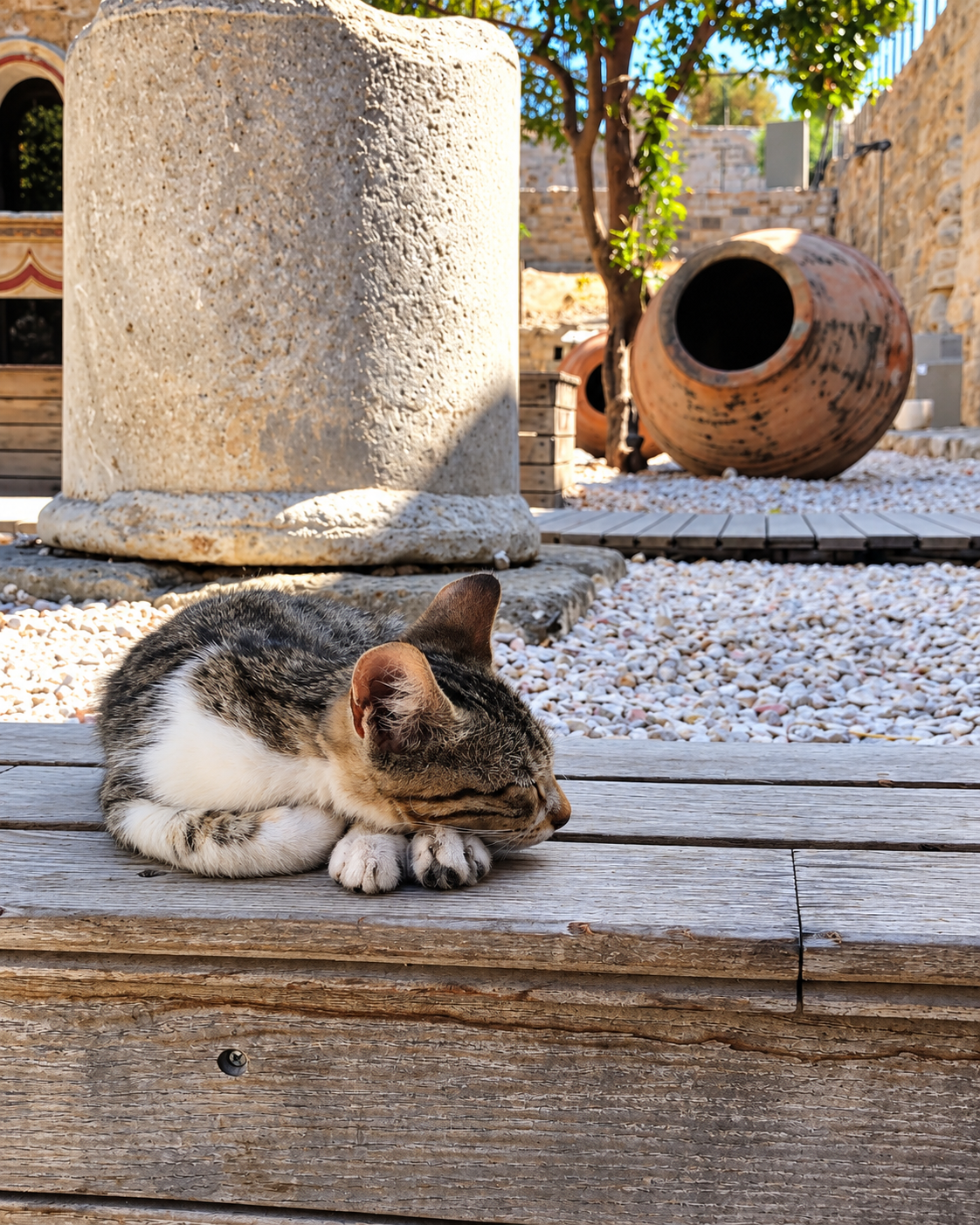
The luxury is the peninsula.
What are the best areas of Bodrum? It depends on the kind of summer you want, and the most important conceptual shift is to stop treating Bodrum as one resort town. It is a peninsula of micro-destinations. The ministry’s regional guide sketches them: Gümüşlük has unspoilt scenery and a long beach close to the ruins of ancient Myndos; Turgutreis has a sophisticated marina; Göltürkbükü is famous for its array of exclusive hotels, seafront restaurants and trendy bars; and Bitez, a popular place for windsurfing and sailing, attracts an upmarket crowd. Each has a different social and physical character, and the differences are the point.
Before the global brands arrived, parts of the peninsula already worked as summer territory for affluent Turkish travellers. A travel guide describes the village of Göltürkbükü as long a favoured hideaway of Turkey’s jet set, and it remains associated with exclusive hotels, waterside restaurants and fashionable social life. Gümüşlük is the counterweight. The tourism ministry sells it on an experience that no beach club can supply: sitting on tables placed in the shallow sea at sunset, feet in the water, enjoying meze and seafood. It is, as the ministry puts it, a small fishing town with a rich and colourful culture and some of the best fish restaurants in the region, where the value of the place rises when the traveller leaves the most visible circuit.
For the modern traveller that variety is the real advantage. A morning in a nearly silent cove, an afternoon on a boat, a drink at a high-design hotel and dinner in a simple fish restaurant, without leaving the same destination: that optionality is what the algorithm cannot flatten, and what makes Bodrum attractive to someone who wants social access without spending every hour inside the scene. It is also one of Bodrum’s structural advantages over smaller island destinations, which cannot offer the same range of settings within a single drive.
| Place | Character |
|---|---|
| Bodrum town | The old harbour, castle and white-house lanes; the historical centre |
| Yalıkavak | The marina and the clearest expression of the new luxury infrastructure |
| Göltürkbükü | Exclusive hotels, seafront restaurants and a fashionable Turkish summer set well before global brands arrived |
| Gümüşlük | The counterweight: scenery, beach and the ruins of ancient Myndos |
| Bitez, Turgutreis and quieter coves | Each with a different physical and social character |
| İçmeler | A calmer coast close to Bodrum town |
Official tourism material distinguishes these areas. This spatial variety is one of Bodrum’s advantages over smaller island destinations.
The Price of Becoming Visible
Visibility changes demand, and demand changes the commercial logic of a destination.
Why has Bodrum become so popular? Because a place that was already desirable became newly legible to a global audience. Social media accelerated visibility, but it did not create the desirability, which rests on history, geography, architecture and a long summer tradition. International attention has consequences that are easy to predict: rising rates, more global brands, heavier seasonal congestion and a hospitality economy increasingly calibrated to high-spend visitors. The local voice in the Glion feature admits as much, saying that Bodrum has become a little more commercial than it was. It would be a mistake to assert a specific social-media price premium without a dedicated pricing dataset, and none is claimed here.
The safer argument is the structural one. A destination built only on social visibility can lose value when tastes move. Bodrum’s defence is history, geography and domestic culture: Halicarnassus, the castle, sailing, local food, white architecture and a long Turkish summer tradition all existed before the current cycle of branded hospitality, and those layers make the place more resilient than any single trend. The destinations that age best are those whose value is carried by things a platform cannot move.
What Remains Beneath the Surface
The new Bodrum is glossy. The reason it works is that the old Bodrum is still visible underneath.
The question for Bodrum is no longer whether international luxury will arrive. It has arrived. The more important question is whether the peninsula can absorb global hospitality, branded nightlife and social-media demand without losing the low-rise, local and geographically varied character that made it desirable. Its future luxury value will depend on protecting difference and not on maximising sameness.
The story is not that Bodrum is the new Mykonos and Instagram made it famous. It is how an old Aegean peninsula with ancient history, Turkish summer culture, whitewashed architecture and a mature yacht economy became newly legible to global luxury travellers, and how social media, international hotels and imported beach-club culture are changing the way that older lifestyle is consumed. The reading would change if the conditions behind it did: if the low-rise fabric gave way to formats built for volume, if the quiet coves were absorbed into a single continuous beach-club frontage, or if the domestic summer culture that predates the brands were priced out of its own peninsula. None of that is inevitable. The new Bodrum is glossy, and the reason it works is that the old Bodrum is still visible underneath. Bodrum’s future value depends on remaining more than a backdrop.
“Bodrum was luxury before the algorithm.
Social media simply taught the rest of the world
how to recognise it.
Bodrum did not become beautiful when Instagram arrived.
It became easier to sell.
The algorithm loves the surface of Bodrum.
The reason to travel is everything underneath it.”

