
On the identity crisis running through modern finance: why traditional trading firms, crypto businesses and banks keep converging on the same needs, and whether the future of money belongs to the institutions that disrupt the system or to those that control the infrastructure connecting its parts.
The future of finance may not belong to the institutions that disrupt the system. It may belong to those that control the infrastructure connecting its competing parts.
Spend a few days in a convention hall of brokers, liquidity providers, payment firms and technology vendors and a pattern appears: everybody sells freedom, and everybody needs a licence. The industry’s factions, forex brokers who promised access to global currencies, crypto entrepreneurs who promised value without intermediaries, and the banks that crypto was supposed to make unnecessary, once claimed to represent different futures. Their business priorities now look uncomfortably alike.
This is not a cryptocurrency explainer, a promotional piece about Dubai, or a recap of a trade show. It is an attempt to examine a contradiction: that the technology built to remove financial intermediaries is, in commercial practice, creating new ones, while the old intermediaries are learning to speak the new technology’s language. Whether that adds up to disruption, convergence or the reconstruction of familiar power structures with new tools is the question, and the answer is treated here as a hypothesis to test, not a conclusion to defend.
A single discipline governs the writing: explain the machinery with precision, and examine the mythology with scepticism. That means using specific terms, balance sheets, regulatory permissions, custody, settlement risk, liquidity, counterparty exposure, and defining them where they appear, because most of the confusion in this field lives in the gaps between a handful of ideas that the industry’s marketing tends to blur.
Crypto Was Supposed to Replace the Middleman. Then It Needed One.
Is intermediation returning because the technology failed, or because large-scale financial commerce needs services that protocols do not provide?
The founding proposition was peer to peer. The Bitcoin paper, dated 31 October 2008, argued for an electronic payment system based on cryptographic proof instead of trust, allowing any two willing parties to transact directly with each other without the need for a trusted third party. The network, a set of nodes agreeing on a ledger, still works that way. But the commercial crypto economy that grew around it is built differently. A centralised exchange is a company: it holds customer assets, runs an order book, connects to banks for fiat on-ramps, relies on market makers for liquidity and employs compliance staff to meet anti-money-laundering rules. The distinction between a network and a business that trades on it is the first thing a sceptic should insist on, because the two are routinely confused, and because the failures have been in the second, not the first.
The collapse of the exchange FTX is the clearest case. It began in November 2022 and, as Axios’s timeline records, FTX announced bankruptcy and Bankman-Fried stepped down as chief executive on 11 November 2022. A federal jury later found Bankman-Fried guilty of seven counts after a run on customer deposits revealed a hole at the centre of the business. That was the collapse of a company, and not of a protocol. The ledger kept working. The custody arrangements, the governance and the honesty of the firm holding customer money did not.
Institutions have their reasons for wanting intermediaries back. A pension fund, a regulated broker or a corporate treasury needs legal accountability if something goes wrong, custody arrangements that satisfy auditors, controls against financial crime and operational resilience. Those are not technological features. They are legal and organisational ones, and they come from firms, not from code. Dubai’s regulators say as much in their structure: the Virtual Assets Regulatory Authority lists custody services among its regulated virtual-asset activities, with its own rulebook, and the Dubai Financial Services Authority requires that firms new to the DIFC seeking to carry out financial services involving crypto tokens must be authorised by the DFSA.
Is crypto replacing banks or becoming more like traditional finance? Commercially, it is acquiring many of the functions of traditional finance. Large-scale crypto commerce tends to need regulated custody, banking access, compliance controls and institutional counterparties, and regulators in Dubai, the United States and elsewhere are building frameworks that license these activities. The technology did not eliminate trust. It relocated it, from banks and clearing houses to exchanges, custodians, issuers and compliance providers. The counterargument deserves its due: self-custody exists, protocols run without an issuer, and a great deal of on-chain activity does not pass through a regulated gatekeeper. The honest claim is narrower than either camp’s slogan. Where money meets the legal system, intermediaries return.
Is a crypto exchange a bank? No. An exchange can offer accounts, balances and transfers without being a licensed bank or providing equivalent legal protections such as deposit insurance, and what protections apply depends on the jurisdiction and the licence. In Dubai, exchanges and custodians are licensed for specific virtual-asset activities, which is a different permission from a banking licence.

The Financial Industry Has an Identity Problem
If these companies represent different financial futures, why are their business priorities becoming so similar?
Forex Expo Dubai 2026 is a useful specimen. The ninth edition ran on 22 and 23 September at Dubai World Trade Centre, Halls 1 to 5, and its organisers describe a gathering of brokerages, introducing brokers, liquidity providers, payment providers and trading-technology firms. The attendance figures come from the organisers and should be read as such: Khaleej Times reported more than 16,000 attendees on the first day alone, and the organisers later announced 23,816 attendees, 270 exhibitors and 150 speakers across five stages, a count they say sets a Guinness World Records title for the largest attendance at a forex event. The same announcement breaks the total into 17,536 visitors, 2,898 traders, 850 introducing brokers, 795 affiliates and 1,737 business attendees.
The event’s own structure is revealing. It created dedicated experiences for verified traders, for introducing brokers and for affiliates, which is to say it was organised around customer acquisition as much as around markets. Introducing brokers and affiliates are the people who find customers for brokerages and are paid for doing so. A hall that counts introducing brokers and affiliates as audience categories in their own right tells a visitor what the business is: a distribution industry whose product happens to be price exposure.
The exhibitors show where that industry is drifting. One trading-technology vendor, Devexperts, said it would demonstrate its DXtrade platform, a white-label platform for brokers running FX and CFDs that can also add a dedicated front end for spot and margin crypto. Trade press had reported weeks earlier that the firm was building a dedicated crypto front end that brokers can brand as their own. Another, B2BROKER, announced that it would attend as a Diamond Sponsor, presenting solutions for brokers, exchanges, prop trading firms, fintech companies and financial institutions. These are announcements of what firms say they offer. They do not show adoption, market share or any relationship between exhibitors, and exhibiting is not partnership. But they illustrate the same migration: platforms built for currency trading are being extended to digital assets, and the vocabulary of freedom and access now shares a stage with the vocabulary of licences, liquidity and custody.
What does Forex Expo Dubai reveal about the trading industry? It shows an industry whose boundaries are blurring. Retail brokerages that built their businesses on currency pairs and contracts for difference now sit beside technology vendors selling crypto front ends, and beside payment providers whose products only make sense if money can move between fiat and digital form. The expo does not prove that any particular firm will succeed at this. It documents a shared direction, and a shared direction among rivals is the first symptom of an identity problem.
The scene also carries a culture. Gold draws, luxury prizes and a record-attendance claim are the language of an industry that sells aspiration, and the aspiration is itself a product. The pitch to a retail trader is not a spreadsheet of expected returns. It is an image of the person who trades, a self-image that is bought and sold as reliably as any instrument, and that kind of identity-building is explored in The Language of Scent: How Fragrance Becomes Identity in Modern Beauty. Finance has always monetised the story people tell about themselves, and a trade hall is where the story is manufactured at scale.
| What can be verified | Source and caution |
|---|---|
| The event | Forex Expo Dubai 2026, 22 and 23 September, Dubai World Trade Centre, Halls 1 to 5, billed as its ninth edition |
| Who it says it gathers | Brokerages, introducing brokers and affiliates, liquidity providers, payment providers, fintech and trading-technology firms (organisers’ description) |
| Scale | Organisers announced 250+ exhibitors before the event; Khaleej Times reported 16,000+ attendees on day one; final organiser figures were 23,816 attendees and 270 exhibitors. All are organiser-supplied |
| A trading-technology vendor | Devexperts said it would show DXtrade, a white-label platform for brokers running FX and CFDs, with a front end for spot and margin crypto |
| A technology and liquidity provider | B2BROKER announced it would attend as a Diamond Sponsor, presenting solutions for brokers, exchanges, prop firms, fintech companies and financial institutions |
| What it does not show | That any two exhibitors have a commercial relationship, or that any exhibitor is a market leader. Exhibiting is not partnership |
Company announcements establish what a firm says it offers. They do not establish adoption, market share or economic performance.
Seven Distinctions That Decide Whether a Financial Argument Is Credible
Most of the confusion in this field lives in the gaps between seven ideas.
A financial argument is credible when it keeps its categories apart. The first distinction is between forex and crypto. Forex is trading in currencies; crypto markets involve digital assets with varied functions, economic structures and legal treatment, and the two are sold through similar interfaces without being the same thing. The second is between a contract for difference and the asset it tracks, which matters more than any other line in the retail end of the market and is taken up in detail below.
The third is between a stablecoin and a bank deposit. A fiat-referenced token is not automatically equivalent to an insured deposit or to central-bank money, and what it is worth in a crisis is decided by redemption rights and reserves. The fourth is between decentralisation and regulation: compliance does not by itself remove technical decentralisation, because different layers of a system can be centralised or decentralised. A network can be open while the firm that offers access to it is licensed, supervised and entirely centralised. The question “is it decentralised?” has no single answer, and anyone who offers one is selling something.
The fifth is between liquidity and volume. High trading volume does not guarantee market depth, resilience or execution quality, and headline volume can flatter a market. The sixth is between an exchange and a bank: an exchange can offer a bank-like experience, with accounts, balances and transfers, without being a licensed bank or providing equivalent legal protections, and the interface is not the protection. The seventh is between tokenisation and speculation. Blockchain representations of traditional assets have different economics and uses from speculative crypto trading, and the most institutional part of the story is not the part with the volatile prices.
| Distinction | What is true | Why it matters |
|---|---|---|
| Forex vs crypto | Forex is trading in currencies. Crypto markets involve digital assets with varied functions, economic structures and legal treatment | The two are sold through similar interfaces and are not the same thing |
| CFD vs spot | Trading a crypto CFD does not mean owning the cryptocurrency; it is a contract with a provider | Ownership, custody and withdrawal rights differ completely |
| Stablecoin vs bank deposit | A fiat-referenced token is not automatically equivalent to an insured deposit or to central-bank money | Redemption rights and reserves decide what the token is worth in a crisis |
| Decentralisation vs regulation | Compliance does not by itself remove technical decentralisation; different layers of a system can be centralised or decentralised | “Is it decentralised?” has no single answer |
| Liquidity vs volume | High trading volume does not guarantee market depth, resilience or execution quality | Headline volume can flatter a market |
| Exchange vs bank | An exchange can offer a bank-like experience without being a licensed bank or providing equivalent legal protections | The interface is not the protection |
| Tokenisation vs speculation | Blockchain representations of traditional assets have different economics and uses from speculative crypto trading | The most institutional part of the story is not the part with the volatile prices |
Seven distinctions that decide whether a financial argument is credible. Each is separated here because the industry’s marketing tends to blur them.
Forex Brokers Don’t Need a Revolution. They Need a Business Model.
Does offering crypto represent financial innovation for a broker, or simply another instrument sold through an established acquisition model?
A retail forex or CFD broker is, among other things, a customer-acquisition machine. It pays to find traders, directly or through introducing brokers and affiliates, earns on spreads, commissions and financing charges, manages the market risk it takes on, and depends on liquidity providers, payment processors and banks to keep the whole thing running. Adding digital assets extends the product shelf without rebuilding the machine. That is a rational commercial move, and it is not in itself innovation. It is the oldest move in distribution: when the customers are already acquired, sell them the next product.
The economics need care, because revenue depends on the execution model, the contract and the jurisdiction. A broker that passes client orders to the market earns differently from one that acts as the counterparty to its clients, and the second arrangement carries a different set of incentives, because the firm’s outcome can be the inverse of its client’s. That does not mean every broker profits from customer losses. It means the structure invites scrutiny, and regulators in some jurisdictions treat it that way.
The European evidence is specific. When the European Securities and Markets Authority announced its restrictions on CFDs for retail clients in 2018, it reported that national analyses of CFD trading across EU jurisdictions showed that 74 to 89 percent of retail accounts typically lose money, with average losses per client ranging from €1,600 to €29,000. Its measures included leverage limits on opening a position of between 30:1 and 2:1, a margin close-out rule, negative balance protection, a prohibition on incentives for trading and a standardised risk warning. They were designed, in the regulator’s words, to ensure that investors cannot lose more money than they put in, restrict the use of leverage and incentives, and provide understandable risk warnings. These rules apply to retail clients in the European Union, not to the UAE, and they are cited here for what they reveal about how a mature regulator reads the business model, not as a description of Dubai.
| A forex/CFD broker adding digital assets | A stablecoin or crypto payments provider | |
|---|---|---|
| Where revenue comes from | Spreads, commissions, financing charges and, depending on the execution model, trading outcomes; digital assets add instruments to the same funnel | Fees on conversion and transfer; for issuers, typically income on the reserves that back each token |
| Where customers come from | Paid acquisition, introducing brokers and affiliates | Businesses and platforms integrating an API or settlement service |
| What it holds | Client money under client-money rules; for spot crypto, a different custody problem | Reserves, wallets and bank accounts |
| What regulators ask | Conduct rules, leverage limits, client-money segregation, plus a separate permission for digital-asset activity | Issuer, custody and conversion licences; reserve and redemption rules |
| Main dependency | Liquidity providers, payment processors and banking access | Banking partners, reserve assets and on- and off-ramps |
| What makes it fragile | Conflicts of interest and retail losses under heavy regulatory scrutiny | Redemption risk and the need for regulated banking access |
Two stylised models for comparison, not profiles of named companies.
Why a Crypto CFD Is Not Crypto, and Custody Is Not a Product Line
A broker that moves from CFDs to custody is not adding a product. It is becoming a different kind of firm.
What is the difference between a crypto CFD and owning crypto? A crypto CFD is a contract for difference with a provider whose value follows a price. It does not give the trader the asset, a wallet or a right to withdraw it. The trader holds a claim on the provider, and the provider’s balance sheet, not the blockchain, is where that claim lives. The European rules show how differently the risk is judged: the same set of measures capped leverage at 2:1 for cryptocurrencies, against 30:1 for major currency pairs. A regulator that treats a crypto contract as fifteen times less leverageable than a euro-dollar contract is telling the market what it thinks about volatility.
Offering spot digital assets is a different business, with different rules. Holding cryptoassets for clients, custody, is different again, with its own licence, its own security burden and its own failure modes: a lost private key cannot be reset by a call-centre agent, and a compromised hot wallet cannot be reversed by a court order. A broker that moves from CFDs to custody is not adding a product. It is becoming a different kind of firm, with different capital, different staff and a different category of operational risk.
The Dubai rulebooks make the separation concrete. The VARA framework treats broker-dealer, custody, exchange and transfer-and-settlement as separate licensed activities, and its second-generation rules mean that virtual asset service providers may offer margin trading only with explicit authorisation, and that approval must be stated in their licence. For a broker whose business is leverage, that sentence is the commercial heart of the matter. Leverage on crypto is not a feature a firm turns on. It is a permission a regulator grants, with its own conditions attached.


The Most Interesting Part of Crypto Isn’t the Coin. It’s the Plumbing.
If the underlying infrastructure changes, will the beneficiaries be crypto-native firms, established institutions or specialist intermediaries connecting the two?
The commercially serious part of the story is not price. It is how value moves between businesses. Stablecoins, tokens designed to hold a steady value against a currency, are the clearest example. They promise faster, continuous settlement and may reduce reliance on chains of correspondent banks, the network of intermediary banks that cross-border payments traditionally pass through, each taking time and a fee. Why do stablecoins matter for payments? Because they can move value across borders around the clock, in minutes, between parties who do not share a bank. The limitation is scale and context, and the numbers need to be read in layers.
By the count of Artemis and Dune, stablecoins processed $33 trillion in on-chain volume in 2025, surpassing Visa and Mastercard combined. A joint analysis by McKinsey and Artemis filtered that activity for what a business or person would recognise as a payment, and found that the true volume of stablecoin payments was about $390 billion in 2025, more than double the 2024 level. McKinsey puts that at roughly 0.02 percent of global payments. In the same analysis, business-to-business payments dominate, at about $226 billion, or roughly 60 percent of stablecoin payment volume, and grew 733 percent year on year. The gap between volume and payments is the whole argument: high volume does not mean depth, and activity is not adoption.
The volume figure also depends on what is counted. Coverage of the McKinsey report notes that the payments figure is based on December 2025 data annualised, and represents roughly 0.02 percent of global payment volumes, with the remainder of on-chain volume made up largely of internal transfers, trading, arbitrage and automated activity. A $35 trillion headline and a $390 billion payments figure can both be true because they measure different things. A sceptical reader should ask of any stablecoin statistic which of the two it is.
| Layer | Estimate | What it measures |
|---|---|---|
| Raw stablecoin transaction volume, 2025 | About US$33 trillion (Artemis and Dune); McKinsey and Artemis work cites about US$35 trillion | Everything moved on-chain, including trading and automated activity |
| Identifiable real payments | About US$390 billion annualised on December 2025 activity (McKinsey and Artemis), roughly 1% of gross flows and about 0.02% of global payments | Payments a business or person would recognise as payments |
| Of which business-to-business | About US$226 billion, roughly 60% of the total | The part with the clearest commercial logic |
| Stablecoin supply, 2026 | About US$308 billion in mid-August 2026, after a peak near US$322 billion in May, according to DefiLlama data as reported | What exists, not what moves |
Aggregator and consultancy estimates that vary by source and methodology. They illustrate the gap between volume and payments and are not official statistics.
Supply tells a different story from flow. Total stablecoin market capitalisation was about $308 billion on 13 August 2026, up 14.3 percent over twelve months and about 4.5 percent below its May 2026 peak, with Tether’s USDT holding about 59 percent of supply and Circle’s USDC about 24 percent in June. Two issuers hold more than four-fifths of the market. That concentration is the infrastructure point in miniature: a payments rail built on an open ledger has, in commercial practice, two dominant private balance sheets underneath it.
The practical constraints are redemption, banking access, liquidity, counterparty risk and legal compliance. A token is only as good as the reserve behind it and the issuer’s ability to honour redemptions, which is why the legal status of a stablecoin as distinct from a bank deposit is not a technicality. It is the difference between a claim on a regulated bank and a claim on a company’s reserve policy. Issuers, meanwhile, typically earn income on the reserves that back their tokens, which makes issuance a business with an interest-rate exposure and not a utility. The pattern is the pattern of finance: the real money is in the plumbing, and the plumbing is owned by whoever holds the reserves, the licences and the bank relationships.
Are stablecoins the same as bank deposits? No. A stablecoin is a token that aims to hold a fixed value against a currency, usually backed by reserves. It is not automatically an insured bank deposit or central-bank money, and its holders rely on the issuer’s reserves and redemption terms.
What the Central Bankers’ Bank Actually Argues
The ledger is new. The issuers, in the vision the BIS prefers, are central banks and banks.
The Bank for International Settlements has pointed to the same gap from the other direction. Its 2025 Annual Economic Report argued that stablecoins offer some promise on tokenisation but fall short of requirements to be the mainstay of the monetary system when set against the three key tests of singleness, elasticity and integrity. Singleness means money issued by different parties is accepted at par. Elasticity means the system can provide money flexibly to meet large-value payments and absorb stress. Integrity means resistance to illicit use. The BIS press release put the policy view plainly: while stablecoins may eventually play a subsidiary role in the hinterland of the financial system if adequately regulated, they do not deliver singleness of money.
Its positive vision was elsewhere. The report argued for a “unified ledger” bringing together tokenised central bank reserves, commercial bank money and financial assets in the same venue, a setup that could replace the sequential updating of accounts in correspondent banking with a single process. That is a vision in which the ledger is new and the issuers are central banks and banks. The following year’s report sharpened the point. Its 2026 chapter, Anchoring trust in money: innovation beyond stablecoins, said that stablecoins display some of tokenisation’s potential to support faster and programmable payments, but current designs fall short on foundational properties of money and threaten financial integrity. Trade coverage of the report notes that it also warned of “stablecoin dollarization” in emerging economies.
The BIS is not a neutral party in this debate, and nobody should pretend it is: central banks have an institutional interest in the monetary system keeping its anchor in public money. But its argument is useful because it separates the technology from the issuer. The same programmable ledger can be operated by a private firm holding dollar reserves or by a consortium of regulated banks and a central bank. The technology is indifferent. The power is not.
Money has long been tied to trust built slowly, and to scarcity that cannot be manufactured. The metals and stones that carried value before any ledger did, a lineage traced in The Language of Modern Necklaces: Metals, Stones, and the New Codes of Personal Luxury, carried it because the people who held them believed it would still be accepted tomorrow. The three BIS tests are, in effect, a modern definition of that belief: that the money in your hand is the same as everyone else’s, that it will be available when needed, and that it has not been fouled by crime. A token that cannot meet them is a product. It is not yet money.
Tokenisation Is the Institutional Story
The most institutional part of the story is not the part with the volatile prices.
What is tokenisation, and is it the same as crypto? Tokenisation is recording claims on real or financial assets on a programmable ledger. It is not the same as speculative cryptocurrency trading, and the contrast is the clearest evidence for the convergence thesis. The BIS argued in 2025 that tokenisation can enhance efficiency and open new possibilities in cross-border payments, securities markets and beyond, while maintaining the key principles of sound money. The institutions that use it are, overwhelmingly, the established ones.
Tokenised US Treasury products are the leading example. By one tracker’s count, tokenised Treasuries sat near $15 billion in assets under management in May 2026, with BlackRock’s BUIDL fund among the leading products. Another report put the sector at $15.20 billion in May, led by Circle’s USYC at $2.91 billion and BlackRock’s BUIDL at $2.58 billion, and by early August at $16.16 billion across 85 separate assets. These are aggregator figures that vary by methodology and date, and they are small against a market of tens of trillions in outstanding Treasuries. But the shape matters more than the size: a government bond, held in a fund run by an established asset manager, represented on a programmable ledger. The leading products are issued by asset managers and regulated issuers, and not by anonymous protocols.
This is where the three narratives collide. For a forex broker, tokenised assets are a new instrument to distribute. For a crypto firm, they are a route to institutional credibility. For a bank, they are a way to modernise settlement without conceding the customer relationship. All three can claim the same product as vindication, and none of them is wrong.


Dubai Doesn’t Need to Choose Sides
Does Dubai offer a glimpse of finance’s next structure, or an especially concentrated example of its existing contradictions?
Dubai is useful as a lens for convergence, not as a predicted winner, because the emirate regulates these activities through distinct bodies, and a firm that wants to straddle them has to hold several permissions. The Virtual Assets Regulatory Authority is the competent entity in charge of regulating, supervising and overseeing virtual assets and virtual-asset activities in all commercial zones across the Emirate of Dubai, excluding the Dubai International Financial Centre. Its second-generation rulebooks of May 2025 covered advisory, broker-dealer, custody, exchange, lending and borrowing, virtual-asset management and investment, transfer and settlement, and issuance, and included strengthened controls around margin trading and token distribution services, clearer definitions for collateral wallet arrangements, and harmonised compliance requirements.
Inside the DIFC, the DFSA applies its own regime. Its update effective on 12 January 2026 made firms directly responsible for determining, on a reasoned and documented basis, whether each crypto token they engage with meets the DFSA’s suitability criteria, so that the regulator no longer prescribes a list of Recognised Crypto Tokens. The shift is from approving products to holding firms accountable, which is a more demanding standard in practice. It came with a carve-out: for fiat-backed stablecoins, the regulator continues to maintain a list, and firms may not list or trade any such token without its prior recognition. Firms must also monitor suitability on an ongoing basis, at least once in every six-month period.
A third layer sits above both. The Central Bank of the UAE published its Payment Token Services Regulation in June 2024, and the regime distinguishes Dirham Payment Tokens, licensed, from Foreign Payment Tokens, registered. In practice the rulebook allows Dirham Payment Tokens to be used for any lawful purpose, while Foreign Payment Tokens may be lawfully used as a means of payment for the purchase of a virtual asset, and a Gulf News account of the rules states that foreign tokens cannot be used to buy goods, excluding virtual assets, and services locally. The first licensed dirham-backed stablecoin followed: the central bank approved AE Coin in December 2024. The one-year transition period officially ended in June 2025.
Regulatory clarity and international connectivity are the case for the model. Licensing cost, overlapping perimeters, competitive pressure and the difficulty of operating across jurisdictions are the case against. Law-firm commentary on the central bank’s regulation notes that no person may perform a payment token service within the UAE unless licensed, in the case of dirham tokens, or registered, in the case of foreign tokens, whatever other permissions the firm holds, and the existence of three principal regimes inside one emirate is itself a lesson: a “single” digital-asset business is a stack of separate permissions, each with a regulator, a cost and a dependency. Dubai is not proof that convergence will win. It is a stress test showing how much institutional machinery convergence requires.
The emirate’s reputation is part of the context. Khaleej Times reported that the expo came weeks after Dubai was ranked the world’s number one location for fintech in the latest Global Financial Centres Index. A ranking of that kind is an indicator of perception among industry professionals, not a measure of outcomes, and it should be held with the same caution as the attendance figures. It does, however, explain why a forex conference and a crypto licensing regime end up in the same conversation here and not elsewhere.
| Regulator | Where and what | What changed |
|---|---|---|
| VARA | The Emirate of Dubai outside the DIFC. Licenses virtual-asset activities: advisory, broker-dealer, custody, exchange, lending and borrowing, management and investment, and transfer and settlement, plus issuance | Version 2.0 of its activity rulebooks (May 2025) tightened margin-trading and token-distribution controls and clarified collateral wallets |
| DFSA | The Dubai International Financial Centre. Regulates financial services involving crypto tokens | From 12 January 2026 it ended its list of recognised crypto tokens, so each firm must document and justify a token’s suitability; it kept its own recognition of fiat stablecoins |
| Central Bank of the UAE | Payment tokens (fiat-referenced stablecoins) under its Payment Token Services Regulation of June 2024 | Dirham payment tokens are licensed; foreign tokens are registered and confined largely to buying virtual assets; algorithmic stablecoins and privacy tokens are prohibited |
| Other federal bodies | The UAE also has federal securities and commodities regulation | Which regulator applies depends on the activity, the token and the location |
A map of who regulates what, with effective dates. Regulatory provisions change; current rules should be checked with the regulators.
The Revolution May Have a Banking Licence
Financial revolutions should be judged not only by whether money moves differently, but by whether power, risk and economic opportunity move with it.
Pull the threads together and a division appears. What may genuinely change is the technical layer: settlement that is faster and programmable, new routes to market access, tokenisation of conventional assets, and interoperability between bank, payment and ledger systems. What may persist is the institutional layer: the need for trusted counterparties, the economics of commercial distribution, the discipline of risk management, and the concentration of power in whoever holds reserves, licences and customers. A blockchain may decentralise some operational functions while leaving custody, governance, distribution and economic control concentrated in commercial institutions. Convergence is not decentralisation, and the second can be absent while the first is complete.
The unglamorous truth of finance is that the thing being sold is rarely the asset. It is the guarantee. A protective layer, whether a regulatory perimeter or a custodian’s balance sheet, is what lets everything on top of it function, the logic of a barrier examined in The Return of Barrier Beauty: Why Lanolin Is the Ultimate Skin Investment. Nobody buys a deposit account for the paper it is written on. They buy the knowledge that when they ask for their money, a counterparty with a balance sheet and a legal duty must hand it over. That knowledge is manufactured by institutions, slowly, and cannot be downloaded.
| What may genuinely change | What may persist |
|---|---|
| Settlement technology: faster, programmable, possibly continuous | The need for trusted counterparties |
| Market access: new ways to reach assets and customers | Commercial distribution: someone still acquires the customer |
| Tokenisation of conventional assets such as Treasuries and funds | Risk management, capital and legal recourse |
| Interoperability between banks, payment firms and ledgers | Concentration of institutional power, in new places |
A framework, not a forecast. Decentralised protocols can still reduce dependence on specific intermediaries, and not all digital-asset activity is becoming institutionally centralised.
The Strongest Counterargument
A reasonable reader could conclude that the open and the regulated systems will coexist, each serving customers the other cannot.
The strongest counterargument should be heard. Decentralised protocols do reduce dependence on specific intermediaries in some uses, self-custody is real, and not all digital-asset activity is becoming institutionally centralised. Where a business or individual in a jurisdiction with weak banking access needs to move value, an open network that does not ask permission is not a marketing claim. It is a capability, and the BIS’s own warnings about stablecoin dollarisation in emerging economies are, read another way, evidence of how much demand there is for it.
A reasonable reader could therefore conclude that the open and the regulated systems will coexist, each serving customers the other cannot. The claim defended here is more modest and, for that reason, more testable: where the technology touches legal recourse, consumer protection and large-scale commerce, the institutions that already know how to supply those things are in a strong position to supply them again, with new tools. It is a claim about where the commercial gravity sits, not a prediction that open protocols will disappear.
Who benefits when traditional finance adopts crypto technology? That is the open question. Beneficiaries could be crypto-native firms, established institutions or specialist intermediaries connecting the two, and the answer will vary by function. Regulatory costs, banking access and distribution tend to favour firms with balance sheets and licences, while open protocols can still lower the cost of moving value for users. The institutional layer and the open layer are in tension, and that tension, not either side’s victory, is the more probable long-run condition.
Who Holds the Power
Power, in this context, is a structural matter: who controls customer assets, liquidity and settlement when a transaction moves between fiat and crypto.
The architecture of any financial system reveals where authority sits. Four questions locate it. Who holds the assets, and under which legal arrangement? Who provides the liquidity, and what happens to execution when markets are stressed? Who controls settlement, and can a transaction be reversed? And who owns the relationship with the customer? A firm that controls two of the four has leverage over those that control one. A firm that controls all four is, whatever it calls itself, a financial institution.
The questions worth putting to any executive in this industry are the plain ones. What part of your business genuinely requires blockchain, and what could work through conventional infrastructure? Who holds the assets? What do you earn from: the transaction, the customer, the asset or the infrastructure? What would make your business model obsolete? The answers separate firms with an infrastructure position from firms with a distribution position, and the second group is the larger and the more exposed. Distribution without a licence, a balance sheet or a differentiated product is the easiest asset in finance to replicate.
Conferences of this kind also trade in a currency that does not appear on any balance sheet: the performance of ambition. The prize draws, the stage lighting and the language of disruption form a culture that markets monetise at least as reliably as they monetise assets. It does not make the machinery behind the culture less real, and it does not make the culture less revealing. The fair reading is that both are true at once: an industry doing serious infrastructure work, wrapped in the aesthetics of a revolution.
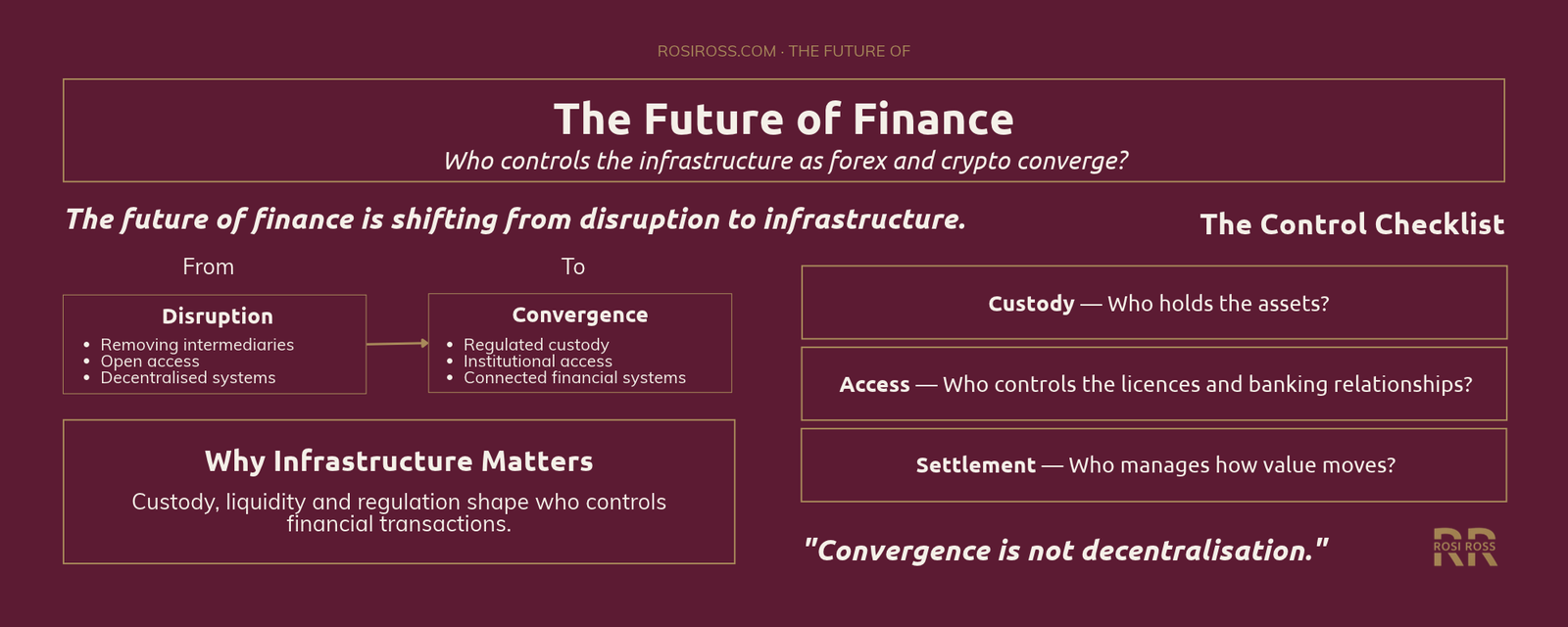
Control, Not Disruption
The future of money may look radically different. The business of controlling it might look surprisingly familiar.
Crypto promised to make the middleman obsolete. Traditional finance learned to speak blockchain. Brokers discovered new assets, payment companies discovered new rails, and institutions discovered that the future of money might not require abandoning the old system after all. The question is not whether forex becomes crypto, or whether crypto becomes banking. It is whether the technology changes who holds financial power, or simply gives familiar institutions a different way to exercise it.
That reading would change if the evidence did. If open, permissionless networks began carrying large-scale commercial settlement without regulated gatekeepers, if a major stablecoin became accepted at par across issuers without a central-bank anchor, or if self-custody became the default for institutions and not the exception, the thesis would weaken. If instead the volume of identifiable payments stays small against the headline numbers, if the leading tokenised products stay in the hands of asset managers and banks, and if regulators keep converting open activity into licensed activity, it strengthens. Neither outcome is certain, and the most useful posture is to watch the infrastructure and not the price.
Durable value has always rested on something that outlasts the story told about it. The pieces that stay relevant in a wardrobe, the argument of timeless luxury fashion pieces, do so because their quality is verifiable and their purpose does not depend on a trend. Finance is the same. A system earns trust by being the thing people return to when the excitement ends. The reader who leaves with a clearer picture of how the market is structured, and not merely a stronger opinion about cryptocurrency, has been served better than one who picked a side.
A note on sources and limits. This is editorial analysis, not investment, legal or regulatory advice, and it recommends no product, broker or token; the author is not a financial adviser. Event details follow organisers’ announcements and press coverage, and exhibitor examples are company announcements that do not establish partnerships or market position. Regulatory descriptions follow VARA’s May 2025 rulebook announcement, the DFSA’s published update effective 12 January 2026 and law-firm commentary on it, and commentary on the Central Bank of the UAE’s Payment Token Services Regulation (June 2024); regimes change and should be verified with the regulators. CFD statistics and leverage limits are from ESMA’s 2018 product-intervention measures and apply to retail clients in the EU, not to the UAE. The BIS characterisations follow its 2025 and 2026 Annual Economic Reports. Market figures, including stablecoin volumes and supply, McKinsey and Artemis’s payments estimate and tokenised-Treasury totals, are commercial, aggregator or consultancy estimates that differ by source and method and are not official statistics. The two business models in the comparison table are stylised, not profiles of named companies.
“Crypto promised to make the middleman obsolete.
Traditional finance learned to speak blockchain.
The question is not whether forex becomes crypto,
or whether crypto becomes banking.
It is whether the technology changes who holds financial power,
or simply gives familiar institutions a different way to exercise it.
The future of money may look radically different.
The business of controlling it might look surprisingly familiar.”

