
On a heritage luxury that depends on rain, a region whose bottles are better known than its name, and a generation that is changing what a celebration is made of.
The Penedès sells the sky. The question now is whether the next generation is buying the bottle, the place or the occasion.
Barcelona sells the sea. Its beaches, its harbour and its Modernista skyline are arranged to face the water. A short drive inland the picture reverses. The land turns dry, the light flattens over low vines, and the luxury that made this hinterland famous depends not on the sea but on the sky. In the Penedès nothing is more valuable than rain, and for several consecutive years there was very little of it.
This is not a tasting note and it is not a winery guide. It is an examination of three pressures on a single place. The first is supply: a drought that cut harvests and forced one of the world’s best-known sparkling brands to restructure. The second is value: a region whose wine is sold in vast quantity and recognised worldwide, yet earns far less per bottle than its French rival. The third is demand: a generation, and a broader public, that is drinking differently from the one that built these brands.
Two producers frame the story. Familia Torres, in Vilafranca del Penedès, is a family business in its fifth generation. Freixenet, in Sant Sadurní d’Anoia, is a global cava brand that passed into full German ownership in March 2026. They share a landscape and a drought. Each has also made a significant move into alcohol-free wine, and that convergence may say more about the future of heritage than anything in their cellars.
The Land Before the Label
The Penedès is a rain-fed landscape. That single fact explains most of what follows.
The Penedès lies among rolling hills just south of Barcelona, the home of cava as well as excellent red and white wines. Its viticulture is divided into three sub-zones that form bands across the region: Penedès Superior, the more inland and higher-elevation vineyards, Penedès Central, the mid-valley, and Penedès Marítim, the coastal strip. Falstaff reports that ninety five percent of cava’s production volume is made in the Penedès. The appellation’s own specification defines the product: a quality sparkling wine obtained through a second bottle fermentation in the traditional method, with at least nine months in contact with the lees.
Where does the water come from? From the sky, almost exclusively. Mireia Torres, the director of innovation and knowledge at Familia Torres, told The Drinks Business that the Penedès has traditionally been a dry farming area, with rain as the sole water source for viticulture. That is a more demanding fact than it sounds. A vineyard that depends on rain cannot be rescued by a switch or a pipe. It can only wait, adapt or fail, and the years from 2021 to 2024 gave it a long lesson in all three.
The region’s luxury, then, is not an architecture or a view. It is a relationship between soil, slope and weather that a producer can steward but not manufacture. Scent works in a comparable way: its value lies in the identity it lends to the wearer rather than in the liquid itself, the mechanism explored in The Language of Scent: How Fragrance Becomes Identity in Modern Beauty. A wine from a named place sells the same promise, that the place is in the glass. A drought makes that promise harder to keep.
The Region the World Knows Only by Its Bottle
Cava is sold everywhere. The place that makes it is known almost nowhere.
Is Barcelona a wine capital? Not in the way Reims or Bordeaux is. The city itself has little wine identity, and the names that carry the region’s reputation are Cava and the Penedès, not Barcelona. That is an editorial observation, not a statistic, but the figures around it are stark. It would be a mistake to read the gap as one of scale. The Penedès sits inside a country with about 13.1 percent of the world’s vineyard area, ahead of France at 11.0 percent, according to preliminary OIV figures for 2024. And on volume, the two sparkling wines are close.
In 2024 the Cava appellation sold 218 million bottles, with turnover of €2.27 billion. The same year Champagne shipped 271.4 million bottles in total, 9.2 percent down on 2023, and Wine Intelligence put its sector turnover below €6 billion. Cava sold roughly four-fifths of Champagne’s bottles. Its revenue was a fraction of Champagne’s. The difference is price.
How wide is the price gap? In 2025, Del Rey’s analysis of export data found that French sparkling wines averaged €19.43 per litre, Italian €4.61 and Spanish €3.24. That compares all French and Spanish sparkling exports, not Champagne and Cava alone, but the order of magnitude is clear. Spain’s own export data puts cava’s average at €3.76 per litre in 2025, up 9.5 percent. Perception follows price. Research from the alcohol delivery platform Drizly, reported by The Drinks Business, found that just 1 percent of the sparkling wine opened by Americans on New Year’s Eve 2023 would be Cava, compared with 67 percent for Champagne. That is one dataset in one market and should be read as illustrative.
| Measure | Cava (DO Cava) | Champagne |
|---|---|---|
| Bottles sold, 2024 | 218 million | 271.4 million shipped |
| Revenue, 2024 | €2.27 billion | Sector turnover below €6 billion |
| Average export price per litre, 2025 | €3.76 (Spanish export data); €3.24 for all Spanish sparkling | €19.43 for all French sparkling |
| Share of New Year’s Eve sparkling, US, 2023 | 1% (one platform’s data) | 67% (one platform’s data) |
Figures come from different bodies and years and are indicative, not a like-for-like series. Spanish and French export prices cover all sparkling wine, not only Cava and Champagne.
Is the gap closing? There is evidence that the appellation is trying. Catalan News reported that cava prices had risen 12 percent since 2023, so revenue fell only 4.2 percent while bottles fell 13.4 percent, and Ara noted sales of 22.4 million bottles of higher-aged cavas, the highest quality. In 2025 the appellation’s sales fell again, to 190 million bottles and revenue of €2.048 billion, with the regulator’s president attributing the fall to a lack of product, not a lack of demand. A region that blames supply for a decline in sales is a region with brand strength to protect.
The value gap reaches the vineyard. Drinks International reported that the average grape price at Codorníu is €0.75 per kilogram, compared with the wider region’s €0.30 to €0.40. A premium that stops at the label does not help the person who grows the grapes, which is why the question of who captures the value of a region’s name is also a question about who can afford to keep farming it.
The Drought, in Dated Numbers
A drought is a number before it is a story, and every number needs a date.
The figures matter because the story is easily exaggerated in both directions. The drought was severe. It also ended, in the sense that matters to regulators, in 2025. Mireia Torres described the situation in 2024 as the most extreme drought since historical records have been kept, one that began in 2021 and in which every year it has rained less. She added that the historical average rainfall in the Penedès is 544 millimetres, and that in 2023 annual rainfall in the region was 54 percent lower.
The institutional response followed. Catalonia declared a drought emergency in February 2024, when its reservoirs fell below 16 percent of capacity after nearly three years of below-average rainfall. Decanter reported that the restrictions mandated that water for crop irrigation be reduced by 80 percent and that the shortage was estimated to reduce production by 60 million bottles. DO Cava figures reported by Drinks International show the harvest side: yields in Catalonia dropped from 300 million kilos in 2021 to 230 million in 2023, with 2024 expected to be even lower. One family winery told The Drinks Business that its 2024 yield was closer to 4,500 kilograms per hectare against a usual maximum of 8,000, and weather piled on weather: a hailstorm on 1 June 2024 devastated an estimated 1,200 to 1,500 hectares of Penedès vines.
Then the rain came. In April 2025, Catalan News reported that after four years and eight months of what the minister described as the largest drought in the last 200 years, the government announced the end of water-use restrictions in the Ter-Llobregat system, affecting around six million people. For the vineyards, recovery was slower than for the reservoirs. The director of the Penedès appellation expected about 25 percent more grapes in the first harvest after the drought than the previous year, above 2024 but not equal to the harvests of six or seven years earlier. A reservoir refills in a season. A root system damaged over several years, and a business built around a missing harvest, take longer.
| Period | Reported figure | Source and caution |
|---|---|---|
| 2021 onward | Drought begins; described as the most extreme since records began. Historical average rainfall: 544 mm | Mireia Torres, via The Drinks Business (2024) |
| 2023 | Rainfall 54% below the historical average. Catalonia’s cava grape yield: 230 million kilos, down from 300 million in 2021 | Torres via The Drinks Business; DO Cava figures via Drinks International |
| February 2024 | Drought emergency declared; reservoirs below 16%; crop irrigation to be cut by 80% | ABC News (wire); Decanter |
| 2024 | A family winery reports about 4,500 kg per hectare against a typical 8,000. A June hailstorm hits an estimated 1,200 to 1,500 hectares | The Drinks Business; Decanter. One winery’s figure is illustrative |
| April 2025 | Water-use restrictions end in the Ter-Llobregat system after four years and eight months | Catalan News |
| 2025 harvest | Expected about 25% above 2024, but below levels of six or seven years earlier | DO Penedès director, via Público |
Dated, attributed figures only. They come from different bodies and definitions and are not a single continuous series.
Familia Torres: Time as Strategy
A family firm’s argument is time. Torres has been making the case, in public, that its horizon is longer than the weather.
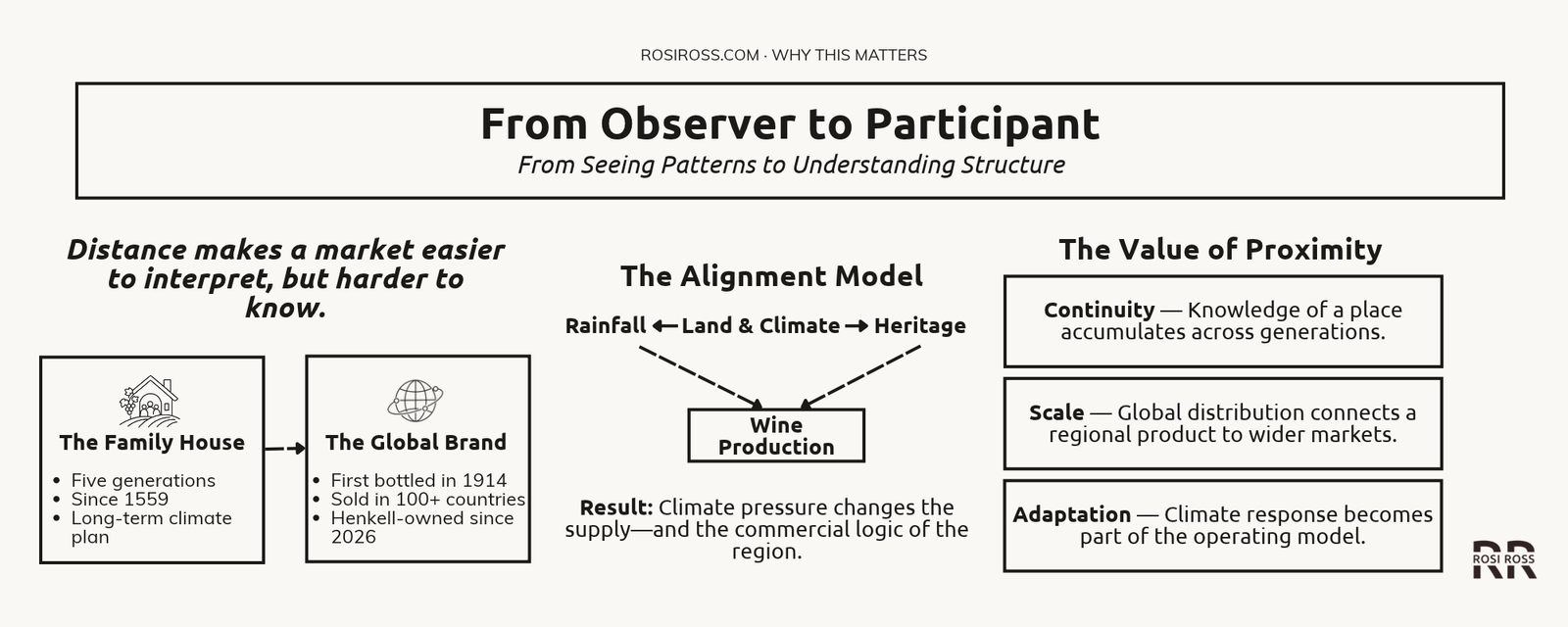
Familia Torres begins its own account in the sixteenth century. Its history states that the first references to the family as winegrowers date back to 1559, but it was in 1870 that brothers Jaime and Miguel Torres Vendrell founded the winery in Vilafranca del Penedès, with a focus on exportation. The same history records the rupture: in 1939, a few months before the end of the Spanish Civil War, the family winery was destroyed during the bombings that targeted the nearby railway station. Is Familia Torres still a family business? On the evidence of its own material, yes: the producers’ association Primum Familiae Vini describes the fifth generation now focused on unique vineyards and historical estates, recovering ancient varieties and implementing regenerative viticulture to tackle climate change.
The climate record is where Torres has most visibly set itself apart. Decanter has described Torres as one of the global wine sector’s leading pioneers in tackling climate change, experimenting with a range of creative ideas, including planting vines at higher altitudes. Its current sustainability page states a goal to reduce CO2 emissions by 60 percent by 2030, with 65 percent of total energy consumption from renewable sources. These are the company’s own numbers. They are targets and self-reported results, and should be read as such.
The most interesting answer to the climate problem is an old vine. Beginning in the late 1980s, Torres set out to find grape varieties that had vanished from use. The Jancis Robinson account describes the method: ads placed in the local press asking people to contact the winery if they came across unidentified grape varieties, which drew hundreds of telephone calls. In the end, the family’s patient research identified and rescued six distinct and promising indigenous varieties. In 2020 the company announced an ancestral winegrowing project in Alts d’Ancosa, dedicated exclusively to the recovered white variety Forcada, to restore historical terraced mountain vineyards while introducing measures to adapt to climate change. A producer replanting an abandoned hillside and calling it a climate strategy is an unusual kind of luxury: it looks backwards to look forwards.
What do the company’s own reports say about pressure? The 2024 sustainability report is candid in its opening lines: the year once again tested the company’s ability to adapt and remain resilient, shaped by global political instability, the increasingly evident effects of climate change and the contraction in wine consumption overall. Two forces in one sentence: a climate that is moving and a market that is shrinking.


Few wine families can claim five generations of continuous work in the same landscape. Familia Torres began in Vilafranca del Penedès in 1870, when the brothers Jaime and Miguel Torres Vendrell founded the house. A name that old can easily become a monument, admired and left unchanged. The Torres family has taken the opposite course. It treats tradition as something that must be defended with new tools, and the cellar, the vineyard and the laboratory work as one organisation.
Torres recognised this early. In 2008 the family launched Torres & Earth, a climate programme built on adaptation, conservation and innovation, with a commitment to direct a fixed share of annual profits to climate-related work. That year the winery also installed its first photovoltaic system at the main Penedès estate, and its cellars now draw on renewable energy generated on site.
In the vineyard, the family has worked with research partners on decision-support systems that combine climate data, satellite imagery and observations of how the vines develop. These systems inform irrigation, disease management and the timing of field operations. Precision viticulture lets a centuries-old estate act on the evidence of each plot rather than on habit. At Mas La Plana, the estate’s regenerative viticulture work aims to restore soil life and biodiversity, which in turn helps the vines cope with heat and drought.
The most distinctive Torres project looks backwards. In the early 1980s, on the advice of a French viticulture professor, Miguel A. Torres began searching Catalonia for grape varieties that had been forgotten after the phylloxera crisis of the late nineteenth century. The method was simple and public. The family placed notices in local newspapers asking growers to report vines they could not identify. Hundreds of calls followed, as Jancis Robinson recorded.
What followed was serious science. The vines were cleaned of disease, multiplied in vitro, identified by DNA analysis with the University of Montpellier, and studied in a dedicated microvinification cellar. Of roughly fifty varieties recovered, six proved worthy of continued work: Garró, Querol, Moneu, Forcada, Gonfaus and Pirene. Torres explains its method in its own account of indigenous varieties, and the practical point is clear. These grapes often ripen late, keep their acidity and tolerate heat, which makes them useful allies in a warmer century. Forcada, a white grape with a delicate floral character, has been planted at higher altitude to counter rising temperatures. Pirene has been grown in the family’s highest vineyard, near 950 metres. A tradition reconstructed with laboratory tools becomes a tool for the future.
Fermentation releases carbon dioxide in a very pure form. Torres saw this as a resource rather than a waste. Working with Orchestra Scientific, a spin-off of the Catalan Institute of Chemical Research, the winery completed a pilot at Pacs del Penedès that concentrates the CO₂ from fermentation for reuse, a collaboration that began with tests in 2017. It is an unusual form of cellar technology, and it sits within the family’s stated ambition of reaching net zero emissions.


Freixenet: Scale, and a Change of Hands
Where Torres argues from time, Freixenet argues from reach.
Freixenet’s history is a story of how a local firm became a worldwide shorthand for celebration. The company’s timeline marks the turning point: the launch of Cordón Negro in 1974, the brand’s most internationally recognised bottle because of its frosted black finish. Henkell Freixenet describes a black frosted bottle distributed in 130 countries, and in the United States it became the best-selling sparkling wine in 1983, known as The Black Bottle. The roots are older: trade profiles trace the company to 1861, when Casa Sala was founded in Sant Sadurní d’Anoia as the first brand exported from the town, while Time Out places the Freixenet cava brand’s birth in 1914, at the hands of Pedro Ferrer Bosch and Dolors Sala Vivé.
The place is part of the product. The Drinks Business notes that the new Freixenet logo is inspired by the mosaic façade of Cavas Freixenet in Sant Sadurní d’Anoia, designed by the architect Joan Torras Puig. Can visitors go from Barcelona? Barcelona’s tourism board describes a 90-minute guided tour of the cava-making process, including the barrel room and the cellar floors, and a second guide adds that the visit covers kilometres of underground cellars excavated beneath Sant Sadurní d’Anoia. Hours and booking arrangements should be confirmed with the producer directly.
Scale changed Freixenet’s relationship to the weather. Pedro Ferrer, the company’s vice-president, described in an internal statement reported by Bloomberg a “terrible drought, originated by climate change,” affecting the company since 2021 but especially since 2023. The company sought to furlough roughly 80 percent of its workforce, some 615 workers in 2024, then announced up to 180 job cuts, 24 percent of its Spanish workforce, citing “existential challenges” and a 45 percent fall in Penedès cava harvests since 2022. It also produced a declassified sparkling wine as an alternative to meet demand in key export markets. Workers’ representatives, Ara reported, pointed to a change in the company’s production model beside the drought. Both readings can be partly right.
Who owns Freixenet? Since March 2026, one German group, wholly. Vinetur reported that Henkell acquired full ownership by purchasing the remaining shares from the founding Ferrer and Bonet families, ending more than a century of family ownership, and that Henkell has stated its commitment to maintaining Freixenet’s tradition and quality while accelerating its development as a global brand. That is not a criticism. Many of the world’s great luxury houses are corporately owned, and a brand can protect a heritage as seriously as a family can. It is a change in what the label means, and a reader deserves to be told.


Some houses modernise by discarding the past. Freixenet has done the reverse. Its relevance rests on a method over a century old and on cellars built a hundred years ago in the Catalan town where cava has always been at home. The house has changed its packaging, its markets and its tools, but it has been careful to keep the method itself unchanged.
The story begins in Sant Sadurní d’Anoia, in the Penedès.
In 1861, Francesc Sala Ferrés founded Casa Sala, a winery that exported still wine. His son Joan Sala began producing cava in 1889. The two lines then joined. In 1911, Dolors Sala Vivé married Pere Ferrer Bosch of the La Freixeneda estate, a man known to everyone as “Freixenet,” and the first bottle of Freixenet sparkling wine reached the market in 1914.
The family’s own timeline records that milestone, and the brand’s name still comes from the estate’s ash trees, freixes in Catalan.Cava can carry its name only when it is made by the traditional method, in which the second fermentation takes place inside the bottle. This is the discipline that ties Catalonia to Champagne, and Freixenet has made it the centre of its identity. The house describes this approach in its account of how cava is made, from harvest to the ageing of each bottle. The wine is not rushed or shortened. Time on the lees gives cava its fine bubbles and its depth, and no shortcut reproduces that.Method does not mean frozen equipment, and it would be false to say Freixenet works only with antique tools. The house has long mixed old and new. The estate’s visitor programme shows the older side of the work: bottles stacked in the cellar and racked in traditional pupitres, the wooden riddling frames of the pre-mechanical era.
The programme, described on the Barcelona tourism pages, also explains how the tasks of 1914 differ from those of today. Visitors see the continuity and the change side by side. The principle is clear: modern equipment serves the old method and does not replace it.
The architecture does a quiet part of the work. The cellars in Sant Sadurní d’Anoia were built in the 1920s in the Catalan modernist style. They were designed to hold wine and to last, and a century later they still do. A winery that ages bottles in a heritage building offers a visible argument for patience, which is hard to counterfeit. Historic cellars cannot be copied by a newcomer, and they tell a consumer more about quality than any slogan.
Freixenet’s brands show the same discipline. Carta Nevada arrived in 1941 in a frosted white bottle, and in 1974 José Ferrer launched Cordón Negro in a matte black one. That bottle became one of the most recognisable shapes in sparkling wine, reaching the top of imported sparkling sales in the United States in 1983 and the Olympic stage of Barcelona in 1992. The group’s own milestones note that Cordón Negro was also the first cava vinified at controlled temperatures, a modern refinement that served the aroma of the wine.
When Cordón Negro marked fifty years in 2024, the house did not reinvent it. It refreshed the packaging and introduced a new Freixenet logo, as The Drinks Business reported. The shape, the colour and the method stayed. Only the surface was updated, which is how a long-lived brand ages well.


The Third Pressure: A Thirst That Is Changing
The drought cut the supply of wine. The shift in drinking may be reshaping the demand for it.
The demand side is as documented as the weather. The International Organisation of Vine and Wine reported that global wine consumption fell 3.3 percent in 2024 to 214 million hectolitres, a third consecutive decline and the lowest since 1961. It attributed the fall to a mix of causes: Reuters reported that inflation and reduced consumer spending power eroded demand, and generational changes in consumer behaviour and a fall in Chinese consumption have also played a part since 2018. The OIV’s statistics chief added that consumers were paying about 30 percent more for a bottle than in 2019 to 2020, while overall consumption had fallen by 12 percent since then.
Spain is a partial exception. Decanter reported that Italy, Spain and Portugal bucked the global trend, with stable or slightly increased consumption in 2024. The region producing cava sits in a market that has held up better than most. That is a reason for caution about extrapolating from the United States or the United Kingdom to Catalonia, and the argument below does not do so.
The evidence on young drinkers, though, is genuinely split, and a responsible account has to say so. Gallup’s 2025 survey found that 54 percent of U.S. adults say they drink, a record low, and that the share of adults under 35 who drink fell from 59 percent to 50 percent since 2023. The same survey found that 66 percent of young people said they think moderate drinking is harmful, against about 50 percent of those 35 and older. It was a telephone poll of 1,002 adults, with a margin of error of plus or minus four percentage points.
Yet a different industry tracker points the other way. IWSR’s Bevtrac survey found that participation among Gen Z of legal drinking age rose from 66 percent in March 2023 to 73 percent in March 2025. Fortune reported that this generation is now more likely than any other to say it is actively choosing to drink more. And The Spirits Business, summarising IWSR, notes both sides: 75 percent of Gen Z consumers said they had moderated their intake over the previous six months, yet a mid-2025 survey showed their consumption broadly in line with other generations.
| Source | What it measured | Finding |
|---|---|---|
| Gallup, July 2025 (US) | Adults 18 and over who say they drink; telephone poll of 1,002 | Overall 54%, a record low. Under 35: 50%, down from 59% in 2023 |
| Gallup, July 2025 (US) | Belief that moderate drinking harms health | 66% of 18 to 34s against about 50% of those 35 and older |
| IWSR Bevtrac, March 2025 (multiple markets) | Gen Z of legal drinking age who drank in the previous six months | 73%, up from 66% in March 2023 |
| IWSR No/Low Study, December 2024 | Gen Z consumers who said they had moderated intake in the past six months | 75% |
Different populations, markets, questions and time frames. The datasets are not contradictory so much as differently shaped, and neither is a measure of wine specifically.
How can both be true? The likely explanation, and it is an interpretation, is that the two surveys measure different things. One asks whether adults in a single country drink at all. The other tracks recent participation among newly legal drinkers across several markets. A person can be a drinker, drink less often and with more variety, and be counted differently by each. The more defensible conclusion is the one IWSR’s own analysts reach: many drinkers across every age group are more deliberate about what they consume. The label “Gen Z has quit” is too crude to survive the data.
Not One Generation, Many Occasions
The unit of analysis is no longer the drinker. It is the occasion.
IWSR’s trend research, reported with the forecasting firm WGSN, offers the most useful description of the shift. A Gen Z legal-age drinker, it says, might choose full-strength alcohol on one occasion, a low-alcohol option the next, and switch to zero alcohol after that, or enjoy each of these on one night out. That is a different logic from loyalty to a category. A buyer of a bottle of cava is not a cava drinker for life. They are choosing a drink for a moment, and a producer whose product cannot adapt to the moment loses the sale.
The generations also differ in what non-alcoholic means. IWSR’s study found that Baby Boomers and Gen X are largely associated with long-standing no-alcohol beer consumption, while Millennials have adopted a wider range of no- and low-alcohol products. Reporting on the same data noted that millennials hold the largest share of no-alcohol drinkers, and that Gen Z drinks less than prior generations did at the same age. IWSR also found that Millennials and Gen Z account for more than three-quarters of the alcohol-adjacent consumer base in the top ten no- and low-alcohol markets. Alcohol-free is not a young person’s fashion. It is a category with different entry points for different ages.
And markets differ. IWSR reported that markets with an older consumer base for no-alcohol, such as Japan and Spain, report fewer drinks per occasion, while younger markets such as Brazil, the US and South Africa show heavier consumption per occasion. Spain, in other words, is not the United States. The Penedès producers are selling into several different drinking cultures at once, and each has a different relationship to the alcohol-free bottle.
The forecasts are modest and should be quoted as such. IWSR reported that no- and low-alcohol volumes in the leading ten markets grew 4 percent in 2024, with value up 6 percent, and that no-alcohol volumes are forecast to expand by 36 percent to 2029. A 2026 analysis added that the combined no- and low-alcohol market is expected to grow at 4 percent a year through 2028, led by no-alcohol at 7 percent, with no-alcohol analogues up 9 percent in 2025. That is growth from a small base, and not a replacement of the alcoholic category.
Money, Class and the Glass
Moderation is not equally distributed. Neither is the ability to pay a premium for it.
Social class complicates any story about drinking, and the evidence is easy to over-read. Gallup’s long-running American data show that upper-income and highly educated Americans are more likely to say they drink alcohol, with about eight in ten of these groups drinking against about half of lower-income Americans and those with a high school diploma or less. A later cut of the data found that 80 percent of adults in households earning $100,000 or more say they drink. These are American figures, from 2015 and 2021 to 2022, and they cannot be assumed to apply to Catalonia or the Gulf.
What they suggest is a pattern worth testing rather than asserting: that drinking, and wine in particular, is tied to the occasions that money buys, such as dining out, travel and social entertaining, and that cost pressure falls hardest where those occasions are fewest. The OIV’s own data point the same way, with bottle prices about 30 percent higher than before the pandemic and consumption down 12 percent. Premiumisation and shrinkage can happen together. A region selling fewer bottles at higher prices is serving a narrower, wealthier group, whether it intends to or not.
Lifestyle belongs here too. The same Gallup survey found that 53 percent of U.S. adults now say moderate drinking is bad for their health, up from 28 percent in 2015, with the shift driven largely by young adults but also increasingly by older ones. Health belief is crossing generations, and class and age are less separable than the headline “Gen Z” suggests. A person can be affluent, health-conscious, socially active and drinking less, all at once.
The Alcohol-Free Turn: Two Producers, One Direction
The most striking fact about Torres and Freixenet is not how they differ. It is where they have both gone.
Familia Torres entered non-alcoholic wine early. Decanter reported that the company began researching dealcoholisation in 2004 and launched its first dealcoholised wine, Natureo White, in 2008, and Decanter’s own account of the launch described Spain’s first almost totally alcohol-free wine, a Muscat made at 0.5 percent alcohol by using a spinning cone. The brand was later taken to zero: Natureo, launched at 0.5 percent, was completely dealcoholised in 2016 to broaden its appeal. Torres is now investing at scale. It announced €6 million between 2024 and 2026 for a new winery at Pacs del Penedès dedicated exclusively to non-alcoholic wines.
Mireia Torres, who directs the project, described the current range in an interview with Ara: six non-alcoholic wines and two sparkling wines, with Natureo whites priced at between 8 and 9 euros. In the same interview she announced a new sparkling wine that will not be part of the Cava DO but will be deeply rooted in the region. A heritage producer building a dedicated alcohol-free cellar and a sparkling wine outside the appellation in the same period is making a statement about where it thinks value is moving.
Freixenet has taken a different route to the same place. The company states that Cordón Negro, its most iconic bottle, now has alcohol-free 0.0 versions in brut and rosé, launched in the iconic black bottle, and describes itself there as the number one international brand in the alcohol-free sparkling segment, citing IWSR. That is a company claim and is attributed as such. Its history in the category is long: Just Drinks noted that Freixenet launched a 0.0 percent sparkling range in 2011. In April 2026 it went further up the price ladder, launching Diamond 0.0 percent, its first super-premium non-alcoholic sparkling wine, initially in the UK, Poland and Belgium, with rosé and still variants planned later in 2026.
| Familia Torres | Freixenet | |
|---|---|---|
| Alcohol-free entry | Research from 2004; Natureo launched 2008 at 0.5%; made 0.0% in 2016 | 0.0% sparkling range launched 2011 |
| Current expression | Six non-alcoholic wines and two sparkling wines; Natureo whites around €8 to €9 | Cordón Negro 0.0 in brut and rosé; Diamond 0.0 super-premium, 2026 |
| Investment signal | €6 million dedicated non-alcoholic winery, 2024 to 2026 | Positions as number one international alcohol-free sparkling brand (company claim, citing IWSR) |
| Heritage asset used | The family name and the Penedès; Natureo is made in the Penedès | The black bottle and the brand name |
Drawn from company statements and trade press. Market-leadership claims are the company’s own and are not independently verified here.
The convergence is the finding. One producer uses the family name and the land. The other uses an object, the black bottle. Both have concluded that the asset they can export is the label and the occasion, and that alcohol may be an option and not a necessity. It is a significant admission for a category that has sold place and process as inseparable from its alcoholic product.
What Is a Heritage Label Worth Without the Alcohol?
If the bottle is the asset, the weather matters less. If the place is the asset, it matters more.
This is the unresolved question behind the whole story. The drought showed what happens when the product depends on a particular harvest: by the company’s account, cava grape harvests in the Penedès fell 45 percent from 2022 and output had to be stretched or declassified. Dealcoholised wine still begins with grapes and fermentation, as Torres’s process shows: wine is made first, then alcohol is removed by vacuum distillation in a spinning cone column. So an alcohol-free wine is not free of the vineyard. It is, however, free of the appellation, the ageing rules and the nine-month minimum on the lees that define cava. Its value rests on the brand and the occasion, not the place.
That may explain why the appellation itself is under strain. The trade press records that in 2017 and 2018 nine prestigious bodegas broke away to form Corpinnat, a collective emphasising terroir-driven sparkling wines from the Penedès and citing concerns that Cava’s standards were too broad and diluted. Falstaff lists what membership requires: organic farming, hand harvesting, vinification on the producer’s own premises, indigenous varieties and at least 18 months in bottle. A region cannot be both a mass-market volume category and a premium place brand without friction, and the friction is visible in the breakaways and in Torres’s sparkling wine outside the DO.
The same discipline applies to any object sold on its past. The pieces that stay relevant in a wardrobe do so because their quality can be verified and their purpose does not depend on a season, the argument of timeless luxury fashion pieces. Jewellery earns its value through craft that can be inspected and material that can be traced, as The Language of Modern Necklaces: Metals, Stones, and the New Codes of Personal Luxury examines. Heritage is credible when something checkable stands behind it. In the Penedès, the checkable things are the land, the rainfall, the ownership and the rules, and each of them is changing.
Why the Land Is Still the Luxury
The most valuable thing in the Penedès cannot be bottled, and cannot be moved.
Strip away the labels and the Penedès offers something rarer than a brand: a landscape in which the production process is legible. Underground cellars cool the bottles while the hills above them bake. Old stone walls mark terraces that farmers abandoned and others are now replanting. A façade in mosaic stands beside vineyards whose yields depend on a rainfall figure. That legibility is also what protects it. A luxury that is entirely abstract can be relocated when the weather turns. A luxury tied to a particular hillside cannot, and the discipline of staying with it, adapting the vine and not moving the brand, is what separates a place-bound wine from a product that merely carries a place name.
Skin offers a useful parallel. In a dry climate, the barrier that holds moisture in is what the whole routine depends on, the point made in The Return of Barrier Beauty: Why Lanolin Is the Ultimate Skin Investment. In the Penedès, the soil, the cellar and the appellation play that role. Protect the barrier and the rest of the system holds. Let it weaken, and what remains is a label.
What Would Change This View
Heritage is what you keep when the weather changes, and when the thirst changes too.
The drought ended, and the apparent lesson is that nothing lasting was lost. That is too easy. The reservoirs refilled, but the vines damaged in the worst years did not all recover at the same speed, and a business built around two or three poor harvests does not unwind itself. The more precise lesson is that the rain returned and the questions did not leave with the water: about what a region’s name is worth, about who owns it, and about what its next customers want to drink.
The two producers show two ways of answering. Torres places its argument in time: old vines, higher ground, published targets, five generations accountable to one family name, and a dedicated alcohol-free cellar. Freixenet places its argument in reach: an icon sold in more than a hundred countries, a supply chain tested hard by the weather, a single corporate owner whose stated commitment to tradition the next decade will test, and a leading position in alcohol-free sparkling. Neither is a villain or a hero. They are what two kinds of heritage look like under the same sky, moving in the same direction.
This reading would change if the evidence did. If alcohol-free wine growth stalled after its recent rise, the idea that the label can outlive the alcohol would weaken. If participation among young drinkers continued to recover, as the IWSR figures suggest, the demand pressure would look cyclical and not structural. If Cava’s revaluation closed the price gap with Champagne, the brand-value problem would be solving itself. If the Penedès saw another run of dry years, the argument about adaptation would be tested again, harder. And if Torres’s climate targets proved, on audited results, to be well short of what it has published, the case that a family time horizon is an adaptive advantage would weaken with them.
Barcelona sells the sea. The Penedès sells the sky. What a buyer should ask of any bottle from this region, with or without alcohol, is not whether the story is beautiful, which it is, but how much of it can still be checked: the land, the family, the label, the rain and the occasion, and whether the five are still connected.
“Barcelona sells the sea.
The Penedès sells the sky.
Heritage is not what a producer inherits.
It is what it manages to keep
when the weather changes,
and when the thirst changes too.”

