
On why a universal museum in the Arabian Gulf is not a cultural import but a civilisational argument, how Jean Nouvel’s dome became the most discussed piece of architecture in the Arab world, why Abu Dhabi’s Saadiyat Cultural District represents the most deliberate act of cultural placemaking of the contemporary era, and what it means when a city decides that the conversation between civilisations belongs at the crossroads of the world rather than at its traditional centres
There is a question embedded in the existence of the Louvre Abu Dhabi that no amount of visitor statistics or architectural photography quite answers: what does it mean for a museum whose founding proposition is the universality of human culture to open a branch in a city that did not exist in its current form fifty years ago, in a region whose cultural heritage predates most of the institutions in whose company it now finds itself? The answer, as the building itself makes clear, is that the question assumes an outdated geography of culture — one in which the great institutions of human civilisation belong to a set of established centres, and in which a new city’s claim to cultural participation must be validated by those centres’ willingness to extend themselves to it. Abu Dhabi’s Saadiyat Cultural District proposes a different argument: that culture has no fixed geography, that the conversation between civilisations belongs wherever people are most committed to having it, and that the crossroads of the world is as legitimate a location for that conversation as any of its traditional capitals.
The UAE has built an extraordinary hospitality and cultural infrastructure across both of its major cities — and understanding Abu Dhabi requires understanding that it operates at a different register from Dubai: more deliberate, more institutionally ambitious, more focused on the long arc of cultural legacy. Abu Dhabi is the capital of the United Arab Emirates and, by area, by far the largest of the seven emirates — covering approximately 87% of the UAE’s total territory. It sits on a roughly T-shaped island at the mouth of a natural harbour on the Gulf coast, connected to the mainland by bridges and to the broader Gulf by a sheltered position that has made it a natural maritime hub for centuries. The city that exists today — with its Corniche waterfront, its international financial institutions, its Formula 1 circuit on Yas Island, and its emerging cultural district on Saadiyat Island — has been built at a speed and a deliberateness that has no modern parallel. What makes Abu Dhabi genuinely interesting as a cultural destination is not this speed. It is the seriousness of the cultural ambition that the speed has been deployed in service of.
The Louvre Abu Dhabi — a universal museum and the argument it makes
The agreement between France and the United Arab Emirates signed in 2007 — by which the Louvre name would be licensed to a new institution in Abu Dhabi for thirty years, with fifteen French national museums contributing works, expertise, and curatorial guidance — was the most consequential act of cultural diplomacy in the museum world of its era. It was also, at the time, among the most debated: French cultural figures questioned whether the national heritage of France should be licensed for commercial purposes to a Gulf state; art professionals questioned whether a museum could be transplanted to a cultural context so different from the one in which the model had developed; sceptics questioned whether the entire proposition was cultural credibility being purchased rather than cultural participation being earned.
What the Louvre Abu Dhabi has demonstrated over its years of operation is that these were, to a significant degree, the wrong questions. The Louvre Abu Dhabi is not a satellite of the Paris institution. It is a genuinely distinct museum with a genuinely distinct curatorial proposition: not the encyclopaedic French national collection displayed in an Arabian setting, but a collection assembled specifically around the thesis of universal humanistic comparison — the idea that artworks from different civilisations, placed in proximity to each other without the conventional hierarchies of Western museum presentation, reveal their shared humanity more clearly than they reveal their differences. A Byzantine icon and a Qur’anic manuscript placed in the same gallery are not in dialogue because one of them has travelled to the other’s territory. They are in dialogue because the institution has chosen to treat the visual and spiritual traditions they represent as equal participants in a shared human conversation. This is the curatorial intelligence that makes the Louvre Abu Dhabi genuinely significant rather than simply symbolically ambitious. The most consequential cultural institutions are those whose design philosophy creates the conditions for encounters that would not occur anywhere else — and the Louvre Abu Dhabi’s comparative curatorial approach is producing encounters of this kind with a consistency that the institution’s critics did not anticipate.
The Louvre Abu Dhabi is a universal museum on Saadiyat Island, Abu Dhabi, opened in November 2017 under a thirty-year intergovernmental agreement signed in 2007 between France and the United Arab Emirates. The agreement grants the Louvre name to the institution and provides for loans of works and curatorial expertise from fifteen French national museums including the Musée du Louvre, the Musée d’Orsay, the Centre Pompidou, and the Palace of Versailles. Its curatorial proposition is explicitly distinct from the Paris Louvre’s encyclopaedic national collection model: the Louvre Abu Dhabi is organised around the theme of universal human civilisation, presenting artworks from different cultures and time periods in thematic proximity that emphasises shared human values, aesthetic parallels, and cross-civilisational exchange rather than national or chronological categorisation. It encompasses 9,200 square metres of galleries including a permanent collection gallery and a temporary exhibition space, and houses over 600 artworks across its permanent collection. The institution is located in the Saadiyat Cultural District, which when fully realised will also include the Zayed National Museum and the Guggenheim Abu Dhabi.


Jean Nouvel’s dome — the architecture as the argument
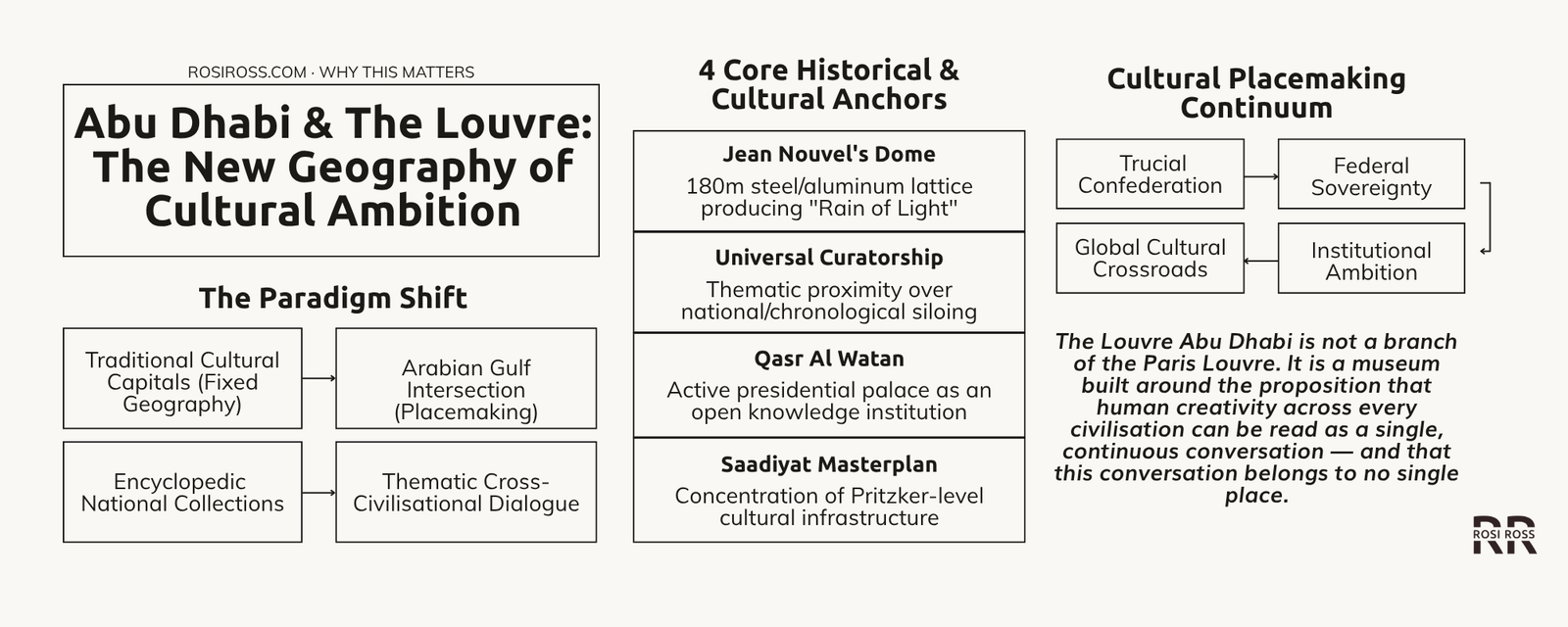
Jean Nouvel, the Swiss-French architect who received the Pritzker Architecture Prize in 2008, designed the Louvre Abu Dhabi around a single dominant architectural idea: a dome 180 metres in diameter, constructed from a layered lattice of steel and aluminium derived from the geometric patterns of traditional Islamic architecture — specifically, the interlaced palm leaf motifs used as roofing material in traditional Arabian building — through which natural light filters to create the specific visual effect Nouvel called the “rain of light.”
The dome is not simply a beautiful roof. It is an argument about the relationship between shelter, light, and cultural space in the specific context of the Gulf. The Arabian climate demands shelter from the sun — historically provided by the dense urban fabric of the traditional medina, by courtyard architecture, by the deep shade of the covered souk. Nouvel’s dome transposes this traditional response to solar intensity into a structure of extraordinary geometrical complexity — its lattice composed of 7,850 unique star-shaped elements across eight overlapping layers, creating a pattern of dappled light on the spaces below that changes through the day as the sun moves. The water system running beneath the museum — inspired by the falaj, the ancient Arabian irrigation channel that the UAE has operated for more than three thousand years and that has been designated a UNESCO Intangible Cultural Heritage — creates a network of reflecting pools and channels that extend the visual dialogue between light, water, and architecture across the museum’s footprint. The dome and the water are not decorative. They are the building’s statement about its specific location — a piece of architecture that could only exist in this climate, in this cultural context, as this kind of institution. The most enduring architectural propositions are always those most specifically in dialogue with the conditions of their place — material, climatic, and cultural — and Nouvel’s dome is one of the most complete contemporary expressions of this principle.
Jean Nouvel’s dome at the Louvre Abu Dhabi is 180 metres in diameter — larger than the dome of St. Peter’s Basilica in Rome — and is constructed from 7,850 unique star-shaped lattice elements across eight overlapping layers of steel and aluminium, derived from geometric patterns found in traditional Islamic architecture and specifically from the interlaced palm leaf motifs of traditional Arabian roofing. The dome creates the visual effect Nouvel described as a “rain of light” — dappled natural illumination that shifts through the day as the sun’s angle changes — and its design addresses the fundamental challenge of the Gulf’s solar climate by providing the deep, diffuse shade that traditional Arabian urban forms achieved through different means. The dome covers the museum’s galleries, restaurants, and public spaces, creating a microclimate beneath it that allows outdoor circulation in a climate that would otherwise prohibit it for much of the year. The building received the Aga Khan Award for Architecture in 2019, the most prestigious recognition in Islamic architecture. Jean Nouvel received the Pritzker Architecture Prize — architecture’s highest honour — in 2008.


The collection — universal humanistic comparison in practice
The Louvre Abu Dhabi’s permanent collection of over 600 works spans twelve galleries arranged not by civilisation or chronological period but by theme — the Early Humans, the First Villages, the Universal Religions, the Trade Routes, the Modern World. Within these themes, objects from apparently distant cultural contexts are placed in visual and conceptual proximity: a Bactrian princess from the third millennium BCE alongside Egyptian funerary figures; Islamic geometric tilework alongside Gothic stained glass; a Japanese screen painting alongside a French Romantic canvas. The effect is not relativism — the institution does not claim that all art is equivalent regardless of context — but rather a specific kind of cross-civilisational reading that the Western museum tradition’s organisational conventions typically prevent.
The most powerful galleries in the Louvre Abu Dhabi are those where this proximity produces unexpected insight rather than simply unexpected adjacency. The gallery of universal religions — in which objects of Christian, Islamic, Buddhist, Jewish, and Hindu devotion are presented as expressions of the same human impulse toward the transcendent — has a specific quality of intellectual and emotional weight that derives precisely from its location: a gallery in which the visual traditions of Islam and Christianity find equal space, in a museum on an island in the Arabian Gulf, within a city that has positioned itself as a meeting point of civilisations. This is the context that makes the Louvre Abu Dhabi’s comparative proposition not merely interesting but genuinely significant: it is not doing something that could equally well be done in Paris or London or New York. It is doing something that can only be done here, in this way, with this specific weight. The most resonant cultural institutions are those that could not exist in any other geography without losing something essential — and the Louvre Abu Dhabi is, in its best moments, precisely this kind of institution.
Qasr Al Watan — the palace as knowledge institution
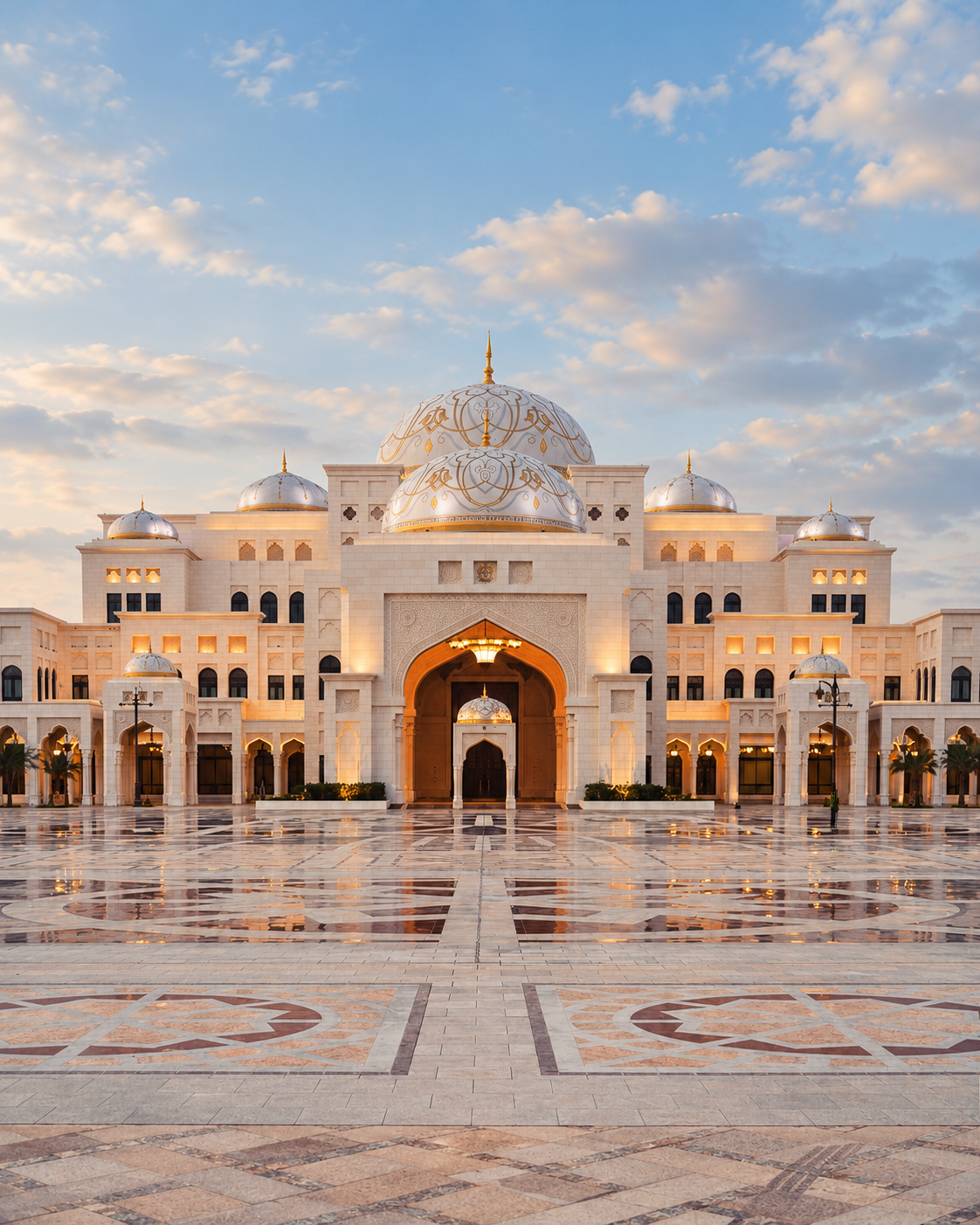
Qasr Al Watan — the Palace of the Nation — is not a conventional palace in the touristic sense: a historic royal residence preserved as a monument to a vanished way of life. It is an active presidential palace, opened to the public as a deliberate act of cultural transparency, whose function is simultaneously governmental and educational — a place where official state visits of global leaders are hosted in the same spaces where the public is invited to understand the history, governance philosophy, and cultural values of the UAE.
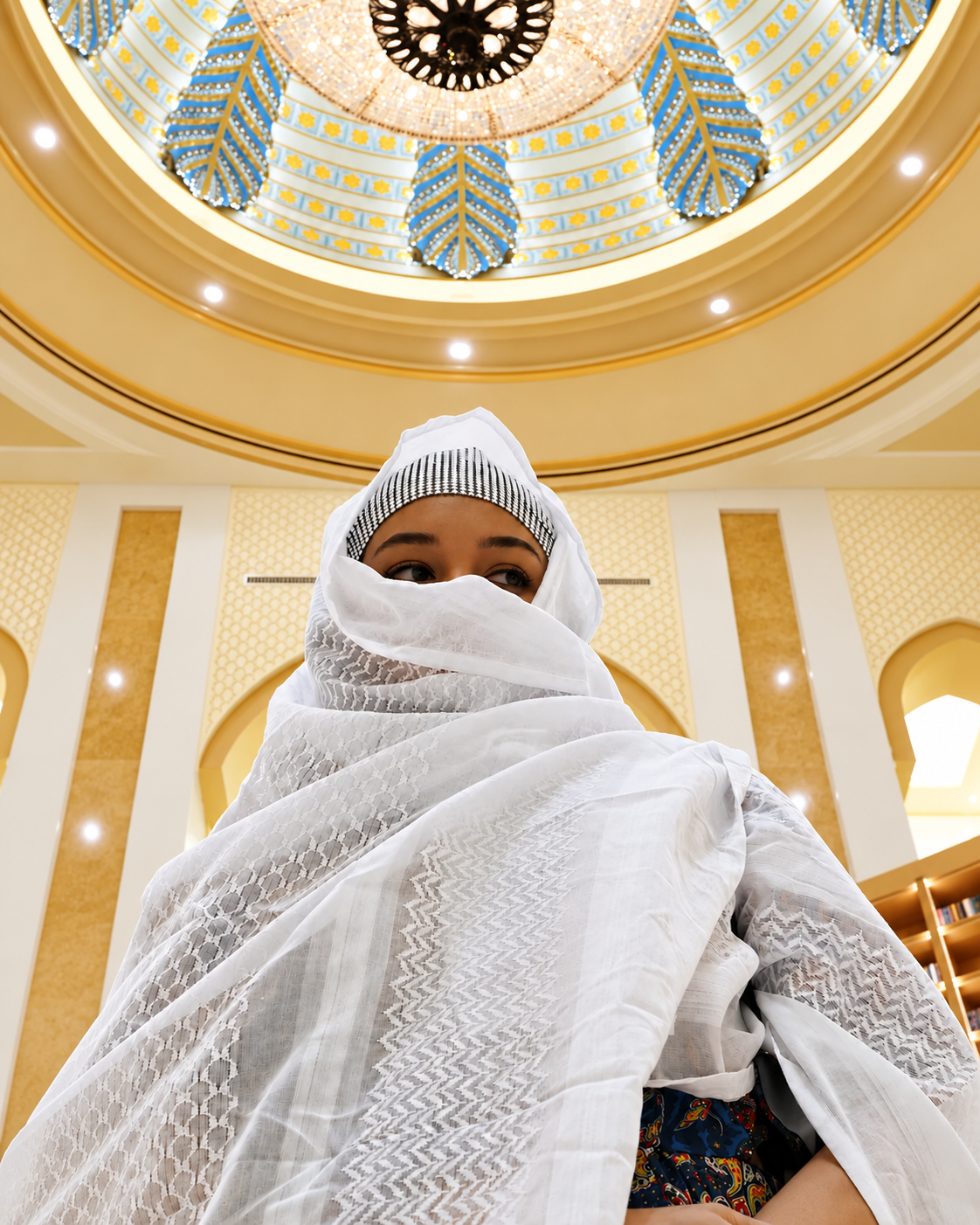
The building is architecturally imposing — a vast structure in white Arabian marble at the western end of the Abu Dhabi Corniche, its interiors organised around the Great Hall, from which the West Wing’s governance exhibits and the Chamber of Collaboration — the formal meeting space for the UAE’s Federal Supreme Council — radiate. The library within the palace, whose collection spans archaeology, history, governance, human sciences, literature, and the arts, makes an explicit statement about the relationship the institution seeks between power and knowledge: that the governing authority of a contemporary nation is most legitimate when it is most visibly in relationship with the full breadth of human intellectual achievement. The “Palace in Motion” light and sound show that illuminates the building’s exterior each evening — tracing the UAE’s journey from a confederation of Trucial States to one of the world’s most prosperous and internationally engaged nations across a sixty-year span that has no equivalent in any modern country’s history — is less a spectacle than an argument: that transformation at this speed and this scale requires a specific kind of cultural confidence, and that confidence is most fully expressed when it can be shared.





Saadiyat Island and the cultural district — the most deliberate act of cultural placemaking in the contemporary world
Saadiyat Island — the name means Island of Happiness in Arabic — is a natural island approximately five kilometres from Abu Dhabi’s city centre, connected by bridge and currently in the most ambitious phase of a development programme whose cultural dimension is without parallel in the contemporary world. The Saadiyat Cultural District, of which the Louvre Abu Dhabi is the first completed major institution, will eventually include the Guggenheim Abu Dhabi — designed by Frank Gehry, whose Abu Dhabi building is expected to be the largest Guggenheim in the world when completed — the Zayed National Museum, designed by Norman Foster & Partners to tell the story of the UAE’s founding father and national development, and a performing arts centre designed by Zaha Hadid Architects whose organic shell form is among the most anticipated architectural projects of the coming decade.
The deliberateness of this cultural placemaking — the specific decision to commission four of the world’s most significant living architects to design four world-class cultural institutions in the same district — is a statement that Abu Dhabi is making not about its wealth but about its ambition: the ambition to be a place where the conversation between civilisations is not merely hosted but genuinely advanced, where the encounter between Eastern and Western cultural traditions produces not simply co-existence but genuine intellectual and aesthetic exchange. The question of whether this ambition is being realised is the most interesting question that Saadiyat Island raises — and the Louvre Abu Dhabi’s success in producing the specific quality of cross-civilisational encounter it was designed to facilitate suggests that the answer, at least for that institution, is yes. The most consequential acts of contemporary placemaking are those that create not simply beautiful buildings but the conditions for a specific quality of human experience that those buildings uniquely enable — and the Saadiyat Cultural District, at its most realised, is producing exactly this kind of place.
The Saadiyat Cultural District is a designated cultural zone on Saadiyat Island, approximately five kilometres from Abu Dhabi’s city centre, conceived as a cluster of world-class cultural institutions designed by globally significant architects. Completed and in development: the Louvre Abu Dhabi (Jean Nouvel, opened 2017); the Guggenheim Abu Dhabi (Frank Gehry, in development — expected to be the largest Guggenheim in the world); the Zayed National Museum (Norman Foster & Partners, in development — dedicated to the UAE’s founding president Sheikh Zayed bin Sultan Al Nahyan); and a performing arts centre designed by Zaha Hadid Architects. The district also encompasses the Manarat Al Saadiyat cultural centre and the NYU Abu Dhabi campus. The Saadiyat Cultural District is considered the most ambitious act of intentional cultural placemaking in the contemporary world because it involves commissioning four of the twentieth and twenty-first century’s most consequential architects to design four major cultural institutions in a single district — a concentration of architectural and cultural ambition with no direct parallel in recent history.
Abu Dhabi as a travel destination — the cultural case
Abu Dhabi is frequently positioned in travel writing as a quieter, more conservative, more governmentally serious alternative to Dubai — which is a description that does justice to some of its character while missing most of what makes it genuinely worth the journey. The Sheikh Zayed Grand Mosque — completed in 2007, capable of accommodating more than 40,000 worshippers simultaneously, its white exterior one of the most visually distinctive architectural statements in the Gulf — is among the most beautiful religious buildings constructed anywhere in the world in the past half-century: a building that achieves through material extravagance — the white Macedonian marble, the Swarovski crystal chandeliers, the hand-knotted carpet (the largest in the world) — a quality of serene, luminous beauty that its ingredients suggest would be impossible. The Corniche — the eight-kilometre waterfront promenade that runs along Abu Dhabi’s western shore, lined with palm trees and facing the Gulf — provides the kind of leisurely waterside civic space that the most civilised cities in the world have always known how to build. Yas Island, which hosts the Abu Dhabi Formula 1 Grand Prix and the Ferrari World and Warner Bros. World theme parks, represents the contemporary entertainment ambition at its most concentrated.
But the most compelling reason to travel to Abu Dhabi specifically — as opposed to the Gulf generally — is the Saadiyat Cultural District and what it represents: a city’s decision to define itself through cultural ambition rather than simply through commercial or recreational infrastructure, and to make that ambition legible in architecture of genuine quality designed by architects of genuine consequence. The Louvre Abu Dhabi is not the finest museum in the world. But it may be the most interesting one in the world at this precise moment — not because of the works it contains but because of the argument it makes about where culture belongs, who gets to participate in it, and what a universal institution looks like when it is built at the crossroads of the world rather than at one of its traditional centres. The UAE’s ambition to position itself as the geography where the world’s most significant conversations happen — whether those conversations are commercial, technological, or cultural — is expressed most completely not in its financial centres or its conference venues but in the Louvre Abu Dhabi’s dome, filtering the Arabian sun into a rain of light above a gallery where a Byzantine icon and a Qur’anic manuscript stand in quiet conversation with each other.
“The Louvre Abu Dhabi’s argument is simple
and radical simultaneously.
Culture has no fixed geography.
The conversation between civilisations
belongs wherever people
are most committed to having it.
And the crossroads of the world —
where East and West have always met,
traded, argued, and influenced each other —
is as legitimate a location
for that conversation
as any of its traditional capitals.”

