
On the 7th Duchess of Bedford and the ritual she invented in 1840, the elliptical towers Killa Design built at the end of JBR, the lobby olive trees that make a 16-metre ceiling feel like a drawing room, and why the finest afternoon teas in the world are always arguments about place
There are rituals that survive because they are convenient, and rituals that survive because they address something deeper than hunger. Afternoon tea is the second kind. It was never simply about food at four o’clock. It was about the quality of attention that a deliberate pause in the middle of a day produces — the specific pleasure of setting down the work, the agenda, the forward momentum of a productive afternoon, and choosing, for one hour, to be precisely where you are. The finest afternoon teas in the world understand this. They are not menus. They are propositions about time.
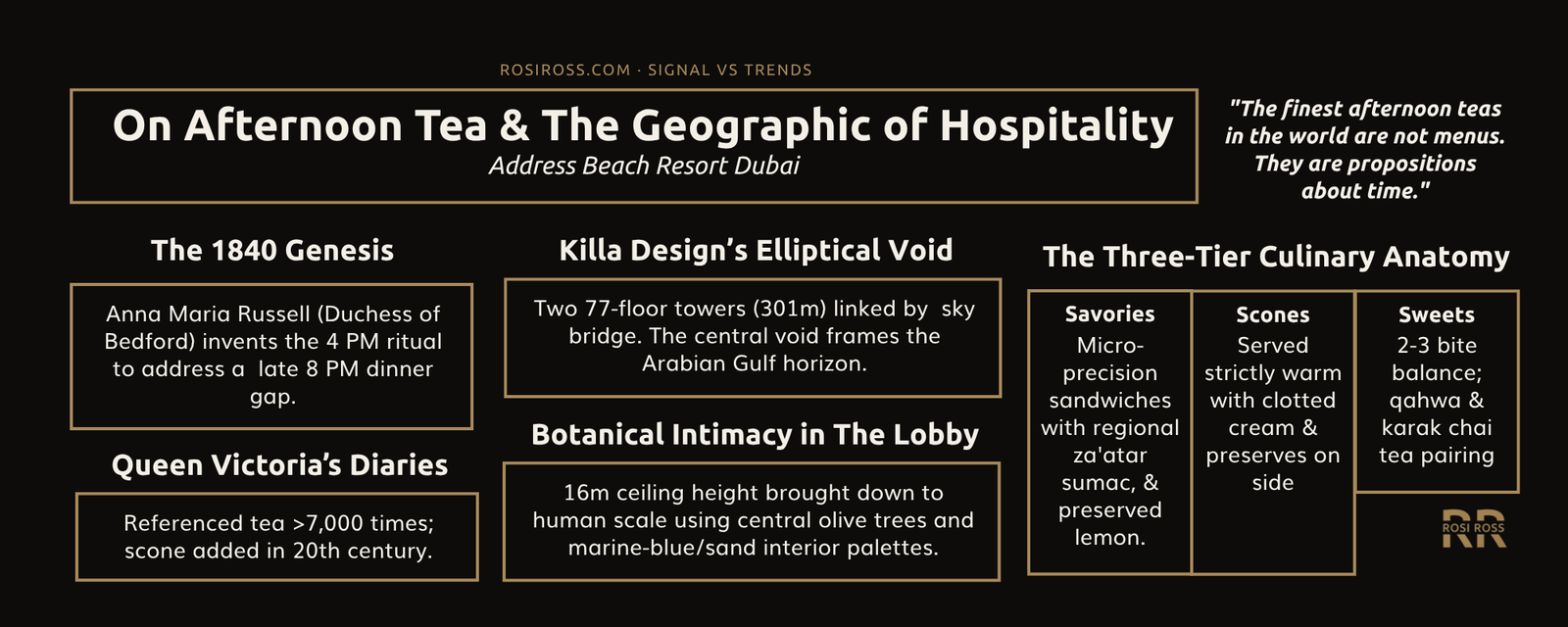
The story begins, as these things often do, with a woman who trusted her instincts. In around 1840, Anna Maria Russell, the 7th Duchess of Bedford and a Lady of the Bedchamber to Queen Victoria, found herself experiencing what she described as a “sinking feeling” in the late afternoon. Dinner in aristocratic England was served as late as 8 or 9 in the evening. Luncheon was light. The hours between were long. The Duchess, staying at Belvoir Castle in Leicestershire, requested a tray of tea, bread and butter, and cake be brought to her private rooms at around four o’clock. Her friends were invited to join. The habit became a ritual. The ritual became a fashion. By the 1860s, afternoon tea had become an entrenched feature of British upper-class life, eventually spreading through every level of society as tea became affordable and the social pleasure of the pause became irresistible regardless of class.
What the Duchess invented was not a meal. It was a social architecture — a format that made stopping feel purposeful rather than indulgent, that gave the middle of an afternoon a shape and a reason, that transformed the otherwise dead hours between productive morning and social evening into something with its own aesthetic logic. As the British Museum’s food historian Tasha Marks documents, Queen Victoria recorded references to tea parties more than 7,000 times in her diaries. The scone, now inseparable from the ritual, was not even introduced until the twentieth century. The ceremony was not fixed from the beginning. It accumulated. It adapted to circumstance, location, and the specific cultural intelligence of wherever it found itself being practised. That capacity for adaptation is precisely what has allowed it to survive not as a nostalgic relic but as a living hospitality form whose finest contemporary expressions have very little in common with a Victorian drawing room in Leicestershire — and yet have everything in common with what the Duchess was attempting to produce.
Afternoon tea was invented in approximately 1840 by Anna Maria Russell, the 7th Duchess of Bedford, who described experiencing a “sinking feeling” during the long gap between a light luncheon and a late evening dinner, typically served at 8 or 9pm in aristocratic England. She began requesting tea, bread, butter, and cake in the afternoon at Belvoir Castle in Leicestershire and began inviting friends to join her. As one of Queen Victoria’s Ladies of the Bedchamber, the Duchess helped spread the ritual through royal and aristocratic circles. Queen Victoria referenced tea parties more than 7,000 times in her diaries. By the 1860s, afternoon tea had become a fashionable social institution. The scone — now considered essential — was only added to the tradition in the 20th century. The ritual has since been adopted and adapted by luxury hotels globally as one of hospitality’s most enduring service formats.
The building — what Killa Design understood about the end of the beach
To understand afternoon tea at Address Beach Resort Dubai, you must first understand the building it occupies — because in few other properties in the world does the architecture so completely shape the quality of the experience available within it.
Address Beach Resort was designed by Killa Design, the Dubai-based architectural practice responsible for the Museum of the Future — the torus-shaped cultural institution that appears on every serious list of the most significant pieces of contemporary architecture in the world. The commission at JBR asked Killa Design to complete the end of the Jumeirah Beach Residence beachfront: a position of enormous urban consequence, where the beach meets the entrance to Dubai Marina, and where the skyline requires a building capable of functioning as both a full stop and an invitation. What they produced is an ellipse.
The two 77-floor towers — 301 metres tall, connected at their base for the lobby and at their peak for the sky bridge, sky lofts, and penthouses — share a single elliptical form in plan, with a void at the centre. That void is a deliberate spatial decision: it increases daylight penetration to the lower floors, creates a framed view from every room toward the Palm Jumeirah, JBR beach, and the Arabian Gulf horizon, and ensures that no room in the tower is oriented away from what the site is actually offering. The facade encompasses 82,000 square metres of curtain wall glass. The landscape podium peels off the building across multiple levels like a nautilus shell, fanning outward toward the beach. The building’s relationship to the light — to the quality of afternoon light on the Arabian Gulf, specifically — was built into the design from the structural level. It is not incidental. It is the premise.
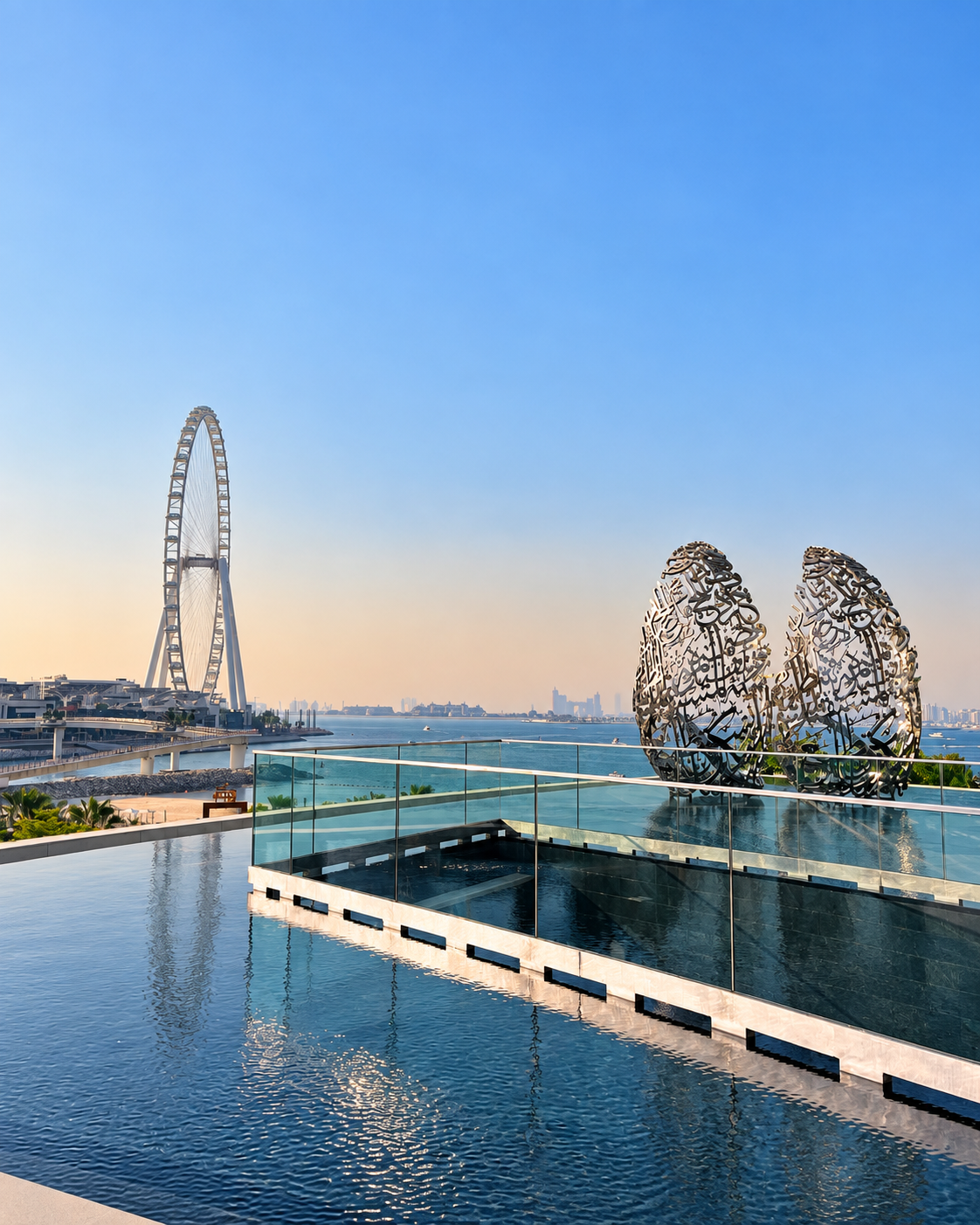
The Guinness World Records title the building holds — the highest outdoor infinity pool in a building in the world, at 293.9 metres — is the most publicly known architectural feature. It is also, architecturally speaking, the least interesting one. The record was never the point. The point was a building designed to make the Arabian Gulf and the Dubai skyline continuously, inescapably present to everyone inside it, at every level, in every space. The infinity pool simply takes this principle to its logical vertical conclusion. The comparison with One&Only One Za’abeel — another Dubai property that positioned itself to exploit the vertical relationship between the guest and the city — is instructive: both argue that altitude is not just a view. It is an emotional condition. Address Beach Resort makes this argument from the beach, looking outward. One Za’abeel makes it from the centre of the city, looking down. The propositions are different. Both are serious.
Address Beach Resort Dubai was designed by Killa Design, the Dubai-based architectural practice also responsible for the Museum of the Future. The twin 77-floor towers, standing 301 metres tall, are connected by what was recognised as the highest occupiable skybridge floor in the world at the time of opening. The towers form an ellipse in plan with a central void that maximises daylight penetration and ensures unobstructed views of the Palm Jumeirah, JBR beach, and the Arabian Gulf from every level. The facade encompasses 82,000m² of curtain wall glass. The landscape podium fans outward toward the beach in a nautilus shell form. The building holds the Guinness World Record for the highest outdoor infinity pool in a building (293.9 metres). Interiors were designed by KCA International, using a palette of marine blues, teals, and sand tones in a triple-height 16-metre lobby.


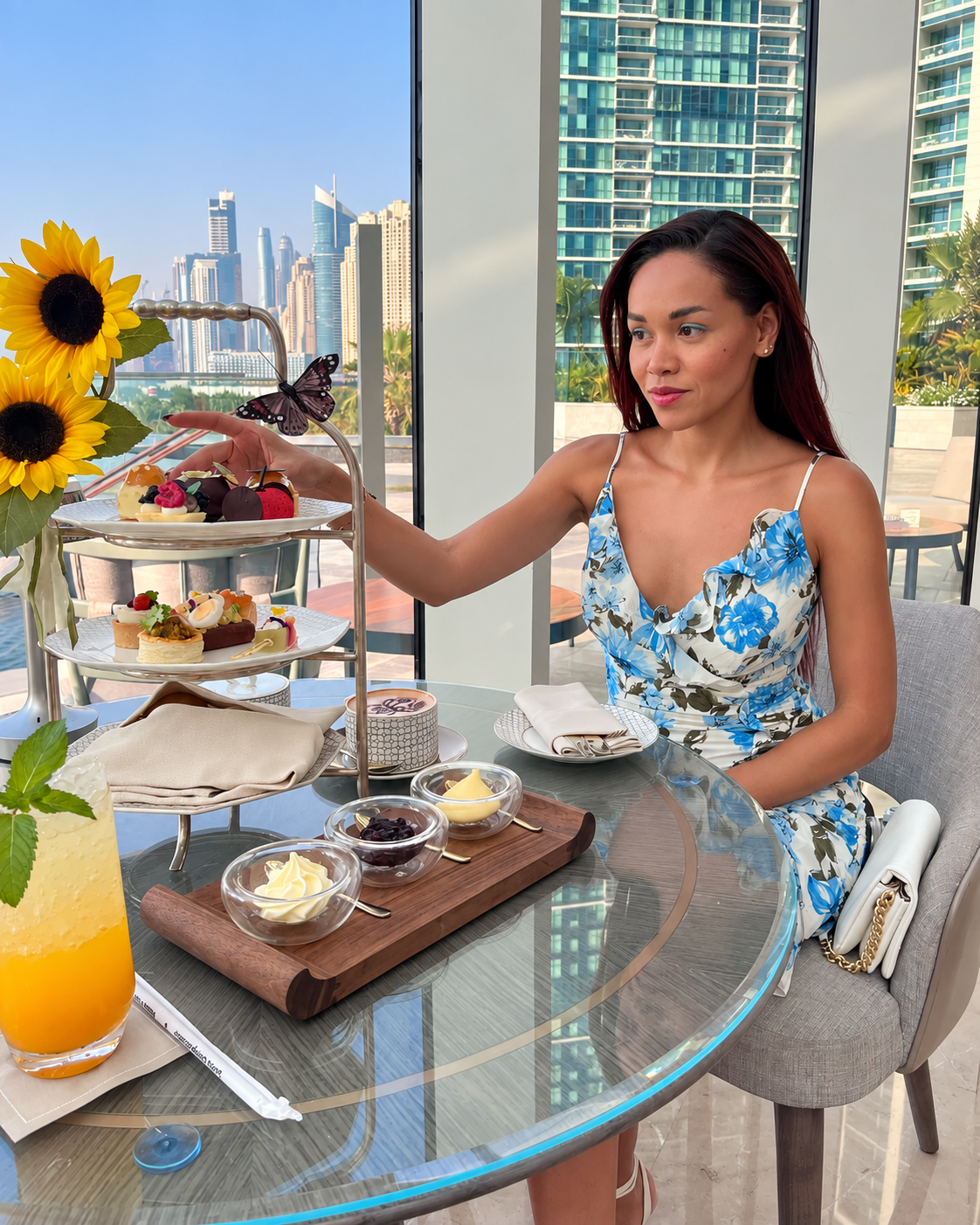
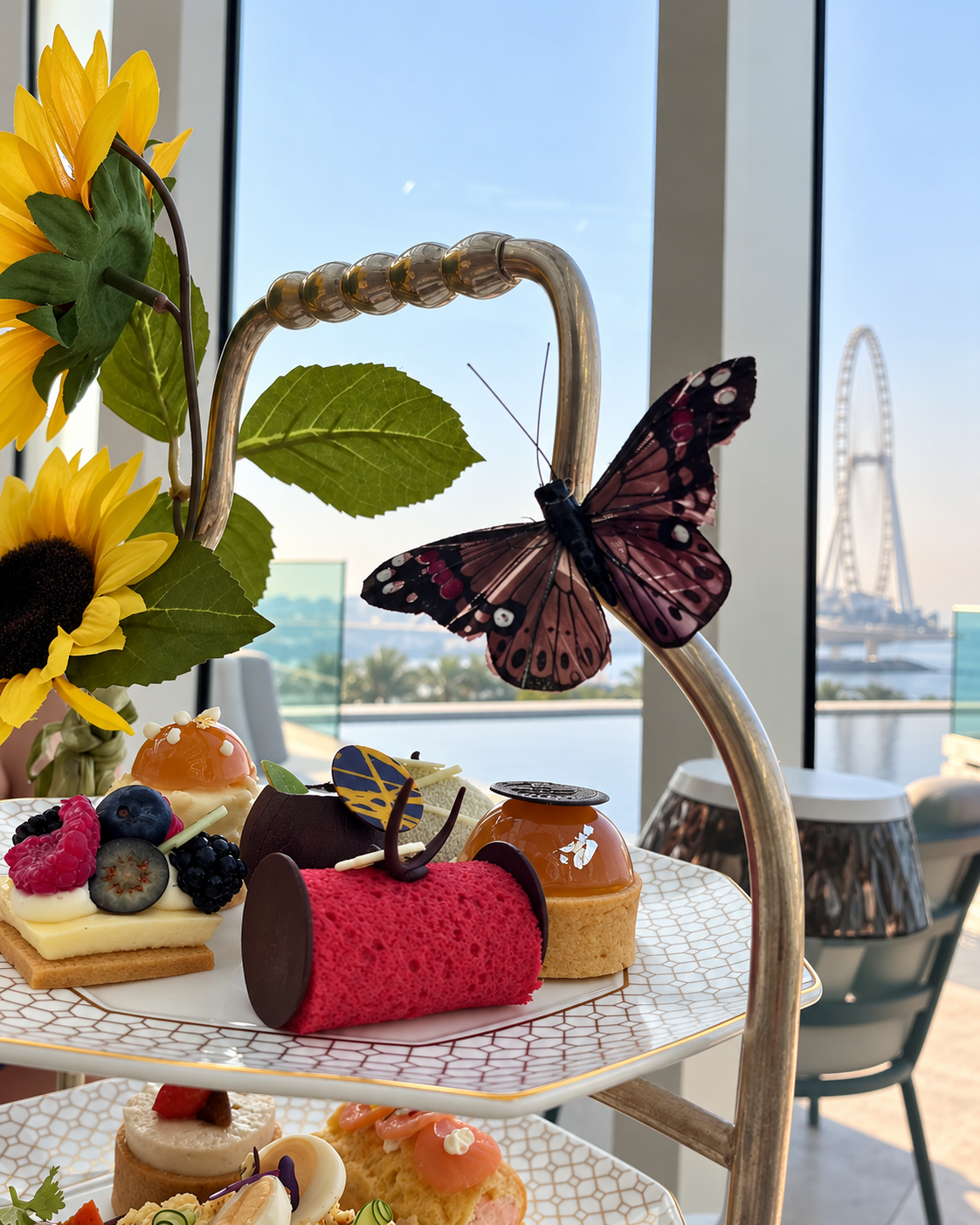
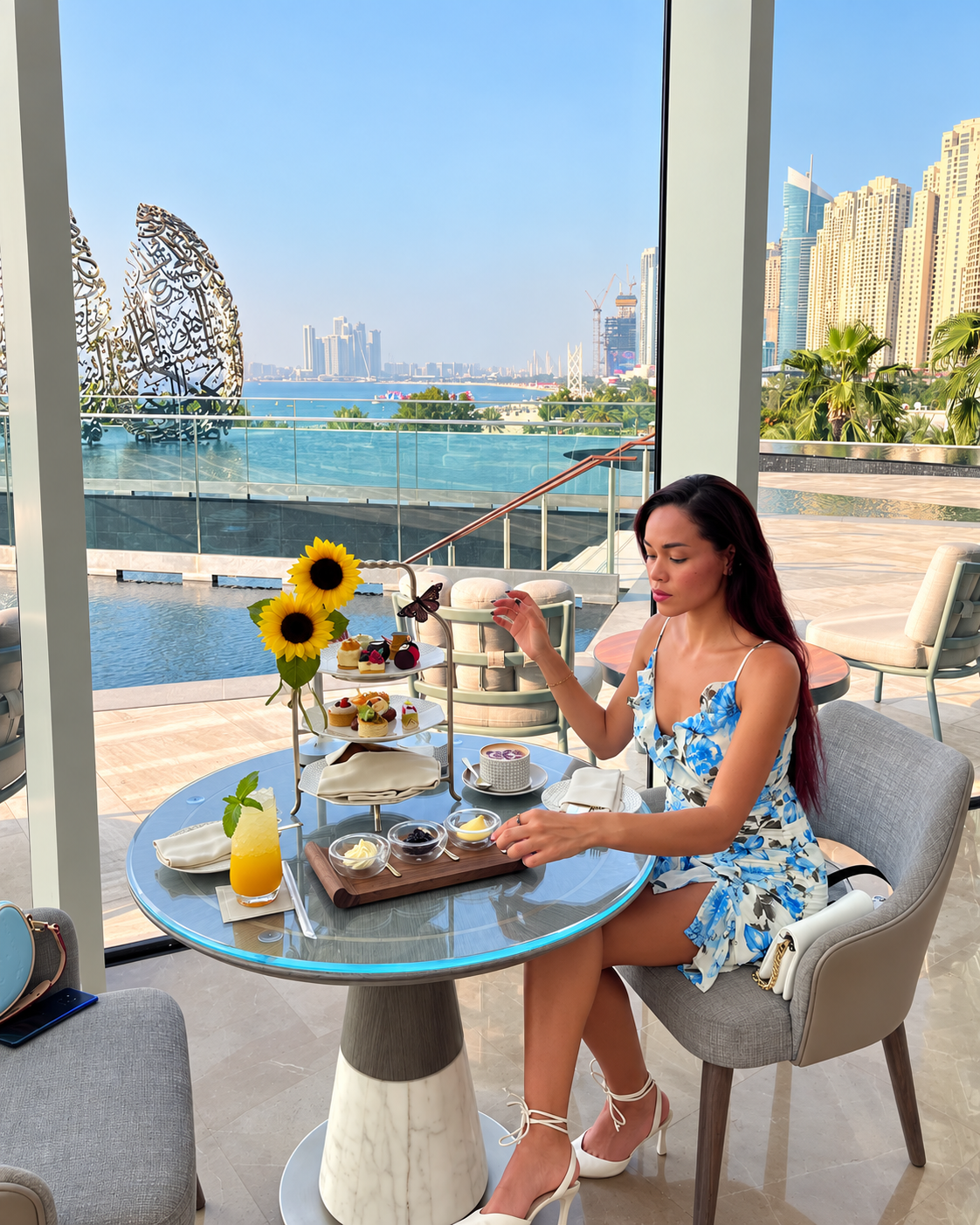
The Lounge — what it means to design a room around olive trees
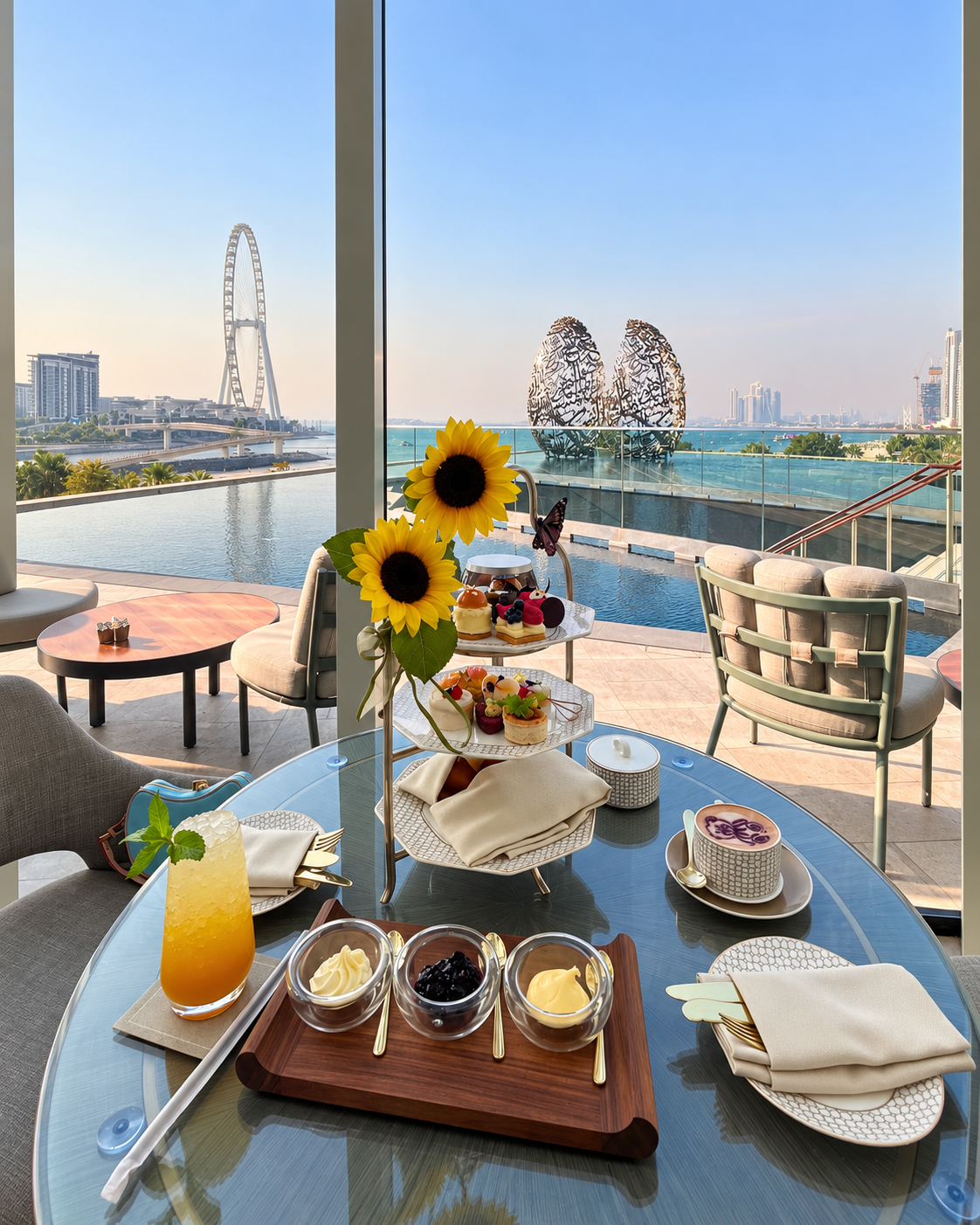
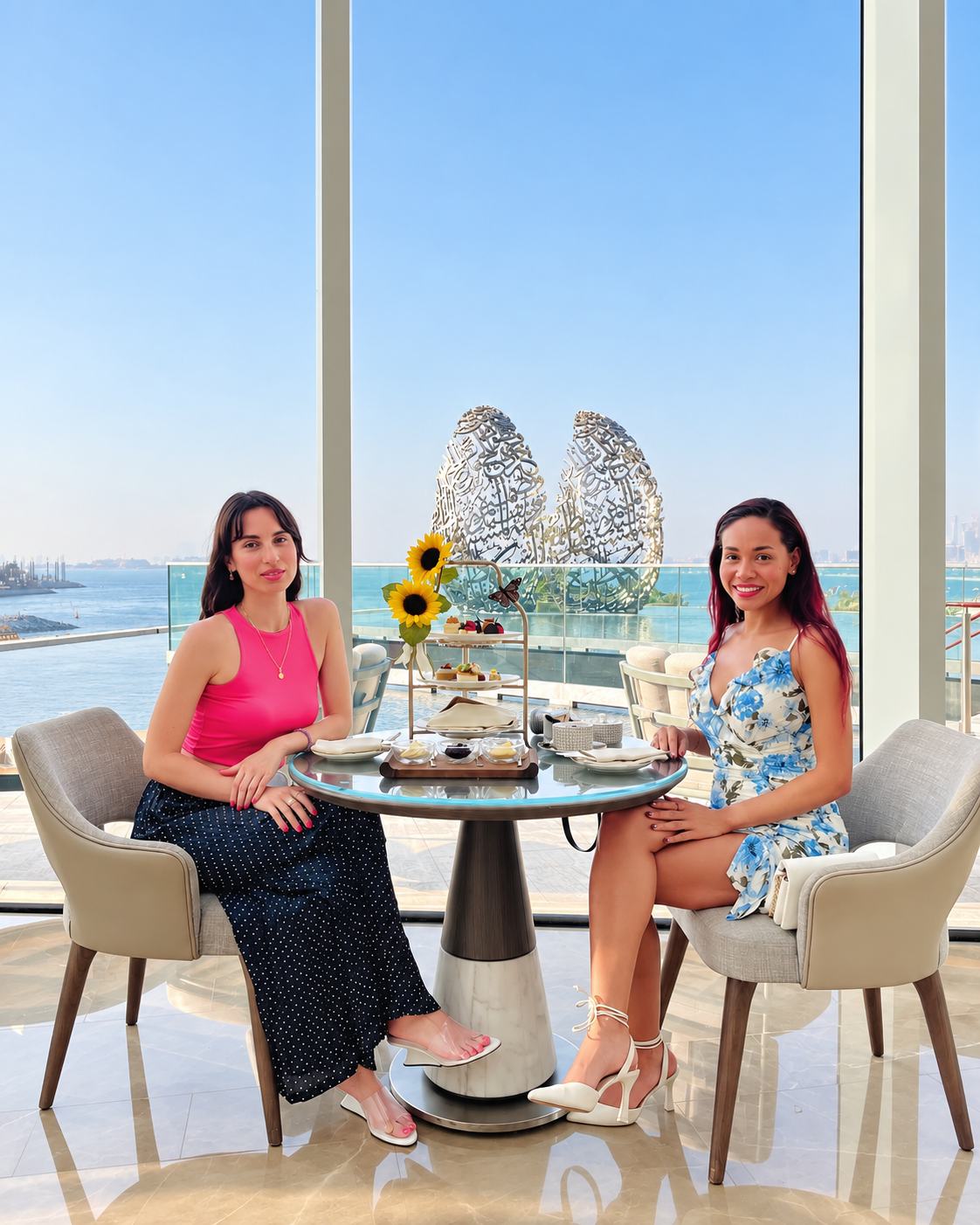
The afternoon tea at Address Beach Resort is served in The Lounge: a space set around the lobby’s most defining design decision, which is also its most quietly radical one. KCA International, who designed the interiors, understood that a 16-metre triple-height lobby ceiling creates a specific problem in luxury hospitality. The problem is not grandeur. It is intimacy. A ceiling at that height imposes distance between the guest and the space — a verticality that reads as institutional rather than welcoming, as civic rather than personal. The solution KCA found was not architectural but botanical.
The olive trees at the centre of the lobby are not decorative. They are structural arguments about scale. Positioned beneath the triple-height ceiling, they create a canopy at human height — a layer of living architecture that intercepts the verticality of the space and produces, within it, pockets of intimacy calibrated to conversation rather than spectacle. The palette around them — marine blues, teals, and the sand tones that reference the Arabic etymology of za’abeel itself (white sand, the name of the broader district, though here applied to the beach and bay context) — completes the spatial argument: you are in a room at the edge of the Gulf, at the end of the beach, and the room knows where it is.
This is the hospitality design problem that the best hotel lounges in the world solve differently and, when they solve it well, solve completely. The Lounge at The Langham London, where afternoon tea has been served since 1865, works through Georgian proportion and a specific relationship between ceiling height and room width that produces intimacy as a mathematical outcome. The Palm Court at The Ritz London achieves it through the Louis XVI decorative programme that fills every surface with pattern at human scale, preventing the eye from ascending to the architecture above. KCA’s olive trees at Address Beach Resort produce it through nature rather than ornament — through the specific pleasure of being shaded, at human height, within a larger space. The mechanism is different. The outcome — the sense of being contained within a room that feels chosen rather than assigned — is the same. The most considered Dubai hospitality spaces share this understanding: the room that makes you feel at home in your best self.
The tea — culinary craftsmanship as cultural argument
The sequence of a properly composed afternoon tea is not arbitrary. It is a choreography whose logic emerged from the practical requirements of the drawing room: food that could be eaten standing, sitting, or in motion through a social space, that held its form without hot plates or additional service, and that offered a progression from savoury to sweet that managed appetite without producing the heaviness of a full meal. The sequence — savouries, scones, pastries and sweets — maps a specific arc of sensory experience whose integrity depends on each stage being resolved at its own level before the next begins.
The savouries are the most technically demanding element of the sequence and the one where the culinary intelligence of the kitchen is most legible. A finger sandwich is a study in proportion: the ratio of filling to bread, the thickness of the crust cut and how it is cut, the moisture content of the filling in relation to the bread’s density, the architectural question of whether the sandwich holds its form until the moment of consumption or begins to soften on the stand. These are not decorative concerns. They determine whether the experience begins with a sensation of careful craft or of an indifferent production line. The traditional cucumber sandwich — the dish that defines the category for most people — is one of the most technically demanding preparations in the entire afternoon tea repertoire, precisely because it has so few places to hide. Thin-sliced cucumber, lightly salted, drained of moisture, on white bread with good butter and a trace of white pepper: everything is the quality of the ingredients and the precision of the execution.
At Address Beach Resort, the culinary programme of the afternoon tea reflects the cultural intelligence of the broader property: a kitchen operating in Dubai, for a multicultural guest population, within a building whose architectural argument is the intersection of international ambition and a specific geography. The savouries incorporate the flavour registers of the Gulf region without reducing them to novelty: za’atar, sumac, and preserved lemon appear not as exoticising gestures but as the natural expression of where the kitchen is. This is the most significant evolution in the international afternoon tea form over the past three decades — the recognition that the ritual’s adaptability is a strength rather than a compromise, that the finest contemporary afternoon teas are arguments about place rather than replications of an English original, and that the Duchess of Bedford’s instinct was never about cucumber sandwiches specifically but about the pleasure of thoughtful food in a deliberately constructed moment of social grace.
The scone deserves its own sentence. At Address Beach Resort, the scones are served warm — the only temperature at which they are what they are supposed to be, and a choice whose apparent simplicity conceals a significant kitchen discipline: to produce scones that arrive warm throughout the service, not warm to the first guest and cool to the last, requires timing, sequencing, and attention to the pace of the table that most kitchens decline to manage. Clotted cream and preserves are served alongside rather than pre-assembled — the correct service, which respects the guest’s preference and prevents the scone’s surface from softening under the cream’s weight before it is eaten.
The pastry and sweet course is where the pastry team makes its clearest statement. In the most considered afternoon teas, the sweet tier is not a selection of miniaturised versions of larger desserts. It is a series of objects designed specifically for this context: two to three bites, structurally coherent, flavour-complete without being cloying, and sequenced to close the experience at a pitch of sweetness that feels resolved rather than excessive. The distinction between a tea pastry and a plated restaurant dessert is philosophical as much as technical: the tea pastry exists within a social context in which the guest is simultaneously eating, conversing, and managing a series of small objects across multiple courses. It must accommodate all of this without requiring full attention to the food itself.
The traditional afternoon tea sequence is savouries, then scones, then pastries and sweets. The order is not conventional but functional: savouries prepare the palate and manage appetite without heaviness; scones served warm with clotted cream and preserves provide the carbohydrate and fat plateau that prevents the sweet course from landing on an unprepared palate; pastries and sweets close the sequence at a controlled pitch of sweetness. Deviating from this sequence — beginning with sweets, or combining courses — disrupts the flavour arc and typically results in palate fatigue before the experience is complete. The formal structure also serves social function: it provides a shared choreography for the table that supports conversation without requiring it to compete with the demands of a complex plated meal.


The tea itself — what a tea list argues about the culture of a room
The tea service is the most consistently underestimated element of the afternoon tea experience and the one whose quality, or absence of quality, is most revealing about the seriousness of the kitchen’s engagement with the ritual. A tea list that offers six varieties of the same commodity grade oolong is not a tea list. A tea list built around the distinctions between first and second flush Darjeeling, between Taiwanese high-mountain oolongs at different oxidation levels, between the smoky registers of Lapsang Souchong and the floral minerality of a good Longjing, is a statement about the same level of craft investment that the kitchen applies to the food.
The question of what tea to serve at Address Beach Resort — at a property positioned in Dubai, serving guests from across every tea-drinking culture in the world — is genuinely complex and genuinely interesting. Gulf Arabic tea culture centres on qahwa (cardamom-spiced Arabic coffee) and karak chai (a spiced black tea with evaporated milk, whose specific flavour is inseparable from the Gulf’s social fabric). Indian tea culture, represented by a significant portion of the guest population in any Dubai luxury hotel, carries its own hierarchies of Assam and Darjeeling. East Asian guests arrive with palate memories of oolongs and green teas that would strike a British afternoon tea traditionalist as belonging to a different category entirely. The most intelligent response to this situation is not to choose one tradition and serve it to everyone. It is to build a tea programme that can speak intelligently to all of them — and to make that breadth its own editorial statement about the kind of place Dubai is and the kind of hospitality Address Hotel can offer within it.
This is, more broadly, the opportunity available to any afternoon tea programme operating outside the United Kingdom: the freedom to define what the ritual means in its specific context, rather than measuring itself against the Langham or the Ritz as standards it can only approximate. The finest afternoon teas outside Britain — at the Mandarin Oriental Hong Kong, at The Taj Mahal Palace in Mumbai, at Raffles Singapore — do not compete with their London antecedents. They have located the principle beneath the British form — the deliberate pause, the social architecture, the crafted sequence — and expressed it in the vocabulary of where they are. The most resonant travel experiences are always those that understand their own geography. An afternoon tea that knows it is in Dubai, on a beach, in a building designed by the architects of the Museum of the Future, should express all of that. Not metaphorically. Literally, through the food, the tea, the view from the table, and the quality of attention the room produces.
Service choreography — what thoughtful hospitality actually looks like
The service of an afternoon tea is a choreography in the theatrical sense: a sequence of movements, timings, and interventions that must be precisely timed without appearing timed at all. The most important skill in afternoon tea service is the management of pacing — the ability to read a table’s social rhythm and match the service to it, offering refills and additional courses at the moment the table is ready for them rather than at a fixed interval that may interrupt a conversation or arrive before a previous course has been finished.
Address Hotels and Resorts, the Emaar Hospitality Group brand within which Address Beach Resort operates, has built its service identity around what the brand describes as genuinely personal hospitality: the recognition that a guest in a luxury setting is not looking to be efficiently processed but to be individually attended to. In The Lounge context, this translates to service that is present without being intrusive, knowledgeable without being performative, and responsive to the specific tempo of each table rather than to a room-wide schedule. The distinction matters more in afternoon tea than in almost any other hospitality format because afternoon tea is, structurally, a social event rather than a dining experience. The service is background to conversation. It fails when it becomes foreground.
The specific quality of service that a team achieves when it has genuinely absorbed the architectural and cultural identity of the space it works within — when the staff in The Lounge understand what the olive trees are for, what the view of the Gulf is doing, why the palette of marine blues and sand tones was chosen — is qualitatively different from the service a team delivers when it has been trained to a standard that could apply to any property. Training can produce competence. Context produces character. The service at Address Beach Resort’s Lounge, at its best, carries the specific character of the building: aware of where it is, confident in what it offers, and genuinely interested in the quality of the experience it is producing rather than merely its own execution of it. The same principle that distinguishes a Bedouin guide who inherited knowledge of Wadi Mujib from one who learned it professionally applies in luxury hospitality: absorbed knowledge produces a different quality of encounter than acquired knowledge, and the guest at the table, however unconsciously, perceives the difference.
Dubai Marina and the question of destination
Address Beach Resort sits at the end of Jumeirah Beach Residence, where the beach meets the entrance to Dubai Marina — one of the most consequential intersections in the city’s geography. Dubai Marina is a purpose-built urban district — consistently identified by Condé Nast Traveller as one of the defining luxury hospitality corridors in the Gulf: approximately 3 kilometres of canal-flanked waterfront, surrounded by residential towers, restaurants, hotels, and the promenades of JBR that constitute one of the most densely social stretches of public space in Dubai. The Marina was conceived in the late 1990s and constructed over the following decade — an artificial canal system that created several kilometres of additional waterfront and the conditions for a neighbourhood whose character is genuinely unlike any other district in the city.
What the Marina offers — and what the positioning of Address Beach Resort at its southern end makes directly accessible — is a quality of urban life that Dubai’s other luxury districts do not provide in the same register: walkable, social, maritime, and cosmopolitan in the specific way that waterfront neighbourhoods achieve when they are properly designed. The restaurant of the Beach at JBR, the promenade that runs below the hotel’s podium, Ain Dubai visible across the water — the world’s tallest Ferris wheel, which reached the horizon of every northward-facing view from the towers — connect the hotel to a specific texture of the city that is not manufactured for tourism but actually inhabited. This is the geographic intelligence of the Address Beach Resort address: it is not a resort set apart from Dubai. It is a resort at the point where two of Dubai’s most compelling public environments — the beach and the marina — meet. The contrast with Nikki Beach’s engineered paradise on Pearl Jumeirah is instructive: both are situated on the waterfront, both understand atmosphere as a designed outcome, but Address Beach Resort occupies a position within the city’s living geography rather than a manufactured one beyond it.
An afternoon spent at The Lounge, looking out across the Gulf from a room positioned to offer the fullest available expression of that view, is an afternoon that is specifically and irreplaceably in Dubai — in this city, at this moment in its development, in a building designed by the same architects who made the Museum of the Future, in a district that is genuinely among the most considered pieces of urban hospitality infrastructure in the contemporary world. The most memorable evenings in Dubai begin and end in rooms that know where they are. Afternoons are no different.
Dubai Marina is a purpose-built urban waterfront district constructed from the late 1990s onward, comprising approximately 3 kilometres of artificial canal system surrounded by residential towers, restaurants, hotels, and the JBR promenade — one of the most walkable, socially active stretches of public space in Dubai. Address Beach Resort occupies a uniquely consequential position at the southern end of Jumeirah Beach Residence, where the JBR beach meets the entrance to Dubai Marina. This intersection gives the property simultaneous access to the beach environment and the urban density of the marina, positioning it within Dubai’s actual social and geographic fabric rather than on a separate manufactured site. The building’s elliptical form and central void were designed specifically to maximise views toward the Palm Jumeirah and the Arabian Gulf from every level.
The larger argument — why afternoon tea endures
Afternoon tea has survived for more than 180 years because it addresses something real: the human need for a defined pause in the middle of the productive day. Not lunch, which is functional. Not dinner, which carries its own social weight and duration. Something in between — an interlude deliberately constructed to produce pleasure, conversation, and the specific quality of ease that only arrives when there is nowhere you are required to be and nothing you are required to do except be present.
The ritual’s genius, as the Duchess of Bedford understood instinctively in 1840, is that it provides this pause with a structure. The structure is the permission. Without the savouries and the scones and the pastries and the tea in its proper sequence, the afternoon pause is merely a break — a gap in the schedule, aimless and easily filled with work. With them, it becomes an experience: something with a beginning, a middle, and a close, something that has been thought about and prepared and offered with care. The effort of the kitchen, however invisible it is meant to be, is what transforms the pause from a suspension of activity into an event worth having.
At Address Beach Resort, the afternoon tea is an event worth having for reasons that are cumulative and specific. The building’s architecture frames the Gulf and the beach as the room’s primary content. The Lounge’s olive trees create intimacy within grandeur. The culinary programme applies the discipline of the traditional sequence to ingredients and flavours that are native to where the kitchen finds itself. The service choreography is calibrated to conversation rather than to the kitchen’s schedule. The view from every table — toward the water, toward the horizon, toward Ain Dubai and the Palm — is the view that only this building, in this position, at this hour of the afternoon, can offer.
When the Duchess of Bedford described her “sinking feeling” in the late afternoon, she was describing not just hunger but the specific quality of an afternoon that had no shape. She solved it with tea and cake and good company. The solution is still available, 185 years later, in a building that the Duchess could not have imagined, in a city that did not exist when she made her request, to guests whose cultural backgrounds she could not have anticipated. The ritual has held. The pleasure it offers — of a deliberately paused afternoon, in a beautiful room, with something carefully made to eat and something worth discussing — is not diminished by the distance from Leicestershire. It is, in the best possible sense, enhanced by it.
“The finest afternoon teas in the world
are not menus.
They are propositions about time.
The Duchess of Bedford understood this
in 1840, in Leicestershire,
describing a sinking feeling
that no amount of efficiency
could address.
Address Beach Resort understands it
in Dubai, in a building made of glass,
above a beach that meets a marina
that meets the Arabian Gulf.
The ritual holds.
The pleasure it offers
is not diminished by the distance
from where it began.
It is — in the best possible sense —
enhanced by it.”

