
On intimate luxury dining, The Greens neighbourhood, Bangkok-inspired pan-Asian cuisine, the evolution of Dubai’s girls’ night culture, and why the most considered dining rooms in a maturing city are the ones that reward return visits rather than first impressions
In Dubai, the most coveted dining rooms are no longer the loudest ones. They are the most considered — the spaces that offer something the city’s grand spectacles cannot: the particular quality of an evening that felt entirely, specifically yours. Luxury is measured less by visibility and more by how a space makes people feel. The most valuable dining rooms in a city are not the most photographed — they are the most returned to.
Dubai’s dining culture has been evolving in ways that the city’s reputation for scale and spectacle does not always make visible. The megastructure restaurant with its thousand-cover footprint, its pyrotechnic service moments and its resident DJ performing for a crowd too large to be a room — this model has not disappeared, but it has been joined by something different. A quieter, more precise form of hospitality has been establishing itself across the city’s less obvious neighbourhoods, in spaces designed not to impress at first glance but to reward the decision to seek them out.
This shift reflects something real in how Dubai’s most engaged diners have begun to understand what they are looking for. The restaurant that requires the specific intention of someone who already knows, or has been told by someone who does, produces the discovery that becomes part of the experience. The knowledge that you are somewhere not everyone has been is a form of intimacy that no amount of production budget can manufacture.
The Greens represents this shift with unusual clarity. Removed from the dense hospitality corridors of Downtown and DIFC, the neighbourhood carries the particular quality of a place that rewards local knowledge over tourist instinct. Lah Lah at Zabeel House by Jumeirah, on the fourth floor above The Greens, belongs to this category precisely — a pan-Asian Dubai dining destination that has earned its place not through spectacle but through the consistent quality of the evenings it makes possible.
The appetite for neighbourhood-rooted Dubai dining intelligence is visible across how the city’s most considered food media covers its restaurant landscape. As GQ Middle East documents in its guide to Dubai’s best neighbourhood dining, the most interesting tables in the city are increasingly found away from its most obvious corridors — driven by community and by the quality of a space that has earned its place in a neighbourhood’s social fabric rather than announced itself through spectacle. Lah Lah belongs to this category precisely.
The same principle that makes Al Barari’s garden café a destination for those who know is at work at Lah Lah. At Nette Al Barari, Where Dubai Slows Down explores what that quality of intentional space feels like when it is achieved at its most refined — the specific satisfaction of an environment that was chosen rather than settled for. Lah Lah achieves a version of the same thing, but in a different register entirely: where Nette offers stillness, Lah Lah offers electricity. Both are forms of Dubai dining intimacy. Both require the decision to arrive.

Bangkok energy meets Dubai sophistication — the design intelligence of Lah Lah The Greens
The most transportive Dubai dining rooms are those that negotiate successfully between where they are and where they take you. Lah Lah manages this negotiation with a confidence that is immediately felt upon arrival and difficult to precisely attribute afterward. The aesthetic language draws from the specific visual culture of modern Asian hospitality — the warm, low-lit register of Bangkok’s most atmospheric bars and restaurants — while remaining entirely its own.
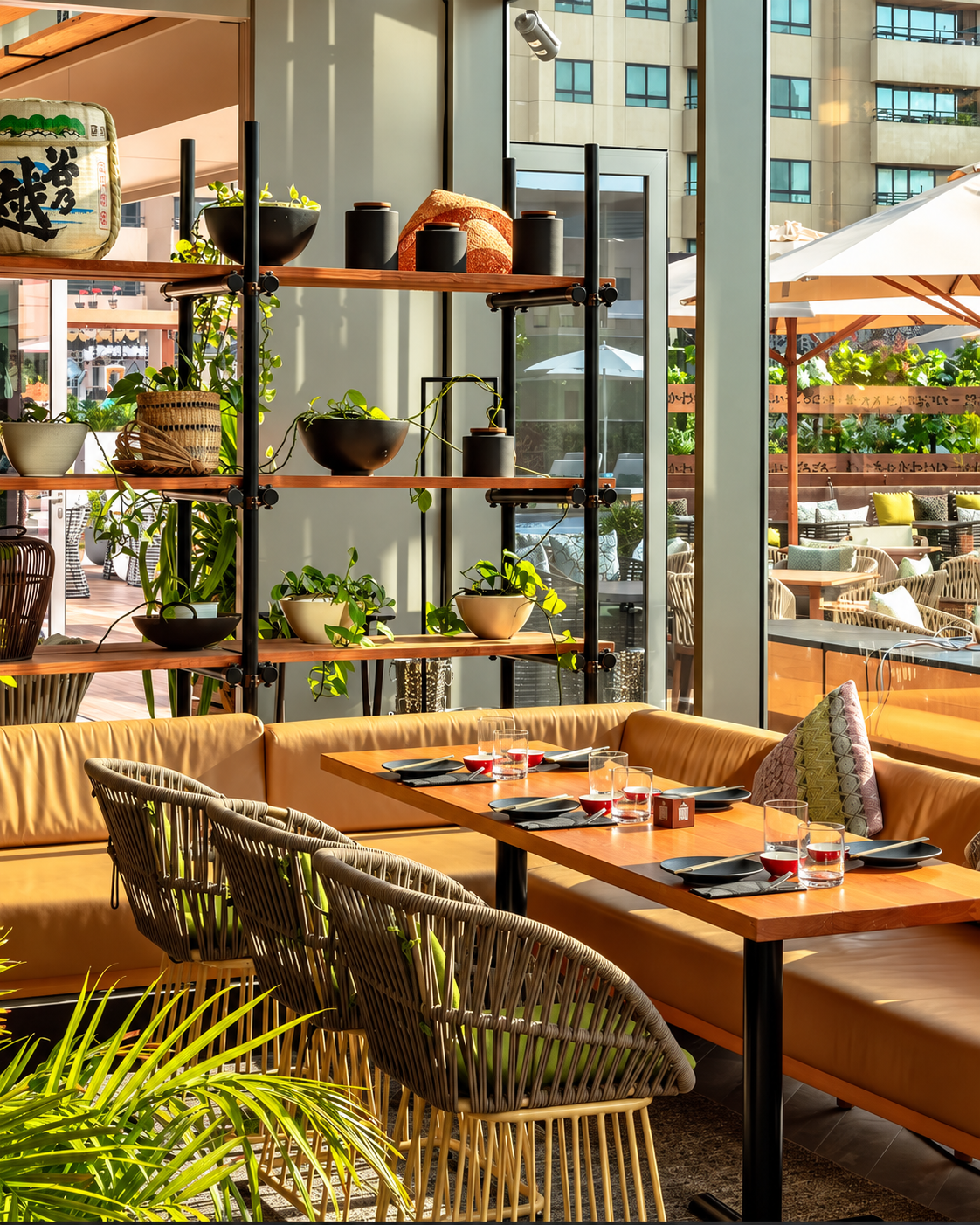
The fourth floor of Zabeel House by Jumeirah, a boutique hotel in The Greens known for attracting Dubai’s stylish and creative crowd, opens onto a world that has clearly decided what it wants to be — and made that decision with enough conviction that the effect lands before a single dish has been ordered or a single drink has arrived. Dark surfaces and warm light. The kind of spatial density that communicates a room full of people without the noise that usually accompanies it. Music that holds the right register — present enough to animate the atmosphere, restrained enough not to compete with the conversation it is designed to serve. This is a Dubai dining room that knows what it is doing.
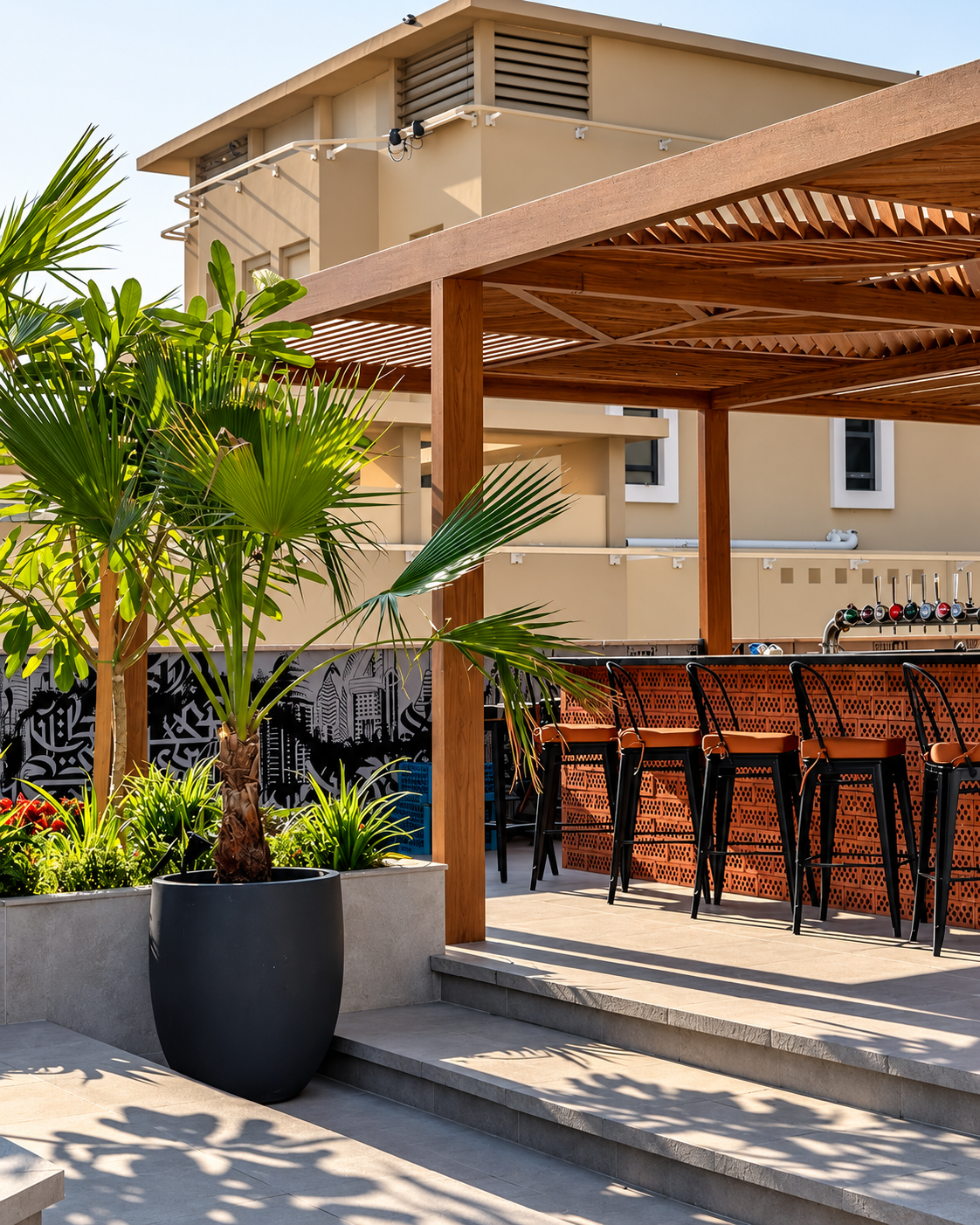
The space within Lah Lah accommodates different moods and configurations without losing coherence. The Lounge offers a refined yet relaxed environment with plush seating and an exclusive feel, perfect for quieter conversations or an intimate pan-Asian dinner. The outdoor Terrace is a breezy, open-air setting with a magnetic energy under Dubai’s glittering skyline — ideal for those who love an alfresco ambiance and the movement between interior and exterior that the best Dubai evenings provide. The Poolside Area serves those seeking a more vibrant, festive atmosphere for larger celebrations. Each zone carries its own invitation. Together, they constitute a Dubai dining destination that serves the full range of an evening’s requirements without requiring a choice about which kind of night it will be.
The renovation that extended and refined the outdoor terrace understood something important about how Dubai diners experience a good night: that the movement between interior and exterior, between the intimate and the expansive, between the contained and the open, is not a compromise but a resource. The terrace is not an overflow. It is a destination within the destination — the specific pleasure of Dubai’s skyline in the middle distance while the warm air of a city evening provides the sensory register that the region does particular justice.
The pan-Asian dining register that Lah Lah occupies has established itself as one of the most creatively compelling categories in Dubai’s restaurant landscape. As GQ Middle East’s guide to the best Asian restaurants in Dubai identifies, the most successful pan-Asian restaurants in the city are those that draw from specific culinary traditions with the confidence of a kitchen that knows which expressions of those traditions are worth bringing to a Dubai table — rather than attempting a comprehensive survey. Lah Lah’s kitchen operates with exactly this selectivity.


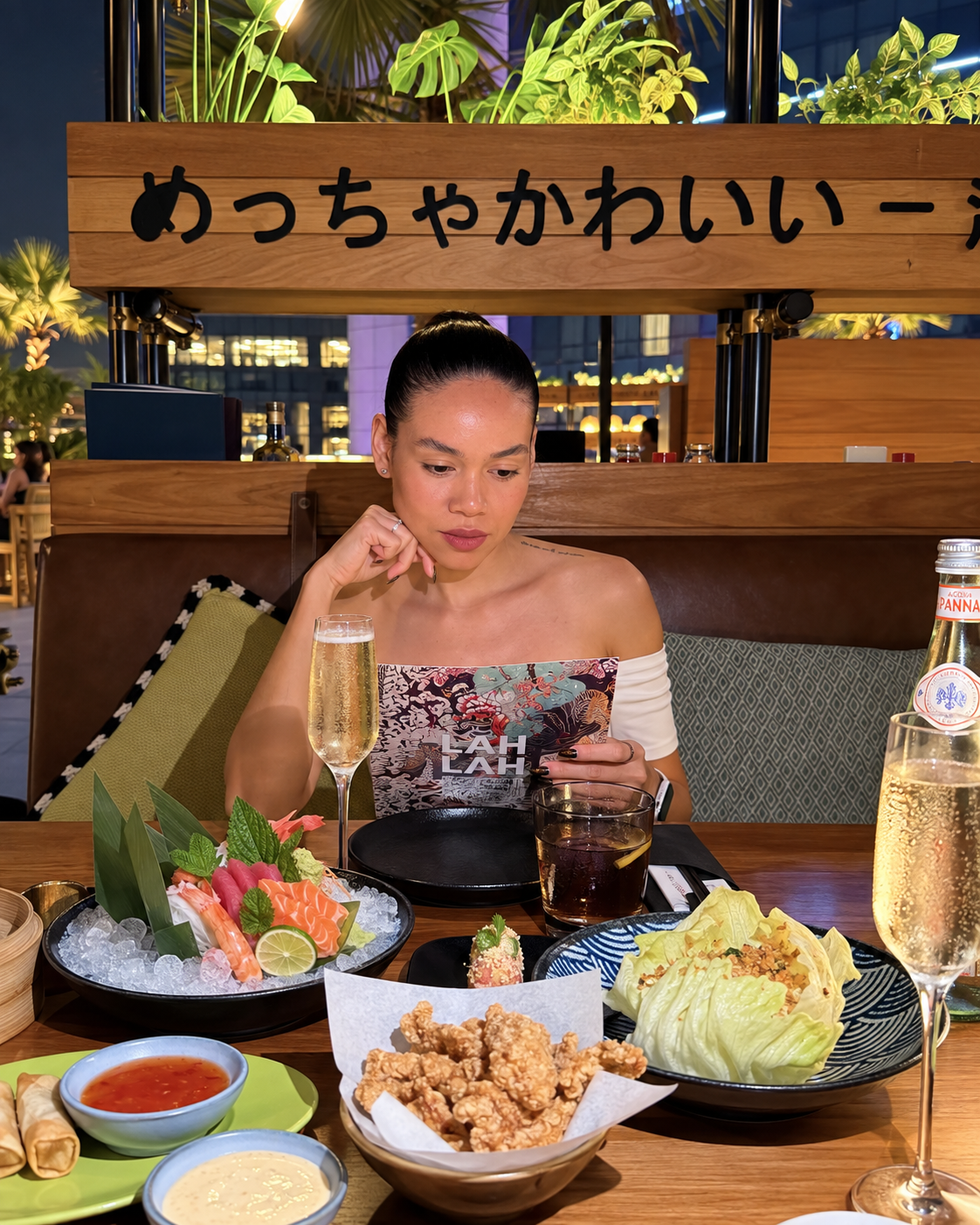
The new ritual of Dubai girls’ night — why Lah Lah’s Wednesday ladies’ night is different
The best girls’ nights are not organised around a promotion. They are organised around a need — the specific human requirement for an evening that belongs entirely to the people in it, governed by the logic of friendship rather than the logic of the working week. What attracts women to a Dubai ladies’ night and keeps them returning to it is not primarily a discounted beverage but an environment in which the conversation can go somewhere real.
The Dubai ladies’ night, as a dining institution, has been in the process of evolving for longer than the conversation about it acknowledges. Its origins are transactional — a midweek promotion designed to fill tables on a quiet evening. This model has not disappeared, but the most considered Dubai venues have understood that the transactional version produces a transactional experience, and that the women who will return to a space — who will make it part of their regular social rotation, who will bring new people and advocate for it — are not the ones attracted by the promotion alone. Promotion initiates. Experience retains. The most successful ladies’ nights in Dubai are those that have understood the difference.
Every Wednesday, Lah Lah transforms into a sanctuary for Dubai’s most socially engaged women, offering an elevated girls’ night experience. The irresistible Wednesday ladies’ night deal includes three complimentary wines at the bar or a three-course set menu with three drinks for AED 160, with an optional AED 10 upgrade to prosecco. With a DJ spinning precisely curated beats, an intimate yet lively terrace, and an atmosphere that effortlessly shifts between romantic dinner and high-energy social hub, Lah Lah delivers a midweek Dubai girls’ night like no other.
What Lah Lah understands — and what makes the Wednesday ladies’ night one of the most consistently recommended in its neighbourhood — is that the specific pleasure of a room that understands what a group of women on a night out actually needs is not primarily a discounted beverage. It is an environment in which the social ritual of sharing food and drink with people you genuinely like feels supported rather than interrupted by the space around it, in which the evening develops at its own pace rather than at the pace the venue requires.
The social rituals of Dubai’s leisure culture span a register broad enough to accommodate the poolside afternoon and the intimate dinner table within the same city’s offering. What makes Lah Lah distinctive within this range is the specific register it occupies — the evening that feels private rather than performed, social rather than spectacular. The contrast with the beach club’s celebratory visibility, explored in A Day at Nikki Beach Dubai and the New Rituals of Leisure, illuminates what Lah Lah is by showing what it is not. Both experiences are valid. Both reward the decision to choose them deliberately. The distinction is in what each asks of the person choosing it — and what it gives back.



The pan-Asian menu at Lah Lah — food as atmosphere, cuisine as conversation
The most memorable Dubai dining dishes are not the most technically complex. They are the ones that arrive in a room at the right moment and become part of the conversation — not an interruption of it, but a continuation. The pan-Asian kitchen at Lah Lah does not attempt to be encyclopedic. It draws from Thailand, Vietnam, China, Japan, and Singapore with the confidence of a kitchen that knows which expressions of each culinary tradition are worth bringing to the table.
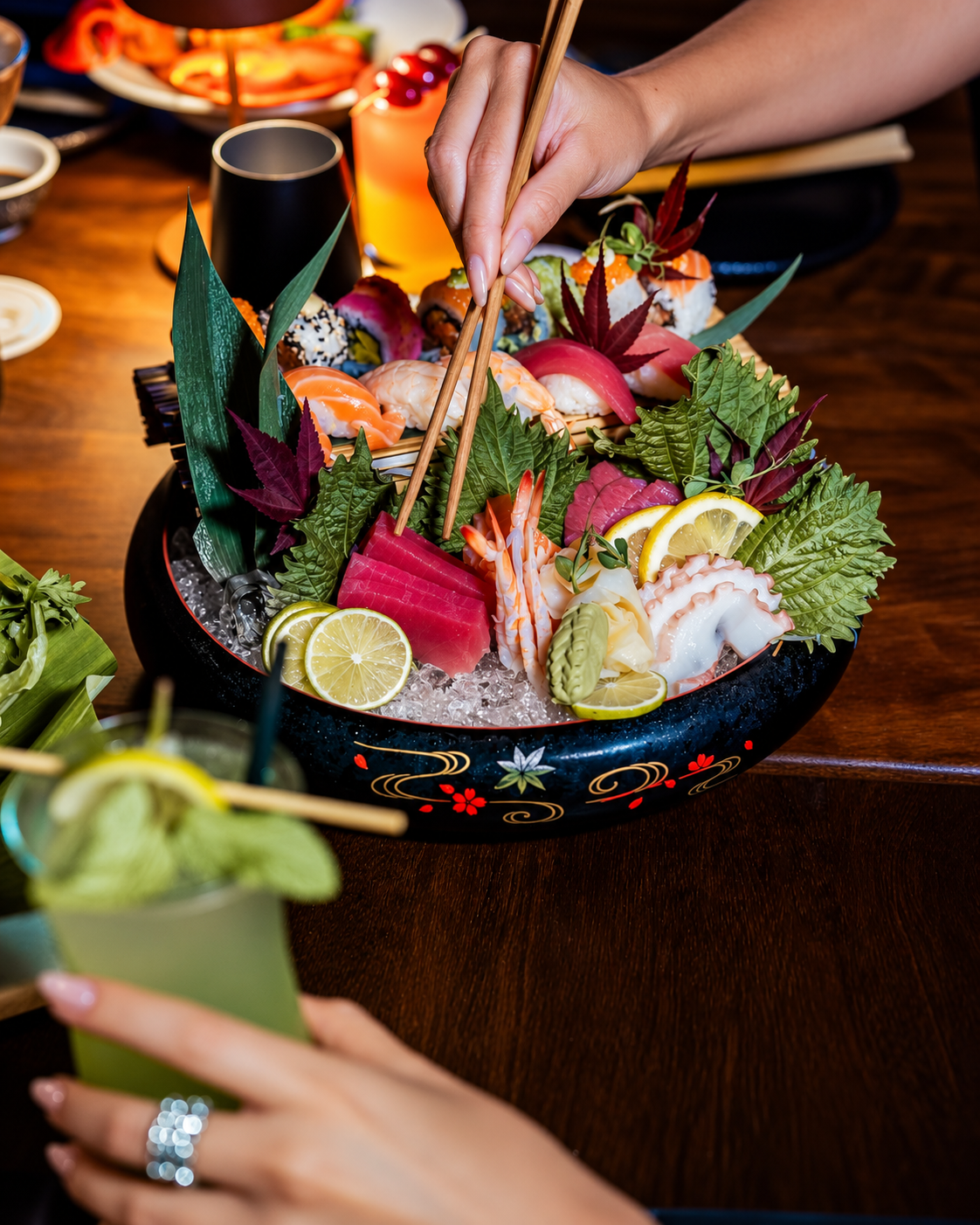
The Sashimi Bowl arrives in the register that the best Japanese-influenced pan-Asian fusion achieves when it is not trying to prove anything: clean, precise, ingredients with enough individual quality that nothing needs to be disguised or complicated. The freshness is the statement. The simplicity is the sophistication. On a table of women who have been somewhere since early morning and who need the evening to offer restoration alongside pleasure, this is exactly the register required — nourishing without being heavy, satisfying without demanding full attention.
The Chili Prawns occupy a different position on the emotional spectrum of the pan-Asian meal. There is a heat and a sweetness in the sauce that the prawn’s own flavour navigates rather than surrenders to — the dish produces the specific pleasure of something that has been made with a clear understanding of balance, of knowing that intensity and subtlety are not opposing values but the same value expressed at different volumes. It is the dish most likely to produce the specific conversational moment where someone stops mid-sentence to comment on what they are eating. This is a high compliment. It means the food has entered the room.
The Nasi Goreng carries the atmospheric quality that rice dishes at their best always do — the sense of a pan-Asian culinary tradition that has been arriving at something over generations rather than inventing itself for the current moment. It is comfort elevated to sophistication by the quality of the ingredients and the precision of the execution. The Mango Soup closes the sensory arc of the Dubai dining meal in the register that the best dessert courses occupy: not sweetness for its own sake but a specific flavour that provides a conclusion to the evening’s eating in the way that the right final note provides a conclusion to a piece of music.
As Condé Nast Traveller’s coverage of Dubai’s hospitality culture reflects, Dubai has developed a range and sophistication that rewards residents and visitors equally — not through the scale of what is available, but through the increasing quality and specificity with which individual spaces have defined their own identity within it. Lah Lah’s pan-Asian menu is precisely this: a clearly defined culinary identity with enough selectivity to carry conviction.


Hospitality as invisible architecture — service, atmosphere, and social intelligence at Lah Lah
The most sophisticated Dubai dining hospitality is the kind that is felt everywhere and visible nowhere — that produces an experience of ease so complete that the guests have no occasion to notice the effort behind it. The concept of invisible architecture in hospitality describes what the best service achieves: the construction of an experience whose scaffolding is never seen.
Lah Lah’s service operates in the register that produces the social quality of a well-hosted evening: staff who understand that their primary function is not the delivery of food and drink but the management of an experience — who have enough social intelligence to read a table’s energy and respond to it, who know when to be present and when to withdraw, who can maintain genuine warmth across the full arc of a Dubai girls’ night without it tipping into performance. The attentiveness that reviewers consistently note is not the attentiveness of staff who check on tables at regular intervals regardless of what the table is doing. It is the attentiveness of people who are actually paying attention.
The hospitality intelligence at Lah Lah extends to the physical space’s management throughout an evening. The transition from the earlier, quieter register of the first arrivals to the fuller, more animated atmosphere of peak hours is navigated without the jarring quality that marks the shift poorly managed — the room fills in a way that feels organic rather than mechanical, as though the Wednesday ladies’ night is assembling itself rather than being assembled around the guests. The crowd at Lah Lah is precisely calibrated to the space: entrepreneurs, creatives, and founders who bring an air of effortless glamour to the evening while maintaining the intimate social energy that separates this Dubai dining room from the spectacle alternatives.
The observation that the most valuable social experiences are those that occur in spaces designed to support genuine connection — where the environment actively serves the relationships being formed within it rather than simply containing them — applies across the full register of Dubai’s social culture. Money, Culture, and Capital: Inside the Event That Shaped Dubai’s Web3 Elite explores what happens when a space is designed around the quality of conversation it enables rather than the spectacle it produces. The principle is identical whether the gathering is professional or social: the room that serves the people in it, rather than asking them to serve the room’s performance, is the room they return to.

Why spaces like Lah Lah matter to Dubai’s dining future — intimate luxury as the mature city’s highest standard
The future of Dubai’s dining culture is being written not in its grandest venues but in its most considered ones — the spaces that have understood that intimacy, well executed, is the most durable form of luxury available to hospitality. The evolution of Dubai’s restaurant landscape has followed a recognisable arc that mirrors the evolution of any maturing luxury market: from spectacle to substance, from scale to precision, from the restaurant as an event to the restaurant as a practice.
What a mature Dubai dining culture requires — and what the city’s most engaged diners are increasingly seeking — is not the continuation of the spectacle but its complement: spaces that understand that the city’s residents have now been here long enough to want something other than a first impression. They want the restaurant that rewards return visits as generously as it rewards first ones. They want the kitchen that has developed a genuine pan-Asian point of view rather than a comprehensive programme. They want the room that was designed for the experience of being in it rather than the experience of photographing it.
Lah Lah occupies this position within The Greens with the particular authority of a space that has been chosen and returned to consistently enough that the neighbourhood has formed around it as a social anchor. The residents who walk from their apartments. The professionals who have made the specific decision that this is where Wednesday evenings go. The out-of-neighbourhood visitors who have been told about it and found that the telling did not oversell. These are the constituencies of a Dubai dining destination that has moved beyond being discovered and into being depended upon — which is the most significant form of success available to hospitality.
The principle that the most enduring luxury is the most considered rather than the most visible — that what holds value over time is what was chosen with intelligence and serves its purpose with consistency — runs through every category of considered consumption in Dubai’s evolving luxury culture. The New Language of Quiet Luxury: Inside the Timeless Wardrobe of Apparis explores this logic through material permanence in fashion — the argument that what endures is what was chosen for how it holds rather than how it reads in a single moment. The restaurant equivalent of the investment wardrobe piece is the room you return to willingly and often, whose value compounds across evenings rather than expiring after the first one.
The understanding that Dubai’s most significant dining experiences are built around the quality of shared time — rather than the quality of individual dishes alone — runs through the city’s hospitality culture at every level. In its most culturally rooted form, that understanding produces the Ramadan iftar, explored in The Best Iftar Experiences in Dubai, where the breaking of fast at sunset with others carries the full emotional freight of community and shared presence. Lah Lah operates in a different register — secular, convivial, pan-Asian — but the underlying principle is identical: a table shared with intention produces something that a table occupied by convention cannot.
As the World Economic Forum has identified in its analysis of social connection and wellbeing, the quality of social relationships and shared experiences is among the most consistent predictors of life satisfaction. The Dubai girls’ night that produces genuine connection — the conversation that went somewhere real, the evening that extended past its intended end time because nobody wanted to leave — is not a minor social pleasure. It is one of the most significant investments in quality of life available to a modern urban existence.
For those planning a Dubai social calendar that covers the full range of what the city offers — from the intimate pan-Asian dinner table to the expansive beach club afternoon — the complementary guide to Nikki Beach Girls’ Day Pass provides the practical detail for the other register of Dubai leisure. Between the two — the curated Wednesday evening at Lah Lah and the curated Tuesday afternoon at Nikki Beach — most of what Dubai’s social luxury offers at its best is covered.
“The most memorable evenings are not the most spectacular ones.
They are the ones in which the space understood what was needed
before anyone asked — and provided it
so quietly that nobody thought to mention it
until later, when they were trying to explain
why they wanted to go back.
That is what intimacy in Dubai luxury dining looks like.
That is what Lah Lah, at its best, provides.”

