
On why confidence abroad has nothing to do with believing nothing can happen, and everything to do with knowing exactly what to do if it does
The most empowered traveller is not the one who believes nothing can happen. It is the one who understands how to move through the world with awareness. Safety, at its most sophisticated, is not about travelling smaller. It is about travelling smarter.
A girl’s trip is rarely only about the destination. It is about the conversation that unfolds over a long walk to nowhere in particular, the discovery no itinerary predicted, the specific kind of independence that only surfaces somewhere unfamiliar. For many women, travelling together becomes a form of education — about the world, about each other, and, eventually, about themselves. But freedom of this kind requires awareness to sustain it. The best travellers are not the ones who ignore uncertainty. They are the ones who prepare for it, because confidence abroad has never come from believing nothing will happen. It comes from knowing, with some precision, that you can handle whatever does.
The New Definition of Travel Safety
Traditional safety advice has always been organised around restriction: what not to do, where not to go. Modern travel intelligence is organised around capability instead: understanding an environment well enough to move through it on your own terms.
This distinction matters more than it first appears. Fear-based advice teaches avoidance. Intelligence-based advice teaches judgment: the ability to read a street, a crowd or a situation and respond to it rather than simply flinch from it. The goal was never to eliminate risk, which no amount of research can fully do. The goal is to reduce the number of moments in which a traveller is genuinely caught off guard, and to make the remaining ones far easier to navigate.
Restriction-based advice has an appealing simplicity. A list of prohibitions is easy to write, easy to repeat and easy to feel responsible for following. Its weakness is that it treats a place as a fixed quantity, safe or unsafe, when safety is closer to a variable that shifts by neighbourhood, hour, season and circumstance. A street that is lively at noon can be empty at midnight. A district that has a reputation can be perfectly easy to move through with the right timing and the right knowledge, while one with no reputation at all can catch an unprepared visitor out.
The deeper problem is what avoidance does to the traveller. A person who has been taught only to fear a destination arrives tense, and tension is not the same as awareness. It narrows attention onto the imagined threat and away from the ordinary signals that actually matter: how locals are moving, which entrances are in use, where the rhythm of a street changes. Over time, a traveller trained to flinch learns very little about the place and relies on rules they do not understand, which tend to fail in exactly the situations the rules did not anticipate.
Capability is not bravado, and it is not the absence of caution. It is a body of practical knowledge that makes caution efficient. In practice it tends to rest on a handful of habits.
Understanding the baseline. Every place has a normal: how crowded a street usually is, how people dress, how they carry their belongings, how strangers behave toward each other. A traveller who has learned the baseline notices the deviation, which is almost always the more useful signal than any list of dangers.
Planning the transitions. Most uncomfortable moments in travel happen at the edges: arrival, departure, the first hour in a new city, the walk home late. Thinking through how you will get from the airport to the hotel, or from the restaurant back to your room, removes the moments when decisions are made tired, lost or in a hurry.
Knowing the local rhythm. Safety follows the clock. Knowing when a market is busy, when a district empties, when transport thins out and what a normal fare looks like converts unknowns into choices. It is the difference between wandering and moving with intention.
Keeping options open. A capable traveller leaves room to change the plan: a second route, a charged phone, a way to reach a trusted contact, a willingness to leave a situation that does not feel right without needing a reason. Optionality is the quiet core of confidence.
Trusting a considered instinct. Instinct is not mystical; it is pattern recognition that improves with exposure and preparation. The aim of good travel intelligence is to give that instinct better material to work with, and then to respect it without second-guessing.


Risk Reduced, Not Removed
The new definition of travel safety rests on a simple sequence: research before the journey, structure around the journey, and honesty about what neither can promise. Each stage reduces risk. None of them removes it, and the distinction is the point.
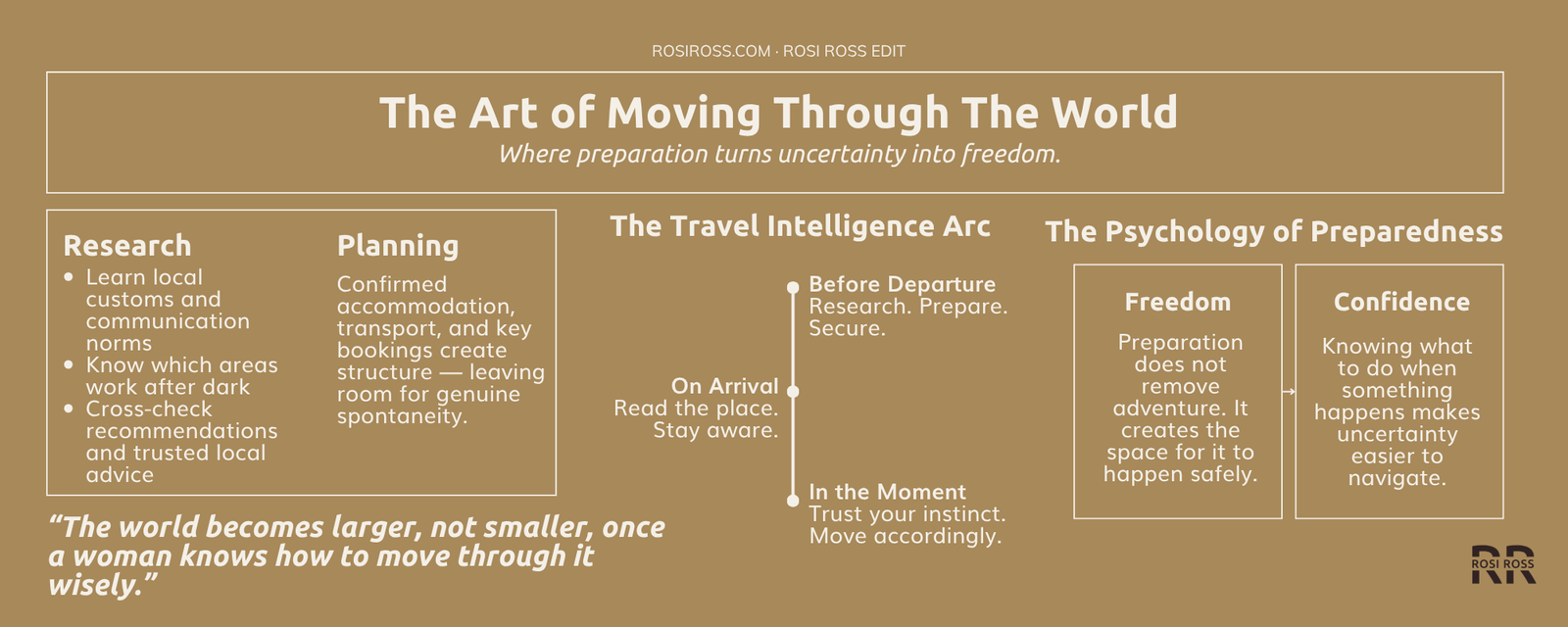
The modern journey begins well before boarding. Research, done properly, extends past restaurant lists and Instagram-worthy addresses into something closer to cultural fluency: local customs, communication norms and the general rhythm of a place. This means studying which areas function well on foot after dark and which do not, and cross-referencing recommendations through tools like Google’s trip planning features or TripAdvisor. Where it exists, a platform like Foursquare can add value too; whatever its reputation for being unfashionable elsewhere, it still holds unusually reliable local data across much of Asia.
Learning a handful of phrases in the local language does more diplomatic work than most travellers expect, and asking a trusted network which neighbourhoods to skip is frequently more accurate than any algorithm’s ranking.
By treating information itself as a form of protection, gathered before departure rather than improvised on arrival. Research the neighbourhoods that work after dark, learn a few local phrases, confirm how you will travel from the airport to your accommodation, and ask a trusted network what to avoid. Preparation reduces the number of moments in which a traveller is caught off guard; it cannot remove risk entirely.
There is a persistent romance around arriving somewhere with no plan at all, but preparation does not remove adventure from a trip. It creates the space in which adventure can happen safely. A structure of confirmed accommodation, transport and key bookings, held loosely around genuine spontaneity, is the balance experienced travellers return to again and again. It is a rhythm not unlike an itinerary built around a quieter Cycladic island, where the day’s structure exists precisely so the unplanned parts of it can unfold without anxiety.
The smartest travellers, in practice, simply know where they are sleeping before they land. Three consecutive years of long-haul girls’ trips, from the Philippines to Borneo to Greece, tend to confirm this rather than complicate it.

It is worth being honest about the limits. No amount of preparation guarantees an uneventful journey, and any advice that promises otherwise is selling reassurance rather than information. Pickpockets, scams, delays, illness and bad luck exist everywhere, and an experienced traveller still meets them. What changes is the size of the surprise. Preparation does not remove the event; it shortens the time between noticing and responding, and it makes the response calmer.
That is the real meaning of the shift from restriction to capability. It does not ask a traveller to be fearless, nor does it pretend that the world is uniformly safe. It asks for something more demanding and more useful: to arrive informed, to read what is in front of them, and to treat a destination as a place to understand rather than a hazard to survive. The reward is not only fewer difficult moments. It is a better journey, because a traveller who is not bracing for the worst is free to notice everything else.
The Female Traveller’s Packing Intelligence
Packing, done with intention, is a safety decision disguised as a style one. A lighter traveller moves faster, navigates more easily, and draws less unwanted attention — which makes the choice of luggage and organisation genuinely functional rather than merely aesthetic.

An organiser that keeps essentials separated by category means a traveller can locate what she needs without unpacking an entire bag in a crowded terminal — a small efficiency that compounds into genuine composure over a long trip.
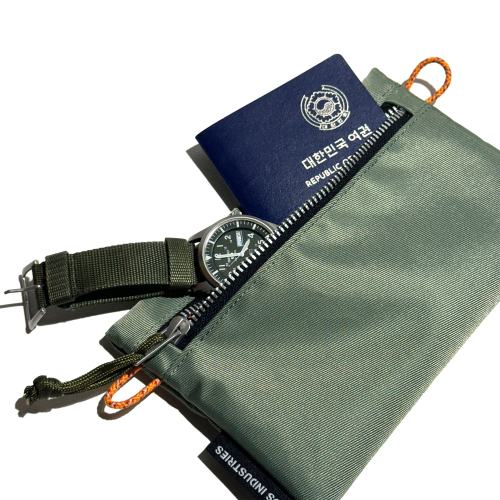


A small lock or a set of colour-coded zip ties on every zipper does two things at once: it discourages casual tampering, and it makes it immediately obvious if a bag has been opened without permission. Knowing exactly what is inside every bag before crossing a border or clearing customs remains one of the simplest and most overlooked safety habits — and the same applies to the instinct to carry only what belongs to you. Well-travelled advice holds firm here: make new friends freely, but let them carry their own luggage.
Digital Safety in the Modern World
A phone now functions as a second passport — maps, payments, translation, and emergency contact all routed through a single device. Protecting digital access has become as essential as protecting the physical one.
This means activating device tracking before departure, securing accounts with strong, unique credentials, and keeping power accessible in situations where a dead battery would otherwise mean losing every one of those functions at once — a genuinely practical vulnerability rather than a theoretical one.

Scanned copies of every essential document — passport, identification, insurance, tickets — held in a secure, password-protected cloud folder, with access shared to one trusted person at home, remove the single greatest source of panic in an already stressful situation: discovering that the only proof of who you are has gone missing along with your bag.
Protecting Your Identity and Valuables
The tone here matters as much as the content. Awareness is not the same instinct as anxiety, and the distinction is the entire point. Keeping a passport and the bulk of one’s cash in a hotel safe rather than on your person, splitting money and cards across more than one location, and wearing a bag across the front with pockets closed in dense crowds are not restrictions on freedom. They are the quiet infrastructure that makes freedom sustainable.
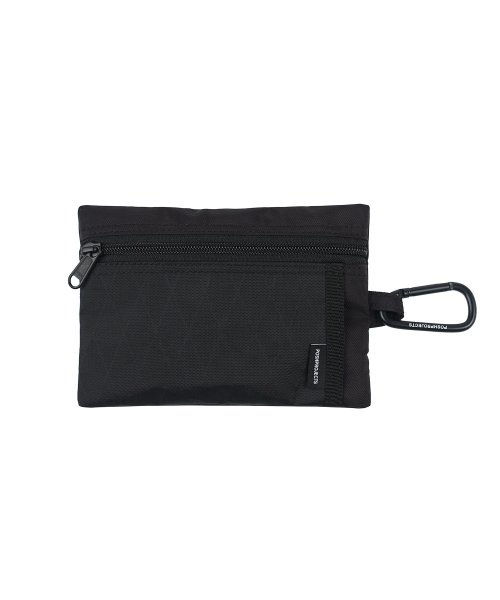
How can I protect my passport while travelling? Keep it in a hotel safe whenever it isn’t strictly needed, carry a second form of identification as backup, and hold a scanned copy in secure cloud storage — redundancy, not paranoia, is the operative principle. A hard card case for the essentials that must stay on your body, separate from the bulk of your belongings, closes the loop.


What documents should travellers keep copies of? Passport, government identification, travel insurance policy, flight and accommodation confirmations, and a list of emergency contacts — embassy details included — stored digitally and, ideally, shared with one person who is not travelling with you.
The Power of Trusting Your Instincts
Travel insurance is rarely thought about until the exact moment it is needed, which is precisely the argument for arranging it before departure rather than after. Coverage worth having extends beyond medical and dental emergencies into lost luggage, cancellations, and delays — and it is worth confirming that any camera, laptop, or phone travelling with you is specifically covered, since many standard policies cap electronics reimbursement well below replacement cost. Vaccination requirements deserve the same early attention: certain destinations require specific immunisations completed four to six weeks in advance, information the CDC’s travel health guidance and the World Health Organization’s international travel advisories both maintain in detail, making early research — not last-minute urgency — the deciding factor in whether a trip proceeds smoothly. Registering an international itinerary with a government programme such as the U.S. State Department’s Smart Traveler Enrollment Program adds a further layer of institutional awareness that costs nothing and asks for little beyond an itinerary already prepared.
Technology can provide data. Experience provides awareness. Instinct remains one of the strongest travel tools available, and confidence is not a matter of ignoring it — it is a matter of respecting it.
Noticing genuine discomfort in a space, reading how other people are behaving within it, and being willing to simply leave when something feels wrong are skills no app can fully replicate. This is not mysticism. It is pattern recognition, built through repeated exposure to unfamiliar environments, and it sharpens the more a traveller practises trusting it rather than talking herself out of it.
Why Girls’ Trips Create Lifelong Confidence
A girls’ trip is rarely only leisure. Across a run of consecutive annual departures — the Philippines one year, Borneo the next, a return to Greece after that — the destination becomes almost secondary to what the friendship absorbs along the way: communication under pressure, patience with delayed flights and changed plans, a working trust that develops nowhere as quickly as it does somewhere unfamiliar together. This is travel functioning as personal growth as much as leisure, an argument that extends comfortably to islands built on the same instinct toward depth over spectacle, such as Mykonos’s own layered identity or the continuity that defines a city as historically dense as Cairo, where understanding a place has always required more than simply visiting it.
The traveller who continues to gain the most from the world will keep favouring solo exploration, digital independence, and genuinely personalised experience over any packaged version of adventure. She will not simply collect destinations. She will build an actual relationship with the places she returns to, and safety, understood properly, will keep shifting further away from restriction and closer to intelligence — the same underlying preference for substance over spectacle that runs through a wardrobe built on fewer, better pieces, a piece of jewellery chosen for what it communicates rather than what it costs, or a skincare philosophy built on supporting a system’s own biology rather than overriding it. The instinct is identical, whichever category it turns up in: know the thing well enough to trust it, and let that knowledge, not fear, do the work of protecting you.
The world becomes larger, not smaller, once a woman knows how to move through it wisely. The ultimate travel skill was never knowing every possible risk in advance. It is knowing herself well enough to trust her own judgment when the itinerary runs out.
“Confidence was never
the absence of risk.
It was the presence of preparation —
the copy of the passport,
the plan for the first night,
the instinct trusted
the moment something felt wrong.
The women who move through the world
most freely
are rarely the ones
who believe nothing can happen.
They are simply the ones
who already know
exactly what they would do
if it did.”

