
On windmills, history before branding existed, the sunset as a ritual rather than a photograph, and why Mykonos became famous not for being beautiful but for teaching the world how to feel summer
Some destinations become famous because they are beautiful. Others become iconic because they create a feeling. Mykonos belongs to the second category — and the feeling it created has proven more durable than any single view.
For decades, travellers have arrived on this small Cycladic island searching for something that resists a simple itinerary: the feeling of endless summer, the sound of footsteps through whitewashed streets, a dinner that turns into an evening without anyone deciding it should. The obvious question — what should you do in Mykonos — has always been the less interesting one. The question worth asking is how a rocky, wind-scoured island of roughly ten thousand permanent residents became one of the world’s most recognisable symbols of Mediterranean living, when a dozen other Greek islands offer comparable light, comparable water, and comparable stone.
The answer is not only beauty. Mykonos built a cultural formula — distinctive Cycladic architecture, international hospitality, an unusually strong sense of place, social energy, effortless style, and a genuine ability to hold tradition and modern luxury in the same frame. It operates on several registers simultaneously: a nightlife destination for one traveller, an architectural study for another, a case study in food, design, and Mediterranean rhythm for a third. The strongest version of Mykonos is available only to the traveller who reads all of these layers as a single argument rather than a checklist.
The Mykonos Effect: How an Island Became a Global Brand
Architecture became branding before branding existed — the visual language of whitewashed cubic houses and blue detail was never designed for a camera, and that is precisely why it still photographs like nothing else.
Mykonos’s transformation from a modest fishing and farming island into a global luxury reference did not happen through marketing in the conventional sense. It happened through visual consistency, sustained over generations: cubic whitewashed buildings, cobalt shutters and church domes, stone pathways worn smooth by foot traffic, windmills silhouetted against the Aegean. This is a built environment that predates tourism by centuries and simply happened to be extraordinarily legible to the twentieth-century eye once the island opened itself to visitors.
What followed was an unusually cosmopolitan population of arrivals — artists, designers, entrepreneurs, and eventually the international entertainment industry — who layered an international sensibility onto Greek foundations without erasing them, a balance Condé Nast Traveller’s own long-running coverage of the island has traced across decades of reinvention. The resulting formula — authenticity paired with exclusivity, spontaneity paired with genuine social energy — is harder to replicate than it looks, which is precisely why so few destinations have managed it.
The Windmills: The Island’s Most Recognisable Symbol
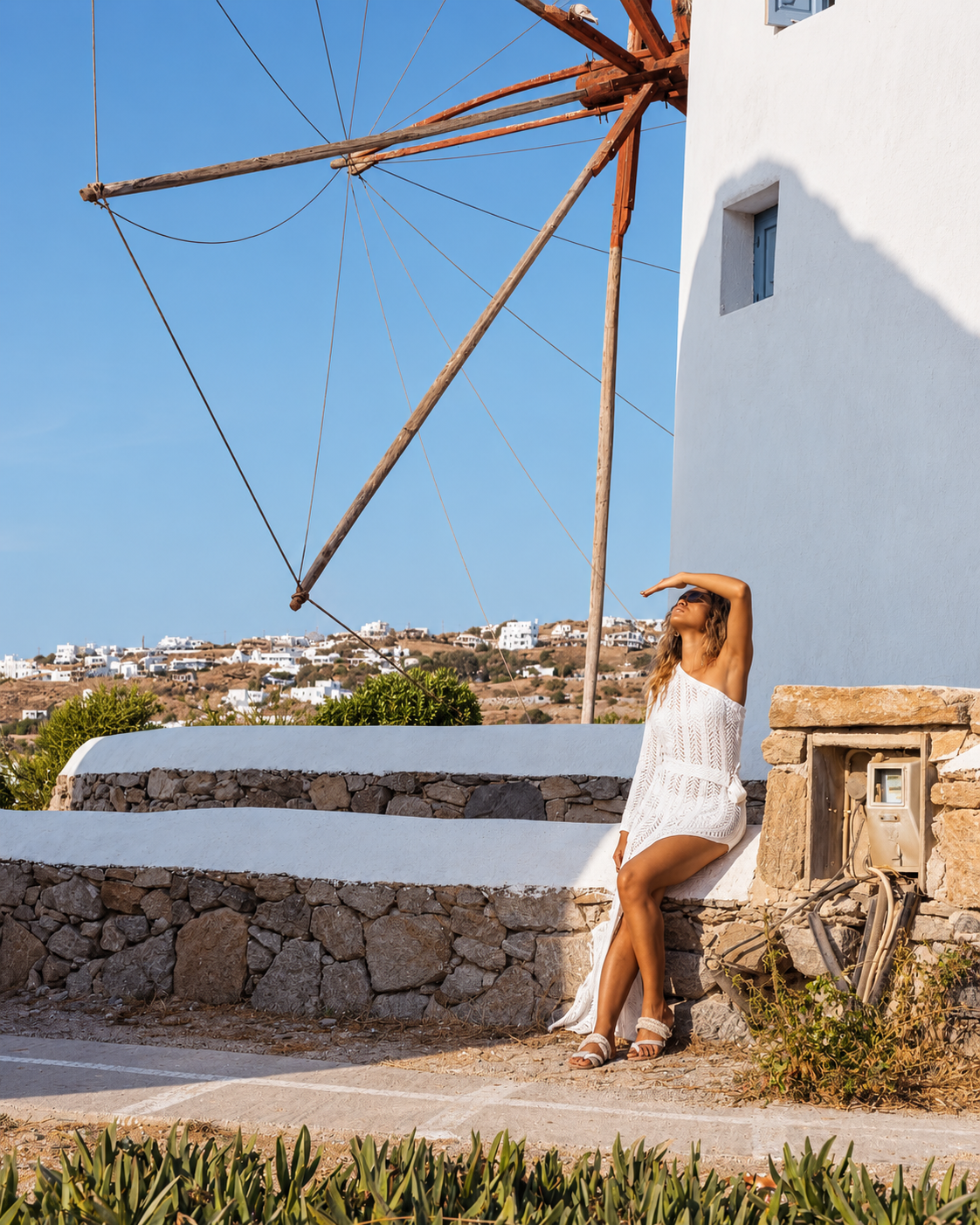
The windmills are the first structures most travellers see, standing on the hill above the harbour at Alefkandra, set to meet the meltemi at full force. They are the survivors of a much larger system: there were once an estimated twenty-eight mills across Mykonos, ten of them in the Kato Mili group, the “lower mills”, and sixteen still stand today. Most were built by the Venetians from the sixteenth century onward, and construction continued into the early twentieth, so the mills worked for roughly four hundred years. Boni’s Mill, on the edge of Chora, was restored in the 1990s with its mechanism intact and now operates as the Agricultural Museum of Mykonos, a small museum devoted to the very grain economy the windmills once sustained, open seasonally in summer. A few of the others have since become private homes and accommodation.
What makes them worth understanding rather than simply photographing is the fact that they were never symbolic to begin with. They were essential agricultural infrastructure, milling the wheat and barley that constituted a meaningful share of the island’s income. Flour went to local farmers and bakers and, reportedly, much further: Mykonos was a busy stop on the sea routes between Europe and the Levant, and passing ships took on provisions here, including the hard biscuit that sailors carried on long voyages. The site was a practical decision: steady northerly wind, open exposure, and a ridge above the harbour where grain could come in and flour could go out.
The buildings themselves are lessons in working with a climate rather than against it. Each is a round, whitewashed stone tower on three levels, with storage for raw grain and finished flour below, the milling floor above, and a rotating cap carrying the sails, which the miller turned to face the wind. Nothing in the form is ornamental: the thick curved walls resist the gale, the white lime reflects the heat, and the circular plan gives the wind nothing to catch. The beauty that visitors now photograph is a by-product of function.
Electricity ended their working life in the middle of the twentieth century, when it became the more reliable way to mill grain, and for a while the mills were simply part of the landscape, waiting for a new meaning. Tourism supplied one. Today the Kato Mili row is among the most photographed places in the Cyclades, crowded at sunset when the light turns the whitewash gold above Little Venice, and their transformation into the single most recognisable silhouette in the Cyclades is a reminder that the most powerful travel symbols are often ordinary structures that history happened to elevate.
Why are the Mykonos Windmills famous? Their fame rests less on their appearance than on what they represent: functional architecture, built for wind and grain, that became cultural shorthand for an entire island’s relationship to sea, climate, and craftsmanship — resilience made visible on a hillside. They also carry the island’s older argument inside its newer one. Mykonos is known today for glamour, yet its most enduring monument is a machine for making bread, and that is the quiet lesson of the hill: the island’s identity was built by work, wind and trade long before it was built by leisure. The traveller who climbs to Boni’s Mill, or simply watches the row from Little Venice at the end of the day, is looking at the island as it was before it became a destination — which is exactly why it still stands.


Matoyianni Street: The Social Heart of Mykonos Town
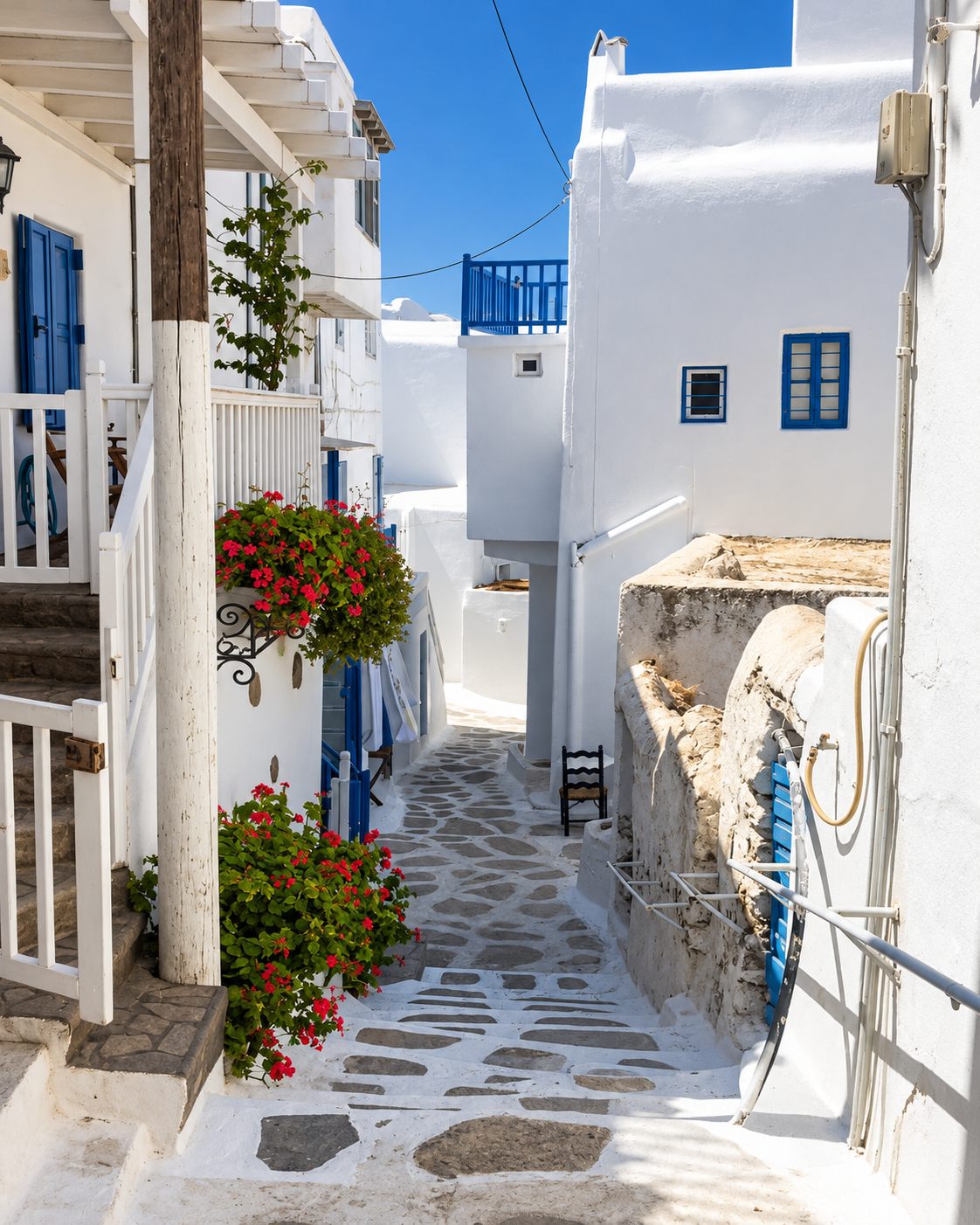
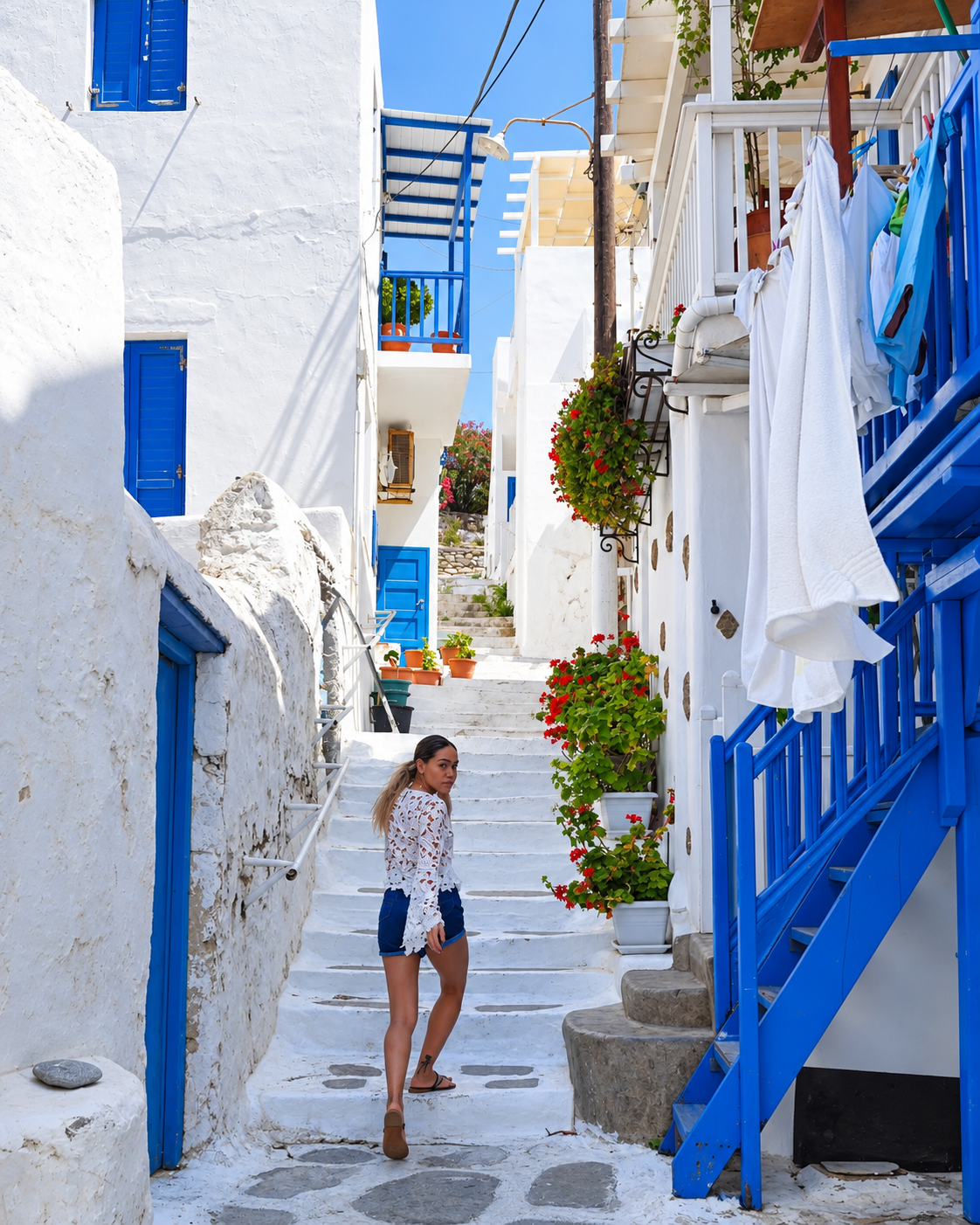
Matoyianni is less a shopping street than a running record of the island’s social rhythm, active from late morning until around midnight and often beyond. It is a short, winding, cobbled pedestrian lane that threads through the whitewashed labyrinth of Chora, linking the Old Port and Manto Mavrogenous Square with the streets toward Little Venice. The name belongs to the Matoyianni family, one of the island’s prominent nineteenth-century families, though some accounts link it to a hero of the War of Independence. The labyrinth around it, tradition holds, was laid out to confuse pirates, and the same quality of getting pleasantly lost is now part of the street’s appeal.
Along its narrow length sit boutiques carrying current collections from both Greek and international designers, jewellers working in the same handmade traditions that have shaped Cycladic craft for generations, and a steady interleaving of galleries, cafés, and small restaurants that give the street its particular texture — commerce, culture, and community occupying the same few hundred metres without ever feeling like separate categories. The buildings are part of the scene: Venetian-era mansions built on shipping wealth, bougainvillaea spilling over whitewashed walls, and doorways that open onto small galleries and temporary exhibitions in the lanes around it.
The street keeps a daily schedule that rewards attention. In the early morning, roughly eight to ten, it belongs to deliveries, shopkeepers raising shutters and a few early walkers, and it is when the architecture reads best. By late morning the shops are open and, with the arrival of day visitors from the boats, the pace builds through the afternoon. As the light lowers, the street becomes the Mediterranean ritual of the evening walk: shops stay open until around midnight in summer, restaurants fill, and the island’s social life moves outdoors. Few places in Mykonos compress as much of that rhythm into so short a distance.
For the traveller who wants to understand how Mykonos actually functions day to day, yes — it is where the island’s international sophistication and its Greek character are least separable, and where an evening walk reveals more about the place than any single landmark could. It is also honest to say that in July and August it is genuinely crowded from late morning to early evening, and a visitor who wants quiet may be better served by the morning hours. The quieter version of the street is often one or two turns away: step off the main lane and the foot traffic drops sharply, and some of the more interesting small cafés and local shops sit in the alleys beyond. The street is a public thoroughfare, free to enter at any hour, and it asks only that the visitor walk it slowly and more than once.


Old Port and Little Venice: The Waterfront and the Sunset Ritual
A port reveals a great deal about the personality of an island, and Mykonos’s Old Port — largely pedestrianised, threaded with cafés and small boats — begins communicating the island’s character before a visitor has reached their hotel. The harbour, first built at the end of the seventeenth century, holds a genuine cross-section of the island’s history: the blue-domed chapel of Agios Nikolaos, patron saint of fishermen and sailors; the statue of Manto Mavrogenous, the heroine of the Greek War of Independence who fitted out ships from her own fortune; and, a few steps inland, three identical eighteenth-century wells that were long the town’s main water supply. Rising just beyond are the flower-draped lanes of Matoyianni and the windmills themselves. The newer commercial port, built for cruise ships and the large ferries, sits a short distance north at Tourlos, some two kilometres from town — a separation that keeps the Old Port’s rhythm intact: a place for a walk, a drink, and a plate of grilled fish rather than a logistics hub.
A short walk along the shore leads to Little Venice, the waterfront quarter of Chora where centuries-old houses rise directly from the sea. Merchants and sea captains began building them in the middle of the eighteenth century, with their lower floors opening onto the water and wooden balconies overhanging the waves, and the comparison to the Italian city rests on genuine architectural kinship rather than marketing shorthand. But its real achievement is not architectural. It is the ritual built around it: a sunset over the Aegean, watched from a waterfront table, repeated nightly across generations of travellers who arrive from every part of the world and, for one hour, share the same view and the same unhurried pace. Because that hour is shared by so many, the best tables are taken early, and the visitor who arrives before the light turns is rewarded.
The most memorable destinations, as a rule, create moments rather than monuments — and Little Venice has spent decades perfecting one particular moment until it became inseparable from the island’s identity. With the windmills keeping watch from the ridge above, the two ends of this waterfront offer the clearest picture of Mykonos at its best: a harbour that still behaves like a harbour, and a sunset that has become an institution.



The New Luxury of Mykonos: Scorpios and Experience Design
Scorpios represents something distinct from the beach clubs that first built Mykonos’s international reputation: not a destination defined by exclusivity alone, but an early and influential example of experience-driven hospitality, where design, music, gastronomy, and a curated sense of community are treated as inseparable parts of the same offering. It opened in May 2015, founded by Thomas Heyne and Mario Hertel after nearly a decade at the island’s Paradise Club, and the founders’ own account of its first season is telling: the weather was poor, almost no one came, and the music was unfamiliar to the island’s crowd. They chose not to make it more commercial. The decision to protect the feeling rather than chase the room is the business model in miniature, and it later brought the venue into the Soho House family.
The location is easy to describe: a peninsula at Paraga on the south coast of Mykonos, about six kilometres from town, flanked by Paraga and Kavos beaches and looking west. The experience is harder, because it is assembled from many small decisions. A whitewashed stone house and restaurant sit above terraces of daybeds and thatched shade that recall an ancient agora, designed by the Athens studio K-studio with Lambs & Lions and the stylist Annabell Kutucu. Stages are built for the hour of sunset, and the music is slower and more melodic than the island’s reputation would suggest. Nothing about it is accidental.
Its Sunset Ritual — a recurring gathering built around music and collective presence at dusk — reframes the sunset not as a backdrop but as a shared practice. By most accounts the format is deliberate: dinner from late afternoon, a live act or low-tempo set as the sun goes down, and a headline DJ later in the night, with the tempo held lower than at comparable Mykonos clubs. It sits in keeping with a wider shift the Greek National Tourism Organisation has itself identified in how the country’s hospitality sector is evolving toward wellness and mindfulness-oriented programming. Crowds vary with the programme and the season, and in high summer it is wise to book dinner or a daybed several weeks ahead.
What makes Scorpios Mykonos famous? It answers a question the hospitality industry is only now asking at scale: why do certain places influence global travel culture disproportionately to their size? Because modern luxury increasingly trades in belonging, atmosphere, and storytelling rather than square footage or star ratings — and Scorpios built its identity around exactly that exchange years before the rest of the industry caught up. The clearest proof is that the model travels. In 2024 the brand opened Scorpios Bodrum on the Turkish coast, adding a dedicated Ritual Space for breathwork, movement and other wellbeing programming alongside the music, which is the same idea carried one step further: if the feeling is the product, the test is whether it can be exported without being diluted.



The Taste of Mykonos: Gyros, Greek Cuisine & Wine Culture
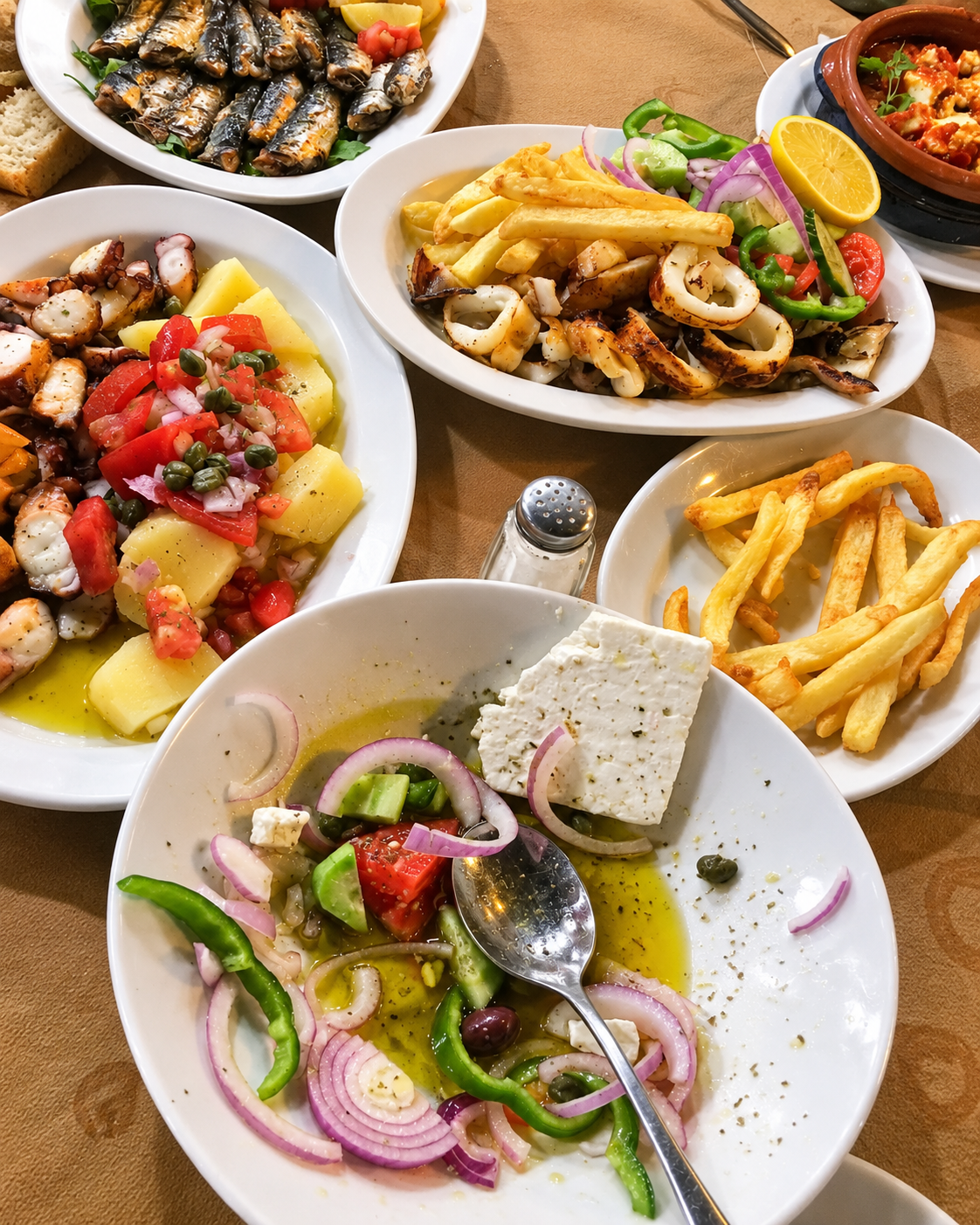
Food remains one of the fastest routes to understanding any destination, and Mykonos rewards the traveller willing to taste rather than only look. The gyro — pork, chicken, or lamb turned slowly on a vertical rotisserie, wrapped in warm pita with tzatziki, tomato, onion, feta, and a dusting of Greek oregano — represents the island’s democratic register: the same meal enjoyed by a fisherman at a stand near the Old Port and a design traveller between boutique visits on Matoyianni. That coexistence of fine dining, seafood tavernas, family-run kitchens, and honest street food, without one undermining the value of another, is itself a form of authenticity that no amount of spending can manufacture.
Wine completes the argument. Greece is among the oldest continuous wine-producing regions in the world, and its indigenous grape varieties — increasingly championed through initiatives such as New Wines of Greece, the country’s official platform for its modern winemaking renaissance — offer a way of tasting geography rather than simply describing it.
What traditional Greek food should you try in Mykonos? Gyros for the island’s democratic register, fresh Aegean seafood for its coastal identity, and a glass of an indigenous white varietal for the clearest possible sense of where you actually are.
The Traveller Mykonos Was Designed For
The island’s appeal splits cleanly across several overlapping profiles: the design traveller drawn to architecture and visual culture; the luxury traveller seeking curated hospitality and serious restaurants; the social traveller after energy, dining, and nightlife; the cultural traveller wanting history and local identity intact beneath the polish; and the Mediterranean romantic, arriving simply for the sunsets, the sea, and the particular quality of light the Cyclades are known for. Few islands accommodate all five without one undermining the others — which is, in itself, a large part of why Mykonos has retained its relevance for as long as it has.
The destinations that continue to matter will compete less on scenery and more on emotional experience, cultural storytelling, design intelligence, and a credible relationship to sustainability. Mykonos offers an instructive case study precisely because it solved the harder half of this equation decades early: it built a lifestyle people wanted to participate in, not merely a view they wanted to capture. The future traveller, increasingly, is not asking only where to go. They are asking which places represent the way they want to live — and that same instinct now shapes travel decisions across the Mediterranean more broadly, from the quieter, agrarian counter-argument found on neighbouring Naxos to cities built on a comparable density of unbroken cultural memory, such as Cairo’s five thousand years of continuous inhabitation. A short sail from Mykonos’s own harbour sits Delos, inscribed as a UNESCO World Heritage Site in 1990 and, by Greek mythology, the birthplace of Apollo — a reminder that this stretch of the Aegean was a centre of pilgrimage and prestige long before it became a centre of nightlife, and that the two histories are closer together than the postcard suggests.
The same intelligence that has made Mykonos legible as a lifestyle rather than a location echoes across other categories of considered luxury: the preference for a wardrobe built on fewer, better pieces over constant acquisition, a jewellery philosophy rooted in objects chosen for what they communicate rather than what they cost, or a skincare approach built around supporting a system’s own biology rather than overriding it. Mykonos, at its best, has always operated on the same principle: work with what is already there — the wind, the light, the stone — and let the atmosphere do what no amount of construction ever could.
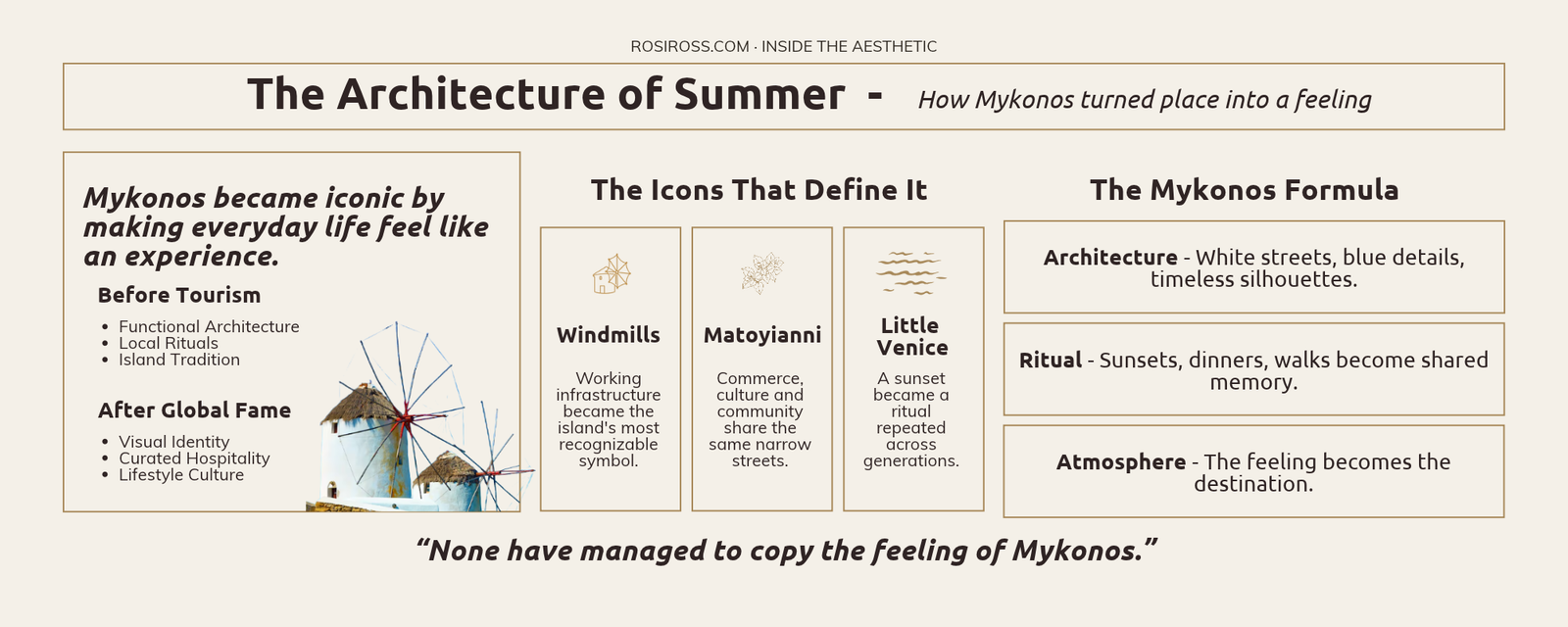
Mykonos’s greatest luxury was never a single beach, restaurant, or view. It is the feeling it taught an entire industry how to manufacture, decades before the rest of the Mediterranean understood that feeling was the product. The island did not become famous only because it is beautiful. It became famous because it taught the world how to experience summer — and it has spent the years since defending that education against every trend that has tried to replace it.
“Mykonos was never selling a view.
It was selling the hour
before the view —
the walk through white streets,
the wine poured slowly,
the sunset no one photographs
because they are too busy watching it.
Other islands can copy the architecture.
None have managed
to copy the feeling.
And in the end,
the feeling was always
the only thing
worth building.”

