
On why Belgrade feels so alive, rough-edged and magnetic: a city at the meeting of two rivers that has spent centuries changing rulers, borders and architectural systems, and that wears Ottoman memory, Central-European streets, Yugoslav concrete and river nightlife all at once.
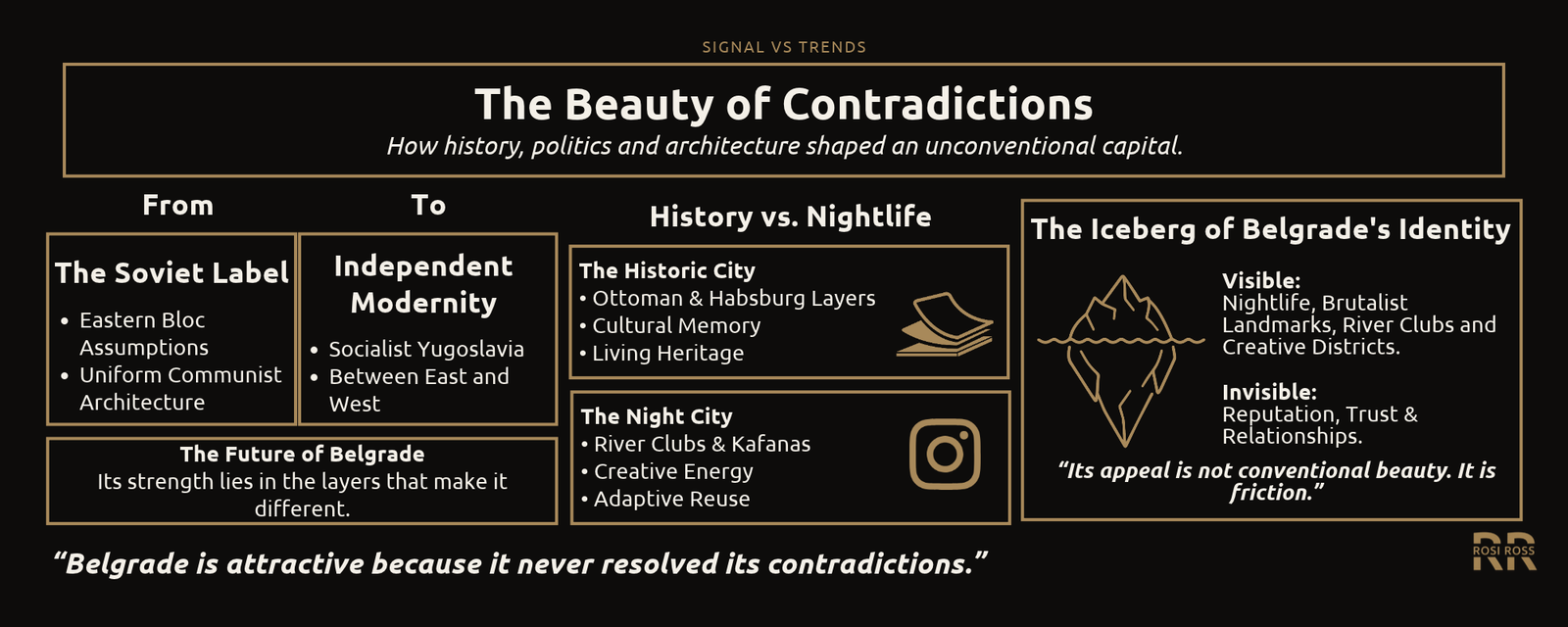
Belgrade is attractive because it never resolved its contradictions.
At night, a taxi crosses from old Belgrade into Novi Beograd. On one side of the river the streets are dense with nineteenth-century façades and café life. On the other, the city opens into enormous blocks, wide empty ground and concrete silhouettes against a wet sky. Cross the Sava and the city changes ideology before it changes language. It does not become less European across the bridge. It becomes another version of Europe. Belgrade is sexiest when it stops trying to look finished.
This is not a standard guide to a Balkan capital. It is an attempt to explain why Belgrade feels so unusually alive, and the explanation is not the generic one. The city is not interesting because it is “post-communist” in some interchangeable Eastern-European sense. It is interesting because it has spent centuries changing rulers, borders, architectural systems and political identities, and because it never tidied the evidence. Ottoman memory, Central-European streets, socialist modernism, brutalist megastructures, the rupture of the 1990s, river nightlife and contemporary creative reuse all remain visible at once. The city does not present history as a clean sequence. It wears several eras simultaneously.
Belgrade’s appeal is not conventional beauty. It is friction. At the confluence of the Sava and the Danube it has been, in turn, a frontier, a fortress, an imperial border, a Yugoslav capital and a post-socialist metropolis, and that produces a visual identity in which polished nineteenth-century façades sit minutes from monumental concrete blocks, floating clubs and experimental cultural spaces. What follows traces that friction, and it begins with a correction.
Ottoman Streets, Austrian Order and Old-European Layers
Belgrade can switch visual languages quickly: one neighbourhood reads Balkan, another Central European.
The city’s own history records that under the command of Sultan Suleiman the Magnificent, on 28 August 1521, the Turks conquered Belgrade, after which it once again became a border town, and remained so until 1717, when it was taken by the Austrians led by Prince Eugene of Savoy. The Austrian period was a deliberate reshaping. In the city’s words, it was marked by a real transformation of the town, which lost its Turkish and oriental outlines. A timeline of the period records that between 1723 and 1736 the Kalemegdan fortress was constructed by Nicolas Doxat de Démoret, a new fortress built to the military standards of its day.
When the Ottomans returned in 1739, they undid much of it: they demolished Austrian barracks and buildings, as well as houses, while many churches were converted into mosques. The Ottoman city of bazaars, mosques and craftsmen largely did not survive either, but the eastern Mediterranean and Balkan social rhythm, the long evening and the table that does not close, remains central to how the city understands itself.
Across the Danube, the other half of the story unfolded. Zemun was conquered by Eugene of Savoy on 1 July 1717 and remained under the Habsburgs for the next 201 years. It became part of the Austrian Military Frontier in 1746, and the 1739 treaty that returned Belgrade to the Ottomans was signed at Zemun, on the bank of the Sava. Zemun was not merged with the capital until 1918, having remained a Habsburg outpost. That is why a short walk from the old centre can feel like a change of country: the north bank was Austrian for two centuries.
The old centre is not Vienna with better nightlife, and it is not Budapest without the polish. Its strongest quality is that historic buildings remain mixed with repairs, graffiti, cafés, apartment life, storefronts and improvisation. The glamour is lived in, not preserved under glass, which is the difference between a museum and a city. The quality of a place that has been used continuously, so that wear becomes part of its value, is the same quality that makes certain surfaces more persuasive with age, a principle explored in timeless luxury fashion pieces: the pieces that last are the ones that look better for having been lived in.
First: Serbia Was Not the Soviet Bloc
Belgrade’s concrete is not Soviet residue. It is evidence of a country that tried to invent its own version of modernity.
Was Serbia part of the Soviet Union? No. Postwar Serbia was part of socialist Yugoslavia, and Yugoslavia broke with Stalin and Moscow in 1948. The rupture is known as the Tito–Stalin split, the culmination of a conflict between the political leaderships of Yugoslavia and the Soviet Union, under Josip Broz Tito and Joseph Stalin. A declassified US assessment dates the decisive moment precisely: on June 28, 1948, the Cominform countries condemned Yugoslavia for pursuing policies hostile to the Soviet Union and expelled Belgrade from the Cominform. The Yugoslav party had by then become the first communist party in power in the Eastern Bloc to openly oppose the Soviet Union.
The consequences were structural. Yugoslavia remained socialist, but it operated outside Soviet control, pursued a self-managed model of its own, never joined the Warsaw Pact and later became a founding member of the Non-Aligned Movement. To call Belgrade’s architecture Soviet is therefore to misread it. Writing on the Museum of Modern Art exhibition that reframed the subject notes that Tito’s signal accomplishment was to position Yugoslavia as the avatar of the “Third Way”, geographically and ideologically an independent zone between the capitalist West and the communist East.
MoMA put the architectural consequence directly. Its exhibition text says that situated between the capitalist West and the socialist East, Yugoslavia’s architects responded to contradictory demands and influences, developing a postwar architecture both in line with and distinct from the design approaches seen elsewhere. The result was not a uniform state aesthetic. It was a hybrid body of work, and the usual shorthand of an undifferentiated Eastern Bloc cannot explain it.
| The Soviet bloc | Socialist Yugoslavia | |
|---|---|---|
| Relationship to Moscow | Under Soviet leadership and the Warsaw Pact | Expelled from the Cominform in June 1948 after the Tito–Stalin split; never joined the Warsaw Pact |
| Economic model | Central planning on the Soviet pattern | A self-managed socialist system |
| Foreign policy | Aligned with Moscow | Non-alignment; Belgrade hosted the first Non-Aligned Movement summit in September 1961 |
| Architecture | A more uniform state aesthetic | A hybrid practice between the capitalist West and the socialist East |
| Today’s term | Soviet or Eastern Bloc | “Socialist Yugoslavia”, not “communist bloc” |
Serbia was part of socialist Yugoslavia, not the Soviet Union. The 1948 break is essential to understanding Belgrade’s style.
The wording matters beyond pedantry. Serbia and Yugoslavia are not interchangeable terms: Serbia was one republic within a federation, and Belgrade was the federal capital. Using “communist” as a synonym for grey, ugly or oppressive collapses all of that into a cliche, and it prevents the reader from seeing what the buildings were actually trying to say.
Belgrade as a City of Frontiers
The result is less a preserved old city than a place reconstructed again and again.
The city’s own official history describes a strategic crossroads. Its list of key dates runs from the first Neolithic settlement around 7000 BC through the Roman colonisation of Singidunum, a military camp of the Fourth Flavian legion. The Roman layer sits at the heart of the modern fortress: the legion set up as a square-shaped castrum occupying the Upper Town of today’s Kalemegdan. Over the following centuries the city was contested in turn by Byzantines, Hungarians, Ottomans and Austrians, and the fortress above the confluence of the Sava and the Danube carries layers from each.
Almost nothing here was allowed to stay finished. Belgrade frequently passed from Ottoman to Habsburg rule, which saw the destruction of most of the city during the Austro-Ottoman wars. Britannica counts it precisely: after 1521 the city was in Ottoman hands except for three periods of occupation by the Austrians, in 1688–90, 1717–39 and 1789–91. Each handover was an act of erasure and rebuilding. The pattern is why the city reads as an argument and not as a monument.
| Layer | What happened | What can still be read |
|---|---|---|
| Roman | Singidunum, a legionary camp at the confluence of the Sava and the Danube | Traces beneath the fortress at Kalemegdan |
| Medieval | A succession of Byzantine, Hungarian and Serbian holders of the fortress | Walls and gates within the fortress |
| Ottoman, from 1521 | Sultan Suleiman the Magnificent conquers the city on 28 August 1521; it becomes a border town | Street memory and a Balkan social rhythm more than intact buildings |
| Austrian, 1717–1739 | Prince Eugene of Savoy captures the city; a new fortress is built between 1723 and 1736 | The fortress and the Central-European urban models it introduced |
| Ottoman return | In 1739 the Ottomans demolish Austrian barracks and buildings and convert many churches into mosques | A history of repeated erasure |
| Zemun | Taken by the Habsburgs in 1717 and held until 1918 | A distinctly Central-European townscape across the Danube |
| Socialist Yugoslavia | A federal capital and a new city on the west bank | Superblocks, civic buildings and towers |
| After 1990 | Breakup, regional war, sanctions and a long transition | Adaptive reuse and unfinished sites |
Belgrade is less a preserved old city than a place reconstructed again and again. Dates follow the city’s own history and standard references.
What is the architectural history of Belgrade? It is a sequence of reconstructions: a Roman camp, later medieval and Byzantine fortifications, Ottoman rule from 1521, a transformative Habsburg interlude from 1717 to 1739, nineteenth-century European modernisation, Zemun’s Habsburg townscape across the Danube, socialist Yugoslav modernism in New Belgrade, and post-1990s adaptive reuse. Because so little of the Ottoman and Austrian fabric survived intact, the layers are read as much through streets and fortifications as through monuments.
Why the Concrete Is More Interesting Than “Communist Architecture”
The concrete aged into cultural capital.
Why does Belgrade have brutalist architecture? Because socialist Yugoslavia undertook rapid reconstruction on a large scale and used concrete as an expressive and economical material. Belgrade’s brutalism should never be reduced to “ugly communist concrete”, and not every Yugoslav building is brutalist. The most interesting structures express scale, collective housing, movement, state ambition and technological confidence.
The Western City Gate, known as the Genex Tower, is the emblem. It is a skyscraper designed in 1977 by Mihajlo Mitrović in the brutalist style, formed by two towers connected with a two-story bridge and a revolving restaurant at the top. It was designed to resemble a high-rise gate greeting people arriving in the city from the west, along the road from the airport, and the two towers are connected by a bridge-like structure on the 26th floor. It was disputed and criticised during the designing and construction process, and it is now a protected cultural monument, designated on 3 November 2021.
Its story is the city’s in miniature. The tower formerly occupied by the Genex company is empty, while the residential tower is still home to scores of people. After years of neglect, in February 2023 the commercial part of the tower was sold to a private company under controversial conditions. The revolving restaurant at the top never became operational. A building conceived as a gate to the modern world now stands as an argument about what to do with the evidence of a vanished state.
The Museum of Contemporary Art at Ušće is a different register: modernist, precise and humane in scale. The museum was designed by Ivan Antić and Ivanka Raspopović in 1960, with construction beginning that year and continuing until 1965, and it opened on 20 October 1965, the Day of Belgrade’s Liberation. The architects received the October Prize from the City of Belgrade on the same day the museum opened. Its form is composed of six cubes creating a crystal-like shape, with a façade covered in white marble panels, and it faces the confluence, facing Kalemegdan Fortress across the water. The institution itself dates from 1958, and the building was closed for renovation between 2007 and 2017, finally reopening on 20 October 2017.
The weight and mass of such buildings assert something, which is how the architecture of power works in any medium: the form tells you what the maker believed was permanent. And the concrete has changed in value. International interest in Yugoslav modernism has grown sharply in a decade, and MoMA’s exhibition helped recast the buildings as globally significant modernism and not merely communist-era residue. What once looked obsolete now reads as rare.
| Building | Designer and date | What it shows | A caution on labels |
|---|---|---|---|
| Western City Gate (Genex Tower) | Mihajlo Mitrović; designed in 1977, completed around 1979 to 1980 | Two towers joined by a bridge on the 26th floor, conceived as a gate to the city from the west | A genuinely brutalist work; the commercial tower stands empty and was sold in 2023 under controversial conditions, while the residential tower is still lived in |
| Museum of Contemporary Art, Ušće | Ivan Antić and Ivanka Raspopović; designed 1960, opened 1965 | A modernist museum composed of cubes, faced in white marble, near the confluence | Modernist; not every concrete or Yugoslav building is brutalist |
| New Belgrade housing blocks | New Belgrade planners, after the Second World War | Superblocks and green communal space as a model of collective life | Planned modernism more than a single style |
| Federal-era civic buildings | Various architects | State ambition rendered in stone and scale | Modernist civic architecture; do not call every state building brutalist |
The most interesting structures express scale, collective housing, movement and technological confidence. “Ugly communist concrete” is a cliche, not a category.
What is Yugoslav modernism? It is the body of architecture produced in socialist Yugoslavia between roughly 1948 and 1980, created between the capitalist West and the socialist East. Writing on MoMA’s show describes the period of intense construction between the country’s 1948 break with the Soviet bloc and the death of its longtime leader Josip Broz Tito in 1980. It is now regarded as globally significant modernism and not merely communist-era residue.
1961 and the Non-Aligned Ambition
Belgrade looked east and west without fully belonging to either.
The first summit of the Non-Aligned Movement was held in Belgrade, Yugoslavia, in September 1961, and it ran from 1 to 6 September, with twenty-five heads of state and prime ministers of the developing world. Tito invited countries that were members of neither the North Atlantic Treaty Organization nor the Warsaw Pact to what he framed as a convention of neutrals. The founding fathers of the movement were five leaders, from Europe, Asia and Africa: Josip Broz Tito of Yugoslavia, Jawaharlal Nehru of India, Gamal Abdel Nasser of Egypt, Kwame Nkrumah of Ghana and Sukarno of Indonesia.
That moment matters aesthetically as much as politically. The city was not merely a regional socialist capital but a diplomatic stage for states seeking distance from both Cold War blocs, and the monumental scale of federal Yugoslav architecture makes more sense when seen through that international ambition. A capital that expects to host the world builds as though the world were watching. Belgrade also hosted the Ninth Summit in September 1989, a reminder that the diplomatic identity outlasted the first flush of the idea.


The 1990s Rupture
The useful point is that a generation of creative culture developed amid discontinuity, not seamless prosperity.
The breakup of Yugoslavia in the early 1990s changed Belgrade economically, politically and psychologically. The Socialist Federal Republic ceased to exist, and war in the region, international sanctions, hyperinflation and, in 1999, NATO’s bombing campaign shaped the city’s passage out of the Yugoslav era. History of this kind should not be turned into atmosphere. The city has been bombed, occupied and politically transformed more than once, and writing about it should resist treating destruction as an aesthetic. It should say plainly that a generation of artists, musicians and organisers built their culture without the assurance of continuity, and that this explains some of the city’s improvisational character.
It also helps explain why Belgrade feels unfinished. It has repeatedly inherited infrastructure from political systems that vanished before the buildings did. A socialist ministry becomes a contemporary government building. An industrial site becomes a club. An old warehouse becomes a creative venue. The riverbanks shift between the informal and the formal. The city’s aesthetic comes partly from adaptive reuse without complete sanitisation, a kind of repair that leaves the scar visible, and the process resembles the way a protective layer is rebuilt without erasing what it protects, the logic examined in The Return of Barrier Beauty: Why Lanolin Is the Ultimate Skin Investment.
Savamala, Cetinjska and Creative Reuse
A creative district should not be treated as a timeless, fixed identity.
Savamala, on the banks of the Sava, was for a time the emblem of Belgrade’s creative regeneration. A planning magazine recalls it as the most glamorous part of Belgrade and the centre of most urban events at the beginning of the twentieth century, unjustly neglected after the Second World War, and an academic study traces how it moved from a forgotten city quarter in the 2010s to part of the largest construction site in Belgrade, the Belgrade Waterfront. Both descriptions are true, and neither is permanent. The developer presents the project as one that revitalises the architectural treasures of the Serbian capital, while the clubs and bars that grew in Savamala dispersed.
Many of them moved to Cetinjska. The street actually started life as a brewery, and that tradition of beer is carried on by the appropriately named Jedno Mesto. A guide recounts how plans to build a waterfront district led to a relocation, so that Cetinjska became the epicentre of Belgrade’s nightlife, and a local recommendation describes Cetinjska 15 as a shelter for all the clubs and bars that were removed from Savamala. The same story is told of a club that suffered directly from the beginning of the Belgrade Waterfront project and moved over to Cetinjska. This is the pattern: cultural energy tends to grow inside reused or semi-industrial space, then relocates when the space is redeveloped.
This is where the writing should become tactile: smoke, concrete, courtyard noise, inexpensive drinks, DJs, and people moving between venues without ceremony. The city’s nightlife feels less choreographed than that of many European capitals, and the spaces carry that quality in their surfaces. It is atmosphere that accumulated, not atmosphere that was commissioned: the opposite of the designed calm that hospitality increasingly sells.
| Place | What it is | What to keep in mind |
|---|---|---|
| Skadarlija | The cobbled bohemian quarter of kafanas, protected by law since 1967 | Cultural memory more than a restaurant street; heavily visited |
| Savamala | A riverside district of galleries, street art and live music | Redevelopment under the Belgrade Waterfront project has transformed it; a creative district is not a fixed identity |
| Cetinjska | A former brewery complex of courtyards, bars and clubs, several of which relocated from Savamala | Energy that grows inside reused, semi-industrial space, which can change quickly |
| Dorćol | The oldest surviving neighbourhood on the Danube’s right bank | Its appeal is the density of ordinary life, not a single landmark |
| Zemun | A former Habsburg frontier town on the Danube | A Central-European counterpoint to the old centre |
| Kalemegdan | The fortress above the confluence | Layers of stone, river and city in one view |
Venues rotate; the tension remains. These are districts to move through, not attractions to collect.
What are the best artistic neighbourhoods in Belgrade? Savamala, a riverside district of galleries, street art and live music, though heavily changed by redevelopment; Cetinjska, a former brewery complex of courtyards and clubs; Dorćol, the oldest surviving neighbourhood on the right bank of the Danube; and Skadarlija, the bohemian quarter. Creative districts evolve, so they are best treated as places to move through and not as fixed attractions.
Dorćol and the Hip Without the Costume
Its appeal is not one landmark but the density of ordinary urban life.
Dorćol, located along the right bank of the Danube, is the oldest surviving neighbourhood in Belgrade, known for its specific urban charm and the mentality of its residents. It combines Ottoman-era roots, older residential fabric, cafés, galleries, design studios and contemporary food culture. This is the part of the city where the creative class feels integrated into the older street network and not isolated in a designated arts quarter. There is no costume, and no ticket.
The district’s style is part of a wider Serbian look that resists a single definition: Central-European tailoring, Balkan sensuality, Yugoslav modernism, sportswear, club culture and contemporary design coexist, and the most recognisable quality is confidence without excessive polish. It is a personal signature assembled from small choices, much as identity is composed in The Language of Scent: How Fragrance Becomes Identity in Modern Beauty, where presence comes from consistency and not from volume. To define a single Serbian aesthetic would be to flatten what makes it interesting.
Why Belgrade Nightlife Feels Less Programmed
The sexiness comes from permeability: dinner turns into drinks, drinks turn into music.
Why is Belgrade famous for nightlife? Because the city has many night cultures at once and they overlap: river clubs, traditional kafanas with live music, underground venues and converted industrial spaces. A reference survey of the subject notes that the prevailing image of Belgrade is, even officially, advertised as a nightlife destination, while it retains its legacy as an intellectual hangout. The culture predates the marketing. What is distinctive is the permeability: the transitions between venues are loose, so a night can run on without a sharp edge.
What is attractive is the contrast. A tailored dinner in a nineteenth-century room, followed by a warehouse club. A brutalist housing block, then river light at sunset. A kafana singer and an electronic set in the same evening. A socialist civic monument beside luxury cars and independent fashion. Old Europe that never fully became Western Europe. The traveller is not meant to collect attractions. The point is to move through these contrasts.
Water is part of the choreography. Belgrade is defined geographically by the confluence of the Sava and the Danube, and the rivers create both separation and connection: old Belgrade on one side, New Belgrade and Zemun on the others, with nightlife and promenades occupying the edges. The river is part of the city’s social architecture, which is why a night so often drifts toward the water.


Why “The New Berlin” Misses the Point
Belgrade does not need to become the next Berlin. Its advantage is that it already became something harder to classify.
Why is Belgrade compared with Berlin? Because of club culture, relatively low-cost nightlife and post-industrial spaces reused for culture. The comparison helps with orientation but is ultimately lazy as a thesis. Berlin’s postwar division and reunification produced one urban history. Belgrade’s mixture of Ottoman, Habsburg, Yugoslav, Balkan and post-1990s layers produced another, and the first answer a visitor should give to “the new Berlin” is that Belgrade is older, more tangled and less resolved.
| Berlin | Belgrade | |
|---|---|---|
| Core urban story | Postwar division and reunification | Ottoman, Habsburg, Yugoslav, Balkan and post-1990s layers |
| Relationship to history | One dominant rupture | Several, overlapping and unresolved |
| Useful comparison | Club culture, post-industrial space and low-cost nightlife | The same ingredients, assembled differently |
| What the label misses | A city that already became something harder to classify |
The comparison is useful for orientation and lazy as a thesis. Belgrade does not need to become the next Berlin.
How Yugoslav Modernism Became Desirable Again
What once looked obsolete increasingly reads as rare.
MoMA’s exhibition, Toward a Concrete Utopia: Architecture in Yugoslavia, 1948–1980, ran from 15 July 2018 to 13 January 2019, and gathered some 400 works, including drawings, models, photographs and film reels, for the first major US exhibition on the architecture of Yugoslavia. MoMA described it as introducing the exceptional work of socialist Yugoslavia’s leading architects to an international audience for the first time, exploring themes of large-scale urbanization, technology in everyday life, consumerism, monuments and memorialization, and the global reach of Yugoslav architecture. Critics were quick to see its significance: one review called it a runaway triumph that made the cohesive case for including Yugoslavia’s concrete utopia in the architectural canon.
Objects accrue meaning when they are reread, and heritage is partly an act of attention. The way ideas of value change as a place is seen anew is the subject of The Language of Modern Necklaces: Metals, Stones, and the New Codes of Personal Luxury, where an object’s worth is as much a matter of how it is read as of what it is made from. Belgrade now benefits from a visual heritage that once looked obsolete and increasingly looks rare, and the political context is inseparable from it. The concrete was made by a state that no longer exists, and that is part of its charge.


Why Belgrade Still Feels Less Packaged
The value lies in the fact that urban life still exceeds the tourism layer.
Compared with highly managed Central-European capitals, Belgrade still contains visual friction: unfinished façades, mixed-use blocks, old signage, heavy infrastructure and businesses inserted into improbable spaces. That does not mean the city is untouched, or cheap forever. Belgrade is not a fringe destination. According to Serbia’s national statistical office, as reported by Tanjug, foreign tourists mostly visited cities, primarily Belgrade, with 1.18 million visits between January and November 2025, in a year when 2.16 million foreign tourists visited Serbia, the largest group, 227,928, coming from Turkey.
The national picture is more mixed than the headline. The statistical office’s year-end release shows tourist arrivals in the Republic of Serbia in 2025 of 4,346,691, with foreign arrivals of 2,348,495, which is a decline of about 1.9 and 1.5 percent respectively on 2024. Monthly data for 2026 shows recovery: Serbia received 470,000 tourists in May 2026, 7.4 percent more year on year, with Belgrade, Novi Sad and Niš the most visited cities, and 400,000 visits in June 2026, a 1.7 percent increase. The opportunity is not simply to be discovered. It is to move from a nightlife reputation to a fuller cultural-city proposition.
| Indicator | Figure | Source and caution |
|---|---|---|
| Foreign visits to Belgrade, January to November 2025 | About 1.18 million, the largest share of foreign city visits in Serbia | Serbia’s statistical office, as reported by Tanjug |
| Foreign tourists in Serbia, January to November 2025 | 2.16 million, led by Turkey (227,928) | Statistical office via Tanjug |
| Serbia, all arrivals, 2025 | 4,346,691, down about 1.9% on 2024; foreign arrivals 2,348,495, down about 1.5% | Statistical Office of the Republic of Serbia; the national trend is not one of uninterrupted growth |
| Serbia, 2026 | May: 470,000 tourists, up 7.4%; June: 400,000 visits, up 1.7% | Statistical office via Tanjug; monthly figures vary |
Belgrade is not a fringe destination. The opportunity is to move from a nightlife reputation to a fuller cultural-city proposition.
The price story should be told with care. Belgrade is not simply inexpensive. The stronger point is comparative value: restaurants, nightlife, culture and design can still feel accessible relative to many Western European capitals while the city offers unusual architectural and historical depth. Exact price comparisons date quickly, so it is better to describe the density of experience than to quote a euro figure.
Is Belgrade worth visiting for design and architecture? Yes, for travellers interested in layered cities. It combines a fortress with Roman, medieval, Ottoman and Austrian layers, Central-European streets, a planned federal-capital district of superblocks across the river, and a lively culture of adaptive reuse. It rewards people who move between contrasts and who accept a city that has not been finished, polished or packaged.
What the City Refuses to Resolve
The city’s most seductive quality is that it still refuses to resolve itself.
As European city travel becomes more visually homogenised, Belgrade’s lack of complete aesthetic coherence may become an asset. Its cultural value lies in the survival of multiple urban systems and not in a perfectly branded destination image, and the challenge will be whether redevelopment preserves that friction or smooths it into the same luxury-city template found elsewhere. Venues will rotate. The tension is what lasts, and it is the reason this is an evergreen story: it does not depend on which club is currently fashionable, but on the city’s durable structure of fortress, Ottoman town, Central-European capital, Yugoslav experiment, post-1990s rupture and contemporary cultural laboratory.
The story is not that Belgrade is a cool post-communist city with brutalist buildings and good nightlife. It is how centuries of frontier history, Ottoman and Central-European urban layers, Yugoslavia’s independent socialist experiment, the violent rupture of the 1990s and a culture of creative reuse produced one of Europe’s least visually resolved and most compelling capitals. Belgrade is beautiful because several versions of Europe are still fighting for space inside it, and the city’s most seductive quality is that it still refuses to resolve itself.
Why Belgrade Is the New Spot for the History-Led Traveller
The traveller who comes for the concrete increasingly stays for the history.
A change in why people travel has been building for several years, and Belgrade sits at the centre of it. The new traveller does not begin with a beach or a checklist. They begin with a feed. They see a slowed-down soundtrack over a grey tower at dusk, a hallway of raw concrete, a monument in fog, and they ask what that place was and who built it. Social media has made Eastern European history visible to a generation that was never taught it, and the question that follows the image is a historical one.
The wider market shows the shift. KAYAK’s 2026 forecast found that seven of its top ten trending destinations are in Eastern Europe, and its travel trends expert described the pull as high-impact trips without the high price tag. History is no longer a niche motive inside that movement. Skyscanner’s trend report for 2027 names history-focused travel as a trend in its own right, and suggests that its appeal lies in travellers trying to escape a fast-paced world and seeking history that offers context and grounds them in timeless human stories.
The visual language arrived first. Domus observed that Soviet modernism has become so popular that it is now a recognised aesthetic, spread through images of massive buildings and a single slowed-down song. By 2026, Euronews could report that brutalist architecture had become a travel trend taking over social media, with tourists flocking to former socialist countries in search of it. The clearest proof of how far an image can move a person is Transnistria, where thousands of posts tagged it as a destination frozen in time. Curiosity about the Eastern Bloc is real, and it is travelling.
Here Belgrade holds an advantage that most of its neighbours do not, and it is also where the correction matters. The traveller searching for “Soviet” history in Belgrade will not find it, because Yugoslavia was never part of the Soviet bloc. What they will find is the more unusual story: a socialist state that broke with Moscow in 1948, built its own modernism between East and West, and hosted the world’s non-aligned leaders in 1961. For a traveller who arrives with a borrowed word, the city offers a more accurate and more interesting history than the one they came for. The hook is the aesthetic. The reward is the correction.
The platforms are already pointing in this direction. Serbian tourism content lists Kalemegdan and Knez Mihailova among the most photogenic TikTok spots in the country, and trade reporting describes Belgrade as increasingly appearing on itineraries alongside more established destinations. Younger travellers are the audience: Polarsteps found that TikTok is now the favourite digital travel tool of one in five Gen Z travellers. A city with a fortress, a bridge into a planned socialist capital and a nightlife scene built inside reused buildings gives that audience several kinds of image at once.
The opportunity carries a responsibility. Reporting on the broader nostalgia trend warns that warm feelings toward a harsh past are amplified by this kind of content, which can flatten history into an aesthetic. Belgrade is better served by the opposite approach. The concrete, the monuments and the unfinished sites matter because of the choices, ambitions and ruptures behind them, including those of the 1990s, which are not atmosphere. The history traveller of this decade is not asking for a costume of the past. They are asking to be taken seriously, and a city that has never tidied its evidence is well placed to do that.
“Belgrade is attractive
because it never resolved its contradictions.
Its concrete is not Soviet residue.
It is evidence of a country that tried
to invent its own version of modernity.
The concrete aged into cultural capital.
The city’s most seductive quality
is that it still refuses to resolve itself.”

