
On why a beachfront resort of fewer than thirty suites can carry more luxury authority than a far larger one: how land, quiet, coastline and visual space, deliberately left empty, become the product, and why that scarcity is the business model.
At Amanwella, luxury is measured in what has been left empty.
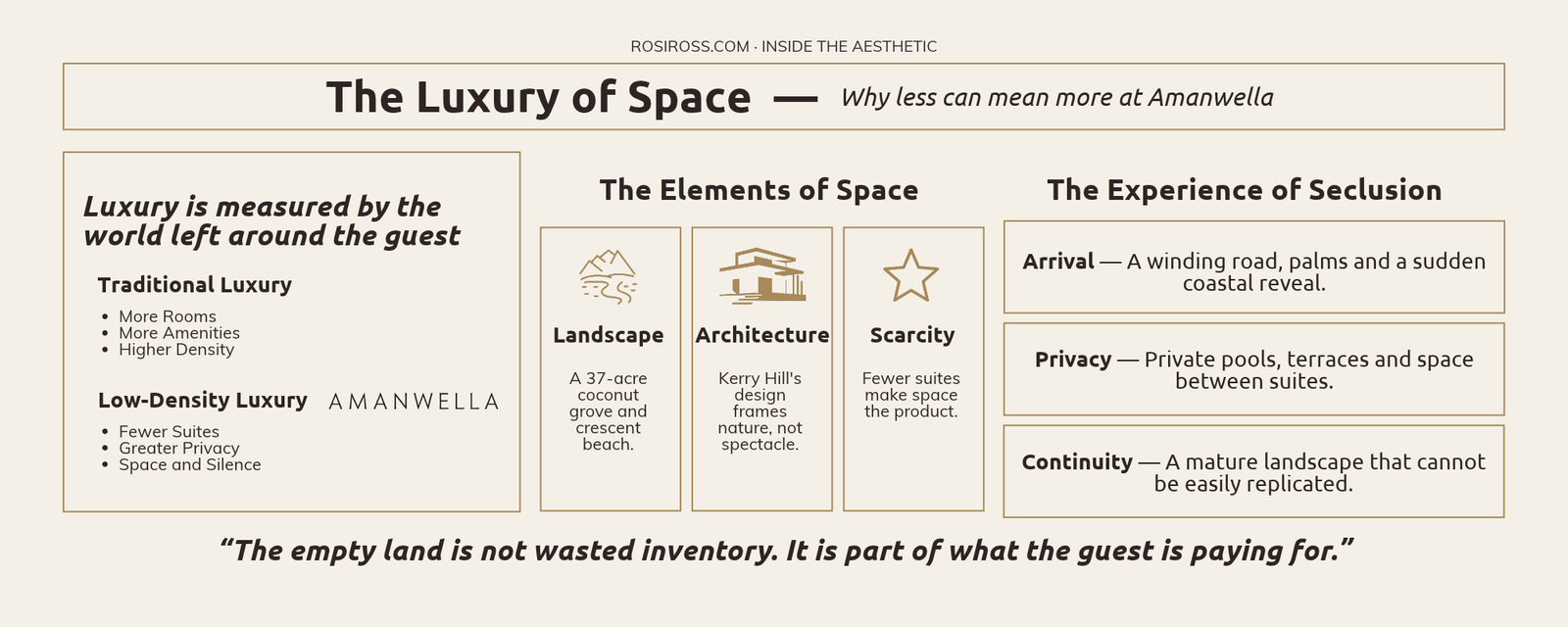
The road narrows before the hotel appears. Coconut palms close in. The sea is still invisible. Then the landscape opens all at once. Amanwella’s first luxury is not a suite. It is the reveal: the moment at which a winding track through the trees gives way to a long curve of sand and open water, and the visitor understands that the site has been allocated to very few people. That is not an accident of design. It is the business model.
This is not a resort review. It treats Amanwella, on Sri Lanka’s south coast, as a study in low-density luxury: a property in which the most valuable thing on sale is not the room but the amount of land, quiet, coastline and visual space deliberately left around it. The larger question is what luxury becomes when the scarce resource is no longer marble, service or square footage, but silence. The answer proposed here is controlled scarcity: a winding road, a small number of suites, private plunge pools, sea-facing terraces, a mature coconut grove and a broad crescent of sand, which together create the sense that a great deal of world has been reserved for very few guests.
The argument connects architecture, landscape, hospitality economics and the state of Sri Lanka’s tourism market, and it is careful about numbers, because several of the facts most often repeated about this resort turn out to be unsettled. It begins with the one that is misstated most often: how many suites there are.
Where Amanwella Actually Is
Amanwella is not difficult to reach. It is designed to feel difficult to see.
Where exactly is Amanwella? The resort sits on Sri Lanka’s southern coast, and Michelin’s guide gives its address as Bodhi Mawatha, Wella Wathuara, Godellawela, Tangalle. The distinction from central Tangalle matters. One independent guide places it just 10 minutes’ drive west of the fishing town of Tangalle, beside a hidden bay. Aman’s own factsheet fixes the geography in broader strokes: the resort lies around 80km east of Galle, home to Amangalla, and 190km south of the capital, Colombo. The position lets the property feel removed while staying connected to a working fishing region and the wider south coast.
Is Amanwella remote? Not in the expeditionary sense. Travellers can reach it by private car in approximately 2.5 hours from Colombo’s Bandaranaike International Airport, or within an hour from Mattala Rajapaksa International Airport, and helicopter transfers to Tangalle or air taxi flights to nearby Dickwella are available for a swifter arrival. Its remoteness is perceptual and designed. The last part of the journey narrows, vegetation thickens, buildings fall away and the resort stays concealed until the moment of arrival.
That sense of arriving at a place set apart from the road, a threshold of shade and quiet, is the most underrated tool in resort design. A hotel that is visible from the highway competes with the highway. A hotel that appears only after a bend in a coconut grove has already changed the guest’s sense of time. By the time the sea is visible, the transition from the ordinary world to a reserved one has been completed, and no lobby, however handsome, could have done it as well.
The name encodes the same idea. Aman’s own copy explains that it combines the Sanskrit-derived word for “peace” with wella, Sinhalese for “beach”. Peace and beach, in that order: the promise is stated before the first guest has arrived.
The Land: Coconut Grove, Beach and Distance
The grove is not decoration. It is shade, privacy and a wind filter at once.
Aman repeatedly describes the resort as nested within a mature coconut grove along a gently curving beach, and its current factsheet places it amid 37 acres of coconut trees, which is close to 15 hectares. Reporting varies: a 2026 independent review states that the hotel’s vast grounds cover 14 hectares, while another review gives 15 hectares of manicured grounds. Land-area reporting differs by source and by method of measurement, and no single figure should be treated as definitive without a property survey. What is not in doubt is the effect.
The grove performs several functions at once. It gives shade, filters wind, separates one building from the next and makes architecture subordinate to landscape. It also does something that is easy to miss: it creates depth. A visitor looking through a stand of palms sees layers, trunk behind trunk, light behind shadow, and each layer reads as distance. Distance is the core product. A grove that has taken decades to mature cannot be bought, planted or accelerated, which is why it works as a moat.
A layer of vegetation that protects what lies behind it is the same principle as a barrier doing quiet work, the logic examined in The Return of Barrier Beauty: Why Lanolin Is the Ultimate Skin Investment. Neither the grove nor the barrier is the headline. Each is what allows the thing behind it to remain intact.
The beach is a crescent. Aman’s materials describe a perfect crescent of golden sand, and independent travel reporting places the beachfront at around 800 metres; that length should be treated as approximate unless Aman publishes a surveyed figure. It is not a promise of calm water. The Indian Ocean is powerful, conditions change with season and tide, and the coast is better understood as dramatic nature than as a guaranteed lagoon. That distinction protects the writing from generic tropical language, and it shapes the experience, because the surf is a presence and not a backdrop.
| Land fact | What is reported | Caution |
|---|---|---|
| Grounds | 37 acres of coconut trees, close to 15 hectares, per the June 2026 Aman factsheet | Reported figures range from about 14 to 15 hectares; no surveyed figure is published |
| Setting | A mature coconut grove beside a crescent of golden sand | The grove is the source of shade, privacy and separation between buildings |
| Beachfront | Around 800 metres in independent travel reports | Approximate; not a surveyed figure |
| Sea | Powerful Indian Ocean surf; conditions vary with season and tide | Dramatic nature, not a guaranteed calm-swimming lagoon |
Land-area and beach-length figures vary by source and are shown as reported.
How Many Suites? The Small Inventory Behind the Experience
The discrepancy is minor. The fact that matters is that the resort is deliberately small.
How many rooms does Amanwella have? Fewer than thirty, and the exact figure depends on the source and the year. The figure of 31, sometimes repeated, could not be verified. Aman’s June 2026 factsheet lists three Garden Pool Suites, five Ocean Hill Pool Suites, twelve Ocean Pool Suites and eight Premium Ocean Pool Suites, each of 100 square metres, which totals 28, and the resort’s current copy likewise describes 28 contemporary suites, each with a private plunge pool and terrace.
Earlier material differs. Aman’s 2024 factsheet listed a different split across the same categories, with eight, twelve, five and five suites, which totals 30. Michelin’s guide lists 30 rooms, and a 2019 review counted a total of 27 rooms, more or less identical. The count varies with how categories are grouped and when a source last checked. For publication, the safest phrasing is fewer than thirty suites, unless the resort confirms the current physical inventory directly.
| Source | Count reported | Note |
|---|---|---|
| Aman factsheet, June 2026 | 28 suites: 3 Garden Pool, 5 Ocean Hill Pool, 12 Ocean Pool, 8 Premium Ocean Pool, each 100 square metres | The most current official breakdown |
| Aman copy deck, 2025 | 28 contemporary suites, each with a private plunge pool and terrace | Official |
| Aman factsheet, 2024 | 30 suites across the same categories | Earlier official figure |
| Michelin Guide | 30 rooms | Independent; date not stated |
| One Mile at a Time, 2019 stay | 27 rooms | Independent; dated |
Counts vary by source and year. The safest phrasing is “fewer than 30 suites” unless Aman confirms the current physical inventory. The figure of 31 could not be verified.
The discrepancy is minor editorially. What matters is the order of magnitude. A beachfront resort of this land area with fewer than thirty keys is, by the standards of the coast, deliberately small, and that smallness is not a limitation to be explained away. It is the premise of the whole proposition.
Kerry Hill and the Bawa Influence
At Amanwella, the architecture behaves like a frame around the land.
Who designed Amanwella? Aman’s official materials identify Kerry Hill as the architect, and describe the design as inspired by Sri Lanka’s legendary architect, Geoffrey Bawa. The distinction is critical, and often blurred. Did Geoffrey Bawa design Amanwella? No. Bawa is the stated design inspiration. Hill, an Australian architect who specialised in hotel design in tropical Asia, interpreted principles that Bawa made globally influential. Press coverage of Hill’s career notes that his early designs are said to have been influenced by his friendship with Geoffrey Bawa, whom it calls one of the first architects to recognise that resorts could be as one with nature.
Bawa’s standing helps explain why the reference carries weight. He is hailed as the father of Tropical Modernism, an international movement that evolved during the 1950s and 1960s and tempers the principles of Modernist design to sultrier climes. Writers on his work have noted that he moved quickly beyond a portable style, and the useful lesson for a resort is that his architecture was rooted in its particular place. The reference is to a method, not a look: build for this climate, this light, this site.
The architectural vocabulary at Amanwella is accordingly restrained. Aman describes suites that open to the sights and sounds of the coast with floor-to-ceiling sliding glass doors on both sides, overlooking a curved beach, ocean and coconut grove. Reviews describe suites crafted from locally sourced stone, with a seamless flow between indoor and outdoor living. The result is linear, restrained architecture of local stone, deep overhangs, open pavilions and large glazed openings, designed to frame the landscape and not to compete with it.
The most important design move is not decorative. Arrival pavilions, terraces, sliding glass and shaded transitions turn the landscape into the primary visual object, and the room is arranged to direct the eye outward. In this register architecture is less a statement than a lens. The building’s job is to disappear at the right moments so that the grove and the sea can do the talking.
| Design move | What it does |
|---|---|
| Linear, restrained pavilions | Keep the buildings low and let the grove and sea set the scale |
| Local stone | Ties the architecture to the ground it stands on |
| Deep overhangs and shaded transitions | Manage sun and rain and soften the move between inside and out |
| Floor-to-ceiling sliding glass on two sides | Turns the landscape into the primary visual object |
| Courtyard plunge pool and sea-facing terrace | Gives every suite a private edge on the same plan |
| Suites stepped down a hillside | Preserves view corridors; the Ocean Pool Suites sit on the lower levels, closest to the sea |
Kerry Hill was the architect. Geoffrey Bawa is the stated design inspiration, and he did not design Amanwella.
What is special about Amanwella’s architecture, then, is a quality that is easy to overlook and difficult to achieve: it recedes. Its restraint relies on high execution quality in proportion, joinery, light and maintenance, because there is nothing to hide behind. That is the same logic as a classic wardrobe piece that earns its longevity by being impeccably made, the argument behind timeless luxury fashion pieces.
The Suite as a Private Observatory
The luxury is the ability to experience sea, treetops and weather without entering a shared space.
Every suite has a private plunge pool and a terrace. Aman describes the Ocean Hill Pool Suites as 100 square metres, with partial views of the sea and surrounding treetops, an individual plunge pool in a private courtyard and an expansive terrace. The Premium Ocean Pool Suites, also 100 square metres, offer the best views of the ocean and are set between the water and the coconut groves. Aman’s own pages add a detail that matters to the experience: each suite has a spacious bathroom with a free-standing bathtub, twin vanities and a dressing area.
The luxury is not simply size. It is the ability to experience sea, treetops and weather without entering a shared public space. A guest can watch a storm cross the bay from a daybed, swim without a single neighbour in sight, and take breakfast in a courtyard that belongs to nobody else. In a sector increasingly preoccupied with a ladder of room categories, there is something almost old-fashioned about this: the baseline room is already complete.
That consistency is the Aman logic. All four categories share the same 100 square metres, differentiated principally by view and position, so the choice a guest makes is not about status but about outlook: garden, hill, ocean or premium ocean. It reduces hierarchy inside the guest experience and moves the value to land and outlook, which is precisely where a low-density resort has the most to offer.
The shared pool makes a different argument. Aman’s material identifies a 47-metre pool, which independent coverage describes as a dramatic 47-metre infinity pool, and the main restaurant is perched eight metres above sea level, with sweeping views across the pool towards the coconut grove and beach. Where suites already have private pools, the public one has to offer something else: openness, length and the relationship between water and ocean. At that scale it works almost as an architectural horizon.


Why Low Density Is a Luxury Business Model
The room is expensive because so few other rooms were allowed to exist beside it.
Traditional hotel metrics reward keys, occupancy and revenue per available room. Ultra-luxury resorts add another variable: how much land, privacy and service infrastructure surrounds each key. A small room count can support high rates only if guests perceive the non-room environment as valuable, and at Amanwella that environment includes beach frontage, the coconut grove, visual privacy, private pools, yoga, beach experiences and access to wildlife landscapes. The property therefore monetises land indirectly, through experience, and not by maximising building density.
A simple piece of arithmetic makes the point without requiring any rate to be stated. Take the grounds at roughly fourteen to fifteen hectares and the inventory at fewer than thirty suites: that is roughly half a hectare of land for every suite, before the beach is counted. By the standards of the coast that is a generous allocation, and the difference is not wasted space. It is the part of the product that the guest experiences as quiet.
Luxury hospitality is increasingly divided between scale and scarcity. Large branded resorts compete through amenities and breadth. Small ultra-luxury properties compete through access, service intensity and low guest density. Amanwella belongs firmly to the second model, and its commercial product is scarcity itself.
| Scale model | Scarcity model (Amanwella) | |
|---|---|---|
| What is sold | Breadth of amenities, facilities and programming | Land, quiet, privacy and outlook |
| Key metric | Keys, occupancy, revenue per available room | Land, coastline and service infrastructure per key |
| Where value sits | In the building | In the non-room environment: grove, beach, spacing, silence |
| Room hierarchy | Elaborate category ladders | A baseline suite that already feels complete, differentiated by view and position |
| What is hard to copy | Amenities and design trends | A mature grove, a long-established site, a crescent of beach, a low key count |
| Main risk | Commodification | Dependence on the health of the coast |
A framework, not a financial analysis. Aman does not publish rates or occupancy for the resort here, and no figures are claimed.
The market-intelligence lesson is the inverse of a common industry instinct. The hospitality industry often treats unused land as unrealised revenue. At the highest end, unused-looking land may be the revenue-generating asset. Space creates scarcity, scarcity supports rate, and rate supports low density. The empty land is not wasted inventory. It is part of what the guest is paying for.
The same principle, that value comes from the thing a luxury object makes visible by leaving it alone, runs through the world of fragrance, where the most valuable ingredient is often restraint, as The Language of Scent: How Fragrance Becomes Identity in Modern Beauty explores. A house that fills every note is easy to copy. One that leaves space is not.
The Beach, the Surf and the Sound of the Indian Ocean
The sea operates as soundscape, view corridor and climate, even when nobody is swimming.
At Amanwella the sea does work even when nobody is in it. It is a soundscape: the surf is audible from the pool, the public pavilions and many suites. It is a view corridor: sliding glass on two sides lines the room up with the water. And it is a climate: it brings salt air, breezes and weather that shape the day. The luxury is therefore sensory and not only recreational, and the scent of salt, coconut and warm stone is as much a part of arrival as anything visible.
The beach itself has a reputation worth noting. A 2026 review in The National describes the stretch of sand in front of the resort as Silent Beach, nicknamed so due to its lack of crowds. That is a different kind of claim from privacy. The beach is a coastline, not a private holding, and the quiet it enjoys is a product of the surrounding geography and the small number of people the resort allows within reach of it, together with the sparse development of this stretch of coast. Practical seclusion is not the same as legal ownership, and the distinction is worth keeping.
The sea also makes the days. The concierge can organise private surf lessons or arrange for guests to join local fishermen and have their catch prepared by the culinary team. The resort has a magnificent swimming pool, several dining venues and a Beach Club. And because it sits on a working coast, the surrounding geography includes Tangalle’s lively markets and jungle paths in Wella Wathuara, which means the resort is luxurious without being territorially detached from ordinary south-coast life: fishing, markets and village roads continue beyond the boundary.


Nature Beyond the Resort
The honest way to say it is that the region is rich, not that the resort is a wildlife park.
What wildlife can be seen near Amanwella? The editorial distinction that matters is between the resort site and the regional ecosystem. Major safari wildlife is a national-park experience, not an animal guaranteed within the hotel grounds. What the resort offers is access: a base from which a remarkable range of habitats can be reached within a compact travel radius, without requiring a separate safari holiday.
Reviews of the resort point guests to Bundala, Yala and Udawalawe National Parks, and describe how elephants, leopards and migratory birds thrive in protected habitats there. Yala is the best known. National Geographic notes that leopards have made Yala National Park Sri Lanka’s top safari centre, and travel guides describe it as boasting one of the highest densities of these big cats on earth. Udawalawe is the elephant park: it is home to several hundred elephants, making the chances of seeing them very high.
Closer to the coast, the wetlands offer a different register of nature. Bundala stretches across 6,200 hectares and is described as one of Sri Lanka’s best destinations for bird watching, protecting an important area of coastal wetland, with almost 200 bird species recorded. Lonely Planet describes it as crisscrossed with wetlands concealing crocodiles, nesting bee-eaters and peacocks, lining a nearly 20km stretch of the coast. A particular local experience is the floating lounge on Mawella Lagoon, a short drive from the resort, from which guests observe rare birdlife at sunrise or sunset.
The sea adds another dimension. Sea turtles nest along this coast: nesting activity peaks along the southwest coast, particularly on beaches between Rekawa and Kosgoda, between November and April, and Lonely Planet notes that at Bundala, from November until March, five out of the world’s seven types of sea turtle can be found. Whale watching from Mirissa Bay is especially rewarding from December to April.
| Habitat | What it offers | Context |
|---|---|---|
| Coconut grove and coast | Shade, privacy and a quiet beach; sea turtles nest along nearby beaches in season | The resort’s own landscape; turtle nesting peaks roughly November to April on beaches between Rekawa and Kosgoda |
| Wetlands and lagoons | Migratory and resident birds, crocodiles; Mawella Lagoon excursions by floating lounge | Bundala protects an important coastal wetland, with almost 200 bird species recorded |
| Udawalawe National Park | Elephants in open grassland | A national-park experience, not a guarantee within the resort grounds |
| Yala National Park | Leopards, elephants, crocodiles, birdlife | Among the highest leopard densities recorded anywhere; sightings are never guaranteed |
Wildlife is described for the wider region. None of these animals should be assumed to roam within the resort grounds.
The value is a layering of ecologies: saltwater coast, wetland, coconut grove and inland jungle in a single journey. It is the reason the site is better described as nature-embedded than as merely beach-adjacent, and it is why a stay can be built around quiet without feeling thin.
Silence as Service
The result is a form of service guests perceive partly because they do not see it.
In high-end hospitality, privacy is usually described as a physical attribute: a wall, a gate, a screened terrace. Amanwella suggests it is also operational. Staff movement, spacing, vehicle circulation, room separation and the absence of crowded public programming all contribute. A resort that sends staff along service paths that guests rarely cross, that schedules the quiet hours of the grounds as carefully as the busy ones and that keeps public spaces uncrowded by design is delivering a form of service that is felt as an absence. The result is a service guests perceive partly because they do not see it.
The strongest rhythm of a stay is not a packed itinerary. Yoga, beach time, cooking, cycling, fishing and wildlife can fill the days: the resort’s chefs offer hands-on cooking classes, beginning with a visit to the local market. But the property’s value comes equally from the absence of obligation. This is luxury framed as permission not to consume every available experience, and it is a more sophisticated offer than abundance, because it hands the guest the one thing a long list of activities cannot: time that belongs to them.
Minimal architecture raises the stakes of execution. When ornament is reduced, proportion, material, door movement, lighting, linen, joinery, sound and maintenance all become more visible. A restrained resort needs unusually high quality to remain convincing over time, because a single worn hinge or poorly aligned joint has nowhere to hide. Details are the whole argument. That is also why minimalism of this kind is expensive to sustain and difficult to fake.


Twenty Years Later: Why the Design Still Works
A competitor can copy a plunge pool or a stone wall. It cannot easily copy a mature coconut grove.
When did Amanwella open? Aman’s trade material gives 2005, and The National’s 2026 review describes the resort as one that has been welcoming guests for more than two decades. Its continued relevance is a useful test of whether tropical minimalism can age without becoming visually obsolete. Fashion in hotel design turns fast: whole generations of interiors, from heavy dark wood to white minimalism to maximal colour, have come and gone within the same period. A property that still reads as current after two decades has passed a test most do not.
One reason is that the concept was specific enough to avoid dependence on a short design trend. Recent travel criticism still describes the property through quiet, restraint and landscape and not through a redesign narrative. The review in The National frames the question directly, asking whether the retreat has stood the test of time. That framing says something: the question is no longer whether the resort is fashionable but whether the idea has endured.
The hotel is also hard to copy for physical reasons: a mature grove, a long-established site, a crescent of south-coast beach, the spacing created by a low key count and two decades of brand memory. The moat is partly physical. Materials that carry meaning through time and place, stone, timber, a standing grove, are the kind of value discussed in The Language of Modern Necklaces: Metals, Stones, and the New Codes of Personal Luxury, where the lasting object is the one whose material outlives the moment in which it was chosen.
Sri Lanka’s Tourism Recovery and the Value of Scarcity
Volume and value are not the same thing.
Amanwella operates inside a destination that has regained global demand. The Sri Lanka Tourism Development Authority reported that Sri Lanka had recorded its highest-ever annual tourist arrivals in 2025, surpassing the previous record set in 2018: 2,362,521 tourists, against the 2018 record of 2,333,796, a rise of 15.1% year-on-year. The momentum carried into the new year, with arrivals climbing 16.2% year-on-year to a record 279,328 in February 2026, after a 9.7% rise in January.
Since then the pattern has been more mixed, which is what a mature market looks like. Arrivals fell by 9.9% year-on-year to 124,551 in June 2026, and the decline narrowed through the summer: 191,704 tourists in August 2026, a 3.3 percent decrease on the same month last year, with cumulative arrivals for the first eight months crossing 1.5 million, reaching 1,535,122, and 158,557 in September, down 0.26% year-on-year. Targets have moved with the numbers: Sri Lanka entered 2026 aiming for 3.0 million arrivals and US$5.0 billion in tourism revenue, and by August the target was revised to 2.7 million arrivals and US$4.2 billion in foreign exchange earnings.
The contrast with spending is the interesting part. Officials have said that tourism revenue has underperformed relative to arrivals since the SLTDA revised daily per-tourist spending down to $148 from $171, based on a new survey, so that higher visitor volumes have not translated into proportionate income growth. Earnings for 2025 were estimated at just over USD 3.2 billion, a moderate rise over the USD 3.17 billion recorded in 2024. Industry voices have drawn the obvious conclusion: one hotel association argued that tourism must shift focus from arrivals to earnings.
More visitors do not automatically mean more value per visitor. A market that succeeds on volume gives added meaning to a property that sells the opposite: a low guest count and a very large amount of land per key, hard to reproduce in more saturated island markets. This is the essential market-intelligence point. In a destination counting heads, a resort that counts hectares is making a different bet, and it is the bet that matters most if the strategic goal is yield and not footfall.
| Indicator | Figure | Source and caution |
|---|---|---|
| International arrivals, 2025 | 2,362,521, up 15.1% on 2,053,465 in 2024; above 2018’s 2,333,796 | Sri Lanka Tourism Development Authority; a record year |
| January and February 2026 | January up 9.7%; February up 16.2% to a record 279,328 | Reported SLTDA figures; a strong start |
| Mid-2026 | June down 9.9%; July down 1.7%; August down 3.3%; September down 0.26% | Monthly performance is more mixed than the 2025 recovery |
| Cumulative, January to August 2026 | 1,535,122 arrivals | Daily Mirror, citing SLTDA data; roughly 3% below the same period of 2018 |
| 2026 targets | Began the year at 3.0 million arrivals and US$5.0 billion; revised in August to 2.7 million and US$4.2 billion | Official ambitions, not forecasts |
| Spending | Estimated US$148 per tourist per day, revised down from US$171; 2025 earnings just over US$3.2 billion against US$3.17 billion in 2024 | Reported figures; volume has grown faster than spending |
The gap between arrivals and spending is the market-intelligence point: volume and value are not the same thing. Figures are as reported by the sources named and may be revised.
Sri Lanka also competes differently from island resorts. Amanwella is not an island within an island: a beach stay can connect directly to temples, villages, national parks, tea country and the heritage landscape of Galle. The region’s attractions include surf at world-class breaks, treks through tea estates, ancient temples and wildlife sanctuaries, all within easy reach, and the ascent of the Mulgirigala rock temple is a local classic. Aman itself markets a combined journey with Amangalla, selling history and nature as complementary forms of Sri Lankan luxury.
Amanwella Versus Amangalla: Space Versus Time
One monetises access to time. The other monetises access to space.
The pairing clarifies Aman’s Sri Lankan strategy. Amangalla, inside the walls of Galle Fort, is about heritage, architecture, the city and accumulated history. Amanwella is about land, coast, modernism and spatial privacy. The two sit roughly 80km apart, and Aman markets them together. Together they show two different ways of interpreting the island, and Amangalla is the more historically layered of the two.
| Amangalla | Amanwella | |
|---|---|---|
| Product | Access to time | Access to space |
| Setting | Inside the walls of Galle Fort, a living World Heritage city | A coconut grove above a crescent bay near Tangalle |
| Strength | History, architecture, urban heritage, cultural density | Land, coast, modernism, spatial privacy |
| Experience | Understanding Galle from inside it | Slowing down beside the ocean |
Two different ways Aman interprets Sri Lanka. One monetises access to time; the other, access to space.
A traveller choosing between them is really choosing what to be given. At Amangalla the scarce resource is the past, preserved and inhabited. At Amanwella it is empty ground, deliberately kept empty. Both are rare, and neither can be manufactured, which is why the pairing works as a single proposition: time and space are the two things money has most difficulty buying in a modern city.
Who Amanwella Is Designed For
The proposition is not for everyone, which is part of its strength.
It suits those who value privacy over nightlife, who are interested in tropical modernism, who want beach and wildlife in a single trip and for whom silence and land are the status signals. It is not designed for those who need a dense restaurant and nightlife scene at the door or who define luxury through a long list of public facilities. Honest positioning of this kind is itself a luxury signal: a property confident of what it is does not try to be everything.
| Designed for | Not designed for |
|---|---|
| Travellers who value privacy more than nightlife | Travellers who need a dense restaurant and nightlife scene outside the door |
| Design-literate guests interested in tropical modernism | Guests who define luxury through a long list of public facilities |
| Guests who want beach and wildlife in one trip | People who prefer a highly social pool and beach |
| People who prefer a small resort to an amenity campus | Travellers who want a guaranteed calm-swimming lagoon every day |
| Luxury travellers for whom silence and land are status signals |
A matching of guest to proposition, not a ranking.
Why is Amanwella considered private? Because of layout and operation, not law. The resort has fewer than thirty suites on roughly fourteen to fifteen hectares of coconut grove, every suite has a private plunge pool and terrace, and neighbours are kept apart. Staff movement, spacing and the absence of crowded public programming add to the effect. This is practical seclusion produced by planning and operation, and not a claim of legal ownership over the shoreline.
The Sustainability Question
Low density is not automatically sustainable.
Low-density resorts are not automatically sustainable. Large land footprints, private pools, landscaping, air conditioning and long-distance travel all carry environmental costs, and aesthetic integration is not the same as measurable sustainability. Aman’s sustainability material references community connection and environmental operations, but any strong sustainability claim should be tied to a specific disclosed metric, and none is claimed here. Fewer buildings on more land is a better starting point than the reverse, but it is a starting point and not a result.
There is also a risk specific to the asset. A beachfront resort’s long-term value depends on the health of the beach, the vegetation and the coastal ecosystem. Erosion, changing weather patterns and development pressure can affect the same natural scarcity that luxury resorts monetise. This is the coastal-risk question, and it is where scarcity and fragility meet: the thing that makes the resort valuable is also the thing most exposed to change.
Market intelligence should therefore treat environmental stewardship as asset protection and not as philanthropy alone. A grove that is not looked after loses its shade; a beach that erodes loses its crescent; a coast that becomes crowded loses its quiet. Each of these is a direct hit to the product. The most commercially rational form of sustainability, in other words, is the one that preserves what the guest came for.
What the Empty Land Is Worth
The most valuable thing Amanwella owns may be the land it chose not to fill.
As global luxury hotels become visually easier to replicate, site-specific scarcity becomes more valuable. Interiors travel: a designer can reproduce a palette, a lighting scheme or a plunge pool anywhere in the world within a year. A landscape cannot. A hotel whose defining asset is landscape and not interior fashion is more resistant to aesthetic commodification, and Amanwella’s future relevance depends less on reinvention than on preserving the low-density relationship between architecture and land.
The story is not that Amanwella is an exclusive resort with a certain number of rooms and a beautiful private beach. It is how a deliberately small resort on Sri Lanka’s south coast converts landscape, distance, mature vegetation, architectural restraint and a very limited key count into one of luxury hospitality’s most powerful assets: privacy. The real product is not a suite. It is the amount of world the suite is allowed to keep around it, and the most valuable thing Amanwella owns may be the land it chose not to fill.
“At Amanwella, luxury is measured in what has been left empty.
The room is expensive because so few other rooms
were allowed to exist beside it.
Amanwella is not difficult to reach.
It is designed to feel difficult to see.
The empty land is not wasted inventory.
It is part of what the guest is paying for.”

