
On the economics of provenance, the infrastructure of digital trust, the verification problem that AI is making urgent, and the emerging case for blockchain as the layer beneath the next generation of premium commerce — with beauty, fashion, and luxury as the defining case study through 2030
A bottle of serum sits on a bathroom shelf. The packaging is flawless. The ingredients are listed. The brand has a sustainability statement on its website, a provenance story in its marketing, a certification logo on its label. But how much of that story can the consumer actually verify? Where were the ingredients sourced? Which supplier handled them? When was this specific batch manufactured? Can the provenance be independently established — not as a marketing claim, but as a recorded fact?
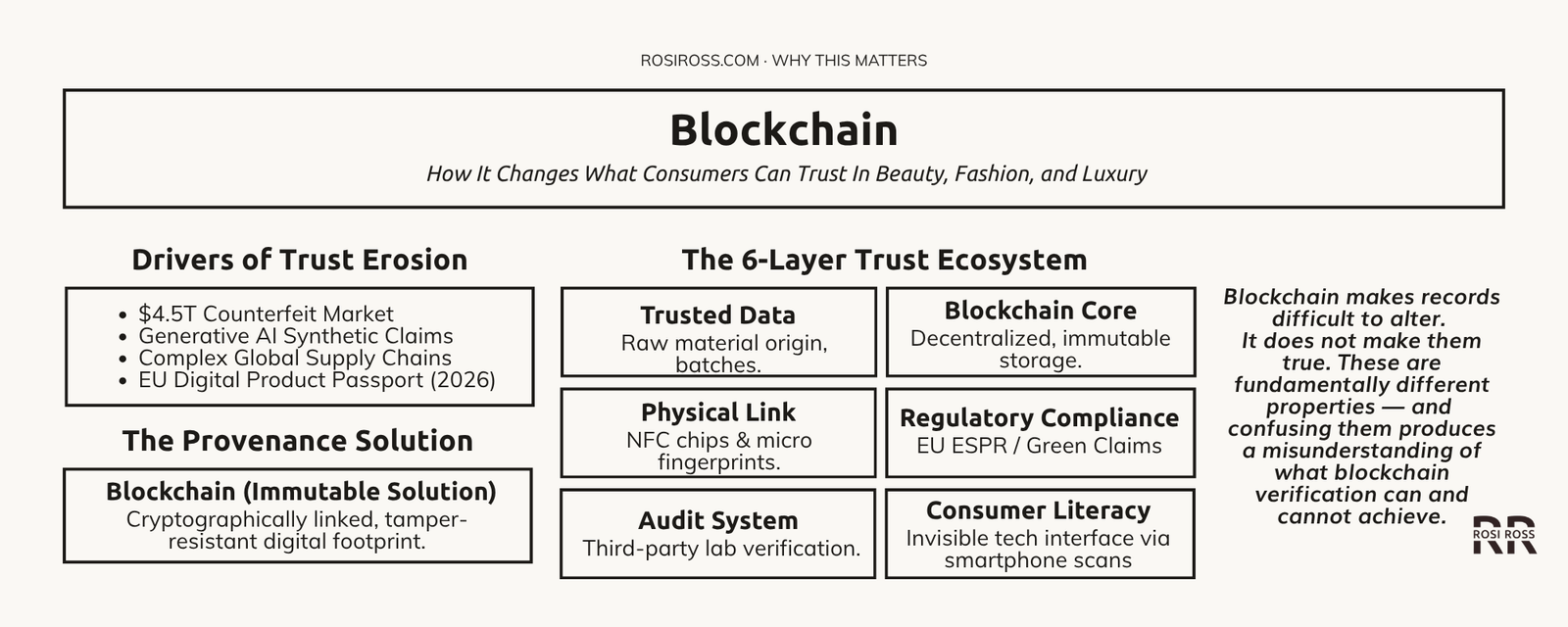
This is not a question about a specific product. It is a question about the fundamental architecture of trust in contemporary commerce — and it is becoming more urgent as the conditions that made brand promises reliable erode on multiple fronts simultaneously. Generative AI makes synthetic imagery, fabricated reviews, and convincing counterfeit brand communications easier to produce than at any previous moment in commercial history. Global supply chains are more complex and more vulnerable to misrepresentation than the certificates printed on product packaging can reliably reflect. The luxury counterfeit market is estimated at $4.5 trillion annually — producing goods sophisticated enough to deceive not only consumers but increasingly the authentication systems designed to catch them.
Into this environment, blockchain enters not as a revolutionary technology but as an infrastructural one — a mechanism for recording and sharing verifiable information across multiple parties in ways that make certain kinds of manipulation structurally difficult. The interesting question is not whether blockchain can do this. It is whether the industry will build the infrastructure — and whether consumers will care enough to use it.
Luxury has always been an information business
The defining characteristic of a luxury product — the quality that distinguishes it from a merely expensive one — is not its price or its material composition. It is the density of information it carries, and the degree to which that information can be trusted. When a consumer purchases a Chanel fragrance, a La Mer cream, or a Cartier bracelet, they are not simply acquiring an object. They are purchasing a set of assurances: that the materials are what the brand claims, that they were sourced as stated, that the product was manufactured under the conditions described, that the craftsmanship meets the standard the brand represents.
For most of the history of the luxury industry, these assurances were delivered through the same mechanisms — heritage, packaging, boutique environments, certificates of authenticity, brand reputation. The authority of the brand was the verification system. The luxury house was, in effect, the trusted intermediary between the consumer and the complexity of the production process that delivered the product to them.
Digital commerce has placed this system under structural pressure that no amount of superior packaging or storytelling can fully resolve. The consumer who encounters a luxury product on a digital platform — or in a market where sophisticated counterfeits circulate — cannot rely on the visual and tactile cues that allowed previous generations to assess authenticity with reasonable confidence. The same shift reshaping beauty purchasing toward evidence-based decisions is reshaping how consumers think about the claims that premium brands make — and creating a commercial environment in which the ability to independently verify those claims is becoming a differentiating quality rather than a supplementary one.
Blockchain is a distributed digital ledger — a record of transactions or data entries maintained simultaneously across multiple computers rather than stored on a single server. Each entry is cryptographically linked to the previous one, creating a chain that makes retrospective alteration structurally difficult: changing any record requires changing all subsequent records across all copies simultaneously, which consensus mechanisms make practically impossible without detection. In commercial applications, blockchain’s most significant property is not speed or efficiency but tamper-resistance: it creates records that are difficult to alter after the fact, making it useful for provenance documentation, supply chain tracking, ownership records, and authentication certificates.
The verification economy is coming into focus
The economic argument for verification infrastructure in luxury is not primarily about ethics or sustainability. It is about money — specifically, about the commercial costs imposed on brands and consumers by the current absence of reliable verification mechanisms, and the commercial value that reliable verification could create.
The global luxury counterfeit market costs legitimate brands an estimated $4.5 trillion annually. The gray market — genuine luxury products sold through unauthorised channels — costs the industry additional billions impossible to quantify precisely because transactions occur outside the brand’s visibility. Supply chain misrepresentation creates regulatory exposure that is increasing as sustainability disclosure requirements become more demanding across major luxury markets including the European Union.
On the consumer side, the economics of verification are equally significant. The secondary luxury market — in which pre-owned luxury goods are resold, sometimes above their original retail cost — is projected to reach $350 billion by 2030. The primary constraint on this market is authentication: the cost, unreliability, and friction of establishing that a pre-owned luxury object is genuine. A reliable digital record of a luxury product’s provenance, manufacture, and ownership history would structurally transform the economics of luxury resale by making the record of authenticity as persistent and as transferable as the object itself.
Professionals who need to understand this infrastructure from a business strategy perspective — without building the technology themselves — have a specific knowledge gap to close.

What blockchain actually adds — and what it cannot do
The most important intellectual distinction in any serious discussion of blockchain’s role in luxury verification is the one most frequently obscured by technology coverage: blockchain makes records difficult to alter. It does not make them true. These are fundamentally different properties, and confusing them produces a misunderstanding of what blockchain verification can and cannot achieve.
A blockchain record documenting the provenance of a luxury handbag is only as accurate as the information entered at the point of manufacture. If false information is entered — if a supplier misrepresents the origin of a material, or if an operator enters fabricated batch data — the fact that this false information is now permanently recorded does not make it accurate. It makes it permanently and immutably inaccurate. The blockchain preserves the record. It cannot independently verify the truth of the claim the record contains.
This leads to the more consequential question the verification economy actually needs to answer: not “is the blockchain secure?” but “who verifies the information before it enters the system?” That question cannot be answered by technology alone. It requires trusted data sources, digital identity infrastructure, auditing mechanisms that confirm physical-world claims before they are committed to a digital record, regulatory frameworks that create accountability for misrepresentation, and consumer literacy sufficient to understand what a blockchain record actually certifies.
The infrastructure the luxury industry needs is therefore not simply a blockchain. It is an ecosystem: trusted data sources + digital identity + physical-world auditing + blockchain infrastructure + regulatory framework + consumer literacy. Blockchain is one layer — significant and potentially irreplaceable — but not the whole. The same principle that distinguishes genuine quality from the performance of quality in any premium category applies to trust infrastructure: substance is not the same as claim, and the difference matters most when the stakes are highest.
For professionals building or specifying verification systems, understanding the technical architecture of that infrastructure is the prerequisite.

A digital product passport (DPP) is a persistent digital record associated with a specific physical product containing information about its origin, manufacture, materials, ownership, and lifecycle — accessible throughout the product’s useful life and beyond. The European Union’s Ecodesign for Sustainable Products Regulation (ESPR), which will require digital product passports for an expanding range of product categories from 2026 onward, establishes DPPs as a regulatory obligation for brands selling in European markets. In luxury contexts, a DPP could contain: ingredient or material origin certification; manufacturing date, location, and batch information; authenticity verification linked to production records; ownership history through subsequent resales; sustainability data; and repair and warranty records. Blockchain is one of the primary candidate technologies for DPP infrastructure, because its tamper-resistance makes falsification structurally difficult.
Beauty has a verification problem
The beauty industry represents one of the most compelling case studies for verification infrastructure, combining the specific challenges of the luxury category with additional complexity layers that make the stakes unusually high. Luxury fashion has a provenance and authenticity problem. Beauty has those problems plus an ingredient safety problem, a claims substantiation problem, and a personal data problem — all operating simultaneously within a regulatory environment that is becoming significantly more demanding across its most important markets.
The ingredient provenance dimension is the most direct. A significant proportion of the premium beauty market is built on ingredient claims — the specific origin, purity, concentration, and sourcing conditions of active ingredients that justify premium pricing and differentiate products from less expensive alternatives. These claims are currently verifiable, if at all, only through the brand’s own certification and testing processes. A blockchain-based ingredient provenance record — in which each stage of the supply chain, from agricultural or laboratory source through processing, formulation, and packaging, is documented by the party responsible for it — would make independent verification possible in principle.
The counterfeit dimension of beauty verification has become commercially significant in ways the industry has been slow to acknowledge publicly. Sophisticated counterfeit luxury skincare products frequently contain materials not declared on their packaging — including heavy metals, industrial solvents, and unregulated synthetic compounds — manufactured without quality controls that determine whether products are safe for skin contact. The consumer who understands ingredient intelligence already knows that what a label claims and what a product contains are not always identical. Verification infrastructure makes that gap closeable. The same analytical precision that governs serious ingredient literacy needs infrastructure — not merely education — to become a reliable mechanism for consumer protection.
Supply chain traceability refers to the capacity to document and verify each stage of a product’s journey from raw material source through manufacturing, logistics, and retail to the end consumer. In the luxury industry, traceability serves three simultaneous functions: compliance (demonstrating adherence to sourcing standards, labour conditions, and environmental regulations); commercial (providing provenance stories that justify premium pricing and differentiate products in competitive markets); and risk management (identifying and isolating contamination, counterfeiting, or quality failures at the specific point in the supply chain where they occurred). Blockchain-based traceability differs from conventional supply chain documentation in that the records are maintained across multiple independent parties rather than controlled by a single authority — making fabrication or retrospective alteration structurally more difficult and independently auditable.
The digital identity of a product — beyond the NFT moment
The concept of a digital product identity — a persistent, unique, transferable digital record associated with a specific physical luxury object — became temporarily entangled with NFT speculation during 2021–2023, and this entanglement caused significant damage to serious engagement with the underlying idea. The relevant concept is not an NFT. It is a digital twin: a digital record permanently and verifiably linked to a specific physical object, that travels with the object through its entire lifecycle, and that can be queried at any point to establish provenance, authenticity, and ownership history.
LVMH, Prada Group, and Cartier launched the Aura Blockchain Consortium in 2021 specifically to create product-level digital identity infrastructure for luxury goods. The consortium now includes over forty luxury brands and has issued more than 40 million digital product identities. The investment-grade luxury object — whether a pearl necklace, a vintage watch, or a limited-edition leather bag — is the category where the commercial case is most immediately legible: a verified record of provenance, ownership, and authenticity makes the object more liquid in resale markets, more efficiently insurable, and more reliably transferable as a long-term investment.
The Ethereum protocol underlies the Aura Consortium and most of the deployed luxury authentication infrastructure currently in operation. Professionals working with or evaluating this infrastructure need specific expertise in its architecture.

AI makes provenance more valuable
The most consequential development for the verification economy over the next five years is not a development in blockchain technology. It is a development in artificial intelligence. Generative AI is systematically eroding the reliability of the visual and informational signals through which consumers have historically assessed the authenticity and quality of products, brands, and claims — and in doing so, it is creating a structural demand for forms of verification that AI cannot replicate or circumvent.
AI image generation can now produce product photography indistinguishable from studio-quality originals. AI text generation can produce brand communications, ingredient provenance stories, sustainability claims, and consumer reviews grammatically and stylistically indistinguishable from genuine ones. AI-generated social proof is creating an information environment in which no consumer-facing signal can be assumed to originate from a genuine human interaction with a real product.
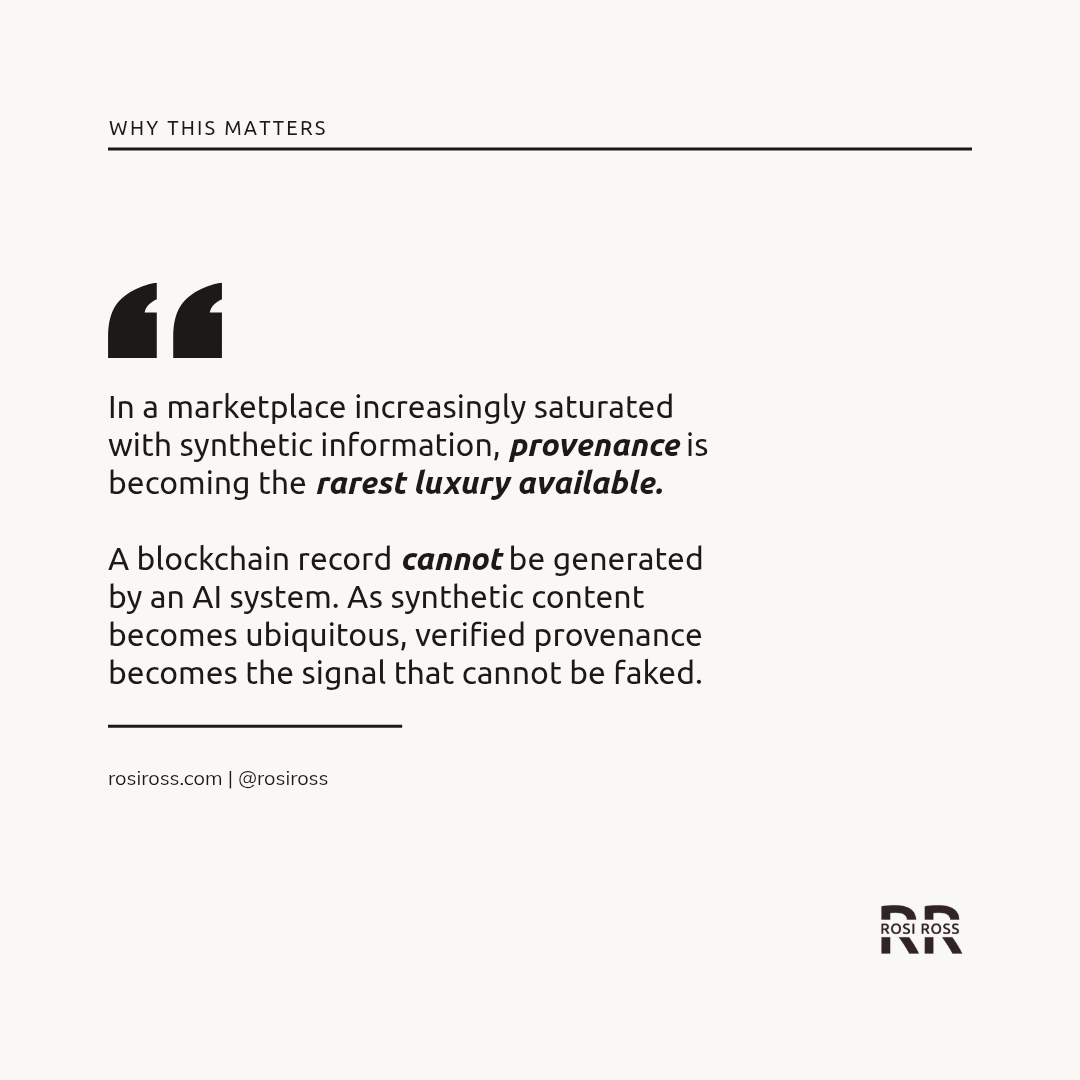
A provenance record that exists in a blockchain — entered at the point of manufacture by verified parties, cryptographically linked to subsequent entries by each stage of the supply chain — cannot be generated by an AI system. It can only be falsified by corrupting the parties responsible for entering it, which is a different and more traceable form of fraud than generating convincing synthetic content. As AI reshapes the economics of beauty content creation, it simultaneously reshapes the economics of trust — making provenance not merely a marketing enhancement but an infrastructure requirement for brands whose claims need to be distinguishable from synthetic alternatives.
The professionals most exposed to this intersection — those making decisions about AI-generated content, brand communications, and verification systems simultaneously — need literacy across both domains.

The business case for trust — resale, insurance, and the loyalty economy
The commercial case for verification infrastructure in luxury extends beyond counterfeit prevention and ingredient transparency into dimensions that affect the long-term economics of the luxury business model itself. Authentication, resale, insurance, loyalty, compliance, and customer relationship management are all domains where reliable product-level verification creates commercially measurable value — and where the brands that build verification infrastructure earliest will accumulate advantages that compound over time.
Pre-owned luxury — projected at $350 billion globally by 2030 — generates significant revenues for third-party platforms including Vestiaire Collective, The RealReal, and Chrono24, and almost no revenue for the brands whose heritage creates the value being resold. Digital product identity changes this relationship: brands can participate in the economics of their products’ secondary lives through authentication services, verified resale programmes, and the loyalty data generated when existing customers register resale transactions.
The compliance dimension is increasingly driven by regulatory pressure. The EU’s Digital Product Passport requirements, the proposed revision of the Green Claims Directive requiring substantiation of environmental marketing claims, and expanding supply chain due diligence legislation across European and North American markets are creating an environment where verification infrastructure transitions from competitive advantage to compliance requirement. Brands that build this infrastructure voluntarily, before regulatory compulsion, will accumulate operational experience that brands responding to regulatory pressure will spend years and significant capital attempting to replicate.
For professionals operating at the intersection of blockchain infrastructure, digital ownership, and the financial mechanics of luxury resale and tokenisation.
The limits of verification — what blockchain cannot do
The most intellectually honest position on blockchain verification is also the least frequently articulated: blockchain is a record-keeping infrastructure with specific and well-defined capabilities, and its value depends entirely on the quality of the broader ecosystem in which it operates. It cannot independently verify the truth of the claims recorded within it. It cannot prevent fraud by parties with legitimate access to enter information. It cannot bridge the gap between a digital record and a physical object without additional authentication mechanisms — a product whose identity has been digitally recorded can still be physically switched for a counterfeit, unless the physical-digital link is itself secured.
The honest version of the blockchain verification proposition looks something like this: blockchain makes certain records more difficult to alter retrospectively. In conjunction with trusted data sources, rigorous supplier auditing, robust physical-digital identity linking (NFC chips, microscopic markers, spectroscopic fingerprinting), regulatory compliance requirements, and consumer education sufficient to make verification a normal part of premium purchase behaviour, it can contribute to a verification ecosystem meaningfully more reliable than the current alternative.
The brands that will build genuinely effective verification infrastructure are not the ones promising to solve counterfeiting with blockchain. They are the ones asking harder questions: how do we verify our suppliers’ data before it enters the system? How do we create a physical-digital link that is tamper-resistant rather than tamper-evident? How do we design consumer-facing verification experiences simple enough to use and compelling enough to motivate use? The intelligence that distinguishes genuine craft from the performance of craft applies to verification infrastructure with equal force — the difference between a system that works and one that merely claims to is located in the quality of the thinking that produced it, not the technology selected to implement it.
What a verified product could look like in the future
The most useful way to understand what blockchain verification might mean for the luxury consumer is not through market projections or technology roadmaps. It is through a specific consumer journey that makes the abstract infrastructure legible as a lived experience.
You are purchasing a luxury serum. The product’s packaging carries a small embossed mark — an NFC chip embedded in the glass, or a microscopic spectroscopic fingerprint in the label — unique to this specific unit. You scan it with your phone. The interface that opens is not a brand website. It is a neutral verification platform that queries the product’s blockchain record and returns, in seconds, a structured set of verified claims.
Origin: The key active ingredient was sourced from a named agricultural cooperative in a specific region, on a specific harvest date, certified by an independent auditor whose credentials are also recorded. Manufacturing: The product was produced at a specific facility on a specific date as part of a batch whose records are linked. Authenticity: This specific unit corresponds to a verified production record and has not previously been registered by another consumer. Ownership: The product is being registered for the first time, establishing the current purchaser as the first owner of record. Sustainability: The packaging is composed of specific recycled materials with a carbon footprint calculation linked to independently verified emissions data. Aftercare: The packaging should be returned to a specific recycling programme, with a QR code linking to the nearest collection point.
Notice what has happened. Blockchain has disappeared into the background. The consumer is not reading a blockchain record. They are receiving verified information about a product they are about to use on their skin, in a format that takes thirty seconds to access and answers questions they actually care about. The technology is invisible. The trust is not. As AI reshapes what can be created without being true, what can be verified without being synthetic becomes, correspondingly, more precious. In a marketplace increasingly saturated with synthetic information, provenance may become one of the most valuable forms of luxury available.
Blockchain product authentication is the practice of using a distributed ledger to create and maintain a verifiable record of a product’s provenance, manufacture, and ownership that can be queried by consumers, retailers, insurers, resellers, and regulators to establish authenticity without relying solely on the brand’s own certification. It differs from conventional authentication in two commercially significant ways: the record is maintained across multiple parties rather than controlled by a single authority, making it more difficult to falsify; and the record is persistent and transferable, meaning authenticity established at manufacture remains accessible throughout the product’s lifecycle. LVMH, Prada, and Cartier’s Aura Blockchain Consortium — operational since 2021 with over 40 luxury brand members and 40 million digital product identities issued — is the most significant operational example of blockchain authentication at luxury scale.
Explore further — Blockchain Council programmes





“Luxury has always been an information business.
The certificate. The heritage. The name.
What blockchain proposes
is not a replacement for trust
but an infrastructure for it —
a way of making certain claims
difficult to falsify
and possible to verify.
In an economy where AI
can generate a provenance story
indistinguishable from a real one,
the ability to prove rather than claim
becomes the rarest luxury of all.”

