
On a sixty-year calendar system that has outlasted empires, and why a framework built to read personality through animals and elements remains genuinely relevant in an age that otherwise treats the past as a settled matter
The Chinese Zodiac is more than a calendar tradition. It is a centuries-old framework that connects time, mythology, personality, and cultural identity — a reminder that history, symbolism, and human connection remain deeply intertwined.
Every winter, as red lanterns illuminate streets across Asia and families gather around tables built specifically around symbolic dishes, one of the world’s oldest continuous cultural systems takes its turn at the centre of attention. Known as Sheng Xiao (生肖), the Chinese Zodiac has connected time, mythology, and personal identity for millennia, assigning each lunar year one of twelve animals in a repeating cycle that has shaped naming conventions, compatibility beliefs, and casual conversation for generation after generation without much interruption. This is not a seasonal curiosity. It is a working cultural infrastructure, still fully operational.
The Origins of the Chinese Zodiac
The system was refined and consolidated during the Han Dynasty, when scholars integrated celestial observation, agricultural cycles and philosophical concepts into a single structured calendar, a genuinely ambitious act of synthesis for its era. The underlying counting tools were older still: the stems and branches had long been used to number days and years, and the Han period gave them the coherence, and the cultural weight, that carried them forward for two millennia.
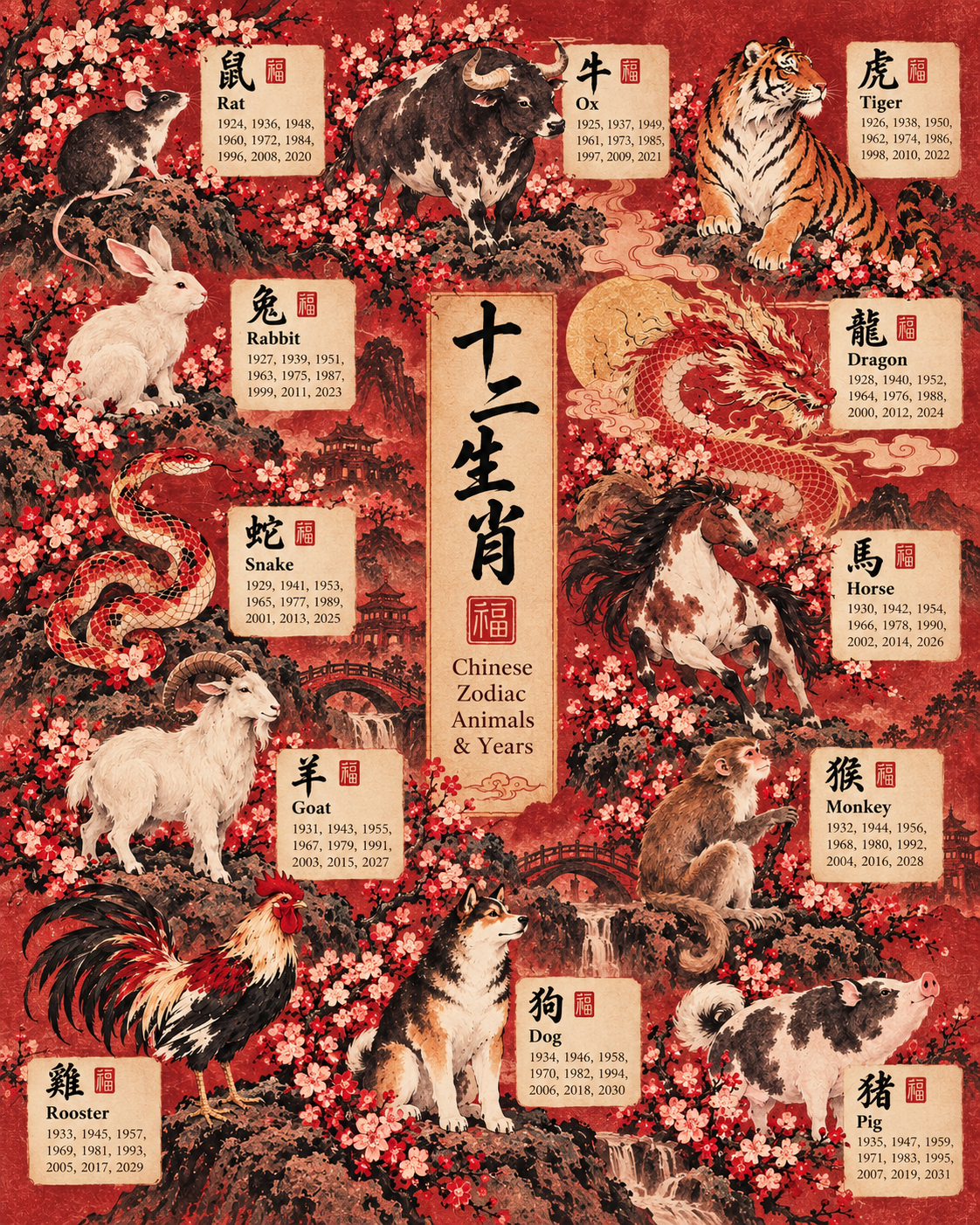
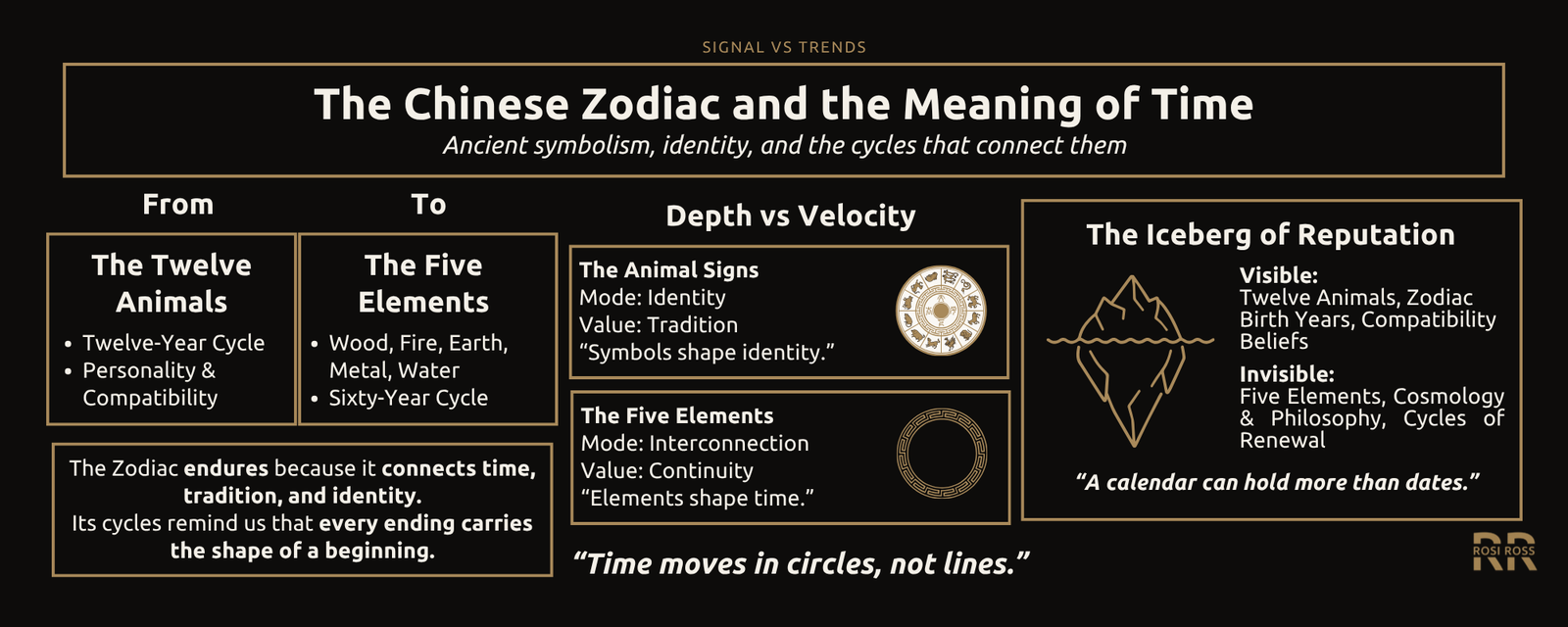
At its foundation, it is a calendar system built from twelve earthly branches, each represented by an animal, layered against ten heavenly stems connected to five elements: wood, fire, earth, metal and water. Together these combine into a sixty-year sexagenary cycle, in which each year carries a unique pairing of animal and elemental character, meaning the specific combination marking any given year will not recur for another six decades.
How many years are in the Chinese Zodiac cycle? Twelve years complete the animal rotation alone, but the full elemental cycle runs sixty, a level of temporal precision that predates most Western calendar systems by centuries. For this reason, a person’s sixtieth year has traditionally been marked as a return to the beginning, a full cycle completed, with a significance in many families that approaches that of a second birth.
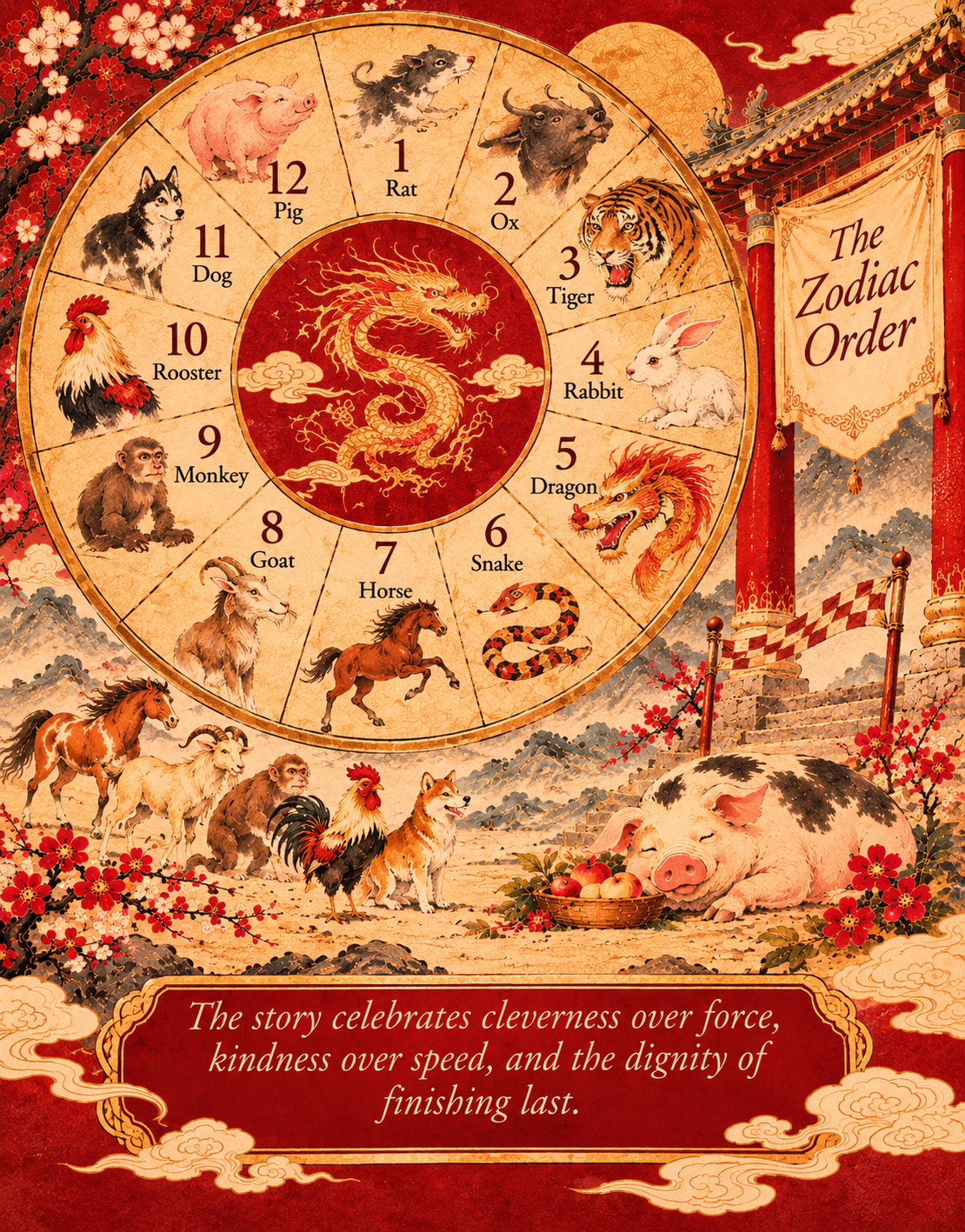
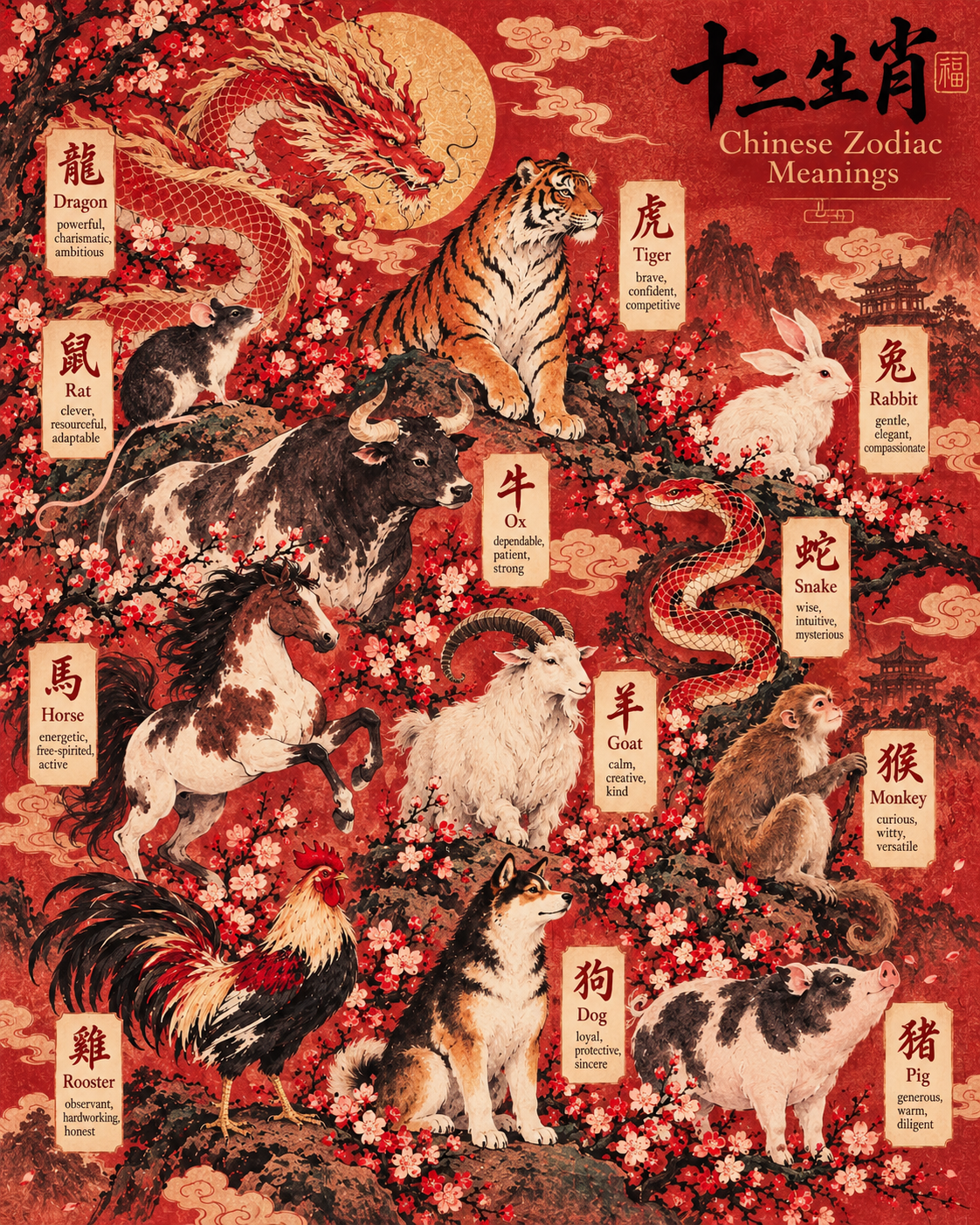
The animal sequence runs: Rat, Ox, Tiger, Rabbit, Dragon, Snake, Horse, Goat, Monkey, Rooster, Dog and Pig, a fixed order whose origin stories vary by region and telling, but whose staying power has proven remarkably consistent across more than two thousand years of continuous use. The best-known account describes a great race, in which the animals crossed a river to earn their place, and the order records who arrived first. Its detail changes from teller to teller, and that variety is part of the point: the story survives because it explains a sequence that people were already living by.
The zodiac has outlasted dynasties, republics and the arrival of the Gregorian calendar because it answers a question every culture asks, which is how to place a single life inside a larger pattern. Its twelve-year rhythm gives families a shared vocabulary for age, for generations and for the passing of time, and its sixty-year cycle gives a lifetime a shape: a beginning, a full turn and a return. That is why it continues to be used long after its original practical purposes have been met by other tools.
The Legend Behind the Order
Long before scholars formalised the zodiac into a working calendar, folklore had already supplied a reason for why the animals line up the way they do — a story about ingenuity, humility, and the particular kind of luck that favours cleverness over brute strength.
The most widely told account, sometimes called the Great Race, holds that the Jade Emperor summoned every animal in the kingdom to a contest: the order in which they crossed a wide, fast-moving river would determine their position in the calendar to follow. The Rat, too small to swim the distance alone, is said to have persuaded the considerably larger Ox to carry it across, leaping down at the final moment to cross the finish line first — securing the opening position through wit rather than strength, a detail Chinese storytelling has never treated as unfair so much as instructive. The Ox followed close behind, its steady effort rewarded with second place despite having done the actual work of the crossing. The Tiger arrived third, having fought the current directly; the Rabbit, unable to swim at all, is said to have hopped across a floating log and a chain of stepping stones, arriving fourth through resourcefulness rather than raw ability. The Dragon, despite possessing the power of flight, arrived only fifth, having paused along the way to bring rain to a village in need — an act of compassion the legend treats as more valuable than the position it cost. The remaining seven animals arrived in turn, each account of their crossing offering its own small lesson, until the Pig, having stopped to eat and nap along the way, closed the cycle in twelfth position. Whether or not any version of this story reflects the calendar’s actual scholarly origins, its persistence across two millennia says something real about what the culture surrounding it chose to value: cleverness over force, kindness over speed, and the quiet dignity of finishing last without shame.



The Symbolism of the Twelve Animals
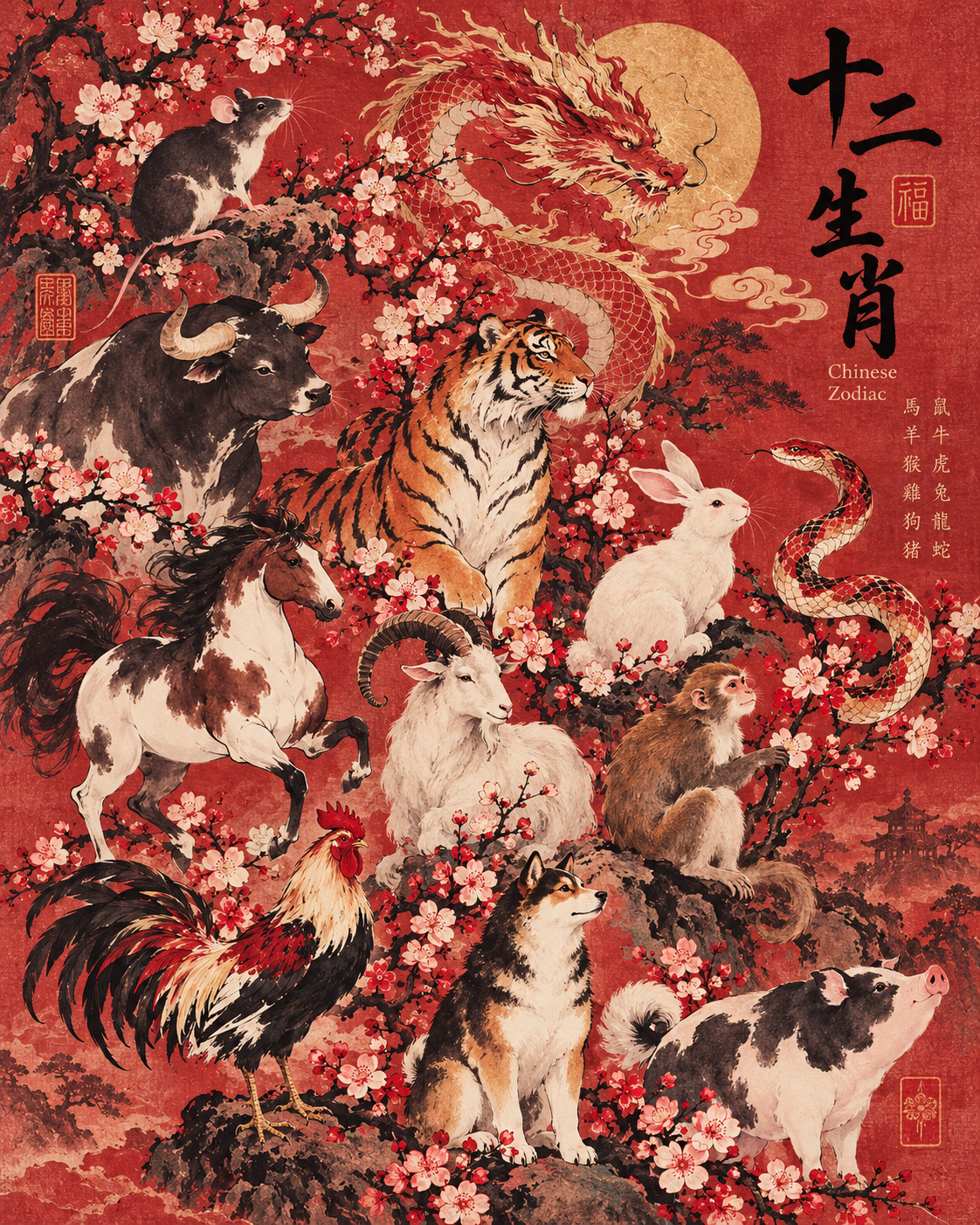
Where Western astrology draws its symbolism from constellations, the Chinese Zodiac draws entirely from earthly creatures and their observed behaviour — a genuinely different epistemology, grounded in the natural world rather than the night sky. The Rat, opening the cycle, represents resourcefulness and quick adaptation, its position at the sequence’s start reflecting a kind of strategic survival instinct. The Ox embodies patience and steady, unglamorous progress rather than any pursuit of immediate reward. The Tiger carries confidence and a genuine willingness to challenge boundaries; the Rabbit, by contrast, represents diplomacy and emotional intelligence, refinement over confrontation.
The Dragon stands apart as the cycle’s only mythical creature, and its symbolic weight reflects that distinction — strength, prosperity, and leadership, among the most respected figures in the entire tradition. The Snake carries intuition and strategic patience rather than impulse; the Horse, independence and genuine appetite for exploration. The Goat represents creativity and compassion, the Monkey curiosity and inventive problem-solving, the Rooster precision and responsibility. The Dog embodies loyalty and integrity, closing trust into the sequence before the Pig completes the cycle entirely — traditionally associated with prosperity and generosity, its occasional Western stereotype of laziness or indulgence a genuine misreading of what the symbol has always represented within its own cultural context: comfort, abundance, and the earned enjoyment of life’s rewards.
Traditional compatibility theory extends this symbolism into how the animals are believed to relate to one another, grouped loosely into four trines of naturally harmonious signs — Rat, Dragon, and Monkey sharing an affinity for ambition and adaptability; Ox, Snake, and Rooster united by discipline and precision; Tiger, Horse, and Dog drawn together through independence and loyalty; Rabbit, Goat, and Pig linked by gentleness and creative sensitivity. Opposite the calendar wheel, certain pairings — Rat and Horse, Ox and Goat, Tiger and Monkey, Rabbit and Rooster, Dragon and Dog, Snake and Pig — are traditionally read as more contentious, temperaments pulling in genuinely different directions rather than complementing one another. None of this functions as prescriptive rule in modern practice so much as a shared cultural shorthand, a way of narrating relationships and family dynamics through a symbolic language most people in the culture already speak fluently, whether or not they take it literally.
The Meaning Behind the Five Elements
What do the five elements mean in Chinese astrology? Wood represents growth, creativity, and expansion; fire, passion and transformation; earth, stability and grounding; metal, structure and determination; water, intelligence and adaptability. Each animal year pairs with one of these five elemental forces, producing a combination that will not repeat for a full sixty years — a level of interpretive complexity that turns the zodiac from a simple twelve-symbol rotation into something considerably more intricate. An Earth Pig year, for instance, carries particular cultural weight precisely because Earth’s association with stability and grounding merges directly with the Pig’s own symbolism of prosperity — two forms of abundance reinforcing one another rather than simply coexisting.
The five elements, or Wu Xing, were never conceived as a static list. Chinese philosophical tradition arranges them into two interacting cycles that give the entire system its dynamism. In the generating cycle, wood feeds fire, fire’s ash becomes earth, earth yields metal, metal collects water as condensation, and water in turn nourishes wood — a closed loop of one force continuously producing the next. A second, overcoming cycle runs in tension with the first: wood parts earth, earth absorbs water, water extinguishes fire, fire melts metal, and metal cuts wood. Together, these two cycles describe a universe in constant negotiation between creation and constraint, growth and limit — the same philosophical framework that underlies traditional Chinese medicine, classical garden design, and much of the country’s architectural feng shui tradition. The zodiac’s elemental layer is simply this same cosmology, applied to the passage of time itself.
Chinese New Year: A Celebration of Renewal
Chinese New Year, also known as the Spring Festival, extends well past the simple marking of a new calendar year. It represents genuine renewal — a deliberate closing of the previous year’s difficulties and an equally deliberate opening toward what comes next. The celebration traditionally runs fifteen days, beginning with a thorough cleaning of the home meant to remove old misfortune and make literal, physical space for new opportunity before the festivities themselves even begin.
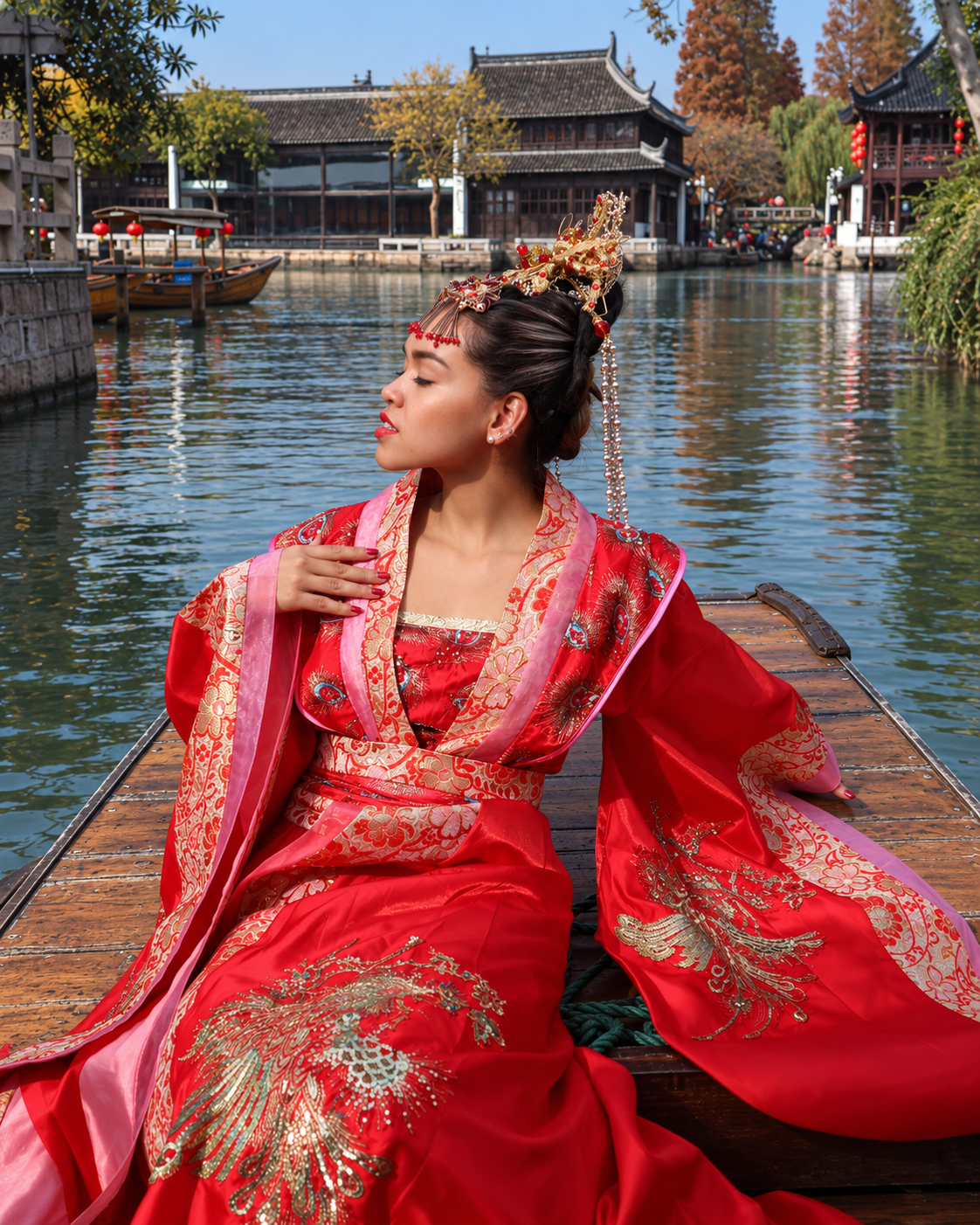
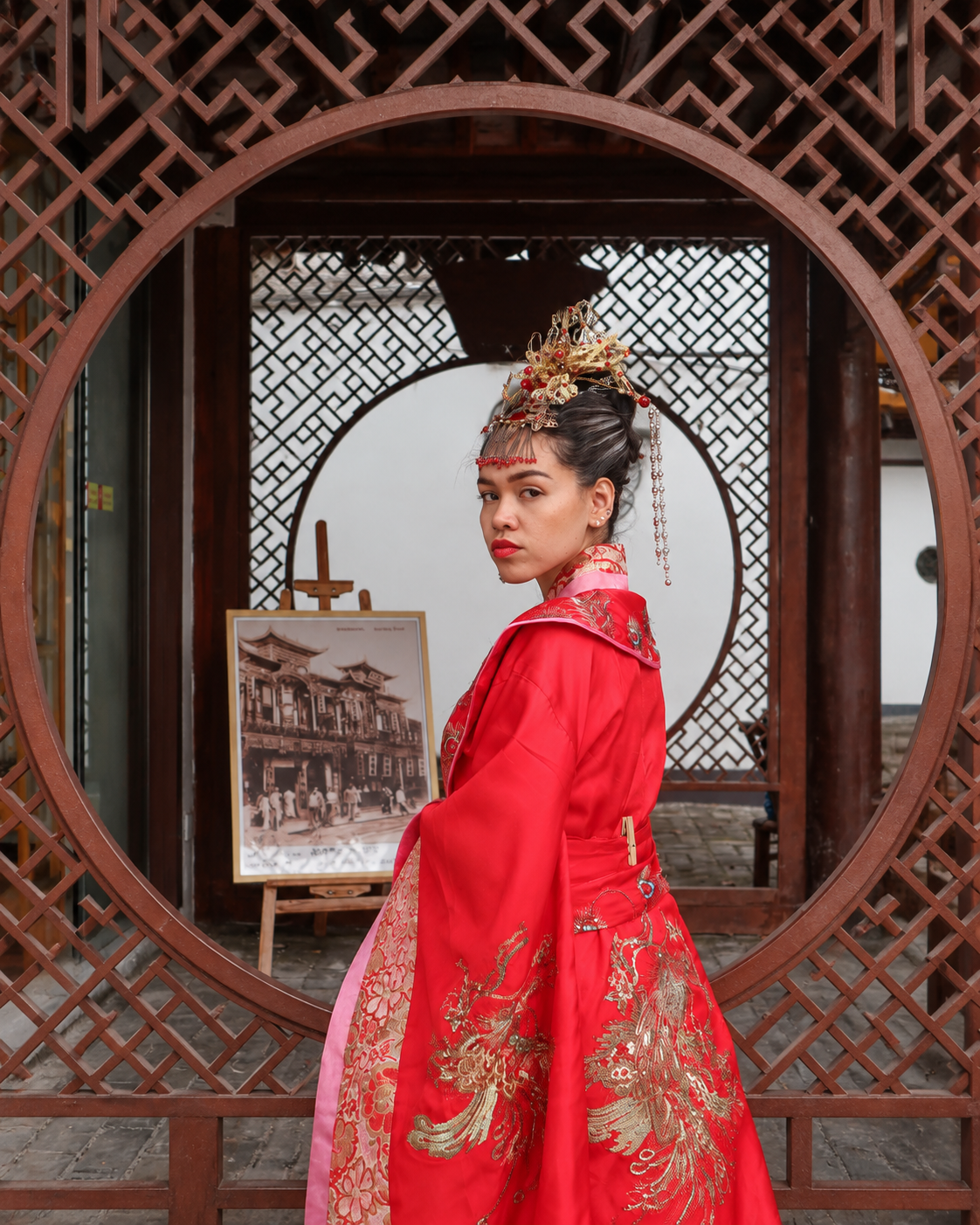
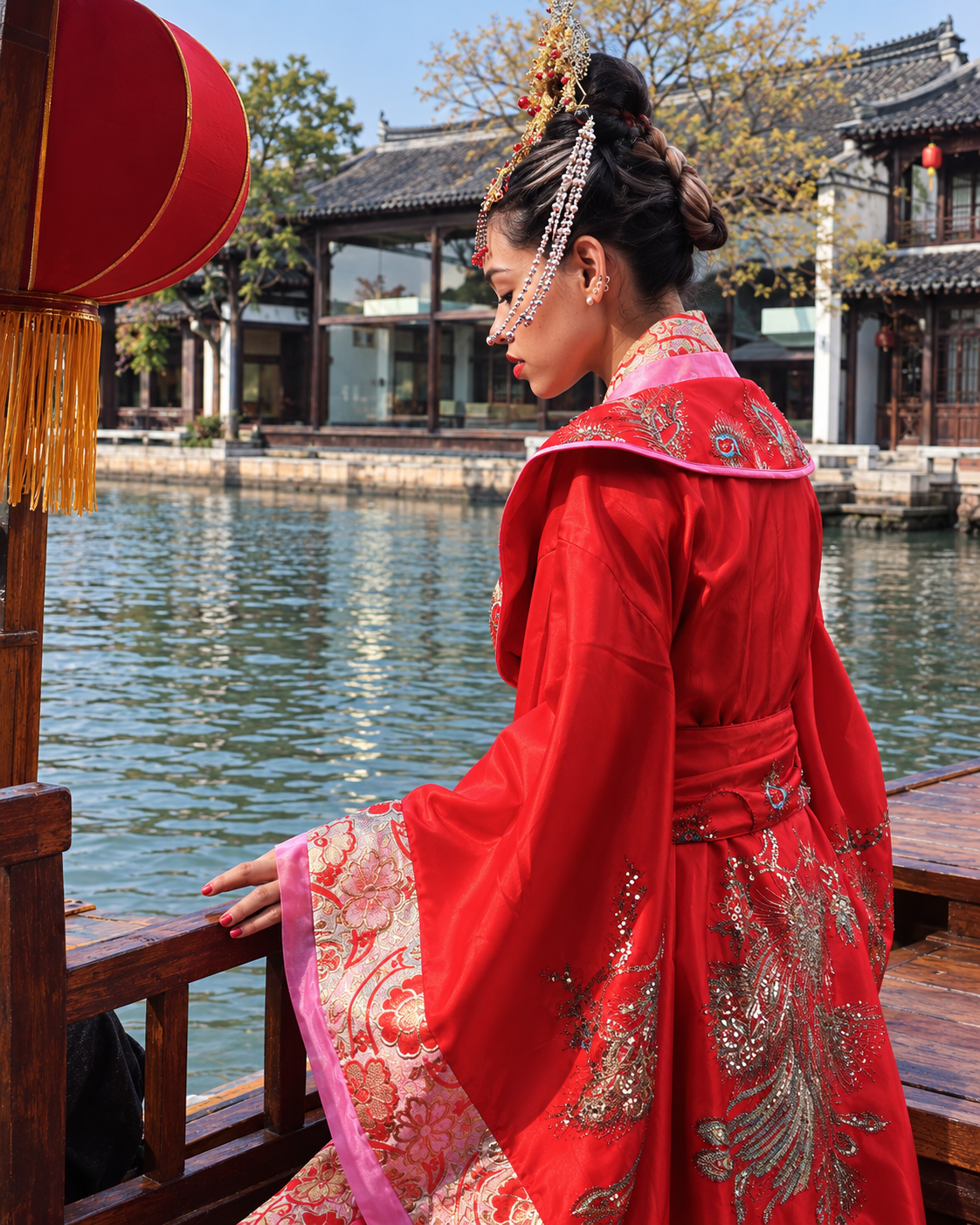
The New Year’s Eve reunion dinner remains the celebration’s emotional centre, built around dishes chosen specifically for what they symbolise rather than simply what they taste like: fish for abundance, dumplings for wealth, tangerines and oranges for good fortune, rice cakes for growth and forward progress. Food, in this context, functions as a genuine language of wish-making for the year ahead. Red dominates the visual register throughout — luck, happiness, and protection made literal in decoration, and in the red envelopes, or hongbao, traditionally gifted to children and family as a direct blessing of prosperity. The tradition’s most famous origin story, the legend of Nian, a mythical creature said to have terrorised villages at the year’s turn until residents discovered that loud noise, fire, and the colour red could frighten it away, remains embedded directly in the modern celebration — the fireworks, lanterns, and red decorations of a contemporary Spring Festival tracing a direct line back to that same act of collective defiance.
Why is Chinese New Year celebrated for fifteen days? The full observance runs from New Year’s Eve through the Lantern Festival, tracing the moon’s own cycle from new to full — a structure that mirrors the celebration’s central theme of renewal moving steadily toward completeness and light. Cities across Asia mark that fifteenth night with thousands of illuminated lanterns, lion dances, and cultural performance, alongside the shared eating of tangyuan — sweet, round rice balls whose shape symbolises family unity and togetherness, the same symbolism found in China’s separate winter solstice tradition of Dongzhi, a genuine echo across two distinct festivals built around the same underlying instinct.


A Festival That Outgrew Its Borders
What began as a domestic Chinese calendar system has become one of the most widely shared observances on earth. Many countries and territories now recognise the turn of the lunar year as a public holiday, and the number of people who take part in some form of Spring Festival each year is often put at around one-fifth of the world’s population, a scale that few cultural events, religious or otherwise, can claim. Vietnam keeps Tết on the same lunar calendar with its own distinct traditions. South Korea’s Seollal frequently falls within days of Chinese New Year, sharing ancestral roots even where specific customs diverge. Beyond Asia, diaspora communities from San Francisco to Sydney to Paris stage parades, lion dances and night markets substantial enough to earn civic recognition from local governments with no historical link to the tradition. This spread was never cultural export in the marketing sense. It reflects genuine adoption: communities finding, inside a framework more than two thousand years old, a structure for renewal flexible enough to hold meaning wherever it is practised.
Why the symbolism travels. The festival’s central images are few and elemental, which is why they translate. Red stands for protection and good fortune, and requires no explanation in any language. The reunion dinner, at which families gather from wherever work and life have scattered them, speaks to a need that is not specific to any culture: to return, once a year, to the people who define where you come from. The red envelope turns generosity into ritual, a blessing passed down rather than a gift exchanged. The lantern, the lion and the firecracker all carry the same quiet argument, that a new year should be met with light, noise and intention, so that whatever was unsettled in the old one does not follow you through the door.
A calendar of beginnings. The cycle of twelve animals gives each year a character without demanding belief. Many who do not follow the zodiac still read their year as an invitation to take stock, and that is the deeper reason the observance has widened beyond its origin. It offers a collective moment to clean, to settle debts, to repair relationships and to start again, an idea every society has in some form and few have ritualised so completely. For diaspora families, it does something more: it hands a language of belonging to the generations born far from the places their grandparents left, and lets them carry it forward on their own terms.
What endures. The traditions will continue to change in form, with the foods, the dress and the cities shifting from one generation to the next. What persists is the structure beneath them: a pause, a gathering and a deliberate crossing from one year into the next. That is why the festival reads less as an inherited custom than as a shared human instrument, one that people in very different places have independently chosen to keep.
The festival is rooted in the lunar calendar, but its core ideas of family reunion, renewal and good fortune are universal. Diaspora communities, neighbouring cultures that share the calendar and cities that welcome public celebrations have all adopted it, which is why it is now among the most widely observed cultural events in the world.
Why the Chinese Zodiac Still Matters Today
In an era defined by acceleration and constant reinvention, the Chinese Zodiac remains relevant precisely because it offers something increasingly scarce: a durable connection between time, tradition, and personal identity. For most people who observe it, knowing one’s zodiac animal has little to do with predicting a specific outcome. It functions instead as a genuine cultural reference point — a way of understanding personality, family tradition, and centuries of accumulated philosophical thought, absorbed casually rather than consulted formally. In December 2024, UNESCO formally inscribed the Spring Festival onto its Representative List of the Intangible Cultural Heritage of Humanity, recognising it as one of the most widely practised living traditions on earth — an official acknowledgment of something Chinese communities worldwide had never actually needed confirmed.
The zodiac’s larger argument extends beyond any single animal or element: that life, understood this way, moves in genuine cycles rather than a straight accumulating line. Seasons return. Years repeat their elemental pairing only once in sixty. Every ending, structurally, contains the beginning of something else. This is the same logic that runs through the case for personal ritual as identity built through repetition rather than dramatic transformation, and it echoes across other belief systems this editorial series has traced — the feng shui logic embedded directly into Hong Kong’s own skyline, the living ritual still active inside Shanghai’s Buddhist and Taoist temples, and the symbolic ecological worldview carried, generation after generation, through a 1,400-year-old Indian painting tradition. Institutions including the Smithsonian’s National Museum of Asian Art and the Metropolitan Museum of Art have each built substantial collections around precisely this material — physical evidence of a symbolic system old enough to have shaped art, architecture, and ritual across an entire civilisation, still functioning exactly as intended.
As lanterns rise into the night sky each year and families gather across continents rather than a single region, the Chinese Zodiac continues its ancient, unhurried rhythm — proof that a system built more than two thousand years ago to make sense of time can remain, without needing revision, one of the more genuinely useful frameworks available for understanding it still.
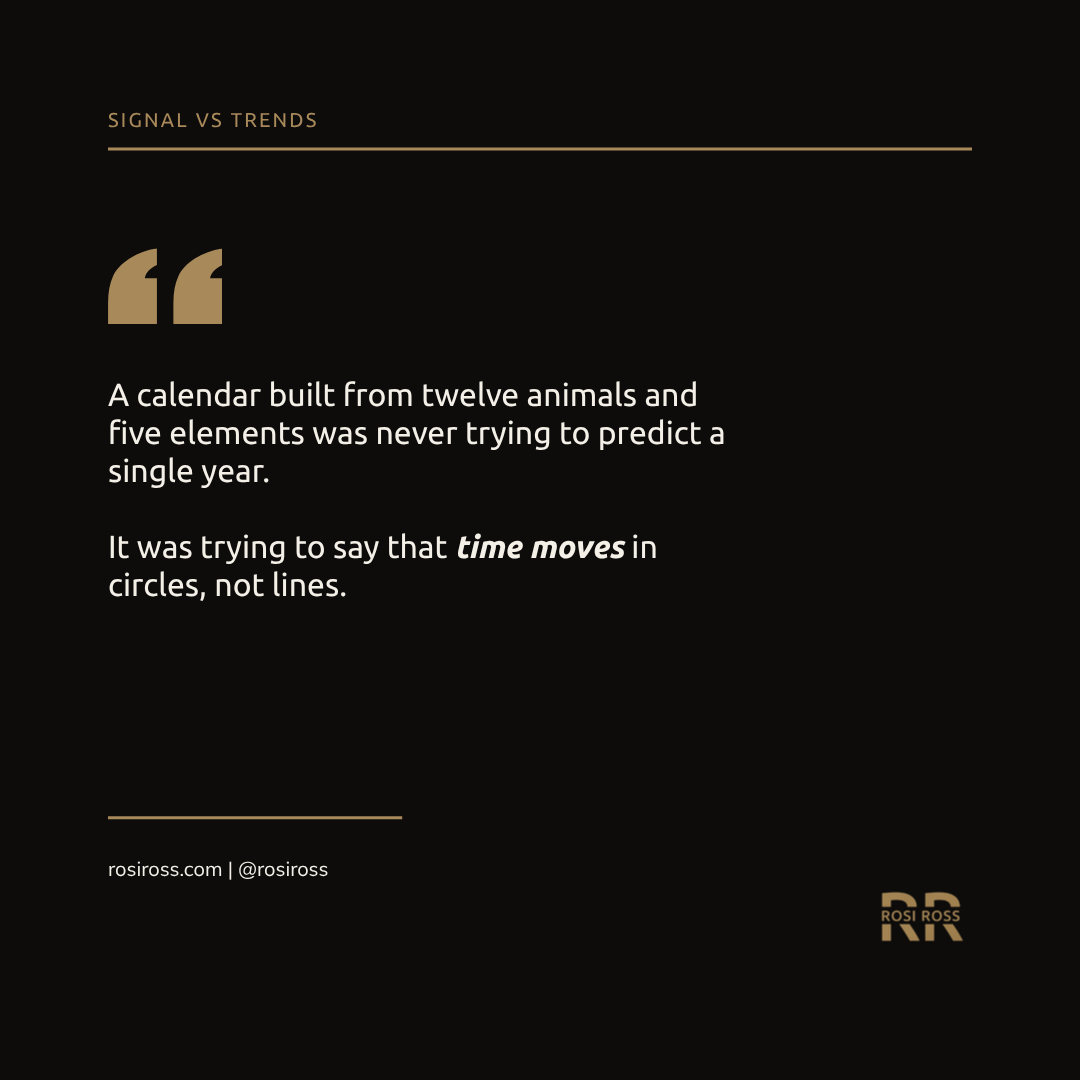
“A calendar built
from twelve animals
and five elements
was never trying
to predict a single year.
It was trying to say something
considerably larger —
that time moves in circles,
not lines,
and that every ending
was always going to carry
the shape of a beginning
somewhere inside it.”

