
On the gold cappuccino in a Dior-branded mug at a Dubai café, what genuine fashion-culinary collaborations look like elsewhere in the world, and why the gap between the two is the most interesting part of the story
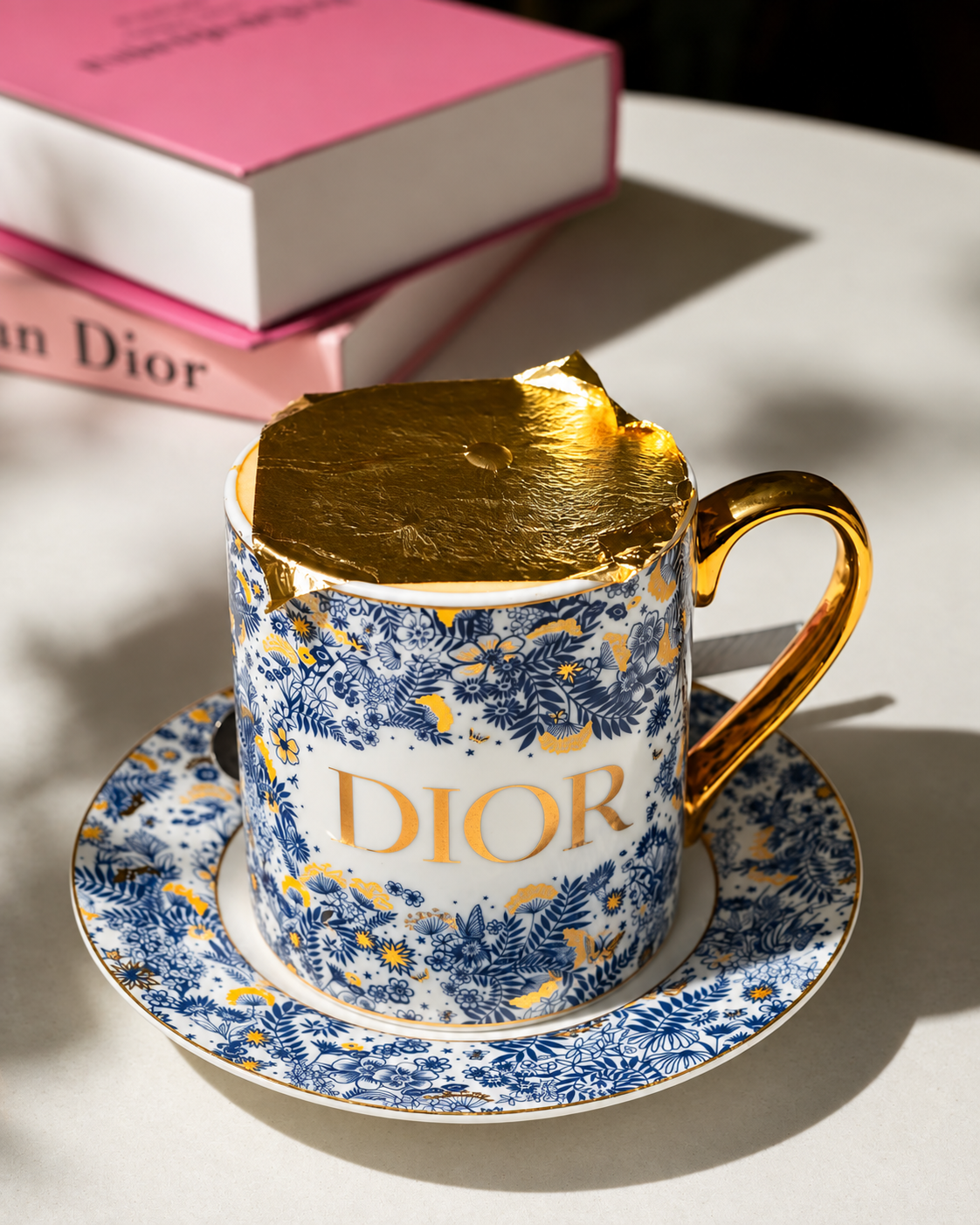
A gold-dusted cappuccino arrives at the table inside a mug carrying Dior’s name and monogram. The phone is lifted before the cup is. The photograph does more work in eight seconds than the coffee does in the four minutes it takes to drink — which is either a very old story about fashion and desire, or a very new one about what a brand name can do once it’s printed on porcelain, whether or not the house whose name it borrows had anything to do with the decision.
The gold cup and the question it raises
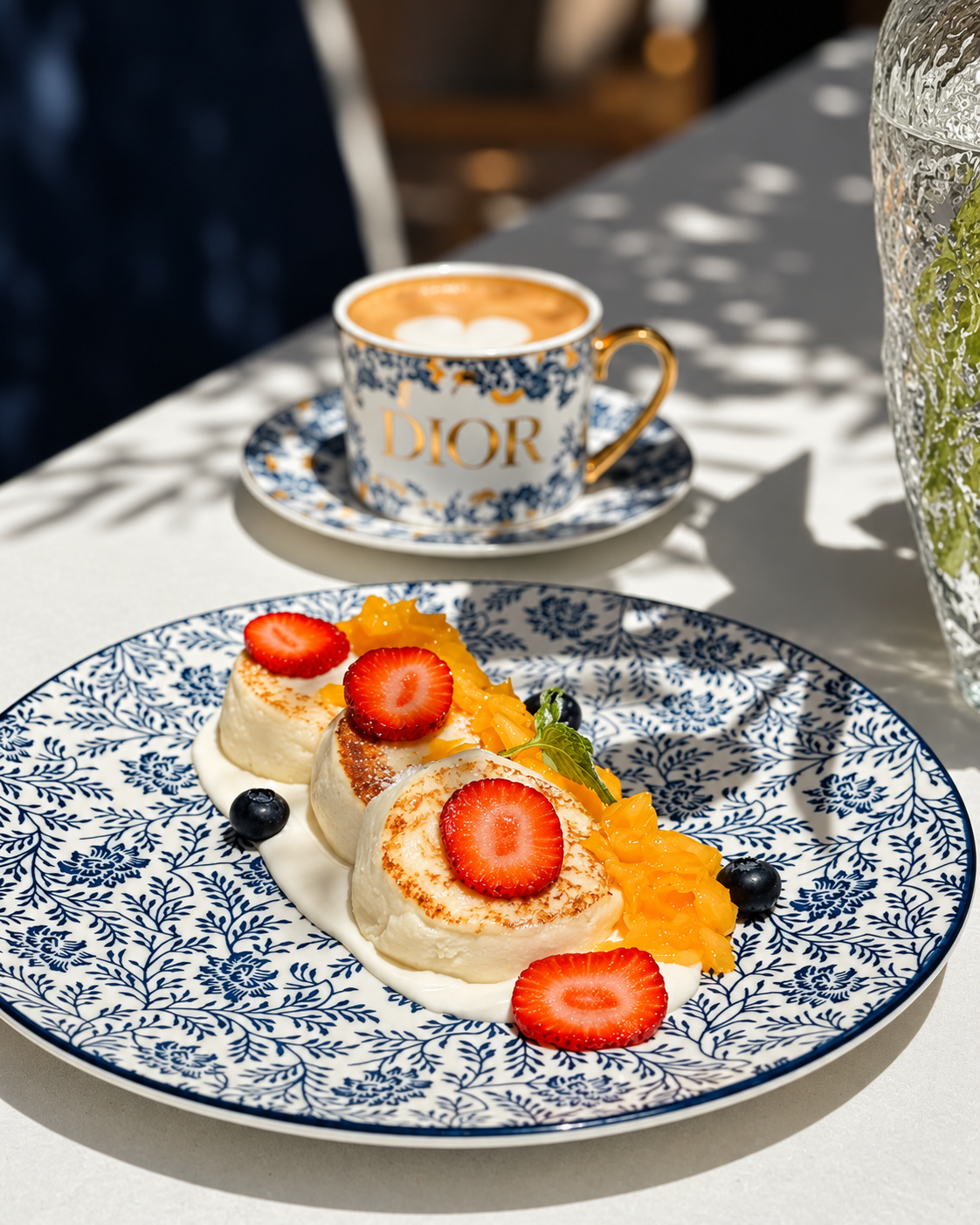
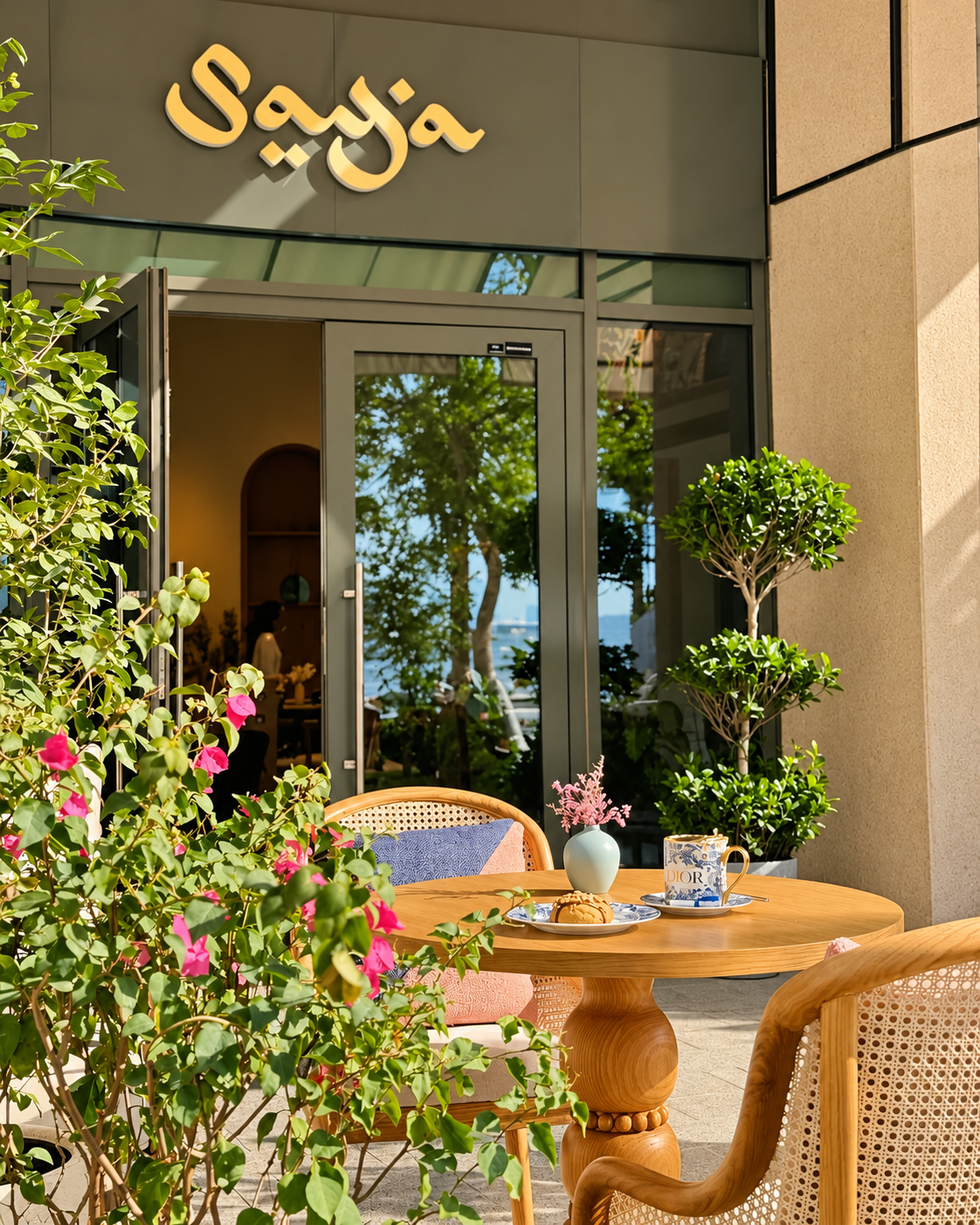
Saya Brasserie is a Dubai-born Mediterranean café brand with several branches across the city, known for a maximalist, highly photogenic interior style and a menu that runs from American breakfast to Mediterranean lunch and dinner. At its Creek Harbour location, Saya serves a “24k Dior coffee” — a cappuccino dusted with edible gold, served in mugs carrying Dior’s name and visual language — inside an interior styled around the same references. Guest reviews and social coverage consistently describe it as a “Dior-themed café,” and the coffee has become the location’s signature photograph.
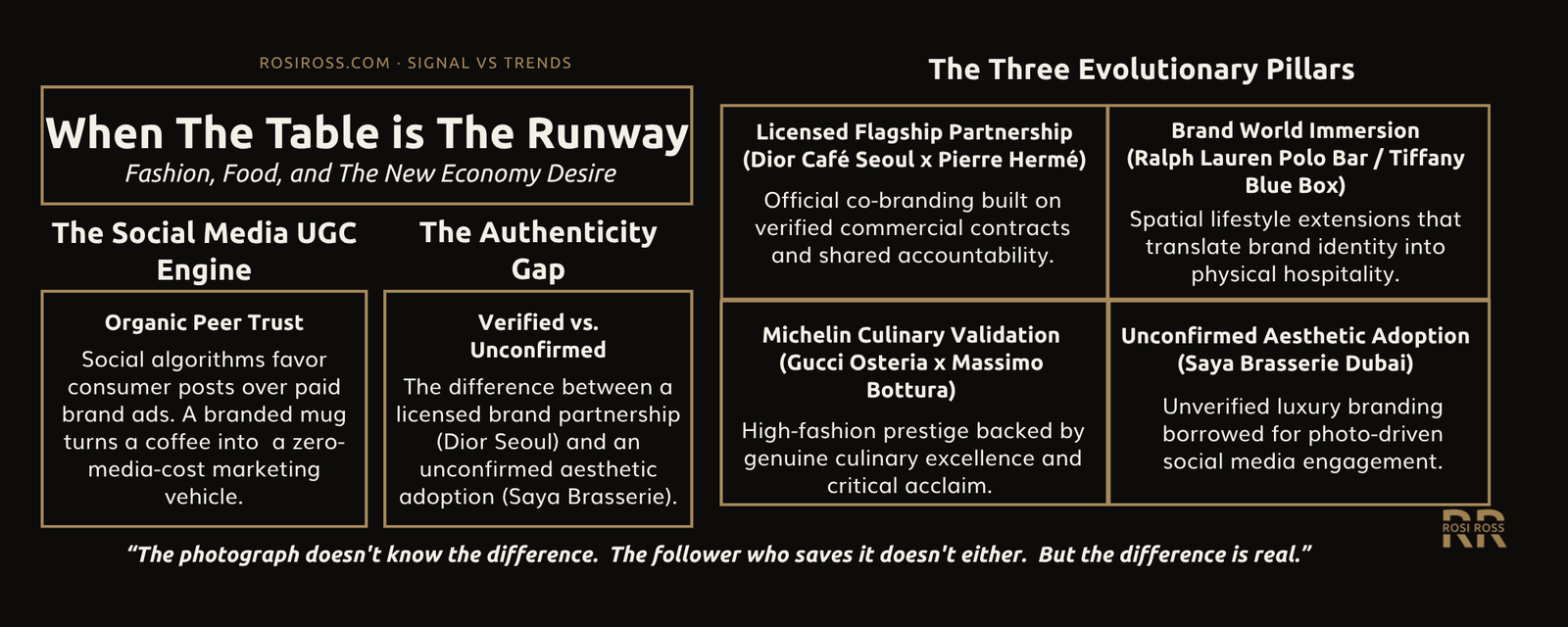
What’s genuinely unclear, and worth stating plainly rather than assuming: there is no public confirmation from Dior or its parent company, LVMH, of an official licensing arrangement, marketing partnership, or brand collaboration with Saya. No trade press coverage, no LVMH announcement, nothing beyond consumer and influencer language describing the aesthetic as “Dior-themed.” That absence is worth noting precisely because Dior does have a genuine, well-documented café collaboration elsewhere — Dior Café at its Seoul flagship, run in partnership with the celebrated French pâtissier Pierre Hermé — which makes the lack of any comparable confirmation for a Dubai café collaboration more conspicuous, not less. Whether Saya’s Dior-branded presentation is a licensed arrangement this piece couldn’t verify, or an aesthetic adoption that borrows the name and colour language without formal permission, is itself the more interesting and more honest story — and it’s the one this piece tells.


The history — from the maison salon to the branded café
The fashion house as host has a longer history than the current wave of branded cafés suggests. Coco Chanel’s salon at 31 Rue Cambon in Paris, opened in 1910, functioned as much as a social environment as a commercial one — a place where the world Chanel was selling could be inhabited, not just purchased. That instinct — that clothing alone can’t produce the world a brand represents, and the world itself has to be provided or at least implied — is the throughline connecting a Belle Époque salon to a 2020s café table.
The modern template is the Tiffany Blue Box Café, which opened at Tiffany & Co.’s Fifth Avenue flagship in 2017: breakfast and lunch served on Tiffany-blue china, allowing a guest to be physically and photographically inside the Tiffany world for the price of a prix-fixe breakfast. Ralph Lauren’s Polo Bar, opened in New York in 2015, took a different approach — no branded products at all, just a full dining room that extends the Ralph Lauren aesthetic (mahogany, equestrian art, a specific American-establishment register) into a restaurant that would have worked as a brand statement even before social media existed to amplify it. Gucci Osteria, opened in Florence in 2018 in partnership with three-Michelin-starred chef Massimo Bottura, raised the ambition further still, and in doing so introduced the category’s central tension: a restaurant built on a fashion house’s name still has to succeed as a restaurant, and the Florence location’s subsequent Michelin recognition confirmed that Gucci’s kitchen met that bar rather than merely borrowing credibility from the name above the door.
Dior’s own genuine precedent in this category — Dior Café at the brand’s Seoul flagship, run with pâtissier Pierre Hermé — is instructive precisely because it’s confirmed, named, and structured as a formal arrangement between two established entities. It’s the version of this category built on record, rather than on the ambiguity that defines Saya’s presentation of its own Dior branding.


The social media mechanics
Understanding why this category exists at all requires understanding what social platforms actually reward. Algorithms across Instagram and TikTok favour content that generates sustained engagement — saves, shares, return views — and they suppress content that reads as advertising, because audiences trust a peer’s unpaid post more than a brand’s paid one. A guest photographing a gold coffee and posting it to their own followers is producing content the platform treats as organic and trustworthy; the same image, produced and paid for directly by a brand, would be labelled and discounted accordingly.
User-generated content (UGC) is content created voluntarily by consumers rather than paid for by brands. It consistently outperforms branded advertising in engagement because audiences trust peer recommendations more than brand communications, and social platforms algorithmically favour content that isn’t flagged as paid promotion. A fashion-culinary collaboration functions as a UGC generation engine: it creates an environment designed to make the guest want to document it, at zero media cost to the brand and with a trust premium no paid campaign can replicate.
This is why a branded object — a mug, a colour, a name printed on porcelain — is such an efficient mechanism regardless of the formal relationship behind it. The gold dusting on the coffee adds a visual distinction that makes the photograph more unusual and more shareable; the Dior name elevates the image from “interesting coffee” to “aspirational experience” in a viewer’s feed. This site’s own earlier coverage of Saya captured that mechanism accurately even without resolving the licensing question — the branding did the content-generation work regardless of its formal status, which is itself the most important thing this category reveals about how desire is manufactured now. The wider shift in Dubai’s dining landscape toward experience-as-content makes this mechanism the default expectation for any new opening, branded association or not.
What each side is actually seeking
In a genuine fashion-culinary collaboration, the fashion house is seeking cultural penetration into daily, unguarded moments — a café table reaches a consumer in a state of leisure and sensory receptivity that a magazine spread or digital ad cannot replicate, and the brand association formed there tends to be more durable than one formed at the moment of a purchase decision. The hospitality partner receives something equally valuable in the other direction: an instantaneous repositioning from local brand to internationally aspirational one, simply by association.
What’s structurally different when that association isn’t formally confirmed is who bears the risk. In a licensed partnership like Dior Café Seoul, both parties have agreed to the terms of the association and share in its outcomes. In an unconfirmed aesthetic adoption, the smaller party captures the reputational upside of the association while the larger house has no formal stake in — and may have no awareness of — how its name is being used. The broader shift away from hype-driven association toward verifiable, evidence-backed claims that’s reshaping other consumer categories applies with equal force here: the association that can be verified is worth more, over time, than the one that merely photographs well.
The global landscape
Placed against its clearest precedents, the category’s pattern becomes legible. The Tiffany Blue Box Café proved that the branded object could outperform the food itself in cultural impact — it generated enormous organic media value primarily through guests’ own photography, not through culinary acclaim. Gucci Osteria proved the opposite risk: when culinary ambition is genuine, the restaurant is judged as a restaurant, and Michelin recognition or its absence becomes part of the story regardless of the fashion context. The Ralph Lauren Polo Bar proved the most durable model of the three — a brand world sustained over a decade because it would have worked as a restaurant even without a single Instagram post. Each of these precedents shares one structural feature Saya’s presentation cannot currently claim: a confirmed relationship between the fashion house and the food and beverage partner, with both parties accountable for what the collaboration represents.



The Dubai dimension
Dubai is not a fashion capital in the conventional sense, but it may be the most sophisticated market anywhere for this specific mechanism, because of what the café already is in the city’s social infrastructure. Without a traditional public square, Dubai’s café culture functions as the connective tissue for an expatriate population that maintains social bonds through shared leisure — the café is where people go to see and be seen, and a brand association layered onto that function isn’t simply offering a beverage, it’s offering a more legible version of the identity performance the café already provides. The same market logic that shapes how global luxury brands choose their Dubai activations — visibility, density of social media activity, a consumer culture that places real value on the visible demonstration of taste — makes this the market where the mechanics of fashion-food collaboration are most exposed, for better and worse: the same conditions that make a genuine collaboration travel furthest also make an unconfirmed one travel just as fast.
The authenticity question
The most important question about any fashion-culinary collaboration is the one its participants are least interested in having asked: is this real, and is the food good enough to justify the association regardless of the answer? Saya’s Mediterranean-American menu — phyllo prawns, saffron cake, Moroccan hummus, honest café cooking executed in a genuinely well-designed room — doesn’t need to meet Gucci Osteria’s culinary ambition to succeed on its own terms. It needs to be good enough that a guest who came for the photograph stays for a meal they’re glad they had.
But the branding question sits underneath that one, unresolved, and it matters more than most coverage of this category is willing to say. Dubai’s leisure landscape is not short on manufactured spectacle, and the gap between a genuinely licensed brand world — built on record, with both parties accountable to it — and an aesthetic that borrows a name’s cultural weight without a confirmed agreement is the difference between the Tiffany and Gucci precedents on one side and something considerably more improvised on the other. The same standard that separates genuine performance from borrowed credibility applies here as much as anywhere else desire is manufactured for sale. The photograph doesn’t know the difference. The follower who saves it doesn’t know the difference. But the difference is real, and it’s the one question this category’s coverage most consistently declines to ask.
“The most important thing about a gold coffee
in a designer mug
is not the coffee.
It is the photograph.
And the most important thing
about that photograph
is not who took it.
It is whether the world it claims to open a door to
actually opened that door —
or simply printed its name on the handle.”

