
On why Florence can feel almost impossibly romantic while remaining visually restrained: how stone, proportion, small bars and a dome above them turn cultural density into a different kind of luxury, and what the city’s success now asks of those who visit.
Florence proves that simplicity does not reduce beauty. It can concentrate it.
In Florence, the extraordinary rarely announces itself before you turn the corner. A narrow stone street suddenly gives way to Brunelleschi’s dome. A glass of wine arrives through a centuries-old opening in a palace wall. A museum holds works you learned about long before you understood why they mattered. Then dinner is three ingredients, a small table, no performance.
For me, and this is a personal verdict and not a ranking, Florence is the most romantic place I have visited. That feeling is the starting point of this essay, because it raises the more interesting question of what produces it. The answer is not a checklist of Renaissance monuments. It is the way a city can feel monumental and intimate at once, with an enormous cathedral, historically consequential art and internationally important museums sitting inside a human-scaled fabric of narrow streets, small piazzas, compact bars and ordinary stone buildings. Grandeur is never far from something human, and that proximity is where the romance lives.
The luxury on offer is cultural density and not display. Florence does not need to manufacture spectacle, because centuries of architecture, painting, sculpture, craft and ritual have already done the work. It is a different definition of luxury, and an increasingly rare one, and it comes with a cost that this essay does not skip: the city’s own success is now one of the pressures on it. Understanding Florence therefore means holding two ideas together, that restraint can be the highest form of richness, and that a city this valuable cannot be consumed at volume without losing what it was valued for.
Why Florence Was Quiet Luxury Before the Trend
Florence was doing quiet luxury before luxury needed the adjective.
Even at peak tourism the architecture remains disciplined. Many of the city’s most important palaces present relatively severe street façades, with richness concentrated in proportion, stone, courtyard and interior. The effect aligns beautifully with contemporary ideas of quiet luxury, though Florence did not need the trend to invent the code. It should be said clearly that this is an interpretive contemporary lens and not a claim about a single unified Renaissance design philosophy. The palaces were built by rival families, and restraint on the street can be read as caution as much as taste. What the lens reveals is the result, not the intention.
And simple does not mean empty. A restrained façade may conceal frescoes, sculpture, family history, guild power, political rivalry and craftsmanship, which is the deeper lesson: reducing visual noise does not reduce meaning. A bare stone wall in a newly built hotel is a design choice. A stone wall in Florence belongs to an urban structure that has been continuously inhabited, repaired and reinterpreted for centuries. The visual simplicity may look similar. The cultural value is completely different. Simplicity becomes rich when time has passed through it.
This is a distinction worth carrying into how luxury is judged more broadly. Objects and spaces that look minimal are only as valuable as the material, craft and history they carry, a point developed in timeless luxury fashion pieces, where the pieces that endure are those whose restraint rests on quality that can be examined and trusted. Florence also corrects a common error: not every old object is luxurious simply because it is old. What the city has is not age alone but continuity, a record of care.
The result is a form of luxury without performance. Florence can deliver enormous cultural prestige through very modest experiences: espresso standing at a bar, a single glass of wine, a church entered from the street, a museum room with no spectacle beyond the work itself. This is not anti-luxury. It is a different definition of luxury, and a useful counterpoint to destinations where luxury is built around constant novelty.
Why Florence Feels Like a Painting
Florence is not decorated by art. Florence was built through the same culture that produced the art.
Why is Florence considered so beautiful? The first answer is institutional and not sentimental. UNESCO inscribed the historic centre in 1982 and describes the urban complex as in itself a unique artistic realization, an absolute chef-d’œuvre, the fruit of continuous creation over more than six centuries. The centre was recorded at 505 hectares, bounded by the remains of the city’s fourteenth-century walls, and the property is now listed with a core area of 532 hectares after later boundary changes. Within it sit medieval streets, fortified palaces, loggias, fountains, churches, bridges and public space in a remarkably coherent fabric. UNESCO also credits the setting: the urban environment of the historic centre remains almost untouched and the surrounding hills provide a perfect harmonious backdrop.
So the feeling that everything looks like a painting has a historical foundation. The city is not one masterpiece. It is a concentration of them, and a city should not be called literally a painting. The better phrase is that it was composed. The effect owes a great deal to a controlled palette and the repetition of materials: the grey of pietra forte and pietra serena, the warm terracotta of rooflines, the stucco and fresco held behind severe façades, the green, pink and white marble of the cathedral complex, the narrow streets that compress perspective, the Arno reflecting changing light and the Tuscan hills behind. Repetition is what turns a set of buildings into a single visual language.
| The material | Where you meet it | What it does to the feeling |
|---|---|---|
| Pietra forte and pietra serena | Palace façades, thresholds, window frames and the small openings of the wine windows | A grey, disciplined palette that steadies the eye |
| Terracotta | Rooflines and the tiles of the dome | Warm colour set against grey stone |
| Stucco and fresco | Walls and interiors behind severe façades | Richness held inside, not displayed outside |
| Green, pink and white marble | The cathedral complex | The one place where the city allows colour to speak |
| Narrow alleys | The medieval street pattern | Compressed perspective, so the dome arrives suddenly |
| The Arno and the hills | The river, its bridges and the Tuscan backdrop | Changing light and a natural frame |
The reading of material and palette is editorial; UNESCO’s entry records the preservation of traditional building materials and the medieval urban form.
There is a second layer to the beauty, and it is economic. UNESCO’s criterion (iii) records that the historic centre attests in an exceptional manner, and by its unique coherence, to its power as a merchant-city of the Middle Ages and of the Renaissance. The coherence the eye registers as beauty is the coherence of a city that was rich, confident and organised enough to build in one idiom for centuries. Beauty here is a by-product of governance, trade and patronage, which is why it does not feel staged.
The Duomo: Monumentality at Human Scale
The Duomo is romantic because it is audacious without making the city around it feel small.
What makes the Florence Duomo important? Santa Maria del Fiore is the architectural centre of the story. Britannica records that its construction was overseen by several architects, beginning with Arnolfo di Cambio in 1296, on the site of the older cathedral of Santa Reparata, and that when it was consecrated in 1436 it was the world’s largest church, able to accommodate 30,000 worshippers. The design passed from Arnolfo through Giotto, Andrea Pisano and Francesco Talenti to Filippo Brunelleschi, and the project was funded and managed through the city, the church and Florence’s powerful guild structures. That made it at once a religious monument and a declaration of civic ambition: a building a whole city agreed to finish over generations, long after any single patron could expect to see it complete.
The cathedral’s marble facing, green, pink and white, is the one place where the city allows colour to speak loudly, and the restraint everywhere else makes that colour more eloquent. A palette that is quiet across the whole city and loud at one address tells the eye where the centre is without any signage at all.
The paradox is scale. The building is enormous and the city around it is not. You can walk along a narrow street with the dome hidden and then, at a turn, find it overhead, a spatial surprise that no master plan could produce on purpose. That is why a large monument can feel intimate here: the approach is human, and the reveal is sudden. Cities that open a grand axis toward their cathedral announce the monument from far away. Florence lets the monument ambush a person who is thinking about something else, and the emotional effect is closer to recognition than to spectacle.


Brunelleschi and the Dome That Changed Architecture
The impossible became the skyline.
How was Brunelleschi’s dome built? The chronology is secure: work on the dome ran from 1420 to 1436, with Brunelleschi and Lorenzo Ghiberti named joint leaders of the project in 1420 and Ghiberti resigning in 1433. The engineering problem was daunting before a single brick was laid. National Geographic frames the questions the builders faced: whether there was enough timber in Tuscany for the scaffolding and templates needed to shape the masonry, and whether a dome could be built at all on the octagonal plan dictated by the existing walls without collapsing inward. Nobody knew. Brunelleschi’s answer was a structure of two concentric shells, an inner one visible from within the cathedral nested inside a wider, taller external dome.
The details explain why the solution is still studied. Britannica notes that the two layers are an inner shell spanning the diameter and a parallel outer shell to protect it from the weather and give it a more pleasing external form, stone for the first 7.1 metres and brick above. A visitor-facing engineering account adds that the bricks were laid in a herringbone pattern that allowed short horizontal sections of the layers to be completed as self-supporting units, which is how a vault of that span could rise without the vast timber centring it would normally demand. Eight white ribs mark the corners of the octagon beneath terracotta tiles, and the lantern that crowns the structure was also designed by Brunelleschi but not begun until 1446, after his death.
| The fact | Brunelleschi’s dome |
|---|---|
| Built | 1420 to 1436, to Filippo Brunelleschi’s plan; the lantern followed after his death |
| Status | Still described as the largest masonry dome ever built (Italia.it; Visit Tuscany) |
| The innovation | Raised without the large timber centring a vault of that size would normally require, using a self-supporting herringbone brick pattern |
| Form | Octagonal, in stone and brick, with two shells and a stair between them |
| Scale | About 45.5 metres across inside; the exterior is usually given as about 54 to 55 metres, and published figures vary with where and how the dome is measured |
| Weight | Estimated by the Museo Galileo at about 37,000 tons |
| Surface | Terracotta tiles on the outer dome, marked by eight white ribs |
Dome chronology and construction follow the cathedral institution, Britannica and the Museo Galileo; dimensions differ between sources and are given as approximate.
The structure was never only engineering. The Museo Galileo goes as far as to say that the construction of the dome represented the event that marked the beginning of the Renaissance, that is, the rediscovery of building models from the classical age, and the dome is widely read as the visual symbol of Florence and of Renaissance humanism. It communicated the city’s belief in its own intellectual and commercial power. In contemporary luxury language, provenance begins here: Florence’s beauty has institutional history behind it, with decisions, payrolls and rivalries on record, and a vault that is still standing six centuries on is the strongest proof of quality that a city can offer.
The Streets: Romance at Walking Speed
Walking becomes a form of editing.
Why are Florence’s streets so distinctive? Because the historic centre preserved its medieval street pattern, narrow alleyways and traditional materials, and so it remains highly walkable. Monuments that would be separated by large distances in other cities sit within an unusually compact network. The city reveals itself in sequences and not destinations: palace, church, bar, bridge, workshop, piazza, museum. That is romance at walking speed, and it is also a different economy of attention. A person who is never in a hurry to get somewhere notices the doorway, the iron ring, the worn step, and those small things carry as much of the city’s character as the headline monuments do.
A few streets away, UNESCO singles out a marvellous 14th-century bridge lined with shops, the Ponte Vecchio, as part of the exceptional surviving fabric of a merchant city. Britannica describes it as the first segmental arch bridge built in the West, an outstanding engineering achievement of Europe’s Middle Ages, and Smarthistory notes that on the night of 3 to 4 August 1944 retreating soldiers blew up all the city’s bridges except the Ponte Vecchio, making it the only remaining premodern bridge over the Arno. It survived because it was already a settlement as much as a crossing: a bridge, a commercial street and part of the city’s fortifications, later nicknamed the Bridge of Gold for its jewellery shops.
The bridge is a useful reminder that beauty and commerce were never opposites in Renaissance Florence. Goldsmiths, artisans, bankers and merchant guilds created the economic conditions in which the city’s artistic culture flourished, and Brunelleschi himself trained as a goldsmith. The tradition of the goldsmith’s bench, of precious metal worked with patience and judged over decades, is the same lineage that still shapes how fine jewellery is made and valued, as The Language of Modern Necklaces: Metals, Stones, and the New Codes of Personal Luxury explores. A shop built into a bridge is a statement about a city that saw craft as civic infrastructure.


The Wine Window and the Luxury of a Small Gesture
A glass of wine passed through a hole in a stone wall can feel more luxurious than a bar designed to look expensive.
What are Florence’s wine windows? If one object makes the argument of this essay, it is the buchetta del vino. Visit Tuscany describes teeny openings in pietra serena with their time-worn wooden doors that still peer out of Florence’s noble palaces, a tradition tied to the great families whose wealth had turned into agricultural estates and who sold their own wine directly to passers-by. The city’s tourism office sizes them precisely: a sort of miniature workshop, the right size to pass a flask of 23 by 36 centimetres, with about 170 in the municipality of Florence, some well preserved and others almost invisible. National Geographic adds a physical detail that explains the rarity: the walls are about a metre and a half thick, so cutting a hole through that rock was terribly expensive.
The scale is the point. A tabernacle-shaped opening in a palace wall, just large enough to pass a flask, does not need to announce that it is special. It is luxury reduced to a gesture, and a gesture is something a city can do without staging. Counts vary by source, which is itself instructive, because a thing this small is still being surveyed. The Associazione Buchette del Vino was founded by three long-time Florentine residents in October 2015 to document them, and a food-tour operator reports that the association counts more than 180, while other accounts say at least 150 still survive.
The windows have also returned to use. National Geographic reported in 2024 that for nearly 500 years visitors have sipped Tuscan wine from these tiny openings, and that they are making a comeback, and some, as the city’s own sources note, have been restored so that cafes, wine bars and even gelato shops serve through them. A story often told, that the windows served as contactless sales during seventeenth-century plague outbreaks, is popular but should be treated as tradition and not established record.
| The wine window (buchetta del vino) | What is known |
|---|---|
| What it is | A small tabernacle-shaped opening, often in pietra serena with a time-worn wooden door, in the wall of a noble palace |
| Why it exists | Families with wine estates sold their own wine directly to passers-by; the practice is associated with the Medici period, and permission from the ruling family is part of the tradition |
| Size | Big enough to pass a flask of roughly 23 by 36 centimetres |
| How many | About 170 in the municipality according to the city’s tourism office; counts range from at least 150 surviving to more than 180 recorded by the association |
| Today | Some have been restored; cafes, wine bars and gelato shops serve through them. The Associazione Buchette del Vino, formed in 2015, maps and documents them |
| Where | Most are found in the centre and in Santo Spirito |
Counts and origins vary by source. The plague-era story is tradition and not established record.
Oltrarno, Small Bars and an Uncomplicated Evening
The pleasure is sitting somewhere simple and feeling that the city does not need to entertain you aggressively.
Here the essay moves away from monumentality. Oltrarno and Santo Spirito, across the Arno, are where the city becomes domestic again: smaller piazzas, artisan streets, wine bars, workshops and the social life of the evening. The pleasure is not a major attraction. It is the possibility of sitting somewhere simple and feeling that the city does not need to entertain you aggressively. The Oltrarno has long been associated with craftspeople and small trades, and the fact that the neighbourhood still holds workshops beside bars is part of why the evening feels unforced.
The most useful word for the Florentine version of pleasure is quiet. It is an aperitivo, one good glass, a long walk, a small trattoria, a beautiful object made well. The phrase dolce vita is often used loosely for this mood, but it is a contemporary shorthand and not a Florentine historical concept, and it belongs to a different city and a different decade. The luxury here comes from concentration, not excess, and it requires nothing of the traveller except a willingness to remain in one place for longer than a schedule would allow.

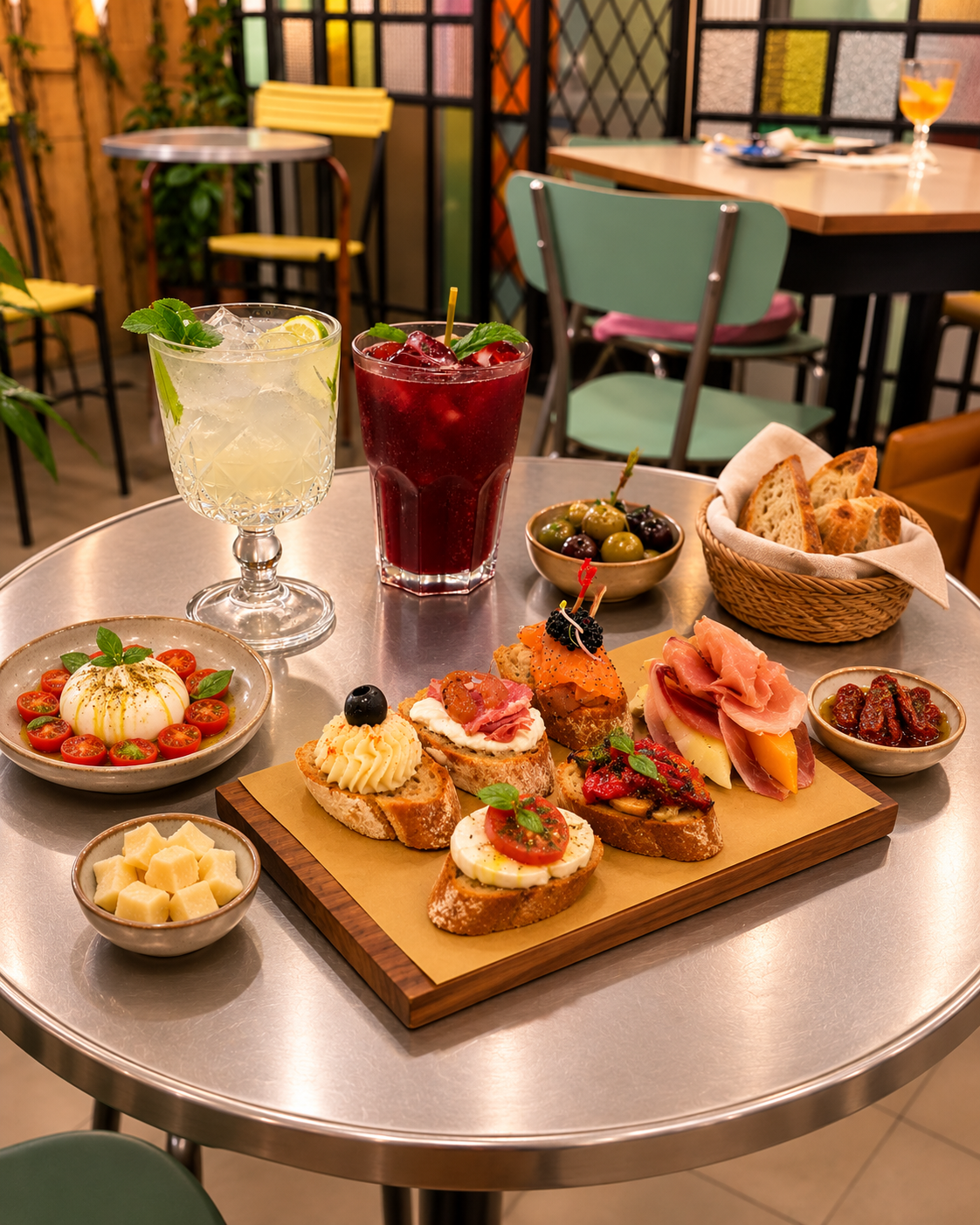


Fewer elements place more pressure on quality.
Tuscan cooking relies on strong ingredients and relatively direct preparation: bread, olive oil, beans, grilled meat, seasonal vegetables and wine. This should not be pushed into a claim that cooking and architecture share a single historical system, and Florence did not design its table to match its stone. But they teach a similar lesson, which is that when you remove everything inessential, the remaining things carry the weight, and the quality of each becomes visible. A short menu is a form of confidence, because nothing on it can hide behind another element.
It is the same principle behind a short ingredient list in a well-made formula, where each component has to justify its place, as The Return of Barrier Beauty: Why Lanolin Is the Ultimate Skin Investment argues for skin. In both cases, the discipline is subtraction. A plate of three ingredients and a restored face of stone both reward attention and punish carelessness, and neither can be improved by decoration.
The Medici and the Economics of Cultural Capital
Patronage created durable cultural assets, not only private consumption.
Florence’s Renaissance cannot be separated from wealth. UNESCO describes how the city became a symbol of the Renaissance during the early Medici period, reaching extraordinary levels of economic and cultural development, and its entry lists the buildings that wealth produced, from the cathedral and Santa Croce to the Palazzo Vecchio, the Uffizi gallery and the Palazzo Pitti. Under the Medici, banking power was converted into architecture, art, libraries, chapels and public cultural prestige. The luxury-history point is that the patronage produced assets that outlived the fortunes behind them.
That is one reason the city can still monetise wealth created centuries ago, and why it is better understood as accumulated cultural capital than as a stock of old things. Value of this kind deepens as the years pass. A commission that looked like private vanity in the fifteenth century now operates as public infrastructure for an entire economy of visitors, scholars, restorers and craftspeople, and the return on it has been compounding for five hundred years. It is the long-horizon logic of every object that gains meaning from time, in the way a pearl or a patinated surface does, which is also why the Medici example matters beyond Florence. Patronage that builds shared assets creates something that the next generation inherits as an advantage and not as a debt.


The Museums That Make Art Feel Ordinary
You can move from a bar to Botticelli without changing neighbourhood.
What museums should you see in Florence? The more useful question is why the city’s museums feel different from those elsewhere. Florence’s official tourism office counts more than seventy museums, alongside monumental churches, historic gardens and villas, which means art is not a separate museum day. It is part of ordinary geography. A morning coffee, a church entered from the street and a painting that changed the history of art can sit within a ten-minute walk of one another, and the lack of ceremony around that fact is part of the luxury.
The Uffizi should be read as more than a museum. It is evidence of how political power, collecting and art became intertwined under the Medici, and the demand for it is extraordinary. The Uffizi Galleries, with Palazzo Pitti and the Boboli Gardens, recorded 4,391,895 visitors in 2019, up from 4,153,101 in 2018, making them Italy’s most visited museum complex, and went on to a new historic record of more than five million visitors in 2023. Those figures are an index of how much of the world arrives wanting the same rooms at the same hour.
The museum people should not skip is the one that explains the city. The Museo dell’Opera del Duomo, behind the cathedral, is more than 6,000 square metres structured into 28 rooms over three floors, and it reopened in 2015 after a renovation that increased gallery space from 2,000 to 6,000 square metres and made room for a full-scale re-creation of the cathedral’s original façade. It holds original works made for the cathedral complex, among them Ghiberti’s Gates of Paradise, the east door of the Baptistery that Michelangelo is said to have named, and Michelangelo’s Pièta Bandini, within an exhibition of over 750 works. Its value is contextual: it lets a visitor understand how the Duomo was actually built and decorated, and why the structure outside needed so many hands.
| Museum | Why it matters | What it lets you understand |
|---|---|---|
| Museo dell’Opera del Duomo | More than 6,000 square metres across 28 rooms, with original works from the cathedral complex, among them the Gates of Paradise and Michelangelo’s Pièta Bandini | How the Duomo was actually built and decorated |
| The Uffizi Galleries | The Uffizi, Palazzo Pitti and Boboli complex recorded 4.39 million visitors in 2019 and more than five million in 2023 | How political power, collecting and art became intertwined under the Medici |
| The city’s other museums | The city’s tourism office counts more than seventy, with the Bargello, the Accademia and the Pitti among the best known | That art is part of the ordinary geography, not a separate museum day |
Visitor figures follow Italian press reporting of the galleries’ own data. The museum count is as stated by the city’s tourism office.
Fewer museums, and longer inside them, is the better trade. Attention is the scarce resource in a city where almost every room is significant, and a museum that explains the city instead of simply displaying famous objects is worth more than a fourth gallery on the same afternoon.




Why Florence Is So Romantic at Night
Night removes information and makes proportion more visible.
The same restraint is what makes the city so persuasive after dark. Shopfronts close, stone façades flatten into shadow, bridges become silhouettes and the Duomo changes from object to presence. Night removes information and makes proportion more visible, and the sound of bells carries further. It is the hour when atmosphere does its quietest work, assembled by centuries and not by a studio.
This is where the sentence that opened the essay lands with the most force, and it should be read as the feeling of one traveller. It is also a feeling the city makes easy, because it takes away what would interrupt it. Romance in Florence is not built mainly through fantasy. It comes from proportion, age, intimacy and repetition: shutters, lamps, stone thresholds, wine glasses, bells, narrow stairs, bridges and the fact that the skyline has been familiar for centuries. The evening has a scent too, of stone cooled after sun, wine, smoke and the faint sweetness of old wood, the kind of place memory that fragrance builds identity from, as in The Language of Scent: How Fragrance Becomes Identity in Modern Beauty.
Why is Florence romantic? Less from fantasy than from proportion, age and intimacy: narrow streets, small piazzas, church bells, the Arno, stone thresholds and evening light, with the Duomo appearing suddenly at the end of a street. The sense that the most important buildings are close to ordinary daily life gives the city its feeling. Whether it is the most romantic city anywhere remains a personal verdict, and the honest version of the claim is that Florence makes that verdict unusually easy to reach.
The Overtourism Paradox
The city’s enduring value creates contemporary pressure.
Is Florence affected by overtourism? Yes, and the essay needs this tension to keep its gravity. The beauty now has measurable economic weight, and that weight is a problem. According to estimates by CST Firenze reported in the local press, Florence recorded more than 4 million tourist arrivals and 9.7 million overnight stays in the first ten months of 2025, figures that rose 7.1 percent in arrivals and 8.5 percent in overnight stays on the same period of 2024, while tourist bus permits increased by 45.3 percent. A local industry summary of the full year put visitors at 4.6 million, against 362,000 year-round residents, a ratio that explains why the city feels the pressure at the scale of the street.
UNESCO itself names mass tourism, with its traffic and pollution, and the decreasing number of residents among the threats to the historic centre, and its monitoring record notes that a joint advisory mission in 2017 focused on the key issues of tourism management and transportation systems. The housing market shows the mechanism. Reporting on the city’s own data found that short-term rentals in the UNESCO zone had risen more than 700 percent since 2019, reaching 12,250 properties in about five square kilometres. Florence became in May 2025 the first city in Italy to ban new lets in its UNESCO-protected historic centre, and in June 2026 the council voted to extend the restriction, almost tripling its scope to cover more than 100,000 properties in surrounding neighbourhoods. Florence’s success can weaken the ordinary urban life that made the city valuable in the first place.
| Indicator | Figure | Source and caution |
|---|---|---|
| Arrivals and overnight stays, January to October 2025 | More than 4 million arrivals and about 9.7 million overnight stays, up 7.1% and 8.5% on 2024 | Estimates by CST Firenze, reported by the local press |
| Tourist bus permits, January to October 2025 | Up 45.3% on the same period of 2024 | The same city data, as reported in a tourism press release |
| Short-term rentals in the UNESCO zone | More than 700% growth since 2019, to 12,250 properties (city data, reported by Skift) | Reporting on city figures; the ban on new lets in the centre took effect in 2025 and was extended beyond it in 2026 |
| UNESCO’s own warning | Threats to the historic centre include mass tourism, traffic and the decreasing number of residents | UNESCO World Heritage Centre |
| What the city is trying | The #EnjoyRespectFirenze campaign and the FeelFlorence pass, which gave rise to more than one million new Wi-Fi connections after launch in June 2024 | Recognised as a best practice by the Sustainable EU Tourism project in 2025 |
Figures are estimates and are revised as official data are published. The full-year visitor figure comes from a local industry summary and is treated as indicative.
The city has not stood still. The European Union’s Sustainable EU Tourism project recognised Florence as a best practice for addressing visitor congestion and protecting residents’ quality of life, citing the Urban Mobility Plan and the #EnjoyRespectFirenze campaign, and the campaign was created by the Municipality as part of a national project for sustainable tourism. The accompanying pass and app are designed to distribute visitors across the town and surrounding villages for more balanced tourism flows and a better visitor experience. These are real instruments, and they are also an admission: a city that must teach its visitors how to behave has already crossed a threshold.
Slow Luxury as a Better Way to See Florence
The future luxury of Florence may be access to the same simplicity before saturation makes it impossible to feel.
The luxury traveller should be encouraged to consume Florence slowly and not aggressively. That is not only a matter of manners. It is the only way to see the thing the city is actually offering, which is a quiet it cannot supply at volume. To consume Florence slowly is also to take less from it, and the behaviours that follow are modest ones.
| The slow edit | Why it works |
|---|---|
| Fewer museums, and longer inside them | Attention is the scarce resource |
| Early or late hours on foot | The streets recover their scale |
| Time in Oltrarno and neighbourhood piazzas | The city becomes domestic again |
| Attention to materials, façades and thresholds | The architecture is read in its details |
| Bars and wine windows as pauses, not stops | Social gestures, not a checklist |
| One evening that contains very little | Restraint is the point |
An editorial summary of the argument, not a prescription.
The paradox at the centre of this is that the strategy is also the luxury. A city that asks little of a person who is willing to wait can give far more than a city that must be conquered on a timetable, and the traveller who chooses that pace is, quite literally, relieving pressure on the place being enjoyed. Slow luxury is not a pose. It is what a fragile asset requires of the people who value it.
The City as a Luxury Asset
Florence’s competitive advantage cannot be reproduced by building another hotel.
Florence’s most valuable assets are accumulated: World Heritage architecture, museums, historic craft, landscape, institutions, cuisine and a globally recognised artistic memory. None of them can be commissioned on a schedule. That makes preservation an economic strategy as much as a cultural responsibility, and it frames a question that matters well beyond Tuscany. As global luxury destinations become more designed, a city whose strongest experiences cannot be newly commissioned may become more valuable precisely because of what it cannot supply on demand.
The difficulty is that accumulated assets are also fragile ones. A resident population, a working craft economy and a legible street life are not decorations on the heritage. They are the heritage, in the sense that UNESCO’s emphasis on authenticity applies to a city that is still lived in. The challenge is stewardship: preserving resident life, craft, urban authenticity and manageable visitor pressure. A Florence that becomes a perfectly preserved stage set with no one living behind the shutters would still be beautiful, and it would no longer be the thing that made the beauty persuasive.
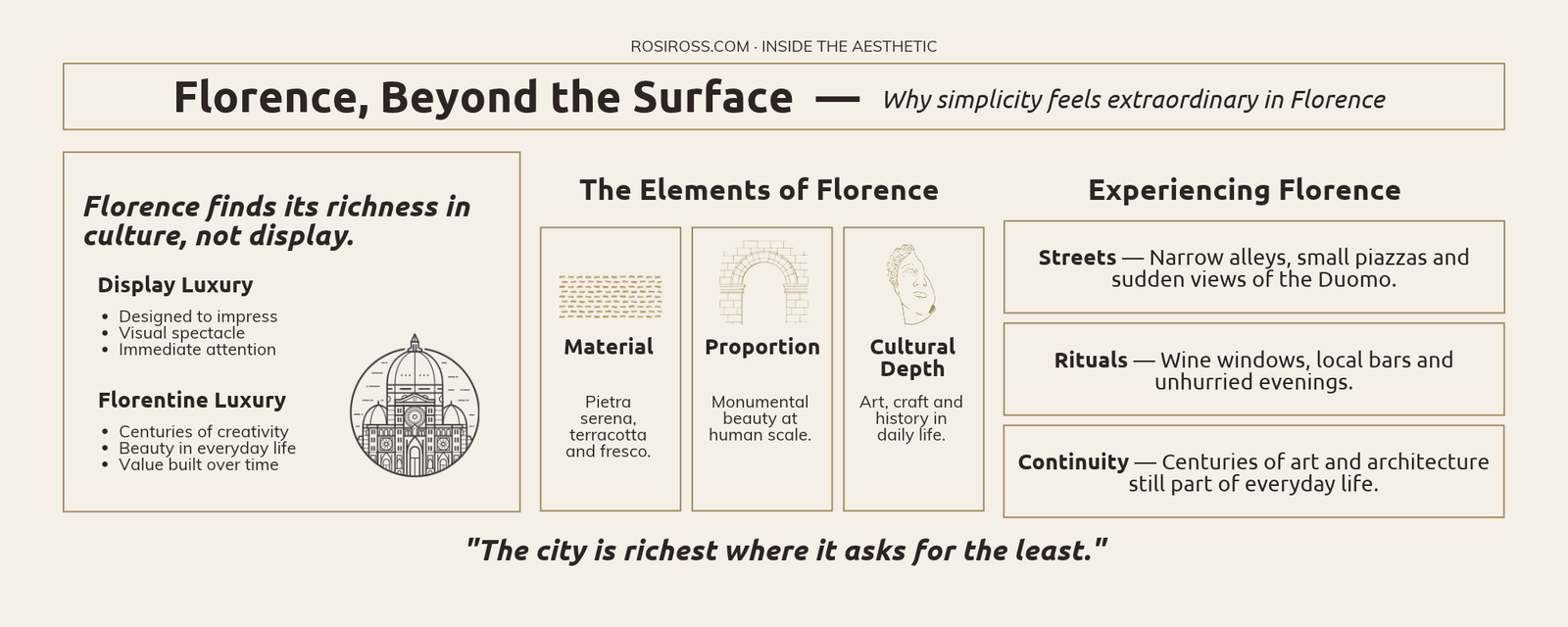
The City Is Richest Where It Asks for the Least
The museums explain Florence intellectually. The small streets make it emotional.
The story is not that Florence is romantic because it has beautiful Renaissance buildings. It is how centuries of artistic ambition, architecture, banking, craft and civic culture created a city in which extraordinary beauty sits inside surprisingly simple daily rituals, and why that contrast can make it feel more luxurious and more romantic than destinations designed to impress much harder. The museums explain Florence intellectually. The small streets make it emotional, and a version of the story that stays only inside institutional heritage loses its romance, while one that stays only in bars and alleys loses its historical weight. The city is persuasive because it keeps moving between the two.
The paradox is that Florence is vast in cultural value precisely because so much of the experience remains small. That reading would change if the conditions behind it did: if resident life thinned further until the neighbourhoods became backdrops, if the small bars and workshops gave way to formats built for volume, or if the pressure on the historic centre outran the instruments now being used to manage it. None of that is inevitable, and the city’s recent regulation of short-term lets suggests a willingness to act. What the evidence supports is a narrower and more durable claim than any ranking: that restraint, when it is backed by six centuries of continuous creation, is one of the most concentrated forms of beauty a city can hold.
“Florence is not decorated by art.
Florence was built through the same culture
that produced the art.
Simplicity becomes rich
when time has passed through it.
Florence was doing quiet luxury
before luxury needed the adjective.
The city is richest where it asks for the least.”

