
On why the bathroom mirror is becoming the new wellness interface, how LED photobiomodulation, microcurrent stimulation, sonic cleansing, and targeted light therapy represent genuinely different biological interventions from topical skincare alone, what the Korean and Scandinavian beauty philosophies contributed to the smart device category’s cultural legitimacy, and why the future of the most considered skincare routine is not more products but more precise interaction with the skin that receives them
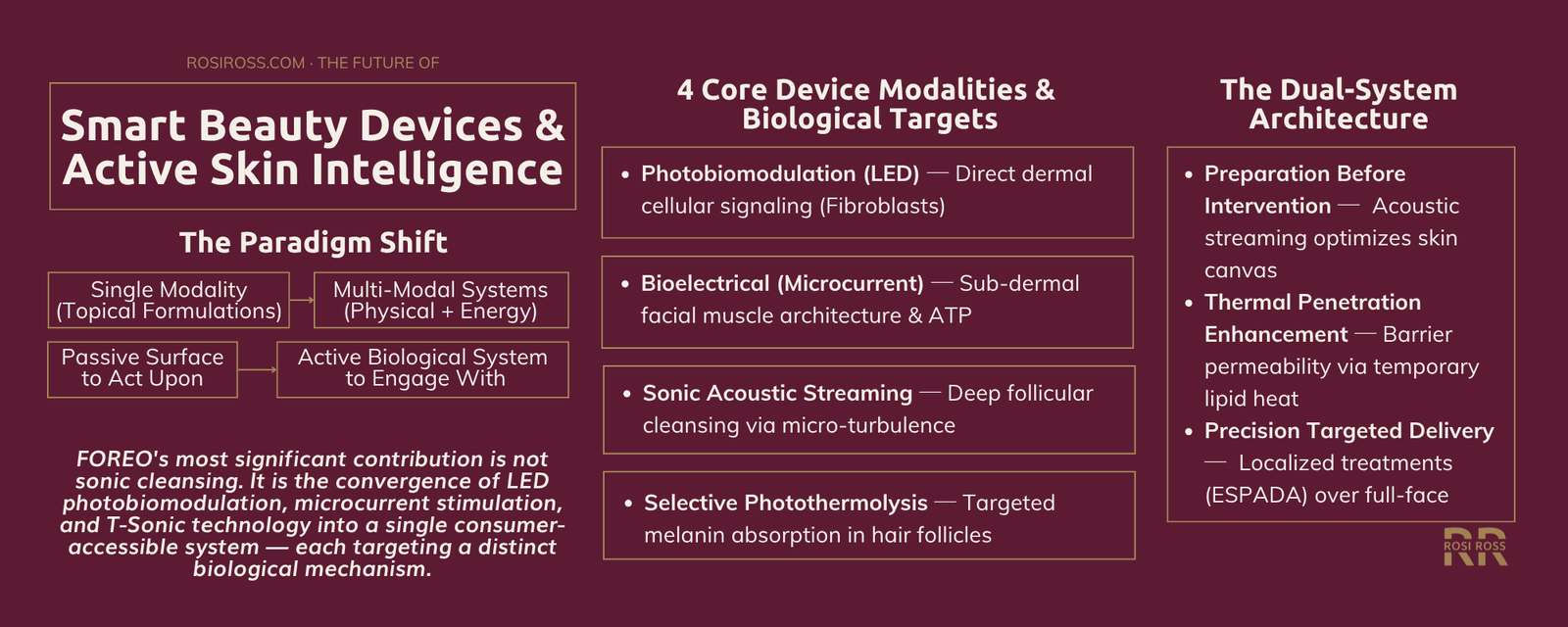
The skincare routine as it has been understood for most of the twentieth century is a one-directional proposition: products are applied to the skin, and the skin is a passive recipient of whatever those products contain. The intelligence of the routine has resided entirely in the formulation — in the specific ingredients chosen by the cosmetic chemist to address specific skin concerns — while the skin itself has remained a surface to be acted upon rather than a system to be understood and engaged with. The smart beauty device represents the most significant challenge to this proposition since the introduction of active ingredients: a category that insists on a different, more reciprocal relationship between the skincare practitioner and the skin they are practising on.
The transition is not from ineffective to effective. Topical skincare, at its most considered and most intelligently formulated, achieves genuinely significant results. The transition is from a single modality — topical application — to a more complete toolkit that includes physical and energy-based interventions capable of reaching and influencing skin biology in ways that topical formulations, which must penetrate the stratum corneum’s selective barrier to reach their targets, cannot always achieve. LED photobiomodulation reaches the dermis through the epidermis without penetrating it. Microcurrent stimulation activates the muscles and connective tissue beneath the skin’s surface. Sonic vibration at specific frequencies disrupts the bonds between sebum and the follicle wall in ways that manual cleansing does not. These are not superior to topical skincare. They are additional — and it is the combination of intelligent topical formulation and intelligent device use that represents the most complete available approach to skin health and skin quality.
The three eras of skincare — and what the device era actually changes
The history of consumer skincare can be understood through three successive orientations. The product era — which dominated most of the twentieth century — was built around the understanding that the quality of the skin was determined by the quality of what was applied to it: the right cream, the right cleanser, the right toner. The formulation was the product, and the product was the solution. The treatment era that began in the 1990s and accelerated through the 2000s introduced a more targeted understanding: not simply what was applied but what was in it, at what concentration, and what biological mechanism it engaged. The retinol revolution, the vitamin C revolution, the AHA and BHA revolution — all of these were expressions of a treatment-oriented skincare culture that valued clinical evidence and visible results over sensory experience and traditional efficacy claims.
The device era does not replace either of these but extends them. The consumer who understands their skin at the ingredient and active level — who knows the difference between a humectant and an emollient, who understands what ceramides do in the barrier, who can evaluate an SPF formula with some intelligence — is the natural audience for a device that adds an additional biological modality to the routine they have already optimised at the topical level. The same evidence-based intelligence that defines the most considered approach to skincare formulation applies to skincare device selection: the device is valuable insofar as its specific mechanism addresses a specific skin concern through a specific biological pathway that topical products cannot reach with the same efficiency. Understanding the mechanism is the prerequisite for intelligent selection — and intelligent selection is the prerequisite for genuine results.
What is LED photobiomodulation — and how does light-based therapy differ from topical skincare in its mechanism?LED photobiomodulation (also called low-level light therapy, LLLT, or LED therapy) is the use of specific wavelengths of light to stimulate biological processes within skin cells without generating heat sufficient to damage tissue. Different wavelengths penetrate to different depths and engage different biological pathways: red light (typically 630–660nm) penetrates to the dermis and stimulates fibroblast activity and collagen synthesis; near-infrared light (typically 830–850nm) penetrates more deeply and reduces inflammation and supports cellular energy production; blue light (typically 415–430nm) penetrates to the upper dermis and has documented antimicrobial effects against Cutibacterium acnes (the bacterium associated with acne). The mechanism differs from topical skincare in a specific and important way: photobiomodulation does not require penetration of the stratum corneum’s lipid barrier to reach its cellular targets. Light travels through tissue rather than needing to be absorbed and transported through it, allowing it to reach the dermis directly — which is why LED therapy can influence fibroblast behaviour at depths that topically applied retinol or vitamin C, which must first cross the barrier and then diffuse through the epidermis, cannot always reach with the same consistency.

LED therapy — what light actually does to skin at the cellular level
LED therapy entered clinical dermatology in the 1990s as a derivative of research into photobiomodulation — the study of how specific wavelengths of light influence biological processes in living tissue. The original clinical applications were wound healing and post-procedure recovery: the observation that red and near-infrared light accelerated tissue repair and reduced inflammation led to its deployment in medical contexts where accelerated healing was clinically valuable. Its translation into consumer skincare followed the same logic that has driven every professional-to-consumer skincare technology transfer: the underlying biology is the same whether the light source is a professional clinical device or a consumer device; the variables are intensity, wavelength specificity, exposure duration, and the consistency with which the protocol can be maintained.
The FOREO FAQ 201 RGB LED Face Mask delivers three distinct wavelengths — red (650nm, targeting fibroblast stimulation and collagen synthesis), green (520nm, targeting pigmentation and melanin regulation), and blue (415nm, targeting Cutibacterium acnes with its documented antimicrobial activity) — across the full surface of the face simultaneously through a mask format whose coverage eliminates the localised application approach of handheld LED devices. The RGB designation is not simply a product differentiation choice. It reflects the established understanding in photobiomodulation research that different skin concerns require different wavelengths because they involve different cellular targets at different depths: a device that delivers only red light addresses fibroblast activity but not pigmentation or acne; a device delivering all three allows the protocol to be adapted to the specific concern being addressed in the specific session. The mask format’s most significant practical advantage is consistency of coverage — the LED panels remain in consistent, controlled proximity to the skin’s surface throughout the treatment session, which is the variable that most significantly affects treatment efficacy in light-based therapy. The same understanding that makes wavelength specificity central to photoprotection intelligence makes it central to photobiomodulation therapy.

Microcurrent — the bioelectrical dimension of modern skincare
Microcurrent stimulation — the application of very low-intensity electrical current (typically in the range of microamperes, millionths of an ampere) to facial tissue — has a longer clinical history than LED therapy, entering aesthetic medicine in the 1980s as a non-invasive alternative to surgical facial muscle manipulation. Its mechanism is distinct from both topical skincare and light therapy: rather than targeting the skin’s cellular biology through chemical or photochemical means, microcurrent acts on the bioelectrical properties of facial muscle tissue and the connective tissue that surrounds it. The facial muscles — responsible for the expressions that create dynamic lines, and whose gradual atrophy and repositioning with age contributes to the structural changes of facial ageing — respond to microcurrent stimulation in ways that have been documented to influence muscle tone and the position of soft tissue in a manner analogous to physical exercise for the musculature beneath the skin’s surface.
The FOREO BEAR deploys microcurrent stimulation alongside its sonic pulsation through the specific Anti-Shock System technology — a safety mechanism that prevents muscle contractions from reaching the uncomfortable intensity threshold that gives some microcurrent devices an unpleasant user experience — and delivers the electrical stimulation through the same handheld device that performs the massage and lifting protocol. The integration of microcurrent with physical massage movement is significant: the manipulation of facial tissue during stimulation amplifies the circulatory and lymphatic drainage benefits of the massage while the microcurrent provides the deeper muscular activation that massage alone cannot reach. The FOREO BEAR mini provides the same microcurrent technology in a more portable format, with the same Anti-Shock System and app connectivity, for travel use or for users whose routine does not require the BEAR’s full treatment time. The barrier-first intelligence that governs the most considered approach to topical skincare finds its device equivalent in microcurrent’s specificity: it addresses the structural facial tissue that topical products cannot reach, working at the biological layer beneath the skin’s surface rather than within it.


Microcurrent stimulation is the application of very low-intensity electrical current (typically in the microampere range, 1–1000 millionths of an ampere) to facial tissue through electrodes placed on the skin’s surface. The current is too weak to cause muscle tetanic contraction (involuntary sustained contraction) but sufficient to influence the bioelectrical properties of facial muscle fibres and the ATP (adenosine triphosphate) production that drives cellular energy metabolism — which is why microcurrent devices are sometimes described as providing “facial exercise” for the underlying musculature. It differs from other non-invasive facial treatments in several specific ways: unlike LED therapy, it acts primarily on muscle and connective tissue rather than on the cellular biology of the epidermis and dermis; unlike ultrasound therapy, it does not generate heat within tissue; unlike radiofrequency treatments, it does not act on collagen through thermal stimulation. Its specific value is in addressing the structural facial tissue beneath the skin’s surface — the muscular and fascial architecture whose gradual change with age contributes to the repositioning of soft tissue that topical skincare and light therapy cannot directly influence.
Sonic cleansing — why the physics of skin preparation determines the quality of everything applied after it
Cleansing is the step in the skincare routine that receives the least intellectual attention relative to its importance. The products applied after cleansing — the serums, the treatments, the moisturisers — are evaluated with considerable sophistication: their ingredients are researched, their concentrations considered, their formulation philosophy understood. The cleansing step is frequently chosen for its sensory properties — how it feels, how it smells, whether it leaves the skin feeling clean — without adequate consideration of what it is actually doing to the skin surface and how that affects the absorption, performance, and sensory experience of the products applied above it.
Sonic cleansing devices address this gap through a specific physical mechanism: the oscillation of silicone bristles or nodules at a frequency (typically 8,000 to 11,000 movements per minute) that generates acoustic streaming — the movement of fluid in response to sonic vibration — within the material being cleansed. At the follicle level, this acoustic streaming disrupts the adhesion between sebum, dead skin cells, and the follicle wall more effectively than the mechanical friction of manual cleansing, which can only act on the surface of the pore’s opening rather than within it. The result is a more complete removal of the material that accumulates within follicles and that, when not adequately removed, creates the surface texture irregularities and congestion that topical treatments must then work harder to address. The FOREO LUNA 3 for Combination Skin addresses the specific challenge of combination skin — the skin type in which the sebaceous activity of the T-zone and the relative dryness of the cheek area create different cleansing requirements within the same facial surface — through its dual-sided design: firmer silicone touchpoints for the areas requiring more thorough sebum and congestion removal, softer touchpoints for the more sensitive areas requiring gentle cleansing without disrupting the barrier. The Japanese beauty philosophy of skin preparation as the foundational step of the entire skincare practice — the understanding that a well-prepared skin receives everything applied to it more effectively — is the most accurate framing of what sonic cleansing actually achieves: not simply removing what is present but creating the optimal surface condition for what comes next.

Sonic cleansing refers to the use of vibration at sonic frequencies (typically 8,000–11,000 oscillations per minute in consumer devices) to enhance the mechanical cleansing action at the skin’s surface and within the follicle. The mechanism that distinguishes sonic cleansing from manual cleansing is acoustic streaming: the movement of fluid in response to high-frequency vibration that creates localised turbulence within the liquid-like material (sebum, emulsified cleanser, dissolved debris) at the follicle wall. This turbulence disrupts the adhesion between follicular contents and the follicle wall more effectively than the mechanical friction of the fingertip, which acts on the skin’s surface but cannot generate equivalent mechanical force within the follicle lumen. The frequency matters because it determines the wavelength of the acoustic disturbance and therefore the scale of particles and adhesions it can effectively disrupt: the 8,000–11,000 oscillations per minute range of consumer sonic cleansing devices is calibrated for the scale of follicular sebum and cellular debris rather than for the scale of larger surface contamination that manual cleansing addresses adequately. The silicone touchpoint material used in FOREO devices, as distinct from the nylon bristles of traditional electric cleansing brushes, is significant: silicone is non-porous, does not harbour bacteria between uses, and transmits sonic vibration more efficiently to the skin’s surface than porous bristle materials.
The smart mask system — device and formula as a designed unit
The most significant formulation development enabled by the smart beauty device category is the understanding that a device and its accompanying formula can be designed as a single system rather than as separate products that happen to be used together. In conventional skincare, the device and the product are chosen independently — the consumer selects a cleanser based on its formulation properties and a cleansing device based on its technology, and the two coexist without having been designed in relation to each other. The smart mask system reverses this: the device is designed around the formula it delivers, and the formula is designed around the specific delivery conditions that the device creates.
The FOREO UFO mini 2 and the FOREO UFO 2 exemplify this system approach: devices that combine LED therapy, warming and cooling thermal functions, T-Sonic pulsations, and cryotherapy-inspired cooling into a single handheld instrument, designed specifically to work with FOREO’s own mask formulas — the UFO Masks Make My Day — which are pre-cut to the device’s surface area, infused with active ingredients calibrated for the duration and thermal conditions of the UFO treatment protocol, and designed to deliver their active content under the specific combination of warmth, vibration, and LED exposure that the device applies during treatment. The thermal element is particularly significant from a formulation perspective: warmth increases the permeability of the stratum corneum by temporarily increasing the mobility of the lipid bilayers that constitute its barrier structure, allowing the penetration of actives that would not achieve the same depth of delivery at ambient temperature. The warming function is therefore not a sensory luxury but a delivery mechanism — the equivalent of what the cosmetic industry calls penetration enhancement, achieved through physical means rather than chemical ones.


Targeted light therapy — blue light at the acne site
The application of blue light (approximately 415nm) to acne-affected skin is among the most clinically documented non-invasive acne interventions available outside prescription medication. The mechanism is specific and well-established: blue light at this wavelength is absorbed by porphyrins — compounds produced as metabolic by-products by Cutibacterium acnes (formerly Propionibacterium acnes), the bacterium most directly associated with inflammatory acne — and the absorption of blue light energy generates reactive oxygen species within the bacterial cell that disrupt cellular membrane integrity and produce bactericidal effects. The treatment is not systemic — it acts on the bacteria at the site of treatment rather than across the entire skin’s bacterial population — which is both its limitation (it requires precise targeting of active lesion sites) and its advantage (it produces no systemic effects and no antibiotic resistance, unlike oral or topical antibiotic treatments for acne).
The FOREO ESPADA 2 deploys blue LED light at this specific wavelength in a handheld pen format that allows precise application to individual lesion sites — addressing the targeting requirement that makes blue light most effective for acne treatment. The addition of T-Sonic pulsations to the ESPADA’s treatment protocol provides the secondary benefit of reducing localised inflammation and promoting the circulatory response that supports the skin’s own healing and repair processes at the treatment site. The pen format is the most appropriate available for this application: a full-face blue light treatment would require the full-face LED mask format, which is more appropriate for diffuse concerns; the targeted approach of the ESPADA addresses the specific site where bacterial activity is concentrated without exposing the surrounding skin to treatment intensity it does not require. The precision principle that governs the most sophisticated approach to complexion makeup — addressing specific areas at the density they require rather than treating the face uniformly — applies equally to targeted light therapy: precision in treatment delivery is not a limitation but an intelligence.

Hair removal technology — the IPL dimension
Intense Pulsed Light (IPL) hair removal represents one of the most clinically mature consumer device applications: the technology has been deployed in professional aesthetic medicine for decades, and its translation to home-use devices has been enabled by the engineering progress that has allowed the intensities and pulse characteristics appropriate for safe home use to be achieved in compact, portable form factors. The mechanism is selective photothermolysis — the targeting of melanin in the hair follicle by light energy of wavelengths (typically 500–1200nm in IPL, filtered to protect the surrounding skin) that are preferentially absorbed by melanin rather than by the surrounding lighter-pigmented tissue. The absorbed light energy converts to heat, which disrupts the follicle’s regenerative capacity through thermal damage to the follicular stem cells responsible for hair regrowth.
The FOREO PEACH 2 deploys IPL technology alongside the FOREO PEACH Cooling Prep Gel in a system approach that addresses one of the primary challenges of home IPL use: skin preparation and comfort management before, during, and after treatment. The cooling prep gel provides the temperature reduction at the skin’s surface that improves treatment comfort by reducing the warmth sensation generated by light absorption — acting on the same principle as the contact cooling systems built into professional IPL and laser hair removal equipment, whose primary function is protecting the epidermis while the follicular target absorbs the treatment energy. The system approach — device and formula designed as an integrated unit — reflects the same design intelligence as the UFO and its mask system: the understanding that the most effective at-home professional treatment experience requires not simply a device equivalent of a professional instrument but the full protocol context in which that instrument achieves its results. The same understanding that the surface you apply a treatment to determines the quality of the treatment’s result governs IPL preparation: the cooling prep gel is not a comfort accessory. It is part of the treatment’s safety and efficacy architecture.


What is Intense Pulsed Light (IPL) — and how does it differ from laser hair removal?Intense Pulsed Light (IPL) is a broad-spectrum light technology that emits a range of wavelengths (typically 500–1200nm in professional devices, filtered for home-use versions to appropriate safety parameters) through a flash lamp, targeting melanin in the hair follicle through the principle of selective photothermolysis — the preferential absorption of specific wavelengths by a target chromophore (melanin) relative to surrounding tissue. Laser hair removal uses a single coherent wavelength (diode laser at 810nm, alexandrite at 755nm, or Nd:YAG at 1064nm) rather than the broad spectrum of IPL, allowing more precise wavelength targeting. The practical differences: IPL treats a larger area per flash, is typically more comfortable at comparable efficacy levels for light-to-medium skin tones, and is better suited to home-use device format due to its lower per-pulse intensity requirements; laser achieves more precisely targeted treatment and is more effective across a wider range of skin tones, but requires professional-level device intensity that makes safe home-use more complex to engineer. Both require multiple sessions for significant reduction — typically six to eight or more — because hair follicles are only susceptible to treatment during the active growth (anagen) phase of the hair cycle.
The sustainable device argument — intelligent investment versus continuous accumulation
The smart beauty device category makes a specific economic argument that is distinct from the economics of consumable skincare products: it is an investment in infrastructure rather than a subscription to a formula. A topical skincare routine is, by its nature, a pattern of continuous consumption — the cleanser, the serum, the moisturiser, the SPF are used and replaced in a cycle that continues indefinitely. The device, by contrast, is a one-time capital investment that continues to deliver its specific biological modality without ongoing product expenditure beyond the formulaic components designed for use with it.
This economic structure aligns with the broader shift in contemporary consumption values toward investing in fewer, better-chosen objects rather than accumulating more of the merely adequate — a philosophy that the most considered approach to every other category of personal investment, from wardrobe to interior design, is also expressing. The consumer who invests in a FOREO BEAR and a FOREO FAQ 201 and uses both consistently across years is making a different kind of skincare commitment from the one who cycles through cleansers and serums: a commitment to a routine whose intelligence lies in the quality of its mechanical and energetic interventions rather than in the accumulation of topical formulations. The most considered skincare routine is not the most expensive one per month. It is the one that most precisely addresses the specific skin’s specific needs with the specific modalities that most effectively reach them — which is increasingly a combination of intelligent topical formulation and intelligent device use, rather than either alone. The evidence-based approach to skincare that prioritises understanding over accumulation finds its most complete expression in the device-enhanced routine: fewer products, chosen with greater understanding, working more effectively because the biological environment they enter has been more intelligently prepared.
“The future of skincare is not more products.
It is smarter rituals.
The next luxury skincare investment
is not a jar.
It is intelligence —
the understanding that skin is a system
to be engaged with
rather than a surface
to be acted upon.
Beauty technology is transforming
the bathroom into a personal wellness laboratory.
What happens there
will increasingly be defined
not by what is applied
but by how intelligently
the skin that receives it
has been understood.”

