
On two neighbouring stretches of Sri Lanka’s south coast that produce two entirely different ideas of luxury, and two different ways of living a day: Galle, built around memory, fortification and a town that still lives inside its history, and Tangalle, built around exposure to nature, wide beaches, coconut land, lagoons and low-density resorts that are designed to disappear into the landscape.
Galle and Tangalle are not rival beach towns. They are two different ways of understanding Sri Lanka.
Drive east from Galle and the architecture slowly gives way to geography. The walls disappear. The roads narrow. The coast gets wider. By Tangalle, luxury is no longer a restored room behind a fort wall. It is the absence of almost everything around you. The journey works because the second place removes what the first one gave you.
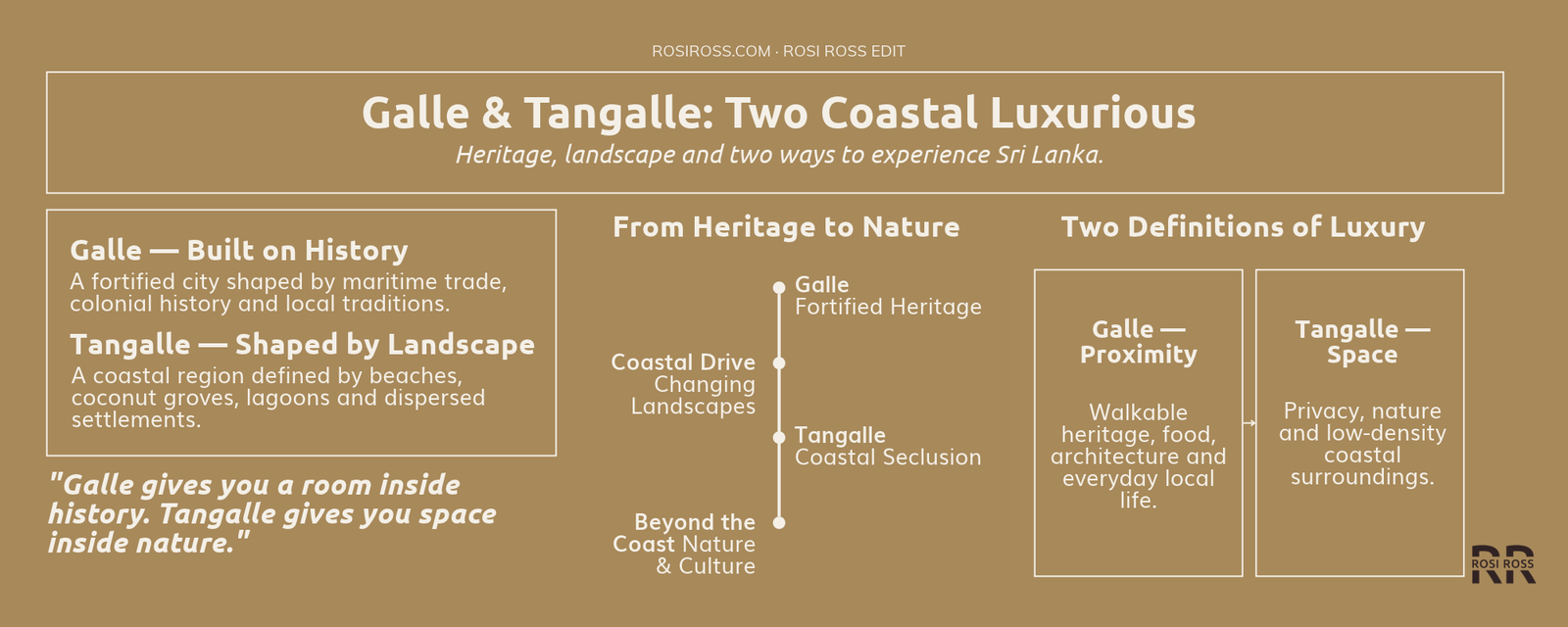
The discovery here is not that one coast is more luxurious than the other. It is that luxury changes form over roughly two hours of road. In Galle it is urban and historical: a seventeenth- and eighteenth-century fortified city, restored houses, courtyards, verandas, galleries, boutique hotels and a walkable cultural core. In Tangalle it becomes spatial: privacy, long beaches, vegetation, cliff edges, lagoons, wildlife and resorts designed to vanish into their surroundings. Galle gives you a room inside history. Tangalle gives you space inside nature.
This is not a hotel listicle, and it avoids two easy mistakes: treating Galle as the cheap, local alternative and Tangalle as the place where the serious hotels are, and calling a low-density coast untouched. Both places are luxurious, and the luxury is coded differently. The more interesting recommendation is not Galle versus Tangalle but Galle plus Tangalle.
A method runs underneath what follows. Hotels are treated as arguments about what luxury is, not as products to be ranked, and each argument is tested against the place around it. Facts about properties come from the operators’ own materials and are dated, because hotel details change faster than coastlines do. Impressions are labelled as the writer’s own.

Why Galle and Tangalle Feel So Different
Galle is defined by what humans built. Tangalle is defined by how much landscape remains around what they built.
The two places are close enough to combine in one journey and different enough to produce two versions of the island. Galle is built around memory: fortifications, merchants, houses, mosques, churches, cafés, and a town that still lives inside its history. Tangalle is built around exposure to nature: wider beaches, rocky coves, coconut land, lagoons and low-density resort landscapes. Their relationships with the Indian Ocean differ too. Galle’s cultural story is maritime and urban, ports, merchants, empire and religious plurality. Tangalle’s is coastal and rural, with Buddhist sites, fishing, lagoon ecology and a dispersed settlement pattern.
| Galle | Tangalle | |
|---|---|---|
| The form luxury takes | Urban and historical: heritage, architecture, walkability, food, art and atmosphere | Spatial: privacy, beach, landscape, wellness and low-density seclusion |
| The defining object | The Fort, built by people | The coast, and how much landscape remains around what was built |
| How the sea is met | From ramparts, bastions and rocky edges, and at nearby beach towns such as Unawatuna | On wide beaches, rocky coves, lagoons and long stretches of palm-backed sand |
| Where local life is | Inside an internationally recognised historic district | Dispersed across roads, villages, beaches and the town, often outside the resort gates |
| What the cultural story is | Maritime and urban: ports, merchants, empire, fortification and religious plurality | Coastal and rural: Buddhist sites, fishing, lagoon ecology and coconut land |
| The proximity you gain | To people and streets | To space and nature |
Galle gives you a room inside history. Tangalle gives you space inside nature. Neither is inherently more luxurious. They answer different definitions of luxury.
There is a measurable side to this difference, and it is worth stating plainly. On the operators’ own figures, a Galle Fort hotel of a few dozen rooms occupies one historic building in a continuous city, while a Tangalle resort occupies a coconut estate and measures its luxury in distance. Heritage luxury is made by what has accumulated around a building. Spatial luxury is made by what has been left empty around it. Both are scarce, and neither can be manufactured quickly, which is why the pairing is more interesting than a contest.
What is the difference between Galle and Tangalle? Galle is a fortified historic city and Tangalle is a stretch of open coast. Galle’s value is cultural density: a UNESCO-listed Dutch fort with fourteen bastions, living streets, mosques, churches, cafés and boutique hotels, all walkable. Tangalle’s value is spatial: fragmented bays and rocky coves, coconut groves, lagoons and low-density resorts. Galle gives you a room inside history, while Tangalle gives you space inside nature.
Lifestyle: Two Daily Rhythms
A coast is lived at a pace, and the pace is the first thing a place gives you.
Luxury is usually sold as a list of rooms and amenities. It is lived as a rhythm. The practical difference between Galle and Tangalle is not only what each contains but how a day moves through it, and the difference is large enough that many travellers feel it within hours of changing coasts.
In Galle the day is organised by streets, shade and the weather. Mornings suit walking while the Fort is cool and the lanes are quiet. The middle of the day belongs to interiors: museums, churches, cafés, shops and verandas. Late afternoon returns to the ramparts, where sunset is the Fort’s most reliable event. Everything is close enough that plans can change on foot, so the day is made of many small decisions, each of them cheap.
In Tangalle the day is organised by light, tide and distance. Mornings and evenings suit the beach and the coconut groves. The middle of the day is for shade, water and being still. Anything beyond the gate, a lagoon, a temple, a blowhole, is a deliberate journey by road. The day is made of a few large decisions and long stretches of not deciding, and those stretches are what the coast is selling.
| Part of the day | Galle | Tangalle |
|---|---|---|
| Early morning | Walk the ramparts and the lanes before the heat and the crowds | The beach at first light, when the coast is at its quietest |
| Late morning | Museums, churches and the shops on Church Street and Pedlar Street | Shade, the pool and the coconut grove, or a short drive to a nearby cove |
| Midday | Lunch in a café inside the Fort, out of the sun | Lunch at the property or at a roadside place in a village, then rest |
| Afternoon | The Old Dutch Hospital’s shops and restaurants, and the lighthouse side of the walls | A cove, a lagoon, or an excursion inland to Mulkirigala |
| Evening | Sunset on the ramparts, then dinner on foot | Sunset from the sand, dinner at the property, and where arranged a guided night watch at Rekawa |
| How you move | On foot | By car, driver or tuk-tuk for anything beyond the gate |
A typical rhythm, written as editorial guidance and not as a schedule. Opening hours and seasons vary.
Food follows the same logic. In Galle, cafés, restaurants, boutique hotels and shops sit in the same lanes as homes, so eating happens along the way and not at a destination. In Tangalle, a meal is more often a decision: dinner at the property, or a simple meal in a village on the road, or fish from a working harbour. Both are part of the lifestyle, and a traveller who eats only at the hotel in either place has seen less of it.
Both coasts include places of worship, and mosques, churches and temples ordinarily ask visitors to cover shoulders and knees and, at mosques and temples, to remove footwear. A light scarf and sandals that slip off are the most useful things to carry, and the ramparts and the beach ask for nothing more than sun protection.
The sea also sets its own terms, and the terms differ. According to Rough Guides, some beaches near Tangalle shelve steeply into the sea and have dangerous currents in places, while the sheltered coves south of the town, such as Pallikaduwa and Goyambokka, are pleasantly calm. That is consistent with the earlier point that these are dramatic beaches and not guaranteed calm-water lagoons. Ask the property or a local lifeguard before swimming, and let that advice outrank any guidebook.
What is the lifestyle like in Galle compared with Tangalle? Galle is a walking, café-and-museum rhythm inside a living historic district, with sunset on the ramparts as the daily event. Tangalle is a beach, grove and pool rhythm, organised by light and tide, in which anything beyond the resort gate is a short drive. Galle is many small decisions. Tangalle is a few large ones and long stretches of rest.
Is it safe to swim in Tangalle? It depends on the beach and the day. Rough Guides cautions that some open beaches near the town shelve steeply and have dangerous currents, while sheltered coves such as Goyambokka and Pallikaduwa are calmer. Ask your property or a local lifeguard on the day.
Galle: A Coastal City Built From History
The Fort’s value lies in the fact that it remains residential and public and not a sealed monument.
UNESCO’s advisers called Galle the best example of a fortified city built by Europeans in South and Southeast Asia, and an outstanding example of European architecture and South Asian traditions interacting; the property was inscribed in 1988. The Portuguese began the fortifications in the late sixteenth century, the Dutch took the town in 1640 and built the walls that survive, and local building traditions altered the European plan: coral appears alongside granite in the ramparts, measures follow the regional system, and the streets are lined with houses that have gardens and verandas supported by columns. The result is a town in which European planning was bent by climate, geology and regional craft.
The Fort should not be presented as colonial architecture preserved under glass. UNESCO notes that it still has residential, public and administrative uses, and that is why it feels social: people still walk the ramparts, live behind the walls, run shops, attend religious institutions and use streets laid out centuries ago. The Central Cultural Fund’s own description of the Fort counts fourteen bastions and a rampart system of about three kilometres around the peninsula. The architecture of fortification, thick walls, bastions and controlled thresholds, is also an architecture of power, a form of authority expressed in structure that the study of design in Amangalla: The Hotel Inside Galle’s Living History reads through one building within the walls.
| Galle’s layers | What they add |
|---|---|
| The fortifications | A Dutch bastioned wall around the peninsula, with fourteen bastions and a sea wall completed in 1729 |
| Portuguese and Dutch history | Portuguese foundations of the late sixteenth century; the Dutch city from 1640 |
| South Asian adaptation | Coral used with granite, local measures, verandas on columns and wide, shaded streets |
| Religious buildings | Mosques, churches and temples within a short walk |
| Living residential streets | Homes, shops and public offices still woven into the fortified plan |
| Boutique hospitality, cafés and galleries | A walkable cultural core, heavily visited and still lived in |
Galle rewards repetition: a second walk often reveals more than the first. Detail follows UNESCO’s advisory evaluation of the Old Town of Galle and its Fortifications and the Central Cultural Fund.
A town remembered this fully is also a town remembered through the senses: salt from the ramparts, spice and woodsmoke from the streets, the particular warmth of old plaster in the afternoon. A place is held in memory through scent as much as sight, as The Language of Scent: How Fragrance Becomes Identity in Modern Beauty explores, and Galle is one of the places where that is easiest to test on foot.
What is Galle best known for? Galle Fort, the best-preserved example of a fortified city built by Europeans in South and Southeast Asia, according to UNESCO’s advisers, founded by the Portuguese in the sixteenth century and developed by the Dutch from 1640. It is known for its ramparts and bastions, its lighthouse, and for remaining a living, walkable city of homes, shops, mosques, churches and cafés.
Why Galle Feels Walkable, Social and Lived-In
The luxury is not seclusion. It is proximity.
In my own experience Galle felt more relaxed and more local than I expected, and that should be taken as one traveller’s impression and not as a measure. Galle Fort is highly touristed and contains upscale hospitality, boutiques and restaurants, so it would be wrong to call it purely local. But its compactness creates an unusually human rhythm: walking, stopping, returning to the same street, sitting on the ramparts, moving between ordinary life and heritage architecture. The city rewards repetition. A second walk often reveals more than the first.
The sea works differently here too. Galle is coastal, but the Fort and not the beach is its defining geographic object. The ocean is met from ramparts, bastions and rocky edges, and at nearby beach towns such as Unawatuna, and not along one uninterrupted resort beach. It is a destination in which the ocean is part of the city’s history before it is part of the leisure product. A scholarly account of the Fort also describes the Galle Fort Reef as the only living coral reef around the walls today, a reminder that the sea beside the ramparts is an ecosystem as well as a view.
Repetition is a method and not only a pleasure. On a first walk the Fort is a set of pictures. On a second it becomes a set of relationships: which house opens onto which courtyard, which street changes character after a corner, which doorway belongs to a home and which to a shop. A traveller who returns to the same street at different hours begins to see who uses it, and that is the point at which a visit stops being a visit to a monument and becomes a visit to a neighbourhood.


What to Do in Galle Fort: A Walking Day
Galle is best read in sequence: the wall, the church, the museum, the street, the wall again.
The Fort is compact enough to be walked in a day and rich enough to need two. The Central Cultural Fund puts the rampart system at about three kilometres, and walking guides give two to three hours for a full circuit once stops for views are included. What follows is an order that makes the layers legible, and it is offered as a sequence to adapt and not as a checklist to complete.
| Stop | What it is | Why it matters |
|---|---|---|
| Main gate, Clock Tower and ramparts | The entrance side of the Fort and the start of the walls | Orientation: the walls explain the plan before any building does |
| National Museum, Church Street | A colonnaded mansion built in 1656, described as the oldest surviving Dutch building in the Fort | The architecture of the first Dutch generation, and the local crafts the museum shows |
| Dutch Reformed Church (Groote Kerk) | A church site from the 1640s, with the present building dated to 1752 to 1755 | Dutch family names on the floor tombstones and in the churchyard point to a community that outlasted the colony |
| National Maritime Museum, Queens Street | A museum in a Dutch warehouse of 1671, with a large Bryde’s whale skeleton | Galle’s story as a trading port; a smaller marine archaeology museum stands behind the Dutch Belfry |
| Meeran Jumma Mosque | A white-fronted working mosque on the seaward side of the Fort | Religious plurality made visible; the interior is not always open to visitors |
| All Saints’ Church | A church built in 1871 | A later layer of the Fort’s religious map |
| Old Dutch Hospital | A restored colonial building now used for shops and dining | A natural stop for lunch or an early evening |
| Sun Bastion | Built by the Portuguese in 1620 as São Tiago and renamed Zon by the Dutch in 1667 | A good vantage over the harbour |
| Lighthouse and Flag Rock Bastion | The seaward walls, where local divers jump from the Flag Rock bastion | Where the Fort ends and the ocean begins; the standard place for sunset |
Sources: UNESCO and Central Cultural Fund for the Fort; published walking guides (Time Out, Atlas and Boots, Holidify) for individual buildings. Hours, entry rules and building dates vary by source; verify before visiting.
One published walking order moves from the Dutch Reformed Church to the restored Dutch Hospital on the western side, then south toward the lighthouse and along the walls past the Meeran Mosque to Flag Rock and Triton Bastion. It works because it alternates interior and exterior: a cool building, then a long view, then a cool building again, which is also the best way to walk in tropical heat. Walking guides such as Time Out and Atlas and Boots describe similar loops.
Beyond the monuments, the Fort rewards unhurried shopping and sitting. Pedlar Street, Church Street and Lighthouse Street hold the shops, and locally made goods and crafts are the most natural things to bring home. Cafés and galleries fill the lanes between. Sunset on the ramparts near Flag Rock and the lighthouse is the Fort’s most dependable event, and it is also when the stone is cooler to walk. A first visit is a set of pictures. A second walk, at a different hour, becomes a neighbourhood.
A few habits keep the Fort a place and not a set. Treat the residential lanes as someone’s street: keep voices low, ask before photographing people, and step into a shop or a café and not only past it. The Fort’s strength is that it is lived in, and the visitor’s manners are part of what keeps it that way.
What are the best things to do in Galle Fort? Walk the ramparts, ideally at sunset near Flag Rock and the lighthouse; visit the Dutch Reformed Church and the National Museum; see the Maritime Museum in its seventeenth-century Dutch warehouse; look at the Meeran Jumma Mosque; browse Pedlar Street and Church Street; and eat in the Old Dutch Hospital or a café in the lanes.
How long do you need in Galle Fort? One full day covers the main sights, and a second walk at a different hour shows how the place is actually used. The full rampart circuit is about three kilometres and is usually given as two to three hours with stops.
Amangalla and the Luxury of Heritage
Galle is not the cheap, local alternative to Tangalle. It offers a different luxury proposition.
Galle’s high luxury is best represented by heritage hospitality. Amangalla occupies a historic building within the Fort, and its proposition is architecture, history, service and the privilege of inhabiting a protected urban landscape. Aman’s own account dates the premises to 1684, when they were built for the Dutch East India Company; they opened as the Oriental Hotel in 1863, were renamed the New Oriental Hotel at the turn of the twentieth century, and traded under that name until Aman acquired the property in 2002. Amangalla opened in 2005, with 29 bedrooms, chambers and suites and a library whose collection of memorabilia tells the story of the hotel, the Fort and the town. Its story is told in full in Amangalla: The Hotel Inside Galle’s Living History , and what matters here is the contrast it sets up.
Amangalla belongs to Aman’s Sri Lankan pairing with Amanwella: one property interprets the island through heritage, the other through landscape. The two properties make the difference between the coasts visible in architecture. The useful question to ask of a heritage hotel is not how it compares with a beach resort, since the two are not trying to do the same thing. It is what the building does for the street around it, and what the street does for the building.
Tangalle: Where the South Coast Opens Up
The town itself is not the primary luxury asset. The surrounding coast is.
Tangalle changes the visual grammar. Sri Lanka’s tourism authorities count it among the important beaches of the southern coast, and its resorts emphasise secluded coves, coconut groves, rocky headlands and long stretches of sand. It is a fishing port on one of the island’s larger bays, protected by an enclosing reef, with a Dutch and British past as an anchorage, and its old fort town is a quiet presence. This is why Tangalle can feel more exclusive while the broader destination remains comparatively low-key: the luxury is not in the town but in the distance between things.
The geography explains the economics. Because the coast is broken into bays, headlands and groves, a resort can hold a large parcel without a neighbour in sight, and the sense of exclusivity comes from the land and not from a wall. Value on this coast is therefore tied to the thing that cannot be added to: undeveloped shoreline. Every kilometre that stays low-rise and vegetated is part of the product, whether or not a hotel owns it.
Why Tangalle’s Beaches Feel More Private
The sense of luxury comes from distance between things.
Tangalle is not one beach. The landscape is fragmented into bays, coves, stretches of open surf and palm-backed sand and not a continuous urban waterfront, and that creates privacy naturally. Hotels can occupy substantial pieces of coastline without the visual density associated with mature resort destinations. The privacy is practical seclusion produced by geography and planning, which is different from legal ownership of a shoreline, and it should be described that way. The Indian Ocean on this coast can also be powerful, and the beaches are better understood as dramatic nature than as guaranteed calm-water lagoons.
Are the beaches better in Tangalle or Galle? They are different. Galle’s defining feature is the Fort and its sea walls, and the sea is experienced from ramparts and from nearby beach towns such as Unawatuna. Tangalle has wider, quieter beaches, rocky coves and palm-backed sand, which is why many beach-focused travellers choose it. The Indian Ocean can be powerful on this coast, so swimming conditions vary with season and tide.


What to Do in Tangalle: Town, Coves and the Hinterland
Tangalle has a town, but it is the radius around it that holds the day.
The town is modest. Tangalle is a fishing port and regional centre in Hambantota District, with a Dutch and later British past as an anchorage on this coast. The old Dutch fort, the rest house and the court house survive as examples of Dutch architecture, although the fort is used today as a prison and is seen as a landmark and not as a sight. The name is usually translated as “projected rock”, a reference to the rocks along the town’s shoreline, which contrast with the sandy beaches on either side.
That is why what to do in Tangalle is mostly a question of radius. A morning in the town itself, at the market, along the harbour and out to the lighthouse, tells a traveller what the coast is for the people who live on it. The rest of a stay is spent at the edges.
| Place | Approximate distance from the town centre | What it offers |
|---|---|---|
| Tangalle Lighthouse | About 1.4 km | A landmark on the town’s rocky shoreline |
| Parewella natural swimming area | About 1.7 km | A natural swimming spot close to town |
| Goyambokka Beach | About 2 km | A sheltered cove, the best-known beach on this stretch |
| Tangalle Beach | About 3.5 km | The town beach, open and long |
| Mawella Beach | About 5.3 km | An open stretch of coast, quieter and less visited |
| Rekawa Beach and lagoon | About 8.2 km | A turtle-nesting beach beside a lagoon, with community-based conservation |
| Hummanaya Blowhole, Kudawella | About 12 km | A natural marine geyser on the coast road; spray of 25 to 30 metres is claimed when the sea is right |
| Mulkirigala Rock Temple | About 16 to 21 km | A rock monastery rising roughly 200 metres, with terraced cave temples |
| Kalametiya Bird Sanctuary | About 17 km | A lagoon and wetland landscape for birdwatching |
| Wewurukannala Vihara | A short drive inland | A giant seated Buddha and elaborate shrines, often combined with the blowhole and Mulkirigala |
Distances are approximate, as listed on a hotel-booking site and in travel guides; road distances differ. Verify before travelling.
Two of these deserve care. Anantara describes Hummanaya as the second-largest blowhole in the world, with spray reaching 25 to 30 metres every few minutes. Rough Guides, more cautiously, notes that it can be spectacular or extremely dull depending on luck, which is a sensible way to see it: as a short stop on a longer drive and not as a destination in itself. Rekawa, by contrast, rewards planning, because it is best met through a guided and conservation-led visit, as described earlier.
Rough Guides suggests a rewarding half-day that combines the blowhole, the giant Buddha at Wewurukannala and the rock temples of Mulkirigala, which is a good way to see that the hinterland is as varied as the coast. It also shows how different Tangalle’s cultural offer is from Galle’s: spread across a landscape and reached by road, not gathered inside a wall and reached on foot.
Swimming deserves the same discipline as sightseeing. The sheltered coves are the natural choice for a calm swim, and the long open beaches are for walking, watching and, with local advice, careful bathing. Evenings are quiet by design. The coast offers sunset from the sand and the night sky, and in season a guided night watch at Rekawa, and not a nightlife. Booking-platform data suggest that guests commonly stay about four days in Tangalle, which fits a coast that rewards staying put.
What is there to do in Tangalle town? The town itself is small: a fishing port and market, a lighthouse, and a few Dutch-era buildings including a fort that is now a prison. Most visitors use it as a base for beaches and coves within a few kilometres, for the Rekawa turtle beach, and for excursions to Hummanaya Blowhole, Wewurukannala and Mulkirigala.
Is Hummanaya Blowhole worth visiting? As a short stop on a longer drive, yes. Anantara describes spray reaching 25 to 30 metres, but Rough Guides notes that it can be spectacular or dull depending on the sea on the day, so it is best combined with Wewurukannala and Mulkirigala in a half-day circuit.
Amanwella and Nature-First Luxury
Amanwella is the cleanest contrast with Amangalla.
Aman describes Amanwella as a secluded resort reached by a winding track through lush jungle, on a broad stretch of golden sand fringed with coconut palms, in a mature coconut grove above a crescent-shaped beach. Its June 2026 factsheet lists 28 suites, each with a private plunge pool, and places the resort about 80 kilometres east of Galle and 190 kilometres south of Colombo; older material gave 30 suites, so the safe phrase is fewer than 30. The design is contemporary and not colonial, by the Australian architect Kerry Hill after the tropical modernism of Geoffrey Bawa, with sea-facing terraces, floor-to-ceiling sliding glass doors and minimal architecture. The name joins the Sanskrit-derived word for peace with wella, the Sinhala word for beach.
Its economics, the logic by which a very small number of keys on a large site can carry more authority than a larger resort, is the subject of Amanwella: Why Space Is the Rarest Luxury in Sri Lanka . For this essay, the point is the contrast: one Aman interprets Sri Lanka through the walls of a fort, and the other through the amount of land it declines to fill.
The Surprise: International Luxury Without a Luxury Bubble
The Maldives often sells isolation as the product. Southern Sri Lanka sells access to a functioning place.
This is the section where a traveller says, I did not know this existed. Sri Lanka’s south coast can deliver internationally recognised luxury names while keeping everyday prices, local restaurants, small shops, tuk-tuks, fishing communities and relatively low-density development outside the resort gates. It should not be called universally cheap: prices vary by season and luxury resorts are expensive. The durable point is relative value. The wider destination often feels less financially inflated and less hermetically packaged than many famous tropical luxury destinations, and exact prices date too quickly to quote.
The comparison with the Maldives should be used carefully and never turned into a winner. A resort in the Maldives typically sells seclusion. A resort here sits inside a functioning place, so a traveller can leave and meet towns, temples, fishermen, cafés, wildlife, heritage sites and ordinary road life within the same journey. That makes the luxury feel embedded and not separate, a different relationship between a hotel and its surroundings from the designed atmosphere of a sealed destination, the contrast explored in Inside the Atmosphere Economy: How NEOM Is Redefining Modern Home Wellness .
Relative value is a better lens than price. It asks how much of a place a traveller can reach for what they spend, and how much of the money stays in the local economy. A coast where a resort meal and a roadside meal can both be eaten on the same day offers a wide range of ways to participate, and a wide range of ways for money to circulate. That coexistence is part of the appeal, and it is also part of what needs protecting. High-end hospitality that displaces the everyday economy around it eventually removes the thing it came for. The best test of a luxury coast is whether the shop, the fishing boat and the tuk-tuk are still there.
A practical way to use that test is to leave the resort gate on foot. Walk to the nearest village shop, the nearest fishing beach, the nearest temple. If the walk is possible, and if the people met on it are going about their own business and not performing for visitors, the luxury is embedded. If the walk leads nowhere, or only to another resort, the luxury is a bubble. Southern Sri Lanka still passes this test in many places, and the interest of the coast lies in how long it continues to.


Galle’s Cultural Density vs Tangalle’s Ecological Space
Tangalle is strongest when the story pulls outward from the hotel.
In Galle, value accumulates through layers. In Tangalle it spreads outward across land and water. Beyond the beach is the coconut-rich coast, the Rekawa lagoon, where turtles nest and a community-based project protects the nests, the inland rock temple at Mulkirigala and, within a longer drive, wildlife landscapes such as Udawalawe and Bundala. Safari wildlife is a national-park experience and not a property of any resort, and wildlife should be presented with conservation discipline and not as entertainment.
Rekawa: Nature Without a Resort Filter
Wildlife should be presented with conservation discipline, not as entertainment.
Rekawa Beach, near Tangalle, is a nesting ground where all five species of marine turtle that nest in Sri Lanka have been recorded. Resort material points visitors toward the turtle protection programme there, and reports date its in-situ conservation to 1996, although other sources date the community project to the mid-1990s more generally. According to the project partner Explorers Against Extinction, local conservationists began with community-led night patrols and ecotourism, employed former egg collectors as nest protectors, and recorded around 800 nests a year when the project began; today a team of trained men and women patrol the beach by rota. The model is instructive for a luxury coast: it turns a former extractive pressure into a livelihood, and the visitor is a guided participant in a small-group night watch, not a spectator at a staged show.
Inland, the Mulkirigala Rock Temple shows a different side of the same hinterland. Reports describe a rock rising roughly 200 metres, with a series of rock temples on terraced levels, Kandyan-era paintings and an associated tradition of monks sheltering in the caves from before the Christian era. Lonely Planet records that Pali manuscripts found in the monastic library by a British official in 1826 were used for the first translation of the Mahavamsa, the great chronicle that opened early Sri Lankan history to European readers, and reference summaries add that the Dutch once called the rock Adam’s Berg. The temple lies roughly 16 to 21 kilometres from Tangalle, depending on the route and the source, and it is a living place of worship and not a backdrop.
| Tangalle’s ecological space | What it is | Context |
|---|---|---|
| Beaches, coves and rocky outcrops | A fragmented coast of bays and headlands, not one continuous waterfront | Privacy arises from the landscape itself |
| Coconut-rich coastal land | Resorts set in groves that give shade, privacy and separation | Inhabited, working land, not wilderness |
| Rekawa lagoon and beach | A turtle-nesting beach beside a mangrove-ringed lagoon, with community-based conservation | Resort material points visitors to a turtle protection programme reported to have run since 1996 |
| Mulkirigala Rock Temple | A temple complex built into a natural rock outcrop inland | Cultural context beyond the resort |
| National parks within reach | Udawalawe, Bundala and Yala for wildlife | Safari wildlife is a national-park experience, not a feature of any resort |
This is not empty land. It is inhabited ecological space, and its luxury value depends on its staying that way.
Local life, too, is different in each place, and that is a reason to leave the hotel in both. In Galle it is visible inside an internationally recognised historic district. In Tangalle it is more dispersed, across roads, villages, beaches and the town, often outside the gates of the international resorts, and it should be encountered as life and not as scenery. Value built on place, patience and a limited supply of something that cannot be reproduced is a principle that runs from the walls of a fort to the world of cultured pearls described in The Return of the Pearl: Inside the Quiet Luxury of Robert Wan .
| Galle is for… | Tangalle is for… |
|---|---|
| Travellers who need history and culture around them | Travellers who prioritise beach and landscape |
| People who prefer walking to resort confinement | People who want privacy and low-density luxury |
| Design and architecture travellers | Wellness and resort travellers |
| Food, café and boutique-hotel travellers | Nature-focused travellers |
| People who want luxury without being physically isolated | People willing to drive for culture and not have it outside the door |
A matching of traveller to place, not a verdict.
Proximity: What Is Near What
Distance is the quiet variable behind every luxury on this coast.
Proximity is the word that explains most of the lifestyle difference, and it means a different thing in each place. In Galle it is proximity to people, streets, history and food: nearly everything is within a walk of everything else. In Tangalle it is proximity to nature and to quiet: the beach is at the door, and almost everything else is a drive. A third kind is proximity to the rest of the island, which is the matter of how long the road takes.
| Route | Approximate road distance | Approximate time | Note |
|---|---|---|---|
| Colombo to Galle | About 116 km | About 1 to 1.5 hours by expressway | The Southern Expressway cut the journey from about three hours |
| Galle to Tangalle | Roughly 60 to 83 km, by route and end point | Roughly 1.25 to 2.5 hours | Aman places Amanwella about 80 km east of Galle |
| Matara to Tangalle | About 36 km | About 40 minutes | Matara is the last large city before Tangalle |
| Colombo to Tangalle | About 190 to 195 km | A long day by road | Aman puts Amanwella about 190 km south of Colombo |
Figures are from the Southern Expressway entry, Aman’s Amanwella factsheet and route-planning sites, and they vary with route and traffic. Verify before travelling.
The Southern Expressway, which Wikipedia lists as running through Galle and Matara and on toward Beliatta and Hambantota, is the reason road times on this coast have shortened. Which sections are open and how they connect to the old coastal road should be checked before a transfer is planned. The older coastal road is slower and more scenic, and the difference between the two is part of why published times for Galle to Tangalle range so widely.
Trains run along the coast and stop at Galle, Unawatuna, Weligama, Mirissa and Matara, among others. Tangalle does not appear to be on the line, so the last stretch is by road: a bus or a taxi of about thirty to forty minutes from Matara. For a luxury journey the practical solution is a driver, which turns the transfer from a logistical problem into the part of the journey in which the landscape changes.
Within Tangalle, distances are small on a map and large in practice. Listing-site figures place Goyambokka about two kilometres from the town centre, Mawella about five and Rekawa about eight, and those short distances are the reason a base is a real decision: a property near Goyambokka suits sheltered swimming, one toward Mawella or Rekawa suits open coast and turtles, and Amanwella, about eighty kilometres east of Galle, sits at the far end of the pairing by design. The hotel is the nearest thing to the coast, and the town is a short drive away.
Seen this way, the two places buy different proximities. Galle buys nearness to other people’s lives. Tangalle buys nearness to a coast, and distance from everything else. A traveller who knows which they want has already chosen the hotel.
How far is Galle from Tangalle? Roughly 60 to 83 kilometres by road depending on the route and the exact start and end points, and usually about one and a half to two hours with traffic. Aman places Amanwella about 80 kilometres east of Galle.
Can you visit Tangalle as a day trip from Galle? It can be done by road, but the round trip is long and it misses the reason to go, which is to stay on the coast and let the pace change. Treat the two as two bases, with the transfer as part of the journey.
The Coast in Between: What the Road Passes
The road from Galle to Tangalle is the third place in this story.
Between the two sit several towns, each with its own temperament, and knowing them makes the transfer legible. Travelling east from Galle, the road passes some of the south coast’s best-known surf and whale-watching towns before the coast widens toward Tangalle.
| Place | What it is known for | What it means for this journey |
|---|---|---|
| Unawatuna | A beach town just east of Galle | Galle’s nearest beach, which is why the Fort is not a beach destination |
| Weligama | A bay with surf breaks, with the bus and railway stations near the water | One of the most consistent surf stops between roughly October and April |
| Mirissa | A small headland beach and a whale-watching departure point | Blue and sperm whales pass offshore from roughly November to April |
| Matara | A busy southern city at the mouth of the Nilwala River, with Dutch fortifications and a star fort across the river | The last major city before Tangalle, about 35 km to the east |
| Dikwella and Hiriketiya | A small coastal market town and a surf bay | The approach to Tangalle, with the Hummanaya blowhole nearby |
Details follow regional travel guides; seasons for surf and whales are approximate and vary by year.
The transfer can be made in one drive or broken at a single stop. The better choice is to break it once, at one town, and not to sample all of them: a morning on the water at Mirissa in season, or a lunch in Weligama, turns the road into a day, and a second stop turns it into a tour. The point of the pairing is the contrast, and the contrast is easiest to feel when the journey between the two coasts is allowed to be quiet.
The road is also where the economy of the south coast is easiest to see. Fishing boats, roadside stalls, schools, junctions, temples and small hotels pass in sequence. They are the evidence that luxury on this coast sits inside a working landscape, and the test applied earlier, whether the shop, the fishing boat and the tuk-tuk are still there, can be run from a car window.
The Difference Between the Two Coasts, Stated Plainly
Galle asks for attention. Tangalle asks for time.
The differences are easier to see once they are set side by side. Galle belongs to Galle District and Tangalle to Hambantota District, both in Southern Province, and the administrative line is a reminder that these are two different places and not one coast with two names. In practice the differences come down to what holds the day, how the sea is met, who is around and what the traveller needs to carry.
| Question | Galle | Tangalle |
|---|---|---|
| Where does the day start? | At the door, on a lane | At the gate, with a decision |
| How do you get around? | On foot | By car, driver or tuk-tuk |
| Where do you swim? | At nearby beach towns; the Fort is not a beach destination | From sheltered coves or the property; open stretches need care |
| What do you do in heat or rain? | Museums, churches, cafés and galleries | The pool, the veranda, a spa, or an inland temple |
| Where is local life? | Inside the Fort’s lanes | In villages, fishing beaches, the market and the roadside |
| How long to stay? | Long enough to walk it twice | A few days; booking data suggest about four is common |
| What is scarce? | Preserved fabric and living streets | Open shoreline and quiet |
Editorial comparison. Neither column is a ranking.
The honest summary is that the two coasts differ most in what they ask of the traveller. Galle asks for attention, because its value is in detail: the street that changes after a corner, the doorway that belongs to a home. Tangalle asks for time, because its value is in duration: the hour at which the beach empties, the tide, the long evening. A traveller with only attention to give will get more from Galle, and one with only time will get more from Tangalle. A traveller with both should do both.
Is Galle or Tangalle better for a first visit to Sri Lanka’s south coast? It depends on what you want first. Galle gives orientation: history, walkability, food and architecture. Tangalle gives rest: beach, privacy and landscape. Most travellers are better served by doing both, starting with Galle so that Tangalle’s space has something to contrast with.
Why You Should Do Both
The journey works because the second destination removes what the first one gave you.
The best recommendation is the pairing. Start with the intensity of Galle’s cultural layers, then move east as architecture thins and landscape expands. The transfer itself becomes part of the story: fort wall to beach, street grid to coconut land, historical density to spatial quiet. A traveller who does only Galle gets the history and misses the space, and one who does only Tangalle gets the space and misses the density. Combined, they make the south coast legible as two answers to one question.
The order matters. Arriving at Tangalle first gives space without context, and the traveller may not understand what the emptiness is the absence of. Arriving from Galle gives the contrast its meaning, because the eye has just spent days in a dense, walled, layered city. Moving east is also a move from the built to the unbuilt, and the road, about two hours along the coast by most accounts, is the hinge between them. Pay attention to it. The villages, the junctions, the roadside stalls and the change in the colour of the land are the part of the journey that no hotel supplies.
The same island has still more registers inland, in the hill country, where a plantation landscape tells another history, the subject of Hatton: Sleeping Inside Sri Lanka’s Tea History and, more broadly, of Sri Lanka, Closer to the Land: Tea Country, Sacred Cities and the Wild South .
Should I stay in Galle or Tangalle? Ideally both. Choose Galle if you want history, walkability, food and architecture around you, and Tangalle if you want beach, privacy and landscape. They are about two hours apart by road, so a single journey can combine them, starting with Galle’s cultural intensity and moving east as the architecture thins and the landscape widens.
Is Tangalle more luxurious than Galle? Neither is inherently more luxurious; they define luxury differently. Galle’s luxury is heritage, architecture and atmosphere, represented by Amangalla inside the Fort. Tangalle’s luxury is privacy, space and nature, represented by resorts such as Amanwella and Anantara Peace Haven. Galle is not a cheaper or merely local alternative to Tangalle.
Can you combine Galle and Tangalle in one Sri Lanka trip? Yes, and the pairing works better than choosing one. They are roughly two hours apart by road along the south coast. The transfer becomes part of the story: fort wall to beach, street grid to coconut land, historical density to spatial quiet.
What Each Destination Risks Losing
Luxury can consume the thing it sells.
The essay needs one critical section. Tangalle’s value comes from low density, vegetation, water, beach and the feeling of space, and overdevelopment would erode the exact qualities international hotels monetise. Galle faces a different risk: heritage streets becoming so tourism-oriented that ordinary residential life disappears. UNESCO’s own monitoring of the Fort has returned repeatedly to this tension. In 2010 its records noted that the Galle Heritage Foundation, the body created to coordinate conservation, appeared to lack the status, funding and resources for overall management of the property, and a later decision recorded a weakness in the Foundation’s management role. More recently, the State Party reported that a Heritage Award Scheme is being used to encourage residents to remain in the historic houses, and that amendments to the Foundation’s Act, which would grant it greater management powers, were being finalised. A scholarly study published by Leiden University argues that while the ramparts are well preserved, the socio-cultural values of the Fort’s residential community have sharply declined. The best luxury development is therefore stewardship, not saturation.
The protective logic is the same on both coasts. A boundary that is allowed to do its work, a rampart in one place and a lagoon or reef in the other, protects what lives behind it, and a coast that is built on to the edge loses the thing that made it worth building on. It is the same idea as the one at the centre of The Return of Barrier Beauty: Why Lanolin Is the Ultimate Skin Investment, that the protection of a living boundary is what lets everything else on it function.
| What it risks losing | What stewardship looks like | |
|---|---|---|
| Galle | Residential and social life, if heritage streets become so tourism-oriented that ordinary life disappears; UNESCO’s records note funding limits at the Galle Heritage Foundation, and a scheme to keep residents in historic houses | Conservation funding, development control and keeping residents in the Fort |
| Tangalle | The low density, vegetation, water and feeling of space that international hotels monetise | Controlled density, protected lagoons and beaches, and wildlife viewed with conservation discipline |
Luxury can consume the thing it sells. The best luxury development is stewardship, not saturation.
The Price-Value Story
Comparative value is a more durable idea than bargain tourism.
The surprise is that a traveller can move between locally priced meals and transport and internationally recognised resort brands within the same destination. High-end hospitality has not fully displaced the everyday economy around it, and that coexistence is part of the south coast’s appeal. No exact prices are quoted here, because they date quickly and vary dramatically by season.
What lasts is the logic. The value of a stay is better judged by what it gives access to than by what it costs: the density of the city outside the door in Galle, the amount of coast and quiet in Tangalle. A traveller who reads value this way will choose a hotel for what it allows them to understand. For readers who apply the same test to what they choose to own and wear, our guide to timeless luxury fashion pieces asks what still holds its worth when the season passes, and the answer is often the same: provenance, patience and a limited supply of something that cannot be reproduced quickly.
Why the Places Must Stay Different
The best luxury development is stewardship, not saturation.
As tropical luxury becomes standardised, destinations with a strong identity outside the hotel are likely to gain value. Galle and Tangalle have that advantage for opposite reasons, Galle because its historical identity is dense and Tangalle because its landscape identity remains spacious. The south coast’s opportunity is not to become another resort corridor. It is to preserve the difference between its places.
The story is not that Galle is cheap and local while Tangalle is where the luxury hotels are. It is how two neighbouring stretches of coast create radically different forms of value: Galle through historical density, architecture and lived urban culture, and Tangalle through spatial luxury, beaches, ecology and a remarkable concentration of nature-first hospitality. The reader should come away with the feeling of having discovered a sophisticated coastal circuit that remains less overbuilt and less internationally obvious than its luxury credentials would suggest. Sri Lanka’s south coast is most valuable because its places still feel different from one another.
Value of this kind is also layered the way jewellery of lasting worth is layered: it is made by what has accumulated, and by what has been left alone. That is the idea at the centre of The Language of Modern Necklaces: Metals, Stones, and the New Codes of Personal Luxury, and it applies as well to a fortified city as to a stone.
“Galle and Tangalle are not rival beach towns.
They are two different ways of understanding Sri Lanka.
Galle gives you a room inside history.
Tangalle gives you space inside nature.
The journey works because the second destination
removes what the first one gave you.
The best luxury development is stewardship, not saturation.”

