
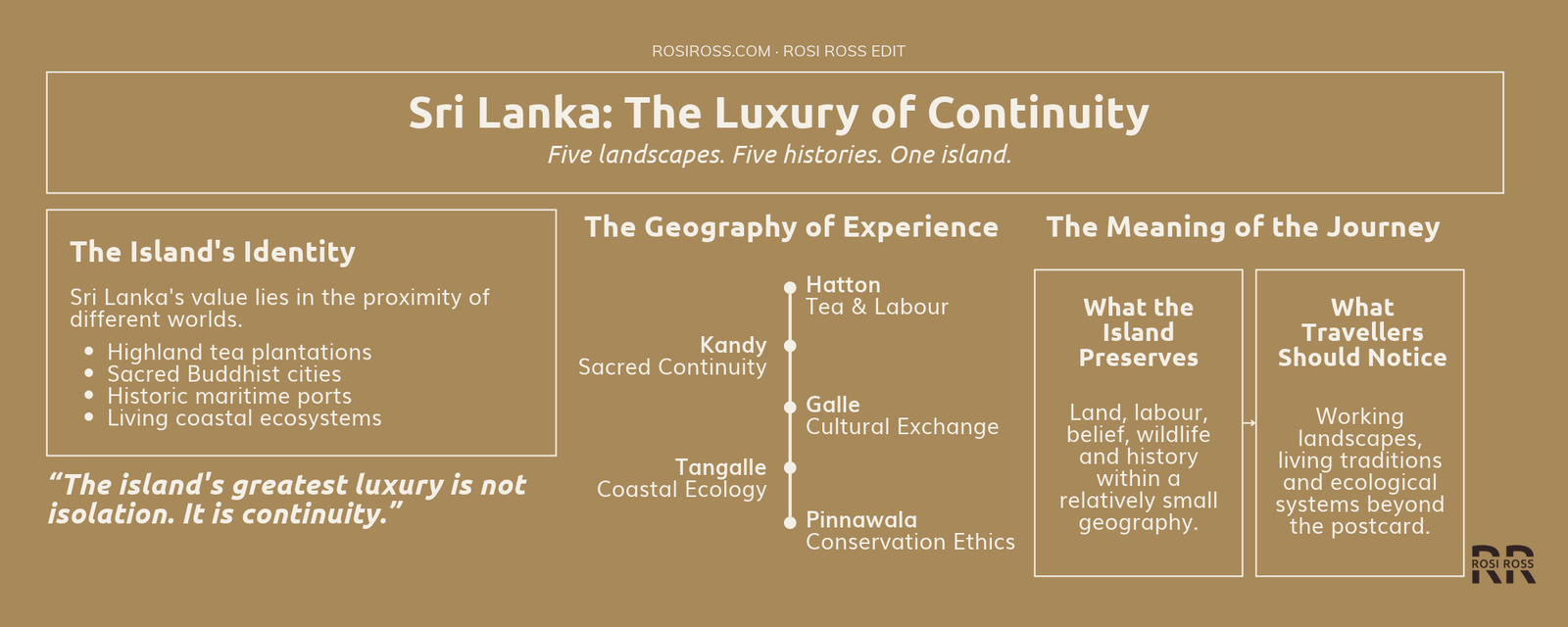
A portrait of an island in which landscape, labour, belief, wildlife and hospitality still sit visibly beside one another: from the tea country of Hatton to the sacred city of Kandy, the fortified port of Galle, the lower-density coast around Tangalle and the elephants of Pinnawala.
Sri Lanka does not feel valuable because it has escaped history. It feels valuable because history, nature and everyday life are still visible in the same frame.
In Sri Lanka, a few hours of road can move you from a tea field planted into the logic of the British Empire, to a Buddhist shrine carrying centuries of political memory, and then to an Indian Ocean coast where fishermen still read the weather before tourists read the menu. That proximity is the story. The island is not one aesthetic. It is several histories living on top of the same land.
Sri Lanka is usually marketed through its beaches, its wildlife and its hotels. Those things are real, and they are not the deepest reason the island stays with a traveller. Its power comes from compression. Within a relatively small geography a visitor moves between misty highlands, tea estates, Buddhist sacred cities, colonial ports, tropical coastline and wildlife landscapes, and what the journey reveals is five different ways of understanding a country: plantation history, sacred continuity, maritime exchange, coastal ecology and the complicated relationship between people and elephants.
This is a portrait and not a list. It follows one route through Hatton, Kandy, Galle, Tangalle and Pinnawala, and it tries to keep beauty and its costs in the same sentence. It does not call the island untouched, because it is not. It is a place where people live, work, worship and farm in landscapes that visitors admire, and the most valuable thing a journey there can offer is the ability to see all of that at once.
The route is a reading order and not a driving order. Pinnawala, for instance, sits roughly halfway between Kandy and Colombo, so a practical journey would fold it in differently. The order here is the order of the argument: from land and labour, to belief, to exchange, to ecology, to responsibility.
How to Read This Essay: Five Lenses and Four Layers of Evidence
A place becomes legible when you decide what question it is answering.
Each stop on this route trains a different question. Hatton asks who made the landscape and on what terms. Kandy asks what belief looks like when it is still in daily use. Galle asks what architecture records when two worlds meet. Tangalle asks what a coast is worth when it is allowed to remain a coast. Pinnawala asks what protection actually requires. Read together, the five questions form a method that travels to other destinations, which is why this essay is built around them and not around a list of things to do.
| Place | Lens | What to look for | The question it trains |
|---|---|---|---|
| Hatton | Land and labour | Estate villages, rail stations, working slopes, the people who work them | Who made this landscape, and on what terms? |
| Kandy | Belief | Ritual, devotion and civic life around the temple | What does heritage look like when it is still used? |
| Galle | Exchange | Verandas, courtyards and the lived-in city beyond the ramparts | What does architecture record about contact? |
| Tangalle | Ecology | Lagoons, palms, fishing and farming that still read together | What is the asset underneath the view? |
| Pinnawala | Responsibility | Welfare, breeding, visitor interaction and conservation purpose | What does protection require, and who pays for it? |
A framework for reading the route, not a verdict on any place.
The evidence used here sits in four layers, and it helps to know which is which. The first is institutional: UNESCO for the World Heritage descriptions of Kandy and Galle, the International Labour Organization for tea-sector work, and the National Zoological Gardens for Pinnawala. The second is investigative: Amnesty International’s May 2026 report on estate labour. The third is press reporting, which carries the elephant statistics and the reaction to the Amnesty report. The fourth is the author’s own observation, which is always labelled as such and is never offered as a claim about all Sri Lankans.
In Sri Lanka, luxury is often not what has been added to the landscape. It is what has not yet been built over.
The island’s natural range is unusually concentrated. The central highlands hold tea, waterfalls and cool mountain air, and the south opens quickly into tropical coastline. The luxury lens that fits such a place is restraint rather than excess. The value of the trip is access to landscape, to mist, forest, water, agricultural land and coast, and not merely the ability to shut oneself away from it. The way air, water and weather shape a place, an idea explored in Inside the Atmosphere Economy: How NEOM Is Redefining Modern Home Wellness , is the first thing a traveller notices here and the last thing a resort can supply.
There is an economic idea inside the word compression. A destination that offers variety per hour of travel gives its visitor more understanding per day, and understanding is the one form of value that cannot be bought in advance and stacked up in a hotel lobby. A traveller spends less of a journey in transit between worlds and more of it inside them. That is a different proposition from a single spectacular asset, and it is the reason the island rewards a slow reading more than a long checklist.
The island is also one of the most globally known destinations that is still intellectually underrated. It is not undiscovered: its tourism industry is mature. The point is that what makes it valuable is hard to reduce to a postcard. A destination can be famous and still misunderstood, and the correction is to look at the places where several kinds of history are visible together.
Is Sri Lanka good for nature and cultural travel? Yes, and the combination is unusually concentrated. Within a small geography, a traveller can move between highland tea estates, sacred Buddhist sites, colonial ports, coastal lagoons and wildlife landscapes. The value lies in seeing land, labour, belief, wildlife and history together, rather than isolating oneself from them in a resort.
What makes Sri Lanka unique beyond beaches? Compression and continuity. Plantation history, Buddhist kingship, maritime colonialism, coastal ecology and the complicated relationship between people and elephants all sit within a few hours of one another, and several of them are still lived and not only preserved. Sri Lanka is globally known but intellectually underrated, because much of what makes it valuable cannot be reduced to a postcard.


Hatton: The Historical Heart of Tea Country
The tea hills are not untouched nature. They are working agricultural landscapes created through colonial capitalism.
Hatton should be the intellectual centre of any journey through the hill country. Sri Lanka Tourism describes it as a town at about 1,271 metres, developed during British colonial rule to serve first the coffee estates and then the tea estates, and its Scottish name is no coincidence: many of the surrounding estates carry Scottish place names. It sits among tea plantations, waterfalls, old estate bungalows, churches and reservoirs such as Castlereagh, and the beauty is real. The task is to make it historically legible.
The story begins with coffee. The British planted the highlands with coffee from the 1820s, and the coffee economy collapsed in the 1860s from an outbreak of coffee rust. As UNESCO puts it in its description of Sri Lanka’s Tea Cultural Landscape, a site on the country’s tentative World Heritage list, planters turned to tea, and the first commercial tea plantation was established by the Scottish planter James Taylor at Loolecondera in 1867. The same account records that large numbers of Tamil workers were brought to the island under indentured systems to meet the demand for estate labour. The sensory side of that history is still there in the air of the hills, in the smell of withering leaf, a reminder that places are remembered through scent as much as sight, as The Language of Scent: How Fragrance Becomes Identity in Modern Beauty explores.
| When | What happened | Why it matters |
|---|---|---|
| 1820s onward | Coffee planting expands across the central highlands under British rule | The commercial transformation of the hills began with coffee |
| 1860s | Coffee rust (Hemileia vastatrix) destroys the coffee economy | Planters turned to tea |
| 1867 | James Taylor establishes the first commercial tea plantation at Loolecondera | Ceylon tea begins |
| 19th century | Large numbers of Tamil workers are brought from South India under indentured systems | The labour that made the landscape productive |
| 19th century | A broad-gauge railway links the hill plantations to the coastal ports | The infrastructure that tied the highlands to global trade |
| Study of 2018 | About 70 percent of tea is grown by roughly 475,000 smallholders (ILO) | The story of tea is not only the estate |
A short chronology drawn from UNESCO’s tentative-list description of Sri Lanka’s Tea Cultural Landscape and the ILO smallholder study. Dates are approximate where sources differ.
Is Hatton worth visiting in Sri Lanka? Yes, for travellers who want to understand tea country as a working landscape and not only as scenery. Hatton, at about 1,271 metres, is a hill-country town founded under British rule to serve coffee and later tea estates, surrounded by plantations, waterfalls, old estate bungalows, churches and reservoirs such as Castlereagh. It rewards visitors who look at the labour, rail and estate villages as well as the view.
What is the history of tea in Hatton? Hatton was founded in the British colonial period to serve coffee estates, which collapsed in the 1860s from coffee rust, after which planters turned to tea. James Taylor established the first commercial tea plantation at Loolecondera in 1867. Large numbers of Tamil workers were brought from South India under indentured systems to work the estates, and a railway linked the highlands to the coast. Surrounding estates still carry Scottish place names.
Hatton also asks for a discipline that colonial architecture tends to defeat. The planter bungalow is visually seductive, and a journey that stops at the veranda tells the shortest version of the story. The richer account is what happened after empire: tea stayed at the centre of the national economy, estate communities became part of the country’s modern social fabric, and smallholders grew in importance. The ILO’s study, launched in December 2018, found that about 70 percent of Sri Lanka’s tea is grown by almost half a million smallholders, on household-run farms, and that rising costs, falling prices and climate change are making tea more expensive and riskier to grow. Hatton belongs to colonial history and to the Sri Lanka of today, and the most honest way to see it is to hold both.


The Women and Communities Behind Ceylon Tea
The tea estate is simultaneously scenery, industry, home and history.
Gravitas requires resisting the picturesque. A tea picker on a misty slope is not a decorative figure. The person is part of the economic history that made Ceylon tea globally valuable, and in many parts of the estate world that person is a woman from a community whose ancestors came from South India. The International Labour Organization describes tea as a major employer in Sri Lanka, particularly of women, and its plantation safety programme notes that the tea sector provides employment for over 2.5 million people. It also records continuing concern about occupational safety at work.
The beauty of Hatton is real, and so is the labour embedded in it. That is not a footnote to the landscape. It is how the landscape was made. It is also not only a story about the past. In May 2026 Amnesty International published a report on Malaiyaha Tamil workers on private tea estates and smallholdings in the Southern Province, based on visits to 45 estates in the Galle and Matara districts and 159 interviews with workers, and on research carried out between January 2024 and January 2026. It said that the abuses meet many of the ILO’s indicators of forced labour, including intimidation and threats. Press coverage of the report also relayed its finding that employers label up to 90 percent of Malaiyaha Tamil workers in the Southern Province as casual, although, by law, they are permanent employees. Sri Lanka’s Plantation Ministry said it was reviewing the report issue by issue.
Care is needed in what the report is taken to prove. It concerns private estates and smallholdings in two southern districts, not the up-country estates around Hatton, and it does not describe every estate on the island. What it offers a traveller is not a verdict on the cup of tea in front of them but a better question to carry: who works here, under what terms, and with what protection? The report’s own description of the community is also a reminder of scale, since Amnesty’s Secretary General spoke of systemic discrimination and exclusion over more than two hundred years. A reader can follow the coverage and form a view. The point is that the postcard and the payroll can look very different, and that a serious travel portrait holds both.


Why the Hill-Country Train Is More Than a View
A train journey keeps the traveller inside the landscape long enough to see transitions that a private transfer can flatten.
The hill-country railway should be treated as social geography, not an Instagram frame. The British built a broad-gauge railway to connect the tea-growing regions with the coastal ports, and the line is the physical record of how the highlands were tied into the commercial economy. From a window the geography becomes legible: towns, estates, workers’ housing, forest, stations and cultivated slopes. Hatton is a major station on the main line. The slow pace is the point. A car delivers a destination. A train delivers a sequence.
There is a practical reading skill here. Watch the order in which things appear: first the commercial town with its shops and station, then the estate boundary and its factory, then the lines of workers’ housing set apart on the slope, then the forest that the estates did not claim. The sequence is the same argument as the chronology above, told in space and not in time. It is also the reason the journey belongs in a portrait of tea country and not in a list of scenic attractions.
Kandy: Where Sacred History Is Still Alive
The most important thing in Kandy is not that the temple survived. It is that belief survived around it.
Kandy should not be reduced to the Temple of the Tooth as a sightseeing stop. It was the capital of the last independent kingdom on the island, set up in the late sixteenth century after the coastal regions had fallen to European powers, and it remained a bastion of Sinhalese independence until the British took it in 1815. UNESCO, which inscribed the Sacred City of Kandy in 1988 under criteria iv and vi, calls it the last capital of the Sinhala kings and the site of the Temple of the Tooth Relic, a famous pilgrimage destination. The relic, historically a palladium of the Sinhalese monarchy, was carried with the court each time the capital moved, and the temple stands within the former royal complex.
That last point is the editorial distinction. A sacred city works differently from an architectural monument. It has schedules, offerings, sounds, rules of dress, processions, believers and inherited obligations, and it is meaningful whether or not visitors are present. The traveller’s role is not to consume the temple as decor but to understand that it belongs first to those who worship there. Objects of this kind hold their meaning independent of context and compound in significance through use and belief, the quality that makes certain things matter far beyond their material, a theme examined in The Language of Modern Necklaces: Metals, Stones, and the New Codes of Personal Luxury. It is also why the annual Esala Perahera procession is better understood as devotion that visitors may witness than as a performance staged for them.
Kandy is also a plural city. The inscribed area is described in secondary summaries as including, beside the Temple of the Tooth and the royal palace complex, the four devales, shrines associated with Natha, Vishnu, Pattini and Kataragama. A sacred city that gathers Buddhist and Hindu traditions within a single heritage boundary is a useful correction to the idea of one national religion and one national culture, and it prepares the ground for the plural island described later in this essay.
What is culturally important about Kandy? Kandy was the last capital of the Sinhala kings and the seat of an independent kingdom until the British took it in 1815. UNESCO inscribed the Sacred City of Kandy in 1988, and the Temple of the Tooth Relic, which houses the sacred tooth of the Buddha, remains a major pilgrimage site. What makes it distinctive is that worship, ritual and civic life continue around the heritage, so it is a living sacred city and not only a monument.


Galle: A Port City Built From Cultural Collision
Galle matters because architecture records contact, not purity.
UNESCO’s advisers, in their 1988 evaluation of Galle, called it the best example of a fortified city built by Europeans in South and Southeast Asia, and an outstanding example of the interaction of European architecture and South Asian traditions. The inscription rests on criterion iv, an urban ensemble that illustrates that interaction. Galle was already a main port of call long before the Europeans arrived. The Portuguese hastily raised a rampart there at the end of the sixteenth century, the Dutch took the town in 1640 and built the fortified city that survives from 1663, and the town reached its full development in the eighteenth century, behind a sea wall finished in 1729. The British took the fort in 1796 and left its fabric largely unchanged, using it as an administrative centre. The Old Town of Galle and its Fortifications was inscribed in 1988.
The temptation is to frame the fort as European history transplanted intact. It was not. Verandas, courtyards, roof forms and local life transformed the imported plan, and the result is a city that records contact. The defensive structure itself, with its ramparts and bastions, is an argument made in stone, which is why the architecture of power, as The Architecture of Power: How Sculptural Footwear Defines Modern Luxury explores, is always a study of form as much as force.
The fort also carries a lesson in resilience that is easy to miss on a casual walk. The ramparts are widely reported to have withstood the Boxing Day tsunami of 2004, which damaged parts of the coastal town, and the World Heritage Committee encouraged international support for rehabilitation of the property and of the country’s cultural heritage the following year. A heritage site that has been tested by the sea, and then looked after by the people who live in it, is a different kind of monument from one that has simply been left alone.
One of the traps of luxury travel is allowing the restored historic quarter to stand in for the place. Galle is not only the fort. It is also a working coastal city of markets, mosques, churches and ordinary homes, and the everyday movement between the fort and the modern town is what keeps a visit from becoming a heritage-hotel story. The ramparts are best read alongside the streets that surround them.
A short exercise helps. Walk the ramparts once for the view, then walk one street inland and ask three questions. Who lives here now? What is being sold, and to whom? Which religious building is closest, and who is entering it? The answers turn the fort from a set to a neighbourhood, and that shift is the whole difference between visiting a heritage site and understanding a city.
Why is Galle Fort a UNESCO World Heritage Site? UNESCO’s advisers described Galle as the best example of a fortified city built by Europeans in South and Southeast Asia, showing the fusion of European planning with South Asian traditions. The Portuguese began fortifying the town in the late sixteenth century, the Dutch took it in 1640 and built the present fort from 1663, and the British took it in 1796. It was inscribed in 1988. The architecture records contact and adaptation, not European history transplanted intact.
Tangalle and the Value of a Less-Mediated Coast
A coastline becomes luxurious when it is still allowed to behave like a coastline.
Tangalle carries what some call the raw quality of the south, but the language has to be precise. Compared with heavily developed resort strips elsewhere in Asia, stretches of Sri Lanka’s southern coast remain lower-rise, greener and more integrated with lagoons, palms, fishing communities and rural settlement. The better phrase is less mediated, not untouched: people live, fish, farm, build and depend on this landscape. Tangalle is a regionally important fishing port on one of the island’s largest bays, protected by an enclosing reef, and it served the Dutch and then the British as an anchorage. Its value is that coast and hinterland still read together.
The coast is an ecosystem and not a backdrop. Rekawa, roughly ten kilometres from the town, is a nesting beach where all five species of marine turtle that nest in Sri Lanka have been recorded. Since the mid-1990s a community-run project has protected it, employing former egg collectors as nest protectors and funding round-the-clock patrols from ecotourism income, according to the project partner Explorers Against Extinction. When the project began, around 800 nests were recorded each year. The model is instructive for a traveller because it turns a former extractive pressure into a livelihood, and because the visitor is a participant in a guided, small-group night watch and not a spectator at a staged show.
The luxury-travel question is whether a hotel, a road or an activity preserves the systems that made the place desirable, because nature is not decoration around a property. It is the property’s underlying asset. Protecting a living boundary, whether skin or shoreline, is what lets everything else on it function, the logic of The Return of Barrier Beauty: Why Lanolin Is the Ultimate Skin Investment, and the same logic governs a coast, where the luxury of a place is inseparable from the health of the water it touches, the principle behind the patient, ocean-based economy described in The Return of the Pearl: Inside the Quiet Luxury of Robert Wan .
| Question for a coastal stay | What a good answer sounds like |
|---|---|
| Does it preserve the lagoon, mangrove and beach it sits beside? | Low-rise building, shared access, no walling off of the shore |
| Does local livelihood still run through the coast? | Fishing, farming and guiding continue alongside the visitor economy |
| Is wildlife watching guided and limited? | Small groups, fixed rules, no touching, income that funds protection |
| Could the place be recognised without the hotel? | The village, the boats and the working shoreline are still the main picture |
A checklist for reading a coast, not a rating of any property.
What is Tangalle known for? Tangalle, in the Southern Province’s Hambantota District, is a regionally important fishing port on one of Sri Lanka’s largest bays, protected by an enclosing reef. Its coast is lower-rise and more integrated with lagoons, palms and fishing communities than many resort strips. Nearby Rekawa is a significant turtle-nesting beach where community-based conservation protects nests, and several marine turtle species nest along this coast.
Pinnawala: Elephants and the Ethics of Conservation
The strongest travel writing does not end at “beautiful animals.” It asks what protection requires.
Pinnawala needs nuance, and the first step is accuracy. The National Zoological Gardens describes it as an elephant orphanage established on 16 February 1975 by the Department of Wildlife Conservation, beginning with five orphaned calves. It later passed to the National Zoological Gardens, operates a captive breeding programme, and, in the official description, is both a conservation centre and a major tourist attraction. The official page gives the herd as 65 elephants, 27 male and 38 female. It is not a wild sanctuary. It is a managed ex-situ conservation facility, and the kind of place that modern wildlife travel needs to ask hard questions about: welfare, breeding, visitor interaction and conservation purpose.
Those questions are not hypothetical. The official visitor page itself refers to an animal interaction programme, which is exactly the kind of practice a thoughtful visitor should ask about. Reference summaries also record that a 2010 report by the Born Free Foundation questioned animal welfare at the orphanage, and that reported herd counts have ranged from 96 in 2011 to 65 on the current official page, so numbers are worth dating. None of this is a verdict. It is a reason to read the institution as a living question and not as a postcard.
The elephant is also far more than a tourism symbol. Sri Lanka’s relationship with elephants runs through religion, agriculture, royal history, conservation and conflict, and the wild population is commonly put at somewhere between six and seven thousand animals. The scale of loss is documented. The Department of Wildlife Conservation reported 397 elephant deaths in 2025 as of mid-December, with human-elephant conflict the leading cause, and press analysis notes that Sri Lanka records the highest elephant mortality in South Asia, with 2023 the worst year on record at 488. A facility with dozens of animals sits inside that national reality.
| Measure | Figure | Source and date |
|---|---|---|
| Wild elephants in Sri Lanka | Commonly estimated at about 6,000 to 7,000 | Press and conservation estimates; counts vary |
| Record year for elephant deaths | 488 in 2023 | Department of Wildlife Conservation, as reported by the Daily Mirror |
| Elephant deaths, 2024 | About 386 to 388 | Department of Wildlife Conservation, as reported by the Daily Mirror |
| Elephant deaths, 2025 | 397 as of mid-December; other tallies report 408 or 409 | Department of Wildlife Conservation; press reports differ |
| Captive herd at Pinnawala | 65 on the official page; 69 reported in February 2025 | National Zoological Gardens; AFP via Daily Excelsior |
Figures are dated and rounded. Counts differ slightly by source and by the month in which a tally was taken.
The numbers frame Pinnawala. A managed herd of dozens sits inside a national situation in which hundreds of wild elephants die every year, and in which human lives are lost as well. Pinnawala is therefore an entry point to a larger question: what does it mean for a country to preserve an animal that is simultaneously sacred, economically costly, ecologically important and deeply embedded in national identity? A visit is most valuable when it carries that question out of the gate. The standard worth applying, here and elsewhere, is a simple one.


A Better Standard for Wildlife Tourism
Accuracy is the first form of respect for the animals and for the reader.
| The standard | Why it matters |
|---|---|
| Prefer observation over performance | Behaviour staged for visitors is not the animal’s own |
| Ask whether contact is necessary | Contact should serve conservation, not only the visitor |
| Look for transparent veterinary, welfare and rehabilitation practice | Good institutions can explain what they do and why |
| Do not mistake captive animals for free-living ones | Context changes what a sighting means |
| Distinguish the categories accurately | Rescue, conservation breeding, sanctuary, zoo and safari are different things |
A framework, not a verdict on any institution. Standards in wildlife tourism continue to evolve.
The last line of that table deserves emphasis. Reference sources note that the Department of Wildlife Conservation created the Elephant Transit Home beside Udawalawe National Park in 1995 for orphaned calves, a rehabilitation model distinct from a permanent captive herd. Whether one model or another is more appropriate is a matter for specialists, but the existence of different models is the reason the categories must be named correctly. A traveller who can say which kind of place they are standing in has already made the visit more honest.
What is Pinnawala Elephant Orphanage? Pinnawala is a managed captive elephant facility, established on 16 February 1975 by the Department of Wildlife Conservation with five orphaned calves, and now run by the National Zoological Gardens as an ex-situ conservation and care centre with a captive breeding programme. Its official material describes a herd of 65 elephants. It is also a major tourist attraction, so it raises real questions about welfare, breeding, visitor interaction and conservation purpose.
The People: Hospitality as a Lived Experience
One traveller’s experience is not a national personality test.
The impression I carried away was of people who were kind, direct and honest in the ordinary transactions of travel. It is one traveller’s experience, and it has to be written as that. Hospitality is not an obligation owed to visitors, and warmth should not be described as though it were a service included in the price. The more useful observation is about structure: because a visitor often moves through functioning communities, a railway station, a tea town, a temple street or a fishing village, and not through sealed tourism districts, encounters can feel less transactional. Those places are not staged primarily for visitors, which is part of why they can feel direct.
There are three ways to write about hospitality, and only one of them earns trust. The slogan says that people are friendly. The scene says what happened: who gave directions on a platform, who explained what was being offered at a temple gate, who answered a question about the tea in the cup. The structure says why such encounters are possible: ordinary places that serve residents first. A portrait uses the scene to prove the structure and leaves the slogan to the brochure.
The island is also not one culture. Sri Lanka includes Sinhalese, Tamil, Muslim and other communities, with Buddhism, Hinduism, Islam and Christianity all shaping social and architectural life, and the most useful instruction to a traveller is to notice difference, and not to search for a single Sri Lankan mentality. A good journey leaves the visitor with more distinctions than they arrived with.
Why “Untouched” Is the Wrong Word
Sri Lanka is not underrated because nobody knows it exists. It is underrated because too much of what makes it valuable is difficult to reduce to a postcard.
The vocabulary of travel writing has habits worth breaking, because language is where condescension enters. Calling a place untouched erases the people who live in it. Calling a coast raw implies something primitive. Calling a captive elephant facility a sanctuary borrows a word from the wild. And describing local warmth without describing a single moment of it substitutes a slogan for an observation.
| Instead of… | Write… | Because… |
|---|---|---|
| “Untouched” or “undiscovered” | Lower-density, less mediated, less overbuilt | People live, fish, farm and build here, and the tourism industry is mature |
| “Raw” | Less mediated | “Raw” implies primitive or undeveloped |
| “Tea country as wilderness” | A working plantation landscape | The hills were reshaped by colonial agriculture and sustained by labour |
| “Elephant sanctuary” | A managed elephant orphanage and ex-situ conservation facility | Accuracy is the first form of respect for the animals and the reader |
| “Smiling locals” | What happened, and who it happened with | Hospitality is observed, not owed |
Editorial language is part of the ethics of travel writing.
This is not pedantry. It is the difference between a portrait and a brochure, and it is also the more durable approach: wildlife-tourism standards and the expectations of readers continue to evolve, and accurate language keeps a piece useful as they do. For readers who want pieces that age well in the same way, our guide to timeless luxury fashion pieces applies the same test of lasting value to what a person chooses to own and wear.
What Sri Lanka Is Really Preserving
The real luxury is density of experience: less time transferring between worlds, more time understanding them.
A single journey through Hatton, Kandy, Galle, Tangalle and Pinnawala exposes a traveller to plantation history, Buddhist kingship, maritime colonialism, coastal ecology, elephant conservation and living rural communities. Very few destinations compress so much cultural and ecological variation into so manageable a geography, and that density is a form of luxury in its own right.
| Place | What it explains | What to look for |
|---|---|---|
| Hatton | Land transformed by empire, tea, labour and climate | Estate villages, rail stations and working slopes, not only the view |
| Kandy | Sacred continuity and the political history of belief | Ritual, devotion and civic life around the temple |
| Galle | Maritime exchange, colonial power and architectural adaptation | The lived-in city beyond the ramparts |
| Tangalle | The ecological and social value of a lower-density coast | Lagoons, palms, fishing and farming that still read together |
| Pinnawala | The difficult ethics of conservation, captivity and human responsibility toward elephants | What protection actually requires |
Five different ways of understanding the island: plantation history, sacred continuity, maritime exchange, coastal ecology and the relationship between people and elephants.
What are the best places to understand Sri Lankan culture? Five places teach five different things: Hatton for plantation history, labour and the legacy of empire; Kandy for sacred continuity and the political history of belief; Galle for maritime exchange and architectural adaptation; Tangalle for the ecological and social value of a lower-density coast; and Pinnawala for the ethics of elephant conservation. The island is not one culture, with Sinhalese, Tamil, Muslim and other communities and Buddhism, Hinduism, Islam and Christianity all shaping everyday life.
As luxury travel becomes more saturated, destinations with living culture and intact ecological systems are likely to become more valuable precisely because they cannot be manufactured quickly. Sri Lanka’s long-term advantage will not come from building more generic resort product. It will come from preserving the landscapes, communities and cultural institutions that give the island its specificity, and the future luxury traveller is likely to value ecological integrity, cultural literacy and experiences that still belong to the place before they belong to tourism.
What Would Change This View
A view worth holding is one that can say what would revise it.
This portrait is conditional, and the conditions are worth stating plainly, because they are the reason it can be reread in a decade without going stale.
The first condition is labour evidence. If inspections, prosecutions or reforms follow the findings on southern estates, and are independently confirmed, the weight of the labour caveat shifts. If they do not, it deepens. The second is elephant outcomes. A sustained fall in elephant and human deaths from conflict would change the national picture that frames Pinnawala, while a continued rise would sharpen the questions asked of every captive facility.
The coast is the third. If the lower-density south is overbuilt, the language of a less-mediated coast stops being accurate, and the essay would need to say so. The fourth is institutional transparency: clearer published welfare, breeding and visitor-interaction standards at facilities such as Pinnawala would change how confidently a visit can be recommended. Finally, sources are revised over time. UNESCO descriptions, ILO findings and official counts change, and the figures here are dated for that reason.
The story is not that Sri Lanka is an untouched paradise with friendly people. It is that the island’s extraordinary natural beauty gains meaning from the people and histories embedded inside it: tea workers in Hatton, Buddhist continuity in Kandy, maritime history in Galle, coastal ecology in Tangalle and the complex ethics of elephant conservation at Pinnawala. The island is valuable because it still allows a traveller to see land, labour, belief, wildlife and history in the same journey. Its greatest luxury is not isolation. It is continuity.
“Sri Lanka does not feel valuable
because it has escaped history.
It feels valuable because history,
nature and everyday life
are still visible in the same frame.
The island’s greatest luxury is not isolation.
It is continuity.”

