
On why self-love was never about constant positivity, and what it actually takes to build the longest relationship any person will ever have
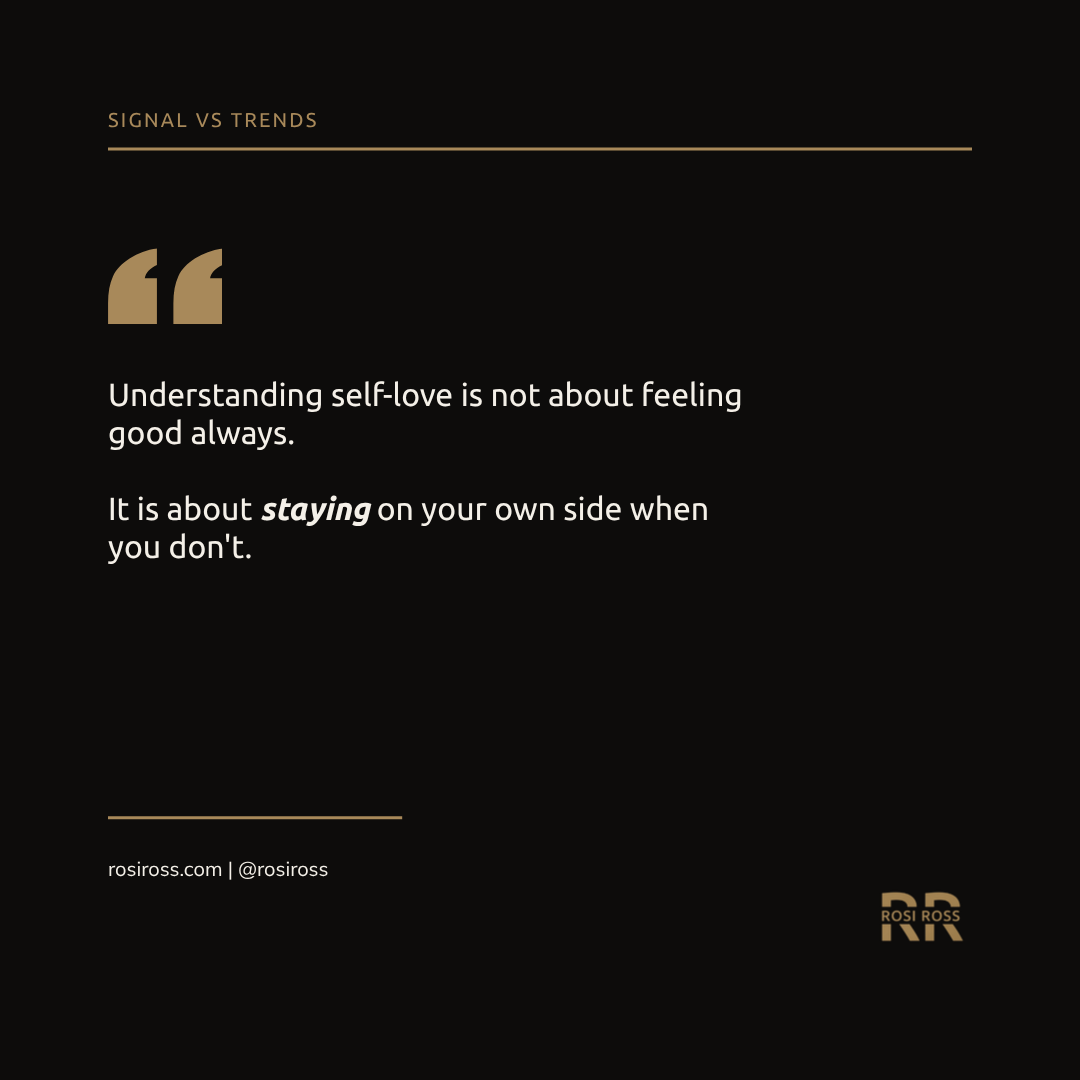
Self-love is not about constant positivity, perfection, or ignoring personal flaws. It is the ability to recognise your own worth while remaining honest about your imperfections — treating yourself with the same patience you would naturally extend to someone you deeply care about.
In an era defined by constant comparison, digital performance, and an unrelenting pressure to optimise nearly every aspect of a life, one of the more genuinely radical acts available is also one of the simplest: learning to actually value yourself. Self-love has, in the process of becoming culturally ubiquitous, also become somewhat flattened — printed on wellness packaging, repeated in motivational captions, shorthand for a confidence that often has very little psychological substance behind it. Beneath that aesthetic sits a considerably deeper concept, one modern psychology has spent decades studying with real rigour rather than simply branding. That research draws a consistent line between three things the culture tends to blur together: self-esteem, which is how highly a person rates themselves; self-compassion, which is how they treat themselves when things go wrong; and self-awareness, which is how accurately they see themselves in the first place. Genuine self-love, the evidence suggests, rests on all three, and none of them can be performed.
The Psychology Behind Self-Love
Self-love is not a fixed personality trait some people are simply born with. It is an ongoing relationship — the longest one any person will ever maintain, and arguably the one that receives the least deliberate attention.
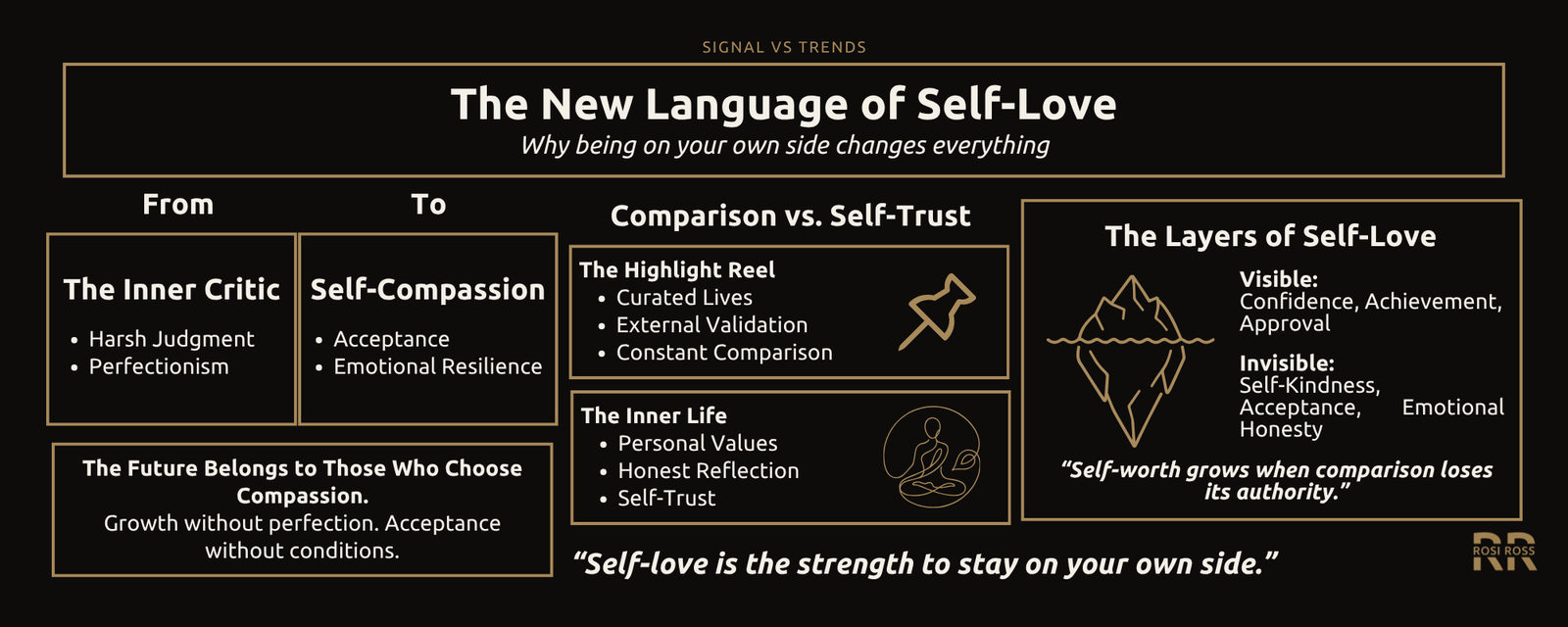
What is self-compassion? Psychologist Kristin Neff, whose research has largely defined the field, describes it as resting on three interlocking components: self-kindness, the ability to meet personal struggle with understanding rather than harsh judgment; common humanity, the recognition that imperfection and difficulty are universal rather than personal failings; and mindfulness, the capacity to observe an emotion clearly without being entirely consumed by it. Neff’s own body of research has linked these three elements to measurable gains in emotional resilience and reduced anxiety — evidence that self-compassion functions as a trainable skill rather than a fixed disposition some people simply happen to have. Together, these elements build a genuinely healthier internal environment, one where a mistake becomes an opportunity for growth rather than proof of some deeper personal inadequacy. The objective was never to become someone who never struggles. It is to become someone who has learned, reliably, how to support themselves the moment struggle actually arrives.
Self-Love Is Not Self-Esteem
The word most often used interchangeably with self-love is self-esteem, and psychology has spent decades showing that they are different things. Self-esteem is an evaluation: a judgement of one’s own worth that tends to rise with success, approval and favourable comparison, and to fall with failure, rejection and unfavourable comparison. That makes it inherently conditional. A widely cited review by Roy Baumeister and colleagues, published in Psychological Science in the Public Interest, examined the popular belief that raising self-esteem produces better performance and better lives, and found the evidence considerably weaker than the cultural enthusiasm for it. Work by Jennifer Crocker and Lora Park, on what they called the costly pursuit of self-esteem, went further: when a person’s sense of worth depends on succeeding in particular domains, the pursuit of it can carry real costs to relationships, learning and wellbeing, because every outcome becomes a verdict.
Self-compassion offers a different foundation. In a comparison of the two across several studies, Kristin Neff and Roos Vonk found that self-compassion was associated with steadier feelings of self-worth, less dependence on specific outcomes and less social comparison than self-esteem was, and that, unlike self-esteem, it was not linked to narcissism. Both were associated with positive emotional states; the difference lay in how well each held up when life did not go well. The practical meaning is simple. Self-esteem asks “how am I doing compared with everyone else?” Self-compassion asks “how am I treating myself right now?” Only the second question remains answerable on a bad day.
Is self-love the same as self-esteem? Not quite. Self-esteem tends to fluctuate with performance and external validation, rising after success and dropping after failure. Self-compassion, by contrast, remains available regardless of outcome, which is why researchers such as Neff and Vonk describe it as a more stable foundation for a healthy relationship with oneself than self-esteem alone.





Self-Awareness: The Skill Beneath the Feeling
Self-love without self-awareness is only a mood. To value yourself honestly, you have to see yourself accurately, and the research suggests that this is rarer than most people assume. Organisational psychologist Tasha Eurich and her team, in a programme of studies summarised in Harvard Business Review, distinguished two kinds of self-awareness: internal, meaning how clearly a person sees their own values, reactions and patterns, and external, meaning how clearly they understand how others see them. The two turned out to be largely unrelated, and while most people believe they are self-aware, only a small minority of the participants in the research, roughly ten to fifteen per cent of nearly five thousand, met the study’s criteria.
The most useful finding is also the most counterintuitive. Introspection, the habit of turning inward and analysing oneself, did not reliably produce self-awareness. People who spent more time analysing themselves were, on average, less self-aware and reported lower wellbeing, because the question they were asking was usually “why”. Asking why tends to generate confident but unreliable explanations and, too often, rumination. Eurich’s research found that the more productive question is “what”: what is the pattern here, what am I feeling, what do I want to do next. The distinction matters for self-love because it separates two very different kinds of self-analysis: the kind that circles a flaw until it hardens into an identity, and the kind that observes a pattern clearly enough to change it.
The idea has older roots. In the early 1970s, Shelley Duval and Robert Wicklund proposed objective self-awareness theory, the observation that when attention turns toward the self, a person naturally compares who they are with who they believe they should be. Whether that comparison produces shame or growth depends almost entirely on the tone in which it is made, and that is where self-compassion enters. Awareness shows a person the gap; compassion is what keeps them able to look at it. Without it, honest self-analysis becomes self-attack. Without awareness, self-compassion becomes self-indulgence. The relationship needs both.
The Modern Crisis of Comparison
One of the more significant obstacles to genuine self-regard today is comparison, and its scale is historically unprecedented. No previous generation carried a device capable of surfacing thousands of curated, filtered, algorithmically favoured versions of other people’s lives before breakfast. Success is rendered effortless. Beauty is rendered permanent. Happiness is rendered continuous, frame after frame. Behind nearly every one of those images sits a considerably more complicated reality, edited out precisely because it complicates the narrative — and edited out, more pointedly, because an unfiltered version simply performs worse in a system built to reward whatever holds attention longest. Comparison functions by disconnecting a person from their own actual experience, redirecting attention toward an imagined standard that was never genuinely attainable in the first place, because it was manufactured for consumption rather than lived by anyone, including the person who posted it.
How do you stop comparing yourself to others? The more useful question was never “why am I not like them.” It is closer to “what does my own life actually require of me right now” — a shift that returns attention to a life a person can genuinely act on, rather than one borrowed, in fragments, from someone else’s edited highlight reel.
Release the Addiction to Perfection
Perfectionism is frequently mistaken for ambition, and the two are not the same thing. In practice, an unrelenting pursuit of flawlessness often functions as a sophisticated form of self-rejection — achievements dismissed almost as quickly as they arrive, mistakes magnified well past their actual significance, the mind reflexively searching for whatever is still missing rather than registering what has genuinely been accomplished. This produces an exhausting, self-perpetuating cycle: achieve, criticise, improve, criticise again, indefinitely. Psychological research on perfectionism, including work published and reviewed by the American Psychological Association, has repeatedly linked its self-critical forms to elevated anxiety and reduced emotional wellbeing — a genuine cost, not simply an unpleasant side effect of otherwise productive striving.
The alternative was never lowering personal standards. It is changing the relationship a person holds with themselves while pursuing those standards — the capacity to hold “I want more for myself” and “I accept who I am today” as two statements that coexist rather than compete. Growth and acceptance were never opposites. The most consistently successful people are rarely those convinced of their own perfection. They are, more often, the ones who have made genuine peace with the fact that imperfection is simply part of the process rather than evidence against it.




Train Yourself in Self-Compassion
Self-compassion is not reserved for people who happen to have been born naturally confident. It is a skill, developed through repetition, and one of its more effective training mechanisms is intentional internal dialogue. Consider the genuine distance between “I failed because I am not good enough” and “this was difficult, but I can learn from it.” The external situation stays identical in both cases. The internal relationship changes entirely.
A handful of consistent practices reinforce this shift over time: building genuinely supportive internal language, extending to oneself the same patience automatically offered a close friend; asking “what” rather than “why” when a pattern repeats, so that self-observation produces information rather than rumination; using deliberate reminders or personal phrases capable of interrupting a spiral of negative thought before it fully takes hold; and protecting the actual environment a person keeps, since the people surrounding someone directly shape how that person comes to see themselves. Relationships that reliably produce insecurity, competition, or emotional exhaustion weaken a person’s relationship with themselves. A genuinely healthy circle was never one that requires a person to shrink in order to remain welcome inside it. It is one that allows them, consistently, to expand.
Stop Resisting Your Own Emotions
Emotions are not enemies. They are information — and resisting what is actually felt tends to create a second, entirely avoidable layer of suffering on top of the original feeling itself.
Many people spend years actively avoiding discomfort: sadness pushed aside, anger ignored, fear disguised as a need for control. But the inability to sit with a difficult emotion frequently produces more genuine suffering than the emotion would have on its own, because resistance adds an additional narrative on top of it — “I should not feel this way,” “why am I reacting like this,” “I need this to be over immediately.” Self-regard, in this specific context, begins the moment resistance is replaced with genuine curiosity: not “how do I make this feeling disappear” but “what is this emotion actually trying to communicate.”
Emotional honesty requires a real degree of vulnerability that many people spend considerable effort avoiding — admitting, plainly, “I am disappointed,” “I am afraid,” or “I do not yet know the answer.” None of this constitutes weakness. It constitutes genuine emotional intelligence, and psychological research supports the point. In a well-known set of studies, James Gross and Oliver John found that habitual suppression of emotion was associated with less positive emotion, poorer relationships and lower wellbeing than reappraisal, the practice of understanding and reframing a feeling. A difficult feeling, allowed to move through fully, is generally temporary. A feeling rejected outright has a considerably higher likelihood of calcifying into a lasting pattern instead.





Practice Radical Acceptance
Acceptance was never a synonym for resignation. It means seeing a reality clearly, without distortion, before deciding what to do about it. Genuine self-regard requires accepting the entire range of a human experience simultaneously — the confident stretches and the uncertain ones, the successes and the errors, the qualities already admired and the ones still being understood. Many people operate on the quiet assumption that they must first become a better version of themselves before earning the right to that acceptance. The mechanism actually runs in the opposite direction: acceptance was never conditional on having already become flawless. It follows simply from being human in the first place.
Self-acceptance, in the clinical literature, is a specific and measurable construct — not a mood, but a stance a person can actually train themselves to hold, independent of how a given day happens to go.
The psychologist Albert Ellis gave this idea a formal name decades ago: unconditional self-acceptance, the practice of choosing to accept oneself as a fallible, complex human being regardless of performance, achievement, or the approval of others — as distinct from self-esteem, which Ellis considered inherently unstable because it is earned and can just as easily be lost. Carl Rogers had already been building toward a similar conclusion from a different clinical direction, arguing that psychological growth depends on what he called unconditional positive regard — first offered by another person, and eventually, crucially, offered by a person to themselves. A meta-analysis by Angus MacBeth and Andrew Gumley, published in Clinical Psychology Review and pooling fourteen studies, found self-compassion to be strongly associated with lower levels of depression, anxiety and stress — not a marginal correlation, but one of the more robust findings in the broader self-compassion literature. Association is not proof of cause, and the studies cannot say which way the influence runs. But self-acceptance, understood this way, is not a soft or sentimental idea. It is one of the better empirically supported predictors of psychological resilience currently available.
Forgiveness sits at the centre of this practice — not because past mistakes cease to matter, but because carrying indefinite shame actively prevents the growth that would otherwise follow from them. Every person holds moments they would, with more awareness, have handled differently. Forgiveness is simply the mechanism that converts those moments into genuine wisdom rather than ongoing punishment, shifting the internal question from “why was I that person” to the considerably more useful “what can actually be learned from who I was then.”


The Feed That Was Never Built to Love You Back
No prior generation has had to build a relationship with itself while simultaneously scrolling past thousands of curated, algorithmically ranked versions of everyone else’s — and the psychological cost of that arrangement is no longer speculative. It is measured, published, and increasingly difficult to argue with.
The theoretical groundwork here predates social media by seventy years. In 1954, the psychologist Leon Festinger proposed social comparison theory, the idea that people determine their own worth largely by measuring themselves against others rather than against any fixed internal standard. Festinger was describing an ordinary human tendency, present in villages, offices, and classrooms long before a single photograph could be filtered. What social platforms did was industrialise that tendency at a scale the theory was never built to anticipate — replacing occasional, local comparison with a continuous, global, algorithmically optimised stream of it, delivered to a phone dozens of times a day.
The research that followed is consistent in its direction, if not always in its size. A set of studies by Erin Vogel and colleagues found that more frequent use of Facebook was associated with a stronger tendency toward upward social comparison and lower self-esteem, and that participants who viewed upward-comparison profiles reported lower self-esteem than those who viewed downward comparisons. A separate longitudinal study by Ethan Kross and colleagues found that more time spent on Facebook predicted declines in young adults’ moment-to-moment emotional state and in their life satisfaction over time. Neither study makes a platform uniquely culpable, and later research has produced mixed and smaller effects. But the pattern they describe, comparison lowering regard for the self, is the one Festinger’s theory would predict.
The mechanism is not incidental to the business model. It is the business model. Engagement-based platforms are engineered to maximise time on screen, and the content most reliably proven to hold attention is frequently the content most likely to trigger what researchers call upward social comparison — bodies, lifestyles, and achievements presented as effortless, because effortless performs better than honest. In 2023, the American Psychological Association issued its first formal health advisory on adolescent social media use, recommending among other things that young people’s use of social media for social comparison, particularly around appearance and beauty, be limited. That same year, the U.S. Surgeon General’s advisory on social media and youth mental health concluded that social media cannot yet be considered sufficiently safe for children and adolescents, and called for urgent action — a notably serious framing from an office that issues advisories sparingly.
Performative Self-Love and the Real Thing
Inside that environment, something subtle has happened to self-love itself. A concept built on private acceptance has been recast as public display: the carefully lit bathtub, the ritual staged for the camera, the caption announcing that a person has finally learned to love themselves, posted in the same feed that taught them to doubt it. Performative self-love looks like the real thing from the outside, which is precisely its appeal, and its limit. It is oriented toward an audience, which means it is conditional on that audience’s response. The practice meant to free a person from needing approval becomes one more thing to earn approval for.
The psychological research draws the contrast sharply. Self-compassion, as Neff describes it, is directed inward and does not depend on outcomes, comparison or witnesses; its defining moment is the private one, after a failure, when no one is watching. Contingent self-worth, in the language of Crocker and Park, is the opposite: worth staked on external validation, and therefore perpetually at risk. A self-care ritual can serve either. The same hour of rest is restoration when it responds to a need and a performance when it responds to a feed. The difference is not in the act. It is in the question that prompted it: “what do I need?” or “how will this look?”
That is also where self-awareness does its quietest and most valuable work. A person who can ask “what am I actually feeling, and what do I actually need” is far harder to sell a version of self-love to, because they are working from information rather than from an image. The tests are simple and entirely private. Does the practice still happen when no one sees it? Does it survive a bad day, or does it disappear along with the mood that made it photogenic? Does it leave the person more at ease, or more watchful? Real self-love tends to be undramatic, repetitive and mostly invisible: an early night, an honest conversation, a kind interior sentence after a mistake. It rarely photographs well, which is a large part of why it lasts.
How can you tell performative self-love from the real thing? Ask what the practice responds to. Genuine self-love responds to a need and holds up in private, on difficult days and without an audience. Performative self-love responds to how it will be seen, and tends to fade when attention does. Self-compassion, self-awareness and honest acceptance are the qualities that tend to distinguish the first from the second.
None of this makes social media uniquely evil, and treating it that way tends to produce guilt rather than genuine change. It does mean that the platforms shaping how millions of people spend their most reflective, comparison-prone hours were never neutral mirrors. They are curated, incentivised, and optimised environments — and a person building a healthier relationship with themselves is, whether they realise it or not, doing that work inside an environment actively engineered to interrupt it. Auditing what actually gets consumed, and how often, is not vanity or paranoia. It is closer to basic environmental hygiene: the same instinct that leads a person to notice which relationships leave them feeling smaller applies just as directly to which feeds do.
The Quiet Power of Believing in Yourself
Self-regard, sustained over time, eventually produces something deeper: self-trust. A person who genuinely understands themselves grows correspondingly less dependent on external validation, making decisions rooted in personal values rather than anticipated approval. The operative question shifts from “will they accept me” to the considerably more grounded “is this aligned with who I actually am.” Self-trust, once established, is what allows creativity, ambition, and authenticity to function without constant internal negotiation — the same foundation that underlies the case for personal ritual as identity built through repetition rather than dramatic reinvention, and the quiet confidence explored in the argument for preparation as the thing that actually enables genuine freedom.
Why Self-Regard Is Not an Indulgence
Perhaps the most persistent misunderstanding about self-love is the assumption that it functions as an indulgence, something extra layered on top of an otherwise serious life. It functions instead as a foundation. The way a person treats themselves shapes, directly, how they approach relationships, work, setback, and opportunity — someone who genuinely respects themselves makes measurably different choices than someone operating from a place of chronic self-criticism. In a culture that continues to reward visible perfection over honest process, choosing compassion over criticism, presence over comparison, and authenticity over performance functions as a genuinely countercultural act. This same instinct — toward substance over surface, toward what is real rather than what merely performs well — runs through other categories explored across this series: a beauty philosophy built on Fjaka, the Adriatic practice of unhurried, mindful presence, a craftsmanship tradition like Gond painting that survives precisely because it never chased trend over meaning, an interior philosophy built around objects chosen for genuine story rather than surface appeal, and the older cyclical worldview carried through the Chinese Zodiac’s own insistence that every ending contains a beginning.
The relationship a person holds with themselves is, by any honest measure, the longest relationship they will ever have. Learning to make that particular relationship a genuinely healthy one may well be the most consequential work available to anyone — not because it guarantees comfort, but because nearly everything else in a life is eventually built, directly or indirectly, on top of it.
“Self-love is not
the absence of struggle.
It is the presence
of someone on your own side
while the struggle
is actually happening —
the voice that says
‘this is hard,
and I can learn from it’
instead of
‘this proves
I was never enough.’
The relationship
is the longest one
you will ever have.
It is worth
finally treating it
that way.”

