
On a Chinese beauty-tools brand as a case study in a larger shift: how manufacturing capability, fast product development, digital distribution and internationally legible design are letting Chinese beauty companies build brands in markets that global beauty once treated as secondary.
The next global beauty winner may not need New York or Paris to validate it first.
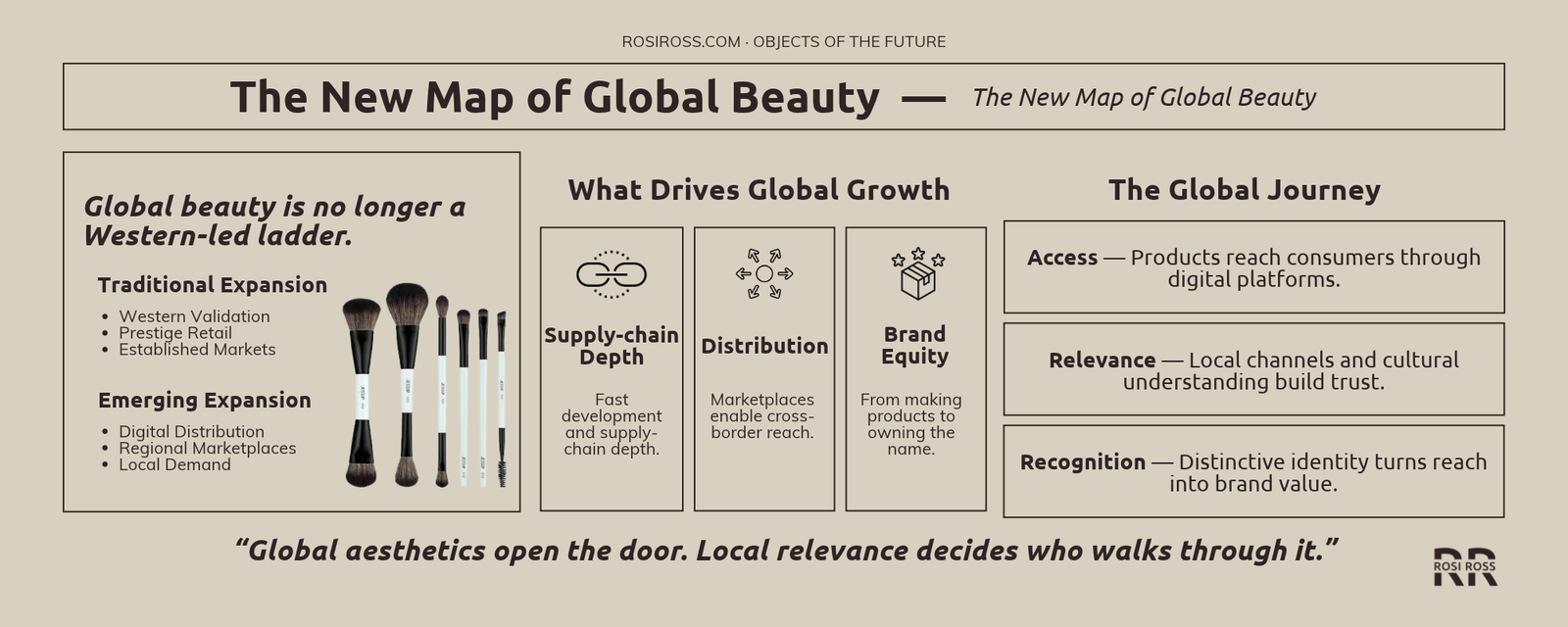
For years, international credibility was imagined as a ladder: prove yourself at home, then in the United States or Europe, then everywhere else. The global beauty map is becoming less hierarchical. A shopper in Mexico City, Dubai or Riyadh can now find the same Chinese-made brush set that a shopper in Madrid or Chicago finds, on a marketplace, in a creator’s tutorial or at a retailer’s shelf, without that brand ever having been famous in Manhattan. The question this essay asks is what that means for who gets to become a global beauty brand.
This is not a brush review, a founder profile or another story about Chinese brands going global. Jessup Beauty, a makeup-brush and beauty-tools company, is used here as a case study in a more consequential shift: Chinese beauty companies combining manufacturing depth, fast product development, digital distribution and internationally legible design to grow in places that Western beauty once treated as secondary. The evidence is partial, because Jessup does not publish its sales by region, and the essay is careful to say what the evidence shows and what it does not. But the pattern it points to is real, and it is changing how beauty globalisation should be understood.
What Is Jessup?
What can be verified is smaller than the mythology, and more interesting.
Jessup is a makeup-brush and beauty-tools brand. A marketplace seller profile describes it as a Hong Kong brand founded by Daniel X and his wife, Jessie X, in 2013, and a European retailer notes that the brand has been on the market since 2013 and that its beginnings are directly related to Hong Kong. It began with makeup brushes and has since widened into sponges, brush cleaners, cosmetic bags, storage and false lashes. The company describes itself as a global beauty-tools brand and says its products are sold in more than 200 countries and regions to more than 10 million customers. Those figures are company-reported and have not been independently audited, so they should be read as claims and not as facts.
Is Jessup a Chinese brand? Largely, with a Hong Kong origin. Retail listings give Hong Kong as its origin, and the seller entity on one major marketplace is based in Shenzhen, in Guangdong province. It is better described as a Greater China beauty-tools brand than as a mainland domestic label, a distinction that matters because Hong Kong and the Pearl River Delta together supply much of the design, sourcing and export expertise behind this category. Ownership details should be confirmed with the company.
Where is Jessup Beauty from, then, and how big is it? It comes from that Hong Kong and Guangdong orbit, and its size cannot be stated. The company does not publish revenue or a geographic sales split, so no region can be called its largest. What can be observed is wide marketplace and retail presence across several regions, and the rest of this essay treats that presence as evidence of reach and not as evidence of share.
Why Makeup Brushes Are Built for Cross-Border Growth
Beauty tools are strategically easier to globalise than many cosmetic formulas.
The choice of category matters more than it first appears. A brush has no shade range to match to a hundred skin tones. It carries fewer formula-regulation issues than skincare or colour cosmetics. Its virtues can be demonstrated on camera in seconds: shape, density, blend, finish. A professional-looking set, with metal ferrules, labelled functions and coordinated packaging, communicates abundance while remaining relatively inexpensive, and it ships light with no meaningful shelf-life problem. That is an ideal profile for cross-border commerce, and it explains why tools, not formulas, are often where a young brand can travel furthest fastest.
| Why brushes travel | What it means |
|---|---|
| No shade range | No need to match hundreds of skin tones |
| Lighter regulation | Fewer formula and ingredient constraints than skincare or colour cosmetics |
| Visible in seconds | Shape, density and finish can be shown on camera |
| Professional look | Metal ferrules and coordinated sets signal quality |
| Abundance at an accessible price | A set communicates generosity before any luxury price point |
| Manageable logistics | Light, durable and without short shelf-life |
Beauty tools are strategically easier to globalise than many cosmetic formulas, which is why they make a clean test case.
Brushes are also native to tutorial culture. They appear naturally in get-ready-with-me videos, transformations, product demonstrations and professional artistry content, and the product does not need a complex explanation. That makes beauty tools disproportionately compatible with creator-led commerce, where the product must explain itself in the time it takes to scroll. A serum needs trust and a lab behind it. A brush needs only a hand and a face.
Latin America: Beauty’s Fastest E-Commerce Growth Story
The opportunity is not merely current size. It is the runway between today’s penetration and tomorrow’s habits.
The macro picture is one of uneven growth. McKinsey’s State of Beauty 2025 describes a roughly $450 billion global beauty industry and expects it to grow 5 percent annually through 2030, after growth of 7 percent a year from 2022 to 2024. It adds that in markets such as Latin America and the Middle East, wealth is growing, presenting an opportunity for global brands, but not without competition from local players. In its executive survey, about 70 percent of executives anticipated very high growth in India and the Middle East, while 51 percent planned to prioritise expansion into North America. McKinsey’s later outlook sharpens the point, expecting growth to be strongest in emerging markets, particularly Latin America and Southeast and Central Asia.
Why is Latin America important for beauty brands? Because it combines a large, digitally engaged consumer base with low online penetration. Euromonitor reported in July 2026 that the region’s beauty and personal-care e-commerce channel had grown at a 25 percent compound annual rate over five years, the fastest globally, yet North America generates 44 percent of beauty sales online, compared with just 11 percent in Latin America. That gap is the runway. The earlier McKinsey series makes the same point from the other direction: in 2023, beauty grew 18 percent in the Middle East and Africa and 17 percent in Latin America, both exceeding industry expectations.
The language of “emerging market” obscures how sophisticated the consumer is. Brazil has one of the world’s largest beauty cultures. Mexico combines scale with cross-border commerce and powerful marketplace infrastructure. The region is digitally engaged, highly social and visually literate. What is underdeveloped is not beauty interest but online penetration, which is precisely why the upside is attractive.
| Signal | Figure | Source and caution |
|---|---|---|
| Global beauty market | About $450 billion; grew 7% a year in 2022 to 2024; expected to grow 5% a year through 2030 | McKinsey, State of Beauty 2025; a forecast |
| Where executives see growth | About 70% expect very high growth in India and the Middle East; 51% plan to prioritise North America | McKinsey executive survey |
| Latin America, beauty e-commerce | Five-year compound annual growth of 25%, the fastest globally; online is 11% of sales against 44% in North America | Euromonitor, July 2026; a growth rate, not a market size |
| Chinese exports to Latin America | Nearly $300 billion in 2025, up 7% | Euromonitor, September 2026; all categories |
| Joy Group (Judydoll, Joocyee) | Overseas sales of $87 million in 2025; Vietnam is its top overseas market | Bloomberg and Fortune reporting; company figures |
| Jessup scale | 200+ countries and regions and 10 million+ customers | Company-reported; not independently audited |
Growth rate is not market size, and the numbers vary by firm and definition. Read them directionally.
Jessup in Mexico: Marketplace Before Flagship
Use a marketplace listing as proof of market presence, not market share.
Mercado Libre Mexico offers concrete evidence of localisation. It carries an official Jessup store, a “tienda oficial”, with a wide range of sets and tools, alongside listings shipped cross-border. That is the model in miniature: marketplace infrastructure connecting Chinese supply to Mexican demand without the brand first building a physical retail network. Elsewhere in the region the signals repeat. Jessup listings on Mercado Libre Chile advertise six interest-free instalments, a nod to how people there actually pay. None of this proves how much Jessup sells. It shows that the brand is present, has adapted to local retail behaviour, and is visible where people search.
The same ledger complicates any simple story. Jessup is not absent from the markets that global beauty treats as primary. It appears on Walmart’s US marketplace and in European retail, where a retailer carries single brushes and entire sets. The accurate reading is that it is a broadly distributed marketplace-era brand whose footprint reaches many places at once, and that its localisation effort in places like Mexico, Chile and the Gulf is notable precisely because those markets were not where Western beauty would have started.
| Where | What can be seen | What it shows, and what it does not |
|---|---|---|
| Mexico | An official Jessup store on Mercado Libre, with many brush sets and tools listed | Marketplace presence and local infrastructure; not total sales or market share |
| Chile | Jessup listings on Mercado Libre Chile advertising six interest-free instalments | Localised payment behaviour in the region |
| United Arab Emirates | Jessup sets on Carrefour UAE, sold by a third-party seller and delivered by Carrefour, including a 14-in-7 set at AED 155 against a listed AED 249 | Regional retail presence through a third-party seller on a major Gulf retailer |
| United States | A Jessup seller storefront on Walmart’s marketplace | Presence in the largest Western market, mostly through marketplaces |
| Europe | Jessup lines at a European beauty retailer | European retail reach |
An evidence ledger, not a revenue map. Listings and prices were observed in November 2026 and change often. Jessup does not publish sales by region, so no region can be called its largest.
Where are Jessup brushes sold? Mainly through cross-border marketplaces and retailers, including Mercado Libre in Mexico and Chile, Walmart’s marketplace, Carrefour in the United Arab Emirates, specialist beauty retailers in Europe and the brand’s own site. The footprint shows reach, not market share.
The Middle East: Glamour, Growth and Regional Logistics
High beauty spend meets visual culture.
Why is the Middle East important for beauty brands? The Gulf suits a beauty-tools category well. Makeup artistry, event dressing, fragrance, glamour and social presentation have strong cultural and commercial visibility, and McKinsey’s survey found about 70 percent of executives anticipating very high growth in India and the Middle East. Wealth is rising, the beauty calendar is dense with occasions, and the consumer is accustomed to polish. A brush set that looks professional and photographs well fits that culture closely.
Jessup’s regional presence is visible at the retail shelf. Carrefour UAE lists several sets, sold by a third-party seller and delivered by Carrefour, including a 14-in-7 double-sided set at AED 155 against a listed AED 249. Prices on such listings move with promotions, so the figure is best read as a snapshot, but the pattern is clear: a Hong Kong-origin brand sits on a Gulf supermarket’s digital shelf beside local and international names, reached through a third-party seller and the retailer’s own delivery network.


Dubai and the New Geography of Beauty Distribution
Infrastructure can make a non-Western market strategically central.
Dubai matters beyond local consumption. It works as a regional e-commerce, logistics, tourism and re-export hub linking the Gulf, South Asia, Africa and the wider Middle East. For a China-based beauty-tools brand, an inventory node in the United Arab Emirates can reduce one of cross-border e-commerce’s biggest weaknesses, delivery time. A product that sits in a Gulf warehouse reaches a customer in a day or two, while a product that ships from Guangdong competes with that on price alone.
The point is not that every Chinese beauty brand should enter through Dubai. It is that logistics and platforms can make a place central that a traditional prestige-retail map would never have put at the centre. The old map ranked markets by the glamour of their department stores. The new one ranks them by the speed and trust of their delivery.
The Chinese Price-to-Quality Advantage
China’s export advantage is becoming less about cheap and more about how much product can be engineered into the price.
What is the price-to-quality advantage of C-beauty? One of its most important advantages is what Chinese consumers call xingjiabi, the relationship between price and quality. Jessup’s catalogue illustrates the logic. On Walmart’s marketplace, a 14-piece synthetic set is listed at about $39, and a three-piece double-ended face set at about $27, while a European retailer lists smaller sets at lower prices. Those are professional-looking sets of synthetic fibres, with labelled functions, metal ferrules and coordinated packaging, priced in the neighbourhood of what many Western professional brush brands charge for far fewer pieces.
That pricing does not automatically prove superior quality. It creates a strong value proposition, and the distinction matters. Cheap product competes on price. Accessible luxury competes on how much aesthetic and functional value is delivered before the consumer reaches a prestige price. Jessup’s opportunity lies in being perceived as the second, not the first. The craft of perceived value, how finish, weight and detail make an object feel worth more than its price, is the same quality that makes certain jewellery pieces hold their meaning, as The Language of Modern Necklaces: Metals, Stones, and the New Codes of Personal Luxury explores.


Are Chinese makeup brushes good quality? Quality varies by brand, as it does everywhere, and price does not by itself prove it. For any brush set, consistency, reviews, warranty and design are better guides than country of origin, and the honest answer for a shopper is to judge the product and not the passport. What has changed is the assumption. Reporting on Chinese beauty has described a shift away from the old idea that Chinese-made beauty is necessarily low quality, as brands gain overseas attention through design, innovation and awards.
From OEM Manufacturing to Owned Brand Equity
The strategic leap is not China making products for global beauty. It is China owning the name on the product.
China has manufactured for the world’s beauty brands for years. What is new is the name on the product. Jessup fits the macro shift from anonymous manufacturing to owned brand equity: a factory that once supplied other labels with a brush now sells its own. The economics change completely. An OEM earns a manufacturing margin and owns nothing the consumer remembers. A brand earns a premium and owns the memory.
Brand equity is slow to build, and it is slow for a reason. It accumulates through years of consistent quality, reviews, service and a name people trust. A marketplace can deliver reach in months, but it cannot deliver trust on a timetable. That is why the interesting question about any brand of this kind is not how fast it sold but whether it is becoming something a customer would ask for by name.
Country of origin remains complicated. Some Chinese brands foreground cultural origin and some lead with performance, price and aesthetics, and Jessup appears closer to the product-first model. That may reduce friction in some markets, but it would be wrong to treat Chinese identity itself as a liability, since consumer attitudes are changing quickly.
Why Global Aesthetics Work, and Where They Fail
Global aesthetics open the door. Local relevance determines whether the consumer walks through it.
A globally legible, Western-influenced design language can lower friction abroad: clean product photography, professional typography, familiar brush shapes, aspirational packaging and social-media-ready colour palettes. The proposition that such a look “never fails” is too absolute, and expansion is not simply translation but repositioning and localisation. Good design raises the price ceiling, since perception affects what people will pay, a principle that holds from the sculpted form of a luxury shoe to the finish on a brush handle.
Historically, low-cost Chinese goods carried a visual penalty overseas. The new generation has learned that industrial capability must be matched by brand codes: coordinated collections, tonal palettes, duo-ended formats, labelled functions. And localisation has to go beyond a Spanish listing or an Arabic page.
How do Chinese beauty brands localise for international markets? By changing the route, not only the language: local-language discovery, local marketplaces and payment methods such as instalments, delivery speed, creator partnerships, regional beauty techniques, cultural calendars such as Ramadan and Eid, and pricing architecture. The Mercado Libre Chile instalments are a small, concrete example of that principle at work.
| Middle East | Latin America | |
|---|---|---|
| Language | Arabic discovery and support | Spanish and Portuguese treated as distinct markets |
| Channel | Regional retail, marketplaces and fast delivery within the Gulf | Mercado Libre and local marketplace credibility |
| Payments | Local payment habits and returns confidence | Instalments and local payment behaviour |
| Creators | Partnerships grounded in local techniques | High social discovery and strong salon and professional ecosystems |
| Calendar | Ramadan and Eid gifting cycles | Local gifting and seasonal retail moments |
| Aesthetic | Polish compatible with a high-glamour beauty culture | Value without discount-brand aesthetics |
A framework, not a claim about what any brand does. The best global brands keep one identity and change the route by which people understand it.
Mexico and the Gulf appear culturally unrelated, but commercially they share useful characteristics for a brand like Jessup: large beauty-engaged consumer segments, strong social platforms, a meaningful event and glamour culture, marketplace adoption and demand for products that feel international. The brand does not need identical campaigns. It needs a proposition flexible enough to translate.
Jessup vs Florasis: Two Different C-Beauty Globalisation Strategies
Chinese brands no longer need to hide their origin by default. Some lead with China; others lead with the product.
C-beauty is not one visual strategy. Florasis, born in Hangzhou in 2017, globalises through cultural specificity: ornate, Chinese-heritage packaging and luxury storytelling. It partnered with DFS, the selective-retail arm of LVMH, to open its first European counter at Samaritaine in Paris, and its Tokyo flagship, opened in January 2025, made it the first Chinese cosmetics brand to operate a flagship store in the Ginza district. The brand has been reported as targeting 50 stores globally by 2027. Its first European collection, Nomadic Glam, was inspired by the Mongolian prairies, which is cultural storytelling used as a commercial asset.
Jessup’s cleaner international language and Florasis’s heritage language are not contradictions. They are different positioning strategies, and both are legitimate. One sells a familiar professional vocabulary at a value price through marketplaces. The other sells a specific cultural identity at a premium through selective retail. A third model, led by Joy Group, which owns Judydoll and Joocyee, goes through product innovation and social virality in Southeast Asia first.
| Brand | Route | Evidence |
|---|---|---|
| Jessup | Product-first, marketplace-led, internationally legible design | Broad marketplace and retailer footprint across several regions |
| Florasis | Chinese heritage and ornate packaging, luxury storytelling | Samaritaine in Paris with DFS, a Ginza Six flagship in Tokyo, a stated target of 50 stores by 2027 |
| Judydoll and Joocyee (Joy Group) | Product innovation and social virality, Southeast Asia first | $87 million in overseas sales in 2025; Vietnam is the top overseas market |
C-beauty is not one visual strategy. Some brands lead with China; others lead with the product.
Why are Chinese beauty brands growing globally? Because competition at home is intense, and because manufacturing capability, fast product development and digital distribution let them test and scale quickly abroad. Fortune describes a wave of Chinese consumer brands going overseas, known as chuhai, and notes that brutal competition at home has pushed Chinese brands to venture into overseas markets.
A Different Map From K-Beauty
The West will not be the main growth engine for Chinese beauty, at least for now.
The most instructive comparison is not with Western brands but with South Korea. K-beauty followed the classical route, and it worked: Euromonitor reports that the category reached $15 billion in 2025, growing by around 22 percent, with the United States accounting for 54 percent of its overseas online sales. The American market was the engine, and American validation was the reward. The same release notes the speed at which a social platform can reorder that market: TikTok Shop rose to become the seventh-largest e-commerce beauty retailer in the US, up from 27th. Korea’s route ran through the largest and most competitive consumer market in the world, and it was won there.
Chinese beauty is drawing a different map. Bloomberg notes that overseas sales of Chinese beauty brands are roughly half those of South Korea, though the gap is narrowing, and that unlike K-beauty, which counts the US as its biggest market, the West will not be the main growth engine, at least for now. Joy Group, the owner of Judydoll and Joocyee, illustrates the pattern: its international sales surged ten-fold over three years to $87 million in 2025, with its first overseas stores in Singapore. Fortune adds the proportion that keeps the story honest: the group’s retail sales exceeded $730 million in 2025, of which $87 million came from overseas, and Vietnam is now its top overseas market. By that arithmetic, overseas is still roughly an eighth of the business at most. The expansion is real, and it is early.
The logic of the route is practical. Southeast Asia sits close to China’s supply chains and shares enough of its beauty culture, climate and platform habits to make a first export manageable. A Joy Group executive told Fortune that people in the region are generally very accepting of Chinese products. That acceptance is a commercial asset that a brand entering the United States cannot assume. Mistakes in a nearby market are cheaper, the lessons travel back to the factory quickly, and the brand arrives in the next region with a record and not only a hope.
This is a more precise version of the thesis than the headline one. It is not that Latin America and the Middle East have replaced the West. For Chinese beauty as a whole, the first overseas step has been Southeast Asia, and Latin America and the Middle East are the next horizon. Euromonitor’s report on Chinese brands in Latin America notes that Korean and Japanese beauty brands paved the way for C-beauty in the region, which places Chinese brands in a lineage and not outside it. What is distinctive is the order: home, then Asia, then the high-growth markets, with the Western prestige retailer a later and optional destination.
The difference in order carries a difference in risk. A brand that wins first in the United States is validated by the most visible market and can be undone by the most expensive one, because customer acquisition costs there are high and incumbents are entrenched. A brand that builds through Asia, Latin America and the Gulf spreads its exposure across many markets, none of which decides its fate alone. It may arrive in the West later and with less glamour, but with a more resilient business behind it, and with evidence of demand that a retailer can examine and not merely a story that a retailer is asked to believe.


China Pace: Test, Learn, Iterate
Speed is a competitive capability.
Chinese brands have become known for how quickly they test, learn, fail and adjust, an advantage that comes from dense supply chains, e-commerce feedback loops and a domestic market used to rapid product cycles. When a factory, a designer and a platform operate within the same ecosystem, a decision can move from idea to listing to sales data within days. That compresses the cost of being wrong, and a company that can afford to be wrong cheaply can afford to try many more things than one that cannot.
For beauty tools, where colourways, bundles, brush shapes and packaging can be iterated cheaply, that is especially valuable. A brush has no formula to reformulate and no regulatory dossier to refile. A new handle finish, a new set size or a new pouch can be offered as a variant and judged on its first weeks of sales. Jessup does not sell one hero brush. Its catalogue runs to dozens of sets, individual professional brushes, sponges, storage, cleaners, bags and lashes, and its marketplace listings carry model codes such as T329, T500 and T600. The numbering itself is evidence of a system: a catalogue managed as a portfolio of experiments, with each code a hypothesis about what some group of customers will want.
On marketplaces, where consumers enter through search and not brand loyalty, breadth creates more search surfaces, more price points and more opportunities for bundling. A customer searching for an eyeshadow brush, a travel set or a gift can land on a different Jessup listing in each case, and the brand is present at every entry point. The pace of the catalogue is therefore not only a product strategy but a discovery strategy, and in markets where social platforms and marketplace search drive purchases, as Euromonitor notes of Latin America, discovery is most of the battle.
The risk is dilution: too many products can make a brand feel generic if the design architecture is weak. A catalogue that grows faster than its identity becomes a list of items with a logo, and a customer cannot tell which of them represents the brand’s best work. Speed also puts pressure on consistency, since a fast-moving range can outrun its quality control, and a single poor batch in a review-driven marketplace travels farther than any campaign. Speed without a coherent system produces a catalogue. Speed with one produces a brand.
Why Emerging Markets Are Becoming Primary Markets
The strategic question is not West or emerging markets. It is where a brand’s economics and proposition have the greatest asymmetry.
The United States and Western Europe remain enormous beauty markets, but they are also crowded, expensive and retailer-concentrated. Customer acquisition costs, influencer saturation, incumbent brands and mature e-commerce penetration create a higher bar for attention. McKinsey still treats North America as a priority for distribution expansion, and its own outlook highlights Latin America and the Middle East as meaningful growth markets.
In income-diverse markets, consumers can be highly aspirational and highly price-sensitive at once, which is not a contradiction. It creates demand for products that look premium and perform credibly without luxury pricing, and beauty tools are well suited to that gap because prestige cues can be built into design, finish and packaging more cheaply than in formula-heavy categories. Social commerce changes the geography: TikTok, Instagram, Mercado Libre, Amazon, AliExpress, Shopee and local marketplaces let a brand build demand before it secures premium offline distribution.
The scale of the wider shift is visible in the trade data. Euromonitor reports that Chinese exports to Latin America reached nearly $300 billion in 2025, a 7 percent increase, with companies moving beyond exports into local manufacturing, supply chains and commercial operations across a consumer market of more than 650 million people. That figure covers every category, and beauty is a small part of it. The direction is the point: Euromonitor frames it as Chinese brands becoming long-term competitors across the region’s consumer economy, not a passing phase.
The Risk of Looking Too Generic
Global legibility can become genericity.
If every Chinese brand adopts the same minimalist typeface, beige palette and Western-influencer language, manufacturing differentiation disappears behind visual sameness. The next phase of C-beauty expansion will probably need stronger proprietary codes. Jessup’s challenge is to move from a credible global brush brand to an identity consumers can recognise without seeing the name, a signature built from small consistent choices, as The Language of Scent: How Fragrance Becomes Identity in Modern Beauty describes for scent.
Two further risks follow. The first is price compression. On marketplaces Jessup competes not only with named Western brands but with hundreds of anonymous brush sets, so brand equity has to justify why a $30 set is worth more than an unbranded $12 alternative, through consistent quality, reviews, warranty, design and professional credibility. The second is platform dependence. A Mercado Libre, Amazon or AliExpress sale creates reach, but the marketplace controls search ranking, fees, data and much of the post-purchase experience, and long-term global brands eventually need direct relationships or differentiated retail partnerships.
Both risks point to the same remedy, which is memory. A brand that customers remember by name escapes the price comparison, and a brand that customers seek out escapes the marketplace’s search results. Everything in the strategy of an accessible-luxury brand ultimately works towards a customer who types the name before the category.


Why the Next Step Does Not Have to Be Sephora
The question is which channel reinforces a brand’s economics, not which carries the most status.
Western beauty prestige treats a Sephora listing as the ultimate validation, but a brand can build significant international scale through regional marketplaces, beauty specialists, social commerce and local distributors without entering the prestige-retail system at all. The lessons run in both directions. Jessup-style brands can teach Western companies to treat secondary markets as primary when the data supports it, to build price-to-quality advantage before brand premium, and to use marketplaces as entry infrastructure.
Western brand codes can teach Chinese companies the value of consistency, of a few iconic products that create memory, as a hero ingredient does in The Return of Barrier Beauty: Why Lanolin Is the Ultimate Skin Investment, and of editorial storytelling that lifts the price ceiling. The same patience governs durable wardrobes, the argument behind timeless luxury fashion pieces: an object earns its place by staying recognisable while improving quietly.
| What Jessup can teach Western brands | What Western brand codes can teach Chinese brands |
|---|---|
| Treat secondary markets as primary when the data supports it | Consistency can be worth more than endless novelty |
| Build price-to-quality advantage before adding brand premium | A few iconic products create memory |
| Design for global visual literacy from the start | Editorial storytelling can raise the price ceiling |
| Use marketplaces as market-entry infrastructure | Distinctive codes outperform generic premium looks |
| Localise distribution, not only language | Long-term trust needs service, quality control and warranty |
| Test quickly but keep a coherent brand system | Do not assume Western validation must come first |
Lessons run in both directions. The strongest brands will combine China’s speed with market-specific cultural intelligence.
What My Time in China’s Cross-Border Industry Taught Me
Personal experience becomes useful when it is treated as history, not nostalgia.
I worked inside China’s cross-border e-commerce ecosystem, and what stayed with me was how quickly teams could identify a Western visual code, manufacture against it, test it digitally and iterate. A colour palette that was working on a Western storefront on Monday could be sampled, photographed and listed within days, and the market’s response would decide by the end of the week whether it stayed. Speed, supplier proximity, visual adaptation and constant cross-border testing were the operating culture, and it was a culture of evidence. Nobody argued about taste for long. The listing either converted or it did not.
That is an observation about an industry and an era, and it says nothing about Jessup, whose operations I have no inside knowledge of and whose story is told here only from public evidence. I include it for a narrower reason. It explains why the advantages described in this essay, the supply chain, the pace and the price-to-quality ratio, are not accidents of a single company. They are the products of an ecosystem in which a factory, a designer, a photographer and a marketplace seller can sit within a short distance of one another, and in which the feedback loop between a customer’s click and a production decision is measured in days and not seasons.
The lesson I took from that period is that speed is a form of learning. A slower company decides what a customer wants and then finds out whether it was right. A faster one lets the customer decide, repeatedly, at low cost, and keeps whatever survives. Over time the second company accumulates something the first cannot easily copy: a large, continuously updated record of what people in many places actually buy. That record is a kind of proprietary knowledge, and it is a large part of why Chinese brands can move into unfamiliar markets with more confidence than their size would suggest.
It is also why the early model had a ceiling. Building against another brand’s visual code is efficient, but it produces products that are legible and not yet memorable. The look is borrowed, so the loyalty is borrowed too, and a customer who buys on resemblance will leave on price. The honest memory of that era is therefore not simply admiration. It is the recognition that a model built on imitation had to become a model built on identity, or it would be competed away by the next factory with a faster sample room.
The model has since evolved. The strongest Chinese brands are no longer simply Westernising products. They are deciding when to localise, when to lead with Chinese identity and when to let the product speak first. One brand will lean on heritage packaging and a story about culture, and another will lean on a clean, professional look and a value that explains itself. Both are strategies, and both require a point of view that the early cross-border model did not need. The question has moved from how quickly a look can be matched to what a brand is willing to stand for.
What carries over from the old culture is the discipline. Testing, iterating and listening to the market remain the strongest habits a company can have, and they are now being joined by things that take longer to build: owned retail, research and design systems, and followings that exist abroad independently of any marketplace. Those assets are slow and expensive, and they are the difference between a seller and a brand.
By 2030, “Chinese beauty brand” may explain less than it does today. As companies build their own retail, research and design systems and followings abroad, nationality will become one attribute among many, in the way that a French or Korean origin is a feature of a brand and not the whole of its meaning. The brands that win will combine China’s operating speed with market-specific cultural intelligence, local enough to trust and global enough to desire.
What the Name Carries
The future of C-beauty will be decided by whether Chinese brands can become brands the world remembers.
The story is not that Jessup is a cheap Chinese brush brand that became popular abroad. It is how a Chinese beauty-tools company illustrates a larger redistribution of global beauty power: high-growth markets are becoming strategic launchpads while Chinese brands combine supply-chain speed, price-to-quality advantage and internationally legible design to build their own consumer equity. A brand that can be found in Mexico City, Dubai and Madrid on the same afternoon has already done something that the old ladder of validation did not require, and it has done it without asking permission from the markets that once held it.
The future of C-beauty will be decided not by whether Chinese brands can manufacture for the world, which they have done for years, but by whether they can become brands the world remembers. Reach is the first achievement, and it is the easier one. Memory is the second, and it is the only one that survives a change in marketplace rules, a price war or a shift in fashion. A customer who types a brand’s name before the category has made a different kind of purchase from one who clicks the cheapest result, and every strategy discussed in this essay, from design codes to localisation to hero products, is ultimately an attempt to produce the first customer and not the second.
The comparison with South Korea clarifies what is at stake. K-beauty built its global name largely through the United States, where validation arrived early and loudly. Chinese beauty is drawing a different map, through Southeast Asia first and then through the high-growth markets of Latin America and the Middle East, with Western prestige retail a later and optional destination. That route is slower to produce headlines and potentially more durable, because it builds customers and logistics in markets where the brand is not competing with a century of incumbents. Whether it also builds a name is the open question.
The argument is conditional, and it would change on evidence. If marketplaces tighten their fees and ranking rules, the low-cost route narrows. If Latin American trade policy turns against imported consumer goods, a route built on cross-border shipping becomes harder, and several governments in the region have already shown concern about the volume of low-priced imports. If audited data showed that a brand’s reach was shallow, with few repeat customers, then presence would prove less than it appears to. If quality control slips as catalogues expand, the price-to-quality advantage that opened the door would close it again. And if Chinese brands succeed in the West at the pace they have in Asia, the map would simply widen.
The strongest reading is not that the old centres no longer matter. New York, London and Paris remain vast markets, and a brand that wins there gains something nowhere else can give it. It is that they no longer come first by default. For the first time, a brand can choose where in the world it wants to become desirable first, and the choice is a strategic one and not a concession. The companies that use that freedom well will be those that treat reach as a beginning, build identity before they are forced to defend a price, and understand that the thing a customer carries away from a purchase is not the product but the name.
“The next global beauty winners
may not enter through New York, London or Paris first.
Global aesthetics open the door.
Local relevance decides whether the consumer walks through it.
The strategic leap is not China making products for global beauty.
It is China owning the name on the product.”

