
On privacy as one of contemporary luxury’s most valuable products: how a low-density resort on Bodrum’s north coast turns land, architectural separation, private water and controlled visibility into a form of wealth, and why the ability to be left alone may now be worth more than being seen.
In an age when almost everything is visible, privacy has become a form of wealth.
The road becomes quieter. The built world recedes. Pine, cypress and olive begin to dominate the view. Then the place does something increasingly rare in luxury: it refuses to reveal itself all at once. Amanruya does not greet you with a façade. It allows you to disappear into the land, and the hotel begins by removing the rest of Bodrum from view.
This is not a hotel review, and it could not honestly be one. I went to Amanruya for dinner and did not stay overnight, so what follows is built from what a dinner visit makes visible, the drive in, the arrival, the landscape, the public architecture, the service and the atmosphere, and from Aman’s own published material, which is kept separate from observation. Nothing here describes a night in a pavilion, a morning routine or the private pool at dawn. That limitation turns out to be useful, because the property’s argument is already legible before anyone reaches a room.
The question is a large one: what is luxury when everyone can see everything? For decades luxury was associated with visibility, famous hotels, recognisable lobbies, crowded restaurants, logos and social proof. Amanruya offers the opposite proposition. Its strongest asset is controlled absence: fewer encounters, fewer eyes, less noise and more territory around the individual. The pavilion is not merely a room. It is a private perimeter, and the essay that follows treats that perimeter as an economic object, a design decision and a cultural signal at once.
Why Privacy Is Becoming Luxury’s Rarest Amenity
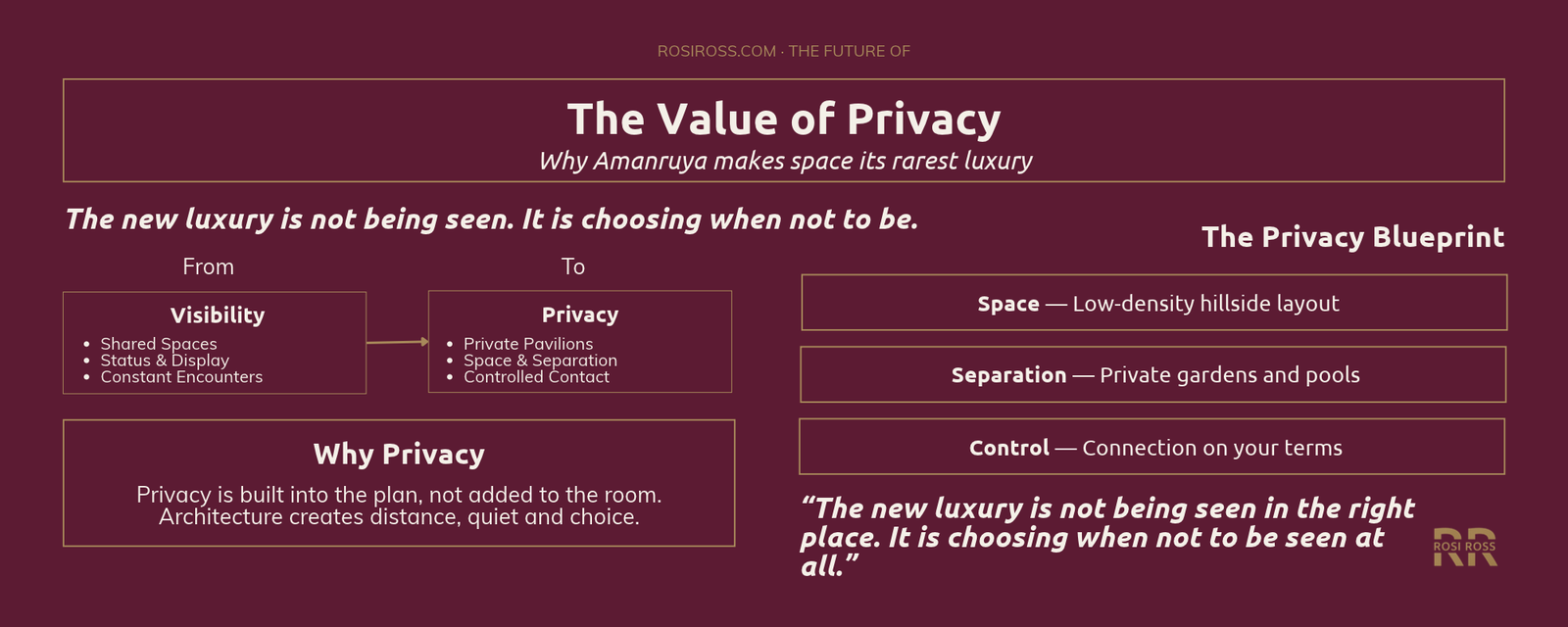
The new luxury is not being seen in the right place. It is choosing when not to be seen at all.
Why are luxury hotels focusing more on privacy? Because the definition of luxury is shifting. Skift’s 2025 luxury research, built on responses from senior hotel and destination executives, puts the change plainly: today’s affluent travellers value privacy, space and emotional connection over status and display. It adds a qualification that matters here, that privacy remains prized but not at the expense of connection, which is exactly the balance Amanruya strikes between pavilion and shared space. The report is sponsored and reflects industry opinion, so it is best read as a statement of what the people who sell luxury believe their guests want, but the direction is echoed elsewhere. One luxury-travel commentary describes how travellers increasingly immune to traditional displays of wealth now treat privacy, purpose and meaningful experiences as the new markers of status.
Contemporary life is unusually exposed. Phones, cameras, notifications, feeds, work platforms and social media have made visibility continuous, so hospitality that creates genuine visual and acoustic separation now solves a modern problem and does not merely reproduce an old aristocratic idea of privacy. Luxury hospitality usually describes privacy architecturally, in walls, villas, entrances and gardens. The emotional result is more specific. It is the freedom to stop being observed. For public figures, high-net-worth travellers, couples, solo travellers and anyone exhausted by a performative social life, the absence of an audience can be more valuable than any decorative excess.
Amanruya’s relevance increases as the outside world becomes louder. A property that was conceived as a retreat now reads as a counter-position to an entire culture of display, and that is a stronger commercial story than the one it was built to tell.
The North-Coast Site: Forest, Olive Groves and Aegean
The land is the real lobby.
Where exactly is Amanruya in Bodrum? Aman describes it as resting amid olive groves and cypress trees on the Bodrum Peninsula’s serene north coast, a village-like resort offering an abundance of space and privacy, and Aman adds that the property is around 15 to 20 minutes from the town of Bodrum, in a rural setting surrounded by olive groves and set against pine-cloaked hills, with the nearest airport 30 minutes by car. Its older documents describe a setting bordered by a forest reserve and facing almost a kilometre of coast, and a factsheet notes a kilometre of private beach on a scalloped coastline of sheltered coves and ancient olive groves. The shore is the north coast, away from the denser social and marina circuits associated with central Bodrum and Yalıkavak, and the remoteness is by design and not by extreme isolation.
What does Amanruya mean? The name explains the proposition. Aman’s own factsheet gives it as “peaceful dream”, combining Aman, which the brand takes from the Sanskrit word for peace, with the Turkish word for dream, rüya. The commercial offer is exactly that, a withdrawal from the visible world. And because there is no single grand architectural gesture that needs to dominate arrival, the experience is distributed across hillside, courtyards, terraces, stone walls, vegetation and water. The land replaces the lobby as the first impression. The most expensive-looking object at Amanruya is the amount of landscape between one person and the next.
The smell of that landscape, resin, dry grass, warm stone and olive leaf, belongs to the same place-memory that scent builds identity from, as explored in The Language of Scent: How Fragrance Becomes Identity in Modern Beauty. A site is remembered through the body before it is remembered through the eye, and a resort whose first impression is atmospheric and not architectural is playing to the more durable sense.
| Amanruya | What is documented |
|---|---|
| The name | Aman, from the Sanskrit for peace, and rüya, Turkish for dream: a “peaceful dream” |
| Where | The north coast of the Bodrum Peninsula, at Demir; about 30 minutes by car from the airport and 15 to 20 minutes from Bodrum town |
| The land | Bordered by forest reserve and surrounded by ancient olive groves, with almost a kilometre of Aegean coast |
| The shore | A private pebble beach, sheltered by a headland |
| The remoteness | Designed, not extreme: the resort lies a short drive from the town |
From Aman’s own materials. Remoteness here is by design rather than geographic isolation.
A Village Rather Than a Hotel
Circulation is dispersed, sightlines are interrupted and guests can inhabit the property without constantly meeting one another.
Aman’s own material repeatedly calls Amanruya village-like, and the design history explains why. Interior Design reported that the late architect Turgut Cansever had developed a small vacation village on the Bodrum peninsula, utilizing the Aegean stone-cottage vernacular decades earlier, and that when the operator engaged his daughter Emine Öğün and her husband Mehmet, they created Amanruya as a compound of freestanding stone guesthouses connected by a labyrinth of stone paths. The walls are locally quarried strawberry stone, the regional name for rose-colored slate, grouted with pink mortar, and the paths are pebble mosaics made by local women, whose contribution is now literally set in stone. A later design-press profile describes the result as having the intimate and tranquil ambience of an Ottoman village, with pavilions inspired by the traditional Anatolian architecture of the region.
Who designed Amanruya? The existing resort is the work of the architects Emine and Mehmet Öğün, carrying the vision of Cansever, and the expansion now under way involves different hands, which this essay returns to below. The village model is fundamental to the privacy thesis. A single hotel block puts its guests in the same corridors. A village disperses them. The idea that form carries a social purpose, so that the shape of a building decides how people meet, is old in architecture, and here the lesson is that restraint is also a design decision. Nothing in the plan is large. Everything in it is placed.
| Who and what | What the record says |
|---|---|
| The vision | The late Turkish architect Turgut Cansever, who developed an earlier vacation village on the peninsula in the Aegean stone-cottage vernacular |
| The realisation | His daughter Emine Öğün and her husband Mehmet Öğün, whose studio designed Amanruya for Aman |
| The model | A village of freestanding stone guesthouses linked by stone paths, and not a hotel block |
| The materials | Locally quarried rose-coloured “strawberry stone” with pink mortar; wood; terracotta roofing; white walls; marble floors |
| The craft | Pebble-mosaic paths made by local women; much of the property made by hand |
Design credits follow design-press reports and Aman’s own material. The expansion is credited separately below.
The Pavilion as a Private Perimeter
This is the market logic of ultra-luxury privacy: sell not only the room, but the buffer around it.
The details in this section come from Aman’s own material and not from the evening I spent there. Every pavilion is freestanding and, in Aman’s words, offers a peaceful private garden and a private 24 to 36 square metre swimming pool. Interiors are 75 square metres, with indoor and outdoor space combined measuring 400 square metres in the sea-view categories, 350 square metres in the garden-view category and 320 square metres in the entry category. The buildings are constructed from local stone and wood, with white walls and marble flooring and a terracotta roof, with Ottoman-inspired design accents, down to handmade kilim rugs from Istanbul and a mangal charcoal fireplace. The result matters because privacy can easily feel clinical. Material memory is what stops seclusion becoming sterile.
A pavilion in this sense is a protective boundary, a layer whose job is to separate what is inside from what is outside while remaining comfortable to live within, the same logic that makes a barrier the foundation of everything else, as The Return of Barrier Beauty: Why Lanolin Is the Ultimate Skin Investment argues for skin. And a boundary has a value that can be priced. A low-density property deliberately gives up the revenue of packing more rooms onto the same land, so each remaining key has to carry more value: privacy, gardens, private pools, larger outdoor footprints and personalised service become the reasons a traveller accepts a higher rate. Luxury is what happens when unused-looking space becomes billable value.
How many pavilions does Amanruya have? A small fact-check belongs here. Current Aman pages do not publish a total, and older documents disagree: a 2023 copy deck states 35 freestanding pavilions, each with its own private garden and swimming pool, while a 2013 design report counted 36 freestanding stone guesthouses. Until Aman confirms the inventory after its enhancements, the honest description is roughly three dozen freestanding pavilions.
| The pavilion | What Aman says | Caution |
|---|---|---|
| Form | Freestanding, each opening to its own garden and private pool | Every pavilion, according to Aman’s accommodation pages |
| Interior | 75 square metres | Indoor space only |
| Indoor and outdoor | Between 320 and 400 square metres in total, depending on category (320, 350 or 400) | The buffer around the room is part of the product |
| Private pool | 24 to 36 square metres | Size varies by pavilion |
| How many pavilions | A 2023 copy deck gives 35; a 2013 design report gives 36; current pages publish no total | Use “roughly three dozen” until Aman confirms the inventory after the enhancements |
The market logic of ultra-luxury privacy: sell not only the room, but the buffer around it.
A Private Pool With No Audience
In a public-pool model, the luxury is the furniture, service and scene. In a private-pool model, the luxury is not needing the scene at all.
Does every Amanruya pavilion have a private pool? Yes, according to Aman’s material: every pavilion is freestanding and opens to its own garden and a private swimming pool of 24 to 36 square metres, surrounded by shaded green gardens and a pergola with a large cushioned daybed. The pool matters commercially because it lets a guest enjoy the defining ritual of a summer resort, water in the sun, without entering a shared social space.
The private pool is not an amenity. It is an escape route. It means the traveller no longer has to choose between water and privacy. It also converts what used to be communal, swimming, sunbathing, dining, spa, into one-to-one or in-room experiences, which increases the number of moments a guest can control, and control is one of the least discussed forms of luxury. Hospitality that once sold a scene now sells the option of having none, and it can do so without giving up the sense of occasion that a pool provides.


The Mausoleum Metaphor, and the Real Bodrum History
Each pavilion feels less like a hotel room than a private stone sanctuary: its own walls, garden, water and silence.
It is tempting to say that each pavilion feels like one’s own mausoleum, and as a figure of speech it captures the stone, the stillness and the sense of a small monument hidden in a landscape. It should stay a metaphor. The actual Mausoleum at Halicarnassus, one of the Seven Wonders of the Ancient World, stood in Bodrum town, and Britannica notes that it is where the word mausoleum originated, from the maussolleion, a monument to King Mausolus. World History Encyclopedia records that when Mausolus died in 353 BCE his body was entombed in what became known as the Mausoleum at Halicarnassus. Nothing in the available official material says the pavilions are based on it. The better phrase is a private stone sanctuary, or a small personal monument hidden in the landscape.
A place that borrows meaning from the ancient ground it stands on, without copying it, is the layered kind of value that the study of enduring objects in The Language of Modern Necklaces: Metals, Stones, and the New Codes of Personal Luxury describes. The peninsula has been a place of withdrawal and of display for twenty-five centuries, and Amanruya belongs to the older, quieter of those two traditions, the one in which a person arranges stone, water and silence around themselves and asks the world to stay outside.
The Luxury of Having No Eyes on You
Romance becomes more powerful when the hotel stops reminding you that other guests exist.
The phrase “no eyes on you” should be kept because it names the psychological product. For couples, privacy changes the emotional geometry of a hotel: room, pool, garden and terrace become one uninterrupted environment and not a private bedroom attached to public leisure, so that intimacy can occupy the whole day. For those who live under constant observation it offers something harder to find, a place where nobody expects a performance.
Noise is rarely listed on a rate sheet, but its absence increasingly has value. Low-density layouts reduce incidental encounters, footsteps, corridor traffic, pool noise and visual clutter, and at Amanruya the forest, the hillside and the spacing of the pavilions make silence feel architectural and not accidental. Atmosphere of that kind, composed by the plan and not by effects, is also what timeless luxury fashion pieces demonstrates in another medium: the most durable luxury looks as if it did not try.
Amanruya is not a hermitage, though. Aman’s factsheet describes a beach club protected by a headland and shaded by mature trees, made up of a series of terraces and a 50-metre infinity pool surrounded by dining and relaxation pavilions, and the resort’s other common spaces allow guests to re-enter social life when they choose. That choice is crucial. Luxury privacy is not isolation imposed by the property. It is the ability to control when connection happens.
Why the Market Is Moving Toward Private Villas
Amanruya is not an isolated aesthetic idea. It is aligned with a structural change in affluent travel preferences.
Is private-villa hospitality growing? Industry estimates suggest so, though they vary by firm and definition, and they are commercial estimates and not official statistics. Grand View Research values the global luxury-travel market at USD 1.59 trillion in 2025, expected to reach USD 3.04 trillion by 2033 at a compound annual growth rate of 8.5 percent, and its definition includes private and customised travel and private villas as an accommodation category. Its separate report on luxury resorts projects the segment to reach USD 203.1 billion by 2033, expanding at 7.5 percent a year from 2026, noting that luxury resorts offering private villas, beachfront escapes, wellness retreats and curated destination activities continue to attract domestic and international travellers.
The point is directional and not precise. The figures come from a commercial research house, the definitions are broad, and a specific luxury-resort market-size figure that has circulated in some briefing materials could not be confirmed and is not used here. What the estimates support is a consistent direction across sources: demand is moving toward space, control and sense of place.
| Signal | What is documented | Caution |
|---|---|---|
| A shift in what the affluent value | Skift’s 2025 luxury report: affluent travellers value privacy, space and emotional connection over status and display, though privacy is prized “not at the expense of connection” | Industry-executive research, presented with sponsors |
| Luxury travel, global | Grand View Research: about USD 1.59 trillion in 2025, rising to about USD 3.04 trillion by 2033 | Commercial estimate; the definition includes private and customised travel |
| Luxury resorts | Grand View Research: USD 203.1 billion by 2033, a 7.5% growth rate from 2026 | Commercial estimate; the 2025 base figure is not used here |
| Bodrum spend | Bodrum’s mayor said in 2025 that the district accounts for about 40% of Muğla’s tourism, with foreign visitors spending about USD 1,400 on average against about USD 950 nationally | Municipality figures, not an independent audit |
Commercial market-size numbers are estimates, not official tourism statistics.
The Economics of Low Density
The resort’s most expensive-looking object is the amount of landscape between one person and the next.
Stone, marble and furniture can be sourced again. A private bay, mature olive groves, forest adjacency, sea frontage and the spatial freedom to separate roughly three dozen pavilions cannot be reproduced easily once a coastline becomes densely developed. The real scarcity is land, and that makes the site itself a form of long-term luxury inventory. Value that rests on a place that cannot be replicated, and on the patience to leave it alone, outlasts value that rests on a fit-out.
The commercial logic is simple to state and difficult to execute. A low-density resort accepts a lower ceiling on volume in exchange for a higher floor on rate, and it must then defend the floor by protecting the very thing that justifies it. That is why a site-to-key ratio, the amount of land attached to each bookable unit, is the quiet metric of the privacy economy. It is rarely published, and it is the number that most separates a resort that sells seclusion from one that describes it.


A dinner visit shows the public edge of a private world.
A dinner visit is a modest vantage point, and an honest one. While the resort was operating, a dinner visit made it possible to experience part of the property without staying. What a dinner shows is the threshold: the approach, the way the landscape is handled, the architecture of the shared spaces, the pace of service and the mood. It does not show what a guest’s days are like inside a pavilion, and this essay does not pretend to.
The distinction between the public edge and the private core is itself part of the argument. A property that hides its heart even from a visitor who has come to dinner has designed its privacy thoroughly. The arrival does not tell a visitor where the guest rooms are, how many there are or how they relate to one another, and the discretion is not an omission. It is the product, delivered to someone who is not even a customer of it.
How Other Luxury Resorts Are Selling Seclusion
The pattern is consistent: high-end hospitality is creating more ways for guests to have hotel-level service without hotel-level exposure.
The most advanced privacy-led resorts design separation into the masterplan and not into a room. Freestanding villas or pavilions, private pools, buffer landscaping, separate arrival routes, in-villa dining, private spa treatments, dispersed restaurants, low room counts and a large ratio of site to key recur across the category, and Amanruya exhibits many of these characteristics. The pattern is broader than any one brand. It reflects an industry that has understood that guests who can afford to be anywhere increasingly choose places where they can be unobserved.
| Seclusion built into the masterplan | How Amanruya expresses it |
|---|---|
| Freestanding pavilions | A village of separate stone buildings in place of a single block |
| Private pools and gardens | Water and territory inside each perimeter |
| Buffer landscaping | Olive groves, cypress and pine between one pavilion and the next |
| Dispersed circulation | Pebbled paths and a hillside that interrupt sightlines |
| Dispersed dining and common spaces | Dining pavilions, a beach club and a pool in separate places |
| Low room count and a high site-to-key ratio | Roughly three dozen pavilions on a large site |
An editorial framework for how privacy-led resorts design separation into the plan and not into the room.
Bodrum’s Two Luxury Economies
The brand is public. The experience is private.
Bodrum is becoming a higher-value tourism market. At the 2025 Istanbul Tourism Fair, the district’s mayor said that Bodrum accounts for 40 per cent of Muğla’s tourism, and that while the average spending of foreign visitors in Turkey is around 950 dollars, in Bodrum it reaches 1,400 dollars. Those are municipality figures and not an independent audit, but they illustrate a district moving toward higher-spend visitors. The picture is not one of uninterrupted growth: Hurriyet Daily News reports that 416,691 foreign visitors arrived by air and sea in the first six months of 2026, a 2.75 percent decline on the same period of 2025, and Muğla as a whole received 3,461,311 foreign tourists in 2025, 6 percent fewer than in 2024. A market that is flat in volume and rising in spend is a market in which privacy-led, high-rate products make commercial sense.
Within the district there are now two luxury economies, a social one of marinas, restaurants, clubs and visible resorts, and a private one of secluded bays, standalone villas and controlled contact. The social model is documented at Yalıkavak, whose marina describes a Shopping Alley it calls the epicentre of luxury shopping in Türkiye, represented by more than 100 brands. Amanruya chooses the second economy almost completely.
| Social luxury | Private luxury |
|---|---|
| Marinas, restaurants, clubs and highly visible resorts | Secluded bays, standalone villas and private pools |
| Beach scenes and networking | In-residence service and controlled contact |
| Value is in the scene | Value is in not needing the scene |
| Visibility is the product | Controlled visibility is the product |
Bodrum now contains both economies. Amanruya chooses the second almost completely.
There is a paradox in the Aman brand worth noting. It is one of luxury hospitality’s most recognisable names, yet its strongest properties sell the fantasy of being unreachable. Brand recognition reassures the guest, while spatial design removes the need for visible status performance once inside. That is a sophisticated status proposition, and it is why intimacy has economic value: it allows a hotel to personalise service with fewer public touchpoints.
Amanruya’s Expansion and the Risk of Losing Emptiness
The development challenge is unusual: grow revenue without making the resort feel more populated.
The resort is changing. Aman Residences, Bodrum is a planned addition of private villas, and Aman describes it as set within Amanruya’s private bay on Bodrum’s north coast, complemented by expanded resort facilities including a new Aman Spa, beach club, restaurants and curated retail. The announcement came in July 2025, in partnership with the wealth management firm RePie Asset Management, and the design credits are split: Denniston Architects is behind the expanded resort and beachfront residential villas, and SAOTA is designing the waterfront, lagoon and forest villas. The site is the Demirbükü cove on Bodrum’s northern coast. Aman’s own pitch for ownership leans on the same idea as the resort, that ownership is defined by privacy, elegant simplicity and intuitive service, with a design ethos that favours restraint, space and stillness.
Is Amanruya currently open? No. The current status has to be stated plainly. Aman’s official site says that Amanruya is currently closed while it undergoes resort enhancements across the village-like resort, with reopening dates to be announced in due course, and its events page specifies that the closure is continuing throughout the 2026 season. Anyone planning a visit should check Aman directly for the latest position.
The commercial question is whether expansion can preserve the perception of privacy that made the original valuable. Amanruya’s scarcity is part of its product. More facilities and residences can deepen the resort ecosystem, but every building increases pressure on the asset that cannot be manufactured later, which is empty space. Aman has not said how many residences will be built, and a trade report notes that the number has not been disclosed, so the question of density cannot yet be answered. The perception of privacy depends on the number.
| The expansion | The opportunity | The risk |
|---|---|---|
| Aman Residences, Bodrum | Villas for private ownership within Amanruya’s private bay, with access to the resort | Every additional building adds pressure on the one asset that cannot be manufactured later: empty space |
| New facilities | A new spa, beach club, restaurants and curated retail | More activity means more people sharing the same bay |
| The architects | Denniston Architects for the expanded resort and beachfront villas; SAOTA for the waterfront, lagoon and forest villas | Two new voices beside the original design |
| The unknown | Aman has not said how many residences will be built | The perception of privacy depends on the number |
Aman Residences, Bodrum was announced in 2025 in partnership with RePie Asset Management. The key question is whether growth can preserve the perception of privacy that made the original valuable.
The Ethics of Seclusion
Private does not automatically mean sustainable or socially superior.
Large land-per-key ratios, private pools, extensive landscaping and secluded infrastructure can be resource-intensive, and any environmental claim should be tied to specific disclosed practices and not inferred from low density or a natural-looking design. A design brief that asked for as little impact on the environment as possible is an intention and not a measurement. A forest edge and an olive grove are assets, and they are also obligations: water, fire risk, soil and habitat are managed or they are lost.
Seclusion is also a luxury available to few, and it is worth saying so. A resort that sells distance from other people is by definition not a model that can be extended to everyone, and an honest account of its value acknowledges that its exclusivity is the source of both its appeal and its limits.
What the Empty Land Is Worth
The rarest room in 2030 may be the one from which nobody else can see you.
The next phase of luxury hospitality may be defined less by bigger suites than by fewer interruptions. As travel becomes more photographed, digitised and socially visible, hotels that can create credible disappearance will gain value, and the challenge will be scaling that privacy without destroying the emptiness that makes it possible.
The story is not that Amanruya is a remote hotel with private pools. It is how a low-density resort on Bodrum’s north coast turns land, architectural separation, private water, vegetation and controlled visibility into a contemporary form of wealth, and why luxury hospitality increasingly understands that the ability to be left alone can be more valuable than being seen. That reading would change if the conditions behind it did: if expansion filled the bay until the resort felt populated, if the village became a development, or if privacy became a feature that could be bought without the land that makes it real. None of that is certain. The luxury is not what surrounds you. It is what does not. The rarest luxury may be the ability to become temporarily invisible.
“In an age when almost everything is visible,
privacy has become a form of wealth.
Amanruya does not greet you with a façade.
It allows you to disappear into the land.
The new luxury is not being seen in the right place.
It is choosing when not to be seen at all.
The rarest room in 2030 may be the one
from which nobody else can see you.”

