
On the changing psychology of island travel, the quiet architecture of Naxos, and why the most valuable Mediterranean beaches in 2030 will be the ones that never needed to raise their voice
The modern traveller is no longer searching for the most photographed beach. They are searching for the beach that still feels like a secret. A landscape with room to breathe. A morning swim without an audience. A coastline where the environment remains the main attraction.
After decades in which Mediterranean destinations competed almost entirely through visibility — famous names, crowded hotspots, the choreography of luxury spectacle — a quieter form of coastal travel is emerging, and it is being driven not by absence of options but by an excess of them. The sophisticated traveller has already seen the postcard. What they are now searching for is proximity to something real: a stretch of shoreline where the sand has not been organised for an audience, a lunch that runs long because no one is waiting for the table, a swim taken without the sense of being observed.
Greece has always understood this instinct, even when the world’s attention was fixed elsewhere. Beyond the mythology built around Mykonos — the island that, more than any other, taught the Mediterranean how to be glamorous — exists another Cycladic story, built not around visibility but around scale, agriculture, and an older relationship to Greek island life. That story belongs largely to Naxos, the archipelago’s largest island, and its case is instructive precisely because it did not need to reinvent itself to become relevant. It simply continued being what it always was, and travel caught up to it.
The New Definition of Mediterranean Luxury
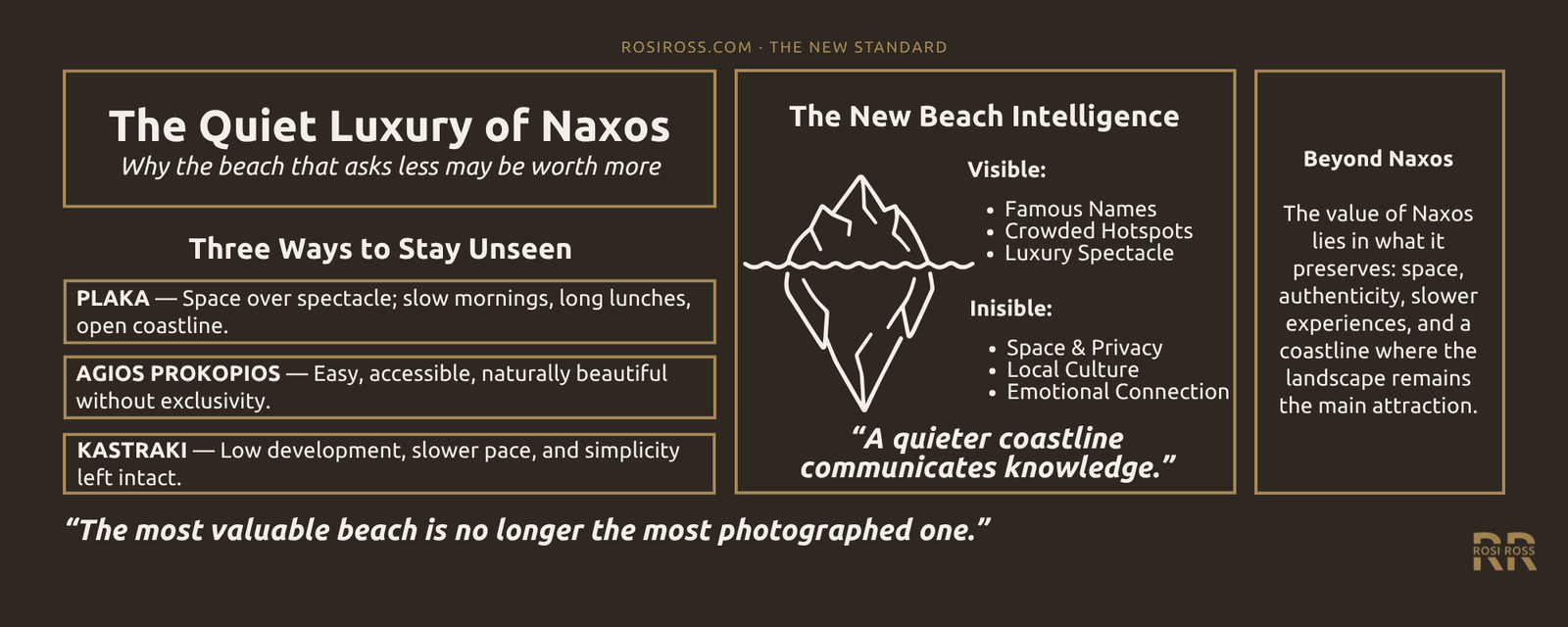
A crowded, famous beach communicates popularity. A quieter coastline communicates knowledge — and knowledge, increasingly, is what luxury travel is being asked to provide.
For much of the last half-century, beach luxury was defined by a fairly narrow set of coordinates: exclusivity, celebrity recognition, the beach club with the highest table minimum, the hotel whose name did the work of status on its own. That formula has not disappeared, but it has stopped being sufficient. The next generation of luxury travel is being defined instead by natural landscape, emotional connection, privacy, local culture, slower experiences, and a preference for places that feel discovered rather than consumed.
Greece is a useful case study for this shift precisely because it offers a rare combination of assets: ancient cultural continuity, exceptional and varied geography, a Mediterranean lifestyle that has never fully commercialised itself out of authenticity, and a hospitality infrastructure sophisticated enough to support genuine comfort without demanding spectacle in return. The value in these beaches is found as much in what is absent — the crowd, the amplification, the performance — as in what is present.
Why Greece Remains the World’s Most Enduring Island Destination
Greece’s advantage is structural rather than seasonal. Its geography alone is difficult to rival: thousands of islands, each carrying a distinct microclimate and coastal character within short sailing distance of one another — dramatic cliffs in the Ionian, protected bays across the Cyclades, long sand beaches on islands like Naxos, volcanic coastlines further south. The variety is practical as well as scenic. A traveller can leave a green, rain-fed Ionian island and, a flight and a ferry later, arrive on a wind-scoured Cycladic ridge or at the rim of a volcanic caldera, and the landscape, the light and the architecture will all have changed. The meltemi, the dry northerly wind that crosses the Aegean through the summer, shapes that variety further, giving the air its particular clarity and deciding which bays are sheltered and which are exposed — a fact of nature that hospitality here has learned to design around rather than against.
Layered onto this is a cultural density that few Mediterranean nations can match: an unbroken line running from ancient civilisation through Byzantine and Venetian architecture to a contemporary hospitality scene now attracting serious design and culinary attention, as the Greek National Tourism Organisation has documented in its own long-term positioning of the islands. On Naxos alone the sequence can be read in a single walk: marble from the archaic Cycladic world, the unfinished gateway of a sixth-century temple, a Venetian castle town founded in 1207, and the chapels and farmhouses of centuries of agricultural life. Few places allow a visitor to read so much history without a guide.
The newer layer is not an imposition on that history but a reading of it. Architects and designers are translating the vernacular — whitewashed volumes, local stone, shaded terraces, thick walls built against wind and sun — into contemporary hotels, and chefs are rebuilding menus around island produce: cheeses, olive oil, wine and vegetables grown a few kilometres from the table.
What distinguishes Greece from destinations that have chased luxury by erasing their own character is that it has largely managed to deliver comfort without needing to sacrifice identity. The whitewashed villages, the family-run tavernas, the working agricultural interior of islands like Naxos — these have not been staged for visitors. They existed before the visitors arrived, and that sequencing is, increasingly, the entire point. It is also a harder advantage to counterfeit. A resort can be built in a year; a village, an agricultural calendar and a language of building cannot. The test for the next decade of Greek luxury is therefore not how much can be added to the islands, but how much of what is already there can be left intact while it is made comfortable.
Mykonos Beyond the Famous Shoreline
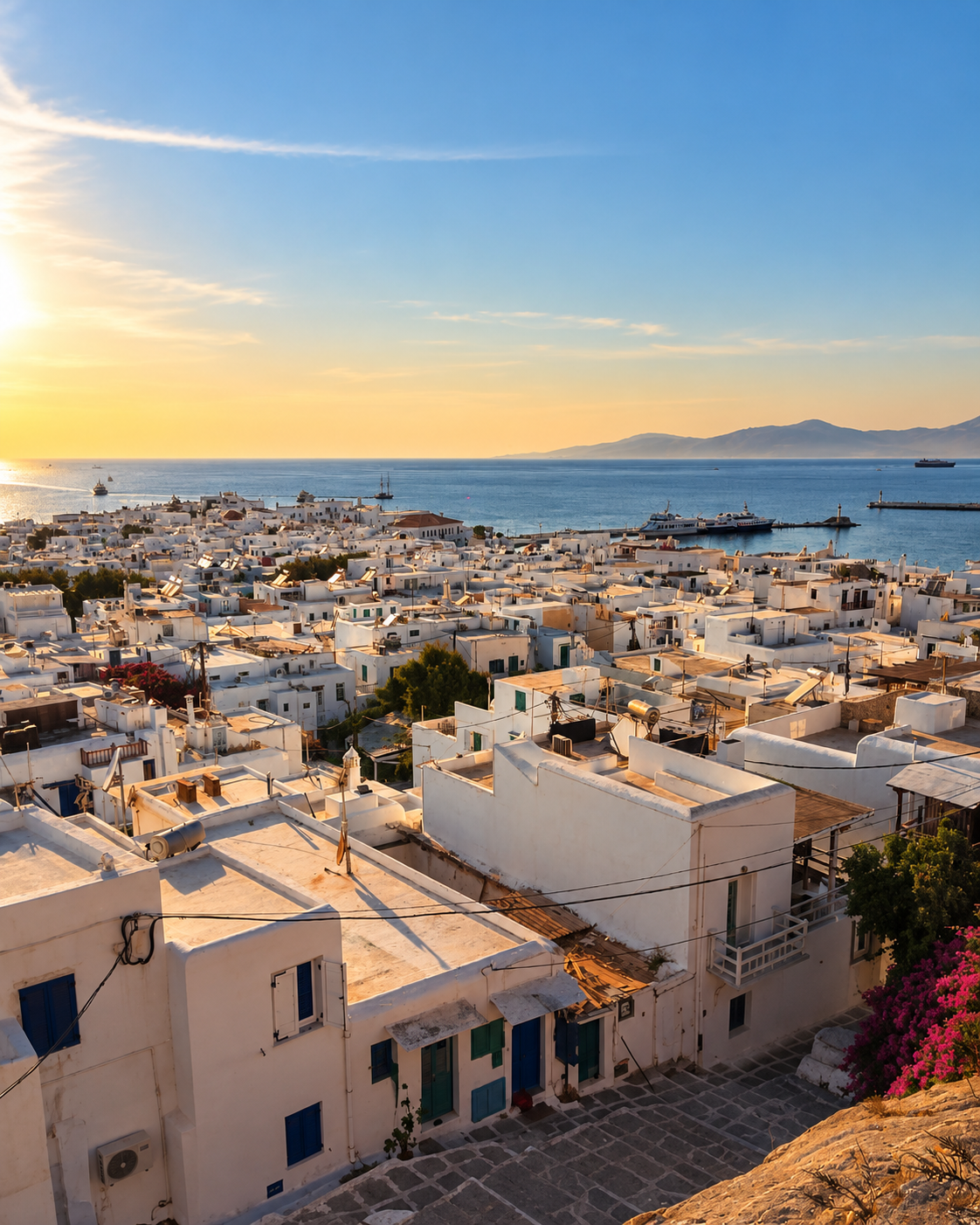
Mykonos deserves credit as the island that effectively invented modern Mediterranean glamour — a formula built on cosmopolitan energy, design-conscious hospitality, international dining, nightlife, and a level of global visibility no other Greek island has matched. Its influence on how the world imagines a Greek holiday is difficult to overstate. From a modest island it became a global shorthand: the white town, the windmills, the beach club as a social institution. That formula has been copied across the Mediterranean, which is its own measure of the original’s authority — and also the reason the original now has to decide what it wants to remain.
But Mykonos’s future, and arguably the Cyclades’ future more broadly, depends on holding that reputation in balance with preservation. A short ferry away sits Delos, the tiny sacred island inscribed as a UNESCO World Heritage Site in 1990, its excavated sanctuary to Apollo a reminder that this part of the Aegean was a centre of pilgrimage and trade long before it was a centre of nightlife. UNESCO describes a site that conveys the image of a great cosmopolitan Mediterranean port. Today no one may stay on Delos overnight except the guards and archaeologists who work there, so it is visited by day and left at dusk — the reverse of Mykonos, which comes alive after dark.
The connection between Delos and Naxos is older than either island’s modern reputation. Naxos was one of the first islands to work in marble, and the archaic lions of Delos are traditionally attributed to Naxian craftsmen and patrons. On Naxos itself, the unfinished gateway known as the Portara — all that remains of a temple to Apollo begun in the sixth century BCE — is oriented toward Delos, which most scholars take as the reason the temple is considered Apollo’s. The two islands were in conversation long before either was a destination.
The proximity of the two — the birthplace of Apollo a boat ride from the birthplace of the modern beach club — is its own quiet argument about what endures. Increasingly, the more compelling question is not where people gather in the Cyclades, but where, within reach of that same archipelago, they can still go to disappear for an afternoon. For many travellers already familiar with Mykonos, that answer leads south, to the greener, larger island of Naxos: the largest of the Cyclades, crowned by Mount Zas, the archipelago’s highest peak, whose mass catches passing rain clouds and helps make the island unusually fertile for the Aegean.
The Beach Intelligence Edit
Naxos is the largest island in the Cyclades and, geologically and agriculturally, among its most fertile — a landscape of high mountains and working valleys rather than the bare, sun-bleached rock most visitors associate with the island group. Its old town carries Venetian and Byzantine layers in equal measure: castles, churches, and monasteries built into a settlement that has functioned continuously rather than been restored for effect. What follows are three beaches that, together, make the argument for a different kind of Cycladic luxury.


Plaka: The Quiet Mediterranean Escape
About ten kilometres from Naxos Town — some twenty minutes by car, or a summer bus along the coastal road — Plaka unfolds across around four kilometres of pale sand, one of the longest uninterrupted beaches on the island, and its scale is precisely what gives it its character. Where a shorter beach concentrates its visitors, Plaka disperses them; a sense of space rather than isolation is the operative feeling, and it is space, more than any single amenity, that increasingly functions as the premium commodity in coastal travel.
Low grassy dunes run along much of its length, with scattered trees, flat stones and luminous shallows, so that the coast reads as landscape rather than development. The beach also changes character as it goes. The northern end, a natural continuation of Agia Anna, is the more organised: sunbeds, umbrellas, and water sports are available for those who want structure, and a handful of restaurants and cafés provide for the day. Walk south and the facilities thin, the dunes rise, and the crowd thins with them. Sections of the beach, mostly toward the southern stretch, operate on a clothing-optional basis, in keeping with a longstanding and unremarked-upon local custom rather than any curated bohemian branding. Nothing about the setting insists on being noticed. Because services and lifeguard cover are limited further south, it rewards the traveller who arrives prepared, with water, shade and no particular schedule.
The coast faces west, which makes the end of the day its finest hour: the light lengthens across the water toward Paros, and a beach that has been quiet all afternoon becomes quieter still.
Is Plaka Beach worth visiting? For travellers who have already experienced the Cyclades’ more famous coastlines, Plaka represents a shift from consumption to connection — an experience organised around swimming, reading, long lunches, and watching the light change over the water, rather than around being entertained. At Tortuga, a bohemian-inspired beach restaurant set just back from the sand, with a modern Mediterranean menu, the day unfolds at its own pace — a long lunch, a second coffee, a cocktail as the light turns — inside a loosely bohemian, low-slung setting that asks nothing of its guests beyond time.
Beyond Plaka the coast continues south toward Orkos, Mikri Vigla, known for its winds, and Kastraki, and further still to Alyko, where a protected coastal juniper forest meets dunes and small coves. For the traveller with a car and a day to spare, the whole stretch offers a quiet that is increasingly hard to find on the island’s more famous shorelines.


Agios Prokopios: The Timeless Greek Classic
Five kilometres from Naxos Town, Agios Prokopios pairs golden sand with water of a clarity that photographs with almost no assistance — the kind of coastline that has made the beach one of the most consistently recommended in the Cyclades by international travel authorities. It lies on the island’s western coast, between Agios Georgios and Agia Anna, along a wide, sheltered bay of a little over a kilometre and a half, and the calm of that bay is much of its appeal: the sea is gentle and unusually clear, and the beach has earned a Blue Flag for the quality of its water.
Its intelligence lies less in exclusivity than in ease: seafood tavernas, cafés, and a small run of beachfront bars sit comfortably alongside a couple of low-key nightclubs, allowing visitors staying nearby to experience the island’s evening rhythm without travelling into town. Sunbeds and umbrellas are laid out along most of the beach, there is lifeguard cover, and the shoreline merges almost seamlessly into Agia Anna to the south — a stroll of ten to thirty minutes along the sand and the coastal path, past a small harbour of fishing caiques and a belt of cedar trees — so that a day can move from one beach to the next without a car.
What makes Agios Prokopios special? Not every exceptional destination needs to be exclusive to be valuable. Agios Prokopios makes the case for what might be called democratic luxury — reliability, ease, and genuine natural beauty that requires no complication to enjoy, accessible by a local bus that runs from Naxos Town for a few euros each way. It is the Greek beach as it has long been imagined: a morning swim, a lunch of grilled fish a few steps from the water, an afternoon that needs no plan, and a first drink as the light turns. Nothing here is new, and that is the point; the formula has endured because it works, and because the setting does most of the work. In high summer it is among the island’s busier beaches, which is part of its character. The landscape, rather than the price point, remains the main attraction.
It also makes a useful counterpoint to Plaka, a short drive further along the same coast. Where Plaka offers space and quiet, Agios Prokopios offers company and convenience — the social, well-served end of the same shoreline — and the traveller who understands the difference can choose between them by mood rather than by price, or move between the two in a single day.


Kastraki: The Future of Slow Luxury
Sixteen kilometres from Naxos Town, Kastraki is reached by driving south through Vivlos village, along a mix of asphalt and dirt road that itself functions as a kind of filter. The journey takes some twenty-five minutes, and bus service to this stretch is limited, so most visitors arrive by car or scooter — a small act of commitment that quietly selects for the traveller who wants to be there. The reward is three kilometres of white sand backed by dunes and shaded by cedar trees (locally called cedars, in fact coastal junipers), with shallow water of a clarity that owes more to the beach’s distance from development than to any particular intervention. Offshore, a small islet breaks the horizon, and at sunset the light falls toward Paros.
Facilities are deliberately modest: a handful of tavernas, a minimarket, a few umbrellas and sunbeds to rent, and small-scale rooms and a few small hotels toward the northern end, while the southern stretch is almost entirely dunes and trees. Beyond the shade of the cedars there is little to organise a day around except the sea itself — snorkelling is good, families favour the shallow water, and long walks along the shore are the default activity. It stays quiet even in high season by Naxos standards, though it is not entirely sheltered: the meltemi can reach this coast in summer, and neighbouring Mikri Vigla, two kilometres north, is a centre for wind sports, so a calmer day or the southern end is the better choice for stillness.
Why is Kastraki becoming a reference point for quiet luxury? The future luxury traveller is increasingly asking a version of the same question: can a place still be experienced before it is fully discovered? Kastraki, with its handful of tavernas and small-scale rooms rather than resort infrastructure, answers that question by declining to develop the answer out of existence. It reflects a broader principle now shaping premium travel — that the most valuable destinations may be the ones that protect their own simplicity rather than build over it.
The value here is subtractive. There is no beach club to book, no programme to follow and no promenade to be seen on; what is offered instead is time, light and the particular luxury of arriving somewhere that has not been arranged for you. It asks something in return — a car, water, shade, a lunch planned around a taverna’s hours — and that mild friction is part of the proposition, since the same self-reliance that keeps the beach quiet is what keeps it intact. A few kilometres south, the ruins of an abandoned hotel at Alyko, among the cedar forest, are a reminder that building and lasting are not the same thing.



Why Beach Travel Is Becoming the New Wellness Luxury
Across the Mediterranean, beach travel is increasingly being understood as a wellness environment rather than simply a scenic backdrop — mental restoration, slow mornings, movement, healthy cuisine, and meaningful distance from a screen doing more for a traveller’s sense of recovery than any single amenity could. This tracks with a broader hospitality trend documented by the World Travel & Tourism Council, which has identified wellness-integrated travel as one of the sector’s most durable growth categories rather than a passing seasonal preference. The most desirable Cycladic beaches now offer, in effect, a psychological reset rather than simply a beautiful photograph — and Naxos, with its comparative lack of density, is unusually well suited to deliver it.
Naxos’s beaches cannot be separated from its interior, which is precisely what makes the island’s food culture distinct within the Cyclades. Fresh seafood arrives alongside vegetables and cheeses grown and produced inland — the island’s fertile valleys make it one of the few Cycladic destinations with genuine agricultural self-sufficiency — dressed in local olive oil and prepared through traditional methods that modern Greek kitchens are now reinterpreting with contemporary technique and a renewed emphasis on sustainability. The argument this makes is a structural one: the food, the landscape, and the rhythm of island life are not separate offerings assembled for a visitor. They are one continuous experience, and Naxos remains close enough to that continuity to still taste it.
The coastline speaks to several overlapping profiles rather than one: the discerning island traveller who has already experienced the Cyclades’ famous names and wants something quieter; the design traveller drawn to architecture, atmosphere, and visual harmony over spectacle; the wellness traveller prioritising restoration and nature; the luxury traveller who wants quality without unnecessary performance; and the cultural traveller seeking a genuine connection to local identity rather than a curated version of it. What unites them is a preference for landscape as the primary luxury asset, authenticity that has not been diluted for an audience, and a pace of travel that allows time itself to be experienced differently.
Will Quiet Become the Ultimate Luxury?
By the end of this decade, premium travellers are likely to be seeking lower-density destinations, nature-first experiences, cultural authenticity, wellness integration, sustainable infrastructure, and a far more personalised relationship to travel than the industry has historically offered. The relevant question is no longer which beach is the most famous. It is becoming which places still feel valuable — and value, in this framework, is measured by what a destination has preserved rather than by what it has added.
The considered relationship to place that defines this shift in travel echoes a wider movement across contemporary luxury more broadly — the same intelligence, for instance, that has produced a preference for a wardrobe built around fewer, better-made pieces rather than constant acquisition, or a skincare philosophy rooted in supporting the body’s own biological systems rather than overriding them. The traveller who chooses Kastraki over a beach club, much like the collector who chooses a single, precisely chosen piece of jewellery over accumulation, is operating from the same underlying instinct: that restraint, applied with intention, is the most durable form of luxury available.
The story here was never simply that Naxos has beautiful beaches to visit. The more accurate story is structural: as global travel becomes increasingly crowded and increasingly curated for visibility, the destinations that retain value will be the ones that preserved authenticity, space, and emotional connection while the rest of the industry was optimising for neither. Plaka, Agios Prokopios, and Kastraki represent a broader movement already underway across the Mediterranean — the return of simplicity as the highest available form of luxury, and of scale, agriculture, and unhurried island life as assets rather than absences. Mykonos taught the world how a Greek island could be seen. What Naxos may end up teaching it is how one stays worth finding.
“The most valuable beach
is no longer the most photographed one.
It is the one that asks nothing of you —
no performance, no audience,
no version of yourself
assembled for the shoreline.
Naxos does not compete
for attention it has never needed.
It simply continues,
season after season,
to be exactly what it was
before anyone arrived to notice.
And in an industry built increasingly
on being seen,
that quiet refusal
may be the rarest luxury left.”

