
On why the smallest object in a room can carry the longest story, and what a Gond-inspired cushion reveals about art, heritage and the forests it asks us to remember
A room is rarely transformed by what is largest in it. It is transformed by what carries meaning — an object with a maker, a method and a story that continues to unfold long after the novelty of buying it has passed.
In interior design, where attention tends to fall on renovation, architecture and the large decisions, the most lasting change often comes from something far smaller. A cushion is the most modest object in a room and, for that reason, one of the most revealing: it is the item a person touches daily, rests against, and chooses without ceremony. When that object carries an image with a lineage, a named artist and a story about the natural world, it stops being an accessory and becomes a quiet piece of cultural memory. That is the proposition behind Tales On Silk, and it is why a Gond-inspired cushion cover deserves a closer look than its size suggests.
Tales On Silk: Where Heritage Meets the Home
Tales On Silk is a home décor house built on a clear idea: give Indian folk artists who have not yet reached wide audiences a platform, then translate their paintings into objects that live in ordinary rooms. Its collections place original artwork beside textile pieces drawn from it, so that the image can travel from the artist’s surface to a sofa without losing its origin. The approach reflects a wider movement in design toward objects with a traceable maker, in which the story of how something was made is part of what is being bought.
What is Tales On Silk? Tales On Silk is a home décor brand that collaborates with Gond artists from central India, pairing original paintings with cushion covers inspired by them. The brand’s emphasis is on giving lesser-known folk artists a platform and on translating their imagery into everyday objects for the home.
The Gond Tradition: Painting as Living Memory
The Gonds are among the largest and oldest Adivasi communities in India, living across the central part of the country, and their painting tradition grew from a close relationship with forest, animal and ritual life. Gond imagery began, as the tradition is commonly described, on the mud walls of village houses, where flora, fauna and deities were painted for festivals and celebrations. These were not decorative images in the modern sense. They were a way of holding a community’s relationship with the natural world in a visible form, and they were renewed with the seasons rather than preserved behind glass.
The move from wall to paper and canvas is closely associated with the artist Jangarh Singh Shyam, whose name now labels a whole school of Gond painting. The method that followed is deliberate and instantly recognisable: an outline, then flat fields of colour left to settle, then dense patterning of lines, dashes and dots laid across the top, the layer that gives each figure its textured, almost woven surface. That patience is part of what the finished image carries. In a visual culture built on speed, a technique that makes its slowness visible has become a form of quiet value. Readers who want the tradition in more depth will find it in our exploration of Gond painting and the idea that we belong to nature, and the wider background in the Encyclopaedia Britannica’s entry on the Gond people.
Santosh Maravi: An Artist Watching His Forest
The collection at the centre of this editorial comes from Santosh Maravi, an emerging Gond artist from the village of Gaarkarmatta in Madhya Pradesh. His ancestral village shapes his subject, which he describes plainly as the environment and how it is changing. His work carries the attentiveness of someone who has watched a landscape alter in a single lifetime, and the melancholy that accompanies that. Rather than argue the point in slogans, he lets the forest speak through imagery: trees that converse, animals that carry their homes with them, creatures that reflect on the limits of their own worlds.
The timing of the collection gave it extra resonance. It was released around the United Nations’ International Day of Forests, observed each year on 21 March, a date set aside to recognise the role forests play in climate, biodiversity and livelihoods. The collection treats the observance not as a theme to decorate but as a conversation to continue, with three motifs, each carrying its own story of resilience and loss.
In Conversation
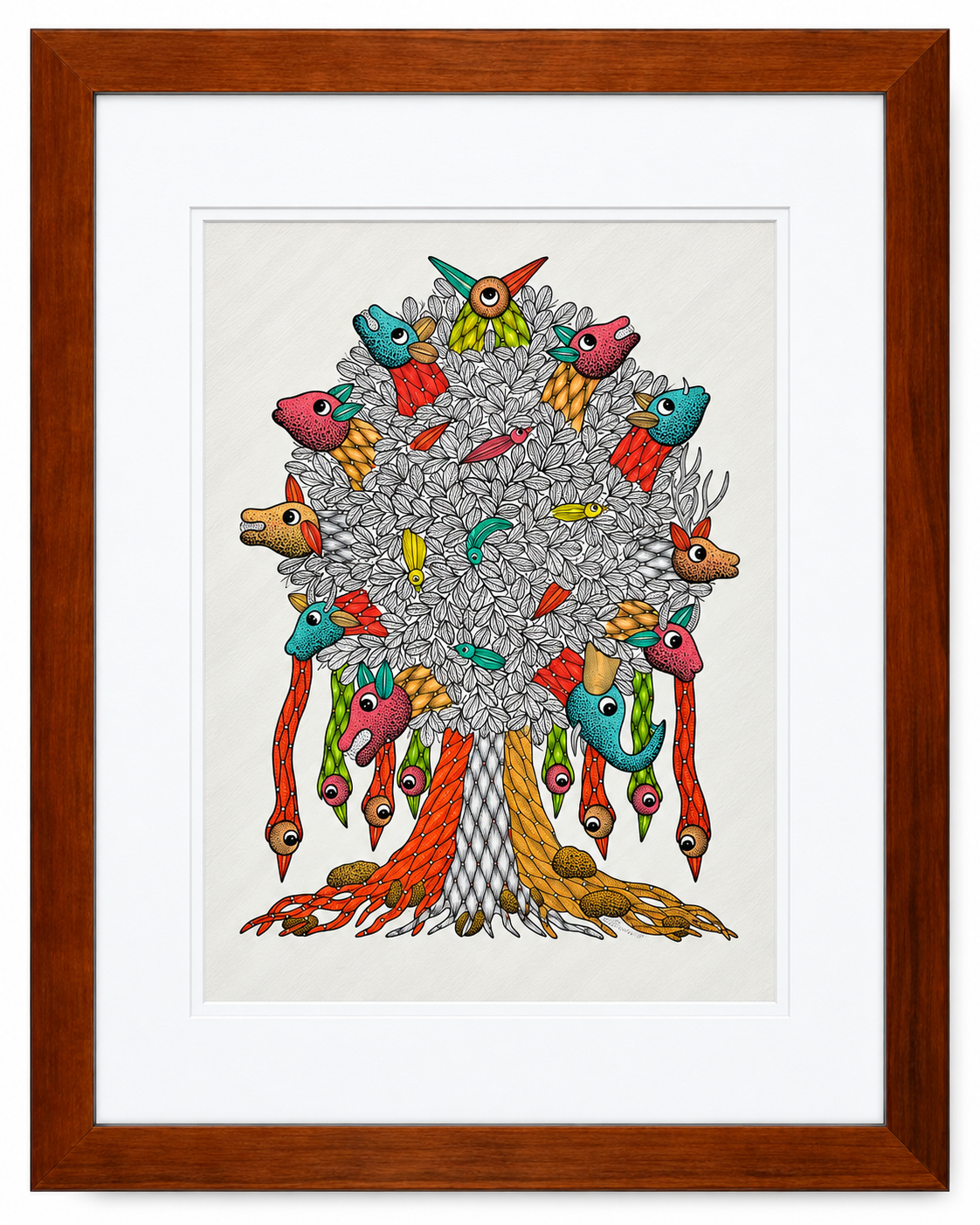
A dialogue between two ancient trees, speaking in the past tense of a time when people, trees and animals lived in harmony.
The first motif is a conversation between two old trees, standing among the remnants of a forest that was once far fuller. Their exchange reads as an elegy delivered as dialogue: they remember a time when the boundaries between people, trees and animals were barely drawn, and the viewer arrives after the loss as a listener. The forest in this telling is not scenery. It is a web of relationships in which every leaf and creature has a role, and the image asks what is owed to a world that has been so generous. The point is made without reproach. The trees do not accuse; they remember, and invite the viewer to do the same. A subject built on memory does not date the way a pattern does, which is precisely why it belongs in a room meant to last.
Herd of Elephants
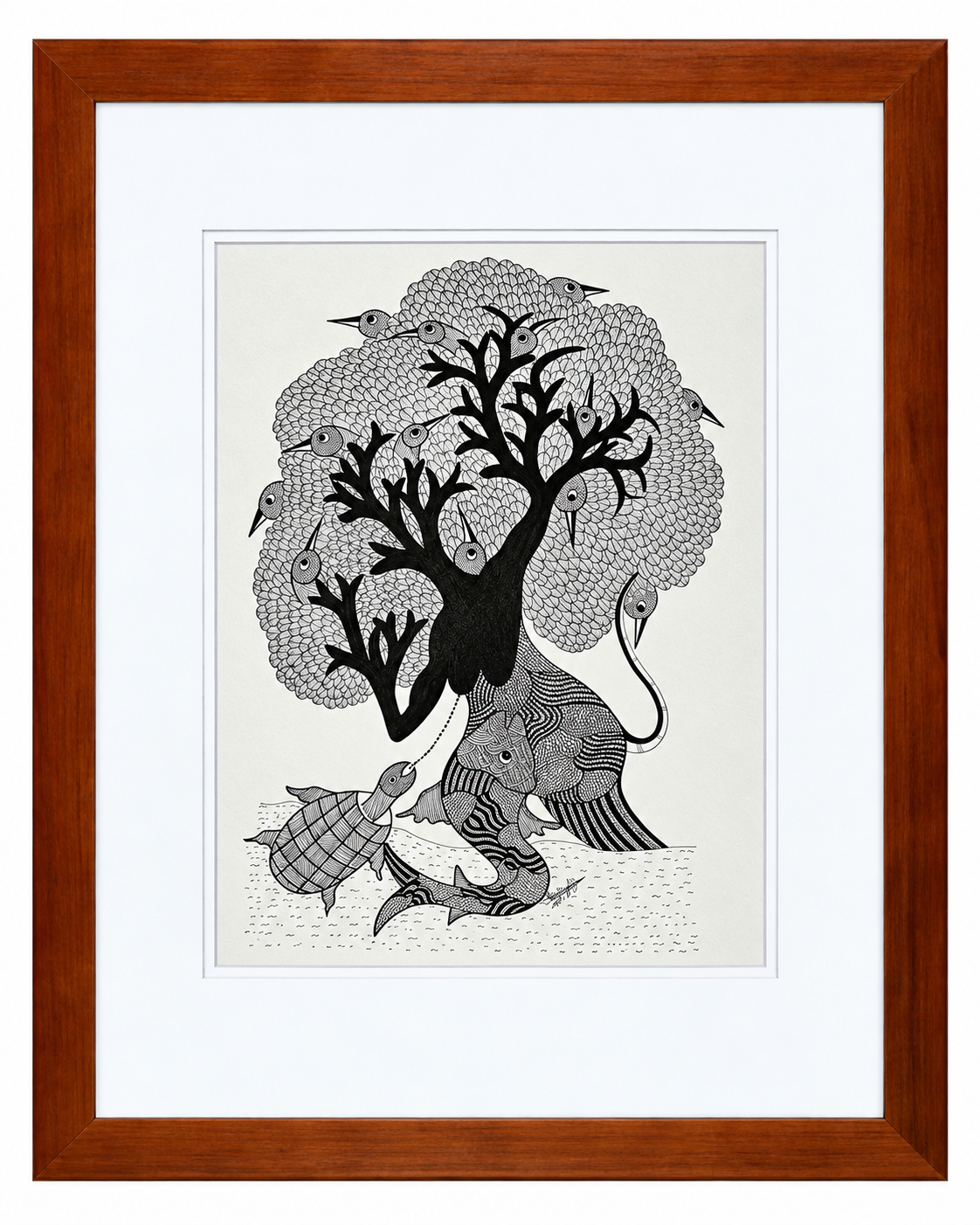
In the second motif, a herd of elephants carries the forest on its shoulders. Anyone familiar with folklore will recognise the logic: an impossible act made to stand for a real anxiety. The elephants cannot defend their home from the pressures of deforestation, so they take it with them, bearing it wherever they go. It is a whimsical image with a serious centre, and the contrast is what gives it force. For the creatures in the picture, the forest is not a collection of trees but a sanctuary, a source of sustenance and a refuge, and the image suggests that if a home cannot be defended, it can at least be carried.
The strength of the motif lies in its indirectness. An image that lectures ages as quickly as the argument it makes, while one that imagines keeps working long after the debate around it has changed. The herd is also a rhythm before it is a subject: repeated forms set up a pulse, and Gond patterning gives each body its own internal texture, so that the group reads as one movement and each animal as a distinct surface.
Fish in a Pond
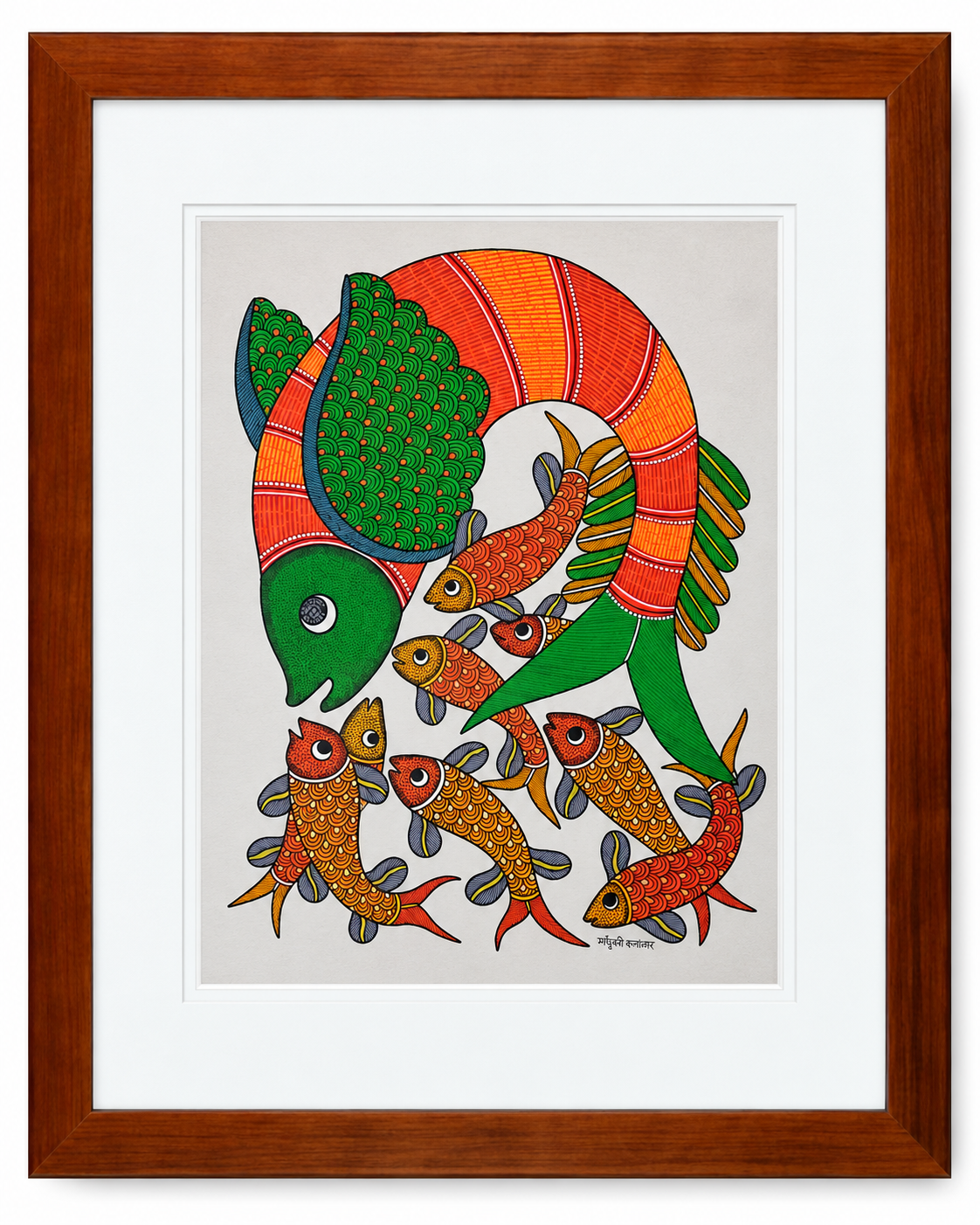
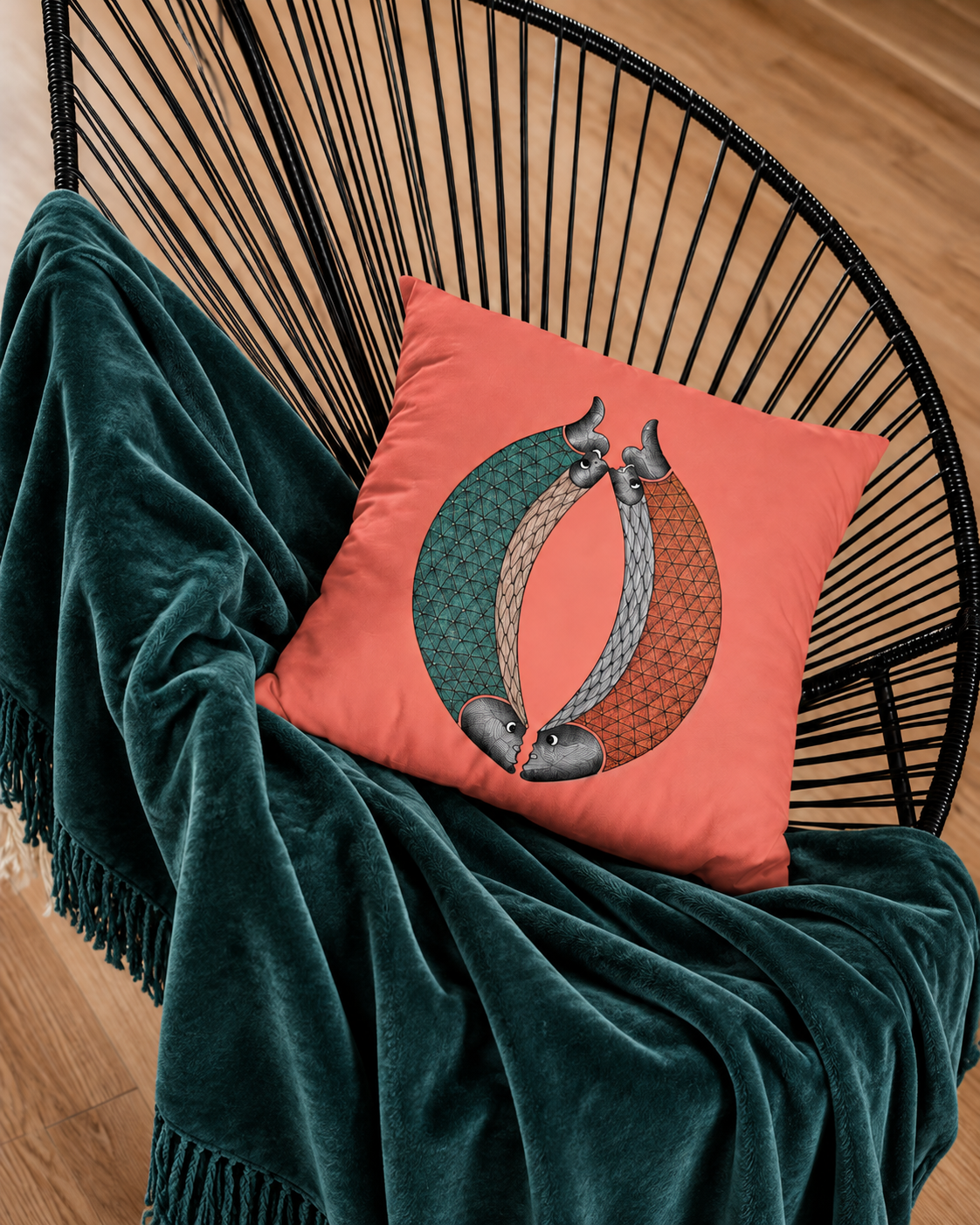
The third motif begins from a boundary. A fish living its whole life in a small pond is unaware of the ocean beyond, and the image speaks to a very human tendency: to be limited by our own experience and surroundings, and to miss the wider world and its possibilities. A pond is a home to one viewer and a trap to another, which is why the image stays open. A work with one fixed message is finished once it is understood. A work whose meaning shifts with the viewer’s circumstances stays unfinished in the best sense.
Design traditions that emphasise balance, feng shui among them, have long treated the objects in a room as part of a wider harmony, and a motif of this kind fits that spirit: a small, bounded world, rendered with care, placed inside a larger one. Whether or not a reader follows such principles, the underlying idea holds. The things we live with quietly shape how we see our own boundaries.



Why the Cushion Is Never Just a Cushion
The covers in the collection are textile objects drawn from original paintings, available in two colourways, Living Coral and Cornflower Blue. Velvet is an unusual carrier for a painted image, and a revealing one. The pile softens every edge and lets colour carry weight, absorbing light so that the image reads as depth rather than shine, and the object is made to be sat against, which changes the relationship with the image from looking to living alongside. The same motif in a warm coral and in a cool blue reads as two different moods, showing how much the cloth changes the picture.
That is also what makes the cushion a considered way into an artist’s world. A cover is the lower-commitment entry point: it brings the imagery into daily contact without the weight of a framed original, and it is meant to be touched, leaned on and eventually replaced. The painting is the work; the cushion is its ambassador. Seen this way, a change of cushion covers is the most accessible form of reinvention a room offers: it does not require a renovation, a large budget or a new layout, only the decision to put something with a story where something neutral used to sit. It echoes the argument made in our reflection on personal ritual, that a life is shaped more by small objects and repeated gestures than by dramatic overhauls.
How do you choose a cushion cover that lasts? Choose for a maker you can name and an image that holds a question rather than a slogan. Look for material that does something the image alone could not, such as velvet that deepens colour, and test the piece by imagining it in a different room. If it only works inside one palette, it is décor. If it holds, it is a work.


Art With a Provenance
As images become cheaper to make than to look at, the scarce signal is evidence of a human process: a named maker, a named place and a method that cannot be faked quickly. In this case the chain is short and specific, an artist from a named village, a documented technique and a brand that credits its collaborators. The wider tradition has its own record of recognition: Bhajju Shyam, a leading figure of the Gond-Pardhan painting tradition, was honoured with the Padma Shri, one of India’s national civilian awards, as listed on the official Padma Awards site. A lineage that can be traced from Jangarh Singh Shyam to today’s emerging artists is the reason a Gond-derived image carries more than its pattern.
For the reader, the habit worth building is simple: ask who made it, where and by what method. An association that can be verified is worth more, over time, than one that merely photographs well. The same instinct runs through our writing on objects chosen for genuine story rather than surface appeal, and it applies equally to a cushion, a painting or a room.

Becoming a Steward of the Story
Each piece in the collection asks something small of its owner: to remember what it depicts. A home filled with objects that carry stories, the forests that speak, the elephants that carry them, the pond that frames a world, becomes a home that quietly keeps those stories alive. In that sense, to live with a Gond-inspired object is to take a modest part in a long conversation between people and the natural world, one that began on the walls of village houses and continues, today, on a sofa. The change it makes is not dramatic. It is cumulative, and it lasts.
“A room is not made
by what is largest in it.
It is made
by what it remembers —
two trees in conversation,
a herd carrying its forest,
a pond that holds a world.
The smallest object
in the room
can carry the longest story.
It only asks
to be lived with.”

