
On why a hotel inside Galle Fort is best read as a cultural artifact that happens to function as a hotel: a seventeenth-century building whose rooms have held Dutch administration, British soldiers, nineteenth-century travellers and contemporary Aman hospitality, inside a World Heritage city that is still lived in.
Amangalla is exclusive because history cannot be replicated.
Long before Amangalla was an Aman, the building had already survived several versions of Galle. It had been a Dutch East India Company building inside a fortified port, a billet for soldiers, and a hotel for travellers moving through a colonial harbour. For generations it carried a name, the New Oriental Hotel, that Galle knew as well as its own ramparts. By the time Aman arrived in the early 2000s, the building possessed more identity than most hotels ever acquire. The task was not to invent a story. It was to avoid erasing one.
This is not a hotel review, and it contains no ratings or lists of amenities. It treats Amangalla as what it also is: a surviving building inside the UNESCO-listed fort of Galle whose architecture has absorbed more than three centuries of political, commercial and social change. The larger question is what makes a luxury hotel historically valuable rather than merely old. The answer proposed here is whether the building still carries evidence of the systems that created it, and Amangalla, embedded in a fortified city shaped by Portuguese, Dutch, British and Sri Lankan histories, is an unusually legible case.
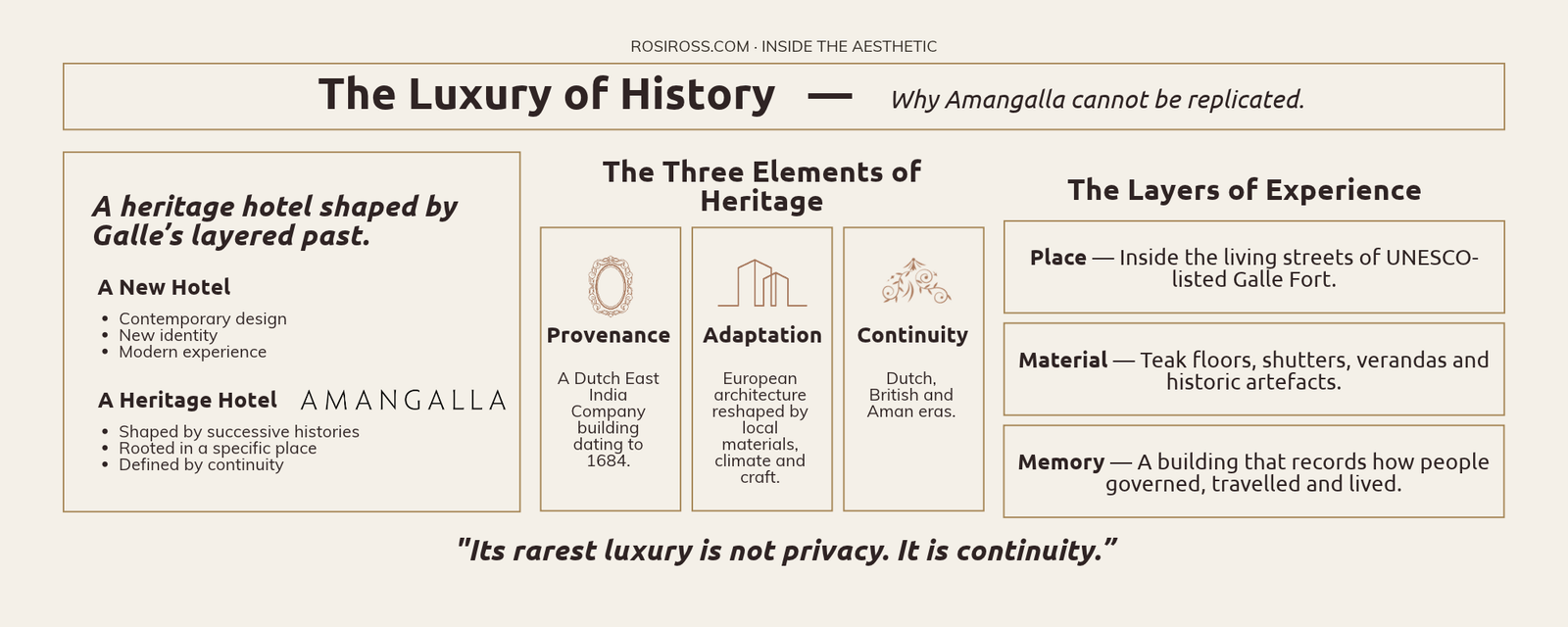
Its exclusivity is therefore of an unusual kind. It is not privacy, scale or newness. It is continuity: Dutch colonial administration, nineteenth-century travel culture, the New Oriental Hotel era, postcolonial Sri Lanka and contemporary Aman hospitality all occupy the same physical structure. That is a product that cannot be manufactured, because what it sells is access to accumulated time.
1684: A Residence Inside the Dutch Fort
Amangalla began as an instrument of colonial administration, not leisure.
Aman’s own materials date the building to 1684 and say it was built by the Dutch East India Company, the VOC. Other accounts add detail that the property’s own text does not. Lonely Planet says it was built to house the Dutch governor and officers, Wikipedia describes the oldest part as built for the headquarters of the Dutch commanders and their staff, with the wider complex completed in stages by around 1715, and hotel histories commonly call it a governor’s residence. The varying descriptions are a useful reminder that a building of this age is not a single event but a sequence, and that its early function is recorded by the institutions that later claimed it.
What is secure is the context. The date places the structure in the period when Galle was becoming one of the most sophisticated fortified port towns in the Dutch colonial network, and it means that the building belongs to the fort’s administrative history before it belongs to hospitality. It stood inside a city whose layout, as UNESCO’s advisers described it, gave prominence to the Commandant’s residence, the arsenal and the powder house, a system that closely linked prosperous trade to military security. The building was part of how an empire organised a harbour.
A seat of authority is also a form of hospitality, in the older sense of the word. Officers, merchants and officials were received, housed and fed within these walls long before a single room was let to a traveller. The building learned its habits of receiving people early, which is one of the reasons the later conversion into a hotel was less of a break than it appears.
What is the history of Amangalla? The oldest part of the building dates to 1684, when it was built inside the Dutch fort at Galle for the Dutch East India Company, described in hotel histories as a governor’s residence. After the British took the fort in 1796 parts of the complex housed soldiers. In the 1860s it became a hotel for travellers moving through the port and later took the name New Oriental Hotel, which it kept until Aman acquired it in 2002. Aman reopened it as Amangalla in the mid-2000s. Exact dates vary slightly between sources.
How old is Amangalla? The oldest part of the building dates to 1684, so the core is more than 340 years old, and the wider complex was completed in stages, with reference accounts giving 1715. Like any heritage structure it has been repaired and adapted over time, so it should not be described as unchanged for three centuries. As a hotel it dates to the 1860s, and as Amangalla to the mid-2000s.
What was Amangalla before it was a hotel? It began in 1684 as a Dutch East India Company building inside the fort, described in hotel histories as a governor’s residence and elsewhere as the headquarters of the Dutch commanders and their staff. After the British took Galle in 1796, parts of the complex were used to house soldiers. It became a hotel for travellers in the 1860s.

Five Lenses and Four Layers of Evidence
A building this old is not one fact. It is a sequence of claims, and a serious reader asks who is making each one.
Five lenses run through what follows. The first is the building itself: its plan, its materials and the way it has been repaired and adapted. The second is the city around it, because a building inside a fortified port cannot be understood apart from the port. The third is empire, the systems of Dutch and British administration that first put the building to use. The fourth is hospitality, the way the premises became a hotel, and then a different kind of hotel. The fifth is conservation, the modern machinery of rules and monitoring that keeps a World Heritage city standing.
The evidence is layered too, and the layers are kept apart on purpose. Dates and descriptions of the city follow UNESCO and its advisers. Dates and descriptions of the hotel follow Aman’s own documents and are labelled as the property’s account. Where histories differ, the differences are shown and not smoothed. And impressions, the smell of old timber in humid weather, say, are labelled as impressions.
| Layer of evidence | Examples in this essay | How it is treated |
|---|---|---|
| The documented record | UNESCO’s World Heritage listing, the ICOMOS evaluation of 1988, state-of-conservation decisions | Used for the history and significance of the city and for conservation pressure |
| The property’s own account | Aman’s copy deck and factsheet: the 1684 origin, the 1863 hotel, the 2002 acquisition, room counts, gardens | Reported as the property’s account, not as settled archival fact |
| Secondary histories | Guidebooks, reference summaries, hotel-history sites | Used where they add colour or an alternative date, and named |
| Impression and legend | Reviewers’ descriptions, claims of the age of floors, anecdotes of past managers | Labelled, hedged, or left out when they cannot be traced |
The purpose of the layers is not to doubt the building. It is to let the reader see how a reputation for age is built.
Why Galle Fort Matters
The hotel only makes sense inside the story of the fort.
Galle was a port long before it was a fortress. The 1988 evaluation prepared for UNESCO’s World Heritage Committee notes that the bay was mentioned as early as the sixth century as a port of call, and that when Ibn Battuta landed in 1344 it was the principal port of the island. The Portuguese settled in 1505, withdrew to Galle in 1588 after a siege at Colombo, and hastily raised a rampart and three bastions on the landward side. The Dutch took the town in 1640 and encircled the whole peninsula with a bastioned stone wall, most of the curtain walls dating from 1663. The result, in the advisers’ words, is a fortified city defended by fourteen bastions that exists today with few changes. The British took the fort on 23 February 1796 and made modest alterations, among them a gate between the Moon and Sun bastions, a lighthouse on the Utrecht bastion and a jubilee tower in 1883.
UNESCO’s advisers concluded that Galle remains the best example of a fortified city built by Europeans in South and Southeast Asia, and the property was inscribed on the World Heritage List in 1988. What they emphasised was not preservation under glass but interaction: an urban ensemble that illustrates the meeting of European architecture and South Asian traditions across several centuries. The fort walls, bastions, drainage, streets and houses form a single urban fabric, not a collection of isolated monuments. The Fort is also not important because time stopped there. It is important because the city continued to be lived in.
That distinction is the hinge of the whole essay. A sealed monument can be admired. A living city has to be negotiated, and a hotel inside it takes part in the negotiation whether it wants to or not.
Why is Galle Fort a UNESCO World Heritage Site? UNESCO’s advisers described Galle in 1988 as the best example of a fortified city built by Europeans in South and Southeast Asia, and an outstanding example of an urban ensemble that illustrates the interaction of European architecture and South Asian traditions from the sixteenth to the nineteenth centuries. The Portuguese began the fortifications, the Dutch built the city that survives, and local materials, measures and climate reshaped the design. It remains a lived-in city.
Is Amangalla inside Galle Fort? Yes. Amangalla lies within the ramparts of Galle Fort, the seventeenth-century fortified city that is a UNESCO World Heritage Site, and guests step directly from the hotel into the fort’s functioning streets, churches, homes, cafés and ramparts. That integration, rather than seclusion, is what distinguishes it.


Architecture Adapted to the Tropics
Galle Fort is not European architecture transplanted. It is European architecture negotiated with a place.
The most important lesson of the fort is adaptation. UNESCO’s advisers stressed that the most salient fact is the use of European models adapted by local labour to the geological, climatic, historic and cultural conditions of Sri Lanka. Coral appears in the ramparts alongside granite. All measures of length, width and height conform to the regional system of measurement. The streets are wide, planted with grass and shaded by suriya trees, and the houses along them have their own gardens and open verandas supported by columns, which the advisers called another sign of the acculturation of an architecture that is European only in its basic design. Beneath it all, a seventeenth-century sewer system was flushed with sea water by a pumping station driven by a windmill on the Triton bastion.
| Feature | What UNESCO’s advisers observed | Why it matters |
|---|---|---|
| Ramparts | Coral is frequently used along with granite | Local geology and materials altered the European model |
| Measurements | All measures of length, width and height conform to the regional metrology | European plans were built to local measure |
| Streets and houses | Wide streets planted with grass and shaded by suriya trees, lined with houses each with its own garden and an open verandah on columns | Climate and everyday life reshaped a European design |
| Street grid | A regular grid adapted to the terrain, with peripheral streets parallel to the ramparts | The city negotiates with its rocky site |
| Drainage | A seventeenth-century sewer system flushed with sea water | Engineering for the tropics, working with the sea |
Drawn from ICOMOS’s 1988 evaluation of Galle for the World Heritage List, which describes European models adapted by local manpower to the geological, climatic, historic and cultural conditions of Sri Lanka.
The ramparts and bastions answer the land as well. Galle sits on a rocky promontory projecting into the Indian Ocean, and the fort’s street grid is adapted to the terrain, with the peripheral streets running parallel to the ramparts. It is an example of architecture negotiating with land, not simply dominating it. Amangalla belongs to this logic. It is a building shaped by rock, monsoon, sea and military necessity, and then by decades of commerce.
The details that make a house of this period habitable are worth naming, because each is an answer to a climatic question. Verandas provide shade and ventilation. Courtyards and gardens organise light and air. High ceilings let heat rise above the people beneath. Shuttered, deep openings admit breezes and exclude the glare. Roof forms respond to monsoon rain. None of these is decoration, and each is the reason the building is still comfortable to be in without having been designed for any modern idea of comfort.
10 Church Street: The Address and the Plan of the House
A hotel that stands at a junction is always part of the street it faces.
Aman’s own description places the hotel at the junction of Church and Middle Streets, with views of the Fort’s ramparts. The address matters. Church Street runs through the old administrative and religious heart of the Fort, and the Groote Kerk, the Dutch Reformed church, stands close enough that some of the hotel’s bedrooms, according to Aman’s factsheet, look onto it. The hotel does not sit behind a drive or a gate set apart from the city. It sits on a corner, which is the most public position a building can hold.
The plan reads as a sequence of rooms of different dignity. The Zaal, or Great Hall, the Dutch word for a main reception room, still receives guests under chandeliers and soaring ceilings that Aman calls fin de siècle, and its doors open to the street. Beyond it, the library holds a collection of memorabilia from the archives of the New Oriental Hotel, which Aman says offers insight into the history of the hotel, the Fort and the town. The chambers face the ramparts from the Church Street wing, and behind the main block a garden holds a pool, a set of ambalamas, the Sinhala word for wayside rest pavilions, and a two-storey Garden House. Aman describes the gardens as some 200 years old.
A plan of this kind, with a public front on the street and a private garden behind, is the standard grammar of the Galle house. The Fort’s residential streets work the same way: a veranda that is half street and half home, a hall, a series of rooms, then a garden that the street cannot see. The hotel is, in this sense, a very large Galle house, and it is useful to read it as one before reading it as a hotel.
Aman’s own factsheet counts 29 rooms, chambers and suites, a figure that varies slightly in other descriptions and is given here once, as context, and not as an amenity. The point is the scale. A building of this size can hold a small number of guests and a large amount of history, and that ratio is part of why the experience feels like a stay in a house and not in a hotel.
1863, 1865 and the New Oriental Hotel Era
The building moved from governing travellers to hosting them.
The date of this transformation is less settled than the legend suggests. Aman’s current materials say the premises opened as the Oriental Hotel in 1863 and was renamed the New Oriental Hotel at the turn of the twentieth century, and The National reports a conversion to the New Oriental Hotel in 1863. Other histories, including one hotel-history site, date the conversion to 1865, with an opening in June 1866 under the Oriental Hotel Company. The accounts agree on the substance: in the second half of the nineteenth century the old Dutch and British building became a hotel for European passengers moving between ships and the port, and for generations afterwards it was known simply as the New Oriental.
A distinction deserves care, because it is easy to blur. On Aman’s dates the building was a hotel for roughly 140 years, from the 1860s until Aman acquired it in 2002, but it carried the name New Oriental for roughly a century of that time, from about 1900. The shorter figure is the name and the longer is the function. Both are real continuities, and both made the building part of Galle’s social memory.
| When | What happened | Source note |
|---|---|---|
| 1684 | The oldest part of the building is built inside the Dutch fort for the Dutch East India Company | Aman gives the date and the VOC origin; Lonely Planet says it housed the governor and officers; Wikipedia says headquarters of the commanders and their staff |
| About 1715 | The wider complex is completed | Reported in reference accounts; the building grew in stages |
| 1796 | The fort passes to the British on 23 February; parts of the complex are used to quarter soldiers | UNESCO’s advisers for the fort; hotel histories for the quarters |
| 1863 to 1866 | The premises becomes a hotel for travellers moving through the port | Aman’s current materials say it opened as the Oriental Hotel in 1863; other histories date the conversion to 1865 and an opening in June 1866 |
| About 1900 | The name New Oriental Hotel takes hold | Aman says it was renamed at the turn of the twentieth century |
| 2002 | Aman acquires the property | Aman’s copy deck: it traded under the New Oriental name until 2002 |
| 2004 or 2005 | Aman opens Amangalla, adding a spa and a new swimming pool to the historic fabric | The brief and most references say 2005; one passage in Aman’s 2025 copy deck says 2004 |
Dates differ between sources, and the building evolved through repair, adaptation and reuse. Treat any single year as the property’s own account and not as settled archival fact.
Was Amangalla the New Oriental Hotel? Yes. Amangalla occupies the building long known as the New Oriental Hotel. Aman’s current materials say the premises opened as the Oriental Hotel in 1863 and was renamed the New Oriental Hotel at the turn of the twentieth century, while other histories date the conversion to 1865. The hotel traded under the New Oriental name until Aman acquired it in 2002 and reopened it as Amangalla in the mid-2000s.
How Travel Changed the Building
The building was hospitality infrastructure long before hospitality became lifestyle.
The New Oriental era lets us ask what international travel looked like before aviation and resort tourism. Hotels in port cities were part of trade routes and administrative networks. Travellers stayed because ships, business, governance and transport brought them there. Lonely Planet records the New Oriental as the lodging of choice for first-class passengers of the P&O steamship line travelling to and from Europe in the nineteenth century, which places the building squarely inside the machinery of imperial shipping. The change of use mirrors Galle’s own: a fortified colonial administrative city increasingly connected to imperial shipping and hospitality.
Modern guests arrive for leisure, but they are following a pattern of movement that is centuries old. The Indian Ocean exchange that carried Arab, South Asian, Portuguese, Dutch and British traders through the harbour is the deeper layer under every polished floor. The mid-century passenger, stepping from a steamer onto the quay and walking up Church Street to a veranda, was making a journey whose final hundred metres has barely changed. That is what a historic hotel in a port offers that a new one cannot: the last hundred metres of a very old route.
The port’s fortunes later shifted, as steamship traffic moved toward Colombo’s harbour, and the New Oriental became a hotel of a quieter and more local kind. That decline, and the person who presided over it, belong to the next layer of the building’s life.
The Twentieth Century: A Hotel Kept by People
Buildings survive when someone decides they will.
The twentieth century belongs to people as much as to institutions. Lonely Planet describes much of the century as a decades-long slow decline during which the hotel was run by the legendary Nesta Brohier, a grand lady who was herself born in room 25. The National calls her a Dutch woman who rescued the hotel from closure and managed it with famous flair. The detail is small and the point is large: the building’s survival depended on particular individuals and on Sri Lankan and Burgher agency, not only on colonial administrators or later on a hotel brand.
A heritage story told only through empires and brands omits the people who kept the lights on in between. The Dutch Burgher community of Galle, descendants of the colonial period who remained after it, is part of the Fort’s living memory, and the names on the floor tombstones of the Groote Kerk nearby are its quiet evidence. A traveller who reads Amangalla as a sequence of rulers has missed the middle of the story, in which a family, a manager and a town kept a historic hotel open when nobody was obliged to.


2005: Aman Arrives
At Amangalla, the luxury intervention is strongest when it is quiet enough for the building to stay visible.
Aman acquired the property in 2002, and describes the opening of Amangalla in the mid-2000s as the beginning of the current era. Most references, and the usual account, give 2005; one passage in Aman’s own 2025 copy deck gives 2004. The brand inherited a building with far more identity than a new property can buy, and the name it chose combines aman, the Sanskrit-derived word for peace, with galla, the Sinhala name for Galle. Its hospitality philosophy has historically favoured low-key service, architectural restraint and a close relationship with place, which makes Amangalla a useful case study in adaptive luxury: the hotel does not need to overpower the structure with a new visual identity.
The additions were the practical ones, a spa and a swimming pool, while the high ceilings, shutters and spatial proportions of the older hotel remained central to the experience. It is worth distinguishing the historic building from the modern interventions, and being plain about which is which. The pool and spa are Aman’s. The Zaal, the verandas and the proportions are older. A guest who knows the difference sees the building more clearly and the brand more fairly.
The discipline of adaptive reuse is mostly a discipline of restraint. Every historic hotel faces the same temptation to add: another wing, another pool, another feature that would be photographed. The harder and more valuable choice is to add only what the building requires and to let the rest of the experience be the building. Whether a given restoration achieves that is a judgement that should be made on site and over time, and not from a brochure.
When did Aman open Amangalla? Aman acquired the property in 2002 and opened it as Amangalla in the mid-2000s, a date given as 2005 in most references and as 2004 in one passage of Aman’s own copy deck. Aman restored the former New Oriental Hotel, retaining much of its historic fabric and furnishings while adding a spa and a new swimming pool. The name combines Aman, meaning peace, with galla, the Sinhala name for Galle.
Why Amangalla Feels Hidden
Amangalla is hidden not by distance, but by history.
Many Aman properties sell remoteness, and Amangalla sells access. It is less visually obvious than a resort-style property because its luxury is embedded in an existing street and architectural system. There is no need for a dramatic arrival through jungle or desert. It hides in plain sight inside the fort, and that discretion is part of its appeal: it is discoverable rather than spectacular. A quiet atmosphere of this kind, produced by proportion, shade and the absence of display, is a different register of luxury from the engineered ambience examined in Inside the Atmosphere Economy: How NEOM Is Redefining Modern Home Wellness , because here the atmosphere is inherited and not designed.
| The hidden Aman test | Why it holds |
|---|---|
| The hotel is integrated into the fort | It is part of the street grid, not set apart from it |
| Its most valuable features are architectural | Time, proportion and material, not spectacle |
| Its history rewards research before arrival | The more you know, the more is visible |
| The city outside matters as much as the hotel inside | Guests step from the hotel into functioning streets |
| Its luxury becomes clearer as the guest understands Galle | It is a property for culturally literate travellers |
Amangalla is hidden not by distance, but by history.
The Exclusivity of Being Inside a Living World Heritage City
You are not removed from Galle. You are placed deeper inside it.
This is the central paradox. The exclusivity is real, but it is not seclusion. It comes from being one of very few ways to inhabit a protected World Heritage city from inside a building that took part in its history. Guests step directly into functioning streets, religious buildings, homes, cafés, government structures and ramparts, and the hotel’s privacy coexists with public urban life. A heritage hotel can either preserve a city’s memory or consume it, and the difference is whether the building stays integrated with the streetscape or turns into a heritage theme park. Here the pool and garden give quiet to the interior, which lets guests experience the fort intensely without leaving it to recover, public history outside and controlled stillness within.
The air of a place like this, the smell of old timber in humid weather, of rain on stone, of the sea carried over the ramparts, is part of what it holds, a reminder that places are remembered through scent as much as sight, as explored in The Language of Scent: How Fragrance Becomes Identity in Modern Beauty. That is an impression and not a measurement, and it is offered as the kind of evidence a building gives to the senses rather than to the archive.
The test of a hotel inside a living city is what happens at its edges. If the street outside the door is still a street, with its own traffic of residents, schoolchildren, shopkeepers and worshippers, the hotel is a participant. If the street has been turned into a corridor of boutiques for visitors, the hotel is a symptom. Galle, at its best, passes the first test, and the discipline of everyone who works and stays here is part of why it continues to.
The Materials That Still Carry the Past
Each material detail should be connected to age, climate, use or historical function.
The hotel is best read through its materials, and each should be understood as more than beautiful. Aman’s own descriptions and independent reviewers describe polished timber floors, high ceilings and shuttered, deep openings that manage heat and light, verandas and courtyard-and-garden relationships that follow the fort’s house type, and a collection of antiques and nineteenth-century artefacts and memorabilia from the New Oriental Hotel’s archive that records the history of the hotel, the Fort and the town. Aman is careful about one point worth repeating: most furniture pieces are either original antiques from the New Oriental Hotel or careful reproductions, so not every visible object is original, and none should be assumed to be.
The floors need the most care. The popular description is of polished teak floors more than three centuries old, and several travel agents repeat it. Aman’s own factsheet is more precise and more modest: it lists jackwood floors in its Bedrooms, Chambers and Suites and teak floors in the Garden Bedrooms and Verandah Chambers. Neither is the same as a documented three-hundred-year-old floor, and the age of any given board should be attributed to the property’s own documentation, and left there, unless independently verified.
| Material | Read it as | Caution |
|---|---|---|
| Polished floors of teak and jackwood | A record of timber craft and long use; Aman’s factsheet distinguishes jackwood and teak by room type | Claims that floors are more than three centuries old come from travel agents, not Aman; do not repeat them as fact |
| Antique furniture | Evidence of the New Oriental Hotel era | Aman says most pieces are original antiques from the hotel or careful reproductions, so not every object is original |
| High ceilings and shutters | Climate management: air, shade and light in a hot, humid port | Interior details have been renewed over time |
| Verandas and deep openings | The Galle house type, with its open verandah on columns | A local adaptation, not a decorative extra |
| Nineteenth-century artefacts and memorabilia | The archive of the New Oriental Hotel, a record of the fort and the town | Displayed as a collection, not as a claim that all items are in their original place |
| Garden and pool | A quiet interior world within a dense urban fabric; Aman describes gardens some 200 years old | The swimming pool and spa are Aman additions, not historic fabric |
Each detail should be read through age, climate, use or historical function, and described as Aman describes it unless independently verified.
Objects that accumulate meaning through time and use, so that the story they carry matters as much as the material, are the subject of The Language of Modern Necklaces: Metals, Stones, and the New Codes of Personal Luxury, and a house like this is, in effect, an inhabited collection of them. Their value lies less in rarity than in having stayed in use.
A Ledger of What Is Known: Record, Property Account and Legend
A historic hotel is trusted when it is clear about which of its stories are documented and which are told.
A table can do what a paragraph cannot, which is to show at a glance how firmly each claim about the building is held. The ledger below sorts the principal claims in this essay by the kind of source that carries them. It is a tool for the reader, and it is offered in the spirit of a good museum label: this is what we know, this is how we know it, and this is what is only said.
| Claim | Carried by | How firmly it is held |
|---|---|---|
| Galle is the best example of a fortified city built by Europeans in South and Southeast Asia | ICOMOS and UNESCO, 1988 | Documented record |
| The oldest part of the building dates to 1684 and was built for the Dutch East India Company | Aman, repeated by Lonely Planet and others | Property account, widely repeated |
| It was a governor’s residence | Hotel histories and Lonely Planet; Wikipedia says commanders’ headquarters | Described differently; attribute it |
| The wider complex was completed about 1715 | Reference accounts | Secondary; stated as reported |
| It opened as a hotel in 1863 | Aman’s current materials and The National | Property account; others say 1865 or 1866 |
| It was called the New Oriental from about 1900 | Aman | Property account |
| Aman acquired it in 2002 and opened Amangalla in the mid-2000s | Aman | Property account; 2004 and 2005 both appear |
| Floors are polished teak more than three centuries old | Travel agents and reviewers | Not documented by Aman; do not repeat as fact |
| Gardens are some 200 years old | Aman | Property account |
| Nesta Brohier rescued the hotel from closure | The National and Lonely Planet | Reported by two sources; attribute it |
The ledger sorts claims by source and does not rank their interest. A claim carried only by the property is not false; it is the property’s account.
Luxury, Conservation and the Pressure of Success
The limitation is part of the value.
Authenticity has operational costs. World Heritage buildings exist within conservation controls, and UNESCO continues to monitor planning, restoration, reuse and the retention of authentic historic fabric in Galle. The record shows a city under real pressure. In 2011 the World Heritage Committee, in decision 35 COM 7B.78, expressed deep concern about the state of the property, and the advisory bodies highlighted its potential vulnerability. By 2021 it was noting that a proposed development of Galle Port had been postponed, while observing that no information had been provided on the traffic situation in the Old Town and that a Tourism Officer was still needed in the Galle Heritage Foundation. In its 2024 decision the Committee noted that the Foundation has adequate staffing but lacks sufficient financial resources, and asked Sri Lanka to investigate mechanisms such as a tourism levy to fund conservation. The same record describes a Heritage Award Scheme intended to encourage residents to remain in the historic houses.
The record continues. A decision of the Committee in 2026 notes that the Galle Port project is on hold, recalls the request for a Heritage Impact Assessment should it proceed, and asks that amendments to the Galle Heritage Foundation Act and to the Urban Development Authority’s regulations for planning in the property be finalised as soon as possible. In other words, the questions that have defined Galle’s conservation for a decade, who has the powers, who pays and what is allowed, remain open. A reader of this essay in the future should check where they stand.
An earlier ICOMOS advisory mission to Galle in 2016 put the central risk in terms that remain useful. It judged that the management of change within the Old Town remained a concern, and that the potential for damage to the cultural values of the Old Town as a living community by large numbers of tourists was a greater threat than the physical works in the harbour. The sentence is a quiet warning to every business that depends on the Fort, including a heritage hotel: the thing that is most valuable is the thing most easily worn away by visiting it.
The paradox is that tourism helps make restoration economically viable, yet excessive commercialisation can erode the residential and social life that makes the fort authentic. That is why Amangalla is best seen as part of a conservation economy and not as a luxury product dropped into a protected zone. The protection that keeps the walls standing is the same barrier of rules that lets everything inside continue to function, a logic of preserving the boundary on which the rest depends, as in The Return of Barrier Beauty: Why Lanolin Is the Ultimate Skin Investment. It also means that the hotel’s fortunes are tied to the fort’s: a hotel in a fort that loses its residents loses the thing it was selling.
| Year | UNESCO record | What it says about the pressure |
|---|---|---|
| 2011 | Decision 35 COM 7B.78: deep concern; advisory bodies highlight potential vulnerability | Development pressure and weak conservation control were the early worry |
| 2021 | Port development postponed; no information on traffic in the Old Town; a Tourism Officer still needed | The pressure shifted toward traffic and visitor management |
| 2024 | Heritage Foundation has adequate staff but lacks funds; a tourism levy suggested; Heritage Award Scheme to keep residents in historic houses | Funding and residential life became the central questions |
| 2026 | Port project on hold; amendments to the Foundation’s Act and planning regulations to be finalised | The legal powers to manage change are still being completed |
Dates and wording follow UNESCO’s state-of-conservation pages and decisions; verify the latest decision before relying on this table.
The Colonial Tension
The right stance is neither apology nor nostalgia. It is historical literacy.
The architecture is beautiful, and it should not be allowed to romanticise colonialism. The building began inside a system of Dutch colonial administration and was later part of British colonial travel and garrison life. Sri Lanka inherited, adapted and repurposed that material history, and the building’s meaning no longer belongs exclusively to the people who built it. It now sits within Sri Lanka’s tourism economy, cultural memory and urban life, and it is kept alive by local managers, craftspeople, conservators and the residents of the fort.
That raises a thoughtful question: who owns heritage after empire? A building created under colonial rule can become part of the heritage of the country that outlived that rule, and it is the continuing life of that country in the building that makes it compelling. The labour that raised the walls, laid the floors and shaped the courtyards was local, and UNESCO’s own language credits the adaptation of European models by local manpower. Reading the building honestly means reading that labour as authorship and not as background.
The difference between old and historic follows. A building is old because time has passed. It is historic when its physical fabric can explain how people once governed, travelled, traded, socialised and lived, and Amangalla qualifies because its successive uses tell the story of Galle’s transformation. Even the architecture of power, with its elevated rooms, thick walls and controlled thresholds, is legible once you know how to read it, the way form expresses authority in any designed object, as The Architecture of Power: How Sculptural Footwear Defines Modern Luxury explores.
Why is Amangalla historically important? Because the building has been part of Galle’s governance, commerce, colonial travel culture, postcolonial life and contemporary hospitality, and its fabric still shows how those uses succeeded one another. It is historic and not merely old because its physical form can explain how people once governed, travelled, traded and lived in the port, while the fort around it continues to be lived in.


Why Amangalla Could Not Exist Anywhere Else
The best heritage hotels are geographically non-transferable.
If the building were copied exactly in another country it would no longer be Amangalla. Its identity depends on the fort, the street grid, the Indian Ocean, the port history and the specific sequence of political eras that shaped Galle. That is one of the strongest tests of meaningful luxury: whether the thing could be moved. Luxury hospitality increasingly values provenance because provenance cannot be rapidly manufactured, and in an era when new hotels can be designed to look old within a few years, an actual seventeenth-century building has a different kind of authority. Patina is valuable because real time is impossible to scale, the same principle that makes an object with a documented origin worth more than an identical one without, as in The Return of the Pearl: Inside the Quiet Luxury of Robert Wan .
Aman’s other property on the southern coast shows the contrast. Amanwella, above a crescent bay near Tangalle, is a contemporary design by Kerry Hill that draws on the tropical modernism of Geoffrey Bawa, an experience of coastline, coconut grove and fishing community. Together the two show two completely different ways Aman interprets Sri Lanka. The economics of the second, where a very small number of keys on a large site carry their own authority, are explored in Amanwella: Why Space Is the Rarest Luxury in Sri Lanka , and the two coasts that frame the pairing are compared in Galle or Tangalle? Two Sri Lankan Coasts, Two Different Luxuries .
| Amangalla | Amanwella | |
|---|---|---|
| Setting | Inside the walls of Galle Fort, a living World Heritage city | A crescent bay near Tangalle, among coconut palms |
| Idea | History, architecture, urban heritage and cultural density | Nature, coastal landscape and modernist restraint |
| Architecture | A seventeenth-century Dutch building adapted over centuries | Contemporary design by Kerry Hill, inspired by the tropical modernism of Geoffrey Bawa |
| Relationship to place | Embedded in streets, homes, churches and ramparts | Defined by beach, grove and fishing community |
| What it is for | Understanding Galle from inside it | Slowing down beside the ocean |
Two different ways Aman interprets Sri Lanka. Amangalla is the more historically layered of the two. Amanwella has 28 suites in Aman’s June 2026 factsheet; older material gave 30.
What makes Amangalla different from Amanwella? Amangalla is a historic building inside the fort at Galle, where the experience is about architecture, urban heritage and cultural density. Amanwella, near Tangalle on the south coast, is a contemporary resort of 28 suites designed by Kerry Hill, inspired by Geoffrey Bawa’s tropical modernism, set above a crescent bay among coconut palms, where the experience is about nature and physical seclusion. Amangalla is the more historically layered of the two. Older material gives Amanwella 30 suites.
What Anyone Should Notice While Staying
A historic building teaches the attentive guest and ignores the hurried one.
What should a guest notice while staying at Amangalla? The essay has argued that this is a building to be read, and reading is a skill that can be practised. It begins at the street. Stand at the corner of Church and Middle Streets and notice how the hotel presents itself to the lane: it sits on a junction in the Fort’s street grid, with its doors open to the street and not set back behind a drive, and that public position tells a visitor more about the building than any description of its rooms.
Inside, the proportions matter more than the finish. Treat the age of any floorboard as the property’s own claim, and notice instead how the height of a ceiling changes the way sound and heat behave, and how the shaded interiors answer the tropical climate. Notice where the breeze enters and where the glare is kept out. These are the working parts of a house designed for a hot, humid port, and they explain why the building is comfortable without having been designed for any modern idea of comfort.
The city is part of the stay as much as the hotel is. A few steps from the garden, the Fort is a working neighbourhood, and how quickly public urban life resumes once a guest steps outside is the clearest sign that this is a living city and not a heritage backdrop. The ramparts and the sea belong to the hotel’s larger geography too: the sea that shaped the walls is the sea that brought the first guests. And a careful guest will also notice how colonial architecture has been adapted into contemporary Sri Lankan hospitality, who works here, and whose skill keeps the building running, because a house of this age survives through people as much as through stone.
For readers who apply the same attention to what they choose to own, our guide to timeless luxury fashion pieces asks a similar question of a wardrobe: what still holds its worth when the season passes. The answer is often the same: provenance, patience and a limited supply of something that cannot be reproduced quickly.
How To Read Any Heritage Hotel
A heritage hotel is easy to book and harder to read. These questions make it readable.
How can a traveller tell whether a heritage hotel is authentic? The answer is a habit of attention and not a scorecard, and it begins with the building itself. A hotel that cannot say what its building is made of, and what it was originally for, is probably selling the picture. A property that can answer both is treating its history as evidence and not as decoration.
The second test is honesty about age. Honest properties distinguish the historic fabric from their own additions, as Amangalla’s spa and pool are distinguished from the older house, and they are careful about which objects are original and which are reproductions. A heritage hotel that claims everything is old is less credible than one that says plainly what is new.
The third and fourth tests look outward. Buildings survive because particular people choose to keep them, so it is worth asking who decided this one would survive, and who still keeps it. And the street outside should still be a street: if residents, shops and worship continue around the building, it is part of a city, and if they do not, it is part of a product.
The last test is the simplest, and perhaps the most revealing. Would the place still be worth visiting without the hotel? If so, the hotel is a guest in something larger, and it is behaving like one. If not, the hotel is the product, and the history around it is only scenery.
What Remains Defines the House
Its rarest luxury is not privacy. It is continuity.
As luxury becomes easier to reproduce visually, heritage properties with real institutional memory become more valuable, and Amangalla’s strongest future asset is not expansion but disciplined preservation. It becomes more exclusive as the world becomes more generic, because its history cannot be copied without becoming false.
The story is not that Amangalla is a beautiful historic Aman in Galle Fort. It is how a seventeenth-century building moved from Dutch colonial administration to nineteenth-century hospitality, survived political and social transformation, and became one of Aman’s most historically significant properties, all while remaining embedded inside a protected city that is still lived in. Its rarest luxury is not privacy. It is continuity.
The finished thought is the one the opening began with. A building that has been a headquarters, a barracks, a port hotel and a modern restoration has been several different places while staying in one location, and a guest who sleeps there sleeps inside all of them at once. What the property sells is not a room. It is access to accumulated time.
“Amangalla is exclusive
because history cannot be replicated.
It is hidden not by distance, but by history.
Patina is valuable
because real time is impossible to scale.
Its rarest luxury is not privacy.
It is continuity.”

