
On why the Arabian desert is not Dubai’s backdrop but its foundational cultural environment, how Bedouin traditions of hospitality, resourcefulness, and environmental knowledge became the social codes of a nation, what Arabic coffee and the majlis reveal about the deep structure of Emirati society, why falconry and camel culture are not folkloric survivals but living systems of knowledge, and what the Al Marmoom Desert Conservation Reserve teaches the traveller that no museum in Dubai can
Dubai is most frequently encountered through what it has built: the towers, the hotels, the shopping districts, the aviation infrastructure, the artificial islands, the record-breaking constructions. This is a legitimate encounter with an extraordinary city. But it is an encounter with a conclusion rather than with the argument that produced it. The argument — the cultural logic that explains why hospitality is treated with such seriousness in Emirati society, why generosity operates as a social obligation rather than a personal preference, why the desert is still crossed in the early morning hours by people who could perfectly well stay in air-conditioned rooms — begins not in the city but in the landscape that preceded it. To understand Dubai, it helps considerably to first understand what the desert demanded of the people who lived in it.
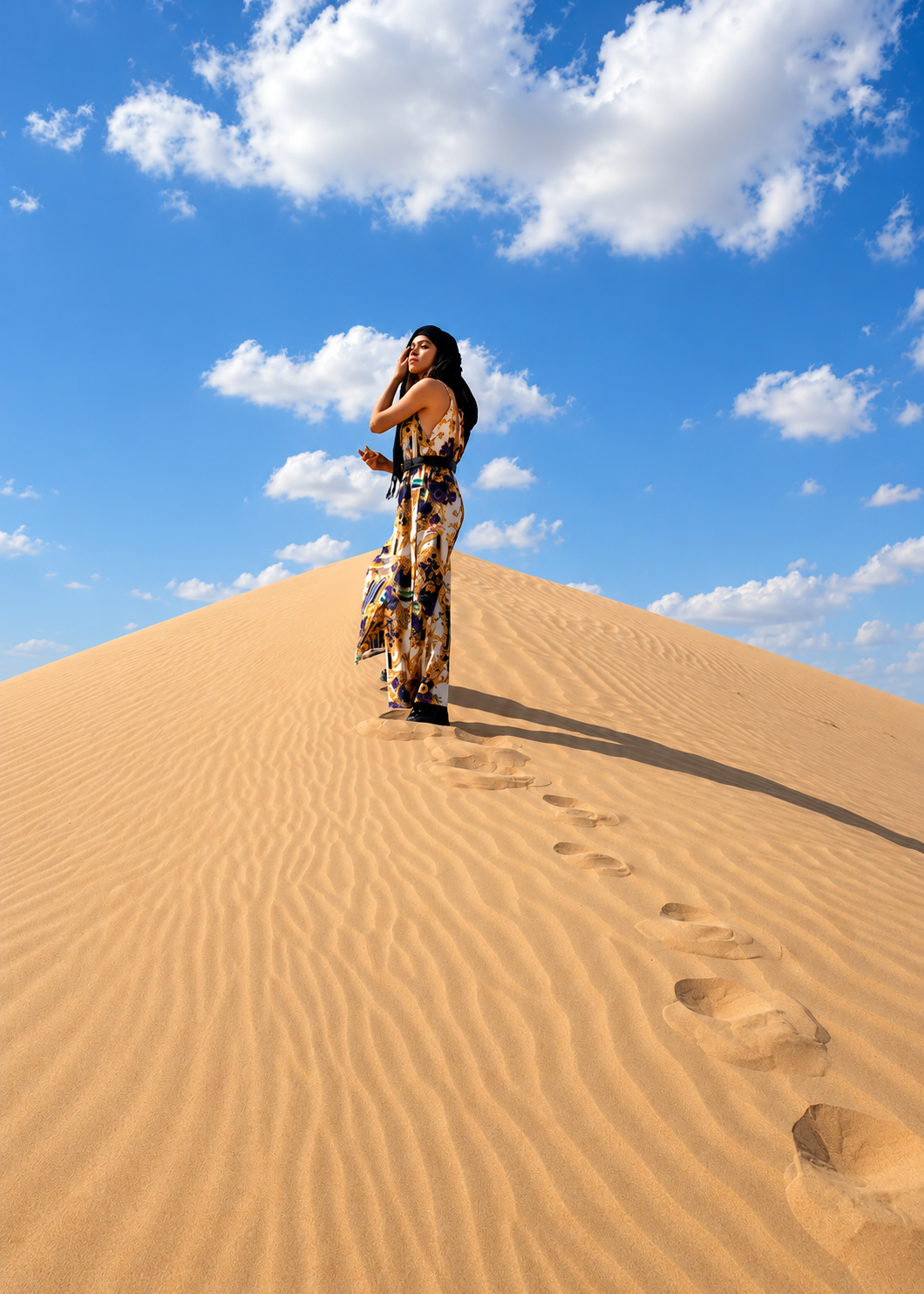
The Arabian Peninsula’s desert environment is not empty. It is a precise, demanding ecosystem with its own internal logic — one that has shaped the social organisation, material culture, spiritual life, and aesthetic traditions of the communities that have inhabited it across centuries of continuous adaptation. Bedouin communities — the Arabic term bedu means desert dwellers, and the Bedouin tradition encompasses a range of nomadic and semi-nomadic peoples across the Arabian Peninsula, North Africa, and the Levant — developed within the Arabian Gulf’s desert environment a specific body of knowledge about water, animals, navigation, food preservation, plant medicine, and social obligation that is among the most sophisticated environmental adaptations in human history. This knowledge, refined across generations, became the foundation of social codes that persist in Emirati culture today with a continuity that is far more than ceremonial.
What the desert demanded — the intelligence of extreme adaptation
The Arabian desert’s environment imposes specific and unforgiving requirements on the communities that inhabit it. Water must be found, remembered, shared, and conserved with a precision that no urban dweller accustomed to municipal infrastructure can fully appreciate. Food must be preserved in conditions that would rapidly spoil it. The temperature range — extreme heat by day, surprising cold by night, seasonal variation that would be dramatic by temperate standards — demands clothing systems and shelter solutions of considerable sophistication. Navigation across a landscape without fixed permanent markers requires the memorisation of star patterns, wind directions, dune formations, and the movement of animals whose behaviour communicates information about water and weather. The social organisation required to survive in this environment — the distribution of resources, the obligations of hospitality, the management of inter-tribal relations — required frameworks of custom and obligation that functioned, in the absence of formal legal and administrative structures, as the community’s primary means of social order.
The most important insight the desert provides about Emirati social culture is this: many of the values and practices that contemporary visitors experience as forms of luxury hospitality — the generosity with food and drink, the insistence on the comfort of guests before the comfort of hosts, the unhurried quality of social encounter, the specific rituals of welcome — originated not as aesthetic preferences but as survival requirements. In an environment where a traveller arriving at a settlement might be carrying no water, no food, and no knowledge of the terrain ahead, hospitality was the social infrastructure that made movement possible. To refuse a traveller food, water, and shelter was not simply an act of meanness. In certain conditions, it was an act of endangerment. The desert made generosity a moral obligation by making survival dependent on it. The most deeply rooted hospitality cultures in the world are always those in which the care of guests was, at some historical point, a matter of genuine consequence — and Emirati hospitality is among the most ancient and most specifically grounded of these.
Bedouin culture refers to the traditions, social organisation, and knowledge systems of the nomadic and semi-nomadic Arab peoples (Arabic: Bedu, meaning desert dwellers) who historically inhabited the desert and arid regions of the Arabian Peninsula, the Levant, and North Africa. In the context of the UAE and the broader Arabian Gulf, Bedouin traditions represent a significant strand of the social and cultural heritage that has shaped Emirati identity alongside the traditions of the settled coastal and oasis communities and the maritime fishing and pearling cultures of the Gulf. Bedouin social organisation was based on tribal structures, with a strong emphasis on collective obligation, hospitality, oral tradition, and the careful management of scarce natural resources. The practices most visibly preserved in contemporary Emirati culture — Arabic coffee (gahwa), the majlis, falconry, camel culture, traditional dress (the kandura and abaya), and the specific ethics of hospitality — draw significantly from Bedouin heritage. Falconry and the art of camel breeding and husbandry are both inscribed on UNESCO’s Representative List of the Intangible Cultural Heritage of Humanity in recognition of their deep roots across Arabian Gulf cultures.
Arabic coffee and the majlis — hospitality as a social system
The two most persistent expressions of Bedouin hospitality in contemporary Emirati culture are the majlis and the Arabic coffee ritual — and understanding either of them properly requires understanding the social function they performed in the desert environment from which they emerged. The majlis — from the Arabic verb jalasa, to sit — is a designated gathering space in which community members meet, converse, negotiate, share information, tell stories, and resolve disputes. In the Bedouin context, the majlis was the primary institution of social governance: the space in which collective decisions were made, in which elders transmitted knowledge to younger generations, in which visitors were received and assessed, and in which the community’s relationship with other groups was managed. It was simultaneously a living room, a court, a council chamber, and a library — and the cultural norms that governed behaviour within it — the obligation to listen, to speak with measured deliberateness, to treat every guest as a person of significance regardless of social standing — were the governance codes of a society without written law.
Arabic coffee — gahwa — is the drink of the majlis, and its preparation and serving are among the most specifically codified rituals in Gulf culture. Gahwa is prepared from lightly roasted green coffee beans, ground with cardamom in a wooden mortar whose rhythmic sound traditionally announced to the surrounding community that coffee was being prepared and guests were being welcomed. It is served in small handleless cups (finjan) from a long-spouted brass or silver coffee pot (dallah) — the dallah being one of the most recognisable symbols of Emirati heritage, appearing on the dirham coin and across the iconography of UAE cultural institutions. The quantity served communicates social information: a cup filled to approximately one third indicates a welcome to stay; a cup overfilled signals that the host considers the visit concluded. The guest signals satisfaction by gently tilting the empty cup from side to side. These are not decorative customs. They are a precise non-verbal communication system evolved for a context in which the management of scarce resources — coffee, water, time, hospitality — required an agreed social language. The most enduring cultural rituals are always those most specifically calibrated to the real conditions that produced them — and the Arabic coffee ceremony is among the most elegant available examples of form following function across centuries of cultural transmission.
Gahwa is the Arabic term for the spiced coffee served across the Arabian Gulf as the primary beverage of hospitality, social gathering, and formal welcome. It is prepared from lightly roasted green or lightly golden coffee beans — giving it a pale golden-green colour distinct from the dark roast of European coffee — ground with cardamom (and sometimes saffron, cloves, or rose water, depending on regional tradition) in a wooden mortar (mihbash) whose rhythmic sound traditionally announced to the surrounding community that a guest was being welcomed. Gahwa is served in small handleless cups (finjan) from a long-spouted brass or silver coffee pot (dallah) — the dallah being one of the most reproduced symbols of Emirati cultural heritage. The quantity served carries social information: approximately one-third full signals a welcome to remain; a cup overfilled signals that the visit is concluding. The guest tilts the empty cup gently from side to side to indicate satisfaction. The entire ritual — preparation, serving, and the non-verbal communication it encodes — is a precise social language evolved for an environment in which the management of scarce resources and the navigation of inter-community relationships required shared codes of extraordinary specificity. Arabic coffee was inscribed on the UNESCO Representative List of the Intangible Cultural Heritage of Humanity in 2015, with Saudi Arabia, UAE, Oman, and Qatar as co-holding nations.




The camel — infrastructure, not accessory
The dromedary camel — Camelus dromedarius — is not, in the context of Arabian Peninsula cultures, a picturesque animal or a tourist prop. It is historical infrastructure: the technology that made long-distance overland travel, trade, and communication possible across an arid environment that would otherwise have been impassable. The camel’s physiological adaptations to desert conditions — its ability to tolerate body temperature variation of up to six degrees Celsius without sweating, to survive without water for up to two weeks in cool weather, to carry loads of 200 to 300 kilograms across sand at speeds that horses cannot sustain in heat — made it the essential tool of Arabian mobility and commerce for millennia. The Silk Road’s Arabian branch, the frankincense trade routes of southern Arabia, the movement of communities between seasonal pastures, the communication between settlements separated by hundreds of kilometres of desert — all of this was made possible by the camel in a way that no other animal could replicate in this specific environment.
Beyond transport, the camel was a complete resource system: its milk, nutritionally rich and far more tolerant of heat than cow’s milk, was a dietary staple across regions where other dairy animals could not survive; its meat was an important food source; its hair was woven into textiles for tents and clothing; its dried dung served as fuel. The knowledge required to breed, train, and maintain camels — an expertise transmitted across generations within specific families and tribes — was among the most valued in the social hierarchy of Bedouin communities. The esteem in which camels are held in contemporary Emirati culture — visible in camel racing (a major sporting tradition with deep cultural roots), camel beauty competitions, and the extraordinary sums paid for prized breeding animals — is not nostalgia. It is the continuation of a recognition that the camel represents a form of accumulated human and animal intelligence that took centuries to develop and that no modern machine has precisely replicated for the specific conditions of desert movement and resource provision. The most enduring relationships between human communities and the natural environment are always those in which the relationship has been refined across sufficient time for a genuine mutual adaptation to occur — and the relationship between Arabian communities and the dromedary camel is among the oldest and most thoroughly developed of these.

Falconry — hunting as environmental knowledge
Falconry in the Arabian Gulf context is among the oldest continuously practised human-animal partnerships in the world, with documented evidence of the practice across the Arabian Peninsula dating to at least the first millennium BCE and oral traditions extending its roots considerably further. It was inscribed on UNESCO’s Representative List of the Intangible Cultural Heritage of Humanity in 2016 — a recognition that falconry represents not simply a hunting technique but a comprehensive system of environmental knowledge, animal husbandry, cultural transmission, and human-animal relationship that has been maintained across cultures and generations. Fourteen countries, including the UAE, are co-holders of the inscription.
In the desert context from which Emirati falconry tradition developed, the falcon was a hunting partner of genuine practical importance. Houbara bustards — the primary quarry of traditional Gulf falconry — provided food in an environment where protein sources were scarce and hunting required covering vast areas of terrain that no human could traverse effectively alone. The falcon’s aerial perspective, speed, and hunting ability extended the hunter’s reach across the desert landscape in ways that expanded the food supply available to the community. The training of a falcon for hunting — a process of extraordinary patience and specific knowledge, requiring the falconer to develop an intimate understanding of the individual bird’s temperament, physical condition, and behaviour across changing environmental conditions — was a form of environmental education as much as a practical skill. A skilled falconer understood the desert through the falcon’s relationship with it: the birds that the hawk hunted, the thermals it rode, the weather patterns it responded to. The falcon was a living instrument for reading the landscape. The UAE’s investment in heritage preservation institutions — including the Hamdan Bin Mohammed Heritage Center, which actively supports the continuation of falconry and other traditional practices — reflects the understanding that this form of environmental knowledge, once lost, cannot be reconstructed from documentation alone. It exists only in continuous practice.
Falconry — the art of training birds of prey to hunt in partnership with humans — was inscribed on UNESCO’s Representative List of the Intangible Cultural Heritage of Humanity in 2016, with the UAE among fourteen co-holding nations. In the Arabian Gulf context, falconry has been practised for at least three thousand years and represents a comprehensive system of knowledge encompassing the training and care of birds of prey, the understanding of desert ecology and prey behaviour, the social transmission of specialist skills across generations, and the ethical framework governing the human-animal relationship in the hunting context. In the UAE, falconry is institutionally supported by the Hamdan Bin Mohammed Heritage Center, which organises the Dubai International Falcon Conference and the annual hunting season, and by the Abu Dhabi Falconers’ Club. The Houbara bustard — the primary traditional quarry of Gulf falconry — has been the subject of significant conservation programmes supported by the UAE government, reflecting the recognition that the preservation of the hunting tradition requires the preservation of the ecological system it depends upon. Contemporary UAE falconry bridges the historical practice and institutional heritage conservation in a way that distinguishes it from purely ceremonial preservation.


Women’s knowledge — the cultural transmission that history rarely records
The history of Bedouin culture that reaches most easily into public record is the history of the public sphere: the majlis, the trading routes, the hunting expeditions, the tribal negotiations. The knowledge systems that sustained the community’s domestic and biological continuity — the management of food and water, the preservation of medicinal and botanical knowledge, the production of textiles and material goods, the transmission of oral tradition, the practice of beauty and healthcare — are less frequently documented but no less consequential. In the social organisation of traditional Bedouin communities, women were the primary custodians of household resource management: the knowledge of which desert plants had medicinal properties, which could be used in food preparation, which were toxic; the techniques for preserving dates, milk, and meat in conditions that would rapidly spoil them; the weaving of textiles from camel and goat hair into the material fabric of camp life; the preparation of henna and natural cosmetics from botanically derived ingredients; the transmission of songs, stories, and collective memory to the next generation.
This body of knowledge — botanical, nutritional, textile, medical, cultural — represents one of the most practically significant intellectual achievements of desert civilisation, and it was transmitted almost entirely through domestic practice and oral tradition rather than through the written record that historians have typically used to reconstruct the past. The contemporary interest in natural and botanical beauty ingredients, in traditional food preservation techniques, in artisanal textile production — all of these connect to a body of knowledge that women in Gulf communities maintained across generations of desert life. Cultural continuity is not created only through monumental architecture or formally documented history. It is also transmitted through domestic knowledge, craft, and everyday ritual — and the most complete understanding of Emirati heritage recognises the women who carried this knowledge as among its most essential custodians.

Henna, rose water, and the beauty of the desert
The beauty practices of traditional Arabian Gulf communities were not aesthetic luxuries. They were knowledge systems shaped by the specific requirements of desert life — by the need to protect skin from extreme sun exposure and temperature fluctuation, to maintain cleanliness in conditions of water scarcity, to manage the physical demands of a mobile outdoor life through the resources available in the natural environment. Rose water — produced by steam distillation of rosa damascena petals — served simultaneously as a cleansing agent, a skin tonic, a cooling preparation, a social greeting ritual, and a fragrance. Its production required specific botanical knowledge and distillation technique; its application was embedded in social ceremony — the pouring of rose water over a guest’s hands upon arrival at a settlement being among the most ancient and most persistent expressions of Emirati welcome. The relationship between fragrance and skin in hot, arid climates is different from that in temperate environments — the skin’s temperature and the dry heat both amplify the behaviour of aromatic compounds, making rose water’s effect in a Gulf desert context qualitatively different from its effect in a European garden.
Henna — the dried and powdered leaves of Lawsonia inermis, the henna plant — has been used across Arabian, South Asian, and North African cultures for at least five thousand years, with evidence of its use in ancient Egypt and across the Arabian Peninsula as a cosmetic, medicinal, and ceremonial material. Its cooling properties — the evaporation of the water in henna paste produces a cooling sensation on the skin — made it practically valuable in the heat of desert summers as well as ceremonially significant as a preparation for marriage celebrations, Eid gatherings, and other social occasions. Argan oil, frankincense resin used as incense and skin treatment, black seed (Nigella sativa) oil, and various botanical preparations from date palms and desert plants formed a material pharmacopoeia of skin and health care that represented the accumulated botanical knowledge of communities who had no access to imported pharmaceutical products and who therefore developed an intimate understanding of what the local environment could provide. These are not alternative remedies in the contemporary wellness sense. They are the primary medical and cosmetic knowledge of a specific civilisation in a specific environment — and they deserve to be understood as such.
The Al Marmoom Desert Conservation Reserve — heritage and ecology together
The Al Marmoom Desert Conservation Reserve is the largest unfenced desert conservation area in the UAE, covering approximately 10% of Dubai’s total land area. Established under an initiative launched by Sheikh Mohammed bin Rashid Al Maktoum, Vice President and Ruler of Dubai, it encompasses the dune landscape southeast of the city alongside an extraordinary ecological dimension: the native Ghaf tree (Prosopis cineraria), the desert’s most important indigenous tree species, which provides shade, fixes nitrogen in the sandy soil, and supports a range of wildlife including Arabian oryx, gazelles, more than 200 bird species, and various reptiles. The Ghaf tree’s capacity to survive in extreme aridity without irrigation — its root system extends up to thirty metres deep to reach groundwater — makes it the desert’s most visible symbol of ecological resilience, and its designation as the UAE’s National Tree reflects both its ecological importance and its cultural significance as the tree under whose shade Bedouin communities rested, sheltered their animals, and gathered.
The Al Marmoom Bedouin Experience, supported by the Hamdan Bin Mohammed Heritage Center, operates within this conservation landscape as a curated interpretation of Bedouin heritage — a reconstructed village built with traditional materials in which visitors can encounter camel culture, falconry demonstrations, the majlis, Arabic coffee ritual, traditional food, basket weaving, and the botanical knowledge of the desert. The experience is honest in its framing: it is a deliberately constructed educational encounter with Bedouin traditions, not an ethnographic immersion in an unchanged way of life. The distinction is important and credit-worthy — the Al Marmoom experience does not claim to be something it is not. What it offers instead is something genuinely valuable: a curated encounter with the specific body of knowledge — ecological, social, culinary, botanical, and cultural — that the desert environment produced and that Emirati society continues to honour as the foundation of its contemporary identity. The most consequential heritage preservation projects are those that understand the distinction between preservation and performance — between the transmission of living knowledge and the staging of a spectacle — and the Al Marmoom initiative operates, at its best, on the right side of that distinction.
The Al Marmoom Desert Conservation Reserve is the largest unfenced desert nature reserve in the UAE, covering approximately 10% of Dubai’s total land area southeast of the city. It was established under an initiative launched by Sheikh Mohammed bin Rashid Al Maktoum to preserve the natural desert ecosystem and provide a protected habitat for native wildlife. The reserve is home to the native Ghaf tree (Prosopis cineraria — the UAE’s National Tree), Arabian oryx, gazelles, and more than 200 recorded bird species. Its infrastructure includes ten animal and bird observation platforms, an outdoor theatre, and a solar power complex. The Al Marmoom Bedouin Experience — supported by the Hamdan Bin Mohammed Heritage Center — operates within the reserve as a heritage tourism programme offering curated encounters with Bedouin traditions including camel culture, falconry, the majlis, Arabic coffee ritual, traditional Emirati breakfast, basket weaving, and botanical knowledge. The combination of desert ecosystem conservation and Bedouin heritage interpretation within a single protected landscape reflects the UAE’s approach to environmental and cultural preservation as interconnected rather than separate dimensions of national heritage.

From desert settlement to global city — the cultural continuity that modernity did not erase
The distance between a Bedouin camp in the Al Marmoom desert and the Burj Khalifa is approximately forty kilometres. The distance between the culture that the camp represents and the culture that the tower has grown from is less than it appears. Modern Dubai is characterised by global migration, technological ambition, luxury infrastructure, and extraordinary architectural invention — and it is simultaneously characterised by a hospitality culture that still treats the welcoming of guests as a social obligation, by a majlis tradition that still functions as a space of community and deliberation in Emirati homes, by a relationship to coffee ritual and date sharing that still carries the weight of the social codes that desert life produced. These things coexist not as contradiction but as continuity.
The most useful insight that a desert experience near Dubai provides is not the exotic framing of an “old Arabia” in contrast to a modern city. It is the more interesting recognition that modernity in the UAE has not replaced its cultural heritage but created a new context in which that heritage is being actively preserved, institutionally supported, and deliberately transmitted to the next generation. The falconry competition, the camel beauty pageant, the Arabic coffee served at the beginning of every formal meeting, the majlis maintained in every Emirati home alongside its contemporary sitting rooms — these are not folkloric survivals clinging to the margins of a modernising society. They are the forms through which a society that has changed faster than any other in living memory continues to recognise itself. The desert built Dubai not only in the geological sense — the sand and the oil lying beneath it — but in the cultural sense: it produced the social codes, the hospitality ethic, the environmental knowledge, and the specific quality of community that makes Emirati society recognisably itself across the extraordinary change of the past six decades.
“The desert is not Dubai’s backdrop.
It is its foundation —
the environment that demanded
generosity, resourcefulness,
knowledge of animals and plants,
the precise social obligations
of hospitality,
and the specific quality of attention
that a landscape without margin for error
produces in the people
who learn to live within it.
The skyline grew from the sand.
The culture grew from what
the sand required.”

